Seminar on
CMC & POST APPROVAL REGULATORY
AFFAIRS
M.M. COLLEGE OF PHARMACY,MMDU,MULLANA
DEPARTMENT OF PHARMACEUTICS
Presented by -
Tanuj Sharma
M. Pharm (Pharmaceutics)
Sem1 (Roll.no.1424713)
Presented to –
Ms. Monika Kadian
• CMC Introduction
• Elements of CMC
• CMC specified products
• Contents of CMC
• Post approval regulatory introduction
• Reporting categories
• Recommendations of post approval
regulatory affairs
• References
CONTENTS
:
Chemistry, Manufacturing and Control
(CMC)
• CMC is one of the most important activities in drug product
development.
• It occurs during all stages of the drug development cycle and
ensures quality and consistency during the manufacturing of
the pharmaceutical product.
• CMC is crucial because it connects the scientific details of drug
development with the practical aspects of large-scale
production.
What is the need of CMC?
• To assure that the drug sold to the public will have quality
attributes similar to those of the drug demonstrated to be safe
and effective.
• To assure that the quality of the drug meets appropriate
standards and is consistent.
• To assure that the drug you are using is the drug described on
the label
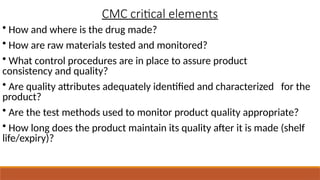
CMC critical elements
• How and where is the drug made?
• How are raw materials tested and monitored?
• What control procedures are in place to assure product
consistency and quality?
• Are quality attributes adequately identified and characterized for the
product?
• Are the test methods used to monitor product quality appropriate?
• How long does the product maintain its quality after it is made (shelf
life/expiry)?
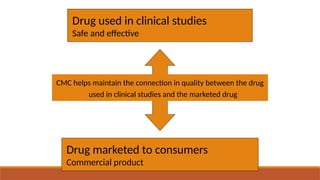
Drug used in clinical studies
Safe and effective
CMC helps maintain the connection in quality between the drug
used in clinical studies and the marketed drug
Drug marketed to consumers
Commercial product
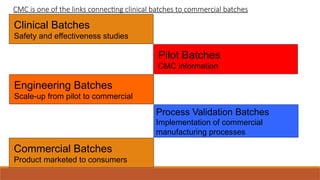
CMC is one of the links connecting clinical batches to commercial batches
Clinical Batches
Safety and effectiveness studies
Pilot Batches
CMC information
Engineering Batches
Scale-up from pilot to commercial
Process Validation Batches
Implementation of commercial
manufacturing processes
Commercial Batches
Product marketed to consumers
CMC is Specific to the Product
•Sterile injectable product – sterility and endotoxin
concentration
•Controlled release product – release profile of active
ingredient over time
•Oral tablet – dissolution profile
•Soluble powder for drinking water – moisture content as
powder, solubility in water
Example: CMC regulatory submission may contain information associated
with API and dosage form, including:
• Name and location of manufacturing and testing sites
• Characterization of the API and composition of the dosage form
• Raw material used to manufacture the API and the finished dosage form
• Description of the product and the process development
• Description the manufacturing process
• Analytical methods and specifications used for testing and release of raw
materials, in-process controls, container and closure system, API and
dosage form.
• Quality testing, bio equivalence testing
• Release and stability testing data for both API and the dosage form
POST APPROVAL REGULATORY AFFAIRS
• Post approval regulatory affairs and services are for
maintaining compliance and ensuring the quality, safety
and Efficacy of approved pharmaceutical products.
• The FDA may require a post approval study at the time
of approval of a premarket approval(PMA),
Humanitarian device exemption(HDE) or product
development protocol(PDP) application to help assure
continued safety and effectiveness of the approved drug
product of medical device
• A sponsor’s failure to comply with any post approval
requirement may be grounds for withdrawing approval i.e.
whether the post approval study will be terminated or
revised/replaced.
• The safety surveillance is designed to detect any rare or long
term adverse effects over the much larger population and
longer time period.
• Harmful effects shown in this trial may result in drug ban or
restricted in certain usage.
• Holders of NDA and ANDA who intended make post approval
changes should follow section 502A of the federal food, Drug
and Cosmetic act.
• Which provides requirements for making and reporting
manufacturing changes to an approval application and
for distribution changes.
• An application must provide specific information to
access the effect of the quality, purity and potency of a
drug product.
REPORTING CATEGORIES-
1. MAJOR CHANGE- substantial potential
2. MODERATE CHANGE- moderate potential
3. MINOR CHANGE- minimal potential
1. MAJOR CHANGE-
• Major changer may require the submission of a
supplement and approved by FDA prior to
distribution of the product.
• This type of supplement is called, prior approval
supplement. And applicant may ask FDA to
expedite its review of prior approval supplement
for public health reason.
• This type of supplement is called, prior approval
supplement-expedite review requested.
2. MODERATE CHANGE-
Two types of moderate changes are there-
• One type of moderate change may requires the
submission of supplement to FDA at least 30 days
before the distribution of the drug product.
• This type of supplement called, and should be clearly
labeled as supplement changes being affected in 30
days.
• FDA inform applicant within 30 days if the information
is missing distribution must be delayed, until
supplement amended.
• If after review, FDA disapprove it may order the
manufacturer to cease distribution of the product made
using disapproval changes.
• 3. MINOR CHANGES-
In annual report the list should be included in the summary
section.
 EQUIVALENT-
Comparing the test results from pre and post changes material
and determining if the results are equivalent
 ADVERSE EFFECT-
Some manufacturing changes have an adverse effect on identity,
strength, quality, purity of the drug product.
RECOMMENDATION ARE PROVIDED FOR POST APPROVAL CHANGES:
1. Component and composition
2. Manufacturing sites
3. Manufacturing process
4. Specification
5. Container closure system
6. Labeling
7. Miscellaneous changes
8. Multiple related change
REFERENCES:
1. https://regulatoryaffairs.freyrsolutions.com
2. https://connect.raps.org
3. https://www.jpharmsci.org
4. Drug Regulatory Affairs by Gajendra Singh, Gaurav
Aggarwal and Vipul Gupta 2021 edition published by CBS
publishers & Distributors Pvt Ltd. Pg no 107-111.
THANK YOU

CMC & Post Approval Regulatory affairs ppt

  • 1.
    Seminar on CMC &POST APPROVAL REGULATORY AFFAIRS M.M. COLLEGE OF PHARMACY,MMDU,MULLANA DEPARTMENT OF PHARMACEUTICS Presented by - Tanuj Sharma M. Pharm (Pharmaceutics) Sem1 (Roll.no.1424713) Presented to – Ms. Monika Kadian
  • 2.
    • CMC Introduction •Elements of CMC • CMC specified products • Contents of CMC • Post approval regulatory introduction • Reporting categories • Recommendations of post approval regulatory affairs • References CONTENTS :
  • 3.
    Chemistry, Manufacturing andControl (CMC) • CMC is one of the most important activities in drug product development. • It occurs during all stages of the drug development cycle and ensures quality and consistency during the manufacturing of the pharmaceutical product. • CMC is crucial because it connects the scientific details of drug development with the practical aspects of large-scale production.
  • 4.
    What is theneed of CMC? • To assure that the drug sold to the public will have quality attributes similar to those of the drug demonstrated to be safe and effective. • To assure that the quality of the drug meets appropriate standards and is consistent. • To assure that the drug you are using is the drug described on the label
  • 5.
    CMC critical elements •How and where is the drug made? • How are raw materials tested and monitored? • What control procedures are in place to assure product consistency and quality? • Are quality attributes adequately identified and characterized for the product? • Are the test methods used to monitor product quality appropriate? • How long does the product maintain its quality after it is made (shelf life/expiry)?
  • 6.
    Drug used inclinical studies Safe and effective CMC helps maintain the connection in quality between the drug used in clinical studies and the marketed drug Drug marketed to consumers Commercial product
  • 7.
    CMC is oneof the links connecting clinical batches to commercial batches Clinical Batches Safety and effectiveness studies Pilot Batches CMC information Engineering Batches Scale-up from pilot to commercial Process Validation Batches Implementation of commercial manufacturing processes Commercial Batches Product marketed to consumers
  • 8.
    CMC is Specificto the Product •Sterile injectable product – sterility and endotoxin concentration •Controlled release product – release profile of active ingredient over time •Oral tablet – dissolution profile •Soluble powder for drinking water – moisture content as powder, solubility in water
  • 9.
    Example: CMC regulatorysubmission may contain information associated with API and dosage form, including: • Name and location of manufacturing and testing sites • Characterization of the API and composition of the dosage form • Raw material used to manufacture the API and the finished dosage form • Description of the product and the process development • Description the manufacturing process • Analytical methods and specifications used for testing and release of raw materials, in-process controls, container and closure system, API and dosage form. • Quality testing, bio equivalence testing • Release and stability testing data for both API and the dosage form
  • 10.
    POST APPROVAL REGULATORYAFFAIRS • Post approval regulatory affairs and services are for maintaining compliance and ensuring the quality, safety and Efficacy of approved pharmaceutical products. • The FDA may require a post approval study at the time of approval of a premarket approval(PMA), Humanitarian device exemption(HDE) or product development protocol(PDP) application to help assure continued safety and effectiveness of the approved drug product of medical device
  • 11.
    • A sponsor’sfailure to comply with any post approval requirement may be grounds for withdrawing approval i.e. whether the post approval study will be terminated or revised/replaced. • The safety surveillance is designed to detect any rare or long term adverse effects over the much larger population and longer time period. • Harmful effects shown in this trial may result in drug ban or restricted in certain usage. • Holders of NDA and ANDA who intended make post approval changes should follow section 502A of the federal food, Drug and Cosmetic act.
  • 12.
    • Which providesrequirements for making and reporting manufacturing changes to an approval application and for distribution changes. • An application must provide specific information to access the effect of the quality, purity and potency of a drug product. REPORTING CATEGORIES- 1. MAJOR CHANGE- substantial potential 2. MODERATE CHANGE- moderate potential 3. MINOR CHANGE- minimal potential
  • 13.
    1. MAJOR CHANGE- •Major changer may require the submission of a supplement and approved by FDA prior to distribution of the product. • This type of supplement is called, prior approval supplement. And applicant may ask FDA to expedite its review of prior approval supplement for public health reason. • This type of supplement is called, prior approval supplement-expedite review requested.
  • 14.
    2. MODERATE CHANGE- Twotypes of moderate changes are there- • One type of moderate change may requires the submission of supplement to FDA at least 30 days before the distribution of the drug product. • This type of supplement called, and should be clearly labeled as supplement changes being affected in 30 days. • FDA inform applicant within 30 days if the information is missing distribution must be delayed, until supplement amended.
  • 15.
    • If afterreview, FDA disapprove it may order the manufacturer to cease distribution of the product made using disapproval changes. • 3. MINOR CHANGES- In annual report the list should be included in the summary section.  EQUIVALENT- Comparing the test results from pre and post changes material and determining if the results are equivalent  ADVERSE EFFECT- Some manufacturing changes have an adverse effect on identity, strength, quality, purity of the drug product.
  • 16.
    RECOMMENDATION ARE PROVIDEDFOR POST APPROVAL CHANGES: 1. Component and composition 2. Manufacturing sites 3. Manufacturing process 4. Specification 5. Container closure system 6. Labeling 7. Miscellaneous changes 8. Multiple related change
  • 17.
    REFERENCES: 1. https://regulatoryaffairs.freyrsolutions.com 2. https://connect.raps.org 3.https://www.jpharmsci.org 4. Drug Regulatory Affairs by Gajendra Singh, Gaurav Aggarwal and Vipul Gupta 2021 edition published by CBS publishers & Distributors Pvt Ltd. Pg no 107-111.
  • 18.