GMTGMT
Gateway Materials
Technology
1
39th Annual Conference on Composites, Materials and Structures
Workshop on Certification of CMC Components for Aerospace Applications
January 26-29, 2015, Cocoa Beach, FL
Federal Aviation Administration (FAA)
Airworthiness Certification –
The Process and the Challenge for CMC
Components in Commercial Aircraft
Stephen T. Gonczy,Stephen T. Gonczy, PhDPhD
Gateway Materials Technology, Inc
Mount Prospect, IL
847-870-1621, gatewaymt@aol.com
KEYWORDS: ceramic matrix composite, airworthiness,
certification, high temperature, design, testing, prodcution
Approved for public release and not subject to export control.
GMTGMT
Gateway Materials
Technology
2
Outline
● Introduction
-- CMC Mechanical Properties
-- CMCs for Civil Air Transport
● FAA and Airworthiness
-- Certification and Airworthiness
-- 14 CFR Aeronautics and Space
-- Critical Materials Regulations
● The FAA Certification Process
-- The Steps
-- The Documents and Guidelines
● Metals and PMC Certification
● CMC Certification
-- Differences Compared to PMCs
-- The Challenges for CMCs
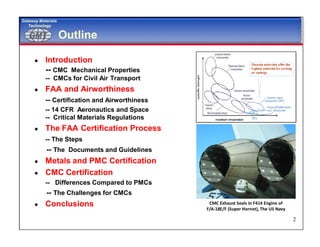
● Conclusions CMC Exhaust Seals in F414 Engine of
F/A-18E/F (Super Hornet), The US Navy
GMTGMT
Gateway Materials
Technology
4
High Strain, Damage Tolerant Failure
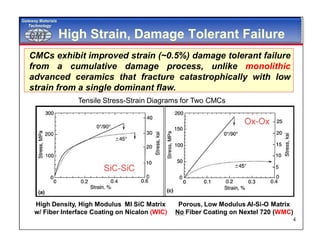
CMCs exhibit improved strain (~0.5%) damage tolerant failure
from a cumulative damage process, unlike monolithic
advanced ceramics that fracture catastrophically with low
strain from a single dominant flaw.
Tensile Stress-Strain Diagrams for Two CMCs
High Density, High Modulus MI SiC Matrix
w/ Fiber Interface Coating on Nicalon (WIC)
Porous, Low Modulus Al-Si-O Matrix
No Fiber Coating on Nextel 720 (WMC)
GMTGMT
Gateway Materials
Technology
5
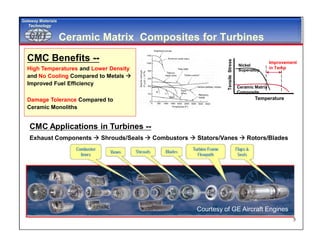
CMC Benefits --
High Temperatures and Lower Density
and No Cooling Compared to Metals 
Improved Fuel Efficiency
Damage Tolerance Compared to
Ceramic Monoliths
CMC Applications in Turbines --
Exhaust Components  Shrouds/Seals  Combustors  Stators/Vanes  Rotors/Blades
TensileStress
Temperature
Nickel
Superalloy
Ceramic Matrix
Composite
Improvement
in Temp
Courtesy of GE Aircraft Engines
Ceramic Matrix Composites for Turbines
GMTGMT
Gateway Materials
Technology
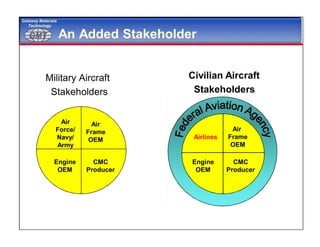
An Added Stakeholder
Military Aircraft
Stakeholders
Air
Force/
Navy/
Army
Air
Frame
OEM
Engine
OEM
CMC
Producer
Airlines
Air
Frame
OEM
Engine
OEM
CMC
Producer
Civilian Aircraft
Stakeholders
GMTGMT
Gateway Materials
Technology
FAA Responsibility and Roles
Federal Aviation Agency
MISSION -- is to provide the safest, most
efficient aerospace system in the world.
 Regulating civil aviation to promote safety –
the safe manufacture, operation, and
maintenance of civil aircraft.
 Developing and operating a system of air traffic control and
navigation for both civil and military aircraft
 Regulating U.S. commercial space transportation
 Researching and developing the National Airspace System and civil aeronautics
 Encouraging and developing civil aeronautics, including new aviation technology
 Developing and carrying out programs to control aircraft noise and other
environmental effects of civil aviation
 Aircraft, Airports, Air traffic,
Licenses and Certifications, Aviation Data,
Regulations and Policies
GMTGMT
Gateway Materials
Technology
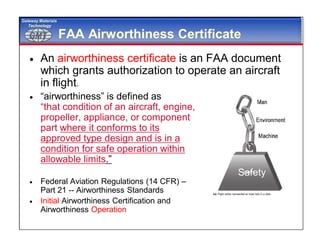
FAA Airworthiness Certificate
 An airworthiness certificate is an FAA document
which grants authorization to operate an aircraft
in flight.
 “airworthiness” is defined as
“that condition of an aircraft, engine,
propeller, appliance, or component
part where it conforms to its
approved type design and is in a
condition for safe operation within
allowable limits.”
 Federal Aviation Regulations (14 CFR) –
Part 21 -- Airworthiness Standards
 Initial Airworthiness Certification and
Airworthiness Operation
Safety
GMTGMT
Gateway Materials
Technology
But it is an absolutely essential
part of the process of converting
science and engineering into real-
world technology with social and
economic benefit.
Warning!! Warning!!
The certification process is not exciting,
fast, easy, or simple.
In fact, it is hard work, time-consuming, and extremely
detailed.
11
GMTGMT
Gateway Materials
Technology
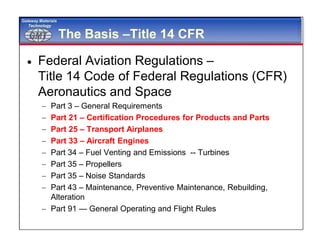
The Basis –Title 14 CFR
 Federal Aviation Regulations –
Title 14 Code of Federal Regulations (CFR)
Aeronautics and Space
 Part 3 – General Requirements
 Part 21 – Certification Procedures for Products and Parts
 Part 25 – Transport Airplanes
 Part 33 – Aircraft Engines
 Part 34 – Fuel Venting and Emissions -- Turbines
 Part 35 – Propellers
 Part 35 – Noise Standards
 Part 43 – Maintenance, Preventive Maintenance, Rebuilding,
Alteration
 Part 91 — General Operating and Flight Rules
GMTGMT
Gateway Materials
Technology
Title 14 CFR
 14 CFR Sec. 25.601 -- General. -- The airplane may not have design features or
details that experience has shown to be hazardous or unreliable. The suitability of each
questionable design detail and part must be established by tests.
 14 CFR Sec. 25.603 -- Materials. -- The suitability and durability of materials used
for parts, the failure of which could adversely affect safety, must--
(a) Be established on the basis of experience or tests;
(b) Conform to approved specifications (such as industry or military specifications, or Technical
Standard Orders) that ensure their having the strength and other properties assumed in the
design data; and
(c) Take into account the effects of environmental conditions, such as temperature and
humidity, expected in service.
 14 CFR 25.605 - Fabrication methods.
[a) The methods of fabrication used must produce a consistently sound structure. If a fabrication
process (such as gluing, spot welding, or heat treating) requires close control to reach this
objective, the process must be performed under an approved process specification.
(b) Each new aircraft fabrication method must be substantiated by a test program.
GMTGMT
Gateway Materials
Technology
Title 14 CFR
§25.609 Protection of structure. Each part of the structure must—
(a) Be suitably protected against deterioration or loss of strength in service
due to any cause, including—
(1) Weathering;
(2) Corrosion; and
(3) Abrasion; and
(4) Have provisions for ventilation and drainage where necessary for protection.
§25.629 Aeroelastic stability requirements.
(a) General. The aeroelastic stability evaluations required under this section include
flutter, divergence, control reversal and any undue loss of stability and control as a
result of structural deformation. The aeroelastic evaluation must include whirl
modes associated with any propeller or rotating device that contributes significant
dynamic forces. Compliance with this section must be shown by analyses, wind
tunnel tests, ground vibration tests, flight tests, or other means found necessary by
the Administrator.
GMTGMT
Gateway Materials
Technology
Title 14 CFR
14 CFR Sec. 25.613 - Material strength properties and design values
(a) Material strength properties must be based on enough tests of material
meeting approved specifications to establish design values on a statistical basis.
(b) Design values must be chosen to minimize the probability of structural
failures due to material variability. Except as provided in paragraph (e) of this
section, compliance with this paragraph must be shown by selecting design values
which assure material strength with the following probability:
(1) Where applied loads are eventually distributed through a single member within an assembly, the
failure of which would result in loss of structural integrity of the component, 99 percent
probability with 95 percent confidence.
(2) For redundant structure, in which the failure of individual elements would result in applied loads
being safely distributed to other load carrying members, 90 percent probability with 95 percent
confidence.
(c) The effects of temperature on allowable stresses used for design in an
essential component or structure must be considered where thermal effects are
significant under normal operating conditions.
(d) The strength, detail design, and fabrication of the structure must minimize the
probability of disastrous fatigue failure, particularly at points of stress concentration.
(e) Greater design values may be used if a "premium selection" of the material is
made in which a specimen of each individual item is tested before use to determine
that the actual strength properties of that particular item will equal or exceed those used
in design.
GMTGMT
Gateway Materials
Technology
Types of FAA Certificates and approvals
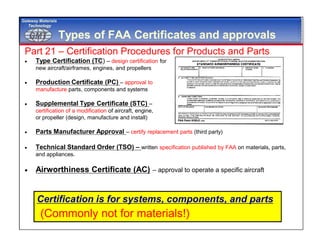
Part 21 – Certification Procedures for Products and Parts
 Type Certification (TC) – design certification for
new aircraft/airframes, engines, and propellers
 Production Certificate (PC) – approval to
manufacture parts, components and systems
 Supplemental Type Certificate (STC) –
certification of a modification of aircraft, engine,
or propeller (design, manufacture and install)
 Parts Manufacturer Approval – certify replacement parts (third party)
 Technical Standard Order (TSO) – written specification published by FAA on materials, parts,
and appliances.
 Airworthiness Certificate (AC) – approval to operate a specific aircraft
Certification is for systems, components, and parts
(Commonly not for materials!)
GMTGMT
Gateway Materials
Technology
STCs and TSOs for PMCs
STC Examples for Composites
 ST00405AT Design, fabricate, and install a composite fuselage interior liner with
subcomponent composite circular supports
(A2NM - Boeing Company, The 757-200)
 SA02365AK Manufacture and installation of a carbon composite engine cowling
 SA01289AT Manufacture of composite engine cowlings. (3A12 - Cessna Aircraft
Company, The 172)
TSO Examples for Composites
 TSO-C148 AIRCRAFT MECHANICAL FASTENERS
 TSO-C90c CARGO PALLETS, NETS, AND CONTAINERS
 TSO-C135 Transport Airplane Wheels and Wheel and Brake Assemblies
 TSO-C28 AIRCRAFT SKIS
No STCs or TSOs for Ceramics that I found (June 2014).
GMTGMT
Gateway Materials
Technology
FAA Documents
 FAA Policy Statement and Memos – policy directives and direction
 FAA Orders -- procedural rules and regulations
 FAA Advisory Circulars (AC)
Guidance documents for all aspects of design, production, operation,
inspection, maintenance, and repair.
Primary guidance on certification
 FAA Technical Standard Orders (TSO)
 minimum performance standard issued by the Administrator for specified
materials, parts, processes, and appliances used on civil aircraft.
 FAA Airworthiness Directives –
 legally enforceable regulations issued by the FAA in accordance with 14
CFR part 39 to correct an unsafe condition in a product
 Technical Reports
 FAA and Industry Guide to Product Certification –
A guide to the current certification process
GMTGMT
Gateway Materials
Technology
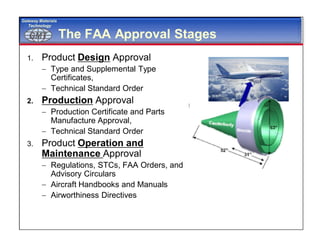
The FAA Approval Stages
1. Product Design Approval
 Type and Supplemental Type
Certificates,
 Technical Standard Order
2. Production Approval
 Production Certificate and Parts
Manufacture Approval,
 Technical Standard Order
3. Product Operation and
Maintenance Approval
 Regulations, STCs, FAA Orders, and
Advisory Circulars
 Aircraft Handbooks and Manuals
 Airworthiness Directives
GMTGMT
Gateway Materials
Technology
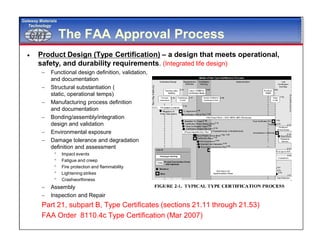
The FAA Approval Process
 Product Design (Type Certification) – a design that meets operational,
safety, and durability requirements. (Integrated life design)
 Functional design definition, validation,
and documentation
 Structural substantiation (
static, operational temps)
 Manufacturing process definition
and documentation
 Bonding/assembly/integration
design and validation
 Environmental exposure
 Damage tolerance and degradation
definition and assessment
 Impact events
 Fatigue and creep
 Fire protection and flammability
 Lightening strikes
 Crashworthiness
 Assembly
 Inspection and Repair
Part 21, subpart B, Type Certificates (sections 21.11 through 21.53)
FAA Order 8110.4c Type Certification (Mar 2007)
GMTGMT
Gateway Materials
Technology
The FAA Approval Process
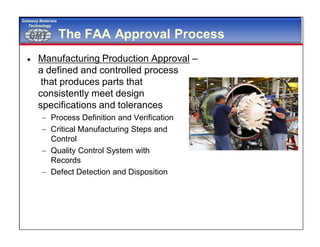
 Manufacturing Production Approval –
a defined and controlled process
that produces parts that
consistently meet design
specifications and tolerances
 Process Definition and Verification
 Critical Manufacturing Steps and
Control
 Quality Control System with
Records
 Defect Detection and Disposition
GMTGMT
Gateway Materials
Technology
The FAA Approval Process
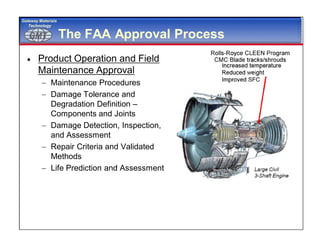
 Product Operation and Field
Maintenance Approval
 Maintenance Procedures
 Damage Tolerance and
Degradation Definition –
Components and Joints
 Damage Detection, Inspection,
and Assessment
 Repair Criteria and Validated
Methods
 Life Prediction and Assessment
GMTGMT
Gateway Materials
Technology
The Supplemetal Type Certificate (STC) Process
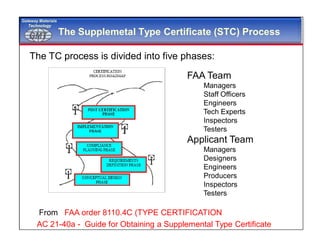
The TC process is divided into five phases:
FAA Team
Managers
Staff Officers
Engineers
Tech Experts
Inspectors
Testers
Applicant Team
Managers
Designers
Engineers
Producers
Inspectors
Testers
From FAA order 8110.4C (TYPE CERTIFICATION
AC 21-40a - Guide for Obtaining a Supplemental Type Certificate
GMTGMT
Gateway Materials
Technology
Tools for the Certification Process
Provided by reference, by industry, and
in Advisory Circulars and Handbooks
 Industrial specifications and test standards
 Design criteria, methods, and approaches
 Physical test methods,
 Analytical methods
 Design stress and thermal
 Life Prediction,
 Property data bases
 Operational (flight) tests
 Fabrication Process control methods
 Inspection methods
 Installation methods
 Maintenance methods
 Field Inspection and Repair methods
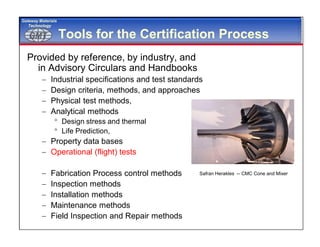
Safran Herakles -- CMC Cone and Mixer
GMTGMT
Gateway Materials
Technology
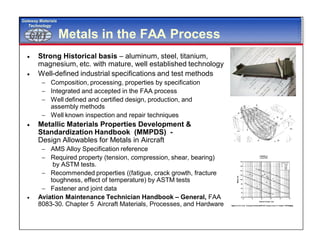
Metals in the FAA Process
 Strong Historical basis – aluminum, steel, titanium,
magnesium, etc. with mature, well established technology
 Well-defined industrial specifications and test methods
 Composition, processing, properties by specification
 Integrated and accepted in the FAA process
 Well defined and certified design, production, and
assembly methods
 Well known inspection and repair techniques
 Metallic Materials Properties Development &
Standardization Handbook (MMPDS) -
Design Allowables for Metals in Aircraft
 AMS Alloy Specification reference
 Required property (tension, compression, shear, bearing)
by ASTM tests.
 Recommended properties ((fatigue, crack growth, fracture
toughness, effect of temperature) by ASTM tests
 Fastener and joint data
 Aviation Maintenance Technician Handbook – General, FAA
8083-30. Chapter 5 Aircraft Materials, Processes, and Hardware
GMTGMT
Gateway Materials
Technology
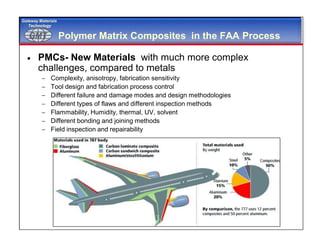
Polymer Matrix Composites in the FAA Process
 PMCs- New Materials with much more complex
challenges, compared to metals
 Complexity, anisotropy, fabrication sensitivity
 Tool design and fabrication process control
 Different failure and damage modes and design methodologies
 Different types of flaws and different inspection methods
 Flammability, Humidity, thermal, UV, solvent
 Different bonding and joining methods
 Field inspection and repairability
GMTGMT
Gateway Materials
Technology
Polymer Matrix Composites in the FAA Process
FAA Policy Statements for Composites
Static Strength Substantiation of Composite Airplane Structure
[PS-ACE100-2001-006, December 2001]
Final Policy for Flammability Testing per 14 CFR Part 23, Sections
23.853, 23.855 and 23.1359 [PS-ACE100-2001-002, January 2002]
Material Qualification and Equivalency for Polymer Matrix Composite
Material Systems[PS-ACE100-2002-006, September 2003]
Bonded Joints and Structures - Technical Issues and Certification
Considerations [PS-ACE100-2005-10038, September 2005]
GMTGMT
Gateway Materials
Technology
Polymer Matrix Composites in the FAA Process
FAA Advisory Circulars for Composites and Materials
 AC 20-107B – Composite Aircraft Structure
 AC 21-26 -- Quality Control for the Manufacture of Composite Structures
 AC23-3 – Structural Substantiation of Secondary Structures
 AC23-20 -- Acceptance Guidance on Material Procurement and Process
Specifications for Polymer Matrix Composite Systems
 AC 25.571 -1C -- Damage Tolerance and Fatigue Evaluation of Structure
 AC 25.613-1 -- Material Strength Properties and Material Design Values
 AC 35.37-1A -- Guidance Material for Fatigue Limit Tests and Composite
Blade Fatigue Substantiation
 AC 500-009 -- Composite Aircraft Structure – Compliance Guidance
 AC 21-40a - Guide for Obtaining a Supplemental Type Certificate
GMTGMT
Gateway Materials
Technology
Polymer Matrix Composites in the FAA Process
FAA Technical Reports
 “Fiber Composite Analysis And Design Volume II Structures”
[DOT-FAA-CT-88-18, Nov. 1979)
 "Certification Testing Methodology for Composite Structures, Volumes I
and II" [DOT/FAA/CT-86/39, October 1986]
 “Handbook: Manufacturing Advanced Composite Components for
Airframes” [DOT/FAA/AR- 96/75, April 1997]
 ”Fiber Composite Analysis and Design, Volume I Composite Materials
and Laminates” [DOT/FAA/CT-85/6 , Oct 1997]
 "Advanced Certification Methodology for Composite Structures"
[DOT/FAA/AR-96/111, April 1997]
GMTGMT
Gateway Materials
Technology
Polymer Matrix Composites in the FAA Process
FAA Technical Reports
 “Guidelines and Recommended Criteria for the Development of a Material
Specification for Carbon Fiber/Epoxy Unidirectional Prepregs"
[DOT/FAA/AR-02/109, March 2003]
 “Guidelines for the Development of Process Specifications, Instructions, and
Controls for the Fabrication of Fiber-Reinforced Polymer Composites"
[DOT/FAA/AR-02/110, March 2003]
 "Guidelines for Analysis, Testing, and Nondestructive Inspection of Impact-
Damaged Composite Sandwich Structures"
[DOT/FAA/AR-02/121, March 2003]
 “Material Qualification and Equivalency for Polymer Matrix Composite Material
Systems“ [DOT/FAA/AR-03/19, September 2003]
 "Assessment of Industry Practices for Aircraft Bonded Joints and Structures"
[DOT/FAA/AR-05/13, July 2005]
Aviation Maintenance Technician (AMT) Airframe Handbook Volume 2 (FAA-
H-8083-31) , Chapter 7 Advanced Composites
GMTGMT
Gateway Materials
Technology
CMH-17 Composites Handbook
Purpose - The Composite Materials Handbook
organization creates, publishes and maintains
proven, reliable engineering information and
standards , subjected to thorough technical
review, to support the development and use of
composite materials and structures
CMH - 17 provides technical guidance on material & process control,
design, analysis, testing, structural substantiation and maintenance.
Six Volumes
 Vol 1 PMC: Guidelines for Characterization of Structural Materials
 Vol 2 PMC: Material Properties
 Vol 3 PMC: Materials Usage,Design and Analysis
 Vol 4 MMCs
 Vol 5 CMCs
 Vol 6 Structural Sandwich Composites
GMTGMT
Gateway Materials
Technology
CMH-17 PMC Handbook
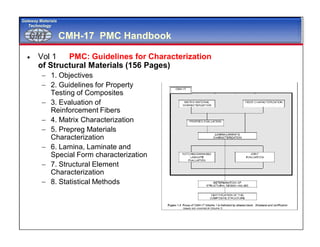
 Vol 1 PMC: Guidelines for Characterization
of Structural Materials (156 Pages)
 1. Objectives
 2. Guidelines for Property
Testing of Composites
 3. Evaluation of
Reinforcement Fibers
 4. Matrix Characterization
 5. Prepreg Materials
Characterization
 6. Lamina, Laminate and
Special Form characterization
 7. Structural Element
Characterization
 8. Statistical Methods
GMTGMT
Gateway Materials
Technology
CMH-17 PMC Handbook
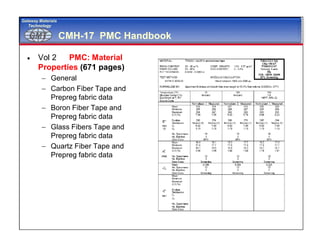
 Vol 2 PMC: Material
Properties (671 pages)
 General
 Carbon Fiber Tape and
Prepreg fabric data
 Boron Fiber Tape and
Prepreg fabric data
 Glass Fibers Tape and
Prepreg fabric data
 Quartz Fiber Tape and
Prepreg fabric data
GMTGMT
Gateway Materials
Technology
CMH-17 PMC Handbook
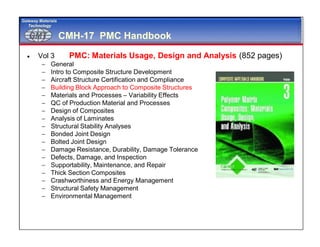
 Vol 3 PMC: Materials Usage, Design and Analysis (852 pages)
 General
 Intro to Composite Structure Development
 Aircraft Structure Certification and Compliance
 Building Block Approach to Composite Structures
 Materials and Processes – Variability Effects
 QC of Production Material and Processes
 Design of Composites
 Analysis of Laminates
 Structural Stability Analyses
 Bonded Joint Design
 Bolted Joint Design
 Damage Resistance, Durability, Damage Tolerance
 Defects, Damage, and Inspection
 Supportability, Maintenance, and Repair
 Thick Section Composites
 Crashworthiness and Energy Management
 Structural Safety Management
 Environmental Management
GMTGMT
Gateway Materials
Technology
Ceramic Matrix Composites for Aircraft
Why not just use PMC rules for CMCs?
 Technically similar to PMCs in
 Composite complexity, anisotropy, fiber architecture
 High strength, High stiffness fibers
 Production process sensitivity and variability
 Different applications than PMCs
 Hot structures (>500C) in or next to engines
 Different than PMCs in
 Different constituents
 Brittle, low strain matrix with early damage accumulation
 Broader range of constituents (Oxide, non-oxide, carbon, etc) and
densification/consolidation methods (CVI, MI, PDC, sinter)
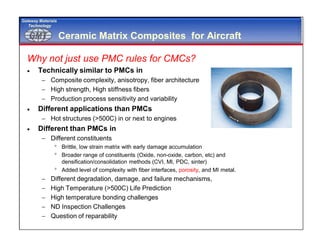
 Added level of complexity with fiber interfaces, porosity, and MI metal.
 Different degradation, damage, and failure mechanisms,
 High Temperature (>500C) Life Prediction
 High temperature bonding challenges
 ND Inspection Challenges
 Question of reparability
GMTGMT
Gateway Materials
Technology
Questions and Challenges in CMC Certification
For a specific CMC part, we have to show the FAA how the part --
 is well-designed for operation, safety, and durability
 risks are managed and life limits are determined.
 is tested and analyzed to certify safety and life.
 can be manufactured reliably with certified quality control.
 variability is controlled and managed.
 is inspected for flaws off the finish line.
 is integrated and installed in the system (joining and assembly).
 is maintained and inspected in service.
 Is repaired or replaced in service.
CMC parts will have to be FAA certified.
What does the FAA need to know to certify CMCs?
How does the FAA learn about CMCs so they can make
Informed decisions about CMC parts in the certification process.
FROM THE OEM DESIGNER, THE CMC PRODUCER, AND THE CMC
COMMUNITY
GMTGMT
Gateway Materials
Technology
Tools for the Certification Process
Develop, validate and document the CMC tools
 Design criteria, methods and approaches
 Physical test methods
 Analytical methods – stress, thermal, life prediction
 Degradation, damage, and failure mechanisms at different
temperatures and environments
 Property data bases
 Process control techniques
 Inspection methods (production line and field)
 Maintenance and repair techniques
On-going interaction with FAA tech experts to inform them about
CMC technology.
GMTGMT
Gateway Materials
Technology CMH-17 CERAMIC MATRIX COMPOSITES
HANDBOOK
CMH-17 Volume 5, Ceramic Matrix Composites
 Part A. Introduction and Guidelines
 History, applications, benefits of CMC systems
 CMC Systems & processing methods
 Fiber and reinforcement technology
 Interphase/Interface technology and approaches
 Fabrication and forming of fiber architecture
 Non-destructive evaluation methods
 Part B. Design and Supportability
 CMCs for Aircraft Turbine Engines
 Design of Attachments for CMCs in Engines
 Part C. Testing
 Physical Test Methods,
 ThermoMechanical
 Part D. Data Requirements and Data Sets
CMC Property Data includes SiC/SiC, Carbon/SiC, Oxide/Oxide, SiC/Si3N4
 Appendix A. Derivation of the Residual Strength Reduction Expressions for LCF and
Rupture Loadings
GMTGMT
Gateway Materials
Technology
References
 http://www.faa.gov/
 Title 14 CFR
 Part 21, 14 CFR subpart B, Type Certificates (sections 21.11 through 21.53)
 FAA Order 8110.4c Type Certification (Mar 2007)
 FAA and Industry Guide to Product Certification (FAA Sep 2004)
 Aircraft Structure Certification and Compliance (Chap 3, Vol 3 (PMC), CMH-17
Handbook)
 Airworthiness: An Introduction to Aircraft Certification By Filippo De Florio
(2006)
 Aviation Maintenance Technician Handbook –FAA 8083-30.
 FAA AC 21-23b, Airworthiness Certification of Civil Aircraft, Engine, Propellers,
and Related Products Imported to the United States
 FAA AC 21-40a, Guide for Obtaining a Supplemental Type Certificate
 “Airworthiness Certification of Aircraft and Related Products” (FAA, July 2012)
GMTGMT
Gateway Materials
Technology
49
Summary of CMC Certification
1. FAA Certification of CMCs has to happen, if we want
CMCs on commercial planes.
2. There is so much CMC technology to validate and
document to obtain certification of a given CMC part.
We can use the PMC ACs and CMH-17 PMC handbook as
templates.
3. All the stakeholders need to work with FAA tech
experts now to keep them fully-informed and current
on CMC design, testing, production, inspection , and
support technology to support certification.

CMC FAA Certification

  • 1.
    GMTGMT Gateway Materials Technology 1 39th AnnualConference on Composites, Materials and Structures Workshop on Certification of CMC Components for Aerospace Applications January 26-29, 2015, Cocoa Beach, FL Federal Aviation Administration (FAA) Airworthiness Certification – The Process and the Challenge for CMC Components in Commercial Aircraft Stephen T. Gonczy,Stephen T. Gonczy, PhDPhD Gateway Materials Technology, Inc Mount Prospect, IL 847-870-1621, gatewaymt@aol.com KEYWORDS: ceramic matrix composite, airworthiness, certification, high temperature, design, testing, prodcution Approved for public release and not subject to export control.
  • 2.
    GMTGMT Gateway Materials Technology 2 Outline ● Introduction --CMC Mechanical Properties -- CMCs for Civil Air Transport ● FAA and Airworthiness -- Certification and Airworthiness -- 14 CFR Aeronautics and Space -- Critical Materials Regulations ● The FAA Certification Process -- The Steps -- The Documents and Guidelines ● Metals and PMC Certification ● CMC Certification -- Differences Compared to PMCs -- The Challenges for CMCs ● Conclusions CMC Exhaust Seals in F414 Engine of F/A-18E/F (Super Hornet), The US Navy
  • 3.
    GMTGMT Gateway Materials Technology 4 High Strain,Damage Tolerant Failure CMCs exhibit improved strain (~0.5%) damage tolerant failure from a cumulative damage process, unlike monolithic advanced ceramics that fracture catastrophically with low strain from a single dominant flaw. Tensile Stress-Strain Diagrams for Two CMCs High Density, High Modulus MI SiC Matrix w/ Fiber Interface Coating on Nicalon (WIC) Porous, Low Modulus Al-Si-O Matrix No Fiber Coating on Nextel 720 (WMC)
  • 4.
    GMTGMT Gateway Materials Technology 5 CMC Benefits-- High Temperatures and Lower Density and No Cooling Compared to Metals  Improved Fuel Efficiency Damage Tolerance Compared to Ceramic Monoliths CMC Applications in Turbines -- Exhaust Components  Shrouds/Seals  Combustors  Stators/Vanes  Rotors/Blades TensileStress Temperature Nickel Superalloy Ceramic Matrix Composite Improvement in Temp Courtesy of GE Aircraft Engines Ceramic Matrix Composites for Turbines
  • 5.
    GMTGMT Gateway Materials Technology An AddedStakeholder Military Aircraft Stakeholders Air Force/ Navy/ Army Air Frame OEM Engine OEM CMC Producer Airlines Air Frame OEM Engine OEM CMC Producer Civilian Aircraft Stakeholders
  • 6.
    GMTGMT Gateway Materials Technology FAA Responsibilityand Roles Federal Aviation Agency MISSION -- is to provide the safest, most efficient aerospace system in the world.  Regulating civil aviation to promote safety – the safe manufacture, operation, and maintenance of civil aircraft.  Developing and operating a system of air traffic control and navigation for both civil and military aircraft  Regulating U.S. commercial space transportation  Researching and developing the National Airspace System and civil aeronautics  Encouraging and developing civil aeronautics, including new aviation technology  Developing and carrying out programs to control aircraft noise and other environmental effects of civil aviation  Aircraft, Airports, Air traffic, Licenses and Certifications, Aviation Data, Regulations and Policies
  • 7.
    GMTGMT Gateway Materials Technology FAA AirworthinessCertificate  An airworthiness certificate is an FAA document which grants authorization to operate an aircraft in flight.  “airworthiness” is defined as “that condition of an aircraft, engine, propeller, appliance, or component part where it conforms to its approved type design and is in a condition for safe operation within allowable limits.”  Federal Aviation Regulations (14 CFR) – Part 21 -- Airworthiness Standards  Initial Airworthiness Certification and Airworthiness Operation Safety
  • 8.
    GMTGMT Gateway Materials Technology But itis an absolutely essential part of the process of converting science and engineering into real- world technology with social and economic benefit. Warning!! Warning!! The certification process is not exciting, fast, easy, or simple. In fact, it is hard work, time-consuming, and extremely detailed. 11
  • 9.
    GMTGMT Gateway Materials Technology The Basis–Title 14 CFR  Federal Aviation Regulations – Title 14 Code of Federal Regulations (CFR) Aeronautics and Space  Part 3 – General Requirements  Part 21 – Certification Procedures for Products and Parts  Part 25 – Transport Airplanes  Part 33 – Aircraft Engines  Part 34 – Fuel Venting and Emissions -- Turbines  Part 35 – Propellers  Part 35 – Noise Standards  Part 43 – Maintenance, Preventive Maintenance, Rebuilding, Alteration  Part 91 — General Operating and Flight Rules
  • 10.
    GMTGMT Gateway Materials Technology Title 14CFR  14 CFR Sec. 25.601 -- General. -- The airplane may not have design features or details that experience has shown to be hazardous or unreliable. The suitability of each questionable design detail and part must be established by tests.  14 CFR Sec. 25.603 -- Materials. -- The suitability and durability of materials used for parts, the failure of which could adversely affect safety, must-- (a) Be established on the basis of experience or tests; (b) Conform to approved specifications (such as industry or military specifications, or Technical Standard Orders) that ensure their having the strength and other properties assumed in the design data; and (c) Take into account the effects of environmental conditions, such as temperature and humidity, expected in service.  14 CFR 25.605 - Fabrication methods. [a) The methods of fabrication used must produce a consistently sound structure. If a fabrication process (such as gluing, spot welding, or heat treating) requires close control to reach this objective, the process must be performed under an approved process specification. (b) Each new aircraft fabrication method must be substantiated by a test program.
  • 11.
    GMTGMT Gateway Materials Technology Title 14CFR §25.609 Protection of structure. Each part of the structure must— (a) Be suitably protected against deterioration or loss of strength in service due to any cause, including— (1) Weathering; (2) Corrosion; and (3) Abrasion; and (4) Have provisions for ventilation and drainage where necessary for protection. §25.629 Aeroelastic stability requirements. (a) General. The aeroelastic stability evaluations required under this section include flutter, divergence, control reversal and any undue loss of stability and control as a result of structural deformation. The aeroelastic evaluation must include whirl modes associated with any propeller or rotating device that contributes significant dynamic forces. Compliance with this section must be shown by analyses, wind tunnel tests, ground vibration tests, flight tests, or other means found necessary by the Administrator.
  • 12.
    GMTGMT Gateway Materials Technology Title 14CFR 14 CFR Sec. 25.613 - Material strength properties and design values (a) Material strength properties must be based on enough tests of material meeting approved specifications to establish design values on a statistical basis. (b) Design values must be chosen to minimize the probability of structural failures due to material variability. Except as provided in paragraph (e) of this section, compliance with this paragraph must be shown by selecting design values which assure material strength with the following probability: (1) Where applied loads are eventually distributed through a single member within an assembly, the failure of which would result in loss of structural integrity of the component, 99 percent probability with 95 percent confidence. (2) For redundant structure, in which the failure of individual elements would result in applied loads being safely distributed to other load carrying members, 90 percent probability with 95 percent confidence. (c) The effects of temperature on allowable stresses used for design in an essential component or structure must be considered where thermal effects are significant under normal operating conditions. (d) The strength, detail design, and fabrication of the structure must minimize the probability of disastrous fatigue failure, particularly at points of stress concentration. (e) Greater design values may be used if a "premium selection" of the material is made in which a specimen of each individual item is tested before use to determine that the actual strength properties of that particular item will equal or exceed those used in design.
  • 13.
    GMTGMT Gateway Materials Technology Types ofFAA Certificates and approvals Part 21 – Certification Procedures for Products and Parts  Type Certification (TC) – design certification for new aircraft/airframes, engines, and propellers  Production Certificate (PC) – approval to manufacture parts, components and systems  Supplemental Type Certificate (STC) – certification of a modification of aircraft, engine, or propeller (design, manufacture and install)  Parts Manufacturer Approval – certify replacement parts (third party)  Technical Standard Order (TSO) – written specification published by FAA on materials, parts, and appliances.  Airworthiness Certificate (AC) – approval to operate a specific aircraft Certification is for systems, components, and parts (Commonly not for materials!)
  • 14.
    GMTGMT Gateway Materials Technology STCs andTSOs for PMCs STC Examples for Composites  ST00405AT Design, fabricate, and install a composite fuselage interior liner with subcomponent composite circular supports (A2NM - Boeing Company, The 757-200)  SA02365AK Manufacture and installation of a carbon composite engine cowling  SA01289AT Manufacture of composite engine cowlings. (3A12 - Cessna Aircraft Company, The 172) TSO Examples for Composites  TSO-C148 AIRCRAFT MECHANICAL FASTENERS  TSO-C90c CARGO PALLETS, NETS, AND CONTAINERS  TSO-C135 Transport Airplane Wheels and Wheel and Brake Assemblies  TSO-C28 AIRCRAFT SKIS No STCs or TSOs for Ceramics that I found (June 2014).
  • 15.
    GMTGMT Gateway Materials Technology FAA Documents FAA Policy Statement and Memos – policy directives and direction  FAA Orders -- procedural rules and regulations  FAA Advisory Circulars (AC) Guidance documents for all aspects of design, production, operation, inspection, maintenance, and repair. Primary guidance on certification  FAA Technical Standard Orders (TSO)  minimum performance standard issued by the Administrator for specified materials, parts, processes, and appliances used on civil aircraft.  FAA Airworthiness Directives –  legally enforceable regulations issued by the FAA in accordance with 14 CFR part 39 to correct an unsafe condition in a product  Technical Reports  FAA and Industry Guide to Product Certification – A guide to the current certification process
  • 16.
    GMTGMT Gateway Materials Technology The FAAApproval Stages 1. Product Design Approval  Type and Supplemental Type Certificates,  Technical Standard Order 2. Production Approval  Production Certificate and Parts Manufacture Approval,  Technical Standard Order 3. Product Operation and Maintenance Approval  Regulations, STCs, FAA Orders, and Advisory Circulars  Aircraft Handbooks and Manuals  Airworthiness Directives
  • 17.
    GMTGMT Gateway Materials Technology The FAAApproval Process  Product Design (Type Certification) – a design that meets operational, safety, and durability requirements. (Integrated life design)  Functional design definition, validation, and documentation  Structural substantiation ( static, operational temps)  Manufacturing process definition and documentation  Bonding/assembly/integration design and validation  Environmental exposure  Damage tolerance and degradation definition and assessment  Impact events  Fatigue and creep  Fire protection and flammability  Lightening strikes  Crashworthiness  Assembly  Inspection and Repair Part 21, subpart B, Type Certificates (sections 21.11 through 21.53) FAA Order 8110.4c Type Certification (Mar 2007)
  • 18.
    GMTGMT Gateway Materials Technology The FAAApproval Process  Manufacturing Production Approval – a defined and controlled process that produces parts that consistently meet design specifications and tolerances  Process Definition and Verification  Critical Manufacturing Steps and Control  Quality Control System with Records  Defect Detection and Disposition
  • 19.
    GMTGMT Gateway Materials Technology The FAAApproval Process  Product Operation and Field Maintenance Approval  Maintenance Procedures  Damage Tolerance and Degradation Definition – Components and Joints  Damage Detection, Inspection, and Assessment  Repair Criteria and Validated Methods  Life Prediction and Assessment
  • 20.
    GMTGMT Gateway Materials Technology The SupplemetalType Certificate (STC) Process The TC process is divided into five phases: FAA Team Managers Staff Officers Engineers Tech Experts Inspectors Testers Applicant Team Managers Designers Engineers Producers Inspectors Testers From FAA order 8110.4C (TYPE CERTIFICATION AC 21-40a - Guide for Obtaining a Supplemental Type Certificate
  • 21.
    GMTGMT Gateway Materials Technology Tools forthe Certification Process Provided by reference, by industry, and in Advisory Circulars and Handbooks  Industrial specifications and test standards  Design criteria, methods, and approaches  Physical test methods,  Analytical methods  Design stress and thermal  Life Prediction,  Property data bases  Operational (flight) tests  Fabrication Process control methods  Inspection methods  Installation methods  Maintenance methods  Field Inspection and Repair methods Safran Herakles -- CMC Cone and Mixer
  • 22.
    GMTGMT Gateway Materials Technology Metals inthe FAA Process  Strong Historical basis – aluminum, steel, titanium, magnesium, etc. with mature, well established technology  Well-defined industrial specifications and test methods  Composition, processing, properties by specification  Integrated and accepted in the FAA process  Well defined and certified design, production, and assembly methods  Well known inspection and repair techniques  Metallic Materials Properties Development & Standardization Handbook (MMPDS) - Design Allowables for Metals in Aircraft  AMS Alloy Specification reference  Required property (tension, compression, shear, bearing) by ASTM tests.  Recommended properties ((fatigue, crack growth, fracture toughness, effect of temperature) by ASTM tests  Fastener and joint data  Aviation Maintenance Technician Handbook – General, FAA 8083-30. Chapter 5 Aircraft Materials, Processes, and Hardware
  • 23.
    GMTGMT Gateway Materials Technology Polymer MatrixComposites in the FAA Process  PMCs- New Materials with much more complex challenges, compared to metals  Complexity, anisotropy, fabrication sensitivity  Tool design and fabrication process control  Different failure and damage modes and design methodologies  Different types of flaws and different inspection methods  Flammability, Humidity, thermal, UV, solvent  Different bonding and joining methods  Field inspection and repairability
  • 24.
    GMTGMT Gateway Materials Technology Polymer MatrixComposites in the FAA Process FAA Policy Statements for Composites Static Strength Substantiation of Composite Airplane Structure [PS-ACE100-2001-006, December 2001] Final Policy for Flammability Testing per 14 CFR Part 23, Sections 23.853, 23.855 and 23.1359 [PS-ACE100-2001-002, January 2002] Material Qualification and Equivalency for Polymer Matrix Composite Material Systems[PS-ACE100-2002-006, September 2003] Bonded Joints and Structures - Technical Issues and Certification Considerations [PS-ACE100-2005-10038, September 2005]
  • 25.
    GMTGMT Gateway Materials Technology Polymer MatrixComposites in the FAA Process FAA Advisory Circulars for Composites and Materials  AC 20-107B – Composite Aircraft Structure  AC 21-26 -- Quality Control for the Manufacture of Composite Structures  AC23-3 – Structural Substantiation of Secondary Structures  AC23-20 -- Acceptance Guidance on Material Procurement and Process Specifications for Polymer Matrix Composite Systems  AC 25.571 -1C -- Damage Tolerance and Fatigue Evaluation of Structure  AC 25.613-1 -- Material Strength Properties and Material Design Values  AC 35.37-1A -- Guidance Material for Fatigue Limit Tests and Composite Blade Fatigue Substantiation  AC 500-009 -- Composite Aircraft Structure – Compliance Guidance  AC 21-40a - Guide for Obtaining a Supplemental Type Certificate
  • 26.
    GMTGMT Gateway Materials Technology Polymer MatrixComposites in the FAA Process FAA Technical Reports  “Fiber Composite Analysis And Design Volume II Structures” [DOT-FAA-CT-88-18, Nov. 1979)  "Certification Testing Methodology for Composite Structures, Volumes I and II" [DOT/FAA/CT-86/39, October 1986]  “Handbook: Manufacturing Advanced Composite Components for Airframes” [DOT/FAA/AR- 96/75, April 1997]  ”Fiber Composite Analysis and Design, Volume I Composite Materials and Laminates” [DOT/FAA/CT-85/6 , Oct 1997]  "Advanced Certification Methodology for Composite Structures" [DOT/FAA/AR-96/111, April 1997]
  • 27.
    GMTGMT Gateway Materials Technology Polymer MatrixComposites in the FAA Process FAA Technical Reports  “Guidelines and Recommended Criteria for the Development of a Material Specification for Carbon Fiber/Epoxy Unidirectional Prepregs" [DOT/FAA/AR-02/109, March 2003]  “Guidelines for the Development of Process Specifications, Instructions, and Controls for the Fabrication of Fiber-Reinforced Polymer Composites" [DOT/FAA/AR-02/110, March 2003]  "Guidelines for Analysis, Testing, and Nondestructive Inspection of Impact- Damaged Composite Sandwich Structures" [DOT/FAA/AR-02/121, March 2003]  “Material Qualification and Equivalency for Polymer Matrix Composite Material Systems“ [DOT/FAA/AR-03/19, September 2003]  "Assessment of Industry Practices for Aircraft Bonded Joints and Structures" [DOT/FAA/AR-05/13, July 2005] Aviation Maintenance Technician (AMT) Airframe Handbook Volume 2 (FAA- H-8083-31) , Chapter 7 Advanced Composites
  • 28.
    GMTGMT Gateway Materials Technology CMH-17 CompositesHandbook Purpose - The Composite Materials Handbook organization creates, publishes and maintains proven, reliable engineering information and standards , subjected to thorough technical review, to support the development and use of composite materials and structures CMH - 17 provides technical guidance on material & process control, design, analysis, testing, structural substantiation and maintenance. Six Volumes  Vol 1 PMC: Guidelines for Characterization of Structural Materials  Vol 2 PMC: Material Properties  Vol 3 PMC: Materials Usage,Design and Analysis  Vol 4 MMCs  Vol 5 CMCs  Vol 6 Structural Sandwich Composites
  • 29.
    GMTGMT Gateway Materials Technology CMH-17 PMCHandbook  Vol 1 PMC: Guidelines for Characterization of Structural Materials (156 Pages)  1. Objectives  2. Guidelines for Property Testing of Composites  3. Evaluation of Reinforcement Fibers  4. Matrix Characterization  5. Prepreg Materials Characterization  6. Lamina, Laminate and Special Form characterization  7. Structural Element Characterization  8. Statistical Methods
  • 30.
    GMTGMT Gateway Materials Technology CMH-17 PMCHandbook  Vol 2 PMC: Material Properties (671 pages)  General  Carbon Fiber Tape and Prepreg fabric data  Boron Fiber Tape and Prepreg fabric data  Glass Fibers Tape and Prepreg fabric data  Quartz Fiber Tape and Prepreg fabric data
  • 31.
    GMTGMT Gateway Materials Technology CMH-17 PMCHandbook  Vol 3 PMC: Materials Usage, Design and Analysis (852 pages)  General  Intro to Composite Structure Development  Aircraft Structure Certification and Compliance  Building Block Approach to Composite Structures  Materials and Processes – Variability Effects  QC of Production Material and Processes  Design of Composites  Analysis of Laminates  Structural Stability Analyses  Bonded Joint Design  Bolted Joint Design  Damage Resistance, Durability, Damage Tolerance  Defects, Damage, and Inspection  Supportability, Maintenance, and Repair  Thick Section Composites  Crashworthiness and Energy Management  Structural Safety Management  Environmental Management
  • 32.
    GMTGMT Gateway Materials Technology Ceramic MatrixComposites for Aircraft Why not just use PMC rules for CMCs?  Technically similar to PMCs in  Composite complexity, anisotropy, fiber architecture  High strength, High stiffness fibers  Production process sensitivity and variability  Different applications than PMCs  Hot structures (>500C) in or next to engines  Different than PMCs in  Different constituents  Brittle, low strain matrix with early damage accumulation  Broader range of constituents (Oxide, non-oxide, carbon, etc) and densification/consolidation methods (CVI, MI, PDC, sinter)  Added level of complexity with fiber interfaces, porosity, and MI metal.  Different degradation, damage, and failure mechanisms,  High Temperature (>500C) Life Prediction  High temperature bonding challenges  ND Inspection Challenges  Question of reparability
  • 33.
    GMTGMT Gateway Materials Technology Questions andChallenges in CMC Certification For a specific CMC part, we have to show the FAA how the part --  is well-designed for operation, safety, and durability  risks are managed and life limits are determined.  is tested and analyzed to certify safety and life.  can be manufactured reliably with certified quality control.  variability is controlled and managed.  is inspected for flaws off the finish line.  is integrated and installed in the system (joining and assembly).  is maintained and inspected in service.  Is repaired or replaced in service. CMC parts will have to be FAA certified. What does the FAA need to know to certify CMCs? How does the FAA learn about CMCs so they can make Informed decisions about CMC parts in the certification process. FROM THE OEM DESIGNER, THE CMC PRODUCER, AND THE CMC COMMUNITY
  • 34.
    GMTGMT Gateway Materials Technology Tools forthe Certification Process Develop, validate and document the CMC tools  Design criteria, methods and approaches  Physical test methods  Analytical methods – stress, thermal, life prediction  Degradation, damage, and failure mechanisms at different temperatures and environments  Property data bases  Process control techniques  Inspection methods (production line and field)  Maintenance and repair techniques On-going interaction with FAA tech experts to inform them about CMC technology.
  • 35.
    GMTGMT Gateway Materials Technology CMH-17CERAMIC MATRIX COMPOSITES HANDBOOK CMH-17 Volume 5, Ceramic Matrix Composites  Part A. Introduction and Guidelines  History, applications, benefits of CMC systems  CMC Systems & processing methods  Fiber and reinforcement technology  Interphase/Interface technology and approaches  Fabrication and forming of fiber architecture  Non-destructive evaluation methods  Part B. Design and Supportability  CMCs for Aircraft Turbine Engines  Design of Attachments for CMCs in Engines  Part C. Testing  Physical Test Methods,  ThermoMechanical  Part D. Data Requirements and Data Sets CMC Property Data includes SiC/SiC, Carbon/SiC, Oxide/Oxide, SiC/Si3N4  Appendix A. Derivation of the Residual Strength Reduction Expressions for LCF and Rupture Loadings
  • 36.
    GMTGMT Gateway Materials Technology References  http://www.faa.gov/ Title 14 CFR  Part 21, 14 CFR subpart B, Type Certificates (sections 21.11 through 21.53)  FAA Order 8110.4c Type Certification (Mar 2007)  FAA and Industry Guide to Product Certification (FAA Sep 2004)  Aircraft Structure Certification and Compliance (Chap 3, Vol 3 (PMC), CMH-17 Handbook)  Airworthiness: An Introduction to Aircraft Certification By Filippo De Florio (2006)  Aviation Maintenance Technician Handbook –FAA 8083-30.  FAA AC 21-23b, Airworthiness Certification of Civil Aircraft, Engine, Propellers, and Related Products Imported to the United States  FAA AC 21-40a, Guide for Obtaining a Supplemental Type Certificate  “Airworthiness Certification of Aircraft and Related Products” (FAA, July 2012)
  • 37.
    GMTGMT Gateway Materials Technology 49 Summary ofCMC Certification 1. FAA Certification of CMCs has to happen, if we want CMCs on commercial planes. 2. There is so much CMC technology to validate and document to obtain certification of a given CMC part. We can use the PMC ACs and CMH-17 PMC handbook as templates. 3. All the stakeholders need to work with FAA tech experts now to keep them fully-informed and current on CMC design, testing, production, inspection , and support technology to support certification.