The Benefits of a Communications degree Dr. Lori DeWittSummer Semester 1CMAT 101Stephen WaldronMatthew EllisNatasha ApauAdam Clarke
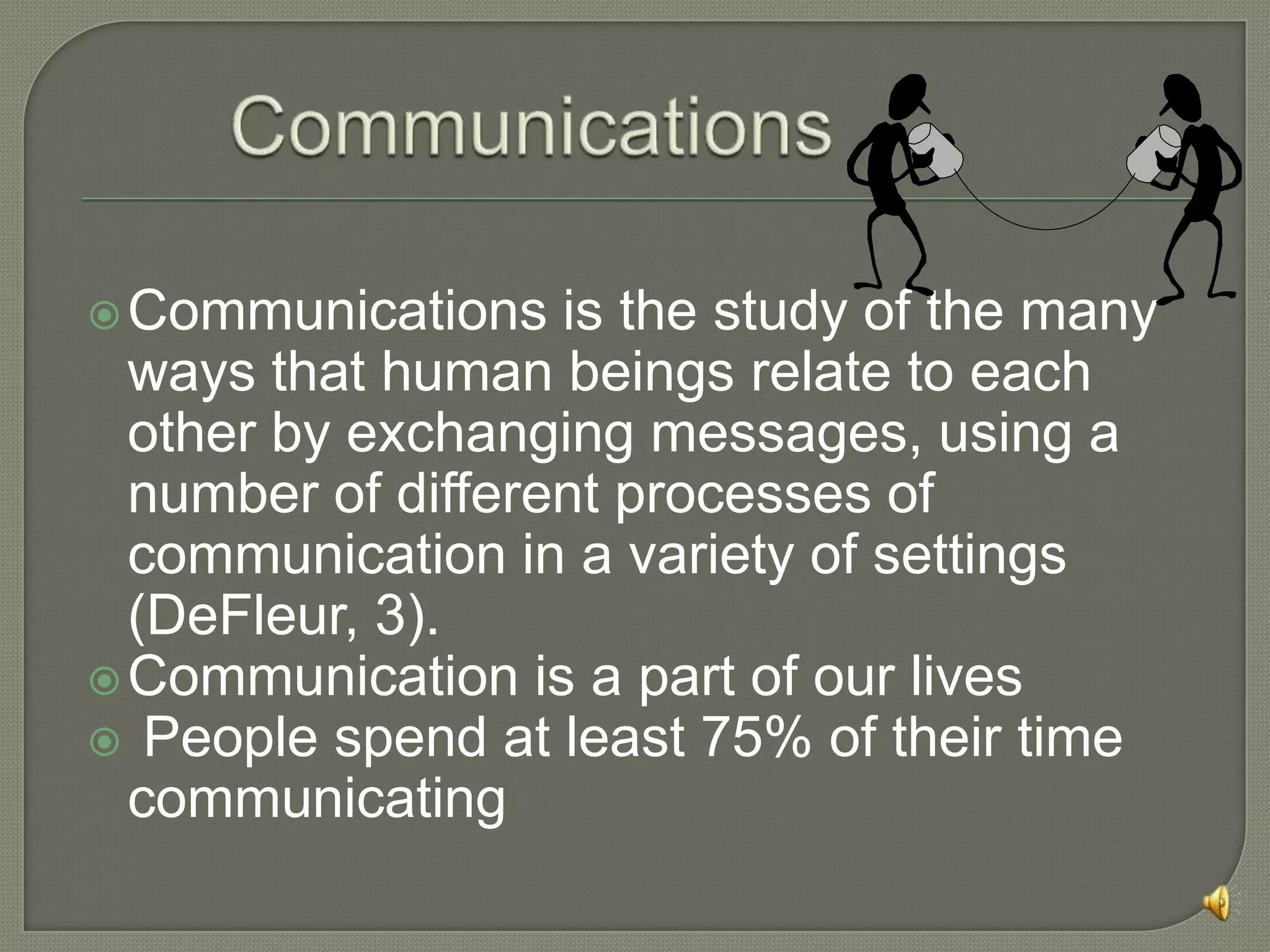
CommunicationsCommunications is the study of the many ways that human beings relate to each other by exchanging messages, using a number of different processes of communication in a variety of settings (DeFleur, 3).Communication is a part of our lives People spend at least 75% of their time communicating
The Importance of Effective Communication Effective communication is all about conveying your thoughts and messages to other people clearly and unmistakably. It’s also about receiving information that others are sending to you, with as little confusion as possible.Communication is only successful when both the sender and the receiver  understand  the same information as a result of the communication.  In a recent survey of recruiters from companies with more than 50,000 employees,   communication skills were cited as the single most important decisive factor in   choosing managers.  Being able to communicate effectively is essential if you want to build an effective  career.    	URL : http://www.mindtools.com/CommSkll/CommunicationIntro.htm
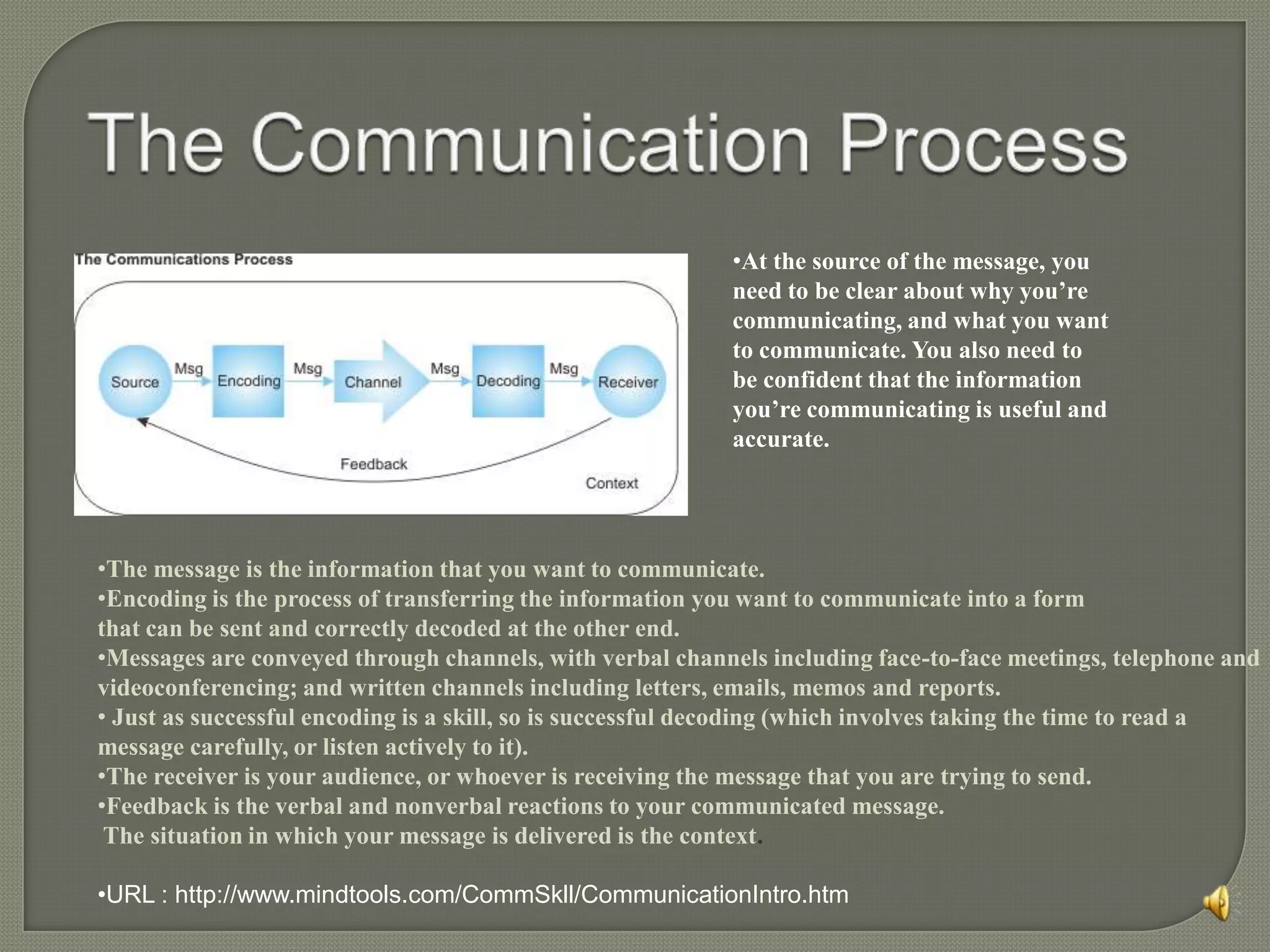
The Communication ProcessAt the source of the message, youneed to be clear about why you’re communicating, and what you wantto communicate. You also need tobe confident that the informationyou’re communicating is useful andaccurate.The message is the information that you want to communicate.
Encoding is the process of transferring the information you want to communicate into a form that can be sent and correctly decoded at the other end.Messages are conveyed through channels, with verbal channels including face-to-face meetings, telephone andvideoconferencing; and written channels including letters, emails, memos and reports. Just as successful encoding is a skill, so is successful decoding (which involves taking the time to read a message carefully, or listen actively to it). The receiver is your audience, or whoever is receiving the message that you are trying to send.
Feedback is the verbal and nonverbal reactions to your communicated message. The situation in which your message is delivered is the context.
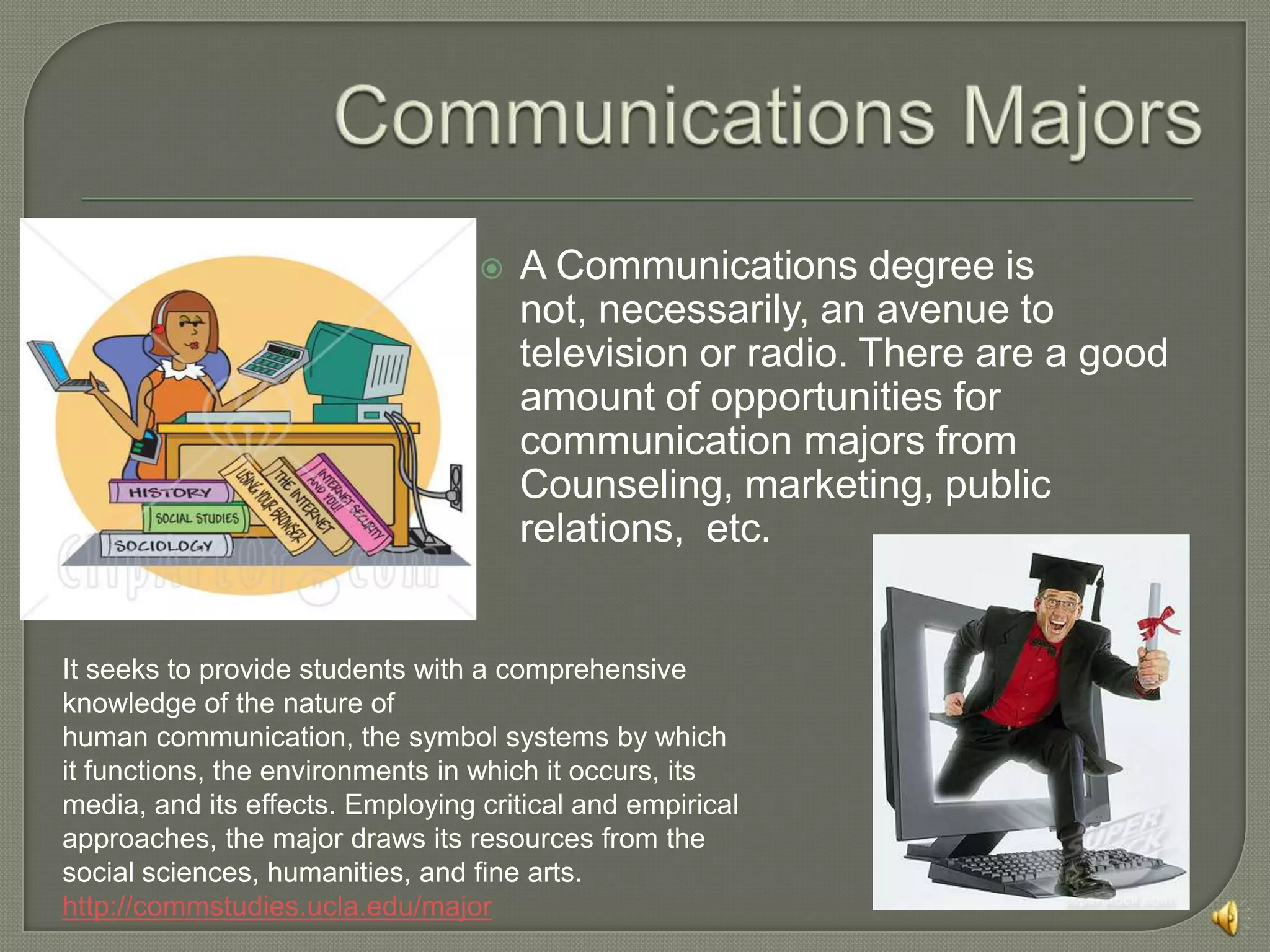
URL : http://www.mindtools.com/CommSkll/CommunicationIntro.htmCommunications	MajorsA Communications degree is not, necessarily, an avenue to television or radio. There are a good amount of opportunities for communication majors from Counseling, marketing, public relations,  etc.It seeks to provide students with a comprehensive knowledge of the nature of human communication, the symbol systems by which it functions, the environments in which it occurs, its media, and its effects. Employing critical and empirical approaches, the major draws its resources from the social sciences, humanities, and fine arts. http://commstudies.ucla.edu/major
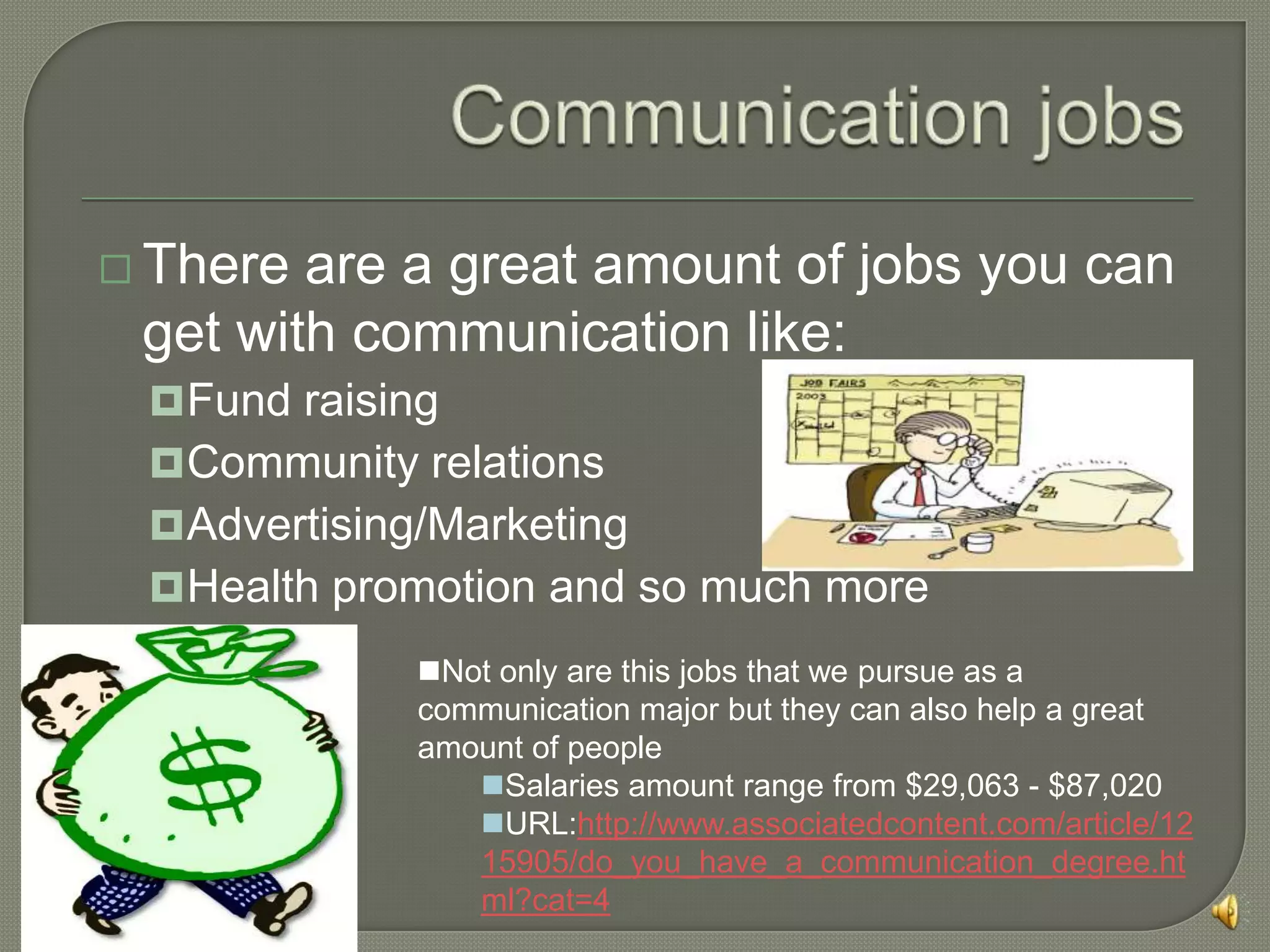
Communication jobs	There are a great amount of jobs you can get with communication like:
Fund raising
Community relations
Advertising/Marketing
Health promotion and so much more
Not only are this jobs that we pursue as a communication major but they can also help a great amount of people
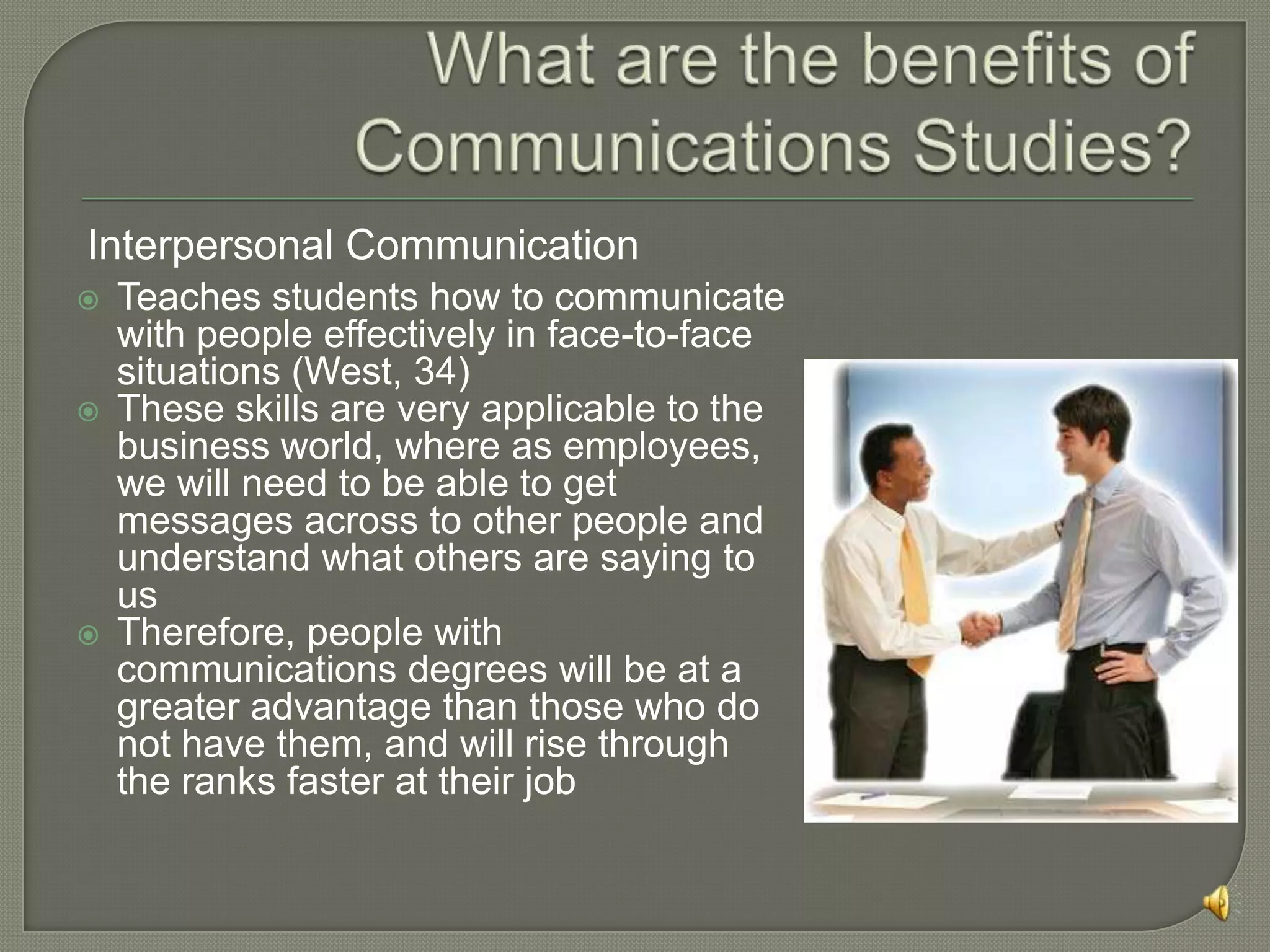
Salaries amount range from $29,063 - $87,020
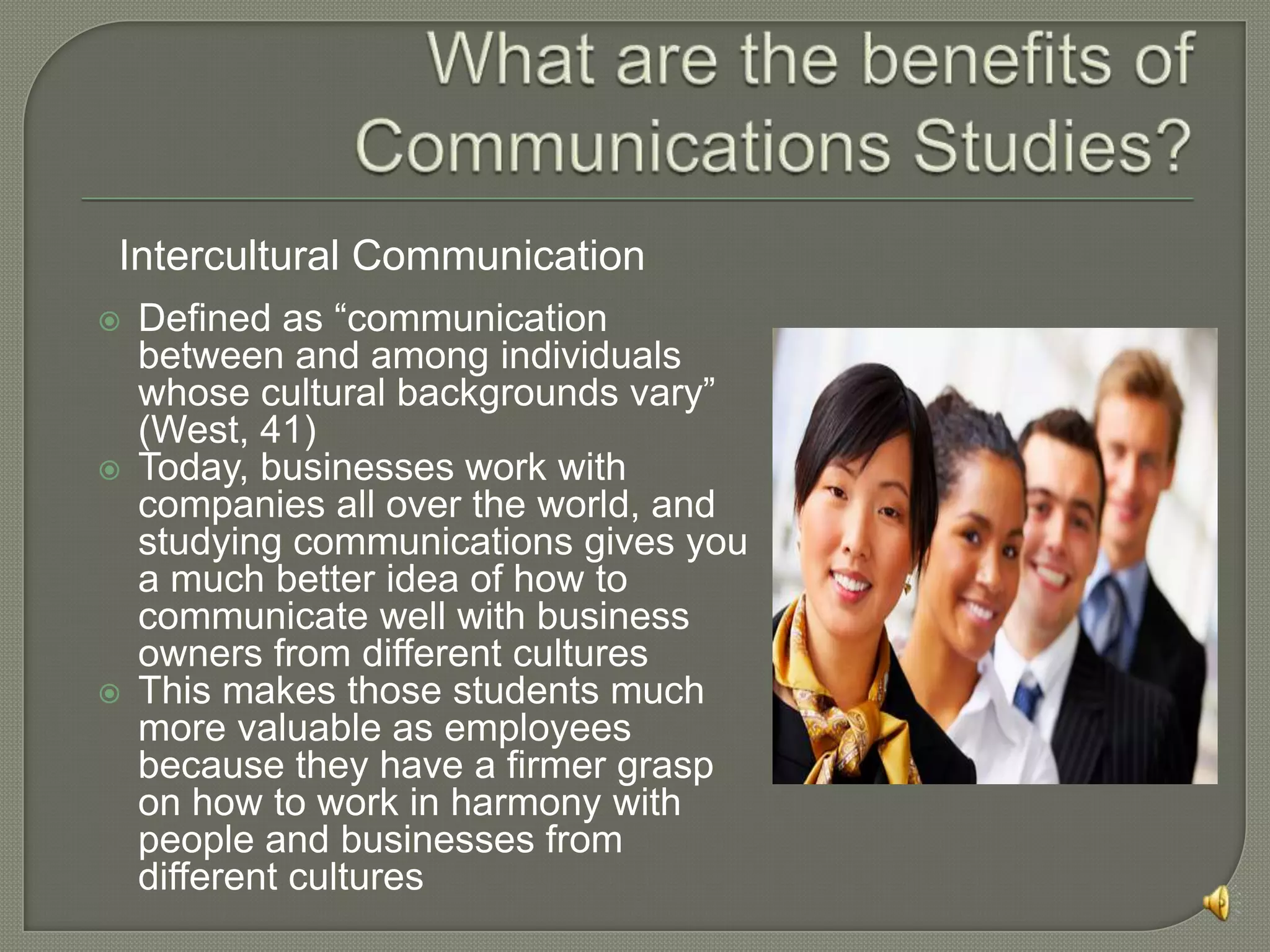
URL:http://www.associatedcontent.com/article/1215905/do_you_have_a_communication_degree.html?cat=4What are the benefits of Communications Studies?Interpersonal CommunicationTeaches students how to communicate with people effectively in face-to-face situations (West, 34)These skills are very applicable to the business world, where as employees, we will need to be able to get messages across to other people and understand what others are saying to usTherefore, people with communications degrees will be at a greater advantage than those who do not have them, and will rise through the ranks faster at their job

CMAT 101 Group Assignment, Powerpoint.

  • 1.
    The Benefits ofa Communications degree Dr. Lori DeWittSummer Semester 1CMAT 101Stephen WaldronMatthew EllisNatasha ApauAdam Clarke
  • 2.
    CommunicationsCommunications is thestudy of the many ways that human beings relate to each other by exchanging messages, using a number of different processes of communication in a variety of settings (DeFleur, 3).Communication is a part of our lives People spend at least 75% of their time communicating
  • 3.
    The Importance ofEffective Communication Effective communication is all about conveying your thoughts and messages to other people clearly and unmistakably. It’s also about receiving information that others are sending to you, with as little confusion as possible.Communication is only successful when both the sender and the receiver understand the same information as a result of the communication. In a recent survey of recruiters from companies with more than 50,000 employees, communication skills were cited as the single most important decisive factor in choosing managers. Being able to communicate effectively is essential if you want to build an effective career. URL : http://www.mindtools.com/CommSkll/CommunicationIntro.htm
  • 4.
    The Communication ProcessAtthe source of the message, youneed to be clear about why you’re communicating, and what you wantto communicate. You also need tobe confident that the informationyou’re communicating is useful andaccurate.The message is the information that you want to communicate.
  • 5.
    Encoding is theprocess of transferring the information you want to communicate into a form that can be sent and correctly decoded at the other end.Messages are conveyed through channels, with verbal channels including face-to-face meetings, telephone andvideoconferencing; and written channels including letters, emails, memos and reports. Just as successful encoding is a skill, so is successful decoding (which involves taking the time to read a message carefully, or listen actively to it). The receiver is your audience, or whoever is receiving the message that you are trying to send.
  • 6.
    Feedback is theverbal and nonverbal reactions to your communicated message. The situation in which your message is delivered is the context.
  • 7.
    URL : http://www.mindtools.com/CommSkll/CommunicationIntro.htmCommunications MajorsACommunications degree is not, necessarily, an avenue to television or radio. There are a good amount of opportunities for communication majors from Counseling, marketing, public relations, etc.It seeks to provide students with a comprehensive knowledge of the nature of human communication, the symbol systems by which it functions, the environments in which it occurs, its media, and its effects. Employing critical and empirical approaches, the major draws its resources from the social sciences, humanities, and fine arts. http://commstudies.ucla.edu/major
  • 8.
    Communication jobs There area great amount of jobs you can get with communication like:
  • 9.
  • 10.
  • 11.
  • 12.
  • 13.
    Not only arethis jobs that we pursue as a communication major but they can also help a great amount of people
  • 14.
    Salaries amount rangefrom $29,063 - $87,020
  • 15.
    URL:http://www.associatedcontent.com/article/1215905/do_you_have_a_communication_degree.html?cat=4What are thebenefits of Communications Studies?Interpersonal CommunicationTeaches students how to communicate with people effectively in face-to-face situations (West, 34)These skills are very applicable to the business world, where as employees, we will need to be able to get messages across to other people and understand what others are saying to usTherefore, people with communications degrees will be at a greater advantage than those who do not have them, and will rise through the ranks faster at their job
  • 16.
    What are thebenefits of Communications Studies?Intercultural CommunicationDefined as “communication between and among individuals whose cultural backgrounds vary” (West, 41)Today, businesses work with companies all over the world, and studying communications gives you a much better idea of how to communicate well with business owners from different culturesThis makes those students much more valuable as employees because they have a firmer grasp on how to work in harmony with people and businesses from different cultures
  • 17.
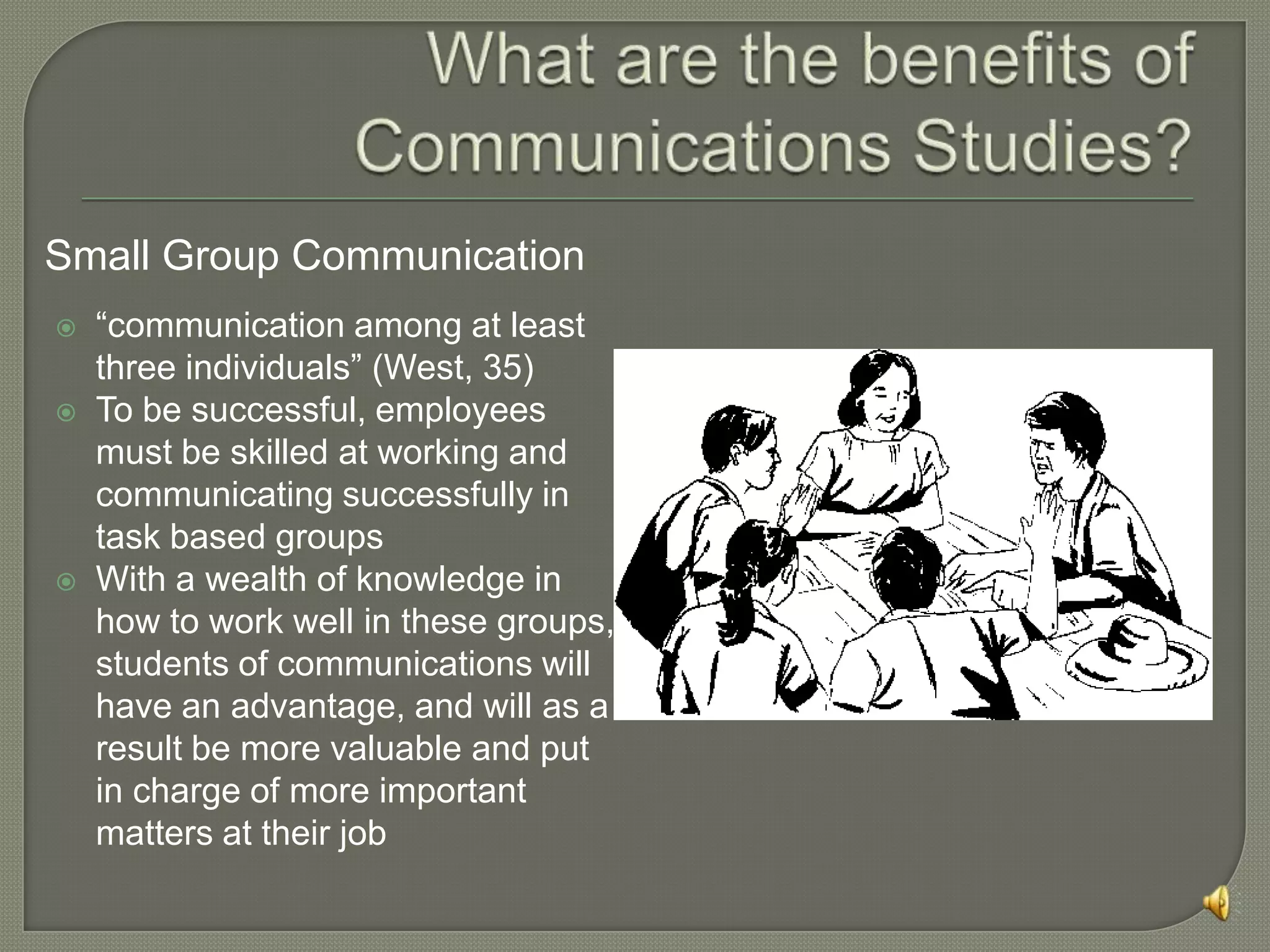
    What are thebenefits of Communications Studies?Small Group Communication“communication among at least three individuals” (West, 35)To be successful, employees must be skilled at working and communicating successfully in task based groupsWith a wealth of knowledge in how to work well in these groups, students of communications will have an advantage, and will as a result be more valuable and put in charge of more important matters at their job
  • 18.
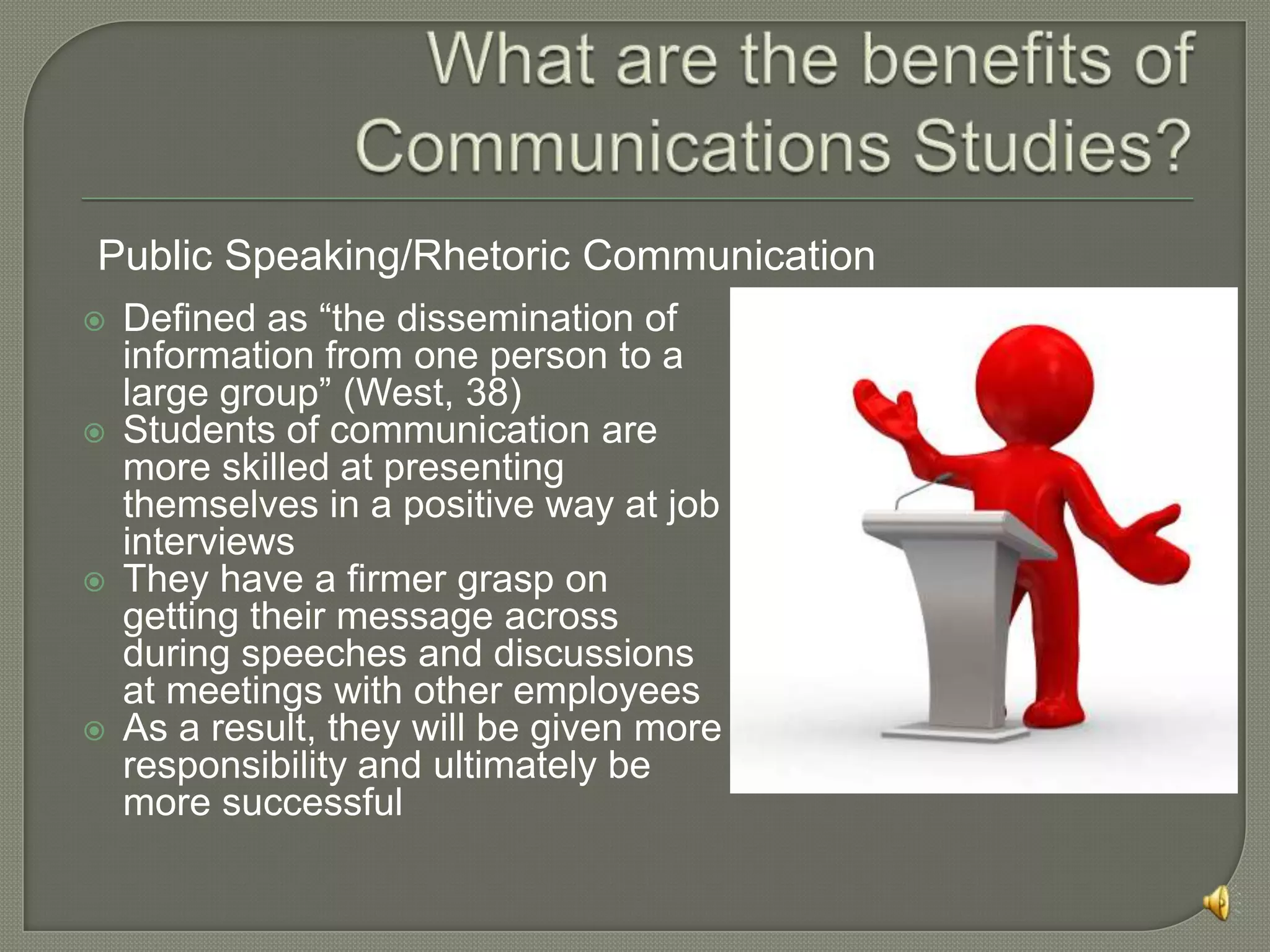
    What are thebenefits of Communications Studies?Public Speaking/Rhetoric CommunicationDefined as “the dissemination of information from one person to a large group” (West, 38)Students of communication are more skilled at presenting themselves in a positive way at job interviewsThey have a firmer grasp on getting their message across during speeches and discussions at meetings with other employeesAs a result, they will be given more responsibility and ultimately be more successful
  • 19.
    Impact of CommunicationCommunicationaffects people in various ways according to a wide range of factors with the technology we have today.
  • 20.
  • 21.
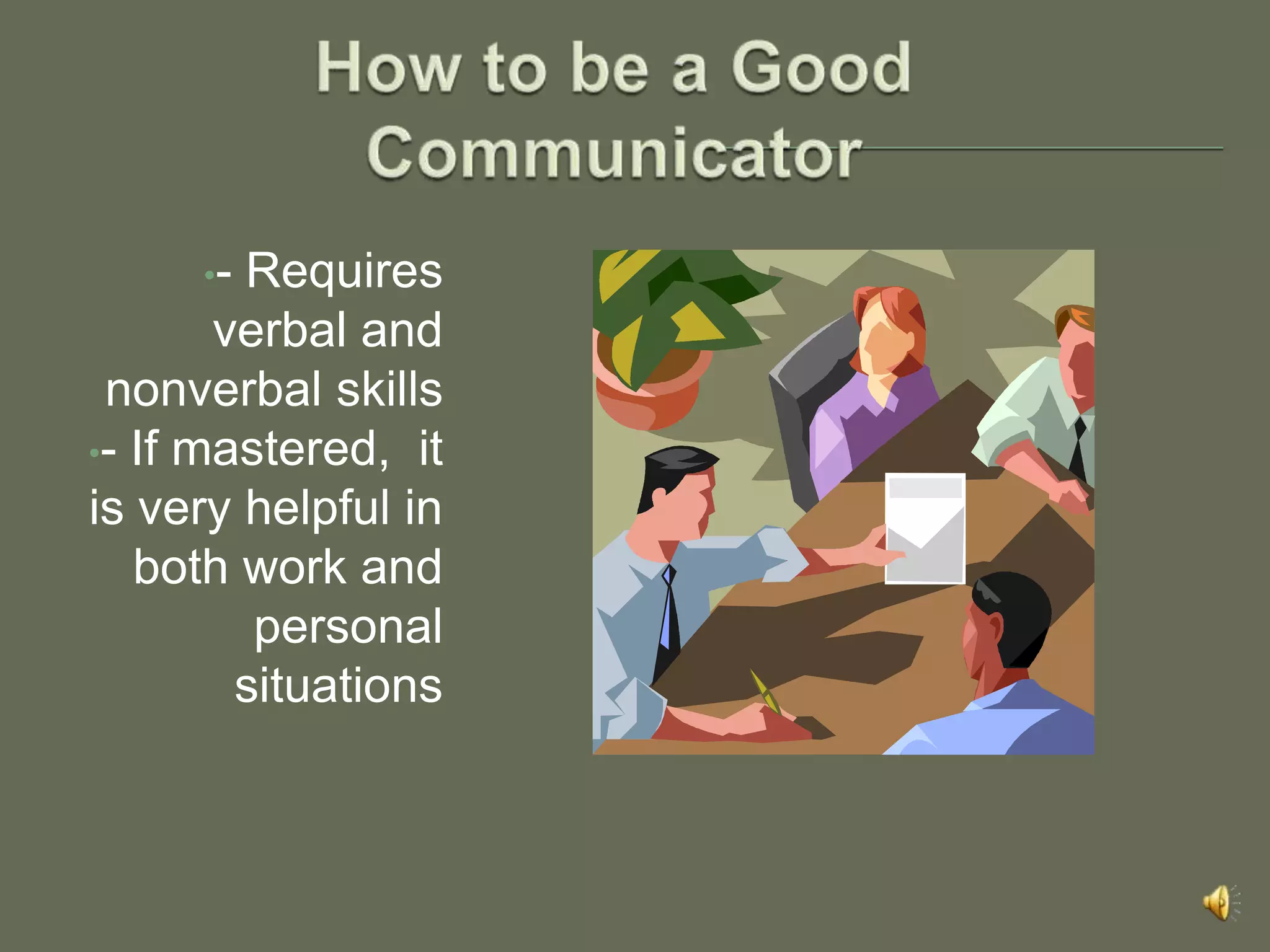
    “One of themost frequent tasks we all face daily is to try to influence people’s ideas” (DeFleur, 301).Negative reality of communication and influenceHow to be a Good Communicator- Requires verbal and nonverbal skills
  • 22.
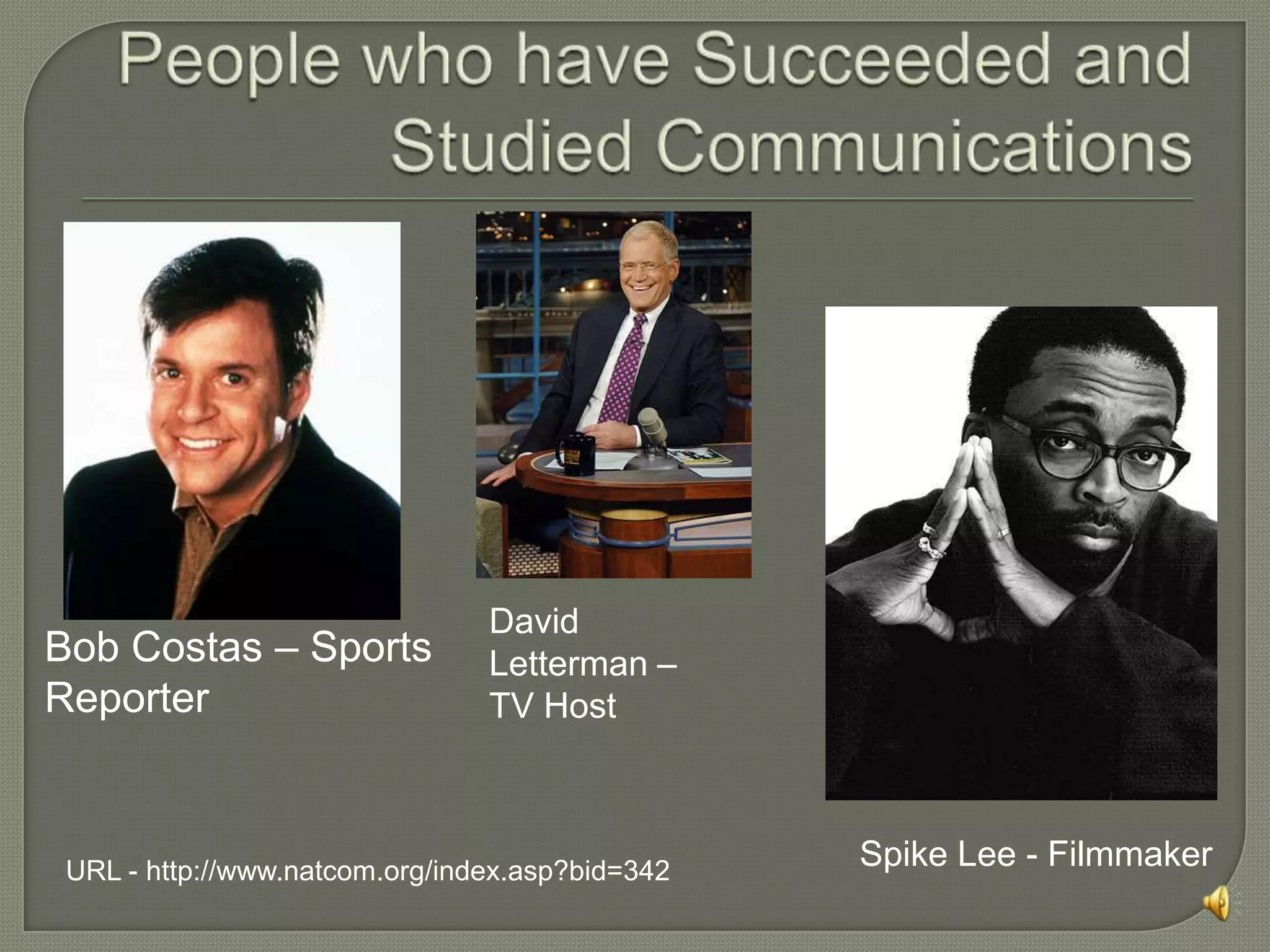
    - If mastered, it is very helpful in both work and personal situationsPeople who have Succeeded and Studied CommunicationsDavid Letterman – TV HostBob Costas – Sports ReporterSpike Lee - FilmmakerURL - http://www.natcom.org/index.asp?bid=342
  • 23.
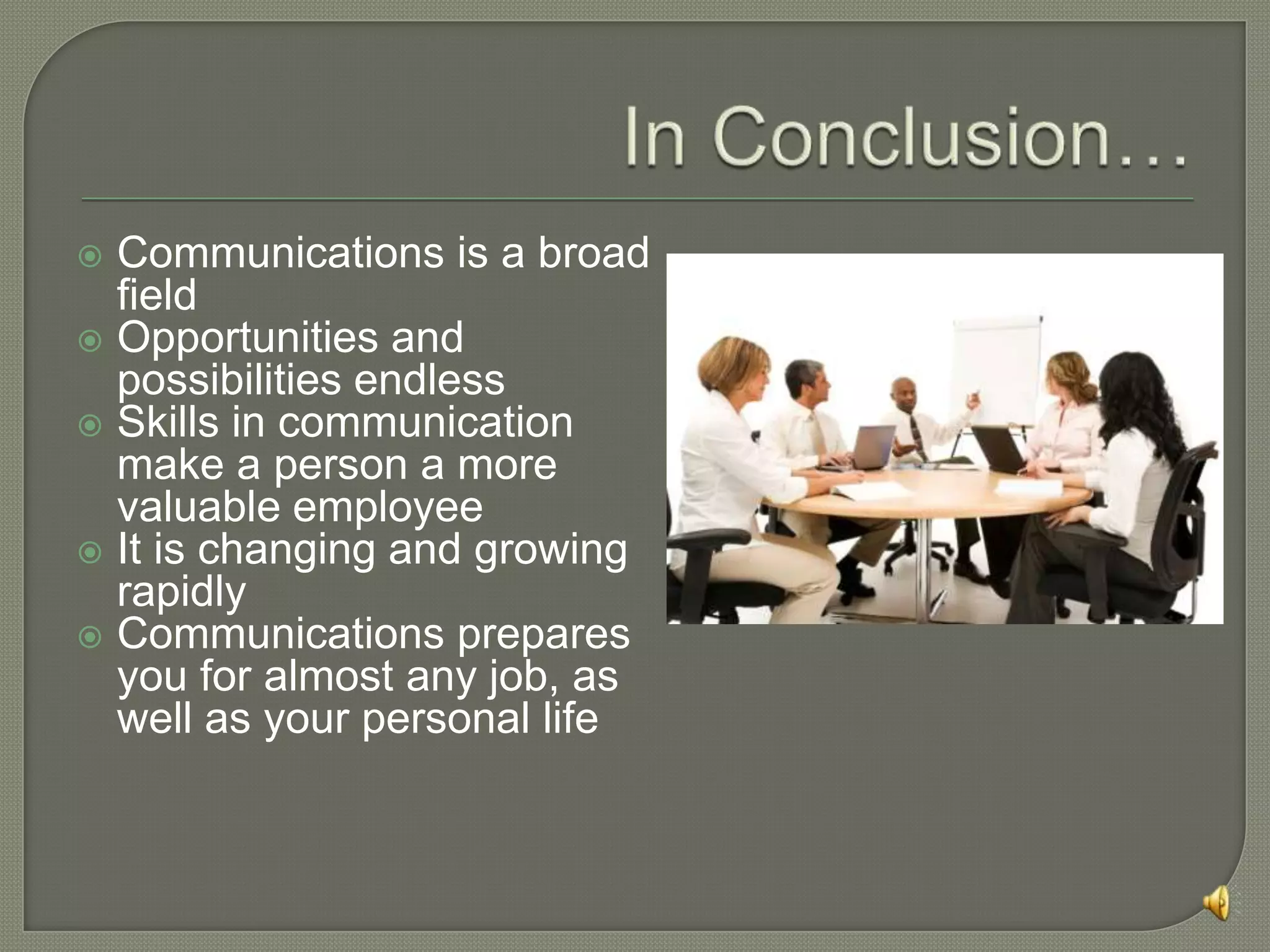
    In Conclusion…Communications isa broad fieldOpportunities and possibilities endlessSkills in communication make a person a more valuable employeeIt is changing and growing rapidlyCommunications prepares you for almost any job, as well as your personal life
  • 24.
    Reference PageMind Tools:Introduction to communication skills. (n.d.). Retrieved from http://www.mindtools.com/CommSkll/CommunicationIntro.htmWest, Richard, & Turner, Lynn. (2007). Introducing communication theory. New York, NY: Mcgraw Hill.DeFleur, M.H., Kearney, P., Plax, T., & DeFleur, M.K. (2005). Fundamentals of human communication. New York, NY: McGraw Hill.Marki, E. (2008). Do you have a communication degree? You're more in demand than ever. Retrieved from http://www.associatedcontent.com/article/1215905/do_you_have_a_communication_degree.html?cat=4.Keith (2006). The major. http://commstudies.ucla.edu/major.Buzzle: All about Human communication. (n.d.). Retrieved from http://www.buzzle.com/articles/all-about-human-communication.htmlNational Communication Association: Famous people with degrees in communication. (n.d.). Retrieved from http://www.natcom.org/index.asp?bid=342

Editor's Notes

  • #12 Communication affects people in various ways according to a wide range of factors with the technology we have today.Factors include the type of media used, graphics and illustrations, the content of news. The ability to influenceDue to technology, communication is now able to influence people on a global level, shape our cultures, strengthen our beliefs, change our perception, start new trends, promote products and services of organizations more efficiently, all of which ultimately maximizes human contact. Negative reality of communication and influenceHowever looking at the big picture, these benefits of technology come with a bit of a price. The disadvantages of better communication have inevitably exploded over the years. Violence and suicides are the result of influences from movies, news and a constant overflowing of new information on the Internet that can be outrageously diabolical and deviating. Cyber bullying has also become common for people to get revenge and post hate messages with low risks of getting caught. Privacy is slowly fading from our vocabulary thanks to the countless number of cameras everywhere and everyone just seems to own hand phones with built-in cameras these days, combining to the accessibility of pictures and videos through medias like picture messaging, emails, social networking sites and blogs.
  • #13 In order to be a an effective communicator, you have to make a deliberate attempt to communicate with others as well as have some important verbal and nonverbal abilities.Important traits of a good speaker include speaking so that your audience will understand you and know what you are talking about, and making sure it is appropriate.Responsibilities of an effective listener include maintaining eye contract, providing feedback, and engaging fully in trying to understand what is being communicated.
  • #14 Actors- James Gandolfini, Denzel Washington Journalists – Dan Rather, Walter Cronkite, Ted Koppel