Consumer Math 30S Unit 1 – Income & Debt Specific Outcomes D-1 Solve problems involving performance-based income. D-2 Use simple and compound interest calculations to solve problems. D-3 Solve problems involving credit-card buying. D-4 Solve problems involving personal loans.
Unit 1 – Income & Debt An employer can pay an employee in several ways. Some employers pay an employee a set salary; others pay an hourly wage or an employee can be paid a commission or by the amount of “pieces” they complete.  In the first part of this unit we will look at calculating an employees gross pay, based on some type of commission.
Unit 1 – Income & Debt Review of Percentages To calculate commission income, students can apply what they have learned about percents from  Senior 2 Consumer Mathematics .  Percent means “out of one hundred.”   Percents such as 10%, 20%, and 5% are easy to calculate, and can be used to estimate others.
Review of Percentages Percents such as 10%, 20%, and 5% are easy to calculate, and can be used to estimate others. To compute 10% of a value, move the decimal point  one place to the left . If no decimal point is indicated, assume it is to the right of the digit in the ones position. To compute 20% of a value, calculate 10% and then multiply the answer by 2. To compute 5% of a value, calculate 10% and then find one-half of that answer. Unit 1 – Income & Debt
A number of methods for calculating percents other than 10%, 20%, or 5% exist. Two of these methods are: setting up a proportion of two ratios  changing the percent to a decimal and multiplying Example Calculate 35% of $4000. Unit 1 – Income & Debt
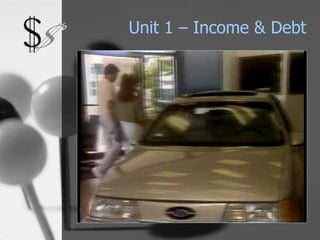
Unit 1 – Income & Debt Commissions What are commissions? A percent of sales that is paid to the salesperson. Which jobs include commissions? Real estate agent, car salesperson, appliance salesperson, clothing salesperson, insurance salesperson Why pay with a commission rather than an hourly wage or salary?   To encourage salespeople to work harder to sell more merchandise .
Unit 1 – Income & Debt
Unit 1 – Income & Debt Three Types of Commissions Straight Commission This type of commission has the salesperson only earning a percentage of the total sales.  There total income is derived from their sales only. Jenna sells insurance and earns 30% commission on each policy she sells.  Last week she sold 2 policies; one for $300 and another for $400.  What is Jenna’s gross pay this week?
Unit 1 – Income & Debt Three Types of Commissions Salary Plus Commission This type of commission has the salesperson earning a percentage of the total sales on top of a regularly paid salary.  There total income is derived from adding their salary to their commission. Sara sells cars and earns $350 a week plus a commission of 6% on any amount over $20 000.  If she sold $62 000 worth of vehicles this week, what is her gross pay?
Unit 1 – Income & Debt Three Types of Commissions Graduated Commission Graduated commission has the salesperson earn an increasing commission rate as the amount of sales increases.  The more they sell, the more they earn. John sells computers and gets 4% on the first $5000, 5% on the next $10 000, and 6% on any sales over $15 000.  Calculate his gross pay is he sold $32 000 worth of computers.
Unit 1 – Income & Debt Commissions online mental math activity. http://www.aaamath.com/g84-commission.html#section1
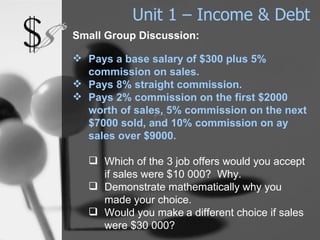
Unit 1 – Income & Debt Small Group Discussion: Consider the following 3 job offers for sales associate positions. The way the income for each is calculated for each job is described below: Pays a base salary of $300 plus 5% commission on sales. Pays 8% straight commission. Pays 2% commission on the first $2000 worth of sales, 5% commission on the next $7000 sold, and 10% commission on ay sales over   $9000 .
Unit 1 – Income & Debt Small Group Discussion: Pays a base salary of $300 plus 5% commission on sales. Pays 8% straight commission. Pays 2% commission on the first $2000 worth of sales, 5% commission on the next $7000 sold, and 10% commission on ay sales over   $9000. Which of the 3 job offers would you accept if sales were $10 000?  Why. Demonstrate mathematically why you made your choice. Would you make   a different choice if sales were $30 000?
Unit 1 – Income & Debt Textbook Assignment: Page 18 – 20 Questions 1 - 11
Unit 1 – Income & Debt EMAIL ASSIGMENT (bcoulter@pwsd.ca) What would be the benefit of paying straight commissions? Would this be a good way for you to be paid? Why or why not?
Unit 1 – Income & Debt Commissions Review Worksheet Questions 1 - 10
Unit 1 – Income & Debt Net Pay vs. Gross Pay What is gross pay? The total amount of money earned before any deductions  have been taken off. What is net pay? The amount of money a person “takes home” after  deductions have been taken off.  Deductions may include: EI (employment insurance), CPP (Canada pension plan),  IT (income tax), union dues, RPP (registered pension plan), RRSP (registered retirement savings plan), bonds, insurance, etc.
Unit 1 – Income & Debt Calculating Net Pay In order to calculate a person’s net pay you will need a set of tax tables and you will need to know the claim code for the individual. Calculating Taxable Income Taxable income is the gross income less the non-taxable deductions.  The non-taxable deductions include:  union dues, RPP, and RRSP.  The taxable income is needed to calculated the income tax that needs to be deducted from the gross pay.
Unit 1 – Income & Debt Determining Deductions After the taxable income has been determined, use the tax tables to record the amount of income tax that needs to be deducted. To calculate the EI and CPP that is to be deducted, you simply use the gross income amount and the tax tables. Finally to calculate the net income you must: Gross Income – all deductions = Net Income
Unit 1 – Income & Debt Example Problem: Peter’s gross pay is $2500.  Calculate his net pay if he contributes $50 a pay period to a RPP and pays $40 for health insurance. Assignment: Net Pay Worksheet

CM30S - 1.1

  • 1.
    Consumer Math 30SUnit 1 – Income & Debt Specific Outcomes D-1 Solve problems involving performance-based income. D-2 Use simple and compound interest calculations to solve problems. D-3 Solve problems involving credit-card buying. D-4 Solve problems involving personal loans.
  • 2.
    Unit 1 –Income & Debt An employer can pay an employee in several ways. Some employers pay an employee a set salary; others pay an hourly wage or an employee can be paid a commission or by the amount of “pieces” they complete. In the first part of this unit we will look at calculating an employees gross pay, based on some type of commission.
  • 3.
    Unit 1 –Income & Debt Review of Percentages To calculate commission income, students can apply what they have learned about percents from Senior 2 Consumer Mathematics . Percent means “out of one hundred.” Percents such as 10%, 20%, and 5% are easy to calculate, and can be used to estimate others.
  • 4.
    Review of PercentagesPercents such as 10%, 20%, and 5% are easy to calculate, and can be used to estimate others. To compute 10% of a value, move the decimal point one place to the left . If no decimal point is indicated, assume it is to the right of the digit in the ones position. To compute 20% of a value, calculate 10% and then multiply the answer by 2. To compute 5% of a value, calculate 10% and then find one-half of that answer. Unit 1 – Income & Debt
  • 5.
    A number ofmethods for calculating percents other than 10%, 20%, or 5% exist. Two of these methods are: setting up a proportion of two ratios changing the percent to a decimal and multiplying Example Calculate 35% of $4000. Unit 1 – Income & Debt
  • 6.
    Unit 1 –Income & Debt Commissions What are commissions? A percent of sales that is paid to the salesperson. Which jobs include commissions? Real estate agent, car salesperson, appliance salesperson, clothing salesperson, insurance salesperson Why pay with a commission rather than an hourly wage or salary? To encourage salespeople to work harder to sell more merchandise .
  • 7.
    Unit 1 –Income & Debt
  • 8.
    Unit 1 –Income & Debt Three Types of Commissions Straight Commission This type of commission has the salesperson only earning a percentage of the total sales. There total income is derived from their sales only. Jenna sells insurance and earns 30% commission on each policy she sells. Last week she sold 2 policies; one for $300 and another for $400. What is Jenna’s gross pay this week?
  • 9.
    Unit 1 –Income & Debt Three Types of Commissions Salary Plus Commission This type of commission has the salesperson earning a percentage of the total sales on top of a regularly paid salary. There total income is derived from adding their salary to their commission. Sara sells cars and earns $350 a week plus a commission of 6% on any amount over $20 000. If she sold $62 000 worth of vehicles this week, what is her gross pay?
  • 10.
    Unit 1 –Income & Debt Three Types of Commissions Graduated Commission Graduated commission has the salesperson earn an increasing commission rate as the amount of sales increases. The more they sell, the more they earn. John sells computers and gets 4% on the first $5000, 5% on the next $10 000, and 6% on any sales over $15 000. Calculate his gross pay is he sold $32 000 worth of computers.
  • 11.
    Unit 1 –Income & Debt Commissions online mental math activity. http://www.aaamath.com/g84-commission.html#section1
  • 12.
    Unit 1 –Income & Debt Small Group Discussion: Consider the following 3 job offers for sales associate positions. The way the income for each is calculated for each job is described below: Pays a base salary of $300 plus 5% commission on sales. Pays 8% straight commission. Pays 2% commission on the first $2000 worth of sales, 5% commission on the next $7000 sold, and 10% commission on ay sales over $9000 .
  • 13.
    Unit 1 –Income & Debt Small Group Discussion: Pays a base salary of $300 plus 5% commission on sales. Pays 8% straight commission. Pays 2% commission on the first $2000 worth of sales, 5% commission on the next $7000 sold, and 10% commission on ay sales over $9000. Which of the 3 job offers would you accept if sales were $10 000? Why. Demonstrate mathematically why you made your choice. Would you make a different choice if sales were $30 000?
  • 14.
    Unit 1 –Income & Debt Textbook Assignment: Page 18 – 20 Questions 1 - 11
  • 15.
    Unit 1 –Income & Debt EMAIL ASSIGMENT (bcoulter@pwsd.ca) What would be the benefit of paying straight commissions? Would this be a good way for you to be paid? Why or why not?
  • 16.
    Unit 1 –Income & Debt Commissions Review Worksheet Questions 1 - 10
  • 17.
    Unit 1 –Income & Debt Net Pay vs. Gross Pay What is gross pay? The total amount of money earned before any deductions have been taken off. What is net pay? The amount of money a person “takes home” after deductions have been taken off. Deductions may include: EI (employment insurance), CPP (Canada pension plan), IT (income tax), union dues, RPP (registered pension plan), RRSP (registered retirement savings plan), bonds, insurance, etc.
  • 18.
    Unit 1 –Income & Debt Calculating Net Pay In order to calculate a person’s net pay you will need a set of tax tables and you will need to know the claim code for the individual. Calculating Taxable Income Taxable income is the gross income less the non-taxable deductions. The non-taxable deductions include: union dues, RPP, and RRSP. The taxable income is needed to calculated the income tax that needs to be deducted from the gross pay.
  • 19.
    Unit 1 –Income & Debt Determining Deductions After the taxable income has been determined, use the tax tables to record the amount of income tax that needs to be deducted. To calculate the EI and CPP that is to be deducted, you simply use the gross income amount and the tax tables. Finally to calculate the net income you must: Gross Income – all deductions = Net Income
  • 20.
    Unit 1 –Income & Debt Example Problem: Peter’s gross pay is $2500. Calculate his net pay if he contributes $50 a pay period to a RPP and pays $40 for health insurance. Assignment: Net Pay Worksheet