CLUSTERING IN WIRELESS SENSOR
NETWORKS USING COMPRESSIVE
SENSING
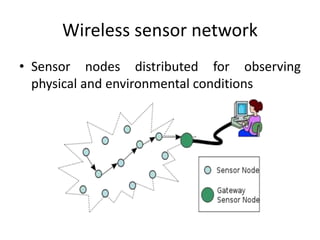
Wireless sensor network
• Sensor nodes distributed for observing
physical and environmental conditions
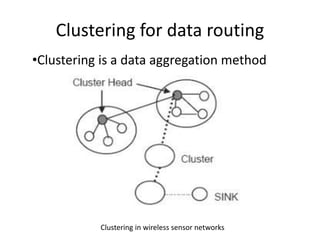
Clustering for data routing
•Clustering is a data aggregation method
Clustering in wireless sensor networks
Compressive sensing
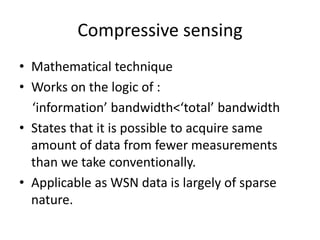
• Mathematical technique
• Works on the logic of :
‘information’ bandwidth<‘total’ bandwidth
• States that it is possible to acquire same
amount of data from fewer measurements
than we take conventionally.
• Applicable as WSN data is largely of sparse
nature.
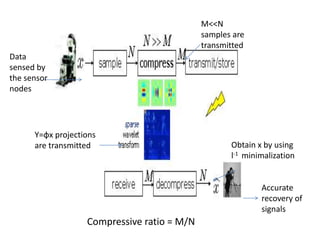
Data
sensed by
the sensor
nodes
M<<N
samples are
transmitted
Y=φx projections
are transmitted Obtain x by using
l-1 minimalization
Accurate
recovery of
signals
Compressive ratio = M/N
Analysis and comparison
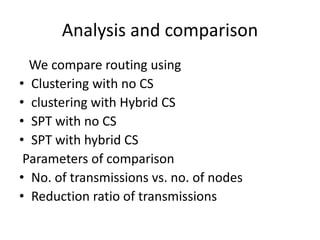
We compare routing using
• Clustering with no CS
• clustering with Hybrid CS
• SPT with no CS
• SPT with hybrid CS
Parameters of comparison
• No. of transmissions vs. no. of nodes
• Reduction ratio of transmissions
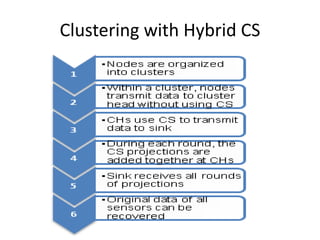
Clustering with Hybrid CS
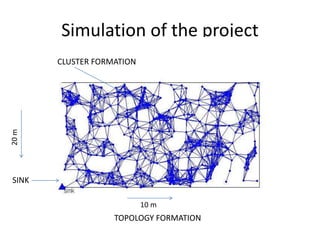
Simulation of the project
TOPOLOGY FORMATION
CLUSTER FORMATION
SINK
20m
10 m
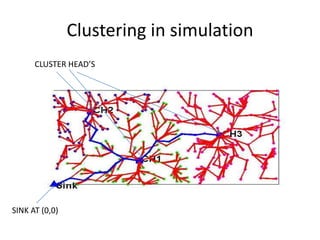
Clustering in simulation
CLUSTER HEAD’S
SINK AT (0,0)
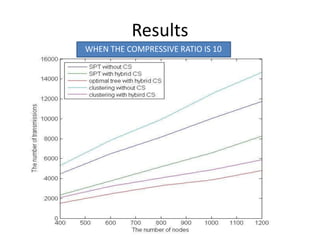
Results
WHEN THE COMPRESSIVE RATIO IS 10
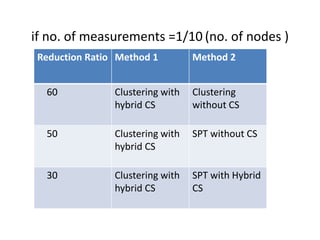
if no. of measurements =1/10 (no. of nodes )
Reduction Ratio Method 1 Method 2
60 Clustering with
hybrid CS
Clustering
without CS
50 Clustering with
hybrid CS
SPT without CS
30 Clustering with
hybrid CS
SPT with Hybrid
CS
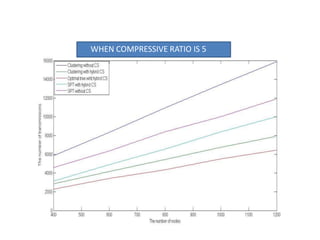
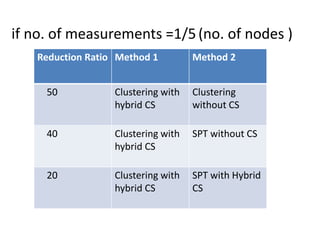
WHEN COMPRESSIVE RATIO IS 5
if no. of measurements =1/5(no. of nodes )
Reduction Ratio Method 1 Method 2
50 Clustering with
hybrid CS
Clustering
without CS
40 Clustering with
hybrid CS
SPT without CS
20 Clustering with
hybrid CS
SPT with Hybrid
CS
Results
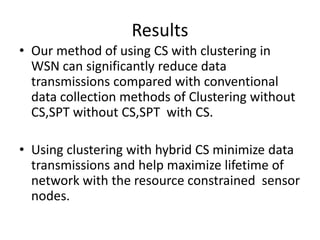
• Our method of using CS with clustering in
WSN can significantly reduce data
transmissions compared with conventional
data collection methods of Clustering without
CS,SPT without CS,SPT with CS.
• Using clustering with hybrid CS minimize data
transmissions and help maximize lifetime of
network with the resource constrained sensor
nodes.

Clustering in wireless sensor networks with compressive sensing

  • 1.
    CLUSTERING IN WIRELESSSENSOR NETWORKS USING COMPRESSIVE SENSING
  • 2.
    Wireless sensor network •Sensor nodes distributed for observing physical and environmental conditions
  • 3.
    Clustering for datarouting •Clustering is a data aggregation method Clustering in wireless sensor networks
  • 4.
    Compressive sensing • Mathematicaltechnique • Works on the logic of : ‘information’ bandwidth<‘total’ bandwidth • States that it is possible to acquire same amount of data from fewer measurements than we take conventionally. • Applicable as WSN data is largely of sparse nature.
  • 5.
    Data sensed by the sensor nodes M<<N samplesare transmitted Y=φx projections are transmitted Obtain x by using l-1 minimalization Accurate recovery of signals Compressive ratio = M/N
  • 6.
    Analysis and comparison Wecompare routing using • Clustering with no CS • clustering with Hybrid CS • SPT with no CS • SPT with hybrid CS Parameters of comparison • No. of transmissions vs. no. of nodes • Reduction ratio of transmissions
  • 7.
  • 8.
    Simulation of theproject TOPOLOGY FORMATION CLUSTER FORMATION SINK 20m 10 m
  • 9.
    Clustering in simulation CLUSTERHEAD’S SINK AT (0,0)
  • 10.
  • 11.
    if no. ofmeasurements =1/10 (no. of nodes ) Reduction Ratio Method 1 Method 2 60 Clustering with hybrid CS Clustering without CS 50 Clustering with hybrid CS SPT without CS 30 Clustering with hybrid CS SPT with Hybrid CS
  • 12.
  • 13.
    if no. ofmeasurements =1/5(no. of nodes ) Reduction Ratio Method 1 Method 2 50 Clustering with hybrid CS Clustering without CS 40 Clustering with hybrid CS SPT without CS 20 Clustering with hybrid CS SPT with Hybrid CS
  • 14.
    Results • Our methodof using CS with clustering in WSN can significantly reduce data transmissions compared with conventional data collection methods of Clustering without CS,SPT without CS,SPT with CS. • Using clustering with hybrid CS minimize data transmissions and help maximize lifetime of network with the resource constrained sensor nodes.