DevOps for networking boost your organization's
growth by incorporating networking in the DevOps
culture Armstrong download
https://textbookfull.com/product/devops-for-networking-boost-
your-organizations-growth-by-incorporating-networking-in-the-
devops-culture-armstrong/
Download full version ebook from https://textbookfull.com
We believe these products will be a great fit for you. Click
the link to download now, or visit textbookfull.com
to discover even more!
The Linux DevOps Handbook: Customize and scale your
Linux distributions to accelerate your DevOps workflow
Wojs■aw
https://textbookfull.com/product/the-linux-devops-handbook-
customize-and-scale-your-linux-distributions-to-accelerate-your-
devops-workflow-wojslaw/
Azure DevOps for Web Developers: Streamlined
Application Development Using Azure DevOps Features
Ambily K K
https://textbookfull.com/product/azure-devops-for-web-developers-
streamlined-application-development-using-azure-devops-features-
ambily-k-k/
Puppet 8 for DevOps Engineers David Sandilands
https://textbookfull.com/product/puppet-8-for-devops-engineers-
david-sandilands/
DevOps for Digital Leaders Reignite Business with a
Modern DevOps Enabled Software Factory 1st Edition
Aruna Ravichandran
https://textbookfull.com/product/devops-for-digital-leaders-
reignite-business-with-a-modern-devops-enabled-software-
factory-1st-edition-aruna-ravichandran/
DevOps in Python: Infrastructure as Python Zadka
https://textbookfull.com/product/devops-in-python-infrastructure-
as-python-zadka/
Global Networking, Communication and Culture: Conflict
or Convergence? Halit Ünver
https://textbookfull.com/product/global-networking-communication-
and-culture-conflict-or-convergence-halit-unver/
Achieving DevOps: A Novel About Delivering the Best of
Agile, DevOps, and Microservices 1st Edition Dave
Harrison
https://textbookfull.com/product/achieving-devops-a-novel-about-
delivering-the-best-of-agile-devops-and-microservices-1st-
edition-dave-harrison/
Networking All in One For Dummies 7th Edition Lowe
https://textbookfull.com/product/networking-all-in-one-for-
dummies-7th-edition-lowe/
The Phoenix Project: A Novel about IT, DevOps, and
Helping Your Business Win Kim
https://textbookfull.com/product/the-phoenix-project-a-novel-
about-it-devops-and-helping-your-business-win-kim/
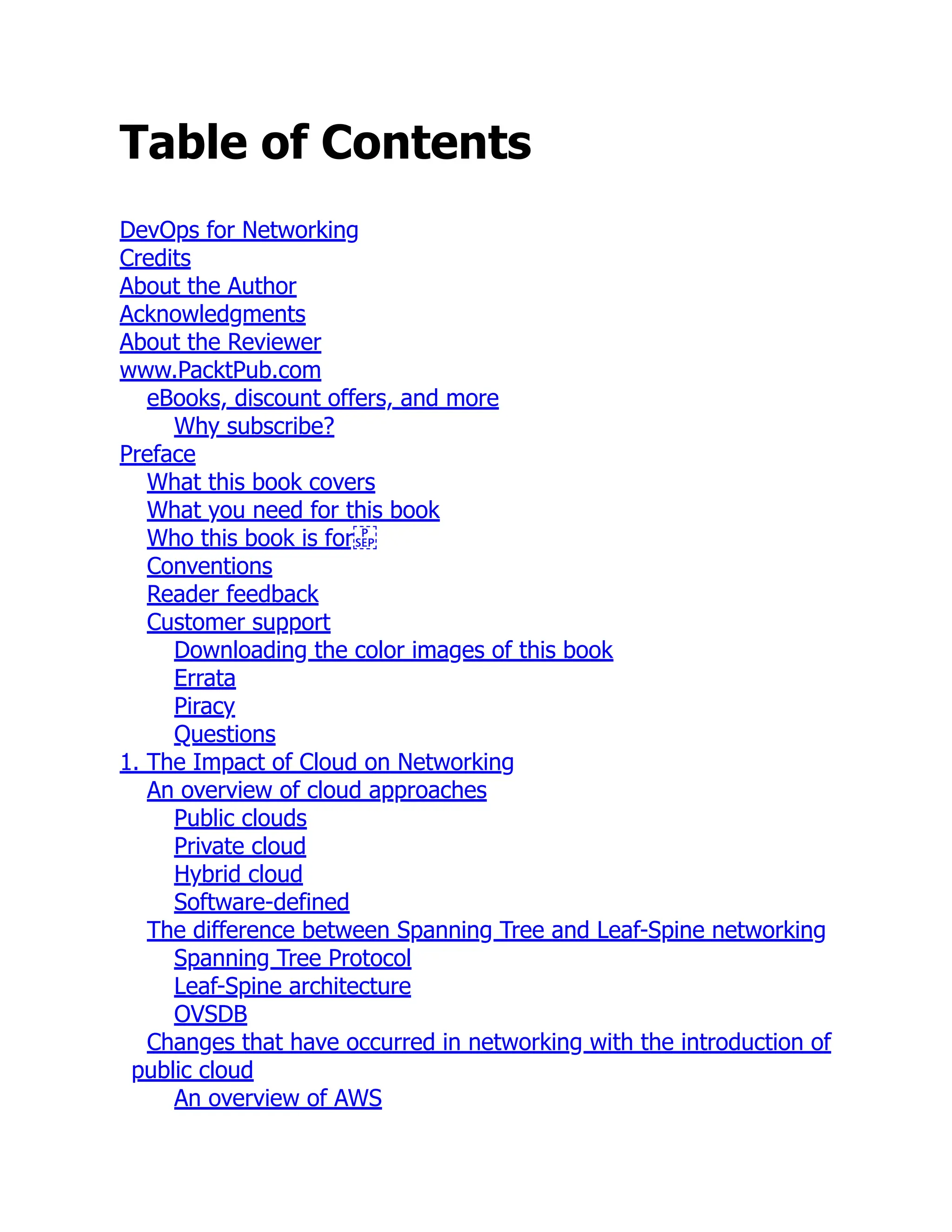
Table of Contents
DevOps for Networking
Credits
About the Author
Acknowledgments
About the Reviewer
www.PacktPub.com
eBooks, discount offers, and more
Why subscribe?
Preface
What this book covers
What you need for this book
Who this book is for
Conventions
Reader feedback
Customer support
Downloading the color images of this book
Errata
Piracy
Questions
1. The Impact of Cloud on Networking
An overview of cloud approaches
Public clouds
Private cloud
Hybrid cloud
Software-defined
The difference between Spanning Tree and Leaf-Spine networking
Spanning Tree Protocol
Leaf-Spine architecture
OVSDB
Changes that have occurred in networking with the introduction of
public cloud
An overview of AWS
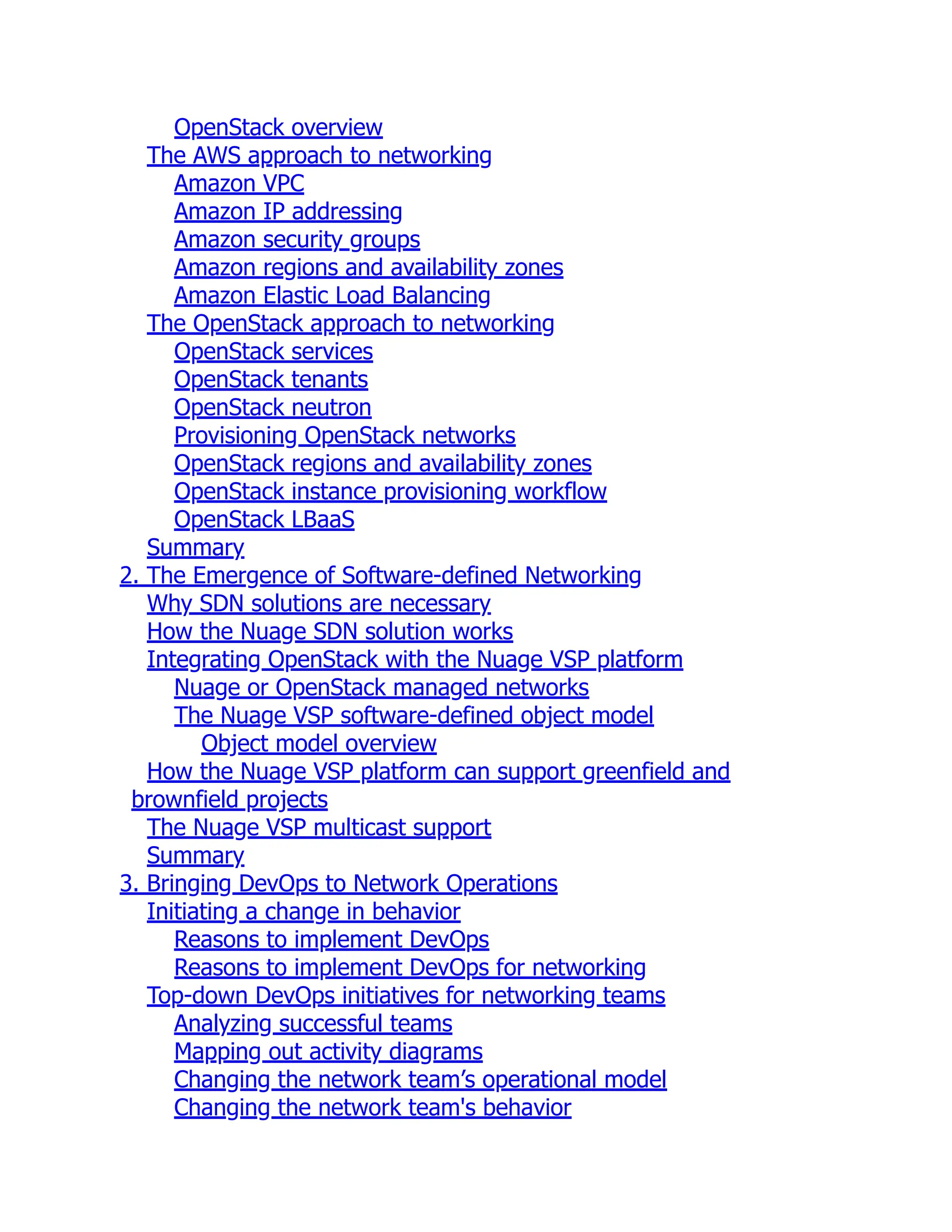
OpenStack overview
The AWS approach to networking
Amazon VPC
Amazon IP addressing
Amazon security groups
Amazon regions and availability zones
Amazon Elastic Load Balancing
The OpenStack approach to networking
OpenStack services
OpenStack tenants
OpenStack neutron
Provisioning OpenStack networks
OpenStack regions and availability zones
OpenStack instance provisioning workflow
OpenStack LBaaS
Summary
2. The Emergence of Software-defined Networking
Why SDN solutions are necessary
How the Nuage SDN solution works
Integrating OpenStack with the Nuage VSP platform
Nuage or OpenStack managed networks
The Nuage VSP software-defined object model
Object model overview
How the Nuage VSP platform can support greenfield and
brownfield projects
The Nuage VSP multicast support
Summary
3. Bringing DevOps to Network Operations
Initiating a change in behavior
Reasons to implement DevOps
Reasons to implement DevOps for networking
Top-down DevOps initiatives for networking teams
Analyzing successful teams
Mapping out activity diagrams
Changing the network team’s operational model
Changing the network team's behavior
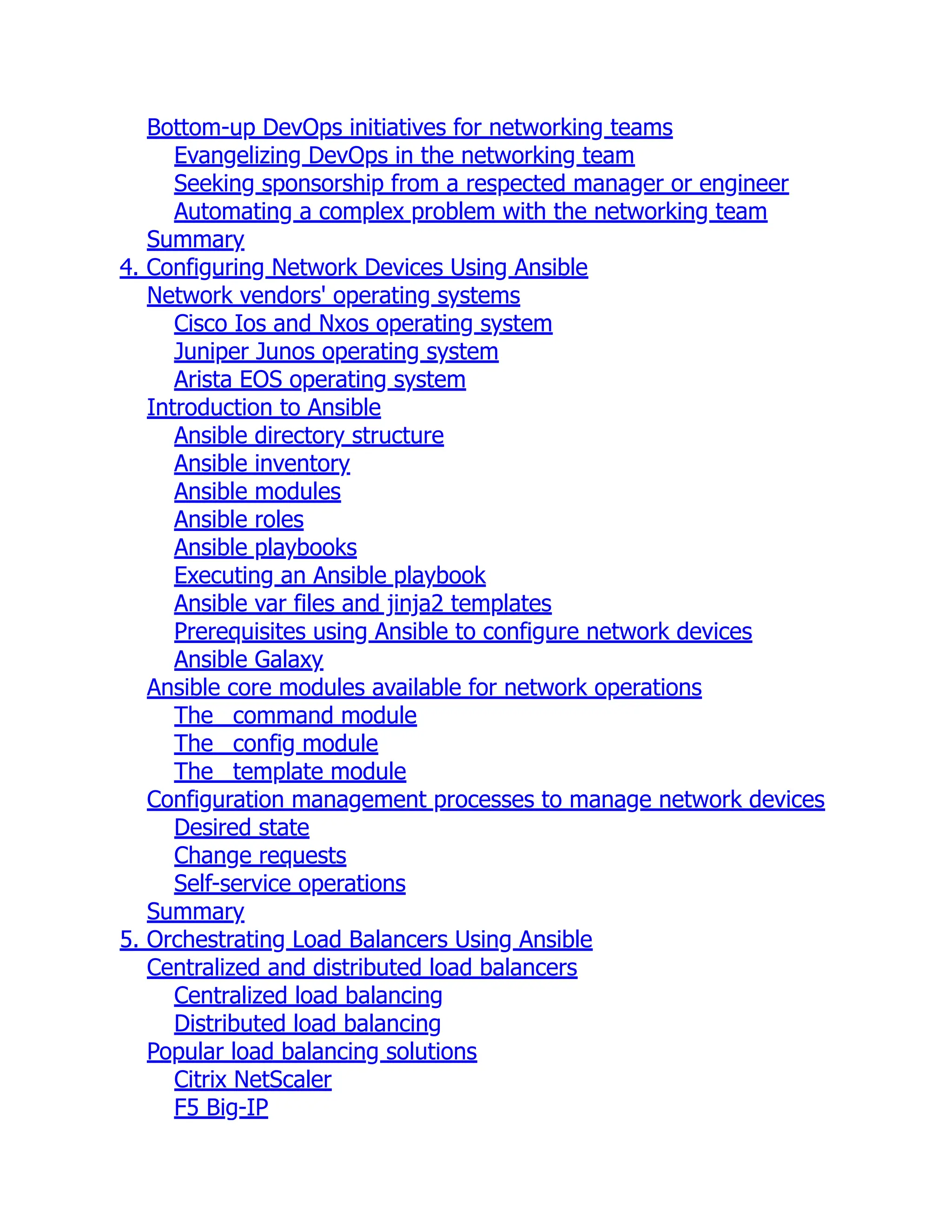
Bottom-up DevOps initiatives for networking teams
Evangelizing DevOps in the networking team
Seeking sponsorship from a respected manager or engineer
Automating a complex problem with the networking team
Summary
4. Configuring Network Devices Using Ansible
Network vendors' operating systems
Cisco Ios and Nxos operating system
Juniper Junos operating system
Arista EOS operating system
Introduction to Ansible
Ansible directory structure
Ansible inventory
Ansible modules
Ansible roles
Ansible playbooks
Executing an Ansible playbook
Ansible var files and jinja2 templates
Prerequisites using Ansible to configure network devices
Ansible Galaxy
Ansible core modules available for network operations
The _command module
The _config module
The _template module
Configuration management processes to manage network devices
Desired state
Change requests
Self-service operations
Summary
5. Orchestrating Load Balancers Using Ansible
Centralized and distributed load balancers
Centralized load balancing
Distributed load balancing
Popular load balancing solutions
Citrix NetScaler
F5 Big-IP
Avi Networks
Nginx
HAProxy
Load balancing immutable and static infrastructure
Static and immutable servers
Blue/green deployments
Using Ansible to Orchestrate load balancers
Delegation
Utilizing serial to control roll percentages
Dynamic inventories
Tagging metadata
Jinja2 filters
Creating Ansible networking modules
Summary
6. Orchestrating SDN Controllers Using Ansible
Arguments against software-defined networking
Added network complexity
Lack of software-defined networking skills
Stateful firewalling to support regularity requirements
Why would organizations need software-defined networking?
Software-defined networking adds agility and precision
A good understanding of Continuous Delivery is key
Simplifying complex networks
Splitting up network operations
New responsibilities in API-driven networking
Overlay architecture setup
Self-service networking
Immutable networking
A/B immutable networking
The clean-up of redundant firewall rules
Application decommissioning
Using Ansible to orchestrate SDN controllers
Using SDN for disaster recovery
Storing A/B subnets and ACL rules in YAML files
Summary
7. Using Continuous Integration Builds for Network Configuration
Continuous integration overview
Developer continuous integration
Database continuous integration
Tooling available for continuous integration
Source control management systems
Centralized SCM systems
Distributed SCM systems
Branching strategies
Continuous integration build servers
Network continuous integration
Network validation engines
Simple continuous integration builds for network devices
Configuring a simple Jenkins network CI build
Adding validations to network continuous integration builds
Continuous integration for network devices
Continuous integration builds for network orchestration
Summary
8. Testing Network Changes
Testing overview
Unit testing
Component testing
Integration testing
System testing
Performance testing
User acceptance testing
Why is testing relevant to network teams?
Network changes and testing today
Quality assurance best practices
Creating testing feedback loops
Continuous integration testing
Gated builds on branches
Applying quality assurance best practices to networking
Assigning network testing to quality gates
Available test tools
Unit testing tools
Test Kitchen example using OpenStack
Network checklist
Network user journey
Quality of Service
Failover testing
Network code quality tooling
Summary
9. Using Continuous Delivery Pipelines to Deploy Network Changes
Continuous integration package management
Continuous Delivery and deployment overview
Deployment methodologies
Pull model
Push model
When to choose pull or push
Packaging deployment artifacts
Deployment pipeline tooling
Artifact repositories
Artifactory
CD pipeline scheduler
Jenkins
Deploying network changes with deployment pipelines
Network self-service
Steps in a deployment pipeline
Incorporating configuration management tooling
Network teams' role in Continuous Delivery pipelines
Failing fast and feedback loops
Summary
10. The Impact of Containers on Networking
Overview of containers
Solaris Zones
Linux namespaces
Linux control groups
Benefits of containers
Deploying containers
CoreOS
etcd
Docker
Docker registry
Docker daemon
Packaging containers
Dockerfile
Packer-Docker integration
Docker workflow
Default Docker networking
Docker user-defined bridge network
Docker Swarm
Docker machine
Docker Compose
Swarm architecture
Kubernetes
Kubernetes architecture
Kubernetes master node
Kubernetes worker node
Kubernetes kubectl
Kubernetes SDN integration
Impact of containers on networking
Summary
11. Securing the Network
The evolution of network security and debunking myths
Account management
Network device configuration
Firewalling
Vulnerability detection
Network segmentation
Securing a software-defined network
Attacks at Overlay
Attacks on the underlay network?
Attacks on the SDN controller
Network security and Continuous Delivery
Application connectivity topology
Wrapping security checks into continuous integration
Using Cloud metadata
Summary
Index
DevOps for Networking
Copyright © 2016 Packt Publishing
All rights reserved. No part of this book may be reproduced, stored
in a retrieval system, or transmitted in any form or by any means,
without the prior written permission of the publisher, except in the
case of brief quotations embedded in critical articles or reviews.
Every effort has been made in the preparation of this book to ensure
the accuracy of the information presented. However, the information
contained in this book is sold without warranty, either express or
implied. Neither the author nor Packt Publishing, and its dealers and
distributors will be held liable for any damages caused or alleged to
be caused directly or indirectly by this book.
Packt Publishing has endeavored to provide trademark information
about all of the companies and products mentioned in this book by
the appropriate use of capitals. However, Packt Publishing cannot
guarantee the accuracy of this information.
First published: October 2016
Production reference: 1261016
Published by Packt Publishing Ltd.
Livery Place
35 Livery Street
Birmingham B3 2PB, UK.
ISBN 978-1-78646-485-9
www.packtpub.com
Credits
Author
Steven Armstrong
Reviewer
Daniel Jonathan Valik
Commissioning Editor
Pratik Shah
Acquisition Editor
Namrata Patil
Content Development Editor
Abhishek Jadhav
Technical Editor
Mohd Riyan Khan
Copy Editor
Dipti Mankame
Project Coordinator
Judie Jose
Proofreader
Safis Editing
Indexer
Pratik Shirodkar
Graphics
Kirk D'Penha
Production Coordinator
Shantanu N. Zagade
Cover Work
Shantanu N. Zagade
About the Author
Steven Armstrong is a DevOps solution architect, a process
automation specialist, and an honors graduate in Computer and
Electronic Systems (BEng) from Strathclyde University in Glasgow.
He has a proven track record of streamlining company's
development architecture and processes so that they can deliver
software at pace. Specializing in agile, continuous integration,
infrastructure as code, networking as code, Continuous Delivery, and
deployment, he has worked for 10 years for leading consulting,
financial services, benefits and gambling companies in the IT sector
to date.
After graduating, Steven started his career at Accenture Technology
solutions as part of the Development Control Services graduate
scheme, where he worked for 4 years, then as a configuration
management architect helping Accenture's clients automate their
build and deployment processes for Siebel, SAP, WebSphere,
Weblogic, and Oracle B2B applications.
During his time at Accenture, he worked within the development
control services group working for clients, such as the Norwegian
Government, EDF Energy, Bord Gais, and SABMiller. The EDF Energy
implementation led by Steven won awards for “best project
industrialization” and “best use of Accenture shared services”.
After leaving Accenture, Steven moved on to the financial services
company, Cofunds, where he spent 2 years creating continuous
integration and Continuous Delivery processes for .Net applications
and Microsoft SQL databases to help deploy the financial services
platform.
After leaving Cofunds, Steven moved on to Thomsons Online
Benefits, where he helped create a new DevOps function for the
company. Steven also played an integral part in architecting a new
private cloud solution to support Thomsons Online Benefits
production applications and set up a Continuous Delivery process
that allowed the Darwin benefits software to be deployed to the new
private cloud platform within minutes.
Steven currently works as the technical lead for Paddy Power
Betfair's i2 project, where he has led a team to create a new
greenfield private cloud platform for Paddy Power Betfair. The
implementation is based on OpenStack and Nuage VSP for software-
defined networking, and the platform was set up to support
Continuous Delivery of all Paddy Power Betfair applications. The i2
project implementation was a finalist for the OpenStack Super User
Award and won a RedHat Innovation Award for Modernization.
Steven is an avid speaker at public events and has spoken at
technology events across the world, such as DevSecCon London,
OpenStack Meetup in Cluj, the OpenStack Summit in Austin, HP
Discover London, and most recently gave a keynote at OpenStack
Days Bristol.
Acknowledgments
I would most importantly like to thank my girlfriend Georgina Mason.
I know I haven't been able to leave the house much at weekends for
3 months as I have been writing this book, so I know it couldn't
have been much fun. But thank you for your patience and support,
as well as all the tea and coffee you made for me to keep me awake
during the late nights. Thank you for being an awesome girlfriend.
I would like to thank my parents, June and Martin, for always being
there and keeping me on track when I was younger. I would
probably have never got through university never mind written a
book if it wasn't for your constant encouragement, so hopefully, you
both know how much I appreciate everything you have done for me
over the years.
I would like to thank Paddy Power Betfair for allowing me the
opportunity to write this book and our CTO Paul Cutter to allow our
team to create the i2 project solution and talk to the technology
community about what we have achieved.
I would also like to thank Richard Haigh, my manager, for
encouraging me to take on the book and all his support in my career
since we started working together at Thomsons Online Benefits.
I would like to thank my team, the delivery enablement team at
Paddy Power Betfair, for continually pushing the boundaries of what
is possible with our solutions. You are the people who made the
company a great innovative place to work.
I would like to thank all the great people I worked with throughout
my career at Paddy Power Betfair, Thomsons Online Benefits,
Cofunds, and Accenture, as without the opportunities I was given, I
wouldn't have been able to pull in information from all those
experiences to write this book.
I would also like to thank Nuage networks for permitting me to write
about their software-defined networking solution in this book.
About the Reviewer
Daniel Jonathan Valik is an industry expert in cloud services,
cloud native technologies, IOT, DevOps, infrastructure automation,
containerization, virtualization, microservices, unified
communications, collaborations technologies, Hosted PBX,
telecommunications, WebRTC, unified messaging, Communications
Enabled Business Process (CEBP) design, and Contact Center
Technologies.
He has worked in several disciplines such as product management,
product marketing, program management, evangelist, and strategic
adviser for almost two decades in the industry.
He has lived and worked in Europe, South East Asia, and now in the
US. Daniel is also an author of several books about cloud services,
universal communications and collaborations technologies, which
includes Microsoft, Cisco, Google, Avaya, and others.
He holds dual master’s degrees: Master of Business Administration
(MBA) and Master of Advanced Studies (MAS) in general business.
He also has a number of technical certifications, including Microsoft
Certified Trainer (MCT). For more information about Daniel, refer to
his blogs, videos, and profile on LinkedIn
(https://www.linkedin.com/in/danielvalik).
www.PacktPub.com
eBooks, discount offers, and
more
Did you know that Packt offers eBook versions of every book
published, with PDF and ePub files available? You can upgrade to the
eBook version at www.PacktPub.com and as a print book customer,
you are entitled to a discount on the eBook copy. Get in touch with
us at <customercare@packtpub.com> for more details.
At www.PacktPub.com, you can also read a collection of free
technical articles, sign up for a range of free newsletters and receive
exclusive discounts and offers on Packt books and eBooks.
https://www.packtpub.com/mapt
Do you need instant solutions to your IT questions? PacktLib is
Packt's online digital book library. Here, you can search, access, and
read Packt's entire library of books.
Why subscribe?
Fully searchable across every book published by Packt
Copy and paste, print, and bookmark content
On demand and accessible via a web browser
Preface
The title of this book is "DevOps For Networking". DevOps, as you
are probably well-aware, is an abbreviated amalgamation of
"Development" and "Operations", so why does it have any
significance to networking? It is true that there is no "Net" in the
DevOps name, though it is fair to say that the remit of DevOps has
extended well beyond its initial goal.
The initial DevOps movement sought to remove the "chucking it over
the fence" and reactive mentality that existed between development
and operations teams, but DevOps can be efficiently used to
promote collaboration between all teams in IT, not just Development
and Operations staff.
DevOps, as a concept, initially aimed to solve the scenario where
developers would develop code, make significant architectural
changes, and not consider the Operations team that needed to
deploy the code to production. So when the time came for the
operations team to deploy the developers' code changes to
production, this would result in a broken deployment, meaning
crucial software fixes or new products would not reach customers as
planned, and the deployment process would typically take days or
weeks to fix.
This led to frustration to all the teams involved, as developers would
have to stop coding new features and instead would have to help
operations staff fix the deployment process. Operations teams would
also be frustrated, as often they would not have been told that
infrastructure changes were required to deploy the new release to
production. As a result, the operations team did not have the idea to
adequately prepare the production environment to support the
architectural changes.
This common IT scenario highlights the broken process and
operational model that would happen continually and cause friction
between development and operations teams.
"DevOps" was an initiative setup to foster an environment of
collaboration and communication between these previously
conflicting teams. It promotes teams to speak daily, making each
other aware of changes and consequently preventing avoidable
situations from happening. So, it just so happens that development
and operations staff were the first set of silos that DevOps aimed to
solve. Consequently, it branded DevOps as a way to unify the teams
to work, as one consolidated fluid function, but it could easily have
been called something else.
DevOps aims to create better working relationships between teams
and a happier working environment, as frankly nobody enjoys
conflict or firefighting preventable issues on a daily basis. It also
aims to share knowledge between teams to prevent the
development teams being viewed as "ignorant to infrastructure" and
operations teams to be "blockers to changes" and "slowing down
devs". These are the common misconceptions that teams working in
silos have of one another when they don't take the time to
understand each other's goals.
DevOps strives to build an office environment where teams
appreciate other teams and their aims, and they are respectful of
their common goals. DevOps is undoubtedly one most talked about
topics in the IT industry today. It is not a coincidence that its
popularity has risen with the emergence of agile software
development, as an alternative to using the more traditional
waterfall approach.
Waterfall development and the "V-Model" encompass the separate
phases of analysis, design, implementation (coding), and testing.
These phases are split up traditionally into different isolated teams,
with formalized project hand-off dates that are set in stone.
Agile was born out of the realization that in the fast-paced software
industry, long running projects were suboptimal and not the best
way of delivering real value to customers. As a result, agile has
moved projects to shorter iteration cycles that incorporated analysis,
design, implementation, and testing into two-week cycles (sprints)
and aimed at using a prototyping approach instead.
The prototyping approach uses the notion of incremental
development, which has allowed companies to gather feedback on
products earlier in the release cycle, rather than utilizing a big bang
approach that delivered the full solution in one big chunk at the end
of the implementation phase.
Delivering projects in a waterfall fashion at the end of the waterfall
implementation stage ran the risk of delivering products that
customers did not want or where developers had misinterpreted
requirements. These issues were typically only discovered in the final
test phase when the project was ready to be taken to market. This
often resulted in projects being deemed a failure or resulting in huge
delays, whereas costly rework and change requests could be
actioned.
Agile software development for the best part has fostered the need
to collapse down those team silos that were typically associated with
waterfall software development, and this strengthened the need for
daily collaboration.
With the introduction of agile software development, it also has
changed the way software testing is carried out too, with the same
DevOps principles also being applied to testing functions.
Quality assurance test teams can no longer afford to be reactive
either, much like operations teams before them. So, this promoted
the need for test teams to work more efficiently and not delay
products reaching market. This, however, could not be done at the
expense of the product, so they needed to find a way to make sure
applications are tested adequately and pass all quality assurance
checks while working in a smarter way.
It was readily accepted that quality assurance test teams can no
longer operate in silos separate from development teams; instead,
agile software development has promoted test cases being written in
parallel to the software development, so they are not a separate
activity. This is in stark contrast to code being deployed into a test
environment and left to a team of testers to execute manual tests or
run a set of test packs where they deal with issues reactively.
Agile has promoted developers and quality assurance testers to
instead work together in scrum teams on a daily basis to test
software before it is packaged for deployment, with those same tests
then being maintained and kept up to date and used to seed the
regression test packs.
This has been used to mitigate the friction caused by developers
checking in code changes that break quality assurance test team's
regression packs. With siloed test teams, a common scenario that
would often cause friction is be that a graphical user interface (GUI)
would suddenly be changed by a developer, resulting in a portion of
regression tests breaking. This change would be done without
notifying the test team. The tests would be failing because they
were written for an old GUI and were suddenly outdated, as
opposed to breaking because developers had actually introduced a
software failure or a bug.
This reactive approach to testing did not build confidence in the
validity of the test failures reported by automated test packs as they
are not always conclusively down to a software failure, and this
introduced unnecessary delays due to suboptimal IT structure.
Instead if the communication between development and test teams
had been better, using the principles promoted by DevOps, then
these delays and suboptimal ways of working can be avoided.
More recently, we have seen the emergence of DevSecOps that have
looked at integrating security and compliance into the software
delivery process, as opposed to being bolted on manual actions and
separate reactive initiatives. DevSecOps has looked at using DevOps
and agile philosophies and embraced the idea of embedding security
engineers in scrum teams to make sure that security requirements
are met at the point of inception.
This means that security and compliance can be integrated as
automated phases in Continuous Delivery pipelines, to run security
compliance checks on every software release, and not slow down
the software development lifecycle for developers and generate the
necessary feedback loops.
So networking teams can learn from DevOps methodologies too
much like development, operations, quality assurance, and security
teams. These teams have utilized agile processes to improve their
interaction with the software development process and benefit from
using feedback loops.
How many times have network engineers had no choice but to delay
a software release, as network changes need to be implemented and
have been done so inefficiently using ticket-based systems that are
not aligned with the processes other departments use? How many
times have manually implemented network changes broken
production services? This isn't a criticism of network teams or the
ability of network engineers; it's the realization that the operational
model needs to change and they can.
What this book covers
This book will look at how networking changes can be made more
efficient so as not to slow down the software development lifecycle.
It will help outline strategies network engineers can adopt to
automate network operations. We will focus on setting up network
teams to succeed in an automation-driven environment, enabling the
teams to work in a more collaborative fashion, and improve
efficiency.
It will also show that network teams need to build new skills and
learn configuration management tools such as Ansible to help them
achieve this goal. The book will show the advantages that these
tools bring, using the network modules they provide, and that they
will help make automation easy and act as a self-starter guide.
We will focus on some of the cultural challenges that need to be
overcome to influence and implement automation processes for
network functions and convince network teams to make the most of
networking APIs that are now provided by vendors can be trusted.
The book will discuss public and private clouds such as AWS and
OpenStack, and ways they are used to provide networking to users.
It will also discuss the emergence of software-defined networking
solutions, such as Juniper Contrail, VMWare NSX, CISCO ACI, and
focus on the Nokia Nuage VSP solution, which aims to make
networking functions a self-service commodity.
The book will also highlight how continuous integration and delivery
processes and deployment pipelines can be applied to govern
network changes. It will also show ways that unit testing can be
applied to automated network changes to integrate them with the
software delivery lifecycle.
A detailed chapter overview for the book is detailed below:
Chapter 1, The Impact of Cloud on Networking, will discuss ways in
which the emergence of AWS for public cloud and OpenStack for
private cloud have changed the way developers want to consume
networking. It will look at some of the networking services AWS and
OpenStack provide out of the box and look at some of the
networking features they provide. It will show examples of how
these cloud platforms have made networking a commodity much like
infrastructure.
Chapter 2, The Emergence of Software-defined Networking, will
discuss how software-defined networking has emerged. It will look
at the methodology and focus on some of the scaling benefits and
features this provides over and above the out-of-the-box experience
from AWS and OpenStack. It will illustrate how one of the market-
leading SDN solutions, Nuage, applies these concepts and principles
and discusses other SDN solutions on the market.
Chapter 3, Bringing DevOps to Network Operations, will detail the
pros and cons of a top-down and bottom-up DevOps initiatives with
regards to networking. It will give readers food for thought on some
of the strategies that have been a success and which ones have
typically failed. This chapter will help CTOs, senior managers, and
engineers who are trying to initiate a DevOps model in their
company's network department and outline some of the different
strategies they could use to achieve the cultural changes they desire.
Chapter 4, Configuring Network Devices Using Ansible, will outline
the benefits of using configuration management tools to install and
push configuration to network devices and discuss some of the open
source network modules available to do this at the moment and how
they work. It will give some examples of process flows that could be
adopted to maintain device configuration.
Chapter 5, Orchestrating Load Balancers Using Ansible, will describe
the benefits of using Ansible to orchestrate load balancers and the
approaches to roll new software releases into service without the
Exploring the Variety of Random
Documents with Different Content
blow of a bludgeon, but the same resistance which arrests the advance of
the one must retard and finally arrest that of the other, if sufficiently
extended. Within the limits of a space in which Professor Stewart conceives
that the first rays of light which ever flashed forth at the dawn of creation,
in the primal æons of the universe, are still to this day, along their original
lines of radiation, “traversing space at the rate of one hundred and eighty-
eight thousand miles per second,” there must certainly be room enough and
absorption enough (which even a few yards of mist will supply) to curb
these runaway steeds somewhere along their lines of flaming passage. At
that very point they are at work acting upon the molecules of the attenuated
vapors of space, and assisting to re-establish the potential energy which has
there been converted, into another form of force by the planetary rotations
of the solar systems of those distant regions. By the law of the diffusion of
gases, and that of the diffusion or transference of heat-energy from
molecule to molecule, the vast realms of interstellar space must tend to be
all brought into approximate uniformity of tensions, and the force
abstracted at those points of space occupied by the relatively few and
insignificant solar systems will be returned, not directly at the identical
places where such solar systems may exist, but at every part of space to
which their radiant energy extends. As we give from our own supplies to
other systems for their support, so they, in turn, give back again to us. It is
said that in the earliest days of creation the stars sang together; they still
sing together, planets and suns, as
“Jura answers from her misty shroud
Back to the joyous Alps, who call to her aloud.”
When old Earth lifts his brimming beaker from the great crystal sea and
drains it to the good health of all the stars of heaven, they each respond with
fiery energy, and by their merry twinkle we may know how highly they
appreciate the toast. We are all one family,—but what a family! Comets,
planets, double stars, variable stars, stars of complementary colors, blue,
yellow, orange, and red stars, stars which blaze up in sudden conflagration,
apparently new stars, nebulæ half star and half vapor, nebulæ all vapor and
others all stars, the vast milky-way like a wondrous river of hundreds of
millions of solar systems, the insulated stars scattered through space like
watchmen on the distant hills beyond the city walls, streams of stars, stars
which are parting from each other in space like scattering families, and
those which travel together in groups like pioneers in a strange country,—
all these and doubtless other unknown types and forms compose this
sidereal family. Will they fall into their categories as lawful subjects, so as
to be properly classified in a single scheme of the visible order of creation,
or shall we fail to interpret their apparent mysteries when we apply the
same principles which have been successfully applied to the phenomena of
our own solar system? Let us see.
In examining the sun, we find that a beam of its light passed through a
prism is thrown upon the wall in a wedge-shaped streak of rainbow-tinted
colors. Fraunhofer, many years ago, found that this spectrum was crossed at
irregular intervals by a series of dark lines, of variable width and distance
apart, of which he catalogued more than five hundred. These lines were
subsequently found to correspond in the aggregate, in their position in the
spectrum, with a series of bright lines of different colors which formed the
separate spectra of various metals when burned, in vapor or powder, in the
flame of an alcohol lamp. Each of these transverse lines was found to have
a fixed and invariable position in the extended scale of the spectrum, and
scarcely any lines of the different elements are alike; so that, when the
spectrum is properly magnified under telescopic observation and the lines
identified, we have the means of determining the presence or absence of
such elements in the vaporous constitution of any incandescent body by
examination of its spectrum. In this way many of our terrestrial elements
are found to exist in the sun,—so many, in fact, that we know that the sun’s
nucleus, or core, must be composed substantially of the same elements, the
same sort of matter, as exists on earth,—that we are, in fact, “a chip of the
old block.” But it was found—and this is the real basis of spectrum analysis
—that if a certain metal or other element be burned in the flame of an
alcohol lamp, and a more brilliant flame of the same metal or element
burned in another lamp be observed through the first flame, it will be seen
that, “while the general illumination of the spectrum is increased, the
previous bright lines characterizing the element are now replaced by dark
lines or lines relatively very faint; in a word, the spectrum characteristic of
the given element is exactly reversed” (Appleton’s Cyclopædia, article
“Spectrum Analysis”). We have referred to this fact above in considering
the origin of sun-spots, showing that they are due to increased heat acting
upon the core of the sun so as to volatilize an abnormally large proportion
of the elements usually in a more condensed state upon the surface of the
solar body beneath its hydrogen envelope. These vapors, thus raised in
temperature, are driven upward by their volatilization into the incandescent
atmosphere of hydrogen, and the vaporous matters in the higher strata thus
produce the characteristic absorption bands of these elements, while the
overheated vapors, by a vast uprush from beneath, hurl aside the more
highly heated hydrogen above to appear as faculæ around the sun-spot, the
cooler upper layers of hydrogen following downward the subsiding
vaporous metallic uprush as it sinks back beneath the photospheric level.
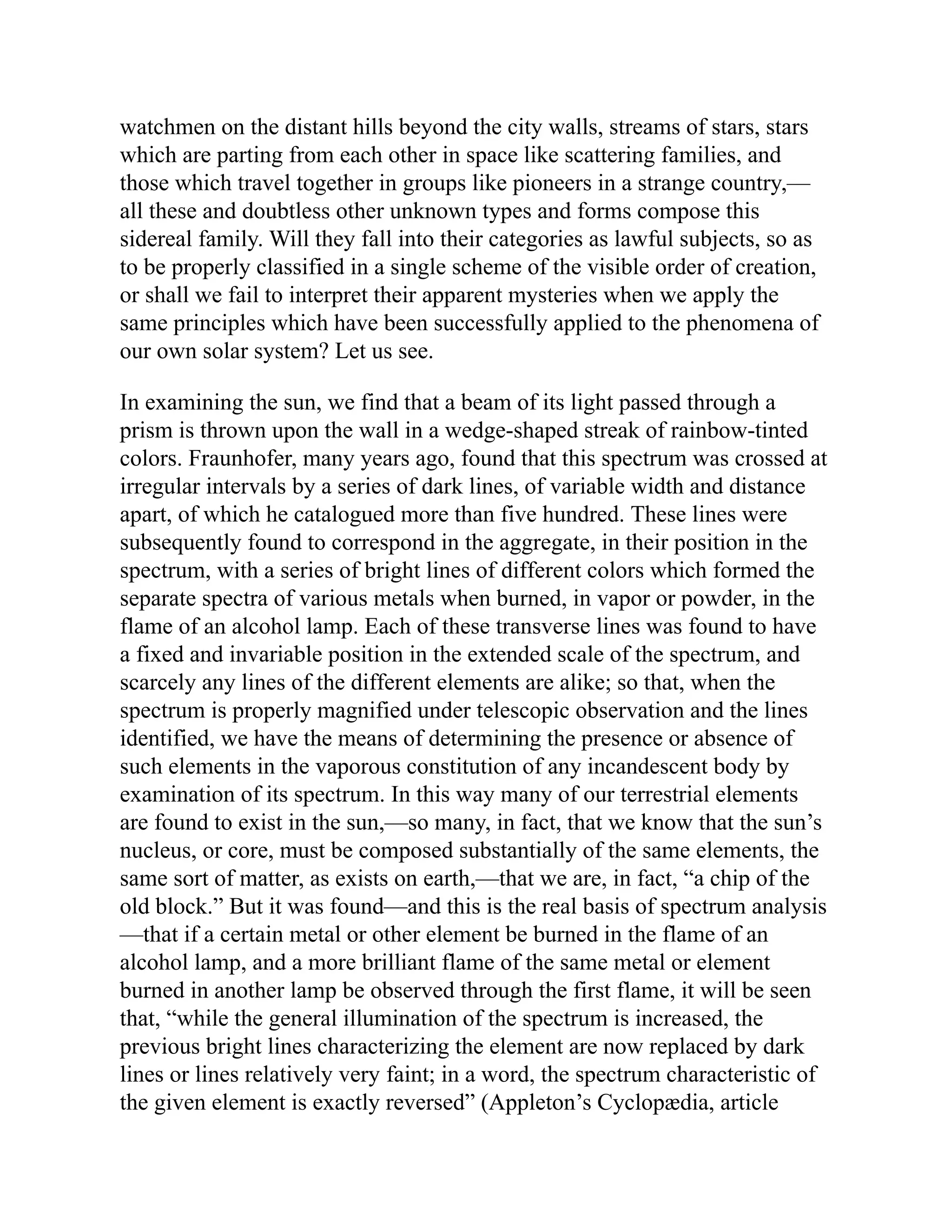
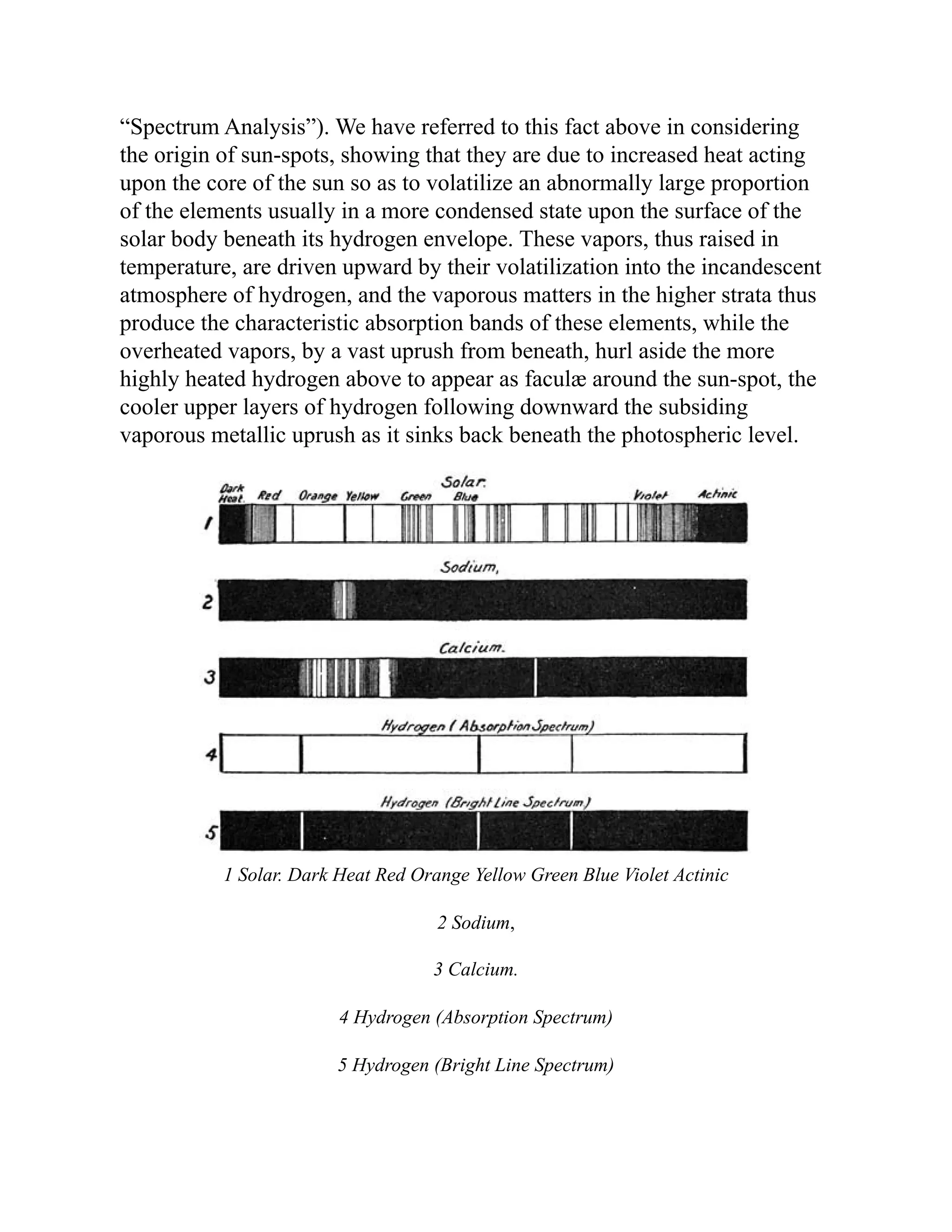
1 Solar. Dark Heat Red Orange Yellow Green Blue Violet Actinic
2 Sodium,
3 Calcium.
4 Hydrogen (Absorption Spectrum)
5 Hydrogen (Bright Line Spectrum)
Spectra of different elements compared with the solar spectrum, and
showing reversal of hydrogen lines under special circumstances.
It is obvious that by similar spectrum analysis we may determine to a large
extent the constitution of the fixed stars and other self-luminous bodies of
space and interpret the phenomena which they exhibit. We quote the
following from the previously cited article in Appleton’s Cyclopædia, by
Professor Proctor: “Spectroscopic analysis applied to the stars has shown
that they resemble the sun in general constitution and condition. But
characteristic differences exist, insomuch that the stars have been divided
into four orders distinguished by their spectra. These are thus presented by
Secchi, who examined more than five hundred star spectra: The first type is
represented by Alpha Lyræ, Sirius, etc., and includes most of the stars
shining with a white light, as Altair, Regulus, Rigel, the stars Beta, Gamma,
Epsilon, Zeta, and Eta of Ursa Major, etc. These give a spectrum showing
all the seven colors, and crossed usually by many lines, but always by the
four lines of hydrogen, very dark and strong. The breadth of these four lines
indicates a very deep, absorptive stratum at a high temperature and at great
pressure. Nearly half the stars observed by Secchi [more than two hundred
out of five hundred] showed this spectrum. The second type includes most
of the yellow stars, as Capella, Pollux, Arcturus, Aldebaran, Alpha of Ursa
Major, Procyon, etc. The Fraunhofer lines are well seen in the red and blue,
but not so well in the yellow. The resemblance of this spectrum to the sun
suggests that stars of this type resemble the sun closely in physical
constitution and condition. About one-third of the stars observed by Secchi
[more than one hundred and fifty out of five hundred] showed this
spectrum. The third type includes Antares, Alpha of Orion, and Alpha of
Hercules, Beta of Pegasus, Mira, and most of the stars shining with a red
light. The spectra show bands of lines; according to Secchi, there are shaded
bands, but a more powerful spectroscope shows multitudes of fine lines.
The spectra resemble somewhat the spectrum of a sun-spot, and Secchi has
advanced the theory that these stars are covered in great part by spots like
those of the sun. About one hundred [out of five hundred] of the observed
stars belong to this type.” (It should be noted that the presence of sun-spots
is no evidence of diminished heat in a sun; see Professor Proctor in his
“Myths and Marvels of Astronomy,” article “Suns in Flames:” “It may be
noticed, in passing, that it is by no means certain that the time when the sun
is most spotted is the time when he gives out least light…. All the evidence
we have tends to show that when the sun is most spotted his energies are
most active. It is then that the colored flames leap to their greatest height
and show their greatest brilliancy, then also that they show the most rapid
and remarkable changes of shape.”) … “The fourth type differs from the
preceding in the arrangement and appearance of the bands. It includes only
faint stars. A few stars, as Gamma of Cassiopeia, Eta of Argus, Beta of
Lyra, etc., show the lines of hydrogen bright instead of dark, as though
surrounded by hydrogen glowing with a heat more intense than that of the
central orb itself around which the hydrogen exists.”
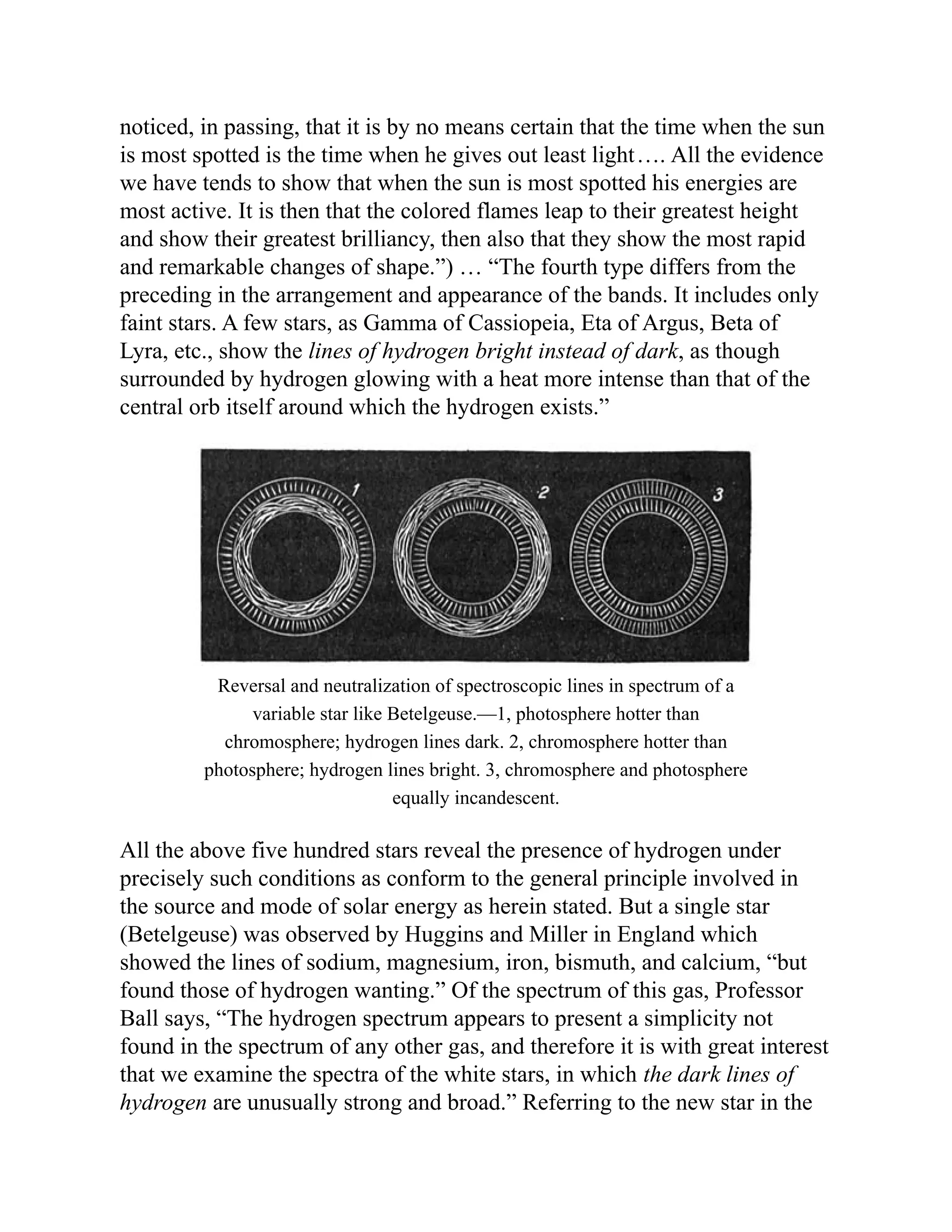
Reversal and neutralization of spectroscopic lines in spectrum of a
variable star like Betelgeuse.—1, photosphere hotter than
chromosphere; hydrogen lines dark. 2, chromosphere hotter than
photosphere; hydrogen lines bright. 3, chromosphere and photosphere
equally incandescent.
All the above five hundred stars reveal the presence of hydrogen under
precisely such conditions as conform to the general principle involved in
the source and mode of solar energy as herein stated. But a single star
(Betelgeuse) was observed by Huggins and Miller in England which
showed the lines of sodium, magnesium, iron, bismuth, and calcium, “but
found those of hydrogen wanting.” Of the spectrum of this gas, Professor
Ball says, “The hydrogen spectrum appears to present a simplicity not
found in the spectrum of any other gas, and therefore it is with great interest
that we examine the spectra of the white stars, in which the dark lines of
hydrogen are unusually strong and broad.” Referring to the new star in the
Northern Crown, which burst forth in 1866, the same writer says, “The
feature which made the spectrum of the new star essentially distinct from
that of any other star that had been previously observed was the presence of
certain bright lines superposed on a spectrum with dark lines of one of the
ordinary types. The position of certain of these lines showed that one of the
luminous gases must be hydrogen.” Of this particular star (Betelgeuse) it is
said (Proctor’s “Familiar Essays”), “Red stars and variable stars affect the
neighborhood of the Milky Way or of well-marked star-streams. The
constellation Orion is singularly rich in objects of this class. It is here that
the strange ‘variable’ Betelgeuse lies. At present this star shows no sign of
variation, but a few years ago it exhibited remarkable changes.” We thus see
that Betelgeuse is a variable star, and it must have passed in its different
variations between the limits of extreme brilliancy, in which the lines of
hydrogen appear bright, and that of a less brilliant stage, in which they
appear dark,—that is, as absorption bands. It has thus, in fact, run the
gamut, so to speak, of color changes, and now occupies an intermediate
position in the scale. In his article “Star unto Star,” the same writer says,
“On this view we may fairly assume that the darkness of the hydrogen lines
is a characteristic of stars at a much higher temperature than our sun and
suns of the same class.” We have already seen that the spectra of stars of the
fourth type—Appleton’s Cyclopædia, “Spectrum Analysis”—“show the
lines of hydrogen bright instead of dark, as though surrounded by hydrogen
glowing with a heat more intense than that of the central orb itself.”
Professor Dunkin says, in his work “The Midnight Sky,” “One of the
conclusions drawn by Kirchhoff from these experiments is that each
incandescent gas weakens, by absorption, rays of the same degree of
refrangibility as those it emits; or, in other words, that the spectrum of each
incandescent gas is reversed when this gas is traversed by rays of the same
refrangibility emanating from an intensely luminous source which gives of
itself a continuous spectrum like that of the sun.” … “The third division,
including Betelgeuse, Antares, Alpha Herculis, and others of like color,
seems to be affected by something peculiar in their physical composition, as
if their photospheres contained a quantity of gas at a lower temperature
than usual. The stars in this class have generally a ruddy tint, probably
owing to their light having undergone some modification while passing
through an absorbing atmosphere…. A great number of the stars in the third
division are variable in their lustre.” We may therefore readily conclude that
midway between the inverted lines which constitute the dark absorption
bands and the faint spectra which show the bright lines of hydrogen direct
there must be an atmosphere of glowing hydrogen superposed upon a
deeper one in such proportion that it will not reveal its presence in the
spectroscope at all; for when the dark and light bands, which occupy
precisely the same position in the spectrum, are of approximately equal
intensity the result will obviously be the neutralization of both. That among
a myriad suns, some with dark hydrogen lines and some with bright, there
should occur occasionally an example corresponding to this point of
divergence, and especially among variable stars, is not only to be expected,
but is, in fact, confirmatory of the general hypothesis itself. It is an
exception which emphatically proves the rule, when we can trace the
operative cause which has produced it.
CHAPTER VI.
THE PHENOMENA OF THE STARS.
Let us now consider the phenomena of the double stars. These were
formerly believed to be single orbs, but the more powerful telescopes of
recent years have shown them to consist of two suns, each substantially
similar to our own sun, revolving around each other at a relatively small
distance apart. In Appleton’s Cyclopædia, article “Star,” we read, “It is
noteworthy that few simple stars show such colors as blue, green, violet, or
indigo; but among double and multiple star systems not only are these
colors recognized, but such colors as lilac, olive, gray, russet, and so on. A
beautiful feature in many double stars remains to be noticed: it is often
found that the components exhibit complementary colors. This is oftener
seen among unequal doubles, and then the larger component shows a color
from the red end of the spectrum, as red, orange, or yellow, while the
smaller shows the corresponding color from the blue end, as green, blue, or
purple. The colors are real, not merely the result of contrast, for when the
larger star is concealed the color of the smaller remains (in most cases)
unchanged. Spectrum analysis shows that the colors of many double stars
are due to the absorptive vapors cutting off certain portions of the light….
The components are circling around each other, or rather around their
common center of gravity.” Professor Ball, in his work “In the High
Heavens,” says, “There is no more pleasing phenomenon in sidereal
astronomy than that presented by the contrasted hues often exhibited by
double stars…. It seemed not at all impossible that there might be some
optical explanation of colors so vividly contrasted emanating from points so
contiguous. It was also remembered that blue stars were generally only
present as one member of an associated pair…. When, however, Dr.
Huggins showed that the actual spectrum of the object demonstrated that
the cause of the color in each star arose from absorption by its peculiar
atmosphere, it became impossible to doubt the reality of the phenomena.
Since then it has been for physicists to explain why two closely neighboring
stars should differ so widely in their atmospheric constituents, for it can be
no longer contended that their beautiful hues arise from an optical illusion.”
Reduced from Plate X. of Nichol’s work. For
interpretation see Chapter XIII., “The Genesis of
Solar Systems.”
Of these double stars with complementary colors we quote the following
from Professor Dunkin (who, in turn, quotes from Admiral Smyth, the
author of “Sidereal Chromatics”): “In Eta Cassiopeiæ the large star is a dull
white and the smaller one lilac; in Gamma Andromedæ, a deep yellow and
sea-green; in Iota Cancri, a dusky orange and a sapphire blue; in Delta
Corvi, a bright yellow and purple; and in Albiero, or Beta Cygni, yellow
and blue. In most of the remaining stars of the list the contrasting colors are
equally marked, and also in many others which are not included in it.”
Some of these double stars are variable in their colors, as are the ordinary
single variables, and, of course, for a similar reason,—to wit, the varying
intensity of more or less cumulative planetary impacts.
The interpretation, of course, as
explained below, is that these
suns, each one of different mass
and consequently of different
electrical resistance, are arranged
in parallel circuit along a single
line of electric current; a pair of
different-sized arc or
incandescent lamps, similarly
arranged, would exhibit precisely
the same phenomena. A
compound solar system of this
sort, apparently, with double sun
and single planetary system in
process of formation, nearly
completed from a spiral nebula, is
shown in a gaseous nebula within
the constellation Ursa Minor,
illustrated in Lord Rosse’s
drawing (see Nichols “Architecture of the Heavens,” Plate X., lower
figure).
More than three thousand of these binary stars have been catalogued, and
some of them make a complete revolution about their common centers of
gravity—so distant are they from each other—in periods of not less than
sixty, or even eighty, years. Of the double star Mizar,—the middle one of
the three which form the tail of the Great Bear,—Professor Ball states that,
by new methods of spectroscopic analysis, the component stars which form
this double have been found to be one hundred and fifty millions of miles
apart, while Alcor, a smaller star, visible to the naked eye, and enormously
farther from Mizar than are the components of the latter from each other,
moves through space in a parallel direction and with the same velocity as its
double companion. What the connection may be, if any, we do not know,
but their identical course is obviously related to some common
circumstance of origin, as is the probable case with those other groups of
stars which drift through space together. They show that solar systems are
not necessarily individual creations, but may be formed in groups at the
same period of time, and by the operation of natural laws simultaneously
directed upon or into the creative matter from which solar systems are built
up and sent along their way. It has been already shown that our sun has a
motion around the center of gravity of our own solar system, as a whole,
similar to that of the binary stars around each other, but that, by reason of
his vast relative mass (seven hundred and fifty to one for all the planets),
this center is always within the confines of his own volume. If, however,
our sun were divided into two suns one, two, or five million miles apart,
each revolving around a common center of gravity situated between the
two, and the planets revolving around the same center of gravity, but
relatively more distant, the planets would thus rotate around both suns as a
common center, and with the electric polarity of both suns the same, as
must necessarily be the case, they would present phenomena precisely
similar to those exhibited by the double stars. And such might very easily
be the case in even a system so small as our own, for the planet Mercury
has so elliptical an orbit that its distance from the sun varies in different
parts of its annual movement from twenty-eight to forty-five millions of
miles. There would then be mutual electric repulsion of the two solar
electrospheres, such as we see in the case of comets and in the sun’s corona
and long streamers. Professor Proctor, article “The Sun’s Long Streamers,”
says, “These singular appendages, like the streamers seen by Professor
Abbe, extend directly from the sun, as if he exerted some repellent
action…. I cannot but think that the true explanation of these streamers,
whatever it may be (I am not in the least prepared to say what it is), will be
found whensoever astronomers have found an explanation of comets’
tails…. Whether the repulsive force is electrical, magnetic, or otherwise,
does not at present concern us, or rather does concern us, but at present we
are quite unable to answer the question.” A similar example is to be found
in the self-repellent positive electrospheres of the earth and moon,
illustrated on a previous page, which, in fact, are types among planets of
precisely what we find in double stars. Now, if these double central suns,
with a common system of planets revolving around them both, differ one
from the other in size, they will differ also in the depth and density of their
hydrogen atmospheres, and the electric forces directed against them will
produce different results in each. In one we will have high temperature,
great volatilization, and wide absorption bands; in the other, a shallow
atmosphere, a temperature below that of an extensive volatilization of its
metallic components, and a spectrum rich in light at the blue end, while the
former one will be correspondingly richer in the yellow and red rays at the
opposite and lower end of the spectrum. One, in fact, will manifest the
phenomena of blue-white stars, the other, those of orange-red, but variously
modified in a chromatic series. The case may be extended to multiple stars,
and complementary colors, more or less perfect, may be almost predicated
as the law of compound solar bodies having cores like that of our sun, but
each of different mass, and surrounded by hydrogen atmospheres of
different depths and densities, both acted upon by the same exterior
planetary electrical currents. It is certainly true of double stars, and
probably so of all the others. Of course such enormously massive double
suns presuppose enormous planets, rotating around them at enormous
distances; but when we compare the distance of our own satellite, the moon,
from the earth with the distance of Neptune from the sun, and consider that
the light of the sun will reach Neptune in about four hours, and then
compare this distance with the inconceivable distances of space requisite to
retard and merge all radiant energy into the diffused molecular energy of
position, our wonder will cease.
Double stars with complementary colors.—A, B, C, D, planets; S, S′,
double central sun; S, larger sun, with dark absorption spectrum,
yellow-red, or orange; S′, smaller sun, many bright lines, bluish-white;
E, E′, lines of planetary energy; S, S′ also show self-repulsion of their
solar electrospheres.
We have also to consider those single stars which (see Appleton’s
Cyclopædia, article “Star”) are variable in their brilliancy. “These stars may
be divided into periodic variables, irregular variables, and temporary stars.
Periodic variable stars are those which undergo increase and diminution of
light at regular intervals. Thus, the star Mira, or Omicron of Cetus, varies in
lustre, in a period of three hundred and thirty-one and one-third days, from
the second magnitude to a faintness such that the star can only be seen with
a powerful telescope, and thence to the second magnitude again. It shines
for about a fortnight as a star of the second magnitude, and then remains
invisible for five months, the decrease of lustre occupying about three
months, the increase about seven weeks. Such is the general course of its
phases. It does not always, however, return to the same degree of
brightness, nor increase and diminish by the same gradations; neither are
the successive intervals of its maxima equal. From recent observations and
inquiries into its history, the mean period would appear to be subject to a
cyclical fluctuation embracing eighty-eight such periods, and having the
effect of gradually lengthening and shortening alternately those intervals to
the extent of twenty-five days one way and the other. The irregularities in
the degree of brightness attained at the maximum are probably also
periodical…. It suggests a probable explanation of these changes of
brightness, that when the star is near its minimum, its color changes from
white to a full red, which, from what we know of the spectra of colored
stars, seems to indicate that the loss of brightness is due to the formation of
many spots over the surface of this distant sun.
“Algol is another remarkable variable, passing, however, much more
rapidly through all its changes. It is ordinarily a second-magnitude star, but
during about seven hours in each period of sixty-nine hours its lustre first
diminishes until the star is reduced to a fourth magnitude, and after it has
remained twenty minutes at its minimum its lustre is gradually restored. It
remains a second-magnitude star for about sixty-two hours in each period of
sixty-nine hours. These changes seem to correspond to what might be
expected if a large opaque orb is circling around this distant sun in a period
of sixty-nine hours, transiting its disk at regular intervals.”
Of this star, Professor Ball says, “Applying the improved spectroscopic
process to Algol, he [Vogel] determined on one night that Algol was
retreating from the earth at a speed of twenty-six miles per second…. When
Vogel came to repeat his observations, he found that Algol was again
moving with the same velocity, but this time towards the earth instead of
from it…. It appeared that the movements were strictly periodic; that is to
say, for one day and ten hours the star is moving towards us, and then for a
like time it moves from us, the maximum speed being … twenty-six miles a
second…. It is invariably found that every time the movement of retreat is
concluded the star loses its brilliance, and regains it again at the
commencement of the return movement…. The spectroscopic evidence
admits of no other interpretation save that there must be another mighty
body in the immediate vicinity of Algol…. Algol must be attended by a
companion star which, if not absolutely as devoid of intrinsic light as the
earth or the moon, is nevertheless dark relatively to Algol. Once in each
period of revolution this obscure body intrudes itself between the earth and
Algol, cutting off a portion of the direct light from the star and thus
producing the well-known effect.” This is, in fact, a periodic transit or
eclipse of Algol by a planet, such as we see in eclipses of our own sun by
the moon and the inner planets, except that Algol’s planet is apparently
single like our moon with reference to the earth, and that it is relatively
much larger than any of our own planets, as we would necessarily suppose
it to be, if solitary. Its mass has been computed by the effects which it
produces, and we learn that it is not a dark sun with a brilliant planet, but a
brilliant sun with a dark planet, just as our solar system presents. “Algol, at
the moment of its greatest eclipse, has lost about three-fifths of its light; it
therefore follows that the dark satellite must have covered three-fifths of the
bright surface…. The period of maximum obscuration is about twenty
minutes, and we know the velocity of the bright star, which, along with the
period of revolution, gives the magnitude of the orbit.” From these data it
has been computed that the globe of Algol itself is about one-fourth larger
than that of our visible sun, but its mass is so much less that its weight is
only one-half that of our sun, so that its body is probably gaseous. The
author concludes, “No one, however, will be likely to doubt that it is the
law of gravitation, pure and simple, which prevails in the celestial spaces,
and consequently we are able to make use of it to explain the circumstances
attending the movements of Algol’s dark companion. This body is the
smaller of the two, and the speed with which it moves is double as great as
that of Algol, so that it travels over as many miles in a second as an express
train can get over in an hour. The companion of Algol is about the same size
as our sun, but has a mass only one-fourth as great. This indicates a globe of
matter which must be largely in the gaseous state, but which, nevertheless,
seems to be devoid of intrinsic luminosity. Their distance [apart] is always
some three million miles. This is, however, an unusually short distance
when compared with the dimensions of the two globes themselves.” With
this exception, the author says, “the movements of Algol and its companion
are not very dissimilar to movements in the solar system with which we are
already familiar.” It will be seen that the want of luminosity in the dark
companion of Algol finds a ready explanation in the fact that it is a planet,
acting precisely as our own planets do, and that the luminosity of Algol
itself is directly attributable to the electricity developed by the presence of
this planet rotating axially and orbitally around it, and the darkness of the
planet itself is the necessary correlative of the heat and light of its sun. The
planet has about one-half the density of Saturn, while Algol has one-half the
density of the sun, and hence we should expect to find on Algol an
atmosphere largely composed of glowing hydrogen, and on its planet an
atmosphere largely composed of oxygen, in which, doubtless, float
enormous clouds of aqueous vapor. The interpretation is direct and
conclusive, and upon no other hypothesis can the facts be explained, for
their close connection with each other demonstrates their common origin,
and their masses are not so different one from the other as to permit, on any
theory of their coequal origin as suns, one to glow with the fires of youth
and energy and the other to have grown dark and dead from old age and
exhaustion, and especially so if still in its gaseous stage, which is that which
must characterize its highest state of incandescent energy from the most
active condensation of its volume, if the nebular hypothesis has any validity
whatever. In fact, this example alone, if the constitution of Algol’s dark
satellite is really gaseous, must go very far to throw the gravest doubt, in
itself, on the validity of this hypothesis.
The star Beta, of the constellation Lyra, has a full period of twelve days and
twenty-two hours, divided into two periods of six days and eleven hours, in
each of which the star has a maximum brightness of about the three and
one-half magnitude, but in one period the minimum is about the four and
one-third magnitude, while in the other it is about the four and one-half
magnitude. This peculiarity points, it is said, to an opaque orb with a
satellite, the satellite being occulted by the primary in the alternative
transits, and therefore the loss of light is less.
The star Delta of Cepheus is quite different, however, for, while it takes
only one, day and fourteen hours in passing from its minimum to maximum
of brightness, it occupies three days and nineteen hours, or somewhat more
than double this time, in passing from maximum to minimum. Two or three
hundred of these variable stars are already known. The above examples are
cited in detail because they furnish the strongest possible proof of the truth
of the hypothesis which we are endeavoring to present. While the
movements of the stars Algol and Beta Lyræ may find an adequate
interpretation in the one case in a large occulting planet, and in the other in
an occulting planet with a satellite, it is obvious that Mira and Delta Cephei
cannot be explained except by the presence of planetary bodies or satellites
which do not mechanically occult the light of their suns. In these regularly
variable stars it is the light which varies, but of course the solar heat must
vary also,—that is to say, the solar energy varies regularly, but with unequal
periods of growth and decline and with larger periods of cyclical variation
in addition. Such variations can only be produced by the action of
permanently connected and orbitally rotating planetary bodies, acting
dynamically through space, to regularly increase and diminish the solar
energy, and such bodies can only do this by their orbital positions with
reference to each other and to the central sun itself. In this case, since the
activity of solar energy is most unquestionably varied by the planetary
energies, by their position and movements, at least a portion of solar energy
must be due to planetary action, and if this be so, it may be affirmed with
certainty that substantially all solar energy may be produced in the same
way; for, otherwise, we seek for two diverse causes to produce a single
effect, which may be produced by one. We have no knowledge, however, of
any planetary energy which could operate to increase or diminish the
energy of the central sun in its emission of light, except that which we have
already presented, and no theory of our own sun’s energy hitherto advanced
has ever taken cognizance of the planetary energies of our system as an
effective cause for those of the sun. But while the sun’s energy is—as it
must be in this case—the outcome of that of the planets, it is equally
obvious that the planets themselves can have no permanent, inherent energy
of their own to generate or modify such energy of the sun, since they are in
fact supplied by the solar energy, and their motions are controlled and
regulated by the sun itself. Hence the inference is irresistible that the planets
must derive their primary force from an external source not solar, and this
they can only do by means of their rotation in space, and the only force
derivable from space of which we have any knowledge is electricity, so that
the circle thus becomes complete. How now shall we explain these
periodical aberrations of energy? The color of a star, as we know, is no
criterion of its age or size. The color is due to atmospheric absorption of the
radiant light. The double stars, for example, revolve around each other at
regular periods, and they are necessarily of nearly the same age, as sidereal
ages are computed, but they frequently differ one from the other in color,
and multiple stars may be all different each from the others; and the color,
as before stated, is no criterion of size, for a small sun, with its glowing
hydrogen in a state of high incandescence, and with few absorption bands in
its spectrum, will appear bluish-white, or of that specific type of stars,
without reference to size, while a much larger sun, with its light darkened
by broad absorption bands and sun-spots, will appear orange or red; and,
consequently, difference of color can be no criterion of distance, since a
blue-white star of small size will outshine a red orb of much greater
magnitude, whether it be more or less distant. The variable stars, for these
reasons, belong to the order of red stars mostly, if not altogether. We must
also bear in mind that sun-spots do not diminish the solar heat, as they are
the result of increased and not of diminished energy. Electric currents of
high potential pass directly, as we know, along the lines of least resistance
to their opposite center of polarity, so that two planets nearly in conjunction
with each other transmit their currents almost directly towards the sun’s
center, and upon the same point of solar latitude, while, if at right angles
with the sun, they must deliver their electricity along converging lines and
thus strike the solar surface at different points. Currents of electricity of
high potential also (see “Electricity in the Service of Man,” page 75), by
their own passage, facilitate the passage of succeeding currents, so that
generators discharging along the same lines find less and less resistance. It
is true that we find no appreciable resistance in the passage of these currents
between the earth and the sun, as their velocity is that of light, but both light
and electricity may be equally retarded by resistance in a small degree. We
know also that in the condensed hydrogen atmosphere of the sun there must
be resistance, and also that the resistance in fluids diminishes as the
temperature rises. Considering now the variable star Mira, as above
described, we observe, as is the case with Delta Cephei, also cited, that the
period between its greatest light, in a descending scale, and its least is about
twice as long as its rise from minimum to maximum. During a period of
four years (1672 to 1676) it is said that it was not visible at all.
Possible solar system of variable star Mira.—D, central sun with axis of
rotation considerably inclined from perpendicular to planetary plane; A,
B, double internal planet, like the earth and moon, with short orbital
period; C, large external planet, like Jupiter, with long period; line A′,
B′, C′, conjunction, period of greatest energy; A, B, C, opposition,
period of least planetary energy.
If Mira be considered a relatively small sun, with its axis strongly inclined
to the planetary plane, and having three planets only, two of them
constituting a double planet, like the earth and moon, but nearly equal in
size, and having a rotation about the sun in nearly eleven months and a
rotation about each other in the same period, and, besides these, a much
more distant large planet, something like our Jupiter, with an orbital period
of many years, so that the cycle of relative positions is complete in about
eighty-eight of the shorter periods of variation, we would have such results
as we see in Mira. Twice in each revolution of the double planet its two
members and their sun would be in conjunction, and we would have great
brilliancy and whiteness until the metallic elements began to volatilize in
increased proportions; then an era of wide absorption bands and redness,
gradually increasing to a maximum after its periods of greatest light, and
then slowly diminishing as the double planet advanced in its rotation; and,
finally, as it again approached conjunction, the brilliant hydrogen
illumination, subsequently followed by the gradually darkened spectrum,
and so on, while the large outer planet by its various positions would first
relatively retard and then accelerate the variation until its grand cycle was
complete. The permanent disappearance for years, if true, may be due to
other causes, which will be referred to in considering the phenomena of
new and temporary stars. Many of the irregular variables may doubtless be
similarly explained,—our own sun, in fact, being a variable with a period of
about eleven years,—and doubtless the apparent irregularity in most cases
is due to lack of sufficient time for observation. Those stars which are in
fact really irregular in their variation owe their changes, doubtless, to the
same causes which produce new stars, so called, and “suns in flames,”
which will be next considered.
Among the countless stars of heaven a great catastrophe seems occasionally
to occur. A star bursts out into sudden flame, to all appearance, or a great
fixed star appears where no star had ever been seen before. In Professor
Proctor’s article, “Suns in Flames” (“Myths and Marvels of Astronomy”),
we will find an extended discussion of these wonderful phenomena. The
astronomer Tycho Brahe described the one which appeared in 1572 as
follows: “It suddenly shone forth in the constellation Cassiopeia with a
splendor exceeding that of stars of the first magnitude, or even Jupiter or
Venus at their brightest, and could be seen by the naked eye on the meridian
at full day. Its brilliancy gradually diminished from the time of its first
appearance, and at the end of sixteen months it entirely disappeared, and
has never been seen since. During the whole time of its apparition its place
in the heavens remained unaltered, and it had no annual parallax, so that its
distance was of the same order as that of the fixed stars.” Tycho described
its changes of color as follows: first, as having been of a bright white;
afterwards of a reddish-yellow, like Mars or Aldebaran; and, lastly, of a
leaden white, like Saturn. In 1604 a first-magnitude star suddenly appeared
in the right foot of Ophiucus. “It presented appearances resembling those
shown by the former, and disappeared after a few months.” Many other
cases are cited by astronomers, and in 1866 “a star appeared in the Northern
Crown, the observations of which threw great light on the subject of so-
called new stars. In the first place, it was found that where this new star
appeared there had been a tenth-magnitude star; the new star, then, was in
reality a star long known, which had acquired new brilliancy. “When first
observed with this abnormal lustre, it was shining as a star of the second
magnitude. Examined with the spectroscope, its light revealed a startling
state of things in those remote depths of space. The usual stellar spectrum,
rainbow-tinted and crossed by dark lines, was seen to be crossed also by
four exceedingly bright lines, the spectrum of glowing hydrogen…. The
greater part of the star’s light manifestly came from this glowing hydrogen,
though it can scarcely be doubted that the rest of the spectrum was brighter
than before the outburst, the materials of the star being raised to an intense
heat. The maximum brightness exceeded that of a tenth-magnitude star
nearly eight hundred times. After shining for a short time as a second-
magnitude star, it diminished rapidly in lustre, and it is now between the
ninth and tenth magnitudes” (Appleton’s Cyclopædia). Of this new star,
Professor Ball says, “Another memorable achievement in the early part of
Dr. Huggins’s career is connected with the celebrated new star that burst
forth in the Crown in 1866. It seemed a fortunate coincidence that just at the
moment when the spectroscope was beginning to be applied to the sidereal
heavens a star of such marvellous character should have presented itself….
The feature which made the spectrum of the new star essentially distinct
from that of any other star that had been previously observed was the
presence of certain bright lines superposed on a spectrum with dark lines of
one of the ordinary types. The position of certain of these lines showed that
one of the luminous gases must be hydrogen…. The spectroscope showed
that there must have been something which we may describe as a
conflagration of hydrogen on a stupendous scale, and this outburst would
account for the sudden increase in luminosity of the star, and also to some
extent explain how so stupendous an illumination, once kindled, could
dwindle away in so short a time as a few days.” It will be seen that these
new stars leap suddenly into great brilliancy: it is a matter of a few hours
only. After remaining a very short time in this stage of abnormal
incandescence, they gradually die out again in lustre and revert to their
original condition; they are not consumed either in body or atmosphere.
Several theories have been advanced to account for these remarkable
phenomena; see “Suns in Flames,” by Professor Proctor. One is, in effect,
that by some sudden “internal convulsion a large volume of hydrogen and
other gases was evolved from it, the hydrogen by its combination with some
other element giving out the lines represented by the bright lines, and at the
same time heating to a point of vivid incandescence the solid matter of the
star’s surface…. As the liberated hydrogen gas became exhausted the flame
gradually abated, and with the consequent cooling the star’s surface became
less vivid and the star returned to its original condition;” which, by the way,
it never could have done if its atmosphere had been exposed to such a
disintegration, without the construction of an entirely new atmosphere
precisely similar to the one just destroyed. The process would be one of
simple combustion. It requires the evolution of enormous volumes of
hydrogen from within the planet, and of other enormous volumes of
something else, by which to burn it up and yet not burn up the original
hydrogen envelope. This other element could not have previously existed
outside the solar body and contiguous thereto, or it would have burned up
the ordinary hydrogen envelope of the sun long before, as well as the
metallic vapors floating therein. Both these mutually hostile gases must
have come from within, and this is manifestly impossible, as we should thus
have explosion and solar destruction, but not combustion. There is no
reason to believe that hydrogen, the lightest of elements, could have
remained occluded within the solar mass, to the exclusion of the heavier
metals, if disassociated, and if held combined no such sudden liberation
could occur. Besides, such convulsion would be impossible in any sun at all
resembling ours, as any further liberation of gases from internal
condensation must be due to solar contraction, hence gradual, and not
sudden. Moreover, such liberation of hydrogen gas from within would show
its spectrum loaded, at its earliest eruption, with absorption bands; and,
Welcome to our website – the ideal destination for book lovers and
knowledge seekers. With a mission to inspire endlessly, we offer a
vast collection of books, ranging from classic literary works to
specialized publications, self-development books, and children's
literature. Each book is a new journey of discovery, expanding
knowledge and enriching the soul of the reade
Our website is not just a platform for buying books, but a bridge
connecting readers to the timeless values of culture and wisdom. With
an elegant, user-friendly interface and an intelligent search system,
we are committed to providing a quick and convenient shopping
experience. Additionally, our special promotions and home delivery
services ensure that you save time and fully enjoy the joy of reading.
Let us accompany you on the journey of exploring knowledge and
personal growth!
textbookfull.com

DevOps for networking boost your organization's growth by incorporating networking in the DevOps culture Armstrong
  • 1.
    DevOps for networkingboost your organization's growth by incorporating networking in the DevOps culture Armstrong download https://textbookfull.com/product/devops-for-networking-boost- your-organizations-growth-by-incorporating-networking-in-the- devops-culture-armstrong/ Download full version ebook from https://textbookfull.com
  • 2.
    We believe theseproducts will be a great fit for you. Click the link to download now, or visit textbookfull.com to discover even more! The Linux DevOps Handbook: Customize and scale your Linux distributions to accelerate your DevOps workflow Wojs■aw https://textbookfull.com/product/the-linux-devops-handbook- customize-and-scale-your-linux-distributions-to-accelerate-your- devops-workflow-wojslaw/ Azure DevOps for Web Developers: Streamlined Application Development Using Azure DevOps Features Ambily K K https://textbookfull.com/product/azure-devops-for-web-developers- streamlined-application-development-using-azure-devops-features- ambily-k-k/ Puppet 8 for DevOps Engineers David Sandilands https://textbookfull.com/product/puppet-8-for-devops-engineers- david-sandilands/ DevOps for Digital Leaders Reignite Business with a Modern DevOps Enabled Software Factory 1st Edition Aruna Ravichandran https://textbookfull.com/product/devops-for-digital-leaders- reignite-business-with-a-modern-devops-enabled-software- factory-1st-edition-aruna-ravichandran/
  • 3.
    DevOps in Python:Infrastructure as Python Zadka https://textbookfull.com/product/devops-in-python-infrastructure- as-python-zadka/ Global Networking, Communication and Culture: Conflict or Convergence? Halit Ünver https://textbookfull.com/product/global-networking-communication- and-culture-conflict-or-convergence-halit-unver/ Achieving DevOps: A Novel About Delivering the Best of Agile, DevOps, and Microservices 1st Edition Dave Harrison https://textbookfull.com/product/achieving-devops-a-novel-about- delivering-the-best-of-agile-devops-and-microservices-1st- edition-dave-harrison/ Networking All in One For Dummies 7th Edition Lowe https://textbookfull.com/product/networking-all-in-one-for- dummies-7th-edition-lowe/ The Phoenix Project: A Novel about IT, DevOps, and Helping Your Business Win Kim https://textbookfull.com/product/the-phoenix-project-a-novel- about-it-devops-and-helping-your-business-win-kim/
  • 5.
    Table of Contents DevOpsfor Networking Credits About the Author Acknowledgments About the Reviewer www.PacktPub.com eBooks, discount offers, and more Why subscribe? Preface What this book covers What you need for this book Who this book is for Conventions Reader feedback Customer support Downloading the color images of this book Errata Piracy Questions 1. The Impact of Cloud on Networking An overview of cloud approaches Public clouds Private cloud Hybrid cloud Software-defined The difference between Spanning Tree and Leaf-Spine networking Spanning Tree Protocol Leaf-Spine architecture OVSDB Changes that have occurred in networking with the introduction of public cloud An overview of AWS
  • 6.
    OpenStack overview The AWSapproach to networking Amazon VPC Amazon IP addressing Amazon security groups Amazon regions and availability zones Amazon Elastic Load Balancing The OpenStack approach to networking OpenStack services OpenStack tenants OpenStack neutron Provisioning OpenStack networks OpenStack regions and availability zones OpenStack instance provisioning workflow OpenStack LBaaS Summary 2. The Emergence of Software-defined Networking Why SDN solutions are necessary How the Nuage SDN solution works Integrating OpenStack with the Nuage VSP platform Nuage or OpenStack managed networks The Nuage VSP software-defined object model Object model overview How the Nuage VSP platform can support greenfield and brownfield projects The Nuage VSP multicast support Summary 3. Bringing DevOps to Network Operations Initiating a change in behavior Reasons to implement DevOps Reasons to implement DevOps for networking Top-down DevOps initiatives for networking teams Analyzing successful teams Mapping out activity diagrams Changing the network team’s operational model Changing the network team's behavior
  • 7.
    Bottom-up DevOps initiativesfor networking teams Evangelizing DevOps in the networking team Seeking sponsorship from a respected manager or engineer Automating a complex problem with the networking team Summary 4. Configuring Network Devices Using Ansible Network vendors' operating systems Cisco Ios and Nxos operating system Juniper Junos operating system Arista EOS operating system Introduction to Ansible Ansible directory structure Ansible inventory Ansible modules Ansible roles Ansible playbooks Executing an Ansible playbook Ansible var files and jinja2 templates Prerequisites using Ansible to configure network devices Ansible Galaxy Ansible core modules available for network operations The _command module The _config module The _template module Configuration management processes to manage network devices Desired state Change requests Self-service operations Summary 5. Orchestrating Load Balancers Using Ansible Centralized and distributed load balancers Centralized load balancing Distributed load balancing Popular load balancing solutions Citrix NetScaler F5 Big-IP
  • 8.
    Avi Networks Nginx HAProxy Load balancingimmutable and static infrastructure Static and immutable servers Blue/green deployments Using Ansible to Orchestrate load balancers Delegation Utilizing serial to control roll percentages Dynamic inventories Tagging metadata Jinja2 filters Creating Ansible networking modules Summary 6. Orchestrating SDN Controllers Using Ansible Arguments against software-defined networking Added network complexity Lack of software-defined networking skills Stateful firewalling to support regularity requirements Why would organizations need software-defined networking? Software-defined networking adds agility and precision A good understanding of Continuous Delivery is key Simplifying complex networks Splitting up network operations New responsibilities in API-driven networking Overlay architecture setup Self-service networking Immutable networking A/B immutable networking The clean-up of redundant firewall rules Application decommissioning Using Ansible to orchestrate SDN controllers Using SDN for disaster recovery Storing A/B subnets and ACL rules in YAML files Summary 7. Using Continuous Integration Builds for Network Configuration
  • 9.
    Continuous integration overview Developercontinuous integration Database continuous integration Tooling available for continuous integration Source control management systems Centralized SCM systems Distributed SCM systems Branching strategies Continuous integration build servers Network continuous integration Network validation engines Simple continuous integration builds for network devices Configuring a simple Jenkins network CI build Adding validations to network continuous integration builds Continuous integration for network devices Continuous integration builds for network orchestration Summary 8. Testing Network Changes Testing overview Unit testing Component testing Integration testing System testing Performance testing User acceptance testing Why is testing relevant to network teams? Network changes and testing today Quality assurance best practices Creating testing feedback loops Continuous integration testing Gated builds on branches Applying quality assurance best practices to networking Assigning network testing to quality gates Available test tools Unit testing tools Test Kitchen example using OpenStack
  • 10.
    Network checklist Network userjourney Quality of Service Failover testing Network code quality tooling Summary 9. Using Continuous Delivery Pipelines to Deploy Network Changes Continuous integration package management Continuous Delivery and deployment overview Deployment methodologies Pull model Push model When to choose pull or push Packaging deployment artifacts Deployment pipeline tooling Artifact repositories Artifactory CD pipeline scheduler Jenkins Deploying network changes with deployment pipelines Network self-service Steps in a deployment pipeline Incorporating configuration management tooling Network teams' role in Continuous Delivery pipelines Failing fast and feedback loops Summary 10. The Impact of Containers on Networking Overview of containers Solaris Zones Linux namespaces Linux control groups Benefits of containers Deploying containers CoreOS etcd Docker
  • 11.
    Docker registry Docker daemon Packagingcontainers Dockerfile Packer-Docker integration Docker workflow Default Docker networking Docker user-defined bridge network Docker Swarm Docker machine Docker Compose Swarm architecture Kubernetes Kubernetes architecture Kubernetes master node Kubernetes worker node Kubernetes kubectl Kubernetes SDN integration Impact of containers on networking Summary 11. Securing the Network The evolution of network security and debunking myths Account management Network device configuration Firewalling Vulnerability detection Network segmentation Securing a software-defined network Attacks at Overlay Attacks on the underlay network? Attacks on the SDN controller Network security and Continuous Delivery Application connectivity topology Wrapping security checks into continuous integration Using Cloud metadata Summary
  • 12.
  • 13.
  • 14.
    DevOps for Networking Copyright© 2016 Packt Publishing All rights reserved. No part of this book may be reproduced, stored in a retrieval system, or transmitted in any form or by any means, without the prior written permission of the publisher, except in the case of brief quotations embedded in critical articles or reviews. Every effort has been made in the preparation of this book to ensure the accuracy of the information presented. However, the information contained in this book is sold without warranty, either express or implied. Neither the author nor Packt Publishing, and its dealers and distributors will be held liable for any damages caused or alleged to be caused directly or indirectly by this book. Packt Publishing has endeavored to provide trademark information about all of the companies and products mentioned in this book by the appropriate use of capitals. However, Packt Publishing cannot guarantee the accuracy of this information. First published: October 2016 Production reference: 1261016 Published by Packt Publishing Ltd. Livery Place 35 Livery Street Birmingham B3 2PB, UK. ISBN 978-1-78646-485-9 www.packtpub.com
  • 15.
    Credits Author Steven Armstrong Reviewer Daniel JonathanValik Commissioning Editor Pratik Shah Acquisition Editor Namrata Patil Content Development Editor Abhishek Jadhav Technical Editor Mohd Riyan Khan Copy Editor Dipti Mankame Project Coordinator Judie Jose Proofreader Safis Editing

  • 16.
    Indexer Pratik Shirodkar Graphics Kirk D'Penha ProductionCoordinator Shantanu N. Zagade Cover Work Shantanu N. Zagade
  • 17.
    About the Author StevenArmstrong is a DevOps solution architect, a process automation specialist, and an honors graduate in Computer and Electronic Systems (BEng) from Strathclyde University in Glasgow. He has a proven track record of streamlining company's development architecture and processes so that they can deliver software at pace. Specializing in agile, continuous integration, infrastructure as code, networking as code, Continuous Delivery, and deployment, he has worked for 10 years for leading consulting, financial services, benefits and gambling companies in the IT sector to date. After graduating, Steven started his career at Accenture Technology solutions as part of the Development Control Services graduate scheme, where he worked for 4 years, then as a configuration management architect helping Accenture's clients automate their build and deployment processes for Siebel, SAP, WebSphere, Weblogic, and Oracle B2B applications. During his time at Accenture, he worked within the development control services group working for clients, such as the Norwegian Government, EDF Energy, Bord Gais, and SABMiller. The EDF Energy implementation led by Steven won awards for “best project industrialization” and “best use of Accenture shared services”. After leaving Accenture, Steven moved on to the financial services company, Cofunds, where he spent 2 years creating continuous integration and Continuous Delivery processes for .Net applications and Microsoft SQL databases to help deploy the financial services platform. After leaving Cofunds, Steven moved on to Thomsons Online Benefits, where he helped create a new DevOps function for the
  • 18.
    company. Steven alsoplayed an integral part in architecting a new private cloud solution to support Thomsons Online Benefits production applications and set up a Continuous Delivery process that allowed the Darwin benefits software to be deployed to the new private cloud platform within minutes. Steven currently works as the technical lead for Paddy Power Betfair's i2 project, where he has led a team to create a new greenfield private cloud platform for Paddy Power Betfair. The implementation is based on OpenStack and Nuage VSP for software- defined networking, and the platform was set up to support Continuous Delivery of all Paddy Power Betfair applications. The i2 project implementation was a finalist for the OpenStack Super User Award and won a RedHat Innovation Award for Modernization. Steven is an avid speaker at public events and has spoken at technology events across the world, such as DevSecCon London, OpenStack Meetup in Cluj, the OpenStack Summit in Austin, HP Discover London, and most recently gave a keynote at OpenStack Days Bristol.
  • 19.
    Acknowledgments I would mostimportantly like to thank my girlfriend Georgina Mason. I know I haven't been able to leave the house much at weekends for 3 months as I have been writing this book, so I know it couldn't have been much fun. But thank you for your patience and support, as well as all the tea and coffee you made for me to keep me awake during the late nights. Thank you for being an awesome girlfriend. I would like to thank my parents, June and Martin, for always being there and keeping me on track when I was younger. I would probably have never got through university never mind written a book if it wasn't for your constant encouragement, so hopefully, you both know how much I appreciate everything you have done for me over the years. I would like to thank Paddy Power Betfair for allowing me the opportunity to write this book and our CTO Paul Cutter to allow our team to create the i2 project solution and talk to the technology community about what we have achieved. I would also like to thank Richard Haigh, my manager, for encouraging me to take on the book and all his support in my career since we started working together at Thomsons Online Benefits. I would like to thank my team, the delivery enablement team at Paddy Power Betfair, for continually pushing the boundaries of what is possible with our solutions. You are the people who made the company a great innovative place to work. I would like to thank all the great people I worked with throughout my career at Paddy Power Betfair, Thomsons Online Benefits, Cofunds, and Accenture, as without the opportunities I was given, I wouldn't have been able to pull in information from all those experiences to write this book.
  • 20.
    I would alsolike to thank Nuage networks for permitting me to write about their software-defined networking solution in this book.
  • 21.
    About the Reviewer DanielJonathan Valik is an industry expert in cloud services, cloud native technologies, IOT, DevOps, infrastructure automation, containerization, virtualization, microservices, unified communications, collaborations technologies, Hosted PBX, telecommunications, WebRTC, unified messaging, Communications Enabled Business Process (CEBP) design, and Contact Center Technologies. He has worked in several disciplines such as product management, product marketing, program management, evangelist, and strategic adviser for almost two decades in the industry. He has lived and worked in Europe, South East Asia, and now in the US. Daniel is also an author of several books about cloud services, universal communications and collaborations technologies, which includes Microsoft, Cisco, Google, Avaya, and others. He holds dual master’s degrees: Master of Business Administration (MBA) and Master of Advanced Studies (MAS) in general business. He also has a number of technical certifications, including Microsoft Certified Trainer (MCT). For more information about Daniel, refer to his blogs, videos, and profile on LinkedIn (https://www.linkedin.com/in/danielvalik).
  • 22.
    www.PacktPub.com eBooks, discount offers,and more Did you know that Packt offers eBook versions of every book published, with PDF and ePub files available? You can upgrade to the eBook version at www.PacktPub.com and as a print book customer, you are entitled to a discount on the eBook copy. Get in touch with us at <customercare@packtpub.com> for more details. At www.PacktPub.com, you can also read a collection of free technical articles, sign up for a range of free newsletters and receive exclusive discounts and offers on Packt books and eBooks. https://www.packtpub.com/mapt Do you need instant solutions to your IT questions? PacktLib is Packt's online digital book library. Here, you can search, access, and read Packt's entire library of books. Why subscribe? Fully searchable across every book published by Packt Copy and paste, print, and bookmark content On demand and accessible via a web browser
  • 23.
    Preface The title ofthis book is "DevOps For Networking". DevOps, as you are probably well-aware, is an abbreviated amalgamation of "Development" and "Operations", so why does it have any significance to networking? It is true that there is no "Net" in the DevOps name, though it is fair to say that the remit of DevOps has extended well beyond its initial goal. The initial DevOps movement sought to remove the "chucking it over the fence" and reactive mentality that existed between development and operations teams, but DevOps can be efficiently used to promote collaboration between all teams in IT, not just Development and Operations staff. DevOps, as a concept, initially aimed to solve the scenario where developers would develop code, make significant architectural changes, and not consider the Operations team that needed to deploy the code to production. So when the time came for the operations team to deploy the developers' code changes to production, this would result in a broken deployment, meaning crucial software fixes or new products would not reach customers as planned, and the deployment process would typically take days or weeks to fix. This led to frustration to all the teams involved, as developers would have to stop coding new features and instead would have to help operations staff fix the deployment process. Operations teams would also be frustrated, as often they would not have been told that infrastructure changes were required to deploy the new release to production. As a result, the operations team did not have the idea to adequately prepare the production environment to support the architectural changes.
  • 24.
    This common ITscenario highlights the broken process and operational model that would happen continually and cause friction between development and operations teams. "DevOps" was an initiative setup to foster an environment of collaboration and communication between these previously conflicting teams. It promotes teams to speak daily, making each other aware of changes and consequently preventing avoidable situations from happening. So, it just so happens that development and operations staff were the first set of silos that DevOps aimed to solve. Consequently, it branded DevOps as a way to unify the teams to work, as one consolidated fluid function, but it could easily have been called something else. DevOps aims to create better working relationships between teams and a happier working environment, as frankly nobody enjoys conflict or firefighting preventable issues on a daily basis. It also aims to share knowledge between teams to prevent the development teams being viewed as "ignorant to infrastructure" and operations teams to be "blockers to changes" and "slowing down devs". These are the common misconceptions that teams working in silos have of one another when they don't take the time to understand each other's goals. DevOps strives to build an office environment where teams appreciate other teams and their aims, and they are respectful of their common goals. DevOps is undoubtedly one most talked about topics in the IT industry today. It is not a coincidence that its popularity has risen with the emergence of agile software development, as an alternative to using the more traditional waterfall approach. Waterfall development and the "V-Model" encompass the separate phases of analysis, design, implementation (coding), and testing. These phases are split up traditionally into different isolated teams, with formalized project hand-off dates that are set in stone.
  • 25.
    Agile was bornout of the realization that in the fast-paced software industry, long running projects were suboptimal and not the best way of delivering real value to customers. As a result, agile has moved projects to shorter iteration cycles that incorporated analysis, design, implementation, and testing into two-week cycles (sprints) and aimed at using a prototyping approach instead. The prototyping approach uses the notion of incremental development, which has allowed companies to gather feedback on products earlier in the release cycle, rather than utilizing a big bang approach that delivered the full solution in one big chunk at the end of the implementation phase. Delivering projects in a waterfall fashion at the end of the waterfall implementation stage ran the risk of delivering products that customers did not want or where developers had misinterpreted requirements. These issues were typically only discovered in the final test phase when the project was ready to be taken to market. This often resulted in projects being deemed a failure or resulting in huge delays, whereas costly rework and change requests could be actioned. Agile software development for the best part has fostered the need to collapse down those team silos that were typically associated with waterfall software development, and this strengthened the need for daily collaboration. With the introduction of agile software development, it also has changed the way software testing is carried out too, with the same DevOps principles also being applied to testing functions. Quality assurance test teams can no longer afford to be reactive either, much like operations teams before them. So, this promoted the need for test teams to work more efficiently and not delay products reaching market. This, however, could not be done at the expense of the product, so they needed to find a way to make sure
  • 26.
    applications are testedadequately and pass all quality assurance checks while working in a smarter way. It was readily accepted that quality assurance test teams can no longer operate in silos separate from development teams; instead, agile software development has promoted test cases being written in parallel to the software development, so they are not a separate activity. This is in stark contrast to code being deployed into a test environment and left to a team of testers to execute manual tests or run a set of test packs where they deal with issues reactively. Agile has promoted developers and quality assurance testers to instead work together in scrum teams on a daily basis to test software before it is packaged for deployment, with those same tests then being maintained and kept up to date and used to seed the regression test packs. This has been used to mitigate the friction caused by developers checking in code changes that break quality assurance test team's regression packs. With siloed test teams, a common scenario that would often cause friction is be that a graphical user interface (GUI) would suddenly be changed by a developer, resulting in a portion of regression tests breaking. This change would be done without notifying the test team. The tests would be failing because they were written for an old GUI and were suddenly outdated, as opposed to breaking because developers had actually introduced a software failure or a bug. This reactive approach to testing did not build confidence in the validity of the test failures reported by automated test packs as they are not always conclusively down to a software failure, and this introduced unnecessary delays due to suboptimal IT structure. Instead if the communication between development and test teams had been better, using the principles promoted by DevOps, then these delays and suboptimal ways of working can be avoided.
  • 27.
    More recently, wehave seen the emergence of DevSecOps that have looked at integrating security and compliance into the software delivery process, as opposed to being bolted on manual actions and separate reactive initiatives. DevSecOps has looked at using DevOps and agile philosophies and embraced the idea of embedding security engineers in scrum teams to make sure that security requirements are met at the point of inception. This means that security and compliance can be integrated as automated phases in Continuous Delivery pipelines, to run security compliance checks on every software release, and not slow down the software development lifecycle for developers and generate the necessary feedback loops. So networking teams can learn from DevOps methodologies too much like development, operations, quality assurance, and security teams. These teams have utilized agile processes to improve their interaction with the software development process and benefit from using feedback loops. How many times have network engineers had no choice but to delay a software release, as network changes need to be implemented and have been done so inefficiently using ticket-based systems that are not aligned with the processes other departments use? How many times have manually implemented network changes broken production services? This isn't a criticism of network teams or the ability of network engineers; it's the realization that the operational model needs to change and they can.
  • 28.
    What this bookcovers This book will look at how networking changes can be made more efficient so as not to slow down the software development lifecycle. It will help outline strategies network engineers can adopt to automate network operations. We will focus on setting up network teams to succeed in an automation-driven environment, enabling the teams to work in a more collaborative fashion, and improve efficiency. It will also show that network teams need to build new skills and learn configuration management tools such as Ansible to help them achieve this goal. The book will show the advantages that these tools bring, using the network modules they provide, and that they will help make automation easy and act as a self-starter guide. We will focus on some of the cultural challenges that need to be overcome to influence and implement automation processes for network functions and convince network teams to make the most of networking APIs that are now provided by vendors can be trusted. The book will discuss public and private clouds such as AWS and OpenStack, and ways they are used to provide networking to users. It will also discuss the emergence of software-defined networking solutions, such as Juniper Contrail, VMWare NSX, CISCO ACI, and focus on the Nokia Nuage VSP solution, which aims to make networking functions a self-service commodity. The book will also highlight how continuous integration and delivery processes and deployment pipelines can be applied to govern network changes. It will also show ways that unit testing can be applied to automated network changes to integrate them with the software delivery lifecycle. A detailed chapter overview for the book is detailed below:
  • 29.
    Chapter 1, TheImpact of Cloud on Networking, will discuss ways in which the emergence of AWS for public cloud and OpenStack for private cloud have changed the way developers want to consume networking. It will look at some of the networking services AWS and OpenStack provide out of the box and look at some of the networking features they provide. It will show examples of how these cloud platforms have made networking a commodity much like infrastructure. Chapter 2, The Emergence of Software-defined Networking, will discuss how software-defined networking has emerged. It will look at the methodology and focus on some of the scaling benefits and features this provides over and above the out-of-the-box experience from AWS and OpenStack. It will illustrate how one of the market- leading SDN solutions, Nuage, applies these concepts and principles and discusses other SDN solutions on the market. Chapter 3, Bringing DevOps to Network Operations, will detail the pros and cons of a top-down and bottom-up DevOps initiatives with regards to networking. It will give readers food for thought on some of the strategies that have been a success and which ones have typically failed. This chapter will help CTOs, senior managers, and engineers who are trying to initiate a DevOps model in their company's network department and outline some of the different strategies they could use to achieve the cultural changes they desire. Chapter 4, Configuring Network Devices Using Ansible, will outline the benefits of using configuration management tools to install and push configuration to network devices and discuss some of the open source network modules available to do this at the moment and how they work. It will give some examples of process flows that could be adopted to maintain device configuration. Chapter 5, Orchestrating Load Balancers Using Ansible, will describe the benefits of using Ansible to orchestrate load balancers and the approaches to roll new software releases into service without the
  • 30.
    Exploring the Varietyof Random Documents with Different Content
  • 31.
    blow of abludgeon, but the same resistance which arrests the advance of the one must retard and finally arrest that of the other, if sufficiently extended. Within the limits of a space in which Professor Stewart conceives that the first rays of light which ever flashed forth at the dawn of creation, in the primal æons of the universe, are still to this day, along their original lines of radiation, “traversing space at the rate of one hundred and eighty- eight thousand miles per second,” there must certainly be room enough and absorption enough (which even a few yards of mist will supply) to curb these runaway steeds somewhere along their lines of flaming passage. At that very point they are at work acting upon the molecules of the attenuated vapors of space, and assisting to re-establish the potential energy which has there been converted, into another form of force by the planetary rotations of the solar systems of those distant regions. By the law of the diffusion of gases, and that of the diffusion or transference of heat-energy from molecule to molecule, the vast realms of interstellar space must tend to be all brought into approximate uniformity of tensions, and the force abstracted at those points of space occupied by the relatively few and insignificant solar systems will be returned, not directly at the identical places where such solar systems may exist, but at every part of space to which their radiant energy extends. As we give from our own supplies to other systems for their support, so they, in turn, give back again to us. It is said that in the earliest days of creation the stars sang together; they still sing together, planets and suns, as “Jura answers from her misty shroud Back to the joyous Alps, who call to her aloud.” When old Earth lifts his brimming beaker from the great crystal sea and drains it to the good health of all the stars of heaven, they each respond with fiery energy, and by their merry twinkle we may know how highly they appreciate the toast. We are all one family,—but what a family! Comets, planets, double stars, variable stars, stars of complementary colors, blue, yellow, orange, and red stars, stars which blaze up in sudden conflagration, apparently new stars, nebulæ half star and half vapor, nebulæ all vapor and others all stars, the vast milky-way like a wondrous river of hundreds of millions of solar systems, the insulated stars scattered through space like
  • 32.
    watchmen on thedistant hills beyond the city walls, streams of stars, stars which are parting from each other in space like scattering families, and those which travel together in groups like pioneers in a strange country,— all these and doubtless other unknown types and forms compose this sidereal family. Will they fall into their categories as lawful subjects, so as to be properly classified in a single scheme of the visible order of creation, or shall we fail to interpret their apparent mysteries when we apply the same principles which have been successfully applied to the phenomena of our own solar system? Let us see. In examining the sun, we find that a beam of its light passed through a prism is thrown upon the wall in a wedge-shaped streak of rainbow-tinted colors. Fraunhofer, many years ago, found that this spectrum was crossed at irregular intervals by a series of dark lines, of variable width and distance apart, of which he catalogued more than five hundred. These lines were subsequently found to correspond in the aggregate, in their position in the spectrum, with a series of bright lines of different colors which formed the separate spectra of various metals when burned, in vapor or powder, in the flame of an alcohol lamp. Each of these transverse lines was found to have a fixed and invariable position in the extended scale of the spectrum, and scarcely any lines of the different elements are alike; so that, when the spectrum is properly magnified under telescopic observation and the lines identified, we have the means of determining the presence or absence of such elements in the vaporous constitution of any incandescent body by examination of its spectrum. In this way many of our terrestrial elements are found to exist in the sun,—so many, in fact, that we know that the sun’s nucleus, or core, must be composed substantially of the same elements, the same sort of matter, as exists on earth,—that we are, in fact, “a chip of the old block.” But it was found—and this is the real basis of spectrum analysis —that if a certain metal or other element be burned in the flame of an alcohol lamp, and a more brilliant flame of the same metal or element burned in another lamp be observed through the first flame, it will be seen that, “while the general illumination of the spectrum is increased, the previous bright lines characterizing the element are now replaced by dark lines or lines relatively very faint; in a word, the spectrum characteristic of the given element is exactly reversed” (Appleton’s Cyclopædia, article
  • 33.
    “Spectrum Analysis”). Wehave referred to this fact above in considering the origin of sun-spots, showing that they are due to increased heat acting upon the core of the sun so as to volatilize an abnormally large proportion of the elements usually in a more condensed state upon the surface of the solar body beneath its hydrogen envelope. These vapors, thus raised in temperature, are driven upward by their volatilization into the incandescent atmosphere of hydrogen, and the vaporous matters in the higher strata thus produce the characteristic absorption bands of these elements, while the overheated vapors, by a vast uprush from beneath, hurl aside the more highly heated hydrogen above to appear as faculæ around the sun-spot, the cooler upper layers of hydrogen following downward the subsiding vaporous metallic uprush as it sinks back beneath the photospheric level. 1 Solar. Dark Heat Red Orange Yellow Green Blue Violet Actinic 2 Sodium, 3 Calcium. 4 Hydrogen (Absorption Spectrum) 5 Hydrogen (Bright Line Spectrum)
  • 34.
    Spectra of differentelements compared with the solar spectrum, and showing reversal of hydrogen lines under special circumstances. It is obvious that by similar spectrum analysis we may determine to a large extent the constitution of the fixed stars and other self-luminous bodies of space and interpret the phenomena which they exhibit. We quote the following from the previously cited article in Appleton’s Cyclopædia, by Professor Proctor: “Spectroscopic analysis applied to the stars has shown that they resemble the sun in general constitution and condition. But characteristic differences exist, insomuch that the stars have been divided into four orders distinguished by their spectra. These are thus presented by Secchi, who examined more than five hundred star spectra: The first type is represented by Alpha Lyræ, Sirius, etc., and includes most of the stars shining with a white light, as Altair, Regulus, Rigel, the stars Beta, Gamma, Epsilon, Zeta, and Eta of Ursa Major, etc. These give a spectrum showing all the seven colors, and crossed usually by many lines, but always by the four lines of hydrogen, very dark and strong. The breadth of these four lines indicates a very deep, absorptive stratum at a high temperature and at great pressure. Nearly half the stars observed by Secchi [more than two hundred out of five hundred] showed this spectrum. The second type includes most of the yellow stars, as Capella, Pollux, Arcturus, Aldebaran, Alpha of Ursa Major, Procyon, etc. The Fraunhofer lines are well seen in the red and blue, but not so well in the yellow. The resemblance of this spectrum to the sun suggests that stars of this type resemble the sun closely in physical constitution and condition. About one-third of the stars observed by Secchi [more than one hundred and fifty out of five hundred] showed this spectrum. The third type includes Antares, Alpha of Orion, and Alpha of Hercules, Beta of Pegasus, Mira, and most of the stars shining with a red light. The spectra show bands of lines; according to Secchi, there are shaded bands, but a more powerful spectroscope shows multitudes of fine lines. The spectra resemble somewhat the spectrum of a sun-spot, and Secchi has advanced the theory that these stars are covered in great part by spots like those of the sun. About one hundred [out of five hundred] of the observed stars belong to this type.” (It should be noted that the presence of sun-spots is no evidence of diminished heat in a sun; see Professor Proctor in his “Myths and Marvels of Astronomy,” article “Suns in Flames:” “It may be
  • 35.
    noticed, in passing,that it is by no means certain that the time when the sun is most spotted is the time when he gives out least light…. All the evidence we have tends to show that when the sun is most spotted his energies are most active. It is then that the colored flames leap to their greatest height and show their greatest brilliancy, then also that they show the most rapid and remarkable changes of shape.”) … “The fourth type differs from the preceding in the arrangement and appearance of the bands. It includes only faint stars. A few stars, as Gamma of Cassiopeia, Eta of Argus, Beta of Lyra, etc., show the lines of hydrogen bright instead of dark, as though surrounded by hydrogen glowing with a heat more intense than that of the central orb itself around which the hydrogen exists.” Reversal and neutralization of spectroscopic lines in spectrum of a variable star like Betelgeuse.—1, photosphere hotter than chromosphere; hydrogen lines dark. 2, chromosphere hotter than photosphere; hydrogen lines bright. 3, chromosphere and photosphere equally incandescent. All the above five hundred stars reveal the presence of hydrogen under precisely such conditions as conform to the general principle involved in the source and mode of solar energy as herein stated. But a single star (Betelgeuse) was observed by Huggins and Miller in England which showed the lines of sodium, magnesium, iron, bismuth, and calcium, “but found those of hydrogen wanting.” Of the spectrum of this gas, Professor Ball says, “The hydrogen spectrum appears to present a simplicity not found in the spectrum of any other gas, and therefore it is with great interest that we examine the spectra of the white stars, in which the dark lines of hydrogen are unusually strong and broad.” Referring to the new star in the
  • 36.
    Northern Crown, whichburst forth in 1866, the same writer says, “The feature which made the spectrum of the new star essentially distinct from that of any other star that had been previously observed was the presence of certain bright lines superposed on a spectrum with dark lines of one of the ordinary types. The position of certain of these lines showed that one of the luminous gases must be hydrogen.” Of this particular star (Betelgeuse) it is said (Proctor’s “Familiar Essays”), “Red stars and variable stars affect the neighborhood of the Milky Way or of well-marked star-streams. The constellation Orion is singularly rich in objects of this class. It is here that the strange ‘variable’ Betelgeuse lies. At present this star shows no sign of variation, but a few years ago it exhibited remarkable changes.” We thus see that Betelgeuse is a variable star, and it must have passed in its different variations between the limits of extreme brilliancy, in which the lines of hydrogen appear bright, and that of a less brilliant stage, in which they appear dark,—that is, as absorption bands. It has thus, in fact, run the gamut, so to speak, of color changes, and now occupies an intermediate position in the scale. In his article “Star unto Star,” the same writer says, “On this view we may fairly assume that the darkness of the hydrogen lines is a characteristic of stars at a much higher temperature than our sun and suns of the same class.” We have already seen that the spectra of stars of the fourth type—Appleton’s Cyclopædia, “Spectrum Analysis”—“show the lines of hydrogen bright instead of dark, as though surrounded by hydrogen glowing with a heat more intense than that of the central orb itself.” Professor Dunkin says, in his work “The Midnight Sky,” “One of the conclusions drawn by Kirchhoff from these experiments is that each incandescent gas weakens, by absorption, rays of the same degree of refrangibility as those it emits; or, in other words, that the spectrum of each incandescent gas is reversed when this gas is traversed by rays of the same refrangibility emanating from an intensely luminous source which gives of itself a continuous spectrum like that of the sun.” … “The third division, including Betelgeuse, Antares, Alpha Herculis, and others of like color, seems to be affected by something peculiar in their physical composition, as if their photospheres contained a quantity of gas at a lower temperature than usual. The stars in this class have generally a ruddy tint, probably owing to their light having undergone some modification while passing through an absorbing atmosphere…. A great number of the stars in the third
  • 37.
    division are variablein their lustre.” We may therefore readily conclude that midway between the inverted lines which constitute the dark absorption bands and the faint spectra which show the bright lines of hydrogen direct there must be an atmosphere of glowing hydrogen superposed upon a deeper one in such proportion that it will not reveal its presence in the spectroscope at all; for when the dark and light bands, which occupy precisely the same position in the spectrum, are of approximately equal intensity the result will obviously be the neutralization of both. That among a myriad suns, some with dark hydrogen lines and some with bright, there should occur occasionally an example corresponding to this point of divergence, and especially among variable stars, is not only to be expected, but is, in fact, confirmatory of the general hypothesis itself. It is an exception which emphatically proves the rule, when we can trace the operative cause which has produced it.
  • 39.
  • 40.
    THE PHENOMENA OFTHE STARS. Let us now consider the phenomena of the double stars. These were formerly believed to be single orbs, but the more powerful telescopes of recent years have shown them to consist of two suns, each substantially similar to our own sun, revolving around each other at a relatively small distance apart. In Appleton’s Cyclopædia, article “Star,” we read, “It is noteworthy that few simple stars show such colors as blue, green, violet, or indigo; but among double and multiple star systems not only are these colors recognized, but such colors as lilac, olive, gray, russet, and so on. A beautiful feature in many double stars remains to be noticed: it is often found that the components exhibit complementary colors. This is oftener seen among unequal doubles, and then the larger component shows a color from the red end of the spectrum, as red, orange, or yellow, while the smaller shows the corresponding color from the blue end, as green, blue, or purple. The colors are real, not merely the result of contrast, for when the larger star is concealed the color of the smaller remains (in most cases) unchanged. Spectrum analysis shows that the colors of many double stars are due to the absorptive vapors cutting off certain portions of the light…. The components are circling around each other, or rather around their common center of gravity.” Professor Ball, in his work “In the High Heavens,” says, “There is no more pleasing phenomenon in sidereal astronomy than that presented by the contrasted hues often exhibited by double stars…. It seemed not at all impossible that there might be some optical explanation of colors so vividly contrasted emanating from points so contiguous. It was also remembered that blue stars were generally only present as one member of an associated pair…. When, however, Dr. Huggins showed that the actual spectrum of the object demonstrated that the cause of the color in each star arose from absorption by its peculiar atmosphere, it became impossible to doubt the reality of the phenomena. Since then it has been for physicists to explain why two closely neighboring stars should differ so widely in their atmospheric constituents, for it can be no longer contended that their beautiful hues arise from an optical illusion.”
  • 41.
    Reduced from PlateX. of Nichol’s work. For interpretation see Chapter XIII., “The Genesis of Solar Systems.” Of these double stars with complementary colors we quote the following from Professor Dunkin (who, in turn, quotes from Admiral Smyth, the author of “Sidereal Chromatics”): “In Eta Cassiopeiæ the large star is a dull white and the smaller one lilac; in Gamma Andromedæ, a deep yellow and sea-green; in Iota Cancri, a dusky orange and a sapphire blue; in Delta Corvi, a bright yellow and purple; and in Albiero, or Beta Cygni, yellow and blue. In most of the remaining stars of the list the contrasting colors are equally marked, and also in many others which are not included in it.” Some of these double stars are variable in their colors, as are the ordinary single variables, and, of course, for a similar reason,—to wit, the varying intensity of more or less cumulative planetary impacts. The interpretation, of course, as explained below, is that these suns, each one of different mass and consequently of different electrical resistance, are arranged in parallel circuit along a single line of electric current; a pair of different-sized arc or incandescent lamps, similarly arranged, would exhibit precisely the same phenomena. A compound solar system of this sort, apparently, with double sun and single planetary system in process of formation, nearly completed from a spiral nebula, is shown in a gaseous nebula within the constellation Ursa Minor, illustrated in Lord Rosse’s drawing (see Nichols “Architecture of the Heavens,” Plate X., lower figure). More than three thousand of these binary stars have been catalogued, and some of them make a complete revolution about their common centers of
  • 42.
    gravity—so distant arethey from each other—in periods of not less than sixty, or even eighty, years. Of the double star Mizar,—the middle one of the three which form the tail of the Great Bear,—Professor Ball states that, by new methods of spectroscopic analysis, the component stars which form this double have been found to be one hundred and fifty millions of miles apart, while Alcor, a smaller star, visible to the naked eye, and enormously farther from Mizar than are the components of the latter from each other, moves through space in a parallel direction and with the same velocity as its double companion. What the connection may be, if any, we do not know, but their identical course is obviously related to some common circumstance of origin, as is the probable case with those other groups of stars which drift through space together. They show that solar systems are not necessarily individual creations, but may be formed in groups at the same period of time, and by the operation of natural laws simultaneously directed upon or into the creative matter from which solar systems are built up and sent along their way. It has been already shown that our sun has a motion around the center of gravity of our own solar system, as a whole, similar to that of the binary stars around each other, but that, by reason of his vast relative mass (seven hundred and fifty to one for all the planets), this center is always within the confines of his own volume. If, however, our sun were divided into two suns one, two, or five million miles apart, each revolving around a common center of gravity situated between the two, and the planets revolving around the same center of gravity, but relatively more distant, the planets would thus rotate around both suns as a common center, and with the electric polarity of both suns the same, as must necessarily be the case, they would present phenomena precisely similar to those exhibited by the double stars. And such might very easily be the case in even a system so small as our own, for the planet Mercury has so elliptical an orbit that its distance from the sun varies in different parts of its annual movement from twenty-eight to forty-five millions of miles. There would then be mutual electric repulsion of the two solar electrospheres, such as we see in the case of comets and in the sun’s corona and long streamers. Professor Proctor, article “The Sun’s Long Streamers,” says, “These singular appendages, like the streamers seen by Professor Abbe, extend directly from the sun, as if he exerted some repellent action…. I cannot but think that the true explanation of these streamers,
  • 43.
    whatever it maybe (I am not in the least prepared to say what it is), will be found whensoever astronomers have found an explanation of comets’ tails…. Whether the repulsive force is electrical, magnetic, or otherwise, does not at present concern us, or rather does concern us, but at present we are quite unable to answer the question.” A similar example is to be found in the self-repellent positive electrospheres of the earth and moon, illustrated on a previous page, which, in fact, are types among planets of precisely what we find in double stars. Now, if these double central suns, with a common system of planets revolving around them both, differ one from the other in size, they will differ also in the depth and density of their hydrogen atmospheres, and the electric forces directed against them will produce different results in each. In one we will have high temperature, great volatilization, and wide absorption bands; in the other, a shallow atmosphere, a temperature below that of an extensive volatilization of its metallic components, and a spectrum rich in light at the blue end, while the former one will be correspondingly richer in the yellow and red rays at the opposite and lower end of the spectrum. One, in fact, will manifest the phenomena of blue-white stars, the other, those of orange-red, but variously modified in a chromatic series. The case may be extended to multiple stars, and complementary colors, more or less perfect, may be almost predicated as the law of compound solar bodies having cores like that of our sun, but each of different mass, and surrounded by hydrogen atmospheres of different depths and densities, both acted upon by the same exterior planetary electrical currents. It is certainly true of double stars, and probably so of all the others. Of course such enormously massive double suns presuppose enormous planets, rotating around them at enormous distances; but when we compare the distance of our own satellite, the moon, from the earth with the distance of Neptune from the sun, and consider that the light of the sun will reach Neptune in about four hours, and then compare this distance with the inconceivable distances of space requisite to retard and merge all radiant energy into the diffused molecular energy of position, our wonder will cease.
  • 44.
    Double stars withcomplementary colors.—A, B, C, D, planets; S, S′, double central sun; S, larger sun, with dark absorption spectrum, yellow-red, or orange; S′, smaller sun, many bright lines, bluish-white; E, E′, lines of planetary energy; S, S′ also show self-repulsion of their solar electrospheres. We have also to consider those single stars which (see Appleton’s Cyclopædia, article “Star”) are variable in their brilliancy. “These stars may be divided into periodic variables, irregular variables, and temporary stars. Periodic variable stars are those which undergo increase and diminution of light at regular intervals. Thus, the star Mira, or Omicron of Cetus, varies in lustre, in a period of three hundred and thirty-one and one-third days, from the second magnitude to a faintness such that the star can only be seen with a powerful telescope, and thence to the second magnitude again. It shines for about a fortnight as a star of the second magnitude, and then remains
  • 45.
    invisible for fivemonths, the decrease of lustre occupying about three months, the increase about seven weeks. Such is the general course of its phases. It does not always, however, return to the same degree of brightness, nor increase and diminish by the same gradations; neither are the successive intervals of its maxima equal. From recent observations and inquiries into its history, the mean period would appear to be subject to a cyclical fluctuation embracing eighty-eight such periods, and having the effect of gradually lengthening and shortening alternately those intervals to the extent of twenty-five days one way and the other. The irregularities in the degree of brightness attained at the maximum are probably also periodical…. It suggests a probable explanation of these changes of brightness, that when the star is near its minimum, its color changes from white to a full red, which, from what we know of the spectra of colored stars, seems to indicate that the loss of brightness is due to the formation of many spots over the surface of this distant sun. “Algol is another remarkable variable, passing, however, much more rapidly through all its changes. It is ordinarily a second-magnitude star, but during about seven hours in each period of sixty-nine hours its lustre first diminishes until the star is reduced to a fourth magnitude, and after it has remained twenty minutes at its minimum its lustre is gradually restored. It remains a second-magnitude star for about sixty-two hours in each period of sixty-nine hours. These changes seem to correspond to what might be expected if a large opaque orb is circling around this distant sun in a period of sixty-nine hours, transiting its disk at regular intervals.” Of this star, Professor Ball says, “Applying the improved spectroscopic process to Algol, he [Vogel] determined on one night that Algol was retreating from the earth at a speed of twenty-six miles per second…. When Vogel came to repeat his observations, he found that Algol was again moving with the same velocity, but this time towards the earth instead of from it…. It appeared that the movements were strictly periodic; that is to say, for one day and ten hours the star is moving towards us, and then for a like time it moves from us, the maximum speed being … twenty-six miles a second…. It is invariably found that every time the movement of retreat is concluded the star loses its brilliance, and regains it again at the
  • 46.
    commencement of thereturn movement…. The spectroscopic evidence admits of no other interpretation save that there must be another mighty body in the immediate vicinity of Algol…. Algol must be attended by a companion star which, if not absolutely as devoid of intrinsic light as the earth or the moon, is nevertheless dark relatively to Algol. Once in each period of revolution this obscure body intrudes itself between the earth and Algol, cutting off a portion of the direct light from the star and thus producing the well-known effect.” This is, in fact, a periodic transit or eclipse of Algol by a planet, such as we see in eclipses of our own sun by the moon and the inner planets, except that Algol’s planet is apparently single like our moon with reference to the earth, and that it is relatively much larger than any of our own planets, as we would necessarily suppose it to be, if solitary. Its mass has been computed by the effects which it produces, and we learn that it is not a dark sun with a brilliant planet, but a brilliant sun with a dark planet, just as our solar system presents. “Algol, at the moment of its greatest eclipse, has lost about three-fifths of its light; it therefore follows that the dark satellite must have covered three-fifths of the bright surface…. The period of maximum obscuration is about twenty minutes, and we know the velocity of the bright star, which, along with the period of revolution, gives the magnitude of the orbit.” From these data it has been computed that the globe of Algol itself is about one-fourth larger than that of our visible sun, but its mass is so much less that its weight is only one-half that of our sun, so that its body is probably gaseous. The author concludes, “No one, however, will be likely to doubt that it is the law of gravitation, pure and simple, which prevails in the celestial spaces, and consequently we are able to make use of it to explain the circumstances attending the movements of Algol’s dark companion. This body is the smaller of the two, and the speed with which it moves is double as great as that of Algol, so that it travels over as many miles in a second as an express train can get over in an hour. The companion of Algol is about the same size as our sun, but has a mass only one-fourth as great. This indicates a globe of matter which must be largely in the gaseous state, but which, nevertheless, seems to be devoid of intrinsic luminosity. Their distance [apart] is always some three million miles. This is, however, an unusually short distance when compared with the dimensions of the two globes themselves.” With this exception, the author says, “the movements of Algol and its companion
  • 47.
    are not verydissimilar to movements in the solar system with which we are already familiar.” It will be seen that the want of luminosity in the dark companion of Algol finds a ready explanation in the fact that it is a planet, acting precisely as our own planets do, and that the luminosity of Algol itself is directly attributable to the electricity developed by the presence of this planet rotating axially and orbitally around it, and the darkness of the planet itself is the necessary correlative of the heat and light of its sun. The planet has about one-half the density of Saturn, while Algol has one-half the density of the sun, and hence we should expect to find on Algol an atmosphere largely composed of glowing hydrogen, and on its planet an atmosphere largely composed of oxygen, in which, doubtless, float enormous clouds of aqueous vapor. The interpretation is direct and conclusive, and upon no other hypothesis can the facts be explained, for their close connection with each other demonstrates their common origin, and their masses are not so different one from the other as to permit, on any theory of their coequal origin as suns, one to glow with the fires of youth and energy and the other to have grown dark and dead from old age and exhaustion, and especially so if still in its gaseous stage, which is that which must characterize its highest state of incandescent energy from the most active condensation of its volume, if the nebular hypothesis has any validity whatever. In fact, this example alone, if the constitution of Algol’s dark satellite is really gaseous, must go very far to throw the gravest doubt, in itself, on the validity of this hypothesis. The star Beta, of the constellation Lyra, has a full period of twelve days and twenty-two hours, divided into two periods of six days and eleven hours, in each of which the star has a maximum brightness of about the three and one-half magnitude, but in one period the minimum is about the four and one-third magnitude, while in the other it is about the four and one-half magnitude. This peculiarity points, it is said, to an opaque orb with a satellite, the satellite being occulted by the primary in the alternative transits, and therefore the loss of light is less. The star Delta of Cepheus is quite different, however, for, while it takes only one, day and fourteen hours in passing from its minimum to maximum of brightness, it occupies three days and nineteen hours, or somewhat more
  • 48.
    than double thistime, in passing from maximum to minimum. Two or three hundred of these variable stars are already known. The above examples are cited in detail because they furnish the strongest possible proof of the truth of the hypothesis which we are endeavoring to present. While the movements of the stars Algol and Beta Lyræ may find an adequate interpretation in the one case in a large occulting planet, and in the other in an occulting planet with a satellite, it is obvious that Mira and Delta Cephei cannot be explained except by the presence of planetary bodies or satellites which do not mechanically occult the light of their suns. In these regularly variable stars it is the light which varies, but of course the solar heat must vary also,—that is to say, the solar energy varies regularly, but with unequal periods of growth and decline and with larger periods of cyclical variation in addition. Such variations can only be produced by the action of permanently connected and orbitally rotating planetary bodies, acting dynamically through space, to regularly increase and diminish the solar energy, and such bodies can only do this by their orbital positions with reference to each other and to the central sun itself. In this case, since the activity of solar energy is most unquestionably varied by the planetary energies, by their position and movements, at least a portion of solar energy must be due to planetary action, and if this be so, it may be affirmed with certainty that substantially all solar energy may be produced in the same way; for, otherwise, we seek for two diverse causes to produce a single effect, which may be produced by one. We have no knowledge, however, of any planetary energy which could operate to increase or diminish the energy of the central sun in its emission of light, except that which we have already presented, and no theory of our own sun’s energy hitherto advanced has ever taken cognizance of the planetary energies of our system as an effective cause for those of the sun. But while the sun’s energy is—as it must be in this case—the outcome of that of the planets, it is equally obvious that the planets themselves can have no permanent, inherent energy of their own to generate or modify such energy of the sun, since they are in fact supplied by the solar energy, and their motions are controlled and regulated by the sun itself. Hence the inference is irresistible that the planets must derive their primary force from an external source not solar, and this they can only do by means of their rotation in space, and the only force derivable from space of which we have any knowledge is electricity, so that
  • 49.
    the circle thusbecomes complete. How now shall we explain these periodical aberrations of energy? The color of a star, as we know, is no criterion of its age or size. The color is due to atmospheric absorption of the radiant light. The double stars, for example, revolve around each other at regular periods, and they are necessarily of nearly the same age, as sidereal ages are computed, but they frequently differ one from the other in color, and multiple stars may be all different each from the others; and the color, as before stated, is no criterion of size, for a small sun, with its glowing hydrogen in a state of high incandescence, and with few absorption bands in its spectrum, will appear bluish-white, or of that specific type of stars, without reference to size, while a much larger sun, with its light darkened by broad absorption bands and sun-spots, will appear orange or red; and, consequently, difference of color can be no criterion of distance, since a blue-white star of small size will outshine a red orb of much greater magnitude, whether it be more or less distant. The variable stars, for these reasons, belong to the order of red stars mostly, if not altogether. We must also bear in mind that sun-spots do not diminish the solar heat, as they are the result of increased and not of diminished energy. Electric currents of high potential pass directly, as we know, along the lines of least resistance to their opposite center of polarity, so that two planets nearly in conjunction with each other transmit their currents almost directly towards the sun’s center, and upon the same point of solar latitude, while, if at right angles with the sun, they must deliver their electricity along converging lines and thus strike the solar surface at different points. Currents of electricity of high potential also (see “Electricity in the Service of Man,” page 75), by their own passage, facilitate the passage of succeeding currents, so that generators discharging along the same lines find less and less resistance. It is true that we find no appreciable resistance in the passage of these currents between the earth and the sun, as their velocity is that of light, but both light and electricity may be equally retarded by resistance in a small degree. We know also that in the condensed hydrogen atmosphere of the sun there must be resistance, and also that the resistance in fluids diminishes as the temperature rises. Considering now the variable star Mira, as above described, we observe, as is the case with Delta Cephei, also cited, that the period between its greatest light, in a descending scale, and its least is about
  • 50.
    twice as longas its rise from minimum to maximum. During a period of four years (1672 to 1676) it is said that it was not visible at all. Possible solar system of variable star Mira.—D, central sun with axis of rotation considerably inclined from perpendicular to planetary plane; A, B, double internal planet, like the earth and moon, with short orbital period; C, large external planet, like Jupiter, with long period; line A′, B′, C′, conjunction, period of greatest energy; A, B, C, opposition, period of least planetary energy. If Mira be considered a relatively small sun, with its axis strongly inclined to the planetary plane, and having three planets only, two of them constituting a double planet, like the earth and moon, but nearly equal in size, and having a rotation about the sun in nearly eleven months and a rotation about each other in the same period, and, besides these, a much
  • 51.
    more distant largeplanet, something like our Jupiter, with an orbital period of many years, so that the cycle of relative positions is complete in about eighty-eight of the shorter periods of variation, we would have such results as we see in Mira. Twice in each revolution of the double planet its two members and their sun would be in conjunction, and we would have great brilliancy and whiteness until the metallic elements began to volatilize in increased proportions; then an era of wide absorption bands and redness, gradually increasing to a maximum after its periods of greatest light, and then slowly diminishing as the double planet advanced in its rotation; and, finally, as it again approached conjunction, the brilliant hydrogen illumination, subsequently followed by the gradually darkened spectrum, and so on, while the large outer planet by its various positions would first relatively retard and then accelerate the variation until its grand cycle was complete. The permanent disappearance for years, if true, may be due to other causes, which will be referred to in considering the phenomena of new and temporary stars. Many of the irregular variables may doubtless be similarly explained,—our own sun, in fact, being a variable with a period of about eleven years,—and doubtless the apparent irregularity in most cases is due to lack of sufficient time for observation. Those stars which are in fact really irregular in their variation owe their changes, doubtless, to the same causes which produce new stars, so called, and “suns in flames,” which will be next considered. Among the countless stars of heaven a great catastrophe seems occasionally to occur. A star bursts out into sudden flame, to all appearance, or a great fixed star appears where no star had ever been seen before. In Professor Proctor’s article, “Suns in Flames” (“Myths and Marvels of Astronomy”), we will find an extended discussion of these wonderful phenomena. The astronomer Tycho Brahe described the one which appeared in 1572 as follows: “It suddenly shone forth in the constellation Cassiopeia with a splendor exceeding that of stars of the first magnitude, or even Jupiter or Venus at their brightest, and could be seen by the naked eye on the meridian at full day. Its brilliancy gradually diminished from the time of its first appearance, and at the end of sixteen months it entirely disappeared, and has never been seen since. During the whole time of its apparition its place in the heavens remained unaltered, and it had no annual parallax, so that its
  • 52.
    distance was ofthe same order as that of the fixed stars.” Tycho described its changes of color as follows: first, as having been of a bright white; afterwards of a reddish-yellow, like Mars or Aldebaran; and, lastly, of a leaden white, like Saturn. In 1604 a first-magnitude star suddenly appeared in the right foot of Ophiucus. “It presented appearances resembling those shown by the former, and disappeared after a few months.” Many other cases are cited by astronomers, and in 1866 “a star appeared in the Northern Crown, the observations of which threw great light on the subject of so- called new stars. In the first place, it was found that where this new star appeared there had been a tenth-magnitude star; the new star, then, was in reality a star long known, which had acquired new brilliancy. “When first observed with this abnormal lustre, it was shining as a star of the second magnitude. Examined with the spectroscope, its light revealed a startling state of things in those remote depths of space. The usual stellar spectrum, rainbow-tinted and crossed by dark lines, was seen to be crossed also by four exceedingly bright lines, the spectrum of glowing hydrogen…. The greater part of the star’s light manifestly came from this glowing hydrogen, though it can scarcely be doubted that the rest of the spectrum was brighter than before the outburst, the materials of the star being raised to an intense heat. The maximum brightness exceeded that of a tenth-magnitude star nearly eight hundred times. After shining for a short time as a second- magnitude star, it diminished rapidly in lustre, and it is now between the ninth and tenth magnitudes” (Appleton’s Cyclopædia). Of this new star, Professor Ball says, “Another memorable achievement in the early part of Dr. Huggins’s career is connected with the celebrated new star that burst forth in the Crown in 1866. It seemed a fortunate coincidence that just at the moment when the spectroscope was beginning to be applied to the sidereal heavens a star of such marvellous character should have presented itself…. The feature which made the spectrum of the new star essentially distinct from that of any other star that had been previously observed was the presence of certain bright lines superposed on a spectrum with dark lines of one of the ordinary types. The position of certain of these lines showed that one of the luminous gases must be hydrogen…. The spectroscope showed that there must have been something which we may describe as a conflagration of hydrogen on a stupendous scale, and this outburst would account for the sudden increase in luminosity of the star, and also to some
  • 53.
    extent explain howso stupendous an illumination, once kindled, could dwindle away in so short a time as a few days.” It will be seen that these new stars leap suddenly into great brilliancy: it is a matter of a few hours only. After remaining a very short time in this stage of abnormal incandescence, they gradually die out again in lustre and revert to their original condition; they are not consumed either in body or atmosphere. Several theories have been advanced to account for these remarkable phenomena; see “Suns in Flames,” by Professor Proctor. One is, in effect, that by some sudden “internal convulsion a large volume of hydrogen and other gases was evolved from it, the hydrogen by its combination with some other element giving out the lines represented by the bright lines, and at the same time heating to a point of vivid incandescence the solid matter of the star’s surface…. As the liberated hydrogen gas became exhausted the flame gradually abated, and with the consequent cooling the star’s surface became less vivid and the star returned to its original condition;” which, by the way, it never could have done if its atmosphere had been exposed to such a disintegration, without the construction of an entirely new atmosphere precisely similar to the one just destroyed. The process would be one of simple combustion. It requires the evolution of enormous volumes of hydrogen from within the planet, and of other enormous volumes of something else, by which to burn it up and yet not burn up the original hydrogen envelope. This other element could not have previously existed outside the solar body and contiguous thereto, or it would have burned up the ordinary hydrogen envelope of the sun long before, as well as the metallic vapors floating therein. Both these mutually hostile gases must have come from within, and this is manifestly impossible, as we should thus have explosion and solar destruction, but not combustion. There is no reason to believe that hydrogen, the lightest of elements, could have remained occluded within the solar mass, to the exclusion of the heavier metals, if disassociated, and if held combined no such sudden liberation could occur. Besides, such convulsion would be impossible in any sun at all resembling ours, as any further liberation of gases from internal condensation must be due to solar contraction, hence gradual, and not sudden. Moreover, such liberation of hydrogen gas from within would show its spectrum loaded, at its earliest eruption, with absorption bands; and,
  • 54.
    Welcome to ourwebsite – the ideal destination for book lovers and knowledge seekers. With a mission to inspire endlessly, we offer a vast collection of books, ranging from classic literary works to specialized publications, self-development books, and children's literature. Each book is a new journey of discovery, expanding knowledge and enriching the soul of the reade Our website is not just a platform for buying books, but a bridge connecting readers to the timeless values of culture and wisdom. With an elegant, user-friendly interface and an intelligent search system, we are committed to providing a quick and convenient shopping experience. Additionally, our special promotions and home delivery services ensure that you save time and fully enjoy the joy of reading. Let us accompany you on the journey of exploring knowledge and personal growth! textbookfull.com