Clouds: the basics
Formation Three requirements for clouds to form
Moisture There must be sufficient water vapor in the air to build a cloud. In the Cloud in a jar experiment this was provided by the boiling water
Cooling Air The air temperature must decrease enough for water vapor to condense. (You see snow on mountain tops because it is cooler at high altitudes…. Clouds form high in the sky because the air is cooler up there) The ice and the cold jar accomplished this in our experiment
Condensation nuclei  Simpler than it sounds Tiny particles, invisible to the human eye, such as dust, dirt, and pollutants, provide surfaces on which water molecules can gather and condense into water droplets. The smoke provided the tiny particles in the Experiment
Types of Clouds Many different classification Altitude Cirrus – High Alto – Mid Stratus - Low Nimbus/Nimbo: associated with precipitation Cumulus fluffy
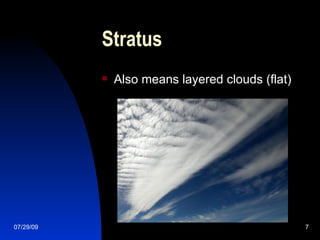
Stratus Also means layered clouds (flat)
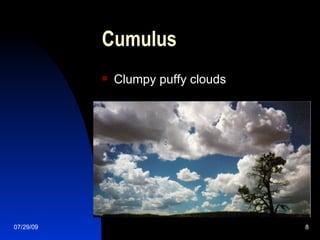
Cumulus Clumpy puffy clouds
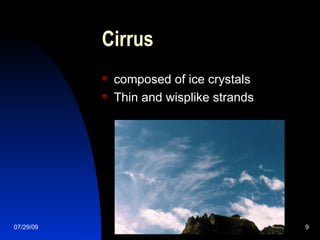
Cirrus composed of ice crystals  Thin and wisplike strands
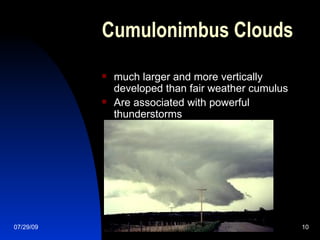
Cumulonimbus Clouds   much larger and more vertically developed than fair weather cumulus  Are associated with powerful thunderstorms
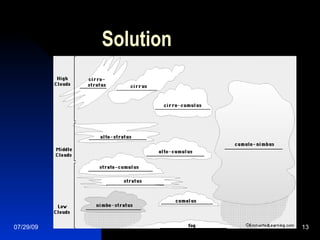
Many more alto-cumulus  - Middle-level, medium-sized puffy clouds. alto-stratus  - Middle-level, layered clouds. cirro-cumulus  - High-altitude, small, wispy, patchy, puffy clouds. cirro-stratus  - High-altitude, thin, wispy clouds in layers. cirrus  - High-altitude, thin, wispy clouds. cumulo-nimbus - Large, dense, towering clouds that cause thunderstorms. cumulus  - Low, puffy clouds. fog  - Ground-hugging clouds. nimbo-stratus  - Low, dark, rain cloud. stratus  - Low, layered, horizontal, wispy clouds with a flat base. strato-cumulus  - Low clouds, broad and flat on the bottom, puffy on top (higher than cumulus and lower than altocumulus).
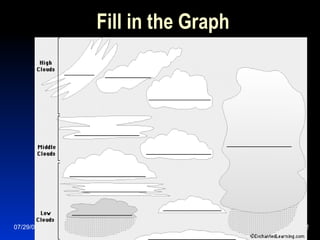
Fill in the Graph
Solution
References Wikipedia.org Enchantedlearning.com www.mal.sbo.hampton.k12.va.us

Clouds: the basics

  • 1.
  • 2.
    Formation Three requirementsfor clouds to form
  • 3.
    Moisture There mustbe sufficient water vapor in the air to build a cloud. In the Cloud in a jar experiment this was provided by the boiling water
  • 4.
    Cooling Air Theair temperature must decrease enough for water vapor to condense. (You see snow on mountain tops because it is cooler at high altitudes…. Clouds form high in the sky because the air is cooler up there) The ice and the cold jar accomplished this in our experiment
  • 5.
    Condensation nuclei Simpler than it sounds Tiny particles, invisible to the human eye, such as dust, dirt, and pollutants, provide surfaces on which water molecules can gather and condense into water droplets. The smoke provided the tiny particles in the Experiment
  • 6.
    Types of CloudsMany different classification Altitude Cirrus – High Alto – Mid Stratus - Low Nimbus/Nimbo: associated with precipitation Cumulus fluffy
  • 7.
    Stratus Also meanslayered clouds (flat)
  • 8.
  • 9.
    Cirrus composed ofice crystals Thin and wisplike strands
  • 10.
    Cumulonimbus Clouds much larger and more vertically developed than fair weather cumulus Are associated with powerful thunderstorms
  • 11.
    Many more alto-cumulus - Middle-level, medium-sized puffy clouds. alto-stratus - Middle-level, layered clouds. cirro-cumulus - High-altitude, small, wispy, patchy, puffy clouds. cirro-stratus - High-altitude, thin, wispy clouds in layers. cirrus - High-altitude, thin, wispy clouds. cumulo-nimbus - Large, dense, towering clouds that cause thunderstorms. cumulus - Low, puffy clouds. fog - Ground-hugging clouds. nimbo-stratus - Low, dark, rain cloud. stratus - Low, layered, horizontal, wispy clouds with a flat base. strato-cumulus - Low clouds, broad and flat on the bottom, puffy on top (higher than cumulus and lower than altocumulus).
  • 12.
  • 13.
  • 14.