Cloud-based Disaster Recovery
Service Overview
Disaster Recovery as a Service (DRaaS)
1
Disaster
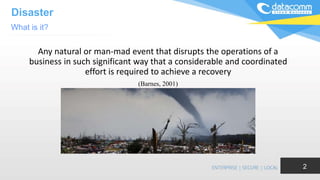
Any natural or man-mad event that disrupts the operations of a
business in such significant way that a considerable and coordinated
effort is required to achieve a recovery
(Barnes, 2001)
What is it?
2
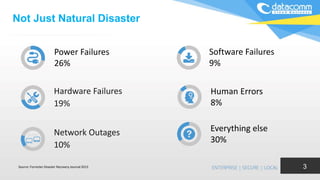
Not Just Natural Disaster
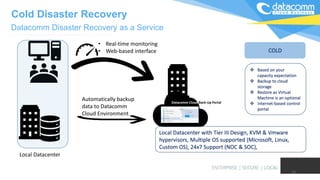
3
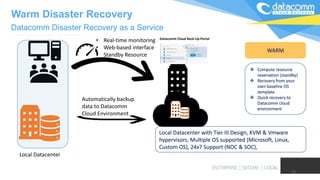
Power Failures
26%
Hardware Failures
19%
Network Outages
10%
Software Failures
9%
Human Errors
8%
Everything else
30%
Source: Forrester Disaster Recovery Journal 2013
4
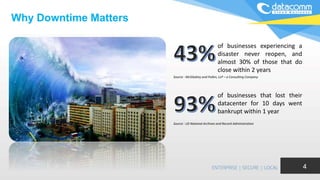
Why Downtime Matters
of businesses experiencing a
disaster never reopen, and
almost 30% of those that do
close within 2 years
of businesses that lost their
datacenter for 10 days went
bankrupt within 1 year
Source : McGladrey and Pullen, LLP – a Consulting Company
Source : US National Archives and Record Administration
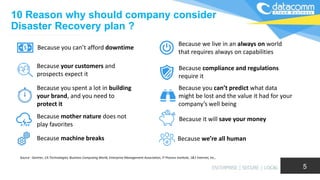
Because you can’t afford downtime
Because your customers and
prospects expect it
Because you spent a lot in building
your brand, and you need to
protect it
Because mother nature does not
play favorites
Because machine breaks
Because we live in an always on world
that requires always on capabilities
Because compliance and regulations
require it
Because you can’t predict what data
might be lost and the value it had for your
company’s well being
Because it will save your money
Because we’re all human
Source : Gartner, CA Technologies, Business Computing World, Enterprise Management Association, IT Process Institute, 1&1 Internet, Inc.,
10 Reason why should company consider
Disaster Recovery plan ?
5
Challenges in Implementing
Disaster Recovery Plan
• Too many moving parts and complexity
• Lack of automation – reliance on manual execution
• Driving without dials – no real time meters to monitor
DR service
• DR drills are expensive and impact production
6
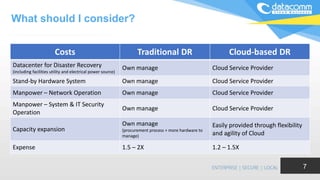
What should I consider?
7
Costs Traditional DR Cloud-based DR
Datacenter for Disaster Recovery
(including facilities utility and electrical power source)
Own manage Cloud Service Provider
Stand-by Hardware System Own manage Cloud Service Provider
Manpower – Network Operation Own manage Cloud Service Provider
Manpower – System & IT Security
Operation
Own manage Cloud Service Provider
Capacity expansion
Own manage
(procurement process + more hardware to
manage)
Easily provided through flexibility
and agility of Cloud
Expense 1.5 – 2X 1.2 – 1.5X
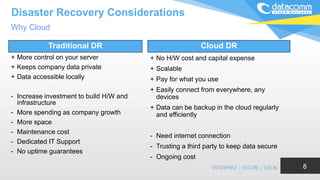
Disaster Recovery Considerations
+ More control on your server
+ Keeps company data private
+ Data accessible locally
- Increase investment to build H/W and
infrastructure
- More spending as company growth
- More space
- Maintenance cost
- Dedicated IT Support
- No uptime guarantees
+ No H/W cost and capital expense
+ Scalable
+ Pay for what you use
+ Easily connect from everywhere, any
devices
+ Data can be backup in the cloud regularly
and efficiently
- Need internet connection
- Trusting a third party to keep data secure
- Ongoing cost
Traditional DR Cloud DR
Why Cloud
8
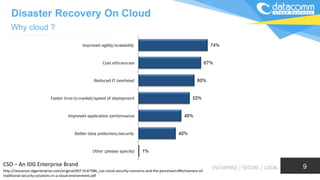
Why cloud ?
Disaster Recovery On Cloud
CSO – An IDG Enterprise Brand
http://resources.idgenterprise.com/original/AST-0147586_cso-cloud-security-concerns-and-the-perceived-effectiveness-of-
traditional-security-solutions-in-a-cloud-environment.pdf
9
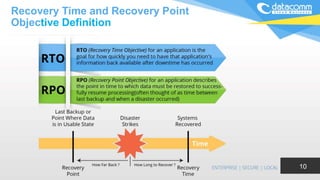
Recovery Time and Recovery Point
Objective Definition
10
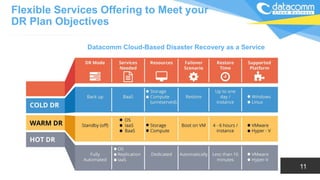
Datacomm Cloud-Based Disaster Recovery as a Service
Flexible Services Offering to Meet your
DR Plan Objectives
11
Ganti gambar
12
Local Datacenter
Automatically backup
data to Datacomm
Cloud Environment
• Real-time monitoring
• Web-based interface
Local Datacenter with Tier III Design, KVM & Vmware
hypervisors, Multiple OS supported (Microsoft, Linux,
Custom OS), 24x7 Support (NOC & SOC),
Datacomm Disaster Recovery as a Service
Cold Disaster Recovery
Datacomm Cloud Back-Up Portal
COLD
 Based on your
capacity expectation
 Backup to cloud
storage
 Restore as Virtual
Machine is an optional
 Internet-based control
portal
13
Local Datacenter
Automatically backup
data to Datacomm
Cloud Environment
• Real-time monitoring
• Web-based interface
• Standby Resource
Local Datacenter with Tier III Design, KVM & Vmware
hypervisors, Multiple OS supported (Microsoft, Linux,
Custom OS), 24x7 Support (NOC & SOC),
Datacomm Disaster Recovery as a Service
Warm Disaster Recovery
Datacomm Cloud Back-Up Portal
WARM
 Compute resource
reservation (standby)
 Recovery from your
own baseline OS
template
 Quick recovery to
Datacomm cloud
environment
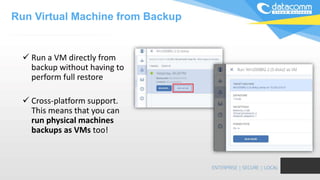
 Run a VM directly from
backup without having to
perform full restore
 Cross-platform support.
This means that you can
run physical machines
backups as VMs too!
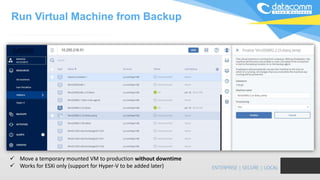
Run Virtual Machine from Backup
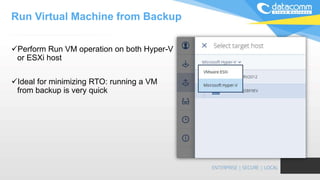
Perform Run VM operation on both Hyper-V
or ESXi host
Ideal for minimizing RTO: running a VM
from backup is very quick
Run Virtual Machine from Backup
 Move a temporary mounted VM to production without downtime
 Works for ESXi only (support for Hyper-V to be added later)
Run Virtual Machine from Backup
17
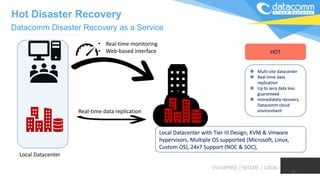
Local Datacenter
Real-time data replication
• Real-time monitoring
• Web-based interface
Local Datacenter with Tier III Design, KVM & Vmware
hypervisors, Multiple OS supported (Microsoft, Linux,
Custom OS), 24x7 Support (NOC & SOC),
HOT
 Multi-site datacenter
 Real-time data
replication
 Up to zero data loss
guaranteed
 Immediately recovery
Datacomm cloud
environment
Datacomm Disaster Recovery as a Service
Hot Disaster Recovery
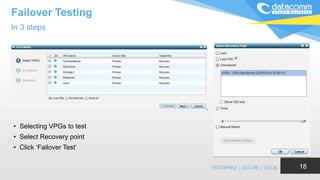
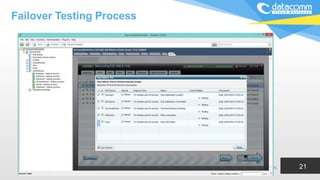
Failover Testing
• Selecting VPGs to test
• Select Recovery point
• Click ‘Failover Test’
In 3 steps
18
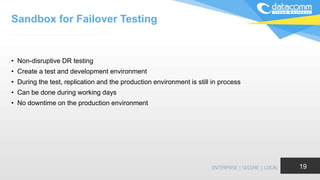
Sandbox for Failover Testing
• Non-disruptive DR testing
• Create a test and development environment
• During the test, replication and the production environment is still in process
• Can be done during working days
• No downtime on the production environment
19
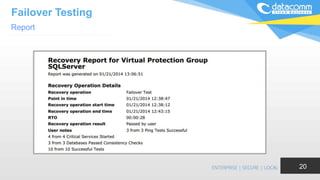
Failover Testing
Report
20
Failover Testing Process
21
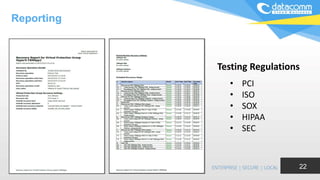
Reporting
22
• PCI
• ISO
• SOX
• HIPAA
• SEC
Testing Regulations
• High availability – guaranteed 99.9% SLA data backup availability
• Physical and virtual systems – protection of both physical and virtual
systems in one service
• Automatic and scheduled backup through online control portal
• Up to zero data loss guaranteed
• File and disk image-based backup - backup of selected files or complete
disk images
• Define your own baseline OS template for recovery
23
Datacomm Disaster Recovery as a Service
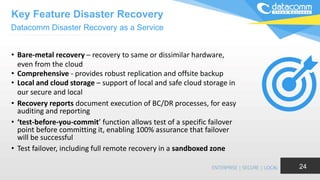
Key Feature Disaster Recovery
• Bare-metal recovery – recovery to same or dissimilar hardware,
even from the cloud
• Comprehensive - provides robust replication and offsite backup
• Local and cloud storage – support of local and safe cloud storage in
our secure and local
• Recovery reports document execution of BC/DR processes, for easy
auditing and reporting
• ‘test-before-you-commit’ function allows test of a specific failover
point before committing it, enabling 100% assurance that failover
will be successful
• Test failover, including full remote recovery in a sandboxed zone
24
Datacomm Disaster Recovery as a Service
Key Feature Disaster Recovery
Cloudciti Disaster Recovery as a Service

Cloudciti Disaster Recovery as a Service

  • 1.
    Cloud-based Disaster Recovery ServiceOverview Disaster Recovery as a Service (DRaaS) 1
  • 2.
    Disaster Any natural orman-mad event that disrupts the operations of a business in such significant way that a considerable and coordinated effort is required to achieve a recovery (Barnes, 2001) What is it? 2
  • 3.
    Not Just NaturalDisaster 3 Power Failures 26% Hardware Failures 19% Network Outages 10% Software Failures 9% Human Errors 8% Everything else 30% Source: Forrester Disaster Recovery Journal 2013
  • 4.
    4 Why Downtime Matters ofbusinesses experiencing a disaster never reopen, and almost 30% of those that do close within 2 years of businesses that lost their datacenter for 10 days went bankrupt within 1 year Source : McGladrey and Pullen, LLP – a Consulting Company Source : US National Archives and Record Administration
  • 5.
    Because you can’tafford downtime Because your customers and prospects expect it Because you spent a lot in building your brand, and you need to protect it Because mother nature does not play favorites Because machine breaks Because we live in an always on world that requires always on capabilities Because compliance and regulations require it Because you can’t predict what data might be lost and the value it had for your company’s well being Because it will save your money Because we’re all human Source : Gartner, CA Technologies, Business Computing World, Enterprise Management Association, IT Process Institute, 1&1 Internet, Inc., 10 Reason why should company consider Disaster Recovery plan ? 5
  • 6.
    Challenges in Implementing DisasterRecovery Plan • Too many moving parts and complexity • Lack of automation – reliance on manual execution • Driving without dials – no real time meters to monitor DR service • DR drills are expensive and impact production 6
  • 7.
    What should Iconsider? 7 Costs Traditional DR Cloud-based DR Datacenter for Disaster Recovery (including facilities utility and electrical power source) Own manage Cloud Service Provider Stand-by Hardware System Own manage Cloud Service Provider Manpower – Network Operation Own manage Cloud Service Provider Manpower – System & IT Security Operation Own manage Cloud Service Provider Capacity expansion Own manage (procurement process + more hardware to manage) Easily provided through flexibility and agility of Cloud Expense 1.5 – 2X 1.2 – 1.5X
  • 8.
    Disaster Recovery Considerations +More control on your server + Keeps company data private + Data accessible locally - Increase investment to build H/W and infrastructure - More spending as company growth - More space - Maintenance cost - Dedicated IT Support - No uptime guarantees + No H/W cost and capital expense + Scalable + Pay for what you use + Easily connect from everywhere, any devices + Data can be backup in the cloud regularly and efficiently - Need internet connection - Trusting a third party to keep data secure - Ongoing cost Traditional DR Cloud DR Why Cloud 8
  • 9.
    Why cloud ? DisasterRecovery On Cloud CSO – An IDG Enterprise Brand http://resources.idgenterprise.com/original/AST-0147586_cso-cloud-security-concerns-and-the-perceived-effectiveness-of- traditional-security-solutions-in-a-cloud-environment.pdf 9
  • 10.
    Recovery Time andRecovery Point Objective Definition 10
  • 11.
    Datacomm Cloud-Based DisasterRecovery as a Service Flexible Services Offering to Meet your DR Plan Objectives 11 Ganti gambar
  • 12.
    12 Local Datacenter Automatically backup datato Datacomm Cloud Environment • Real-time monitoring • Web-based interface Local Datacenter with Tier III Design, KVM & Vmware hypervisors, Multiple OS supported (Microsoft, Linux, Custom OS), 24x7 Support (NOC & SOC), Datacomm Disaster Recovery as a Service Cold Disaster Recovery Datacomm Cloud Back-Up Portal COLD  Based on your capacity expectation  Backup to cloud storage  Restore as Virtual Machine is an optional  Internet-based control portal
  • 13.
    13 Local Datacenter Automatically backup datato Datacomm Cloud Environment • Real-time monitoring • Web-based interface • Standby Resource Local Datacenter with Tier III Design, KVM & Vmware hypervisors, Multiple OS supported (Microsoft, Linux, Custom OS), 24x7 Support (NOC & SOC), Datacomm Disaster Recovery as a Service Warm Disaster Recovery Datacomm Cloud Back-Up Portal WARM  Compute resource reservation (standby)  Recovery from your own baseline OS template  Quick recovery to Datacomm cloud environment
  • 14.
     Run aVM directly from backup without having to perform full restore  Cross-platform support. This means that you can run physical machines backups as VMs too! Run Virtual Machine from Backup
  • 15.
    Perform Run VMoperation on both Hyper-V or ESXi host Ideal for minimizing RTO: running a VM from backup is very quick Run Virtual Machine from Backup
  • 16.
     Move atemporary mounted VM to production without downtime  Works for ESXi only (support for Hyper-V to be added later) Run Virtual Machine from Backup
  • 17.
    17 Local Datacenter Real-time datareplication • Real-time monitoring • Web-based interface Local Datacenter with Tier III Design, KVM & Vmware hypervisors, Multiple OS supported (Microsoft, Linux, Custom OS), 24x7 Support (NOC & SOC), HOT  Multi-site datacenter  Real-time data replication  Up to zero data loss guaranteed  Immediately recovery Datacomm cloud environment Datacomm Disaster Recovery as a Service Hot Disaster Recovery
  • 18.
    Failover Testing • SelectingVPGs to test • Select Recovery point • Click ‘Failover Test’ In 3 steps 18
  • 19.
    Sandbox for FailoverTesting • Non-disruptive DR testing • Create a test and development environment • During the test, replication and the production environment is still in process • Can be done during working days • No downtime on the production environment 19
  • 20.
  • 21.
  • 22.
    Reporting 22 • PCI • ISO •SOX • HIPAA • SEC Testing Regulations
  • 23.
    • High availability– guaranteed 99.9% SLA data backup availability • Physical and virtual systems – protection of both physical and virtual systems in one service • Automatic and scheduled backup through online control portal • Up to zero data loss guaranteed • File and disk image-based backup - backup of selected files or complete disk images • Define your own baseline OS template for recovery 23 Datacomm Disaster Recovery as a Service Key Feature Disaster Recovery
  • 24.
    • Bare-metal recovery– recovery to same or dissimilar hardware, even from the cloud • Comprehensive - provides robust replication and offsite backup • Local and cloud storage – support of local and safe cloud storage in our secure and local • Recovery reports document execution of BC/DR processes, for easy auditing and reporting • ‘test-before-you-commit’ function allows test of a specific failover point before committing it, enabling 100% assurance that failover will be successful • Test failover, including full remote recovery in a sandboxed zone 24 Datacomm Disaster Recovery as a Service Key Feature Disaster Recovery

Editor's Notes

  • #2 This is the first page. You can change the text into anything that suit your need.
  • #19 VPGs = Virtual Protection Group https://www.zerto.com/disaster-recovery-planning/3-step-failover-test-for-disaster-recovery/