Industrial
revolutions
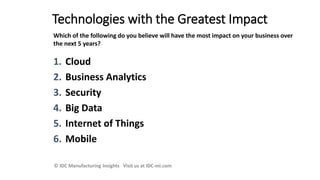
Technologies with the Greatest Impact
© IDC Manufacturing Insights Visit us at IDC-mi.com
Which of the following do you believe will have the most impact on your business over
the next 5 years?
1. Cloud
2. Business Analytics
3. Security
4. Big Data
5. Internet of Things
6. Mobile
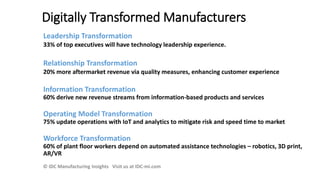
Digitally Transformed Manufacturers
Leadership Transformation
33% of top executives will have technology leadership experience.
Relationship Transformation
20% more aftermarket revenue via quality measures, enhancing customer experience
Information Transformation
60% derive new revenue streams from information-based products and services
Operating Model Transformation
75% update operations with IoT and analytics to mitigate risk and speed time to market
Workforce Transformation
60% of plant floor workers depend on automated assistance technologies – robotics, 3D print,
AR/VR
© IDC Manufacturing Insights Visit us at IDC-mi.com
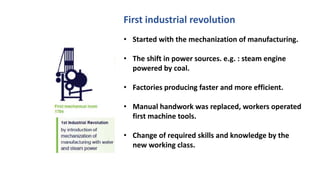
• Started with the mechanization of manufacturing.
• The shift in power sources. e.g. : steam engine
powered by coal.
• Factories producing faster and more efficient.
• Manual handwork was replaced, workers operated
first machine tools.
• Change of required skills and knowledge by the
new working class.
First industrial revolution
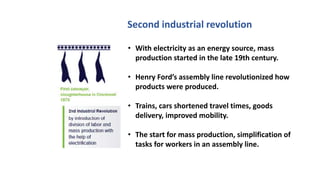
Second industrial revolution
• With electricity as an energy source, mass
production started in the late 19th century.
• Henry Ford’s assembly line revolutionized how
products were produced.
• Trains, cars shortened travel times, goods
delivery, improved mobility.
• The start for mass production, simplification of
tasks for workers in an assembly line.
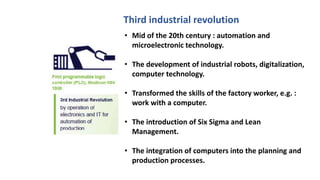
• Mid of the 20th century : automation and
microelectronic technology.
• The development of industrial robots, digitalization,
computer technology.
• Transformed the skills of the factory worker, e.g. :
work with a computer.
• The introduction of Six Sigma and Lean
Management.
• The integration of computers into the planning and
production processes.
Third industrial revolution
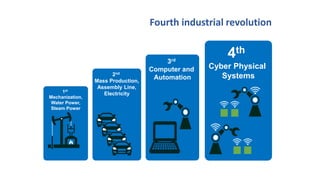
1st
Mechanization,
Water Power,
Steam Power
2nd
Mass Production,
Assembly Line,
Electricity
3rd
Computer and
Automation
4th
Cyber Physical
Systems
Fourth industrial revolution
• Cloud
• Additive Manufacturing (3D printing)
• Vertical and horizontal integration
• Internet of Things
• Autonomous robots
• Enhanced cybersecurity
Key components of Industry 4.0
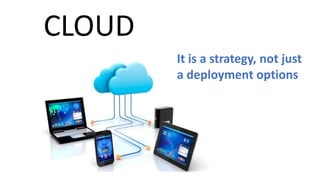
CLOUD
It is a strategy, not just
a deployment options
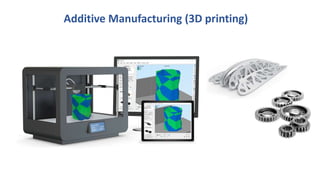
Additive Manufacturing (3D printing)
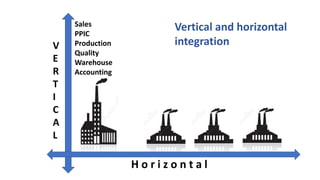
Sales
PPIC
Production
Quality
Warehouse
Accounting
V
E
R
T
I
C
A
L
H o r i z o n t a l
Vertical and horizontal
integration
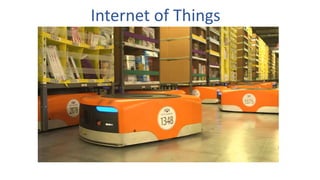
Internet of Things
smart machines, storage systems and
production facilities capable of
autonomously exchanging information,
triggering actions and controlling each other
independently. fundamental improvements
in manufacturing, engineering, material
usage and supply chain and life cycle
management.
Internet of Things
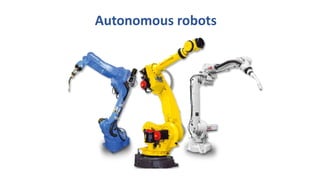
Autonomous robots
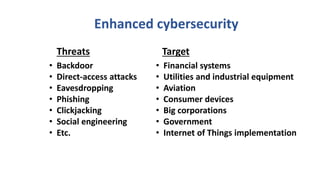
Enhanced cybersecurity
• Financial systems
• Utilities and industrial equipment
• Aviation
• Consumer devices
• Big corporations
• Government
• Internet of Things implementation
• Backdoor
• Direct-access attacks
• Eavesdropping
• Phishing
• Clickjacking
• Social engineering
• Etc.
Threats Target
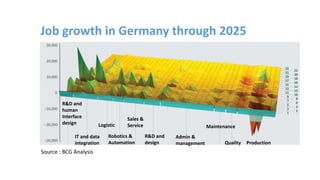
Job growth in Germany through 2025
R&D and
human
Interface
design
IT and data
integration
Logistic
Robotics &
Automation
Sales &
Service
R&D and
design
Admin &
management
Maintenance
Quality Production
Source : BCG Analysis
So, where we are now ?
• Mid of the 20th century : automation and microelectronic technology.
• The development of industrial robots, digitalization, computer technology.
• Transformed the skills of the factory worker, e.g. : work with a computer.
• The introduction of Six Sigma and Lean Management.
• The integration of computers into the planning and production processes.
Most of us are here : Third industrial revolution
1. Data and process integration ? Closed loop system or Excel still the king ?
2. Data analysis for decision making ? Again, is it still Excel ?
3. Automation ? Alert, paperless, wireless transaction, machine connectivity.
4. Customer oriented ? Promise date, real time update, responsive.
5. Horizontal integration ? We can start with simple things.
The one that survives is the one that is most adaptable to change
The only thing worse
than being blind is
having sight but no
vision
Helen Keller

Darwin - PT IMI

  • 1.
  • 2.
    Technologies with theGreatest Impact © IDC Manufacturing Insights Visit us at IDC-mi.com Which of the following do you believe will have the most impact on your business over the next 5 years? 1. Cloud 2. Business Analytics 3. Security 4. Big Data 5. Internet of Things 6. Mobile
  • 3.
    Digitally Transformed Manufacturers LeadershipTransformation 33% of top executives will have technology leadership experience. Relationship Transformation 20% more aftermarket revenue via quality measures, enhancing customer experience Information Transformation 60% derive new revenue streams from information-based products and services Operating Model Transformation 75% update operations with IoT and analytics to mitigate risk and speed time to market Workforce Transformation 60% of plant floor workers depend on automated assistance technologies – robotics, 3D print, AR/VR © IDC Manufacturing Insights Visit us at IDC-mi.com
  • 4.
    • Started withthe mechanization of manufacturing. • The shift in power sources. e.g. : steam engine powered by coal. • Factories producing faster and more efficient. • Manual handwork was replaced, workers operated first machine tools. • Change of required skills and knowledge by the new working class. First industrial revolution
  • 5.
    Second industrial revolution •With electricity as an energy source, mass production started in the late 19th century. • Henry Ford’s assembly line revolutionized how products were produced. • Trains, cars shortened travel times, goods delivery, improved mobility. • The start for mass production, simplification of tasks for workers in an assembly line.
  • 6.
    • Mid ofthe 20th century : automation and microelectronic technology. • The development of industrial robots, digitalization, computer technology. • Transformed the skills of the factory worker, e.g. : work with a computer. • The introduction of Six Sigma and Lean Management. • The integration of computers into the planning and production processes. Third industrial revolution
  • 7.
    1st Mechanization, Water Power, Steam Power 2nd MassProduction, Assembly Line, Electricity 3rd Computer and Automation 4th Cyber Physical Systems Fourth industrial revolution
  • 8.
    • Cloud • AdditiveManufacturing (3D printing) • Vertical and horizontal integration • Internet of Things • Autonomous robots • Enhanced cybersecurity Key components of Industry 4.0
  • 9.
    CLOUD It is astrategy, not just a deployment options
  • 10.
  • 11.
    Sales PPIC Production Quality Warehouse Accounting V E R T I C A L H o ri z o n t a l Vertical and horizontal integration
  • 12.
    Internet of Things smartmachines, storage systems and production facilities capable of autonomously exchanging information, triggering actions and controlling each other independently. fundamental improvements in manufacturing, engineering, material usage and supply chain and life cycle management.
  • 13.
  • 14.
  • 15.
    Enhanced cybersecurity • Financialsystems • Utilities and industrial equipment • Aviation • Consumer devices • Big corporations • Government • Internet of Things implementation • Backdoor • Direct-access attacks • Eavesdropping • Phishing • Clickjacking • Social engineering • Etc. Threats Target
  • 16.
    Job growth inGermany through 2025 R&D and human Interface design IT and data integration Logistic Robotics & Automation Sales & Service R&D and design Admin & management Maintenance Quality Production Source : BCG Analysis
  • 17.
    So, where weare now ?
  • 18.
    • Mid ofthe 20th century : automation and microelectronic technology. • The development of industrial robots, digitalization, computer technology. • Transformed the skills of the factory worker, e.g. : work with a computer. • The introduction of Six Sigma and Lean Management. • The integration of computers into the planning and production processes. Most of us are here : Third industrial revolution 1. Data and process integration ? Closed loop system or Excel still the king ? 2. Data analysis for decision making ? Again, is it still Excel ? 3. Automation ? Alert, paperless, wireless transaction, machine connectivity. 4. Customer oriented ? Promise date, real time update, responsive. 5. Horizontal integration ? We can start with simple things. The one that survives is the one that is most adaptable to change
  • 19.
    The only thingworse than being blind is having sight but no vision Helen Keller