Challenges for cloud software
                     engineering	

                                          Ian Sommerville	

                               St Andrews University	


Challenges for Cloud Software Engineering, 2012                	

Slide 1
Why is cloud software engineering
different – or is it?	

What needs to be done to make cloud
software engineering easier for the
research community?	


Challenges for Cloud Software Engineering, 2012   	

Slide 2
Public, private, community clouds	


Challenges for Cloud Software Engineering, 2012   	

Slide 3
There will be a number of public cloud
providers offering different capabilities at
different prices at different times	

Public cloud computing prices will
continue to fall and it will be the most
economical approach	


Challenges for Cloud Software Engineering, 2012   	

Slide 4
Private (institutional) clouds for science
research are not really viable	

Community clouds make sense for data-
intensive computing if they are located
close to the sources of the data	

Community clouds hosting standard
software may be a useful approach –
possibly hosted on public clouds	


Challenges for Cloud Software Engineering, 2012   	

Slide 5
What makes the cloud different (and
          challenging)?	


Challenges for Cloud Software Engineering, 2012   	

Slide 6
Scale	


          Thousands of nodes that may be
          distributed across the world	


Challenges for Cloud Software Engineering, 2012              	

Slide 7
Elasticity	


                 No fixed hardware architecture	


                                    Scale out and scale in	


Challenges for Cloud Software Engineering, 2012                   	

Slide 8
Pay as you go pricing	


Variable costs for applications	


Payment according to resources used	


Challenges for Cloud Software Engineering, 2012         	

Slide 9
Cloud services	


Challenges for Cloud Software Engineering, 2012               	

Slide 10
Infrastructure as a service	


Challenges for Cloud Software Engineering, 2012      	

Slide 11
Instead of buying and running physical
 equipment (computers, storage, etc.),
 you ‘rent’ these as required from a cloud
 provider	

 You ship your programs and data to a
 remote data centre and run them there
 rather than locally	

 The familiar Grid computing model	

Challenges for Cloud Software Engineering, 2012   	

Slide 12
Platform as a service	


Challenges for Cloud Software Engineering, 2012           	

Slide 13
The cloud provider makes a set of APIs
 available which you use in your program
 to interact with the platform	

 Scaleability is transparent. Automatic
 scale out/scale in as demand changes	

 Primarily geared to writing web-based
 applications	

Challenges for Cloud Software Engineering, 2012   	

Slide 14
Software as a service	


Challenges for Cloud Software Engineering, 2012          	

Slide 15
Software is shared by different users and
       accessed using a web browser	

       Services are stateless, functional
       abstractions	

       Multi-tenant databases for efficient
       operation	

       Accessed via a service interface – SOAP
       or RESTful interface	


   Challenges for Cloud Software Engineering, 2012   	

Slide 16
Levels of cloud usage	


Challenges for Cloud Software Engineering, 2012          	

Slide 17
Cloud hosting	

 You use the cloud to provide server
 capability rather than incurring the capital
 costs of server purchase	

 Applications need not be ‘cloud aware’	

 Fixed server infrastructure	

 Can run existing codes in Fortran/C	


Challenges for Cloud Software Engineering, 2012               	

Slide 18
If server type and platform available, then
should not require any application
changes	

Almost certainly poorer performance
than local execution. 	

But makes sense for occasional runs/
demonstrations etc.	

Challenges for Cloud Software Engineering, 2012   	

Slide 19
Problems	

 Relatively low level model of interaction.	

 You need to know about lots of stuff (such as
 certificates, security keys, etc. that have nothing to
 do with your work)	


 Performance is difficult to predict	

 License issues	

 Costs may be high for high volumes of
 data transfer in/out of clouds	

Challenges for Cloud Software Engineering, 2012                 	

Slide 20
Software engineering challenge	


         Build a software development
      environment that radically simplifies
    hosting scientific applications on a range
                    of clouds	


Challenges for Cloud Software Engineering, 2012   	

Slide 21
Cloud interfacing	

You build applications that make use of
the cloud providers APIs (PaaS) to access
common services.	

‘High-level’ cloud awareness. The platform
takes care of scaleability on demand. 	

Limited programming language support	


      Challenges for Cloud Software Engineering, 2012             	

Slide 22
Challenge is using existing PaaS APIs for
 computationally-intensive applications	

       –  Systems are set up to support web-based
          applications	

       –  Google Apps – 30 second time limit on tasks	


 Significant application change required	

 Several experiments here – mixed
 conclusions. 	

Challenges for Cloud Software Engineering, 2012       	

Slide 23
Software engineering challenge	


 Investigate how to adapt applications that
   are computation/data intensive to run
   within the constraints set by the PaaS
      interfaces from cloud providers	


Challenges for Cloud Software Engineering, 2012   	

Slide 24
Cloud software engineering	


Build ‘cloud aware’ applications which can
 adapt to the cloud capabilities that are
                 available	


Challenges for Cloud Software Engineering, 2012   	

Slide 25
Application architecture designed for the
 cloud	

 Underlying infrastructure management
 done in the program itself, depending on
 performance and cost requirements	

 What abstractions do we need for this?	


Challenges for Cloud Software Engineering, 2012   	

Slide 26
Three grand challenges	


Challenges for Cloud Software Engineering, 2012       	

Slide 27
Programming models for the cloud	

 Building a PaaS for high performance/
 throughput computing	

 Cloud-aware software development
 environments	


Challenges for Cloud Software Engineering, 2012   	

Slide 28
Scaling up and scaling out	

 Traditional model to cope with increased
 computational demand is to scale up	

 Supported by some cloud providers who
 offer different instance types.	

 Scaling out is the more usual cloud
 model	


Challenges for Cloud Software Engineering, 2012       	

Slide 29
Coping with scaling out	

 Redesigning algorithms and code to work
 with a flexible rather than a fixed
 number of resources 	


       –  Interaction between program and platform to know
          what resources are being used and what resources are
          available	

       –  Structuring program into a flexible number of
          computational components	

       –  Avoiding sequential computations (Amdahl’s Law)	


Challenges for Cloud Software Engineering, 2012                	

Slide 30
Programming models	

 Are there programming models that can
 take advantage of elasticity and massive
 parallelism?	

       –  Invent new models for parallel computation	

       –  Adapt existing problems to the current map/reduce
          programming model	


Challenges for Cloud Software Engineering, 2012           	

Slide 31
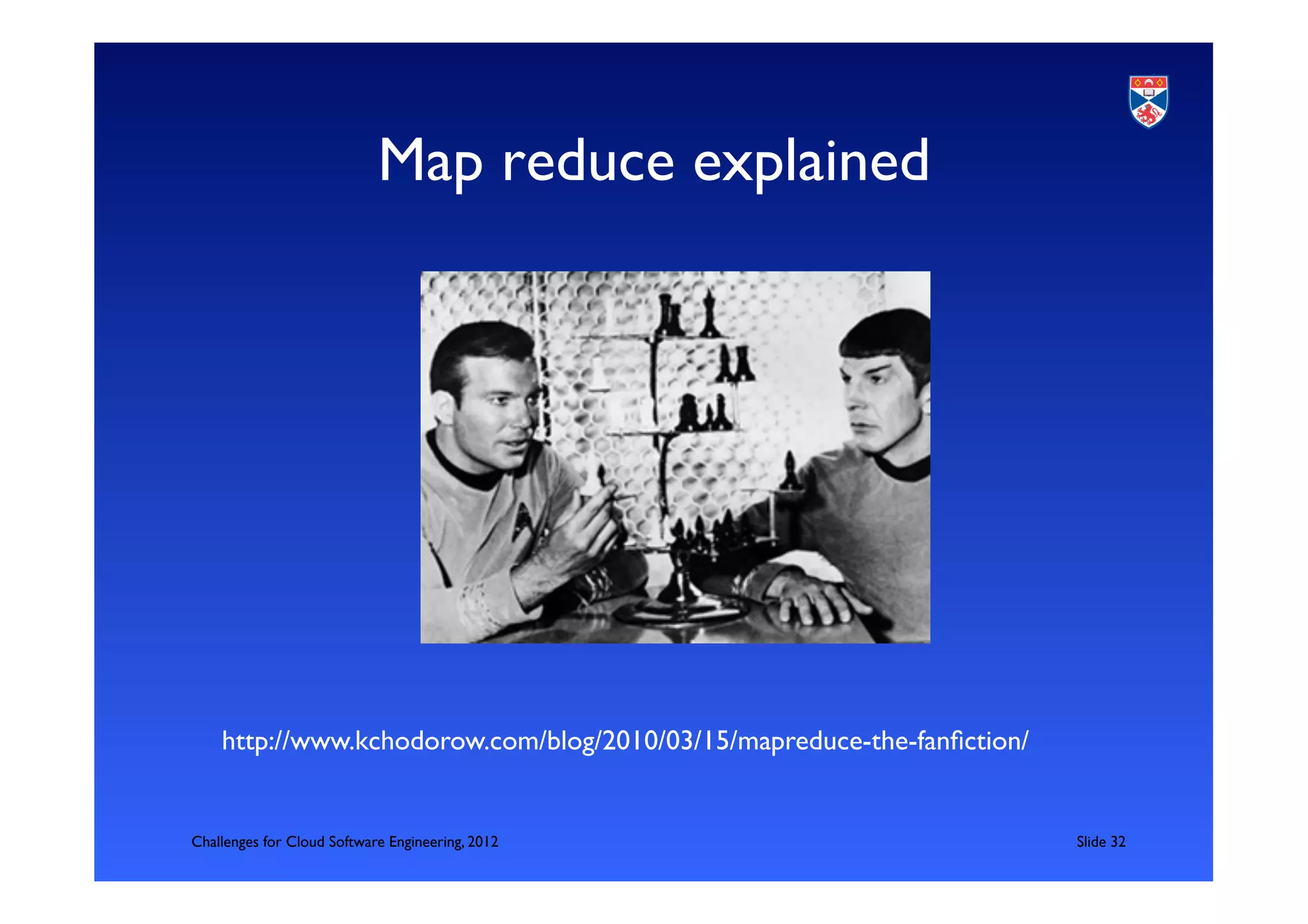
Map reduce explained	


    http://www.kchodorow.com/blog/2010/03/15/mapreduce-the-fanfiction/	


Challenges for Cloud Software Engineering, 2012                            	

Slide 32
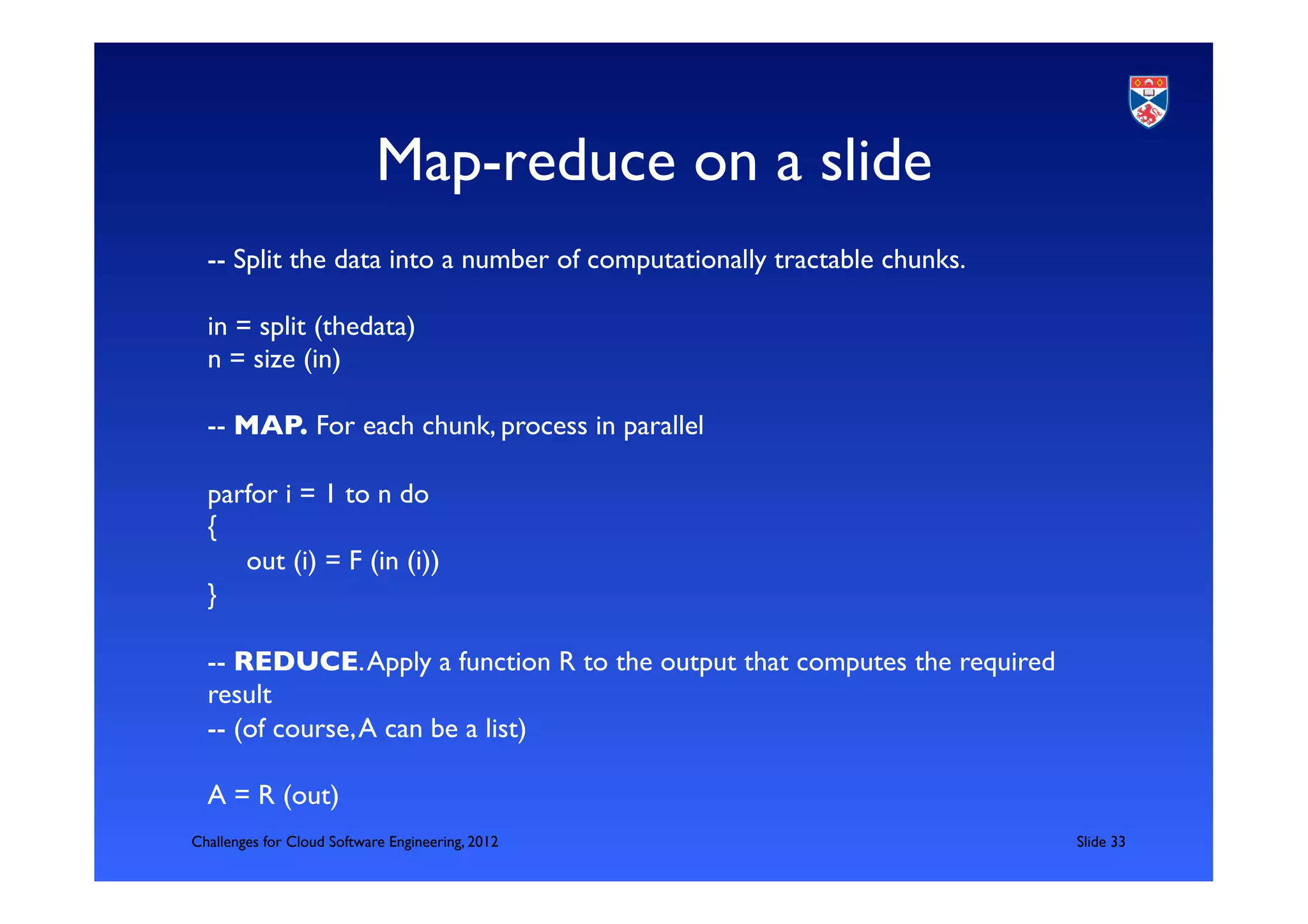
Map-reduce on a slide	

  -- Split the data into a number of computationally tractable chunks. 	


  in = split (thedata)	

  n = size (in)	


  -- MAP. For each chunk, process in parallel 	


  parfor i = 1 to n do	

  {	

       out (i) = F (in (i))	

  }	


  -- REDUCE. Apply a function R to the output that computes the required
  result	

  -- (of course, A can be a list)	


  A = R (out)	

Challenges for Cloud Software Engineering, 2012                              	

Slide 33
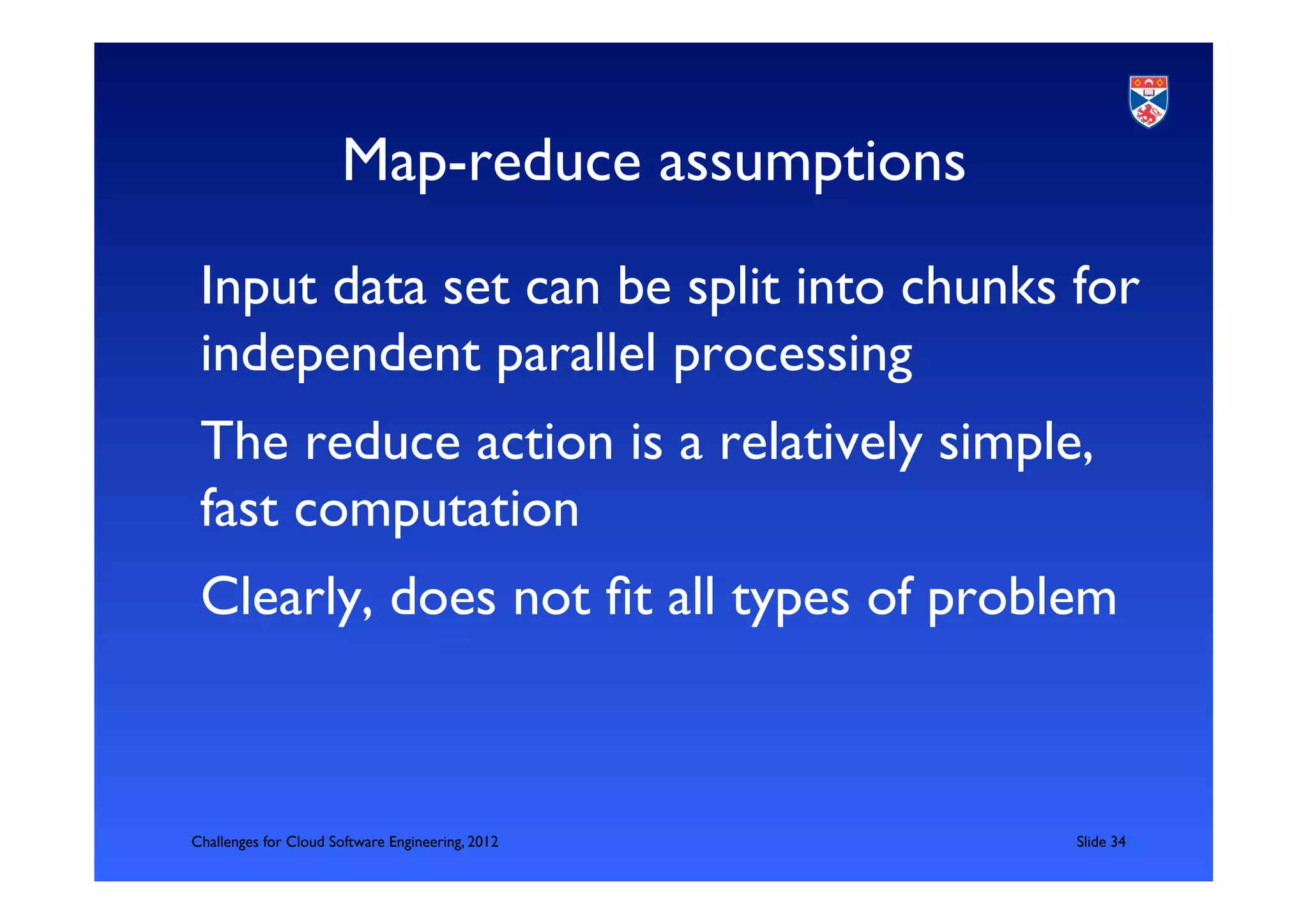
Map-reduce assumptions	

 Input data set can be split into chunks for
 independent parallel processing	

 The reduce action is a relatively simple,
 fast computation	

 Clearly, does not fit all types of problem	


Challenges for Cloud Software Engineering, 2012   	

Slide 34
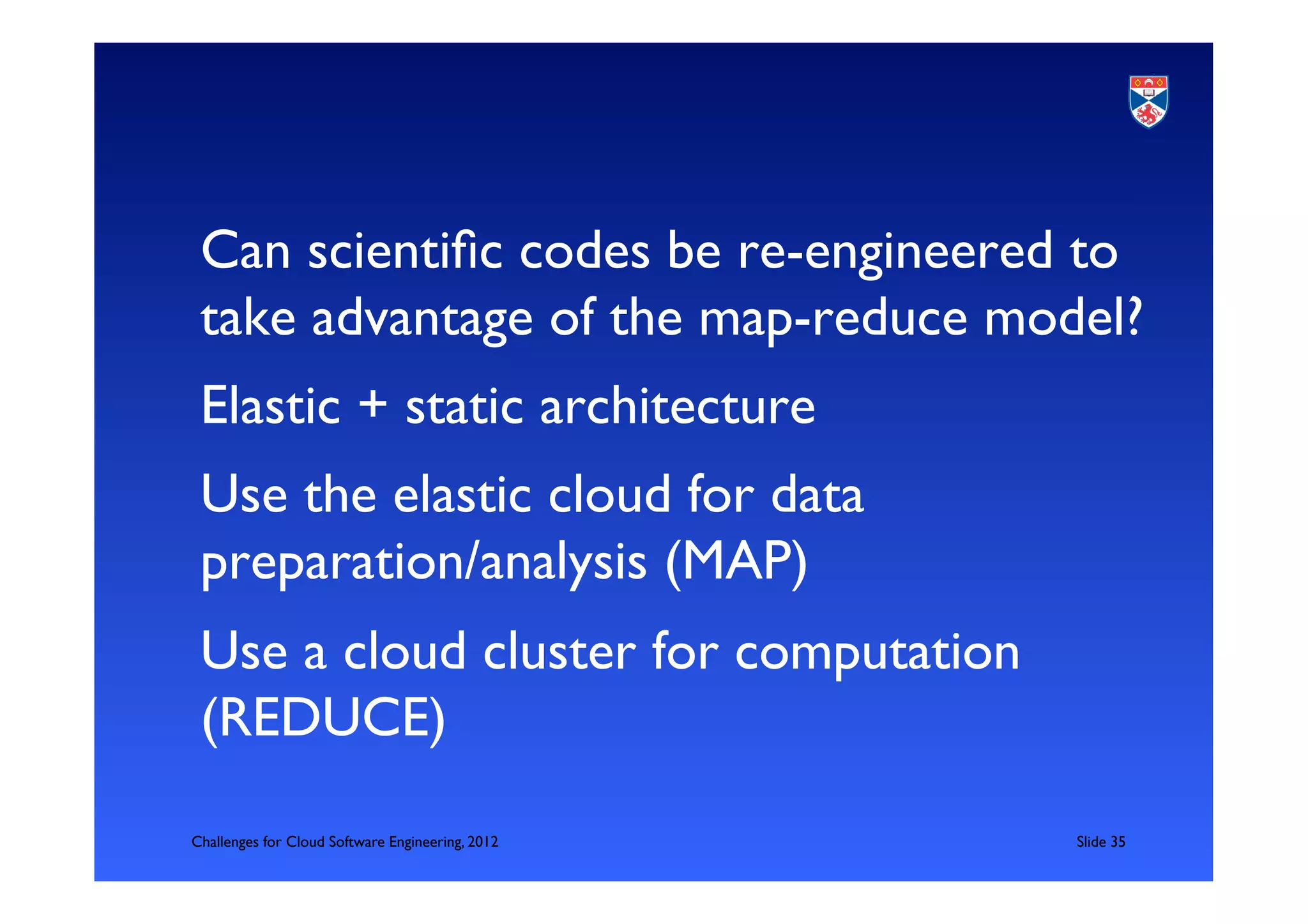
Can scientific codes be re-engineered to
 take advantage of the map-reduce model?	

 Elastic + static architecture	

 Use the elastic cloud for data
 preparation/analysis (MAP)	

 Use a cloud cluster for computation
 (REDUCE)	

Challenges for Cloud Software Engineering, 2012   	

Slide 35
Opportunistic computing	


            Taking advantage of low-price/free
           resources when these are available?	


Challenges for Cloud Software Engineering, 2012    	

Slide 36
Fixed budget computation	


Compute till you run out of money	

 Get as much computational capability as
 your budget will allow	

 Use spot prices	

 Stop and start instances	


Challenges for Cloud Software Engineering, 2012       	

Slide 37
Budget-driven programming	

 Develop systems that take advantage of
 variable pricing in different clouds/at
 different times	

 Potentially significant for
 computationally-intensive applications	


Challenges for Cloud Software Engineering, 2012   	

Slide 38
PaaS for Science	

 Develop a set of APIS for data/compute
 intensive applications to support cloud
 interaction	


Long-running applications	


Cost/demand awareness	


Performance measurement/tuning	


Intermittent execution	

Challenges for Cloud Software Engineering, 2012              	

Slide 39
SDE for the cloud	

 Creating an environment for the
 development of cloud-aware applications	

 Hiding low level details of IaaS cloud
 interaction	

 Testing environment	

 Occasional computation	

 Preliminary work – ELVIRA, St Andrews	

 http://cloudresearch.jiscinvolve.org/wp/category/projects/
 elvira/	

Challenges for Cloud Software Engineering, 2012            	

Slide 40
Software as a service	


Challenges for Cloud Software Engineering, 2012          	

Slide 41
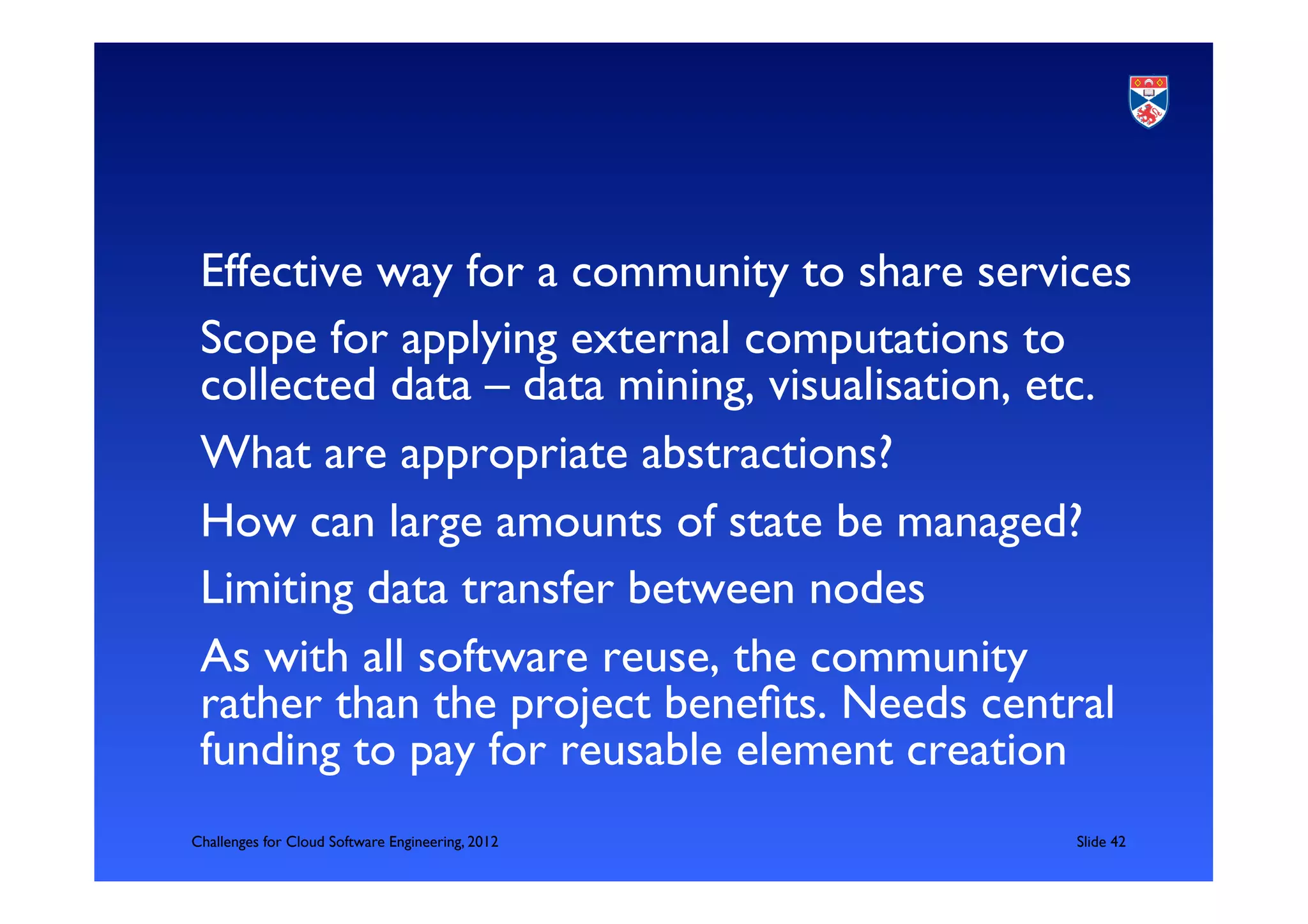
Effective way for a community to share services	

 Scope for applying external computations to
 collected data – data mining, visualisation, etc.	

 What are appropriate abstractions?	

 How can large amounts of state be managed?	

 Limiting data transfer between nodes	

 As with all software reuse, the community
 rather than the project benefits. Needs central
 funding to pay for reusable element creation	

Challenges for Cloud Software Engineering, 2012   	

Slide 42
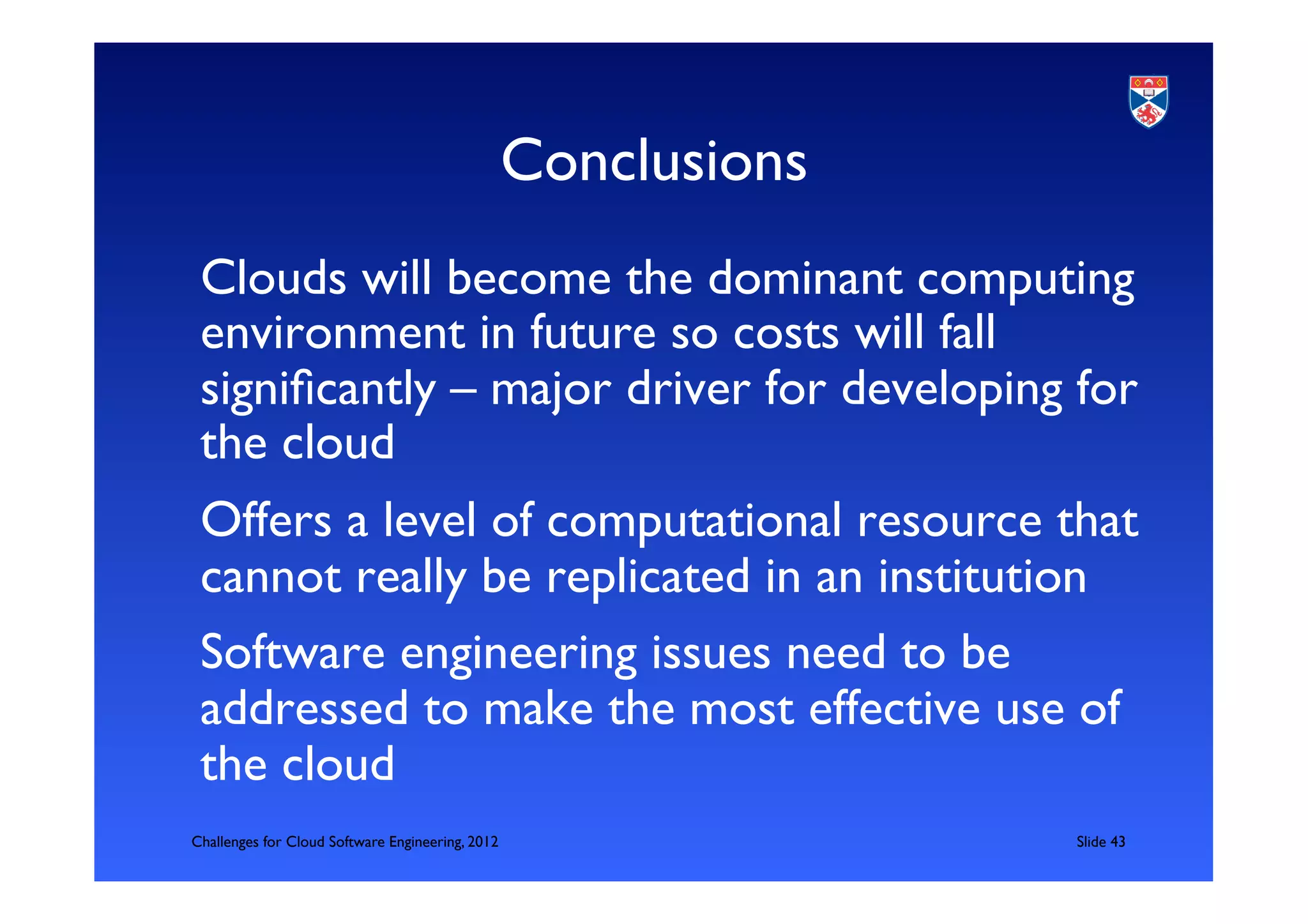
Conclusions	

 Clouds will become the dominant computing
 environment in future so costs will fall
 significantly – major driver for developing for
 the cloud	

 Offers a level of computational resource that
 cannot really be replicated in an institution	

 Software engineering issues need to be
 addressed to make the most effective use of
 the cloud	


Challenges for Cloud Software Engineering, 2012                    	

Slide 43

Cloud software engineering

  • 1.
    Challenges for cloudsoftware engineering Ian Sommerville St Andrews University Challenges for Cloud Software Engineering, 2012 Slide 1
  • 2.
    Why is cloudsoftware engineering different – or is it? What needs to be done to make cloud software engineering easier for the research community? Challenges for Cloud Software Engineering, 2012 Slide 2
  • 3.
    Public, private, communityclouds Challenges for Cloud Software Engineering, 2012 Slide 3
  • 4.
    There will bea number of public cloud providers offering different capabilities at different prices at different times Public cloud computing prices will continue to fall and it will be the most economical approach Challenges for Cloud Software Engineering, 2012 Slide 4
  • 5.
    Private (institutional) cloudsfor science research are not really viable Community clouds make sense for data- intensive computing if they are located close to the sources of the data Community clouds hosting standard software may be a useful approach – possibly hosted on public clouds Challenges for Cloud Software Engineering, 2012 Slide 5
  • 6.
    What makes thecloud different (and challenging)? Challenges for Cloud Software Engineering, 2012 Slide 6
  • 7.
    Scale Thousands of nodes that may be distributed across the world Challenges for Cloud Software Engineering, 2012 Slide 7
  • 8.
    Elasticity No fixed hardware architecture Scale out and scale in Challenges for Cloud Software Engineering, 2012 Slide 8
  • 9.
    Pay as yougo pricing Variable costs for applications Payment according to resources used Challenges for Cloud Software Engineering, 2012 Slide 9
  • 10.
    Cloud services Challenges forCloud Software Engineering, 2012 Slide 10
  • 11.
    Infrastructure as aservice Challenges for Cloud Software Engineering, 2012 Slide 11
  • 12.
    Instead of buyingand running physical equipment (computers, storage, etc.), you ‘rent’ these as required from a cloud provider You ship your programs and data to a remote data centre and run them there rather than locally The familiar Grid computing model Challenges for Cloud Software Engineering, 2012 Slide 12
  • 13.
    Platform as aservice Challenges for Cloud Software Engineering, 2012 Slide 13
  • 14.
    The cloud providermakes a set of APIs available which you use in your program to interact with the platform Scaleability is transparent. Automatic scale out/scale in as demand changes Primarily geared to writing web-based applications Challenges for Cloud Software Engineering, 2012 Slide 14
  • 15.
    Software as aservice Challenges for Cloud Software Engineering, 2012 Slide 15
  • 16.
    Software is sharedby different users and accessed using a web browser Services are stateless, functional abstractions Multi-tenant databases for efficient operation Accessed via a service interface – SOAP or RESTful interface Challenges for Cloud Software Engineering, 2012 Slide 16
  • 17.
    Levels of cloudusage Challenges for Cloud Software Engineering, 2012 Slide 17
  • 18.
    Cloud hosting Youuse the cloud to provide server capability rather than incurring the capital costs of server purchase Applications need not be ‘cloud aware’ Fixed server infrastructure Can run existing codes in Fortran/C Challenges for Cloud Software Engineering, 2012 Slide 18
  • 19.
    If server typeand platform available, then should not require any application changes Almost certainly poorer performance than local execution. But makes sense for occasional runs/ demonstrations etc. Challenges for Cloud Software Engineering, 2012 Slide 19
  • 20.
    Problems Relatively lowlevel model of interaction. You need to know about lots of stuff (such as certificates, security keys, etc. that have nothing to do with your work) Performance is difficult to predict License issues Costs may be high for high volumes of data transfer in/out of clouds Challenges for Cloud Software Engineering, 2012 Slide 20
  • 21.
    Software engineering challenge Build a software development environment that radically simplifies hosting scientific applications on a range of clouds Challenges for Cloud Software Engineering, 2012 Slide 21
  • 22.
    Cloud interfacing You buildapplications that make use of the cloud providers APIs (PaaS) to access common services. ‘High-level’ cloud awareness. The platform takes care of scaleability on demand. Limited programming language support Challenges for Cloud Software Engineering, 2012 Slide 22
  • 23.
    Challenge is usingexisting PaaS APIs for computationally-intensive applications –  Systems are set up to support web-based applications –  Google Apps – 30 second time limit on tasks Significant application change required Several experiments here – mixed conclusions. Challenges for Cloud Software Engineering, 2012 Slide 23
  • 24.
    Software engineering challenge Investigate how to adapt applications that are computation/data intensive to run within the constraints set by the PaaS interfaces from cloud providers Challenges for Cloud Software Engineering, 2012 Slide 24
  • 25.
    Cloud software engineering Build‘cloud aware’ applications which can adapt to the cloud capabilities that are available Challenges for Cloud Software Engineering, 2012 Slide 25
  • 26.
    Application architecture designedfor the cloud Underlying infrastructure management done in the program itself, depending on performance and cost requirements What abstractions do we need for this? Challenges for Cloud Software Engineering, 2012 Slide 26
  • 27.
    Three grand challenges Challengesfor Cloud Software Engineering, 2012 Slide 27
  • 28.
    Programming models forthe cloud Building a PaaS for high performance/ throughput computing Cloud-aware software development environments Challenges for Cloud Software Engineering, 2012 Slide 28
  • 29.
    Scaling up andscaling out Traditional model to cope with increased computational demand is to scale up Supported by some cloud providers who offer different instance types. Scaling out is the more usual cloud model Challenges for Cloud Software Engineering, 2012 Slide 29
  • 30.
    Coping with scalingout Redesigning algorithms and code to work with a flexible rather than a fixed number of resources –  Interaction between program and platform to know what resources are being used and what resources are available –  Structuring program into a flexible number of computational components –  Avoiding sequential computations (Amdahl’s Law) Challenges for Cloud Software Engineering, 2012 Slide 30
  • 31.
    Programming models Arethere programming models that can take advantage of elasticity and massive parallelism? –  Invent new models for parallel computation –  Adapt existing problems to the current map/reduce programming model Challenges for Cloud Software Engineering, 2012 Slide 31
  • 32.
    Map reduce explained http://www.kchodorow.com/blog/2010/03/15/mapreduce-the-fanfiction/ Challenges for Cloud Software Engineering, 2012 Slide 32
  • 33.
    Map-reduce on aslide -- Split the data into a number of computationally tractable chunks.  in = split (thedata) n = size (in) -- MAP. For each chunk, process in parallel  parfor i = 1 to n do {      out (i) = F (in (i)) } -- REDUCE. Apply a function R to the output that computes the required result -- (of course, A can be a list) A = R (out) Challenges for Cloud Software Engineering, 2012 Slide 33
  • 34.
    Map-reduce assumptions Inputdata set can be split into chunks for independent parallel processing The reduce action is a relatively simple, fast computation Clearly, does not fit all types of problem Challenges for Cloud Software Engineering, 2012 Slide 34
  • 35.
    Can scientific codesbe re-engineered to take advantage of the map-reduce model? Elastic + static architecture Use the elastic cloud for data preparation/analysis (MAP) Use a cloud cluster for computation (REDUCE) Challenges for Cloud Software Engineering, 2012 Slide 35
  • 36.
    Opportunistic computing Taking advantage of low-price/free resources when these are available? Challenges for Cloud Software Engineering, 2012 Slide 36
  • 37.
    Fixed budget computation Compute till you run out of money Get as much computational capability as your budget will allow Use spot prices Stop and start instances Challenges for Cloud Software Engineering, 2012 Slide 37
  • 38.
    Budget-driven programming Developsystems that take advantage of variable pricing in different clouds/at different times Potentially significant for computationally-intensive applications Challenges for Cloud Software Engineering, 2012 Slide 38
  • 39.
    PaaS for Science Develop a set of APIS for data/compute intensive applications to support cloud interaction Long-running applications Cost/demand awareness Performance measurement/tuning Intermittent execution Challenges for Cloud Software Engineering, 2012 Slide 39
  • 40.
    SDE for thecloud Creating an environment for the development of cloud-aware applications Hiding low level details of IaaS cloud interaction Testing environment Occasional computation Preliminary work – ELVIRA, St Andrews http://cloudresearch.jiscinvolve.org/wp/category/projects/ elvira/ Challenges for Cloud Software Engineering, 2012 Slide 40
  • 41.
    Software as aservice Challenges for Cloud Software Engineering, 2012 Slide 41
  • 42.
    Effective way fora community to share services Scope for applying external computations to collected data – data mining, visualisation, etc. What are appropriate abstractions? How can large amounts of state be managed? Limiting data transfer between nodes As with all software reuse, the community rather than the project benefits. Needs central funding to pay for reusable element creation Challenges for Cloud Software Engineering, 2012 Slide 42
  • 43.
    Conclusions Clouds willbecome the dominant computing environment in future so costs will fall significantly – major driver for developing for the cloud Offers a level of computational resource that cannot really be replicated in an institution Software engineering issues need to be addressed to make the most effective use of the cloud Challenges for Cloud Software Engineering, 2012 Slide 43