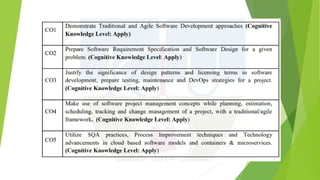
Management of
Software Systems
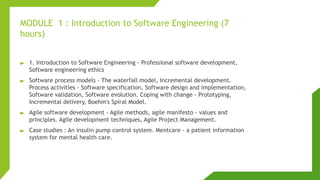
MODULE 1 : Introduction to Software Engineering (7
hours)
► 1. Introduction to Software Engineering - Professional software development,
Software engineering ethics
► Software process models - The waterfall model, Incremental development.
Process activities - Software specification, Software design and implementation,
Software validation, Software evolution. Coping with change - Prototyping,
Incremental delivery, Boehm's Spiral Model.
► Agile software development - Agile methods, agile manifesto - values and
principles. Agile development techniques, Agile Project Management.
► Case studies : An insulin pump control system. Mentcare - a patient information
system for mental health care.
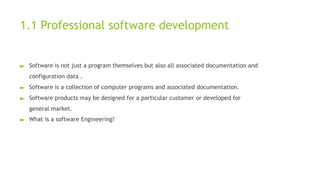
1.1 Professional software development
► Software is not just a program themselves but also all associated documentation and
configuration data .
► Software is a collection of computer programs and associated documentation.
► Software products may be designed for a particular customer or developed for
general market.
► What is a software Engineering?
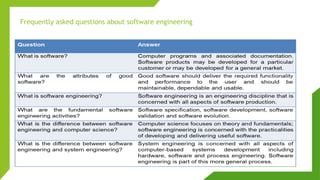
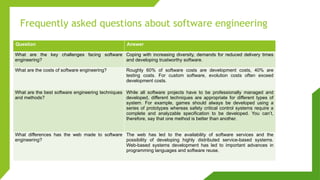
Frequently asked questions about software engineering
Question Answer
What are the key challenges facing software
engineering?
Coping with increasing diversity, demands for reduced delivery times
and developing trustworthy software.
What are the costs of software engineering? Roughly 60% of software costs are development costs, 40% are
testing costs. For custom software, evolution costs often exceed
development costs.
What are the best software engineering techniques
and methods?
While all software projects have to be professionally managed and
developed, different techniques are appropriate for different types of
system. For example, games should always be developed using a
series of prototypes whereas safety critical control systems require a
complete and analyzable specification to be developed. You can’t,
therefore, say that one method is better than another.
What differences has the web made to software
engineering?
The web has led to the availability of software services and the
possibility of developing highly distributed service-based systems.
Web-based systems development has led to important advances in
programming languages and software reuse.
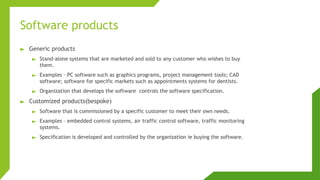
Software products
► Generic products
► Stand-alone systems that are marketed and sold to any customer who wishes to buy
them.
► Examples – PC software such as graphics programs, project management tools; CAD
software; software for specific markets such as appointments systems for dentists.
► Organization that develops the software controls the software specification.
► Customized products(bespoke)
► Software that is commissioned by a specific customer to meet their own needs.
► Examples – embedded control systems, air traffic control software, traffic monitoring
systems.
► Specification is developed and controlled by the organization ie buying the software.
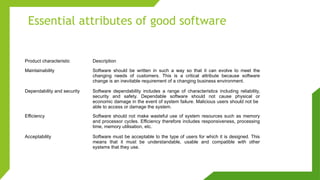
Essential attributes of good software
Product characteristic Description
Maintainability Software should be written in such a way so that it can evolve to meet the
changing needs of customers. This is a critical attribute because software
change is an inevitable requirement of a changing business environment.
Dependability and security Software dependability includes a range of characteristics including reliability,
security and safety. Dependable software should not cause physical or
economic damage in the event of system failure. Malicious users should not be
able to access or damage the system.
Efficiency Software should not make wasteful use of system resources such as memory
and processor cycles. Efficiency therefore includes responsiveness, processing
time, memory utilisation, etc.
Acceptability Software must be acceptable to the type of users for which it is designed. This
means that it must be understandable, usable and compatible with other
systems that they use.
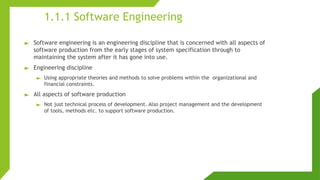
1.1.1 Software Engineering
► Software engineering is an engineering discipline that is concerned with all aspects of
software production from the early stages of system specification through to
maintaining the system after it has gone into use.
► Engineering discipline
► Using appropriate theories and methods to solve problems within the organizational and
financial constraints.
► All aspects of software production
► Not just technical process of development. Also project management and the development
of tools, methods etc. to support software production.
► More and more, individuals and society rely on advanced software systems.
We need to be able to produce reliable and trustworthy systems economically
and quickly.
► It is usually cheaper, in the long run, to use software engineering methods and
techniques for software systems rather than just write the programs as if it
was a personal programming project. For most types of system, the majority
of costs are the costs of changing the software after it has gone into use.
Importance of software engineering
Software process activities
► Software specification, where customers and engineers define the software
that is to be produced and the constraints on its operation.
► Software development, where the software is designed and programmed.
► Software validation, where the software is checked to ensure that it is what
the customer requires.
► Software evolution, where the software is modified to reflect changing
customer and market requirements.
General issues that affect most software
► Heterogeneity
► Increasingly, systems are required to operate as distributed systems across
networks that include different types of computer and mobile devices.
► Business and social change
► Business and society are changing incredibly quickly as emerging economies
develop and new technologies become available. They need to be able to change
their existing software and to rapidly develop new software.
► Security and trust
► As software is intertwined with all aspects of our lives, it is essential that we can
trust that software
1.1.2 Software Engineering diversity
► There are many different types of software system and there is no universal set
of software techniques that is applicable to all of these.
► The software engineering methods and tools used depend on the type of
application being developed, the requirements of the customer and the
background of the development team.
Software Engineering fundamentals
► Some fundamental principles apply to all types of software system, irrespective
of the development techniques used:
► Systems should be developed using a managed and understood development process.
Of course, different processes are used for different types of software.
► Dependability and performance are important for all types of system.
► Understanding and managing the software specification and requirements (what the
software should do) are important.
► Where appropriate, you should reuse software that has already been developed
rather than write new software.
Application types
► Stand-alone applications
► These are application systems that run on a local computer, such as a PC. They
include all necessary functionality and do not need to be connected to a network.
► Interactive transaction-based applications
► Applications that execute on a remote computer and are accessed by users from
their own PCs or terminals. These include web applications such as e-commerce
applications.
► Embedded control systems
► These are software control systems that control and manage hardware devices.
Numerically, there are probably more embedded systems than any other type of
system.
► Batch processing systems
► These are business systems that are designed to process data in large batches. They process large
numbers of individual inputs to create corresponding outputs.
► Entertainment systems
► These are systems that are primarily for personal use and which are intended to entertain the user.
► Systems for modeling and simulation
► These are systems that are developed by scientists and engineers to model physical processes or
situations, which include many, separate, interacting objects.
► Data collection systems
► These are systems that collect data from their environment using a set of sensors and send that
data to other systems for processing.
► Systems of systems
► These are systems that are composed of a number of other software systems
1.1.3 Software Engineering and the Web
► The Web is now a platform for running application and organizations are
increasingly developing web-based systems rather than local systems.
► Web services allow application functionality to be accessed over the web.
► Cloud computing is an approach to the provision of computer services where
applications run remotely on the ‘cloud’.
► Users do not buy software buy pay according to use
Web software Engineering
► Software reuse is the dominant approach for constructing web-based systems.
► When building these systems, you think about how you can assemble them from
pre-existing software components and systems.
► Web-based systems should be developed and delivered incrementally.
► It is now generally recognized that it is impractical to specify all the requirements
for such systems in advance.
► User interfaces are constrained by the capabilities of web browsers.
► Technologies such as AJAX allow rich interfaces to be created within a web browser
but are still difficult to use. Web forms with local scripting are more commonly
used.
1.2 Software engineering ethics
► Software engineering involves wider responsibilities than simply the
application of technical skills.
► Software engineers must behave in an honest and ethically responsible way if
they are to be respected as professionals.
► Ethical behaviour is more than simply upholding the law but involves following
a set of principles that are morally correct.
Issues of professional responsibility
► Confidentiality
► Engineers should normally respect the confidentiality of their employers or clients irrespective of
whether or not a formal confidentiality agreement has been signed.
► Competence
► Engineers should not misrepresent their level of competence. They should not knowingly accept work
which is outwith their competence.
► Intellectual property rights
► Engineers should be aware of local laws governing the use of intellectual property such as patents,
copyright, etc. They should be careful to ensure that the intellectual property of employers and clients
is protected.
► Computer misuse
► Software engineers should not use their technical skills to misuse other people’s computers. Computer
misuse ranges from relatively trivial (game playing on an employer’s machine, say) to extremely
serious (dissemination of viruses).
ACM/IEEE Code of Ethics
► The professional societies in the US have cooperated to produce a code of
ethical practice.
► Members of these organisations sign up to the code of practice when they
join.
► The Code contains eight Principles related to the behaviour of and decisions
made by professional software engineers, including practitioners, educators,
managers, supervisors and policy makers, as well as trainees and students of
the profession.
Rationale for the code of ethics
► Computers have a central and growing role in commerce, industry, government,
medicine, education, entertainment and society at large. Software engineers are
those who contribute by direct participation or by teaching, to the analysis,
specification, design, development, certification, maintenance and testing of
software systems.
► Because of their roles in developing software systems, software engineers have
significant opportunities to do good or cause harm, to enable others to do good or
cause harm, or to influence others to do good or cause harm. To ensure, as much
as possible, that their efforts will be used for good, software engineers must
commit themselves to making software engineering a beneficial and respected
profession.
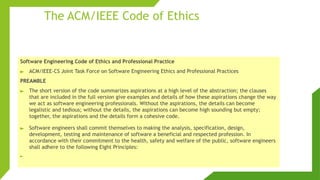
The ACM/IEEE Code of Ethics
Software Engineering Code of Ethics and Professional Practice
► ACM/IEEE-CS Joint Task Force on Software Engineering Ethics and Professional Practices
PREAMBLE
► The short version of the code summarizes aspirations at a high level of the abstraction; the clauses
that are included in the full version give examples and details of how these aspirations change the way
we act as software engineering professionals. Without the aspirations, the details can become
legalistic and tedious; without the details, the aspirations can become high sounding but empty;
together, the aspirations and the details form a cohesive code.
► Software engineers shall commit themselves to making the analysis, specification, design,
development, testing and maintenance of software a beneficial and respected profession. In
accordance with their commitment to the health, safety and welfare of the public, software engineers
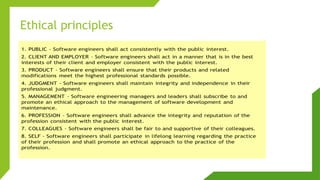
shall adhere to the following Eight Principles:
►
Ethical principles
SOFTWARE PROCESS MODELS
The software process
► A structured set of activities required to develop a software system.
► Many different software processes but all involve:
► Specification – defining what the system should do;
► Design and implementation – defining the organization of the system and
implementing the system;
► Validation – checking that it does what the customer wants;
► Evolution – changing the system in response to changing customer needs.
► A software process model is an abstract representation of a process. It
presents a description of a process from some particular perspective.
Software process descriptions
► When we describe and discuss processes, we usually talk about the activities
in these processes such as specifying a data model, designing a user interface,
etc. and the ordering of these activities.
► Process descriptions may also include:
► Products, which are the outcomes of a process activity;
► Roles, which reflect the responsibilities of the people involved in the process;
► Pre- and post-conditions, which are statements that are true before and after a
process activity has been enacted or a product produced.
Plan-driven and agile processes
► Plan-driven processes are processes where all of the process activities are
planned in advance and progress is measured against this plan.
► In agile processes, planning is incremental and it is easier to change the
process to reflect changing customer requirements.
► In practice, most practical processes include elements of both plan-driven
and agile approaches.
► There are no right or wrong software processes.
Software process models
► The waterfall model
► Plan-driven model. Separate and distinct phases of specification and development.
► Incremental development
► Specification, development and validation are interleaved. May be plan-driven or
agile.
► Reuse-oriented software engineering
► The system is assembled from existing components. May be plan-driven or agile.
► In practice, most large systems are developed using a process that
incorporates elements from all of these models.
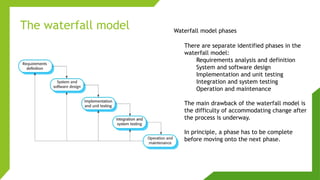
The waterfall model Waterfall model phases
There are separate identified phases in the
waterfall model:
Requirements analysis and definition
System and software design
Implementation and unit testing
Integration and system testing
Operation and maintenance
The main drawback of the waterfall model is
the difficulty of accommodating change after
the process is underway.
In principle, a phase has to be complete
before moving onto the next phase.
Waterfall model problems
► Inflexible partitioning of the project into distinct stages makes it difficult to
respond to changing customer requirements.
► Therefore, this model is only appropriate when the requirements are well-
understood and changes will be fairly limited during the design process.
► Few business systems have stable requirements.
► The waterfall model is mostly used for large systems engineering projects
where a system is developed at several sites.
► In those circumstances, the plan-driven nature of the waterfall model helps
coordinate the work.
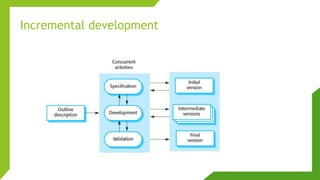
Incremental development
► Incremental Development is based on the idea of developing an initial
implementation, exposing this to user comment and evolving it through
several versions until an adequate system has been developed. Specification,
development and validation activities are interleaved rather than separate,
with rapid feedback across activities.
► It is better for business,e-commerce and software systems.
► The customer can evaluate the system at a relatively early stage in the
development to see if it delivers what is required. If not, then only the
current increment has to be changed and possibly new functionality defined
for later increments.
Incremental development benefits
► The cost of accommodating changing customer requirements is reduced.
► The amount of analysis and documentation that has to be redone is much less than
is required with the waterfall model.
► It is easier to get customer feedback on the development work that has been
done.
► Customers can comment on demonstrations of the software and see how much has
been implemented.
► More rapid delivery and deployment of useful software to the customer is
possible.
► Customers are able to use and gain value from the software earlier than is possible
with a waterfall process.
Incremental development problems
► The process is not visible.
► Managers need regular deliverables to measure progress. If systems are developed
quickly, it is not cost-effective to produce documents that reflect every version of
the system.
► System structure tends to degrade as new increments are added.
► Unless time and money is spent on refactoring to improve the software, regular
change tends to corrupt its structure. Incorporating further software changes
becomes increasingly difficult and costly.
Process activities
► Real software processes are inter-leaved sequences of technical, collaborative and managerial
activities with the overall goal of specifying, designing, implementing and testing a software
system.
► The four basic process activities of specification, development, validation and evolution are
organized differently in different development processes.
► In the waterfall model, they are organized in sequence, whereas in incremental development
they are inter-leaved.
Software specification/requirement
Engg
► The process of establishing and defining what services are required from the
system and identifying the constraints on the system’s operation and
development.
► Is a particularly critical stage of the software process as errors at this stage
inevitably lead to later problems in system design and implementation.
► RE process aims to produce an agreed requirements document that specifies a
system satisfying stakeholder requirements.
► Requirements are presented at two levels: End users and customers need a
high level statement of the requirements; system developers need a more
detailed system specification.
The requirements engineering process
Software specification
► The process of establishing what services are required and the constraints on the system’s operation and
development.
► Requirements engineering process
► Feasibility study
► Is it technically and financially feasible to build the system?
► Developed within the existing budgetary constraints.(cost effective)
► Requirements elicitation and analysis
► What do the system stakeholders require or expect from the system?
► Observations from existing systems, discussions with potential users ,task analysis.
► This may involve the development of one or more models and prototypes
► Requirements specification
► Is the activity of translating the information gathered during the analysis activity into a document
► Two types of requirements
► User requirements :are abstract statements of the system requirements for the customer and end user of the system.
► System requirements are a more detailed description of the functionality to be provided.
► Requirements validation
► Checking the validity of the requirements(consistent/complete)
Software design and implementation
► The process of converting the system specification into an executable system.
► Software design
► Design a software structure that realises the specification;
► Implementation
► Translate this structure into an executable program;
► The activities of design and implementation are closely related and may be
inter-leaved.
Software design and implementation
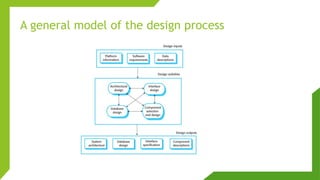
► Software platform-the environment in which software will execute.
► Information about this platform is an essential input to the design process,as
designers must decide how best to integrate it with the software ‘s
environment.
► The requirement specification is the description of the functionality the
software must provide and its performance and dependability requirements.
► If the system is to process existing data, then the description of that data
may be included in the platform specification.
► Otherwise ,the data description must be an input to the design process so
that the system data organization to be defined.
A general model of the design process
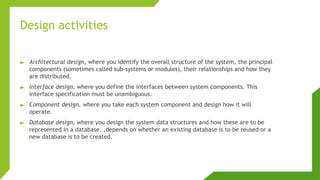
Design activities
► Architectural design, where you identify the overall structure of the system, the principal
components (sometimes called sub-systems or modules), their relationships and how they
are distributed.
► Interface design, where you define the interfaces between system components. This
interface specification must be unambiguous.
► Component design, where you take each system component and design how it will
operate.
► Database design, where you design the system data structures and how these are to be
represented in a database. ,depends on whether an existing database is to be reused or a
new database is to be created.
Design outputs
► System Architecture
► Database Specification
► Interface specification
► Component specification
Software validation
► Verification and validation (V & V) is intended to show that a system
conforms to its specification and meets the requirements of the
system customer.
► Validation involves checking and review processes and system testing.
► System testing involves executing the system with test cases that are
derived from the specification of the real data to be processed by the
system.
► Testing is the most commonly used V & V activity.
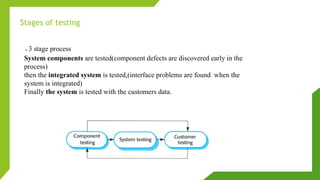
Stages of testing
.3 stage process
System components are tested(component defects are discovered early in the
process)
then the integrated system is tested,(interface problems are found when the
system is integrated)
Finally the system is tested with the customers data.
Testing stages
► Development or component testing
► Individual components are tested independently;
► Components may be functions or objects or coherent groupings of these entities.
► Test automation tools such as JUnit that can rerun component tests when new versions
of the components are created, are commonly used.
► System testing
► Testing of the system as a whole.
► Concerned with showing the system meets its functional and non functional
requirements , Testing of emergent properties is particularly important.
► Acceptance testing(alpha testing)
► This is the final stage in the testing process before the system is accepted for
operational use.
► Testing with customer data to check that the system meets the customer’s needs.
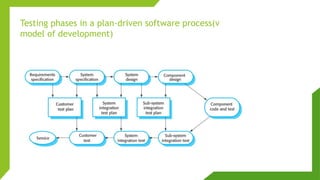
Testing phases in a plan-driven software process(v
model of development)
► Acceptance testing(alpha testing)
► Alpha Testing is a type of software testing performed to identify bugs before releasing the product
to real users or to the public. Alpha Testing is one of the user acceptance testing.
► Custom systems are developed for a single client
► This alpha testing process continues until the system developer and the client agree that the
delivered system is an acceptable implementation of requirements.
Beta testing
⮚ When software is to be marketed as a software product ,beta testing is used.
⮚ Beta Testing is performed by real users of the software application in a real environment.
⮚ This involves delivering a system to a number of potential users who agree to use that system.
⮚ They report problem to system developers.
⮚ This exposes the product to real use and detects errors that may not have been anticipated by the
system builders.
⮚ After this feedback,the system is modified and released either for further beta testing or general
sale.
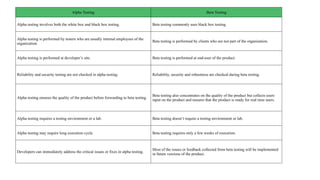
Alpha Testing Beta Testing
Alpha testing involves both the white box and black box testing. Beta testing commonly uses black box testing.
Alpha testing is performed by testers who are usually internal employees of the
organization.
Beta testing is performed by clients who are not part of the organization.
Alpha testing is performed at developer’s site. Beta testing is performed at end-user of the product.
Reliability and security testing are not checked in alpha testing. Reliability, security and robustness are checked during beta testing.
Alpha testing ensures the quality of the product before forwarding to beta testing.
Beta testing also concentrates on the quality of the product but collects users
input on the product and ensures that the product is ready for real time users.
Alpha testing requires a testing environment or a lab. Beta testing doesn’t require a testing environment or lab.
Alpha testing may require long execution cycle. Beta testing requires only a few weeks of execution.
Developers can immediately address the critical issues or fixes in alpha testing.
Most of the issues or feedback collected from beta testing will be implemented
in future versions of the product.
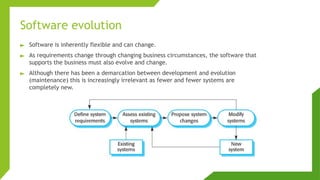
Software evolution
► Software is inherently flexible and can change.
► As requirements change through changing business circumstances, the software that
supports the business must also evolve and change.
► Although there has been a demarcation between development and evolution
(maintenance) this is increasingly irrelevant as fewer and fewer systems are
completely new.
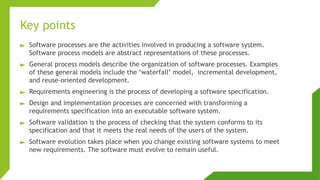
Key points
► Software processes are the activities involved in producing a software system.
Software process models are abstract representations of these processes.
► General process models describe the organization of software processes. Examples
of these general models include the ‘waterfall’ model, incremental development,
and reuse-oriented development.
► Requirements engineering is the process of developing a software specification.
► Design and implementation processes are concerned with transforming a
requirements specification into an executable software system.
► Software validation is the process of checking that the system conforms to its
specification and that it meets the real needs of the users of the system.
► Software evolution takes place when you change existing software systems to meet
new requirements. The software must evolve to remain useful.
Coping with change
► Change is inevitable in all large software projects.
► Business changes lead to new and changed system requirements
► New technologies open up new possibilities for improving implementations
► Changing platforms require application changes
► Change leads to rework so the costs of change include both rework (e.g. re-analyzing
requirements) as well as the costs of implementing new functionality
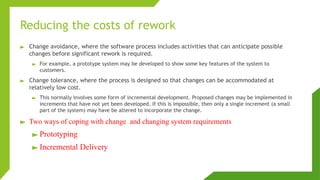
Reducing the costs of rework
► Change avoidance, where the software process includes activities that can anticipate possible
changes before significant rework is required.
► For example, a prototype system may be developed to show some key features of the system to
customers.
► Change tolerance, where the process is designed so that changes can be accommodated at
relatively low cost.
► This normally involves some form of incremental development. Proposed changes may be implemented in
increments that have not yet been developed. If this is impossible, then only a single increment (a small
part of the system) may have be altered to incorporate the change.
► Two ways of coping with change and changing system requirements
► Prototyping
► Incremental Delivery
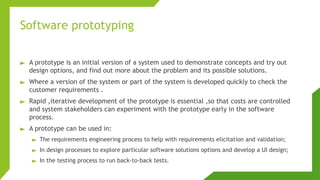
Software prototyping
► A prototype is an initial version of a system used to demonstrate concepts and try out
design options, and find out more about the problem and its possible solutions.
► Where a version of the system or part of the system is developed quickly to check the
customer requirements .
► Rapid ,iterative development of the prototype is essential ,so that costs are controlled
and system stakeholders can experiment with the prototype early in the software
process.
► A prototype can be used in:
► The requirements engineering process to help with requirements elicitation and validation;
► In design processes to explore particular software solutions options and develop a UI design;
► In the testing process to run back-to-back tests.
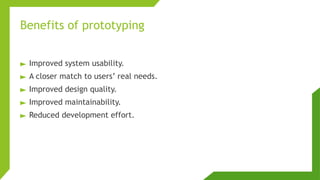
Benefits of prototyping
► Improved system usability.
► A closer match to users’ real needs.
► Improved design quality.
► Improved maintainability.
► Reduced development effort.
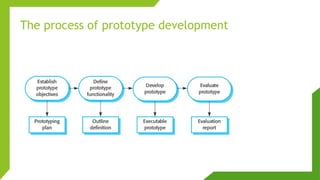
The process of prototype development
Prototype development process
► May be based on rapid prototyping languages or tools
► May involve leaving out functionality
► Prototype should focus on areas of the product that are not well-
understood;
► Error checking and recovery may not be included in the prototype;
► Focus on functional rather than non-functional requirements such as
reliability and security
Throw-away prototypes
► Prototypes should be discarded after development as they are not
a good basis for a production system:
► It may be impossible to tune the system to meet non-functional
requirements;
► Prototypes are normally undocumented;
► The prototype structure is usually degraded through rapid change;
► The prototype probably will not meet normal organizational quality
standards.
Incremental development and delivery
► Incremental development
► Develop the system in increments and evaluate each increment before proceeding to
the development of the next increment;
► Normal approach used in agile methods;
► Evaluation done by user/customer proxy.
► Incremental delivery
► Deploy an increment for use by end-users;
► More realistic evaluation about practical use of software;
► Difficult to implement for replacement systems as increments have less functionality
than the system being replaced.
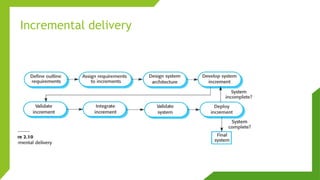
Incremental delivery
Incremental delivery advantages
► Customer value can be delivered with each increment so system
functionality is available earlier.
► Early increments act as a prototype to help elicit requirements for
later increments.
► Lower risk of overall project failure.
► The highest priority system services tend to receive the most
testing.
Incremental delivery problems
► Most systems require a set of basic facilities that are used by different parts
of the system.
► As requirements are not defined in detail until an increment is to be implemented,
it can be hard to identify common facilities that are needed by all increments.
► The essence of iterative processes is that the specification is developed in
conjunction with the software.
► However, this conflicts with the procurement model of many organizations, where
the complete system specification is part of the system development contract.
Boehm’s spiral model
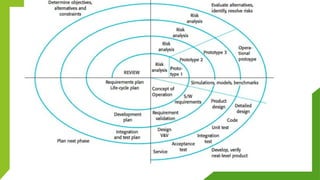
► Process is represented as a spiral rather than as a sequence of activities with
backtracking.
► Each loop in the spiral represents a phase in the process.
► The innermost loop might be concerned with system feasibility, next is requirement
definition, system design,….
► No fixed phases such as specification or design - loops in the spiral are chosen depending
on what is required.
► Risks are explicitly assessed and resolved throughout the process.
Spiral model sectors
► Objective setting
► Specific objectives for the phase are identified.
► Constraints on the process and the product are identified and a detailed management
plan is drawn up.
► Project risks are identified.
► Risk assessment and reduction
► Risks are assessed and activities put in place to reduce the key risks.
► Development and validation
► A development model for the system is chosen which can be any of the generic models.
► Planning
► The project is reviewed and the next phase of the spiral is planned.
Spiral model usage
► Spiral model has been very influential in helping people think about iteration
in software processes and introducing the risk-driven approach to
development.
► In practice, however, the model is rarely used as published for practical
software development.

Management of System Software:Introduction to Software Engineering - Professional software development, Software engineering ethics. Software process models

  • 1.
  • 3.
    MODULE 1 :Introduction to Software Engineering (7 hours) ► 1. Introduction to Software Engineering - Professional software development, Software engineering ethics ► Software process models - The waterfall model, Incremental development. Process activities - Software specification, Software design and implementation, Software validation, Software evolution. Coping with change - Prototyping, Incremental delivery, Boehm's Spiral Model. ► Agile software development - Agile methods, agile manifesto - values and principles. Agile development techniques, Agile Project Management. ► Case studies : An insulin pump control system. Mentcare - a patient information system for mental health care.
  • 4.
    1.1 Professional softwaredevelopment ► Software is not just a program themselves but also all associated documentation and configuration data . ► Software is a collection of computer programs and associated documentation. ► Software products may be designed for a particular customer or developed for general market. ► What is a software Engineering?
  • 5.
    Frequently asked questionsabout software engineering
  • 6.
    Frequently asked questionsabout software engineering Question Answer What are the key challenges facing software engineering? Coping with increasing diversity, demands for reduced delivery times and developing trustworthy software. What are the costs of software engineering? Roughly 60% of software costs are development costs, 40% are testing costs. For custom software, evolution costs often exceed development costs. What are the best software engineering techniques and methods? While all software projects have to be professionally managed and developed, different techniques are appropriate for different types of system. For example, games should always be developed using a series of prototypes whereas safety critical control systems require a complete and analyzable specification to be developed. You can’t, therefore, say that one method is better than another. What differences has the web made to software engineering? The web has led to the availability of software services and the possibility of developing highly distributed service-based systems. Web-based systems development has led to important advances in programming languages and software reuse.
  • 7.
    Software products ► Genericproducts ► Stand-alone systems that are marketed and sold to any customer who wishes to buy them. ► Examples – PC software such as graphics programs, project management tools; CAD software; software for specific markets such as appointments systems for dentists. ► Organization that develops the software controls the software specification. ► Customized products(bespoke) ► Software that is commissioned by a specific customer to meet their own needs. ► Examples – embedded control systems, air traffic control software, traffic monitoring systems. ► Specification is developed and controlled by the organization ie buying the software.
  • 8.
    Essential attributes ofgood software Product characteristic Description Maintainability Software should be written in such a way so that it can evolve to meet the changing needs of customers. This is a critical attribute because software change is an inevitable requirement of a changing business environment. Dependability and security Software dependability includes a range of characteristics including reliability, security and safety. Dependable software should not cause physical or economic damage in the event of system failure. Malicious users should not be able to access or damage the system. Efficiency Software should not make wasteful use of system resources such as memory and processor cycles. Efficiency therefore includes responsiveness, processing time, memory utilisation, etc. Acceptability Software must be acceptable to the type of users for which it is designed. This means that it must be understandable, usable and compatible with other systems that they use.
  • 9.
    1.1.1 Software Engineering ►Software engineering is an engineering discipline that is concerned with all aspects of software production from the early stages of system specification through to maintaining the system after it has gone into use. ► Engineering discipline ► Using appropriate theories and methods to solve problems within the organizational and financial constraints. ► All aspects of software production ► Not just technical process of development. Also project management and the development of tools, methods etc. to support software production.
  • 10.
    ► More andmore, individuals and society rely on advanced software systems. We need to be able to produce reliable and trustworthy systems economically and quickly. ► It is usually cheaper, in the long run, to use software engineering methods and techniques for software systems rather than just write the programs as if it was a personal programming project. For most types of system, the majority of costs are the costs of changing the software after it has gone into use. Importance of software engineering
  • 11.
    Software process activities ►Software specification, where customers and engineers define the software that is to be produced and the constraints on its operation. ► Software development, where the software is designed and programmed. ► Software validation, where the software is checked to ensure that it is what the customer requires. ► Software evolution, where the software is modified to reflect changing customer and market requirements.
  • 12.
    General issues thataffect most software ► Heterogeneity ► Increasingly, systems are required to operate as distributed systems across networks that include different types of computer and mobile devices. ► Business and social change ► Business and society are changing incredibly quickly as emerging economies develop and new technologies become available. They need to be able to change their existing software and to rapidly develop new software. ► Security and trust ► As software is intertwined with all aspects of our lives, it is essential that we can trust that software
  • 13.
    1.1.2 Software Engineeringdiversity ► There are many different types of software system and there is no universal set of software techniques that is applicable to all of these. ► The software engineering methods and tools used depend on the type of application being developed, the requirements of the customer and the background of the development team. Software Engineering fundamentals ► Some fundamental principles apply to all types of software system, irrespective of the development techniques used: ► Systems should be developed using a managed and understood development process. Of course, different processes are used for different types of software. ► Dependability and performance are important for all types of system. ► Understanding and managing the software specification and requirements (what the software should do) are important. ► Where appropriate, you should reuse software that has already been developed rather than write new software.
  • 14.
    Application types ► Stand-aloneapplications ► These are application systems that run on a local computer, such as a PC. They include all necessary functionality and do not need to be connected to a network. ► Interactive transaction-based applications ► Applications that execute on a remote computer and are accessed by users from their own PCs or terminals. These include web applications such as e-commerce applications. ► Embedded control systems ► These are software control systems that control and manage hardware devices. Numerically, there are probably more embedded systems than any other type of system.
  • 15.
    ► Batch processingsystems ► These are business systems that are designed to process data in large batches. They process large numbers of individual inputs to create corresponding outputs. ► Entertainment systems ► These are systems that are primarily for personal use and which are intended to entertain the user. ► Systems for modeling and simulation ► These are systems that are developed by scientists and engineers to model physical processes or situations, which include many, separate, interacting objects. ► Data collection systems ► These are systems that collect data from their environment using a set of sensors and send that data to other systems for processing. ► Systems of systems ► These are systems that are composed of a number of other software systems
  • 16.
    1.1.3 Software Engineeringand the Web ► The Web is now a platform for running application and organizations are increasingly developing web-based systems rather than local systems. ► Web services allow application functionality to be accessed over the web. ► Cloud computing is an approach to the provision of computer services where applications run remotely on the ‘cloud’. ► Users do not buy software buy pay according to use
  • 17.
    Web software Engineering ►Software reuse is the dominant approach for constructing web-based systems. ► When building these systems, you think about how you can assemble them from pre-existing software components and systems. ► Web-based systems should be developed and delivered incrementally. ► It is now generally recognized that it is impractical to specify all the requirements for such systems in advance. ► User interfaces are constrained by the capabilities of web browsers. ► Technologies such as AJAX allow rich interfaces to be created within a web browser but are still difficult to use. Web forms with local scripting are more commonly used.
  • 18.
    1.2 Software engineeringethics ► Software engineering involves wider responsibilities than simply the application of technical skills. ► Software engineers must behave in an honest and ethically responsible way if they are to be respected as professionals. ► Ethical behaviour is more than simply upholding the law but involves following a set of principles that are morally correct.
  • 19.
    Issues of professionalresponsibility ► Confidentiality ► Engineers should normally respect the confidentiality of their employers or clients irrespective of whether or not a formal confidentiality agreement has been signed. ► Competence ► Engineers should not misrepresent their level of competence. They should not knowingly accept work which is outwith their competence. ► Intellectual property rights ► Engineers should be aware of local laws governing the use of intellectual property such as patents, copyright, etc. They should be careful to ensure that the intellectual property of employers and clients is protected. ► Computer misuse ► Software engineers should not use their technical skills to misuse other people’s computers. Computer misuse ranges from relatively trivial (game playing on an employer’s machine, say) to extremely serious (dissemination of viruses).
  • 20.
    ACM/IEEE Code ofEthics ► The professional societies in the US have cooperated to produce a code of ethical practice. ► Members of these organisations sign up to the code of practice when they join. ► The Code contains eight Principles related to the behaviour of and decisions made by professional software engineers, including practitioners, educators, managers, supervisors and policy makers, as well as trainees and students of the profession.
  • 21.
    Rationale for thecode of ethics ► Computers have a central and growing role in commerce, industry, government, medicine, education, entertainment and society at large. Software engineers are those who contribute by direct participation or by teaching, to the analysis, specification, design, development, certification, maintenance and testing of software systems. ► Because of their roles in developing software systems, software engineers have significant opportunities to do good or cause harm, to enable others to do good or cause harm, or to influence others to do good or cause harm. To ensure, as much as possible, that their efforts will be used for good, software engineers must commit themselves to making software engineering a beneficial and respected profession.
  • 22.
    The ACM/IEEE Codeof Ethics Software Engineering Code of Ethics and Professional Practice ► ACM/IEEE-CS Joint Task Force on Software Engineering Ethics and Professional Practices PREAMBLE ► The short version of the code summarizes aspirations at a high level of the abstraction; the clauses that are included in the full version give examples and details of how these aspirations change the way we act as software engineering professionals. Without the aspirations, the details can become legalistic and tedious; without the details, the aspirations can become high sounding but empty; together, the aspirations and the details form a cohesive code. ► Software engineers shall commit themselves to making the analysis, specification, design, development, testing and maintenance of software a beneficial and respected profession. In accordance with their commitment to the health, safety and welfare of the public, software engineers shall adhere to the following Eight Principles: ►
  • 23.
  • 24.
  • 25.
    The software process ►A structured set of activities required to develop a software system. ► Many different software processes but all involve: ► Specification – defining what the system should do; ► Design and implementation – defining the organization of the system and implementing the system; ► Validation – checking that it does what the customer wants; ► Evolution – changing the system in response to changing customer needs. ► A software process model is an abstract representation of a process. It presents a description of a process from some particular perspective.
  • 26.
    Software process descriptions ►When we describe and discuss processes, we usually talk about the activities in these processes such as specifying a data model, designing a user interface, etc. and the ordering of these activities. ► Process descriptions may also include: ► Products, which are the outcomes of a process activity; ► Roles, which reflect the responsibilities of the people involved in the process; ► Pre- and post-conditions, which are statements that are true before and after a process activity has been enacted or a product produced.
  • 27.
    Plan-driven and agileprocesses ► Plan-driven processes are processes where all of the process activities are planned in advance and progress is measured against this plan. ► In agile processes, planning is incremental and it is easier to change the process to reflect changing customer requirements. ► In practice, most practical processes include elements of both plan-driven and agile approaches. ► There are no right or wrong software processes.
  • 28.
    Software process models ►The waterfall model ► Plan-driven model. Separate and distinct phases of specification and development. ► Incremental development ► Specification, development and validation are interleaved. May be plan-driven or agile. ► Reuse-oriented software engineering ► The system is assembled from existing components. May be plan-driven or agile. ► In practice, most large systems are developed using a process that incorporates elements from all of these models.
  • 29.
    The waterfall modelWaterfall model phases There are separate identified phases in the waterfall model: Requirements analysis and definition System and software design Implementation and unit testing Integration and system testing Operation and maintenance The main drawback of the waterfall model is the difficulty of accommodating change after the process is underway. In principle, a phase has to be complete before moving onto the next phase.
  • 30.
    Waterfall model problems ►Inflexible partitioning of the project into distinct stages makes it difficult to respond to changing customer requirements. ► Therefore, this model is only appropriate when the requirements are well- understood and changes will be fairly limited during the design process. ► Few business systems have stable requirements. ► The waterfall model is mostly used for large systems engineering projects where a system is developed at several sites. ► In those circumstances, the plan-driven nature of the waterfall model helps coordinate the work.
  • 31.
  • 32.
    Incremental development ► IncrementalDevelopment is based on the idea of developing an initial implementation, exposing this to user comment and evolving it through several versions until an adequate system has been developed. Specification, development and validation activities are interleaved rather than separate, with rapid feedback across activities. ► It is better for business,e-commerce and software systems. ► The customer can evaluate the system at a relatively early stage in the development to see if it delivers what is required. If not, then only the current increment has to be changed and possibly new functionality defined for later increments.
  • 33.
    Incremental development benefits ►The cost of accommodating changing customer requirements is reduced. ► The amount of analysis and documentation that has to be redone is much less than is required with the waterfall model. ► It is easier to get customer feedback on the development work that has been done. ► Customers can comment on demonstrations of the software and see how much has been implemented. ► More rapid delivery and deployment of useful software to the customer is possible. ► Customers are able to use and gain value from the software earlier than is possible with a waterfall process.
  • 34.
    Incremental development problems ►The process is not visible. ► Managers need regular deliverables to measure progress. If systems are developed quickly, it is not cost-effective to produce documents that reflect every version of the system. ► System structure tends to degrade as new increments are added. ► Unless time and money is spent on refactoring to improve the software, regular change tends to corrupt its structure. Incorporating further software changes becomes increasingly difficult and costly.
  • 35.
    Process activities ► Realsoftware processes are inter-leaved sequences of technical, collaborative and managerial activities with the overall goal of specifying, designing, implementing and testing a software system. ► The four basic process activities of specification, development, validation and evolution are organized differently in different development processes. ► In the waterfall model, they are organized in sequence, whereas in incremental development they are inter-leaved.
  • 36.
    Software specification/requirement Engg ► Theprocess of establishing and defining what services are required from the system and identifying the constraints on the system’s operation and development. ► Is a particularly critical stage of the software process as errors at this stage inevitably lead to later problems in system design and implementation. ► RE process aims to produce an agreed requirements document that specifies a system satisfying stakeholder requirements. ► Requirements are presented at two levels: End users and customers need a high level statement of the requirements; system developers need a more detailed system specification.
  • 37.
  • 38.
    Software specification ► Theprocess of establishing what services are required and the constraints on the system’s operation and development. ► Requirements engineering process ► Feasibility study ► Is it technically and financially feasible to build the system? ► Developed within the existing budgetary constraints.(cost effective) ► Requirements elicitation and analysis ► What do the system stakeholders require or expect from the system? ► Observations from existing systems, discussions with potential users ,task analysis. ► This may involve the development of one or more models and prototypes ► Requirements specification ► Is the activity of translating the information gathered during the analysis activity into a document ► Two types of requirements ► User requirements :are abstract statements of the system requirements for the customer and end user of the system. ► System requirements are a more detailed description of the functionality to be provided. ► Requirements validation ► Checking the validity of the requirements(consistent/complete)
  • 39.
    Software design andimplementation ► The process of converting the system specification into an executable system. ► Software design ► Design a software structure that realises the specification; ► Implementation ► Translate this structure into an executable program; ► The activities of design and implementation are closely related and may be inter-leaved.
  • 40.
    Software design andimplementation ► Software platform-the environment in which software will execute. ► Information about this platform is an essential input to the design process,as designers must decide how best to integrate it with the software ‘s environment. ► The requirement specification is the description of the functionality the software must provide and its performance and dependability requirements. ► If the system is to process existing data, then the description of that data may be included in the platform specification. ► Otherwise ,the data description must be an input to the design process so that the system data organization to be defined.
  • 41.
    A general modelof the design process
  • 42.
    Design activities ► Architecturaldesign, where you identify the overall structure of the system, the principal components (sometimes called sub-systems or modules), their relationships and how they are distributed. ► Interface design, where you define the interfaces between system components. This interface specification must be unambiguous. ► Component design, where you take each system component and design how it will operate. ► Database design, where you design the system data structures and how these are to be represented in a database. ,depends on whether an existing database is to be reused or a new database is to be created.
  • 43.
    Design outputs ► SystemArchitecture ► Database Specification ► Interface specification ► Component specification
  • 44.
    Software validation ► Verificationand validation (V & V) is intended to show that a system conforms to its specification and meets the requirements of the system customer. ► Validation involves checking and review processes and system testing. ► System testing involves executing the system with test cases that are derived from the specification of the real data to be processed by the system. ► Testing is the most commonly used V & V activity.
  • 45.
    Stages of testing .3stage process System components are tested(component defects are discovered early in the process) then the integrated system is tested,(interface problems are found when the system is integrated) Finally the system is tested with the customers data.
  • 46.
    Testing stages ► Developmentor component testing ► Individual components are tested independently; ► Components may be functions or objects or coherent groupings of these entities. ► Test automation tools such as JUnit that can rerun component tests when new versions of the components are created, are commonly used. ► System testing ► Testing of the system as a whole. ► Concerned with showing the system meets its functional and non functional requirements , Testing of emergent properties is particularly important. ► Acceptance testing(alpha testing) ► This is the final stage in the testing process before the system is accepted for operational use. ► Testing with customer data to check that the system meets the customer’s needs.
  • 47.
    Testing phases ina plan-driven software process(v model of development)
  • 48.
    ► Acceptance testing(alphatesting) ► Alpha Testing is a type of software testing performed to identify bugs before releasing the product to real users or to the public. Alpha Testing is one of the user acceptance testing. ► Custom systems are developed for a single client ► This alpha testing process continues until the system developer and the client agree that the delivered system is an acceptable implementation of requirements. Beta testing ⮚ When software is to be marketed as a software product ,beta testing is used. ⮚ Beta Testing is performed by real users of the software application in a real environment. ⮚ This involves delivering a system to a number of potential users who agree to use that system. ⮚ They report problem to system developers. ⮚ This exposes the product to real use and detects errors that may not have been anticipated by the system builders. ⮚ After this feedback,the system is modified and released either for further beta testing or general sale.
  • 49.
    Alpha Testing BetaTesting Alpha testing involves both the white box and black box testing. Beta testing commonly uses black box testing. Alpha testing is performed by testers who are usually internal employees of the organization. Beta testing is performed by clients who are not part of the organization. Alpha testing is performed at developer’s site. Beta testing is performed at end-user of the product. Reliability and security testing are not checked in alpha testing. Reliability, security and robustness are checked during beta testing. Alpha testing ensures the quality of the product before forwarding to beta testing. Beta testing also concentrates on the quality of the product but collects users input on the product and ensures that the product is ready for real time users. Alpha testing requires a testing environment or a lab. Beta testing doesn’t require a testing environment or lab. Alpha testing may require long execution cycle. Beta testing requires only a few weeks of execution. Developers can immediately address the critical issues or fixes in alpha testing. Most of the issues or feedback collected from beta testing will be implemented in future versions of the product.
  • 50.
    Software evolution ► Softwareis inherently flexible and can change. ► As requirements change through changing business circumstances, the software that supports the business must also evolve and change. ► Although there has been a demarcation between development and evolution (maintenance) this is increasingly irrelevant as fewer and fewer systems are completely new.
  • 51.
    Key points ► Softwareprocesses are the activities involved in producing a software system. Software process models are abstract representations of these processes. ► General process models describe the organization of software processes. Examples of these general models include the ‘waterfall’ model, incremental development, and reuse-oriented development. ► Requirements engineering is the process of developing a software specification. ► Design and implementation processes are concerned with transforming a requirements specification into an executable software system. ► Software validation is the process of checking that the system conforms to its specification and that it meets the real needs of the users of the system. ► Software evolution takes place when you change existing software systems to meet new requirements. The software must evolve to remain useful.
  • 52.
    Coping with change ►Change is inevitable in all large software projects. ► Business changes lead to new and changed system requirements ► New technologies open up new possibilities for improving implementations ► Changing platforms require application changes ► Change leads to rework so the costs of change include both rework (e.g. re-analyzing requirements) as well as the costs of implementing new functionality
  • 53.
    Reducing the costsof rework ► Change avoidance, where the software process includes activities that can anticipate possible changes before significant rework is required. ► For example, a prototype system may be developed to show some key features of the system to customers. ► Change tolerance, where the process is designed so that changes can be accommodated at relatively low cost. ► This normally involves some form of incremental development. Proposed changes may be implemented in increments that have not yet been developed. If this is impossible, then only a single increment (a small part of the system) may have be altered to incorporate the change. ► Two ways of coping with change and changing system requirements ► Prototyping ► Incremental Delivery
  • 54.
    Software prototyping ► Aprototype is an initial version of a system used to demonstrate concepts and try out design options, and find out more about the problem and its possible solutions. ► Where a version of the system or part of the system is developed quickly to check the customer requirements . ► Rapid ,iterative development of the prototype is essential ,so that costs are controlled and system stakeholders can experiment with the prototype early in the software process. ► A prototype can be used in: ► The requirements engineering process to help with requirements elicitation and validation; ► In design processes to explore particular software solutions options and develop a UI design; ► In the testing process to run back-to-back tests.
  • 55.
    Benefits of prototyping ►Improved system usability. ► A closer match to users’ real needs. ► Improved design quality. ► Improved maintainability. ► Reduced development effort.
  • 56.
    The process ofprototype development
  • 57.
    Prototype development process ►May be based on rapid prototyping languages or tools ► May involve leaving out functionality ► Prototype should focus on areas of the product that are not well- understood; ► Error checking and recovery may not be included in the prototype; ► Focus on functional rather than non-functional requirements such as reliability and security
  • 58.
    Throw-away prototypes ► Prototypesshould be discarded after development as they are not a good basis for a production system: ► It may be impossible to tune the system to meet non-functional requirements; ► Prototypes are normally undocumented; ► The prototype structure is usually degraded through rapid change; ► The prototype probably will not meet normal organizational quality standards.
  • 59.
    Incremental development anddelivery ► Incremental development ► Develop the system in increments and evaluate each increment before proceeding to the development of the next increment; ► Normal approach used in agile methods; ► Evaluation done by user/customer proxy. ► Incremental delivery ► Deploy an increment for use by end-users; ► More realistic evaluation about practical use of software; ► Difficult to implement for replacement systems as increments have less functionality than the system being replaced.
  • 60.
  • 61.
    Incremental delivery advantages ►Customer value can be delivered with each increment so system functionality is available earlier. ► Early increments act as a prototype to help elicit requirements for later increments. ► Lower risk of overall project failure. ► The highest priority system services tend to receive the most testing.
  • 62.
    Incremental delivery problems ►Most systems require a set of basic facilities that are used by different parts of the system. ► As requirements are not defined in detail until an increment is to be implemented, it can be hard to identify common facilities that are needed by all increments. ► The essence of iterative processes is that the specification is developed in conjunction with the software. ► However, this conflicts with the procurement model of many organizations, where the complete system specification is part of the system development contract.
  • 63.
    Boehm’s spiral model ►Process is represented as a spiral rather than as a sequence of activities with backtracking. ► Each loop in the spiral represents a phase in the process. ► The innermost loop might be concerned with system feasibility, next is requirement definition, system design,…. ► No fixed phases such as specification or design - loops in the spiral are chosen depending on what is required. ► Risks are explicitly assessed and resolved throughout the process.
  • 65.
    Spiral model sectors ►Objective setting ► Specific objectives for the phase are identified. ► Constraints on the process and the product are identified and a detailed management plan is drawn up. ► Project risks are identified. ► Risk assessment and reduction ► Risks are assessed and activities put in place to reduce the key risks. ► Development and validation ► A development model for the system is chosen which can be any of the generic models. ► Planning ► The project is reviewed and the next phase of the spiral is planned.
  • 66.
    Spiral model usage ►Spiral model has been very influential in helping people think about iteration in software processes and introducing the risk-driven approach to development. ► In practice, however, the model is rarely used as published for practical software development.