CloudSecurity
Assessment
Methods
By Aditya Sanjay Chawan
whoami
 Cybersecurity Analyst at Network Intelligence
 1+ year at NII
 Swimming, reading, football and volleyball
 CEH, CCP
Cloudisnotfully
secure!!!
 Despite the various benefits cloud has its drawbacks
 Famous companies like Uber, Sony, Target, Capital
One, Marriott, Dropbox, Equifax have ben hacked
 Attackers are already ahead, what can we do?
 Traditional security approach works??
 Cloud security should come with a different approach
CloudSecurity
Assessment
Methods
 Methods that are used to check the security of your
cloud environment, identify any weaknesses and
vulnerabilities, and provide suggestions to fix those
issues.
 End goal is to identify potential security risks,
vulnerabilities, and misconfigurations and to provide
actionable recommendations.
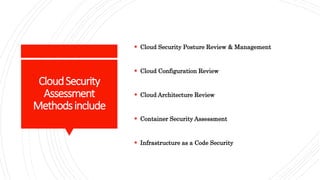
CloudSecurity
Assessment
Methodsinclude
 Cloud Security Posture Review & Management
 Cloud Configuration Review
 Cloud Architecture Review
 Container Security Assessment
 Infrastructure as a Code Security
CloudSecurity
PostureReview
andManagement
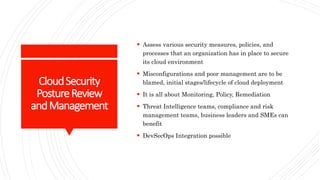
 Assess various security measures, policies, and
processes that an organization has in place to secure
its cloud environment
 Misconfigurations and poor management are to be
blamed, initial stages/lifecycle of cloud deployment
 It is all about Monitoring, Policy, Remediation
 Threat Intelligence teams, compliance and risk
management teams, business leaders and SMEs can
benefit
 DevSecOps Integration possible
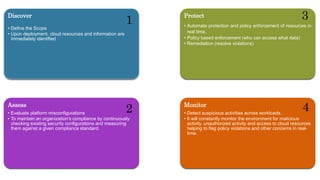
Discover
• Define the Scope
• Upon deployment, cloud resources and information are
immediately identified
Assess
• Evaluate platform misconfigurations
• To maintain an organization’s compliance by continuously
checking existing security configurations and measuring
them against a given compliance standard.
Monitor
• Detect suspicious activities across workloads.
• It will constantly monitor the environment for malicious
activity, unauthorized activity and access to cloud resources
helping to flag policy violations and other concerns in real-
time.
Protect
• Automate protection and policy enforcement of resources in
real time.
• Policy based enforcement (who can access what data)
• Remediation (resolve violations)
1
2
3
4
CloudSecurity
PostureReview
andManagement
 Vulnerabilities include misconfigured S3 bucket, wrong
provisioning of infrastructure due to IaC, lack of good
cloud architects
 Tools include Azure Security Center, DivvyCloud by
Rapid7, CrowdStrike Falcon Horizon, Cloudsploit,
Scoutsuite
Cloud
Configuration
Review
 Configuration is the process of setting minute settings
for elements of a cloud environment to ensure that
they can interoperate and communicate.
 Complexities of cloud environment make configuration
more challenging than on premise
 CIS Benchmarks, PCI DSS, NIST followed (level1 and
level2)
 Everything is an API call
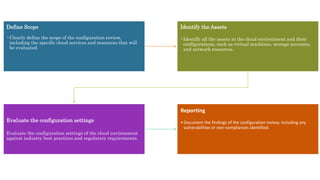
Define Scope
•Clearly define the scope of the configuration review,
including the specific cloud services and resources that will
be evaluated.
Identify the Assets
•Identify all the assets in the cloud environment and their
configurations, such as virtual machines, storage accounts,
and network resources.
Evaluate the configuration settings
Evaluate the configuration settings of the cloud environment
against industry best practices and regulatory requirements.
Reporting
•Document the findings of the configuration review, including any
vulnerabilities or non-compliances identified.
Cloud
Configuration
Review
 Vulnerabilities include insecure key management,
inadequate access control through IAM settings,
overprivileged accounts, inadequate logging and
monitoring, non-compliance
 Tools include AWS Config, Prowler, Microsoft Cloud
App Security, Scoutsuite
Cloud
Architecture
Review
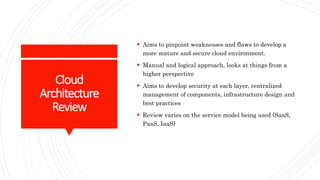
 Aims to pinpoint weaknesses and flaws to develop a
more mature and secure cloud environment.
 Manual and logical approach, looks at things from a
higher perspective
 Aims to develop security at each layer, centralized
management of components, infrastructure design and
best practices
 Review varies on the service model being used (SaaS,
PaaS, IaaS)
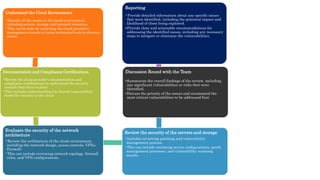
Understand the Cloud Environment
•Identify all the assets in the cloud environment,
including servers, storage, and network resources.
•This can be done by reviewing the cloud provider's
management console or using automated tools to discover
assets.
Documentation and Compliance Certifications
•Review the cloud provider's documentation and
compliance certifications to understand the security
controls they have in place.
•This includes understanding the shared responsibility
model for security in the cloud.
Evaluate the security of the network
architecture
•Review the architecture of the cloud environment,
including the network design, access controls, VPNs,
Firewall.
•This can include reviewing network topology, firewall
rules, and VPN configurations.
Review the security of the servers and storage
•Includes reviewing patching and vulnerability
management process.
•This can include reviewing server configurations, patch
management processes, and vulnerability scanning
results.
Discussion Round with the Team
•Summarize the overall findings of the review, including
any significant vulnerabilities or risks that were
identified.
•Discuss the priority of the issues and recommend the
most critical vulnerabilities to be addressed first
Reporting
•Provide detailed information about any specific issues
that were identified, including the potential impact and
likelihood of them being exploited.
•Provide clear and actionable recommendations for
addressing the identified issues, including any necessary
steps to mitigate or eliminate the vulnerabilities.
Cloud
Architecture
Review
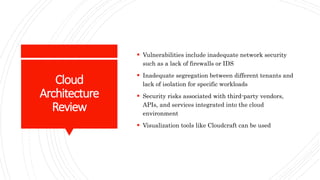
 Vulnerabilities include inadequate network security
such as a lack of firewalls or IDS
 Inadequate segregation between different tenants and
lack of isolation for specific workloads
 Security risks associated with third-party vendors,
APIs, and services integrated into the cloud
environment
 Visualization tools like Cloudcraft can be used
Containerand
Kubernetes
Security
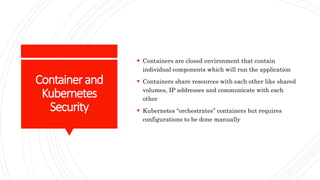
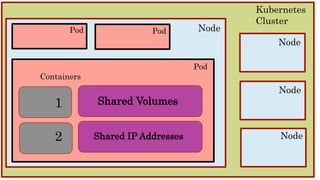
 Containers are closed environment that contain
individual components which will run the application
 Containers share resources with each other like shared
volumes, IP addresses and communicate with each
other
 Kubernetes “orchestrates” containers but requires
configurations to be done manually
Pod
Containers
1
2
Shared Volumes
Shared IP Addresses
Pod
Pod Node
Node
Node
Node
Kubernetes
Cluster
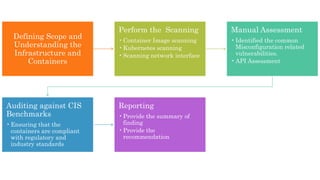
Defining Scope and
Understanding the
Infrastructure and
Containers
Perform the Scanning
•Container Image scanning
•Kubernetes scanning
•Scanning network interface
Manual Assessment
•Identified the common
Misconfiguration related
vulnerabilities.
•API Assessment
Auditing against CIS
Benchmarks
•Ensuring that the
containers are compliant
with regulatory and
industry standards
Reporting
•Provide the summary of
finding
•Provide the
recommendation
Containerand
Kubernetes
Security
 Container breakouts in which escaping the container is
possible, use of insecure image repositories can cause
vulnerabilities, insecure API Server
 Insecure pod and network policies can cause damage,
improper cluster configuration can cause platform
issues, inadequate namespace isolation
 Tools include Kube-bench, Kube-hunter, Terrascan,
Clair, Kube-audit
Infrastructureas
aCodeSecurity
 Infrastructure is managed and deployed using code
rather than manually.
 Declarative vs Imperative
 Chef is for imperative, Terraform and Puppet are for
declarative. Ansible has support for both
 We are looking at Code Review, Code repository
security, Access Control, Backup and Recovery,
Compliance, Encryption, Ghost Resources.
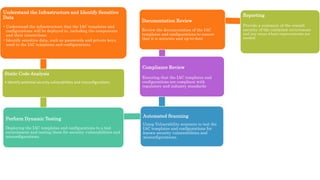
Understand the Infrastructure and Identify Sensitive
Data
•Understand the infrastructure that the IAC templates and
configurations will be deployed to, including the components
and their interactions
•Identify sensitive data, such as passwords and private keys,
used in the IAC templates and configurations.
Static Code Analysis
• Identify potential security vulnerabilities and misconfigurations
Perform Dynamic Testing
Deploying the IAC templates and configurations to a test
environment and testing them for security vulnerabilities and
misconfigurations.
Automated Scanning
Using Vulnerability scanners to test the
IAC templates and configurations for
known security vulnerabilities and
misconfigurations.
Compliance Review
Ensuring that the IAC templates and
configurations are compliant with
regulatory and industry standards
Documentation Review
Review the documentation of the IAC
templates and configurations to ensure
that it is accurate and up-to-date
Reporting
Provide a summary of the overall
security of the container environment
and any areas where improvements are
needed.
Infrastructureas
aCodeSecurity
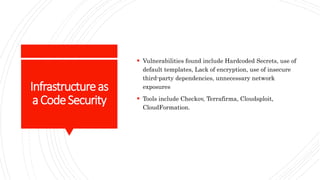
 Vulnerabilities found include Hardcoded Secrets, use of
default templates, Lack of encryption, use of insecure
third-party dependencies, unnecessary network
exposures
 Tools include Checkov, Terrafirma, Cloudsploit,
CloudFormation.
Thank you for your patient
listening

Cloud Security Assessment Methods.pptx

  • 1.
  • 2.
    whoami  Cybersecurity Analystat Network Intelligence  1+ year at NII  Swimming, reading, football and volleyball  CEH, CCP
  • 4.
    Cloudisnotfully secure!!!  Despite thevarious benefits cloud has its drawbacks  Famous companies like Uber, Sony, Target, Capital One, Marriott, Dropbox, Equifax have ben hacked  Attackers are already ahead, what can we do?  Traditional security approach works??  Cloud security should come with a different approach
  • 5.
    CloudSecurity Assessment Methods  Methods thatare used to check the security of your cloud environment, identify any weaknesses and vulnerabilities, and provide suggestions to fix those issues.  End goal is to identify potential security risks, vulnerabilities, and misconfigurations and to provide actionable recommendations.
  • 6.
    CloudSecurity Assessment Methodsinclude  Cloud SecurityPosture Review & Management  Cloud Configuration Review  Cloud Architecture Review  Container Security Assessment  Infrastructure as a Code Security
  • 7.
    CloudSecurity PostureReview andManagement  Assess varioussecurity measures, policies, and processes that an organization has in place to secure its cloud environment  Misconfigurations and poor management are to be blamed, initial stages/lifecycle of cloud deployment  It is all about Monitoring, Policy, Remediation  Threat Intelligence teams, compliance and risk management teams, business leaders and SMEs can benefit  DevSecOps Integration possible
  • 8.
    Discover • Define theScope • Upon deployment, cloud resources and information are immediately identified Assess • Evaluate platform misconfigurations • To maintain an organization’s compliance by continuously checking existing security configurations and measuring them against a given compliance standard. Monitor • Detect suspicious activities across workloads. • It will constantly monitor the environment for malicious activity, unauthorized activity and access to cloud resources helping to flag policy violations and other concerns in real- time. Protect • Automate protection and policy enforcement of resources in real time. • Policy based enforcement (who can access what data) • Remediation (resolve violations) 1 2 3 4
  • 9.
    CloudSecurity PostureReview andManagement  Vulnerabilities includemisconfigured S3 bucket, wrong provisioning of infrastructure due to IaC, lack of good cloud architects  Tools include Azure Security Center, DivvyCloud by Rapid7, CrowdStrike Falcon Horizon, Cloudsploit, Scoutsuite
  • 10.
    Cloud Configuration Review  Configuration isthe process of setting minute settings for elements of a cloud environment to ensure that they can interoperate and communicate.  Complexities of cloud environment make configuration more challenging than on premise  CIS Benchmarks, PCI DSS, NIST followed (level1 and level2)  Everything is an API call
  • 11.
    Define Scope •Clearly definethe scope of the configuration review, including the specific cloud services and resources that will be evaluated. Identify the Assets •Identify all the assets in the cloud environment and their configurations, such as virtual machines, storage accounts, and network resources. Evaluate the configuration settings Evaluate the configuration settings of the cloud environment against industry best practices and regulatory requirements. Reporting •Document the findings of the configuration review, including any vulnerabilities or non-compliances identified.
  • 12.
    Cloud Configuration Review  Vulnerabilities includeinsecure key management, inadequate access control through IAM settings, overprivileged accounts, inadequate logging and monitoring, non-compliance  Tools include AWS Config, Prowler, Microsoft Cloud App Security, Scoutsuite
  • 13.
    Cloud Architecture Review  Aims topinpoint weaknesses and flaws to develop a more mature and secure cloud environment.  Manual and logical approach, looks at things from a higher perspective  Aims to develop security at each layer, centralized management of components, infrastructure design and best practices  Review varies on the service model being used (SaaS, PaaS, IaaS)
  • 14.
    Understand the CloudEnvironment •Identify all the assets in the cloud environment, including servers, storage, and network resources. •This can be done by reviewing the cloud provider's management console or using automated tools to discover assets. Documentation and Compliance Certifications •Review the cloud provider's documentation and compliance certifications to understand the security controls they have in place. •This includes understanding the shared responsibility model for security in the cloud. Evaluate the security of the network architecture •Review the architecture of the cloud environment, including the network design, access controls, VPNs, Firewall. •This can include reviewing network topology, firewall rules, and VPN configurations. Review the security of the servers and storage •Includes reviewing patching and vulnerability management process. •This can include reviewing server configurations, patch management processes, and vulnerability scanning results. Discussion Round with the Team •Summarize the overall findings of the review, including any significant vulnerabilities or risks that were identified. •Discuss the priority of the issues and recommend the most critical vulnerabilities to be addressed first Reporting •Provide detailed information about any specific issues that were identified, including the potential impact and likelihood of them being exploited. •Provide clear and actionable recommendations for addressing the identified issues, including any necessary steps to mitigate or eliminate the vulnerabilities.
  • 15.
    Cloud Architecture Review  Vulnerabilities includeinadequate network security such as a lack of firewalls or IDS  Inadequate segregation between different tenants and lack of isolation for specific workloads  Security risks associated with third-party vendors, APIs, and services integrated into the cloud environment  Visualization tools like Cloudcraft can be used
  • 16.
    Containerand Kubernetes Security  Containers areclosed environment that contain individual components which will run the application  Containers share resources with each other like shared volumes, IP addresses and communicate with each other  Kubernetes “orchestrates” containers but requires configurations to be done manually
  • 17.
    Pod Containers 1 2 Shared Volumes Shared IPAddresses Pod Pod Node Node Node Node Kubernetes Cluster
  • 18.
    Defining Scope and Understandingthe Infrastructure and Containers Perform the Scanning •Container Image scanning •Kubernetes scanning •Scanning network interface Manual Assessment •Identified the common Misconfiguration related vulnerabilities. •API Assessment Auditing against CIS Benchmarks •Ensuring that the containers are compliant with regulatory and industry standards Reporting •Provide the summary of finding •Provide the recommendation
  • 19.
    Containerand Kubernetes Security  Container breakoutsin which escaping the container is possible, use of insecure image repositories can cause vulnerabilities, insecure API Server  Insecure pod and network policies can cause damage, improper cluster configuration can cause platform issues, inadequate namespace isolation  Tools include Kube-bench, Kube-hunter, Terrascan, Clair, Kube-audit
  • 20.
    Infrastructureas aCodeSecurity  Infrastructure ismanaged and deployed using code rather than manually.  Declarative vs Imperative  Chef is for imperative, Terraform and Puppet are for declarative. Ansible has support for both  We are looking at Code Review, Code repository security, Access Control, Backup and Recovery, Compliance, Encryption, Ghost Resources.
  • 21.
    Understand the Infrastructureand Identify Sensitive Data •Understand the infrastructure that the IAC templates and configurations will be deployed to, including the components and their interactions •Identify sensitive data, such as passwords and private keys, used in the IAC templates and configurations. Static Code Analysis • Identify potential security vulnerabilities and misconfigurations Perform Dynamic Testing Deploying the IAC templates and configurations to a test environment and testing them for security vulnerabilities and misconfigurations. Automated Scanning Using Vulnerability scanners to test the IAC templates and configurations for known security vulnerabilities and misconfigurations. Compliance Review Ensuring that the IAC templates and configurations are compliant with regulatory and industry standards Documentation Review Review the documentation of the IAC templates and configurations to ensure that it is accurate and up-to-date Reporting Provide a summary of the overall security of the container environment and any areas where improvements are needed.
  • 22.
    Infrastructureas aCodeSecurity  Vulnerabilities foundinclude Hardcoded Secrets, use of default templates, Lack of encryption, use of insecure third-party dependencies, unnecessary network exposures  Tools include Checkov, Terrafirma, Cloudsploit, CloudFormation.
  • 23.
    Thank you foryour patient listening