Cloud Mobility
Presented By:
YogendraTamang MSCS/070/670
Uttam Man Karmacharya MSCS/070/669
MSc(Computer Systems and Knowledge Engineering), IOE, Pulchowk
Outline
1. Introduction
2. The Business Problem
3. Mobile Enterprise Application Platforms
4. Mobile Application Architecture Overview
5. Summary
Introduction
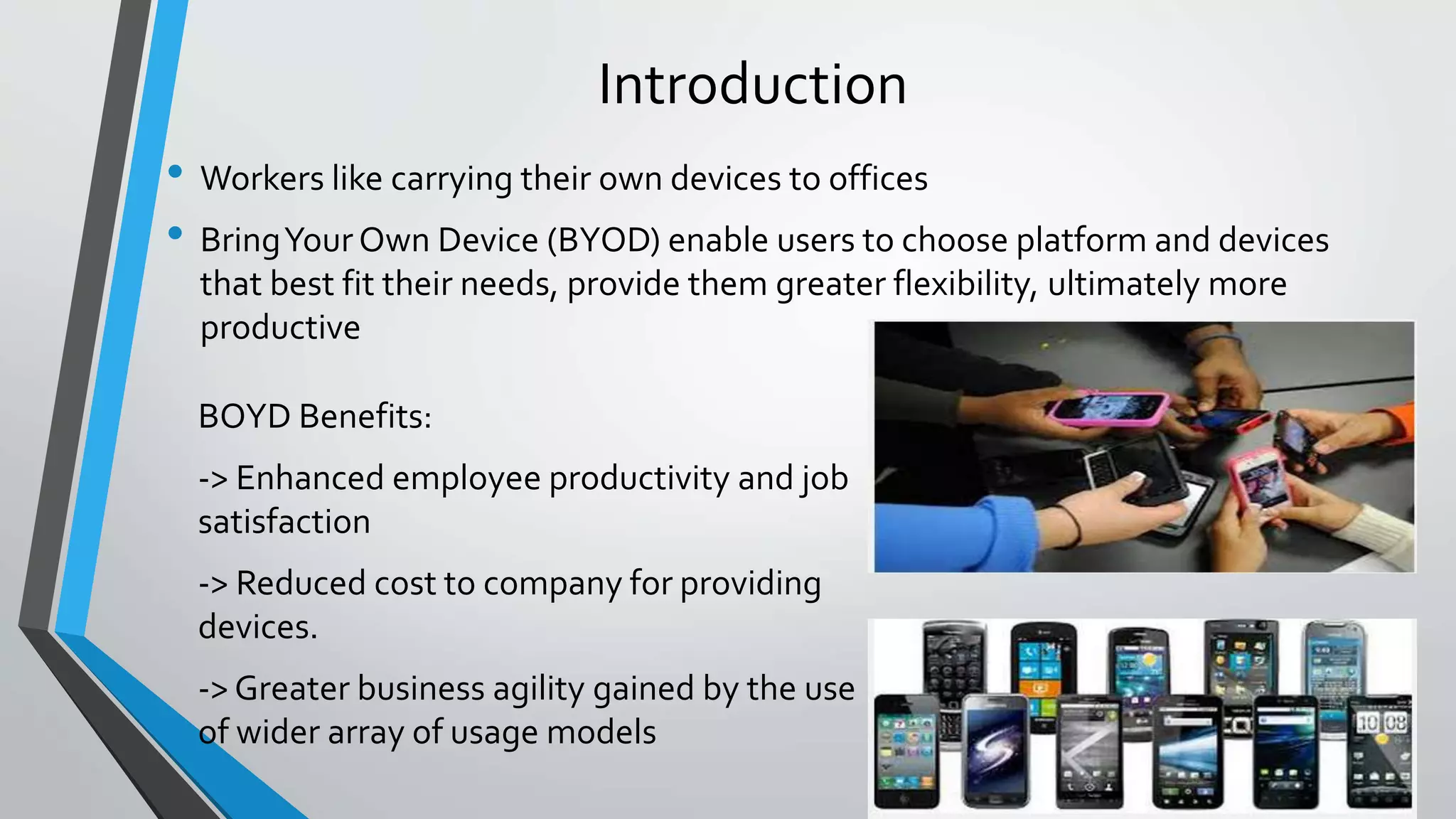
• Workers like carrying their own devices to offices
• BringYour Own Device (BYOD) enable users to choose platform and devices
that best fit their needs, provide them greater flexibility, ultimately more
productive
BOYD Benefits:
-> Enhanced employee productivity and job
satisfaction
-> Reduced cost to company for providing
devices.
-> Greater business agility gained by the use
of wider array of usage models
Introduction
• Companies are using mobile application
to get better business dexterity and
deliver greater customer values.
• To spread idea of mobility expand the
reach of mobility, enterprise require
design and approach that allow a
comprehensive view and integrate
mobility as fundamental fraction of
Enterprise Architecture
Business Problem
• Spent a lot to rationalize their business
process and their support systems on
ERP to various business intelligence
systems
• Fruition of business progression is to
mobilize both domestic and peripheral
devices like phones, pads, iPods, nodes
etc.
Business Problem
1. Segregate systems/Data and Intangible Business Process
Able to segregate process from each other
2.Security and Access Control
Securities like authorization, authentication, and data encryption are
obligatory
3. Amalgamation
No application can exist in aggregation
Enterprise systems are connected and amalgamate through data.
Standards based amalgamation and integrations
Business Problem
4. Elasticity
• Enterprise should be available to ever-
increasing mobile devices over time.
5. Support
• Different Operations Systems
6. Infrastructure
• Availability of various infrastructure services
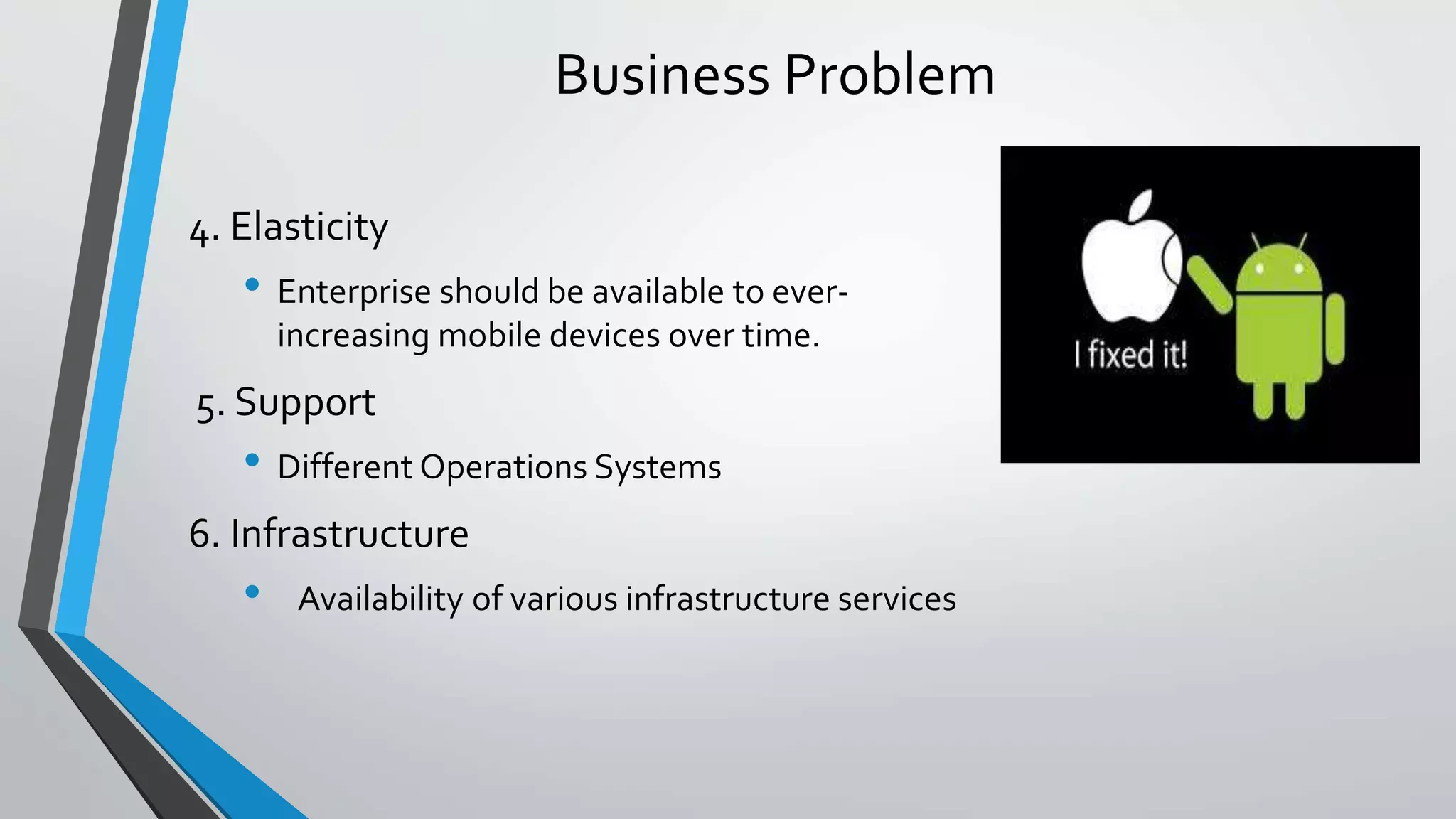
Mobile EnterpriseApplication Platform
• Performs and promotes “Any Mobile Application to Any
Device”
• Key Elements:
Mobile Devices
Middle-Ware
ManagementToolkit
Application Development Environment
Resource Integration Framework
Mobile EnterpriseApplication Platform
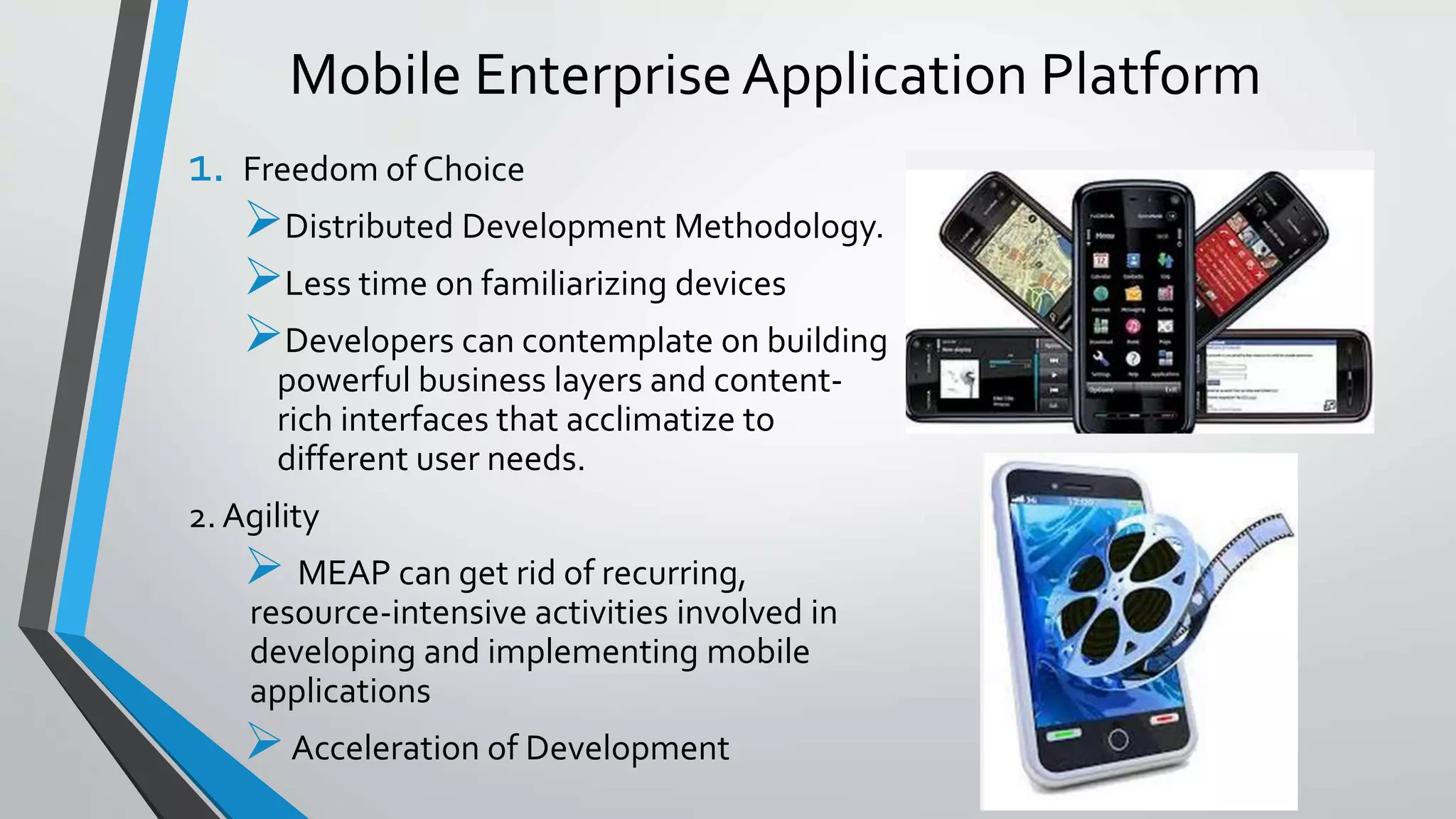
1. Freedom of Choice
Distributed Development Methodology.
Less time on familiarizing devices
Developers can contemplate on building
powerful business layers and content-
rich interfaces that acclimatize to
different user needs.
2. Agility
 MEAP can get rid of recurring,
resource-intensive activities involved in
developing and implementing mobile
applications
Acceleration of Development
Mobile EnterpriseApplication Platform
1. Feature Rich
2. Robust connectivity
Use of Prebuilt Application Integrators
3. Off-Line On Premise integration to Business
Processes with clients
 Applications can work separately of a
master server connection.
Updates are pushed when mobile devices
reconnect to the network.
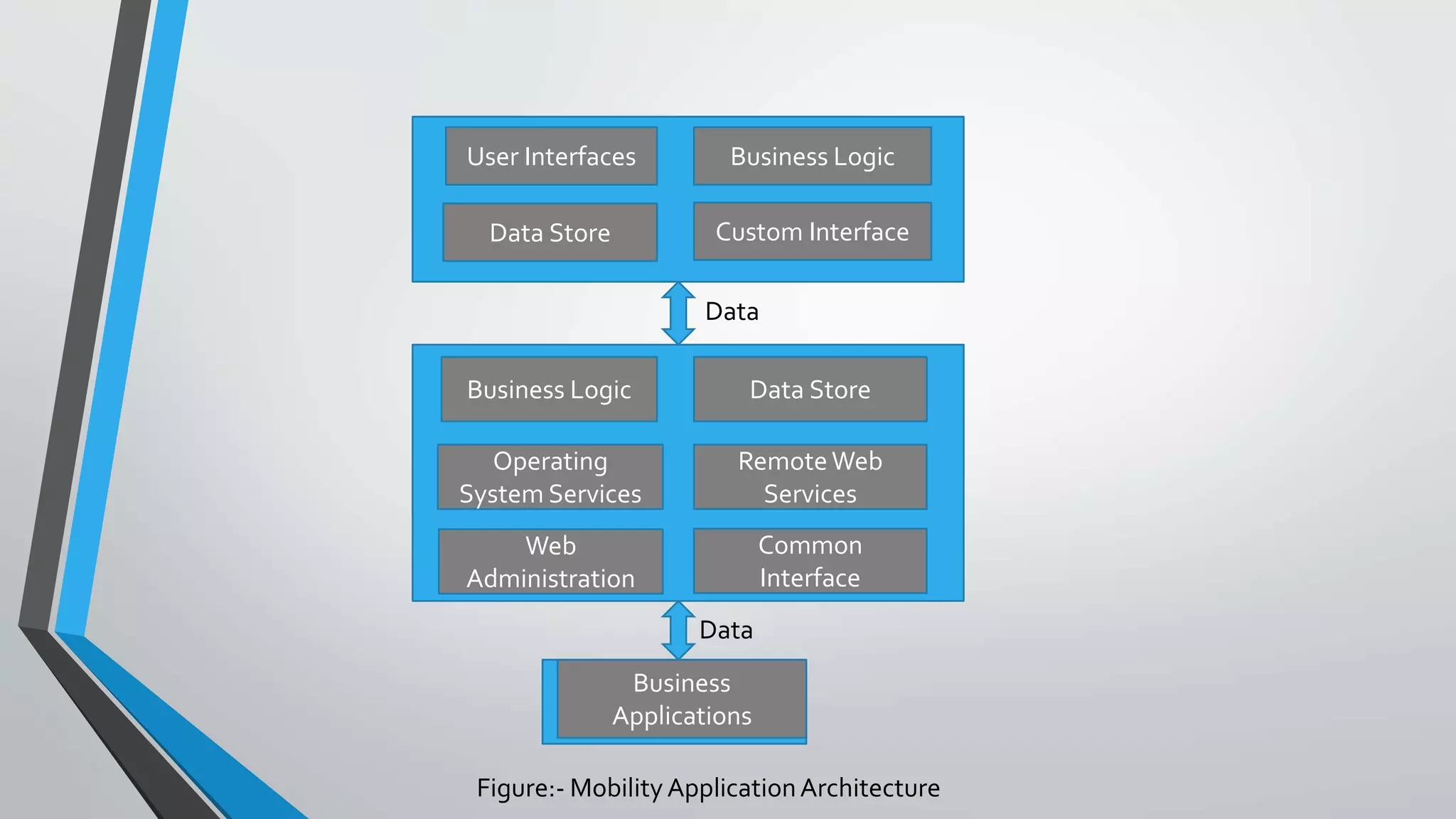
Mobile Application Architecture
Three major parts of the mobile architecture are:
An Enterprise System
Middleware
Handheld App
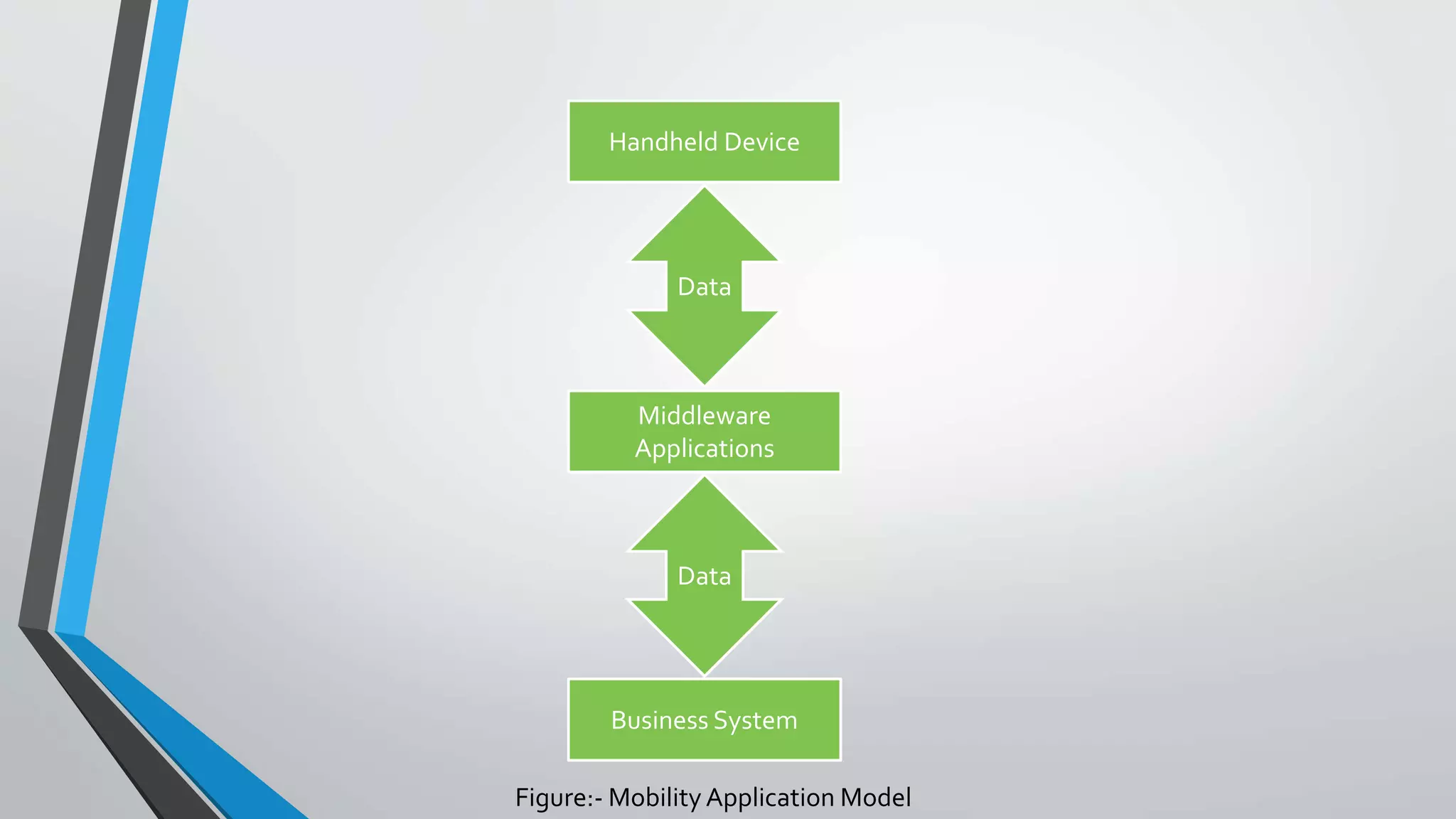
Middleware
Applications
Handheld Device
Business System
Data
Data
Figure:- Mobility Application Model
Figure:- Mobility ApplicationArchitecture
User Interfaces Business Logic
Custom InterfaceData Store
Business Logic Data Store
RemoteWeb
Services
Operating
System Services
Common
Interface
Web
Administration
Business
Applications
Data
Data
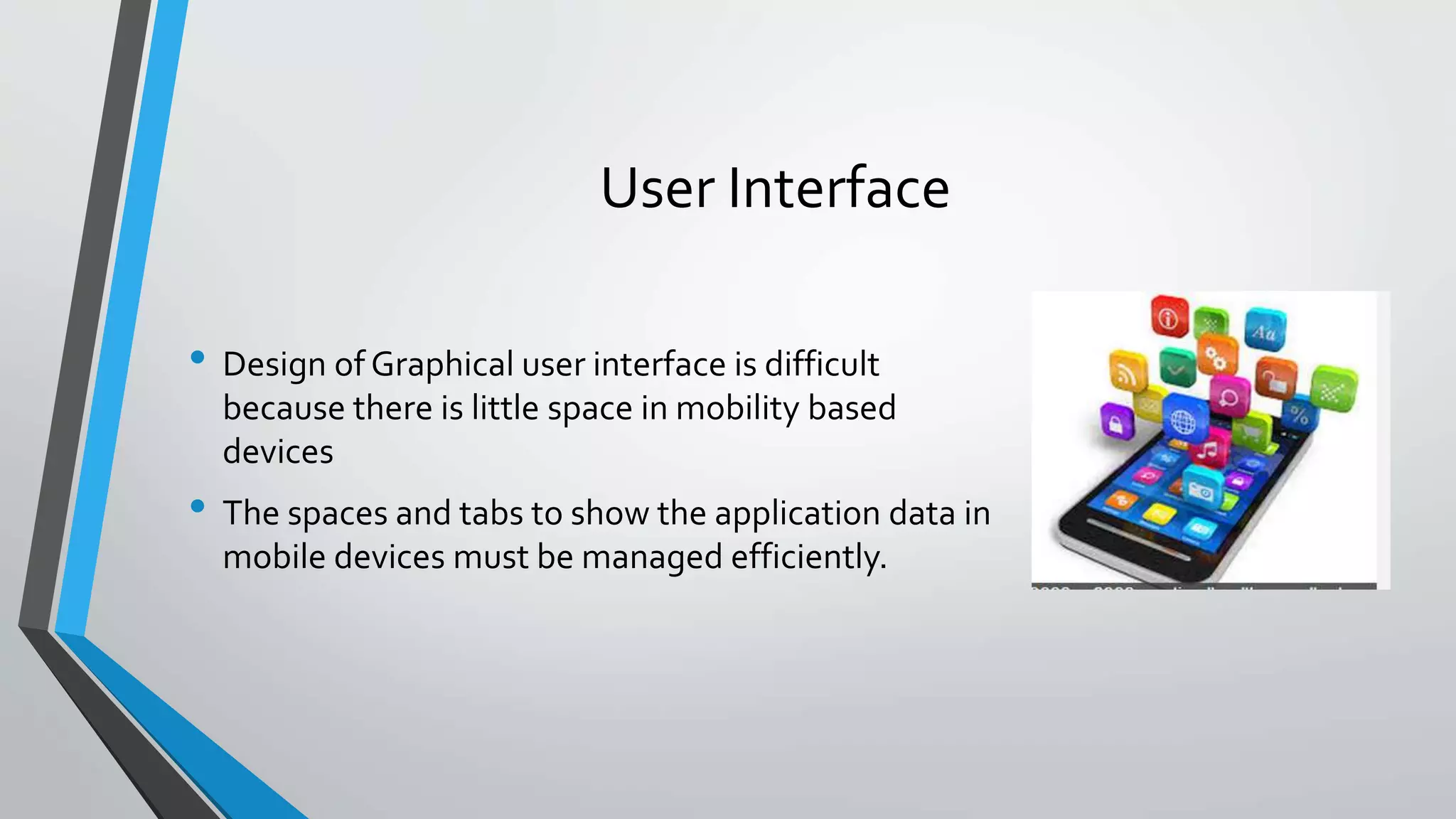
User Interface
• Design of Graphical user interface is difficult
because there is little space in mobility based
devices
• The spaces and tabs to show the application data in
mobile devices must be managed efficiently.
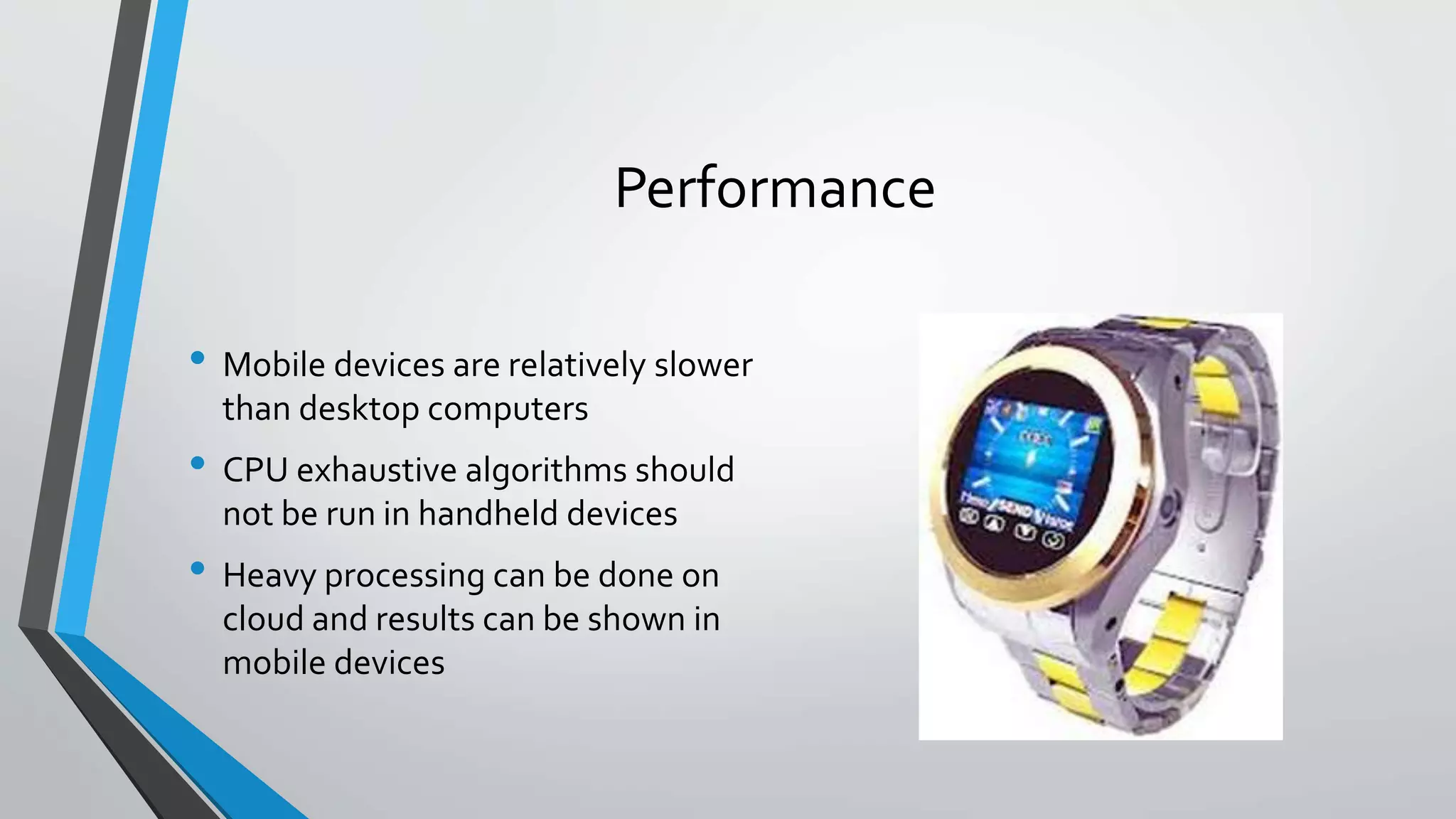
Performance
• Mobile devices are relatively slower
than desktop computers
• CPU exhaustive algorithms should
not be run in handheld devices
• Heavy processing can be done on
cloud and results can be shown in
mobile devices
Memory Management
• Most mobile computing devices
come with limited memory
• Huge data storage in handheld
devices should be minimized
• Huge storage can be stored on
cloud
Security
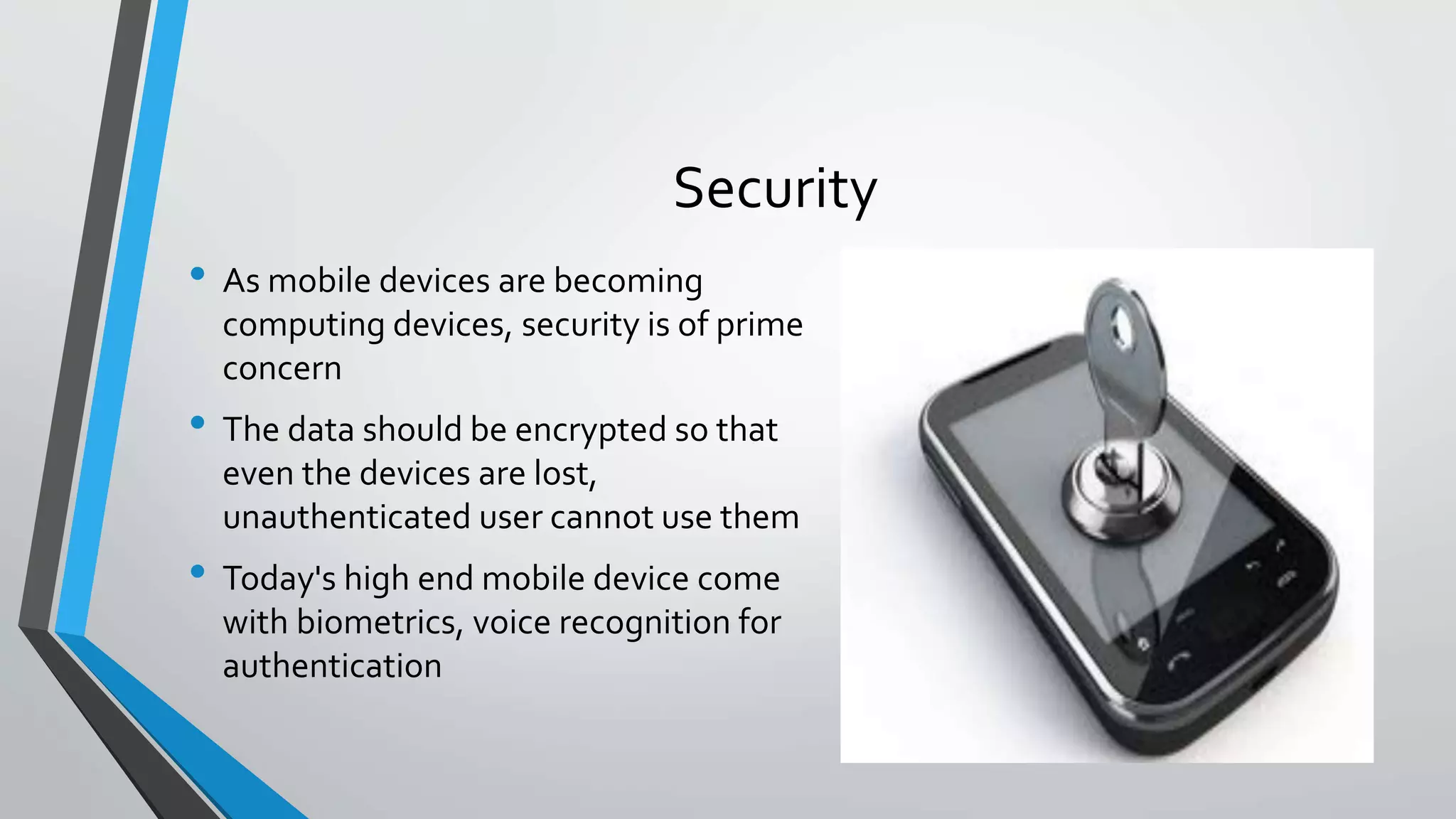
• As mobile devices are becoming
computing devices, security is of prime
concern
• The data should be encrypted so that
even the devices are lost,
unauthenticated user cannot use them
• Today's high end mobile device come
with biometrics, voice recognition for
authentication
Summary
• Handling serious tasks and decision
making in real-time.
• Quick and well organized operations
• Vital information and dealings on mobile
devices.

Cloud mobility final

  • 1.
    Cloud Mobility Presented By: YogendraTamangMSCS/070/670 Uttam Man Karmacharya MSCS/070/669 MSc(Computer Systems and Knowledge Engineering), IOE, Pulchowk
  • 2.
    Outline 1. Introduction 2. TheBusiness Problem 3. Mobile Enterprise Application Platforms 4. Mobile Application Architecture Overview 5. Summary
  • 3.
    Introduction • Workers likecarrying their own devices to offices • BringYour Own Device (BYOD) enable users to choose platform and devices that best fit their needs, provide them greater flexibility, ultimately more productive BOYD Benefits: -> Enhanced employee productivity and job satisfaction -> Reduced cost to company for providing devices. -> Greater business agility gained by the use of wider array of usage models
  • 4.
    Introduction • Companies areusing mobile application to get better business dexterity and deliver greater customer values. • To spread idea of mobility expand the reach of mobility, enterprise require design and approach that allow a comprehensive view and integrate mobility as fundamental fraction of Enterprise Architecture
  • 5.
    Business Problem • Spenta lot to rationalize their business process and their support systems on ERP to various business intelligence systems • Fruition of business progression is to mobilize both domestic and peripheral devices like phones, pads, iPods, nodes etc.
  • 6.
    Business Problem 1. Segregatesystems/Data and Intangible Business Process Able to segregate process from each other 2.Security and Access Control Securities like authorization, authentication, and data encryption are obligatory 3. Amalgamation No application can exist in aggregation Enterprise systems are connected and amalgamate through data. Standards based amalgamation and integrations
  • 7.
    Business Problem 4. Elasticity •Enterprise should be available to ever- increasing mobile devices over time. 5. Support • Different Operations Systems 6. Infrastructure • Availability of various infrastructure services
  • 8.
    Mobile EnterpriseApplication Platform •Performs and promotes “Any Mobile Application to Any Device” • Key Elements: Mobile Devices Middle-Ware ManagementToolkit Application Development Environment Resource Integration Framework
  • 9.
    Mobile EnterpriseApplication Platform 1.Freedom of Choice Distributed Development Methodology. Less time on familiarizing devices Developers can contemplate on building powerful business layers and content- rich interfaces that acclimatize to different user needs. 2. Agility  MEAP can get rid of recurring, resource-intensive activities involved in developing and implementing mobile applications Acceleration of Development
  • 10.
    Mobile EnterpriseApplication Platform 1.Feature Rich 2. Robust connectivity Use of Prebuilt Application Integrators 3. Off-Line On Premise integration to Business Processes with clients  Applications can work separately of a master server connection. Updates are pushed when mobile devices reconnect to the network.
  • 11.
    Mobile Application Architecture Threemajor parts of the mobile architecture are: An Enterprise System Middleware Handheld App
  • 12.
  • 13.
    Figure:- Mobility ApplicationArchitecture UserInterfaces Business Logic Custom InterfaceData Store Business Logic Data Store RemoteWeb Services Operating System Services Common Interface Web Administration Business Applications Data Data
  • 14.
    User Interface • Designof Graphical user interface is difficult because there is little space in mobility based devices • The spaces and tabs to show the application data in mobile devices must be managed efficiently.
  • 15.
    Performance • Mobile devicesare relatively slower than desktop computers • CPU exhaustive algorithms should not be run in handheld devices • Heavy processing can be done on cloud and results can be shown in mobile devices
  • 16.
    Memory Management • Mostmobile computing devices come with limited memory • Huge data storage in handheld devices should be minimized • Huge storage can be stored on cloud
  • 17.
    Security • As mobiledevices are becoming computing devices, security is of prime concern • The data should be encrypted so that even the devices are lost, unauthenticated user cannot use them • Today's high end mobile device come with biometrics, voice recognition for authentication
  • 18.
    Summary • Handling serioustasks and decision making in real-time. • Quick and well organized operations • Vital information and dealings on mobile devices.