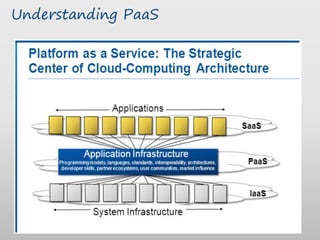
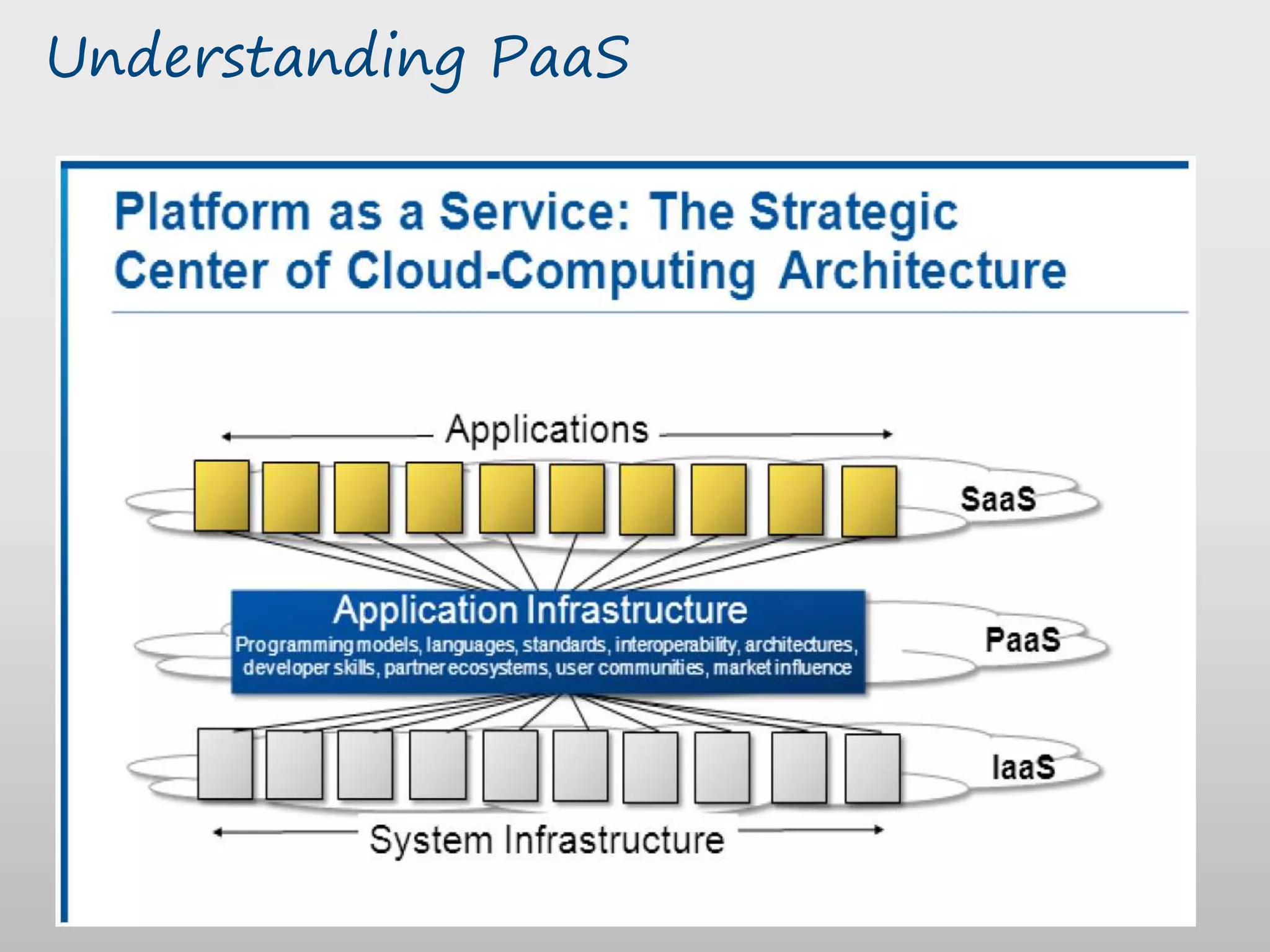
Understanding PaaS
Cloud Foundry - Open PaaS
• Open Source
• Multi-Language, Multi-Framework,Multi Application services,
Multi-cloud.
• Cloud Portability
• Cloud Foundry is both
. deployment destination
. layer that allows deployment to a choice
of clouds, both public and private.
Cloud Foundry - Introduction
• Cloud Foundry Open Source Software (OSS)
Available to anyone - see http://cloudfoundry.org.
CertifiedCloud Foundry Providers : https://www.cloudfoundry.org/certified-platforms/
• Pivotal Cloud Foundry (Pivotal CF) which is a commercial product available from Pivotal. It provides
extra tools for installation andadministrationnot included in the OSS product.
• Pivotal Web Services PWS http://run.pivotal.io/, which is an instance of Pivotal Cloud Foundry hosted
on Amazon Web Services (AWS).
• The following services are available to Pivotal CF and on PWS:
Data Storage: MySQL, PostgreSQL, MongoDB, Redis, Riak, DataStax (Cassandra), Neo4J, Pivotal HD (Hadoop) and a
lot more
Messaging: Pivotal RabbitMQ
Why Cloud Foundry?
• PaaS platform solution should be available on top of any cloud and not just locked into a
specific one”
• Cloud Foundry accelerates this application deployment. It fully automates not only initial
infrastructure, but also ongoing life cycle events.
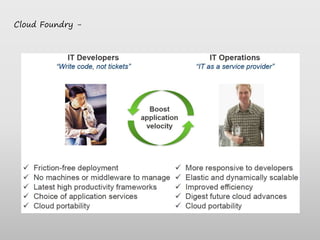
• With Cloud Foundry, developers can focus on the application code
• huge efficiency is gained from infrastructure automation, scaling and management
• To focus on app innovation not on infrastructure management and scaling
• multi cloud portability. Cloud Foundry is a future proof eco system
• Ultimately, Cloud Foundry makes both application build and run in extremely scalable,
fast and extensible way giving you the speeds you need to iterate in weeks for your
company to be more innovative, competitive and profitable.
Cloud Foundry -
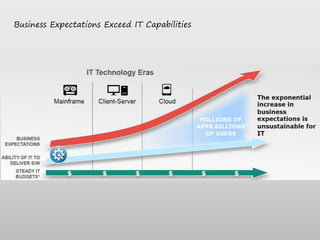
Business Expectations Exceed IT Capabilities
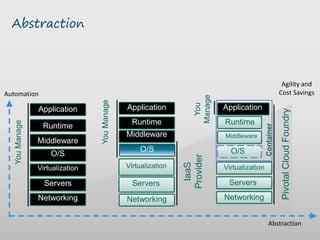
Abstraction
Abstraction
Agility and
Cost Savings
StorageServers
Networking
O/S
Middleware
Virtualization
DataApplication
Runtime
YouManage
O/S
Servers
Networking
Middleware
Virtualization
DataApplication
Runtime
YouManage
IaaS
ProviderYou
Manage
O/S
Servers
Networking
Middleware
Virtualization
DataApplication
Runtime
PivotalCloudFoundry
Container
Automation
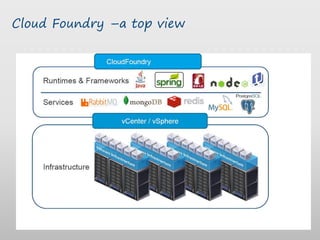
Cloud Foundry –a top view
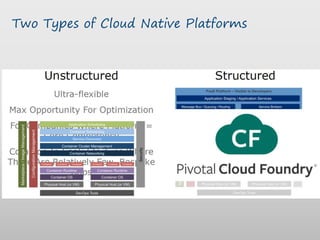
Two Types of Cloud Native Platforms
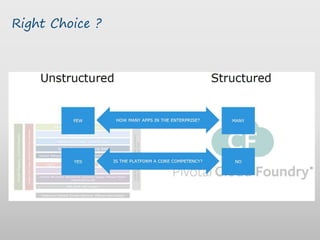
Right Choice ?
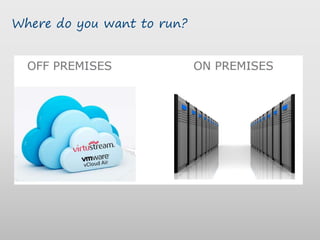
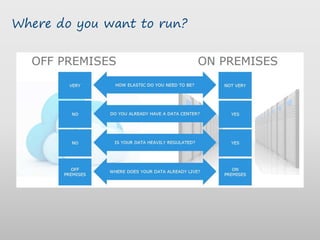
Where do you want to run?
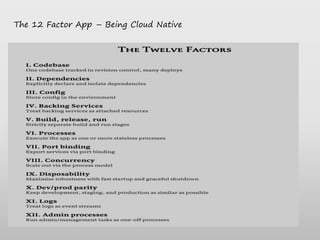
The 12 Factor App – Being Cloud Native
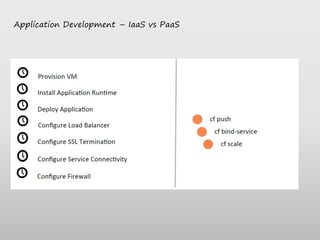
Application Development – IaaS vs PaaS
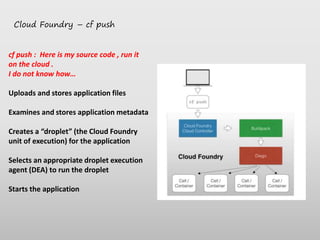
Cloud Foundry – cf push
cf push : Here is my source code , run it
on the cloud .
I do not know how…
Uploads and stores application files
Examines and stores application metadata
Creates a “droplet” (the Cloud Foundry
unit of execution) for the application
Selects an appropriate droplet execution
agent (DEA) to run the droplet
Starts the application
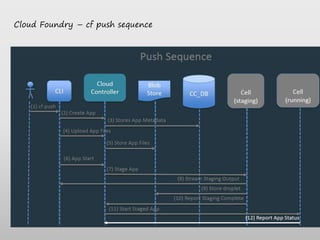
Cloud Foundry – cf push sequence
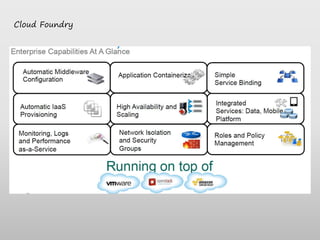
Cloud Foundry
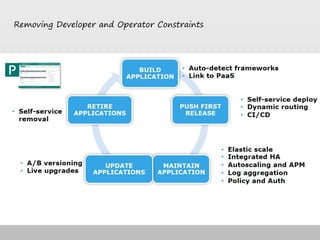
Removing Developer and Operator Constraints
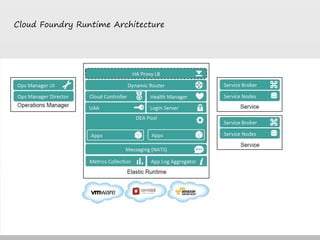
Cloud Foundry Runtime Architecture
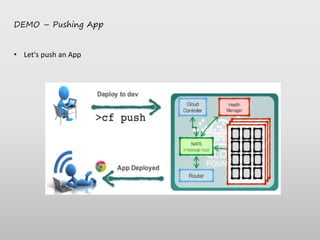
DEMO – Pushing App
• Let's push an App
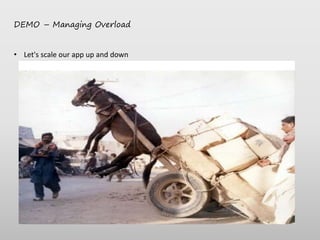
DEMO – Managing Overload
• Let's scale our app up and down
Integrating docker with Cloud Foundry
They both solve one problem i.e. Ship and Deploy the software
But They are completely Different .
Cloud Foundry has all the stuff around it such as combining services ,health
monitoring , load balancing , scaling and so it is a bit complex than docker.
Docker is pretty light weight , allows to create container for application , use it and
ship it wherever you want to.
So Let’s see if we use them together , what the use case can be ………
Solution to deploy docker container in Cloud Foundry
1. Docker Buildpack
2. Docker Service Provider
3. Cloud Rocker
4. Diego
5. Lattice
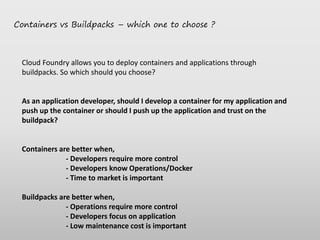
Containers vs Buildpacks – which one to choose ?
Cloud Foundry allows you to deploy containers and applications through
buildpacks. So which should you choose?
As an application developer, should I develop a container for my application and
push up the container or should I push up the application and trust on the
buildpack?
Containers are better when,
- Developers require more control
- Developers know Operations/Docker
- Time to market is important
Buildpacks are better when,
- Operations require more control
- Developers focus on application
- Low maintenance cost is important
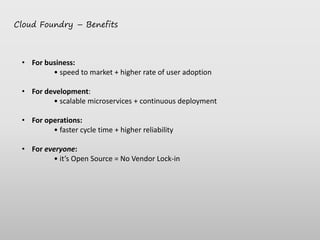
Cloud Foundry – Benefits
• For business:
• speed to market + higher rate of user adoption
• For development:
• scalable microservices + continuous deployment
• For operations:
• faster cycle time + higher reliability
• For everyone:
• it’s Open Source = No Vendor Lock-in
Thank you
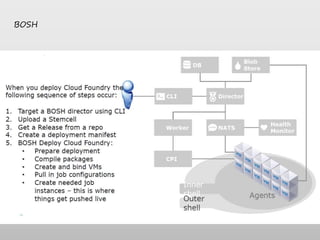
BOSH
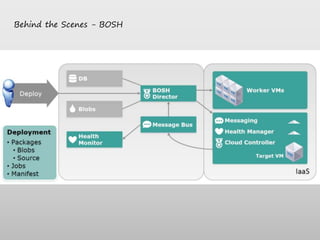
Behind the Scenes - BOSH
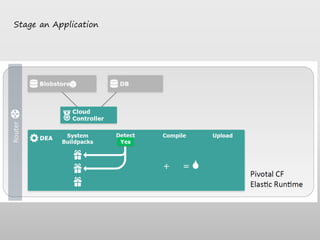
Stage an Application
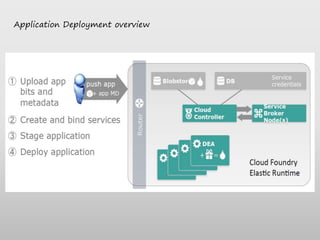
Application Deployment overview
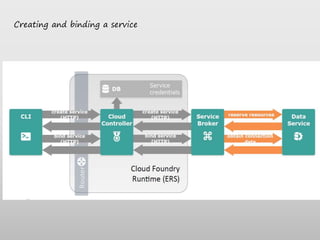
Creating and binding a service
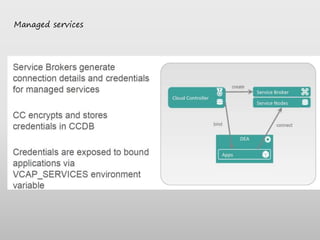
Managed services

Cloud foundry

  • 1.
  • 2.
    Cloud Foundry -Open PaaS • Open Source • Multi-Language, Multi-Framework,Multi Application services, Multi-cloud. • Cloud Portability • Cloud Foundry is both . deployment destination . layer that allows deployment to a choice of clouds, both public and private.
  • 3.
    Cloud Foundry -Introduction • Cloud Foundry Open Source Software (OSS) Available to anyone - see http://cloudfoundry.org. CertifiedCloud Foundry Providers : https://www.cloudfoundry.org/certified-platforms/ • Pivotal Cloud Foundry (Pivotal CF) which is a commercial product available from Pivotal. It provides extra tools for installation andadministrationnot included in the OSS product. • Pivotal Web Services PWS http://run.pivotal.io/, which is an instance of Pivotal Cloud Foundry hosted on Amazon Web Services (AWS). • The following services are available to Pivotal CF and on PWS: Data Storage: MySQL, PostgreSQL, MongoDB, Redis, Riak, DataStax (Cassandra), Neo4J, Pivotal HD (Hadoop) and a lot more Messaging: Pivotal RabbitMQ
  • 4.
    Why Cloud Foundry? •PaaS platform solution should be available on top of any cloud and not just locked into a specific one” • Cloud Foundry accelerates this application deployment. It fully automates not only initial infrastructure, but also ongoing life cycle events. • With Cloud Foundry, developers can focus on the application code • huge efficiency is gained from infrastructure automation, scaling and management • To focus on app innovation not on infrastructure management and scaling • multi cloud portability. Cloud Foundry is a future proof eco system • Ultimately, Cloud Foundry makes both application build and run in extremely scalable, fast and extensible way giving you the speeds you need to iterate in weeks for your company to be more innovative, competitive and profitable.
  • 5.
  • 6.
  • 7.
  • 8.
  • 9.
    Two Types ofCloud Native Platforms
  • 10.
  • 11.
    Where do youwant to run?
  • 12.
    Where do youwant to run?
  • 13.
    The 12 FactorApp – Being Cloud Native
  • 14.
  • 15.
    Cloud Foundry –cf push cf push : Here is my source code , run it on the cloud . I do not know how… Uploads and stores application files Examines and stores application metadata Creates a “droplet” (the Cloud Foundry unit of execution) for the application Selects an appropriate droplet execution agent (DEA) to run the droplet Starts the application
  • 16.
    Cloud Foundry –cf push sequence
  • 17.
  • 18.
    Removing Developer andOperator Constraints
  • 19.
  • 20.
    DEMO – PushingApp • Let's push an App
  • 21.
    DEMO – ManagingOverload • Let's scale our app up and down
  • 22.
    Integrating docker withCloud Foundry They both solve one problem i.e. Ship and Deploy the software But They are completely Different . Cloud Foundry has all the stuff around it such as combining services ,health monitoring , load balancing , scaling and so it is a bit complex than docker. Docker is pretty light weight , allows to create container for application , use it and ship it wherever you want to. So Let’s see if we use them together , what the use case can be ………
  • 23.
    Solution to deploydocker container in Cloud Foundry 1. Docker Buildpack 2. Docker Service Provider 3. Cloud Rocker 4. Diego 5. Lattice
  • 24.
    Containers vs Buildpacks– which one to choose ? Cloud Foundry allows you to deploy containers and applications through buildpacks. So which should you choose? As an application developer, should I develop a container for my application and push up the container or should I push up the application and trust on the buildpack? Containers are better when, - Developers require more control - Developers know Operations/Docker - Time to market is important Buildpacks are better when, - Operations require more control - Developers focus on application - Low maintenance cost is important
  • 25.
    Cloud Foundry –Benefits • For business: • speed to market + higher rate of user adoption • For development: • scalable microservices + continuous deployment • For operations: • faster cycle time + higher reliability • For everyone: • it’s Open Source = No Vendor Lock-in
  • 26.
  • 27.
  • 28.
  • 29.
  • 30.
  • 31.
  • 32.