Topic : Cloud
Computing
Contents
What is Cloud Computing.
Examples of Cloud Computing.
Types of Cloud Computing.
Various Cloud services.
Advantages of Cloud Computing.
Disadvantages of Cloud Computing.
Conclusion
Cloud Computing
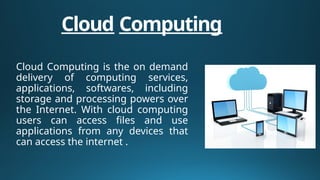
Cloud Computing is the on demand
delivery of computing services,
applications, softwares, including
storage and processing powers over
the Internet. With cloud computing
users can access files and use
applications from any devices that
can access the internet .
Examples of cloud Computing
Now a days almost every individual is using cloud service.
For example-use of Google drive , use of amazon web
services ,using Netflix video services etc.
Types of cloud computing
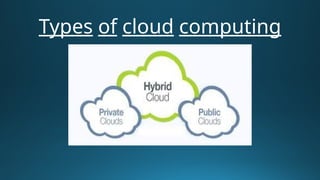
Public Cloud Computing
The public cloud is where the cloud
resources ,like services and storage are
owned and operated by a third party cloud
service providers and delivered over the
internet.as it is owned by a third party ,with
the public cloud ,you share the
storage ,hardware and network devices
with multiple users and organizations. The
resources are made available on pay- as-
you- go basis, meaning users only pay for
what they use.
e.g: Google Drive.
Private cloud computing
The private cloud ,is an infrastructure that
is used exclusively by a single organization.
It can be physically located at a company’s
on site data center or hosted by a third
party provider. In a private cloud ,the
infrastructure and services are maintained
on a private network; hardware and
software are dedicated solely to your
company.
e.g: Education Institutions, Banking
Systems.
Hybrid Cloud
Hybrid Cloud – using both
private and public
clouds ,depending on their
purpose. you host your most
important applications on your
own servers to keep them
more secure and secondary
applications elsewhere.
e.g:Disney +,Netflix.
Various Cloud Services
There are three cloud services :
Infrastructure as a service(IAAS)
Platform as a service(PAAS)
Software as a service (SAAS)
Software as a Service(SaaS)
SAAS provides on demand
access to application software
,usually requiring a
subscription by the
user .while using Microsoft
office 365, Google doc, to edit
a document online, we use
SAAS from cloud .A user is
not concerned about
installation of the software
applications . It is used by
end users.
Platform as a service (PaaS)
Through this service ,a user can
install and execute an application
without worrying about the
underlaying infrastructure and
their setup. PaaS provides a
platform,runtime environment and
some extra tools to develop, test
and deliver software applications.
It is generally used by developers.
Here users don’t have any control
over infrastructure.
Infrastructure as a service(IAAS)
The IAAS providers can offer
different kinds of computing
infrastructure, such as servers,
virtual machines, storage and
backup facility, operating systems
or any other hardware and
software. using IAAS from the cloud
,a user can use the hardware
infrastructure located at a remote
location to configure and execute
any software application on that
cloud infrastructure.
It is used by system administrators.
Advantages of cloud computing
Scalability
Companies don’t need to pay or build
the infrastructure needed to support
their highest load levels .likewise they
can quickly slow down if resources
are not being used.
Unlimited storage
The cloud offers almost limited
storage capacity. At any time you can
quickly expand your capacity with
very nominal fees.
Cost saving
Cost saving is one of the biggest
cloud computing benefits. It helps
you to save money as it does not
need any physical hardware
investments.
Data Security
The cloud gives us data security .As
the copy of our data saves on
various servers if 1 fails our data is
safe on the other server.
Disadvantages of cloud computing
• Requires a constant Internet connection.
• Does not work well with low -speed connections.
• Limited controls.
• Sometimes you may not get all the features.
Conclusion
Cloud Computing is a rapidly growing technology
that has transformed the way business operate. By
adopting cloud computing ,businesses can benefit
from cost saving, scalability and flexibility, improved
disaster recovery, enhanced security and increased
collaboration and productivity. It is a fantastic
platform that offers servers ,storage and
applications helpful for managing the business in a
secure way from anywhere in the world.
Thank you.

seninar presentation cloud computing.pptx

  • 1.
  • 2.
    Contents What is CloudComputing. Examples of Cloud Computing. Types of Cloud Computing. Various Cloud services. Advantages of Cloud Computing. Disadvantages of Cloud Computing. Conclusion
  • 3.
    Cloud Computing Cloud Computingis the on demand delivery of computing services, applications, softwares, including storage and processing powers over the Internet. With cloud computing users can access files and use applications from any devices that can access the internet .
  • 4.
    Examples of cloudComputing Now a days almost every individual is using cloud service. For example-use of Google drive , use of amazon web services ,using Netflix video services etc.
  • 5.
    Types of cloudcomputing
  • 6.
    Public Cloud Computing Thepublic cloud is where the cloud resources ,like services and storage are owned and operated by a third party cloud service providers and delivered over the internet.as it is owned by a third party ,with the public cloud ,you share the storage ,hardware and network devices with multiple users and organizations. The resources are made available on pay- as- you- go basis, meaning users only pay for what they use. e.g: Google Drive.
  • 7.
    Private cloud computing Theprivate cloud ,is an infrastructure that is used exclusively by a single organization. It can be physically located at a company’s on site data center or hosted by a third party provider. In a private cloud ,the infrastructure and services are maintained on a private network; hardware and software are dedicated solely to your company. e.g: Education Institutions, Banking Systems.
  • 8.
    Hybrid Cloud Hybrid Cloud– using both private and public clouds ,depending on their purpose. you host your most important applications on your own servers to keep them more secure and secondary applications elsewhere. e.g:Disney +,Netflix.
  • 9.
    Various Cloud Services Thereare three cloud services : Infrastructure as a service(IAAS) Platform as a service(PAAS) Software as a service (SAAS)
  • 10.
    Software as aService(SaaS) SAAS provides on demand access to application software ,usually requiring a subscription by the user .while using Microsoft office 365, Google doc, to edit a document online, we use SAAS from cloud .A user is not concerned about installation of the software applications . It is used by end users.
  • 11.
    Platform as aservice (PaaS) Through this service ,a user can install and execute an application without worrying about the underlaying infrastructure and their setup. PaaS provides a platform,runtime environment and some extra tools to develop, test and deliver software applications. It is generally used by developers. Here users don’t have any control over infrastructure.
  • 12.
    Infrastructure as aservice(IAAS) The IAAS providers can offer different kinds of computing infrastructure, such as servers, virtual machines, storage and backup facility, operating systems or any other hardware and software. using IAAS from the cloud ,a user can use the hardware infrastructure located at a remote location to configure and execute any software application on that cloud infrastructure. It is used by system administrators.
  • 13.
    Advantages of cloudcomputing Scalability Companies don’t need to pay or build the infrastructure needed to support their highest load levels .likewise they can quickly slow down if resources are not being used. Unlimited storage The cloud offers almost limited storage capacity. At any time you can quickly expand your capacity with very nominal fees. Cost saving Cost saving is one of the biggest cloud computing benefits. It helps you to save money as it does not need any physical hardware investments. Data Security The cloud gives us data security .As the copy of our data saves on various servers if 1 fails our data is safe on the other server.
  • 14.
    Disadvantages of cloudcomputing • Requires a constant Internet connection. • Does not work well with low -speed connections. • Limited controls. • Sometimes you may not get all the features.
  • 15.
    Conclusion Cloud Computing isa rapidly growing technology that has transformed the way business operate. By adopting cloud computing ,businesses can benefit from cost saving, scalability and flexibility, improved disaster recovery, enhanced security and increased collaboration and productivity. It is a fantastic platform that offers servers ,storage and applications helpful for managing the business in a secure way from anywhere in the world.
  • 16.