Presented by
Venkatesh Jambulingam
Cloud Security Expert
18-Jul-2021
Cloud Computing
| 18-Jul-2021 | Venkatesh Jambulingam |
▶Cloud Computing Definition
▶Characteristics of Cloud
▶Service Models
▶Deployment Models
▶Cloud Computing Roles
▶Benefits of Cloud Computing
▶Cloud Providers by Service Models
2
Contents
| 18-Jul-2021 | Venkatesh Jambulingam |
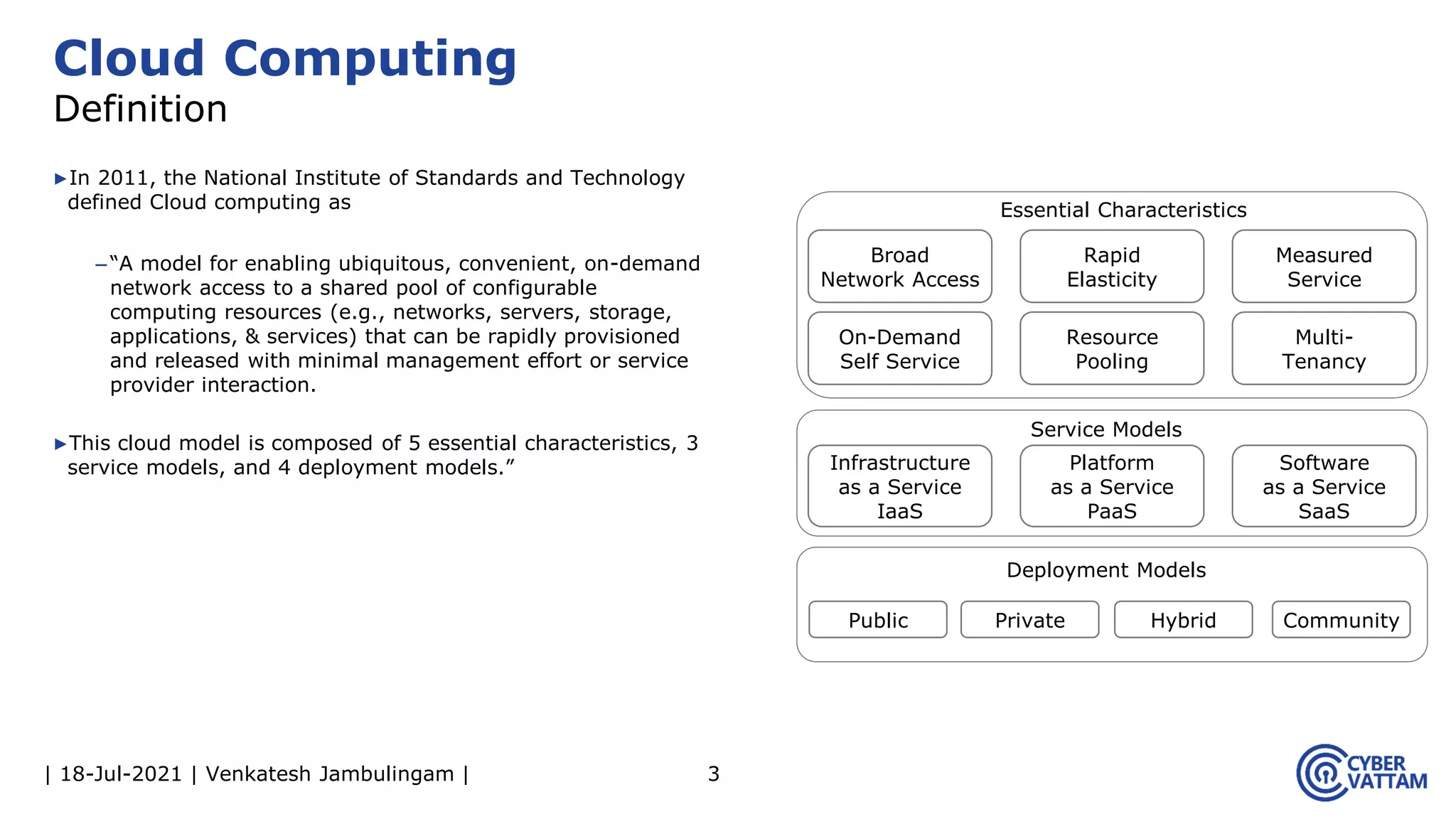
▶In 2011, the National Institute of Standards and Technology
defined Cloud computing as
–“A model for enabling ubiquitous, convenient, on-demand
network access to a shared pool of configurable
computing resources (e.g., networks, servers, storage,
applications, & services) that can be rapidly provisioned
and released with minimal management effort or service
provider interaction.
▶This cloud model is composed of 5 essential characteristics, 3
service models, and 4 deployment models.”
3
Cloud Computing
Definition
Infrastructure
as a Service
IaaS
Rapid
Elasticity
Measured
Service
On-Demand
Self Service
Resource
Pooling
Multi-
Tenancy
Platform
as a Service
PaaS
Software
as a Service
SaaS
Public Private Hybrid Community
Essential Characteristics
Service Models
Deployment Models
Broad
Network Access
Cloud Characteristics
| 18-Jul-2021 | Venkatesh Jambulingam |
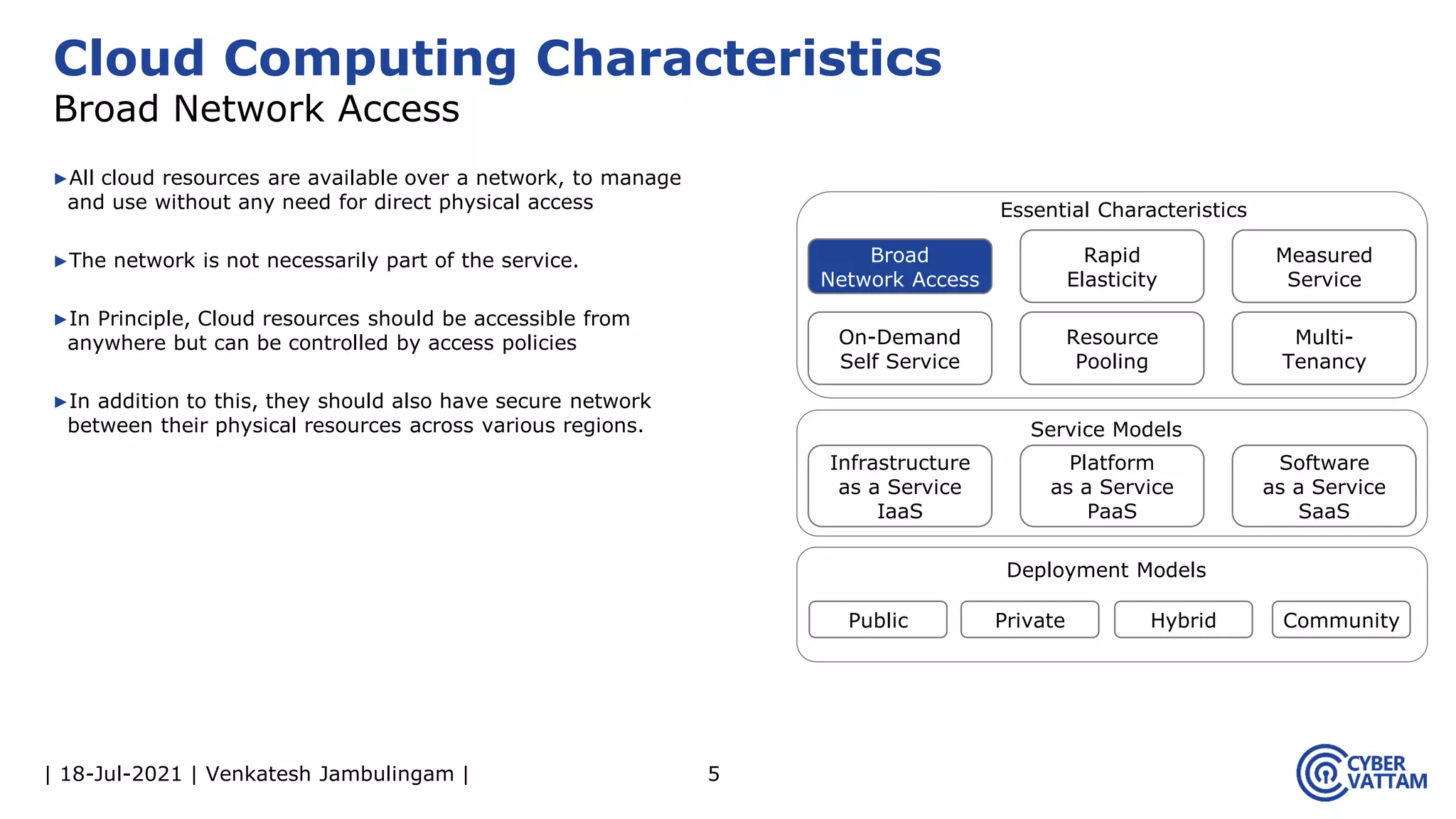
▶All cloud resources are available over a network, to manage
and use without any need for direct physical access
▶The network is not necessarily part of the service.
▶In Principle, Cloud resources should be accessible from
anywhere but can be controlled by access policies
▶In addition to this, they should also have secure network
between their physical resources across various regions.
5
Cloud Computing Characteristics
Broad Network Access
Infrastructure
as a Service
IaaS
Rapid
Elasticity
Measured
Service
On-Demand
Self Service
Resource
Pooling
Multi-
Tenancy
Platform
as a Service
PaaS
Software
as a Service
SaaS
Public Private Hybrid Community
Essential Characteristics
Service Models
Deployment Models
Broad
Network Access
| 18-Jul-2021 | Venkatesh Jambulingam |
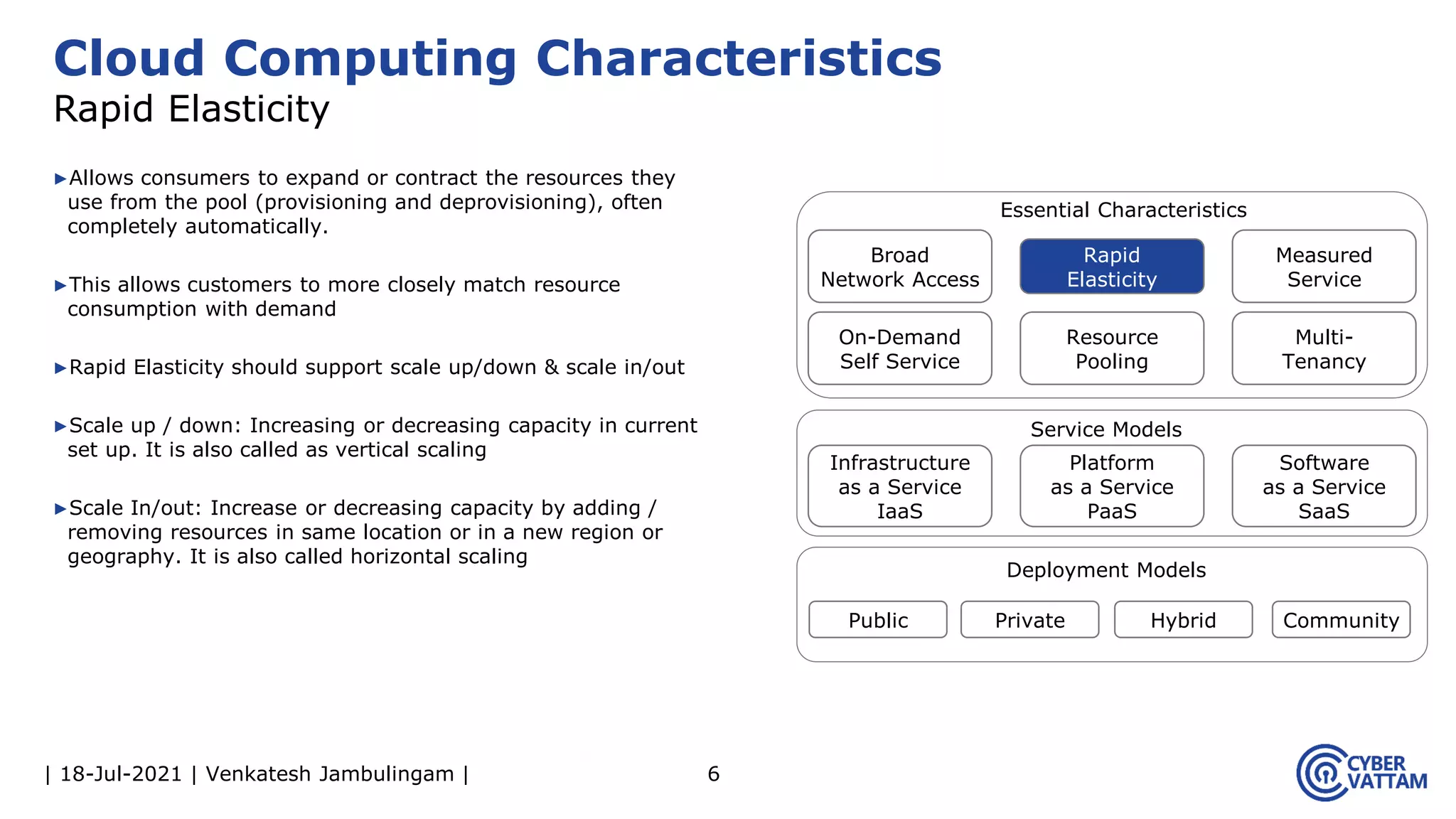
▶Allows consumers to expand or contract the resources they
use from the pool (provisioning and deprovisioning), often
completely automatically.
▶This allows customers to more closely match resource
consumption with demand
▶Rapid Elasticity should support scale up/down & scale in/out
▶Scale up / down: Increasing or decreasing capacity in current
set up. It is also called as vertical scaling
▶Scale In/out: Increase or decreasing capacity by adding /
removing resources in same location or in a new region or
geography. It is also called horizontal scaling
6
Cloud Computing Characteristics
Rapid Elasticity
Infrastructure
as a Service
IaaS
Rapid
Elasticity
Measured
Service
On-Demand
Self Service
Resource
Pooling
Multi-
Tenancy
Platform
as a Service
PaaS
Software
as a Service
SaaS
Public Private Hybrid Community
Essential Characteristics
Service Models
Deployment Models
Broad
Network Access
| 18-Jul-2021 | Venkatesh Jambulingam |
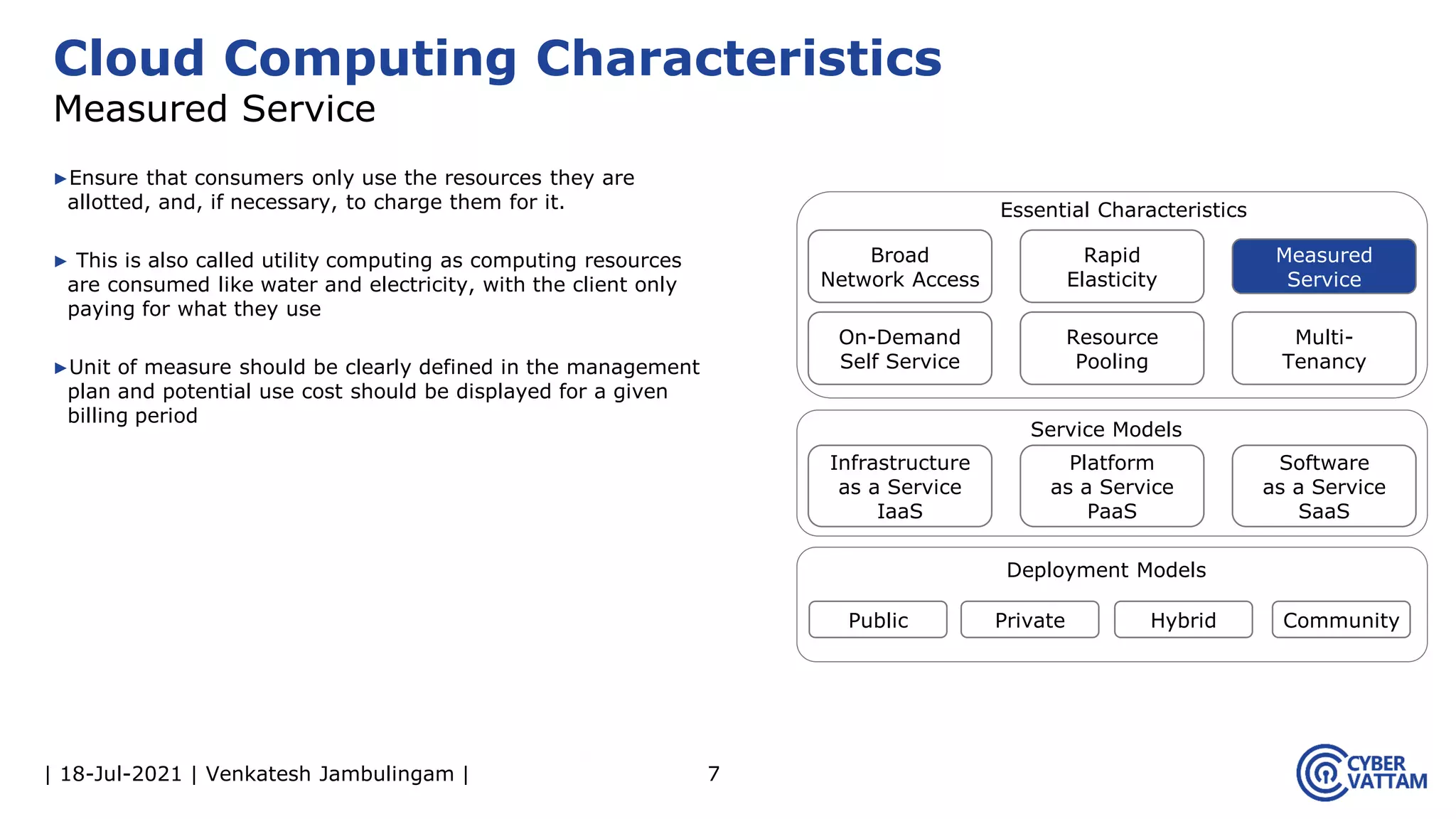
▶Ensure that consumers only use the resources they are
allotted, and, if necessary, to charge them for it.
▶ This is also called utility computing as computing resources
are consumed like water and electricity, with the client only
paying for what they use
▶Unit of measure should be clearly defined in the management
plan and potential use cost should be displayed for a given
billing period
7
Cloud Computing Characteristics
Measured Service
Infrastructure
as a Service
IaaS
Rapid
Elasticity
Measured
Service
On-Demand
Self Service
Resource
Pooling
Multi-
Tenancy
Platform
as a Service
PaaS
Software
as a Service
SaaS
Public Private Hybrid Community
Essential Characteristics
Service Models
Deployment Models
Broad
Network Access
| 18-Jul-2021 | Venkatesh Jambulingam |
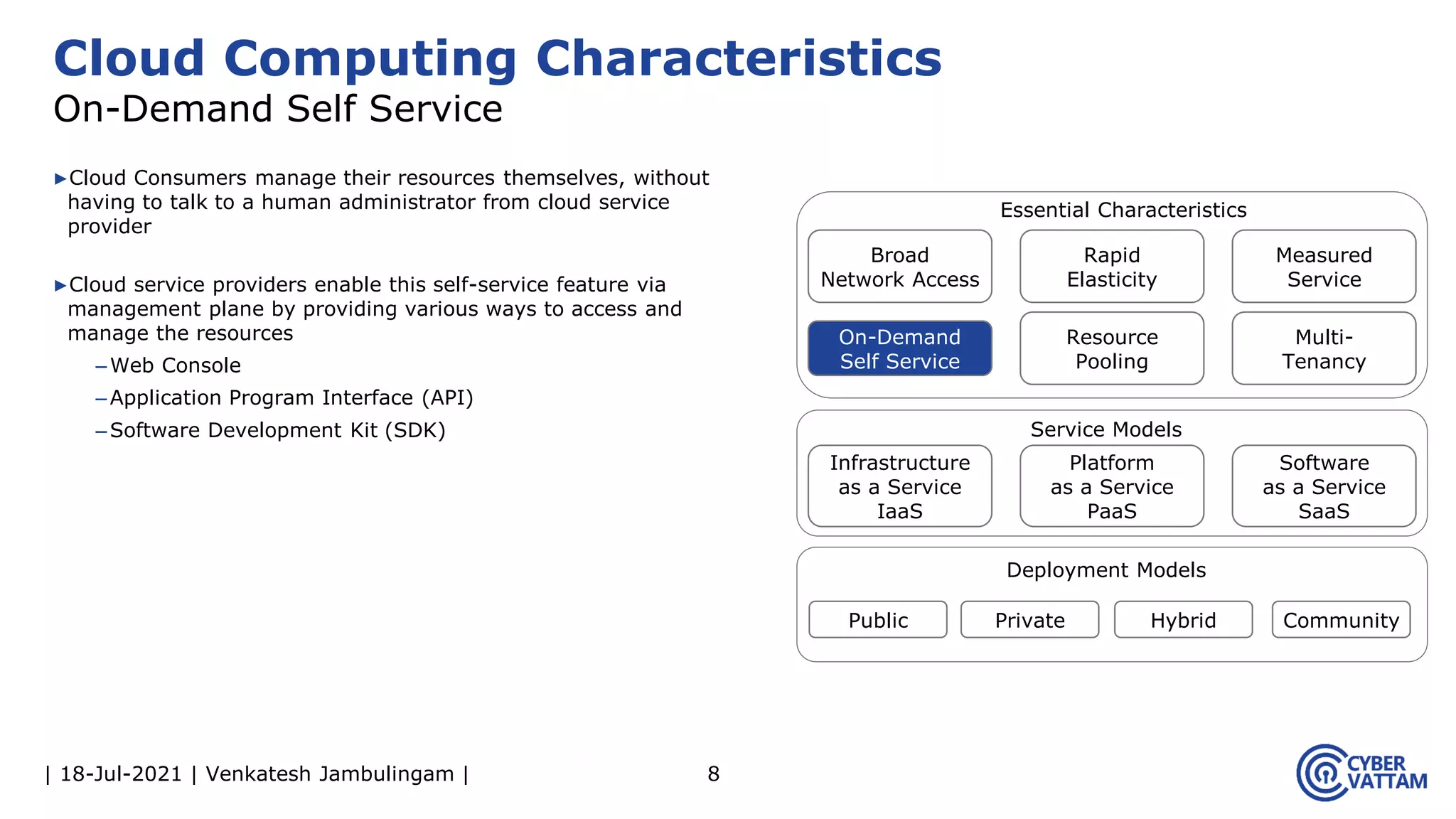
▶Cloud Consumers manage their resources themselves, without
having to talk to a human administrator from cloud service
provider
▶Cloud service providers enable this self-service feature via
management plane by providing various ways to access and
manage the resources
–Web Console
–Application Program Interface (API)
–Software Development Kit (SDK)
8
Cloud Computing Characteristics
On-Demand Self Service
Infrastructure
as a Service
IaaS
Rapid
Elasticity
Measured
Service
On-Demand
Self Service
Resource
Pooling
Multi-
Tenancy
Platform
as a Service
PaaS
Software
as a Service
SaaS
Public Private Hybrid Community
Essential Characteristics
Service Models
Deployment Models
Broad
Network Access
| 18-Jul-2021 | Venkatesh Jambulingam |
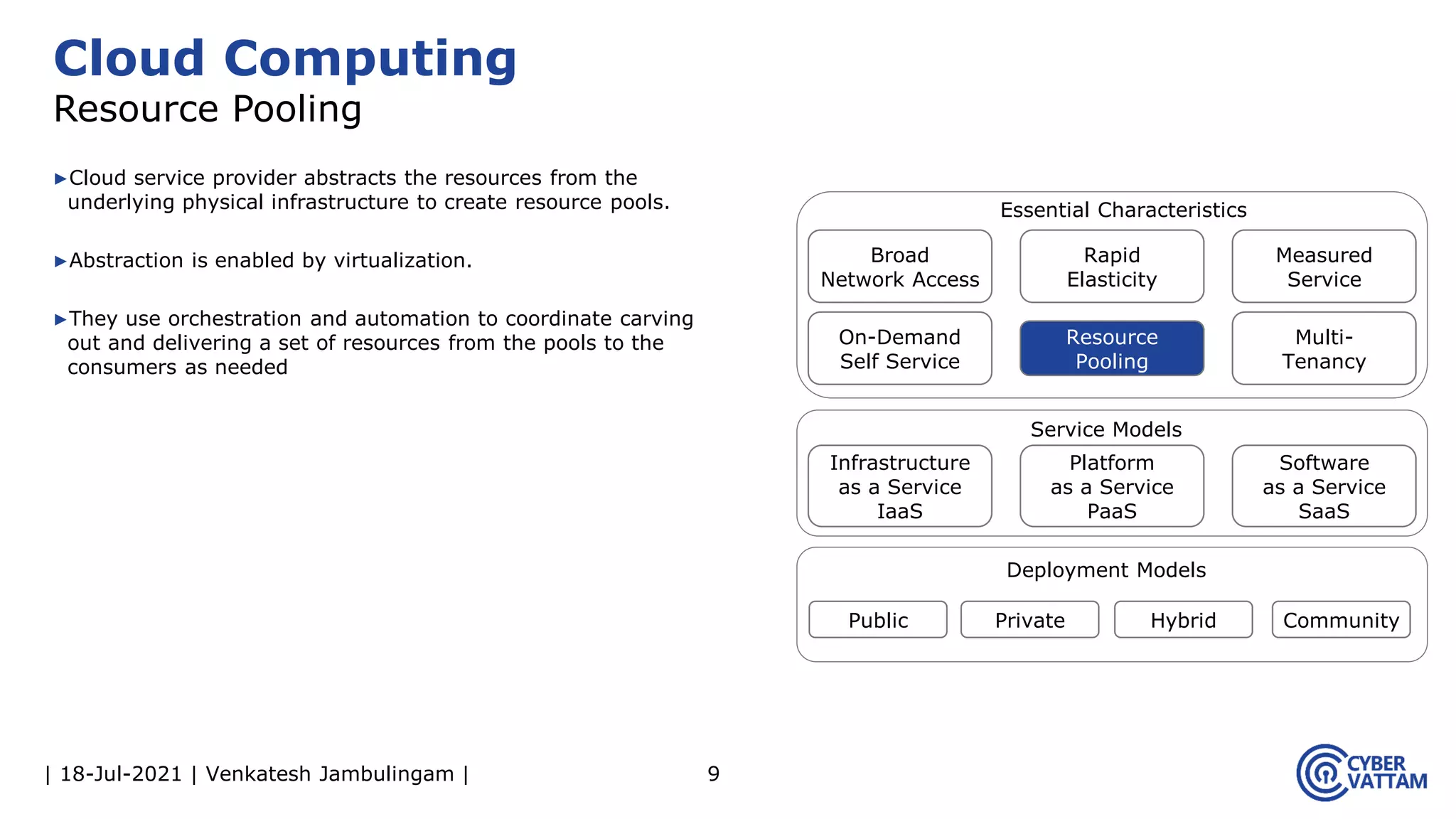
▶Cloud service provider abstracts the resources from the
underlying physical infrastructure to create resource pools.
▶Abstraction is enabled by virtualization.
▶They use orchestration and automation to coordinate carving
out and delivering a set of resources from the pools to the
consumers as needed
9
Cloud Computing
Resource Pooling
Infrastructure
as a Service
IaaS
Rapid
Elasticity
Measured
Service
On-Demand
Self Service
Resource
Pooling
Multi-
Tenancy
Platform
as a Service
PaaS
Software
as a Service
SaaS
Public Private Hybrid Community
Essential Characteristics
Service Models
Deployment Models
Broad
Network Access
| 18-Jul-2021 | Venkatesh Jambulingam |
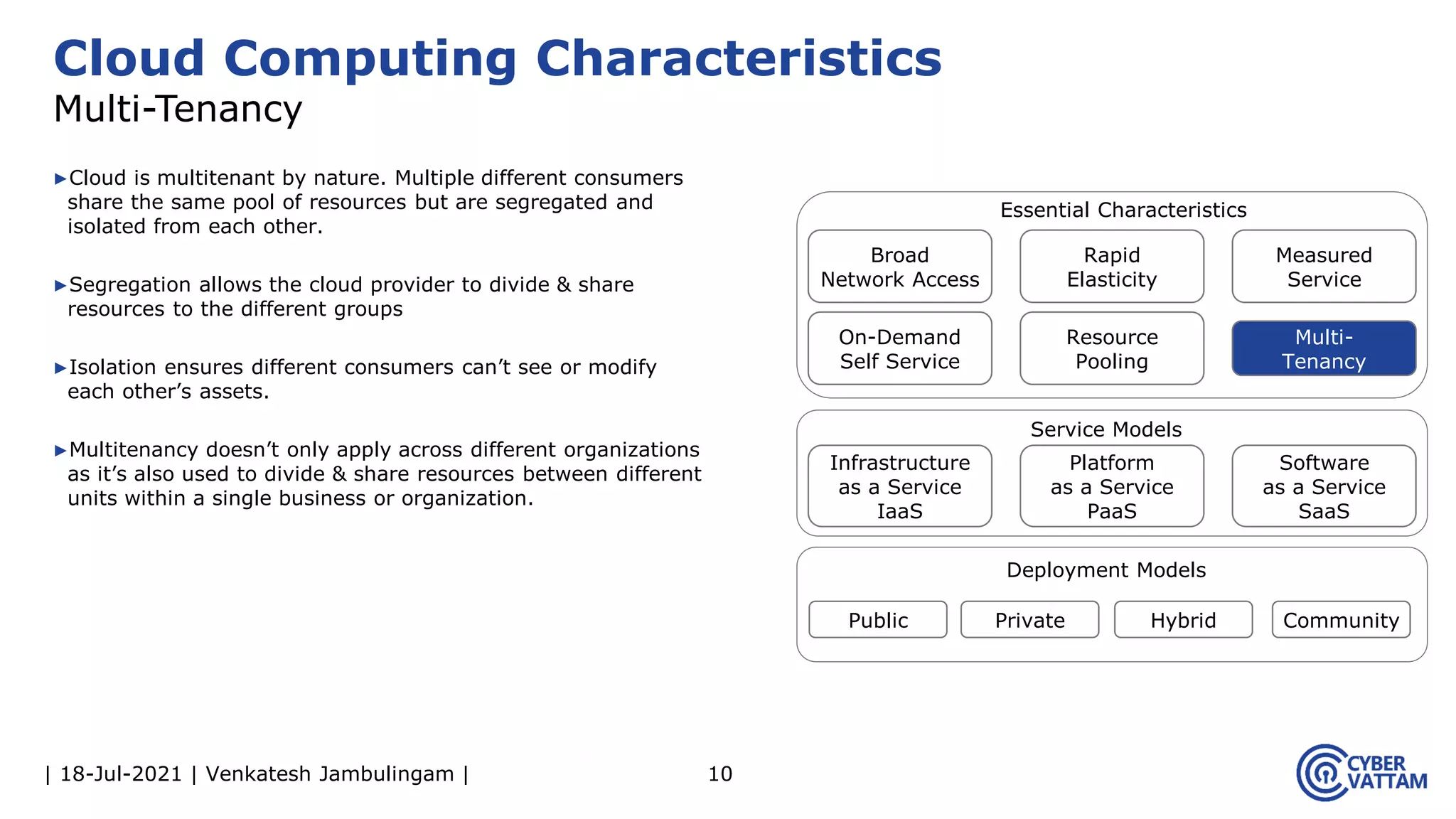
▶Cloud is multitenant by nature. Multiple different consumers
share the same pool of resources but are segregated and
isolated from each other.
▶Segregation allows the cloud provider to divide & share
resources to the different groups
▶Isolation ensures different consumers can’t see or modify
each other’s assets.
▶Multitenancy doesn’t only apply across different organizations
as it’s also used to divide & share resources between different
units within a single business or organization.
10
Cloud Computing Characteristics
Multi-Tenancy
Infrastructure
as a Service
IaaS
Rapid
Elasticity
Measured
Service
On-Demand
Self Service
Resource
Pooling
Multi-
Tenancy
Platform
as a Service
PaaS
Software
as a Service
SaaS
Public Private Hybrid Community
Essential Characteristics
Service Models
Deployment Models
Broad
Network Access
Cloud Service Models
| 18-Jul-2021 | Venkatesh Jambulingam |
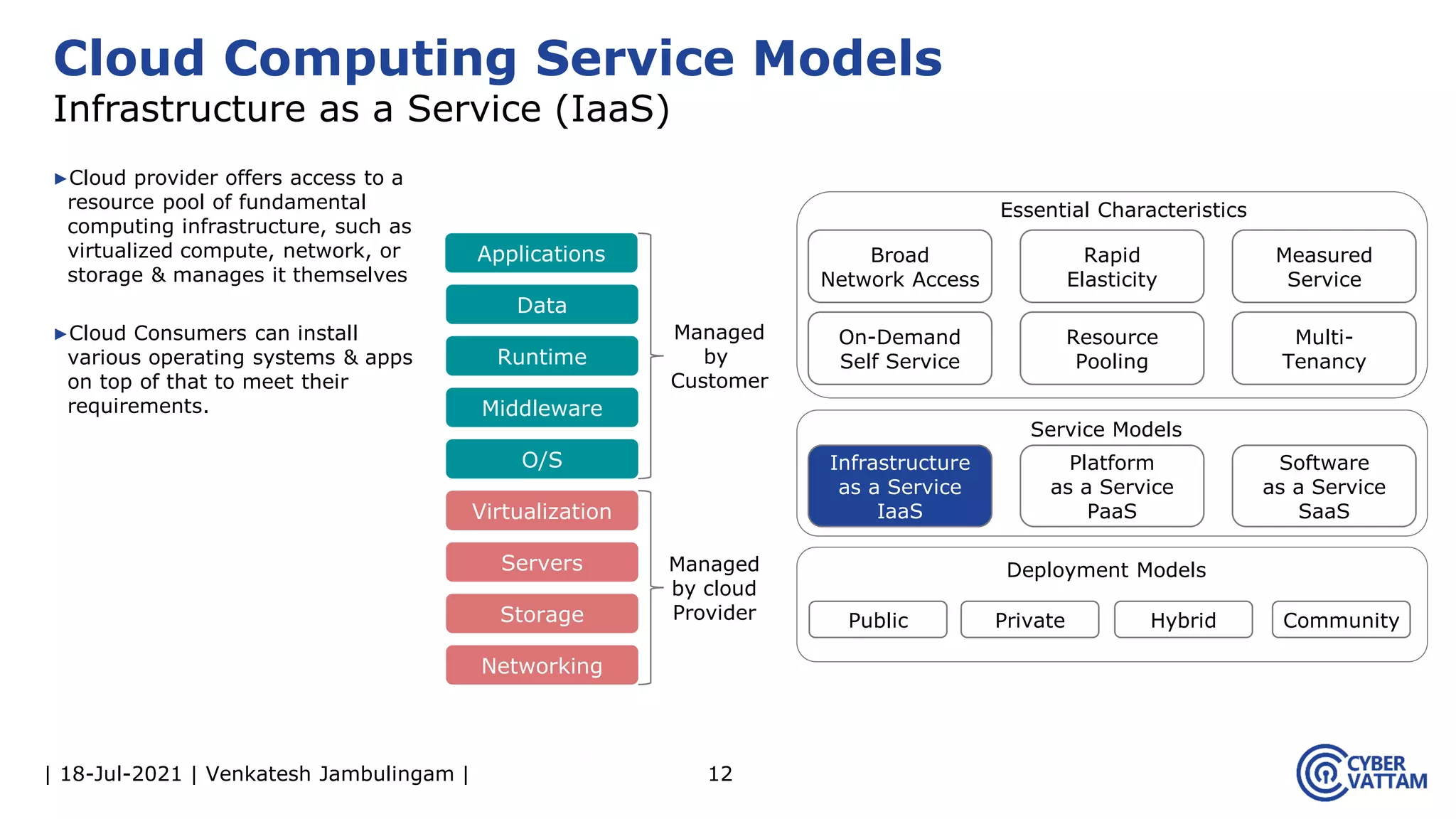
▶Cloud provider offers access to a
resource pool of fundamental
computing infrastructure, such as
virtualized compute, network, or
storage & manages it themselves
▶Cloud Consumers can install
various operating systems & apps
on top of that to meet their
requirements.
12
Cloud Computing Service Models
Infrastructure as a Service (IaaS)
Infrastructure
as a Service
IaaS
Rapid
Elasticity
Measured
Service
On-Demand
Self Service
Resource
Pooling
Multi-
Tenancy
Platform
as a Service
PaaS
Software
as a Service
SaaS
Public Private Hybrid Community
Essential Characteristics
Service Models
Deployment Models
Broad
Network Access
Data
Runtime
Middleware
O/S
Applications
Managed
by
Customer
Virtualization
Servers
Storage
Networking
Managed
by cloud
Provider
| 18-Jul-2021 | Venkatesh Jambulingam |
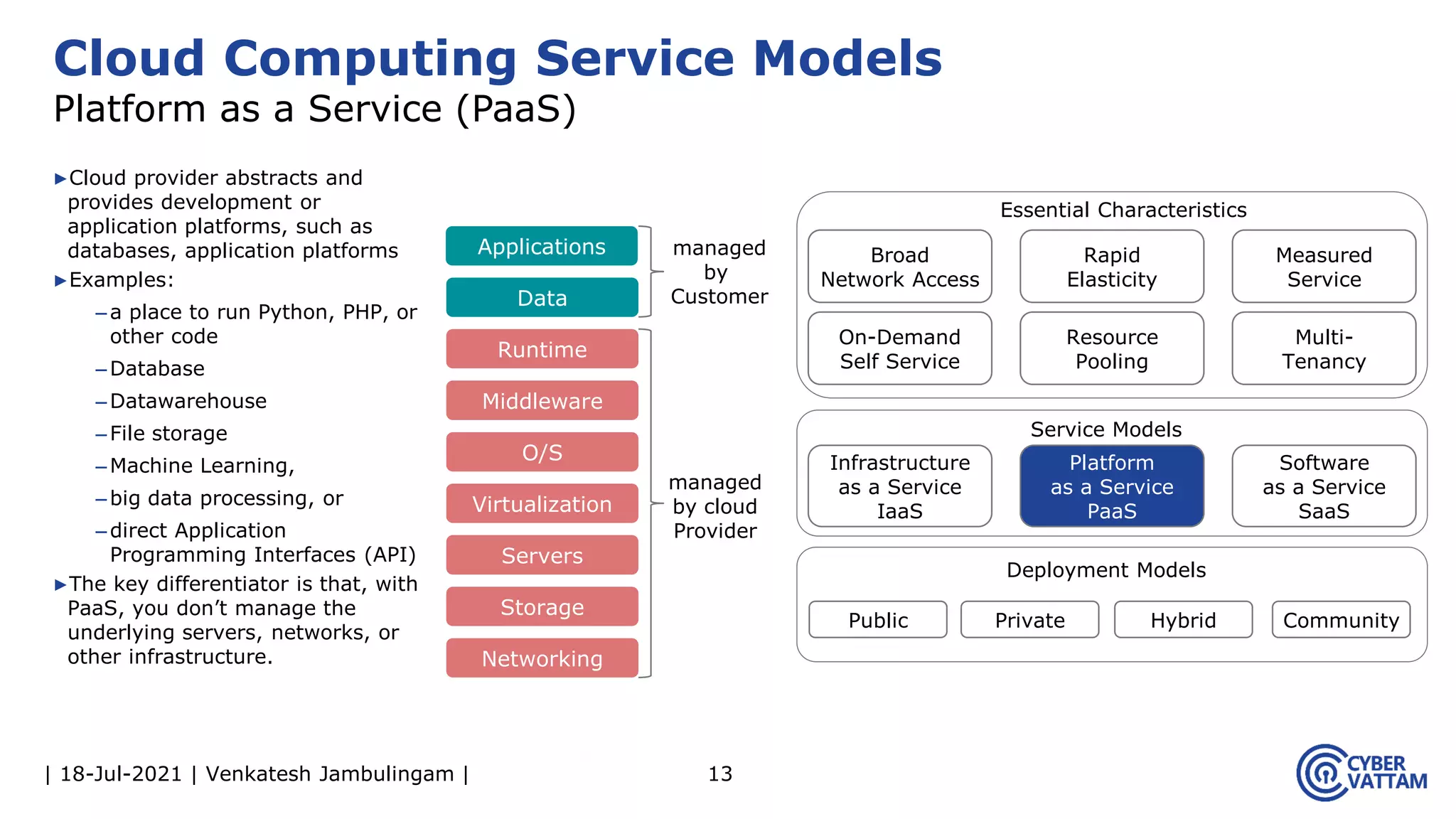
▶Cloud provider abstracts and
provides development or
application platforms, such as
databases, application platforms
▶Examples:
–a place to run Python, PHP, or
other code
–Database
–Datawarehouse
–File storage
–Machine Learning,
–big data processing, or
–direct Application
Programming Interfaces (API)
▶The key differentiator is that, with
PaaS, you don’t manage the
underlying servers, networks, or
other infrastructure.
13
Cloud Computing Service Models
Platform as a Service (PaaS)
Infrastructure
as a Service
IaaS
Rapid
Elasticity
Measured
Service
On-Demand
Self Service
Resource
Pooling
Multi-
Tenancy
Platform
as a Service
PaaS
Software
as a Service
SaaS
Public Private Hybrid Community
Essential Characteristics
Service Models
Deployment Models
Broad
Network Access
Data
Applications managed
by
Customer
Runtime
Middleware
O/S
Virtualization
Servers
Storage
Networking
managed
by cloud
Provider
| 18-Jul-2021 | Venkatesh Jambulingam |
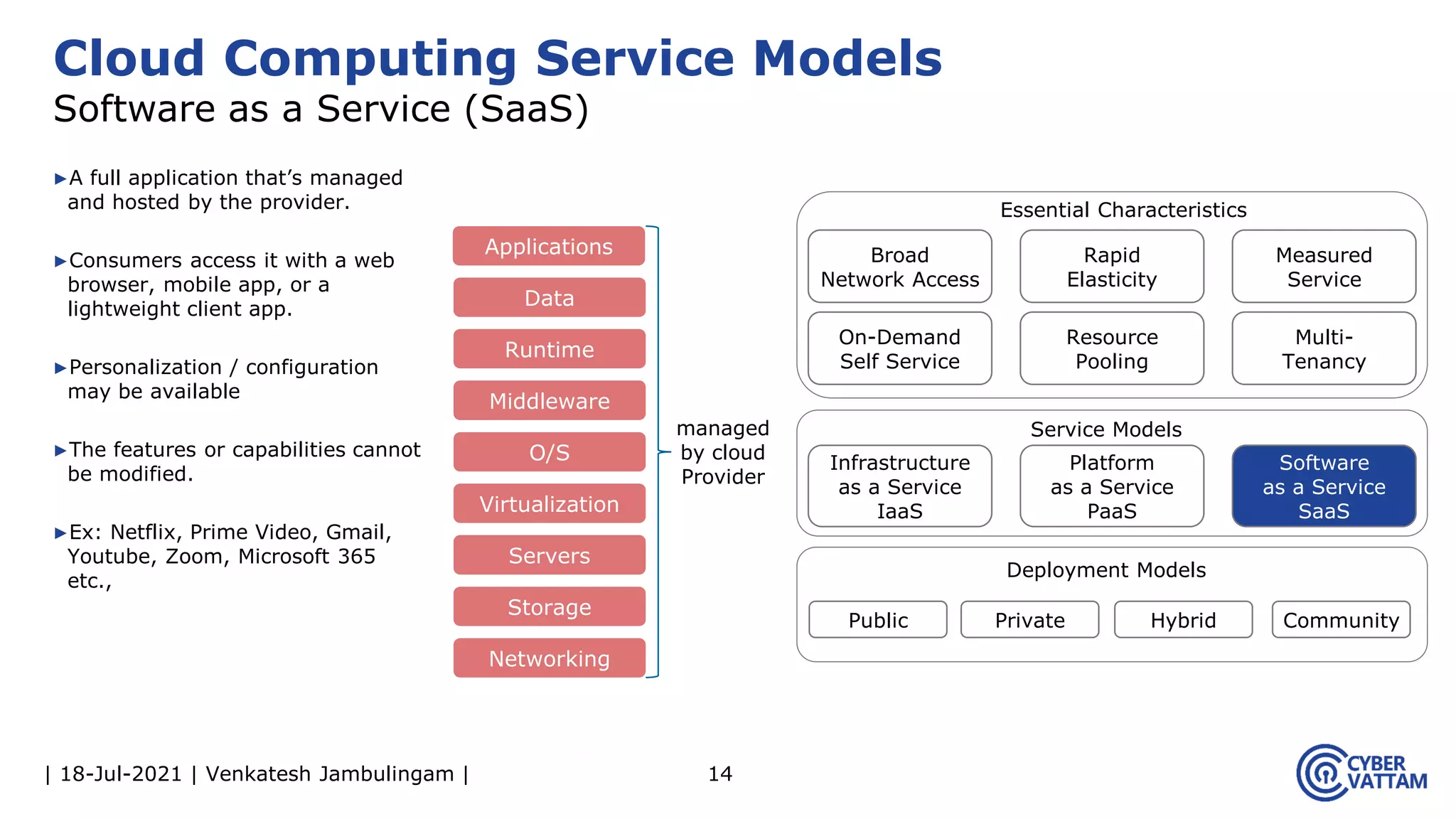
▶A full application that’s managed
and hosted by the provider.
▶Consumers access it with a web
browser, mobile app, or a
lightweight client app.
▶Personalization / configuration
may be available
▶The features or capabilities cannot
be modified.
▶Ex: Netflix, Prime Video, Gmail,
Youtube, Zoom, Microsoft 365
etc.,
14
Cloud Computing Service Models
Software as a Service (SaaS)
Infrastructure
as a Service
IaaS
Rapid
Elasticity
Measured
Service
On-Demand
Self Service
Resource
Pooling
Multi-
Tenancy
Platform
as a Service
PaaS
Software
as a Service
SaaS
Public Private Hybrid Community
Essential Characteristics
Service Models
Deployment Models
Broad
Network Access
Data
Runtime
Middleware
O/S
Virtualization
Servers
Storage
Networking
Applications
managed
by cloud
Provider
Cloud Deployment Models
| 18-Jul-2021 | Venkatesh Jambulingam |
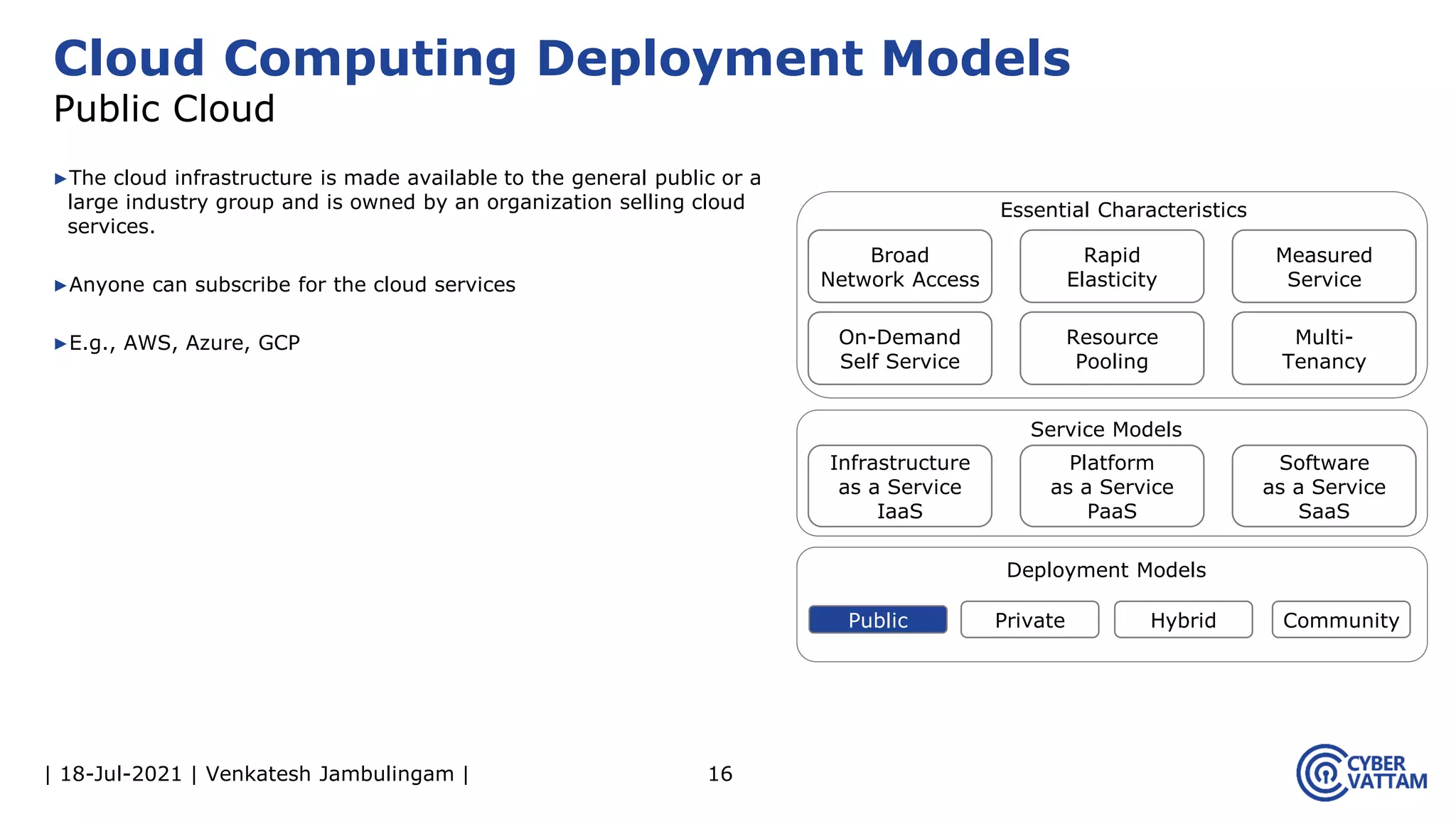
▶The cloud infrastructure is made available to the general public or a
large industry group and is owned by an organization selling cloud
services.
▶Anyone can subscribe for the cloud services
▶E.g., AWS, Azure, GCP
16
Cloud Computing Deployment Models
Public Cloud
Infrastructure
as a Service
IaaS
Rapid
Elasticity
Measured
Service
On-Demand
Self Service
Resource
Pooling
Multi-
Tenancy
Platform
as a Service
PaaS
Software
as a Service
SaaS
Public Private Hybrid Community
Essential Characteristics
Service Models
Deployment Models
Broad
Network Access
| 18-Jul-2021 | Venkatesh Jambulingam |
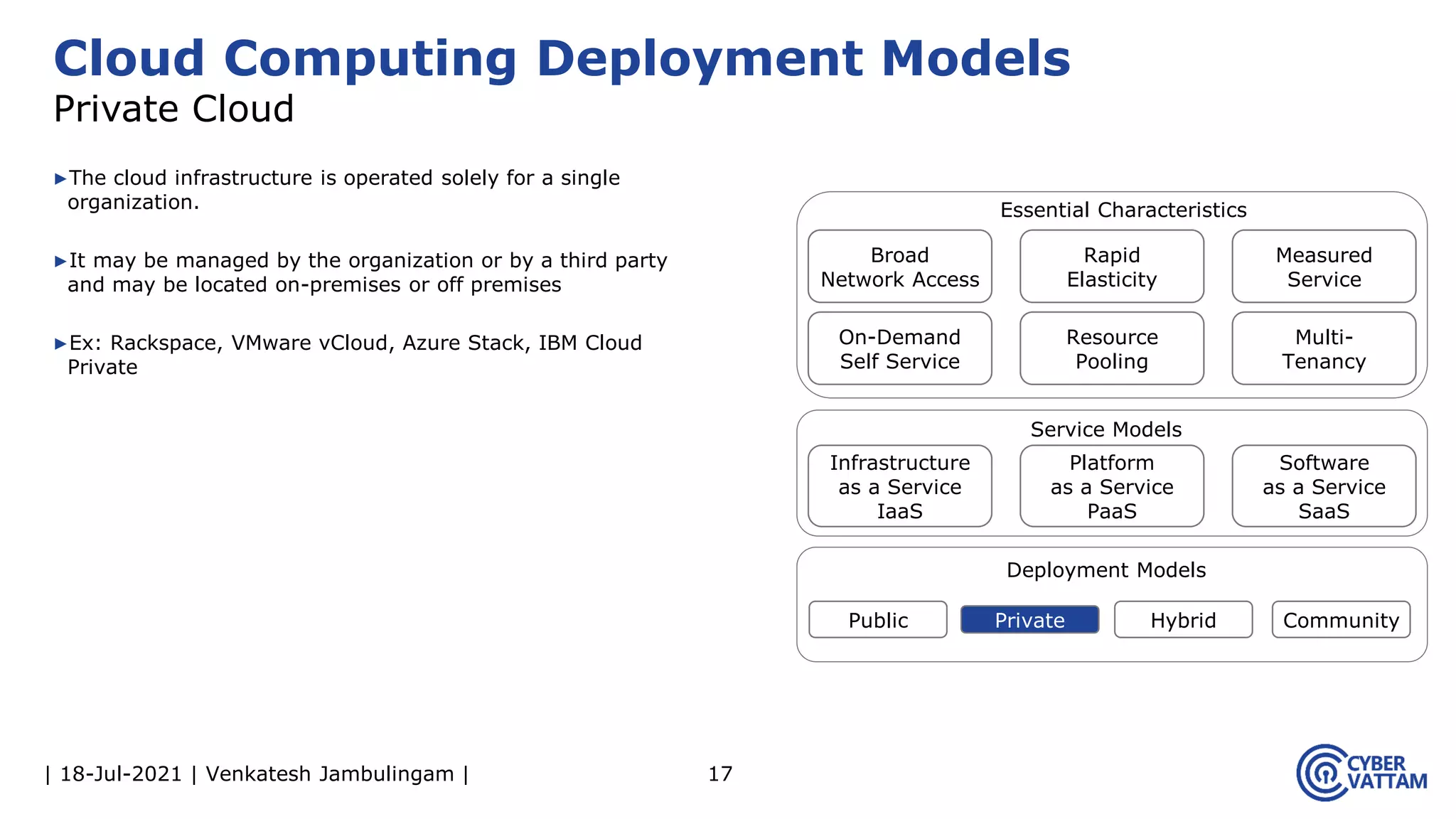
▶The cloud infrastructure is operated solely for a single
organization.
▶It may be managed by the organization or by a third party
and may be located on-premises or off premises
▶Ex: Rackspace, VMware vCloud, Azure Stack, IBM Cloud
Private
17
Cloud Computing Deployment Models
Private Cloud
Infrastructure
as a Service
IaaS
Rapid
Elasticity
Measured
Service
On-Demand
Self Service
Resource
Pooling
Multi-
Tenancy
Platform
as a Service
PaaS
Software
as a Service
SaaS
Public Private Hybrid Community
Essential Characteristics
Service Models
Deployment Models
Broad
Network Access
| 18-Jul-2021 | Venkatesh Jambulingam |
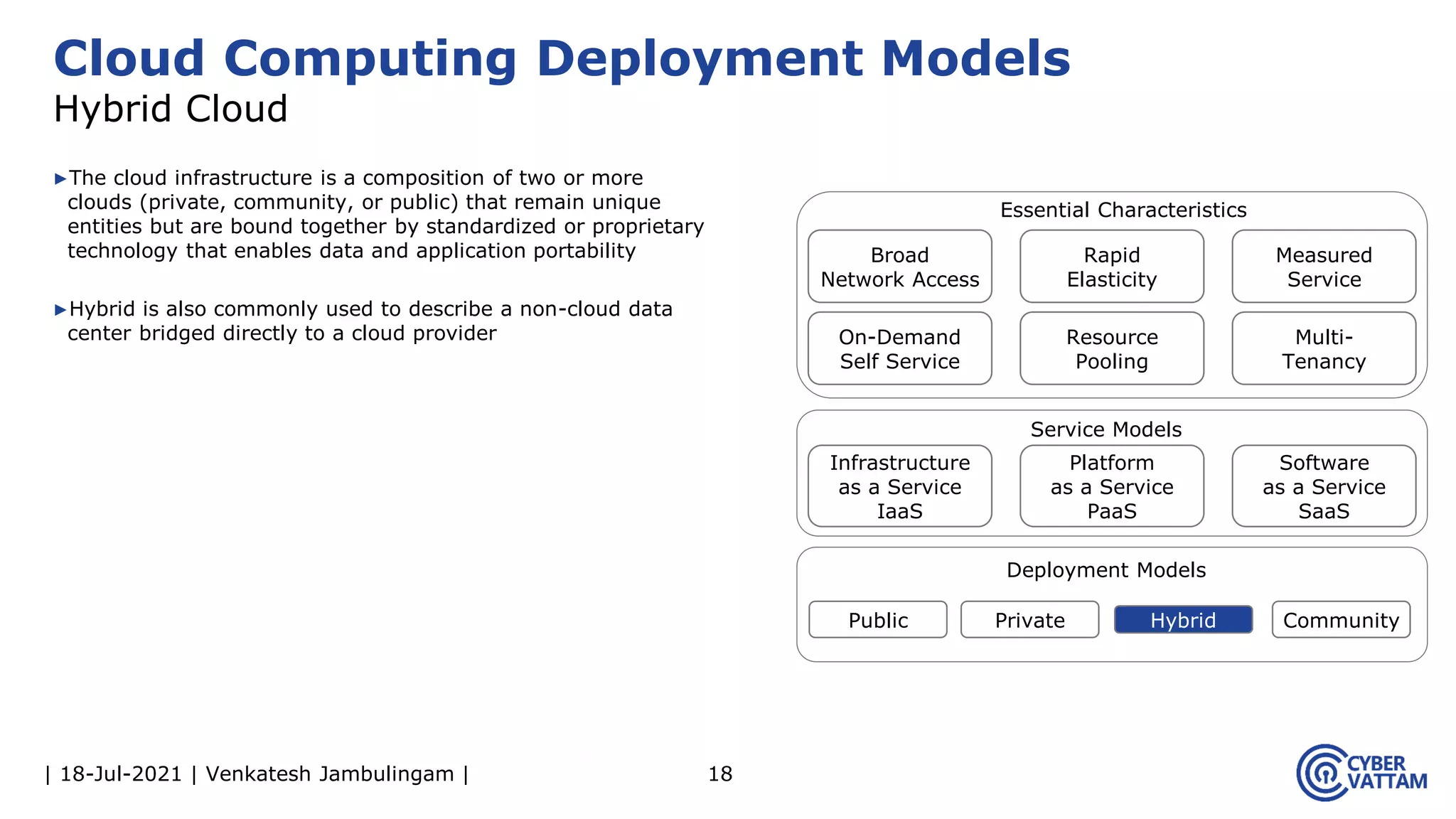
▶The cloud infrastructure is a composition of two or more
clouds (private, community, or public) that remain unique
entities but are bound together by standardized or proprietary
technology that enables data and application portability
▶Hybrid is also commonly used to describe a non-cloud data
center bridged directly to a cloud provider
18
Cloud Computing Deployment Models
Hybrid Cloud
Infrastructure
as a Service
IaaS
Rapid
Elasticity
Measured
Service
On-Demand
Self Service
Resource
Pooling
Multi-
Tenancy
Platform
as a Service
PaaS
Software
as a Service
SaaS
Public Private Hybrid Community
Essential Characteristics
Service Models
Deployment Models
Broad
Network Access
| 18-Jul-2021 | Venkatesh Jambulingam |
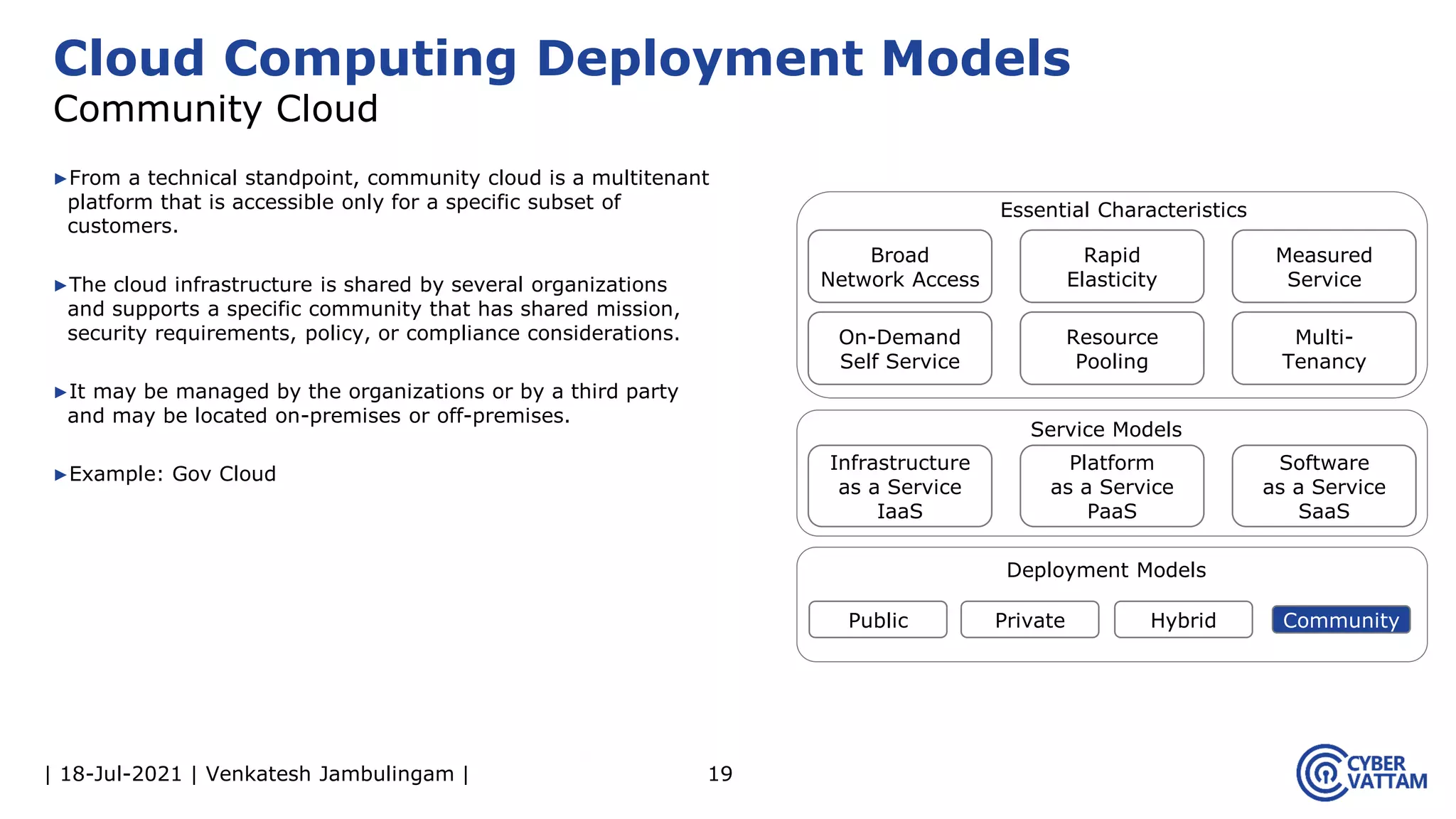
▶From a technical standpoint, community cloud is a multitenant
platform that is accessible only for a specific subset of
customers.
▶The cloud infrastructure is shared by several organizations
and supports a specific community that has shared mission,
security requirements, policy, or compliance considerations.
▶It may be managed by the organizations or by a third party
and may be located on-premises or off-premises.
▶Example: Gov Cloud
19
Cloud Computing Deployment Models
Community Cloud
Infrastructure
as a Service
IaaS
Rapid
Elasticity
Measured
Service
On-Demand
Self Service
Resource
Pooling
Multi-
Tenancy
Platform
as a Service
PaaS
Software
as a Service
SaaS
Public Private Hybrid Community
Essential Characteristics
Service Models
Deployment Models
Broad
Network Access
Cloud Roles
| 18-Jul-2021 | Venkatesh Jambulingam | 21
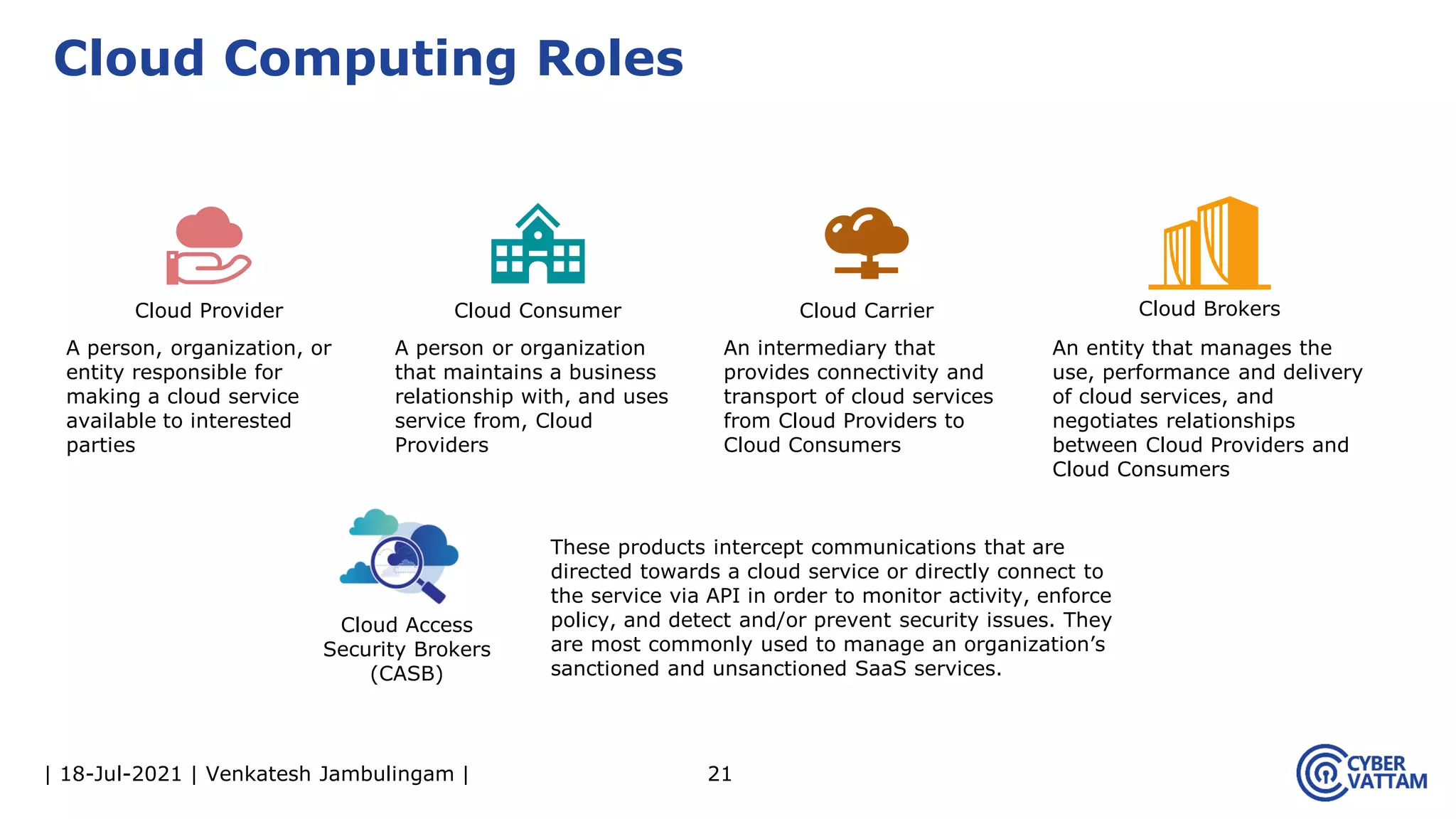
Cloud Computing Roles
Cloud Carrier
An intermediary that
provides connectivity and
transport of cloud services
from Cloud Providers to
Cloud Consumers
Cloud Provider
A person, organization, or
entity responsible for
making a cloud service
available to interested
parties
Cloud Consumer
A person or organization
that maintains a business
relationship with, and uses
service from, Cloud
Providers
Cloud Access
Security Brokers
(CASB)
These products intercept communications that are
directed towards a cloud service or directly connect to
the service via API in order to monitor activity, enforce
policy, and detect and/or prevent security issues. They
are most commonly used to manage an organization’s
sanctioned and unsanctioned SaaS services.
Cloud Brokers
An entity that manages the
use, performance and delivery
of cloud services, and
negotiates relationships
between Cloud Providers and
Cloud Consumers
Cloud Benefits
| 18-Jul-2021 | Venkatesh Jambulingam | 23
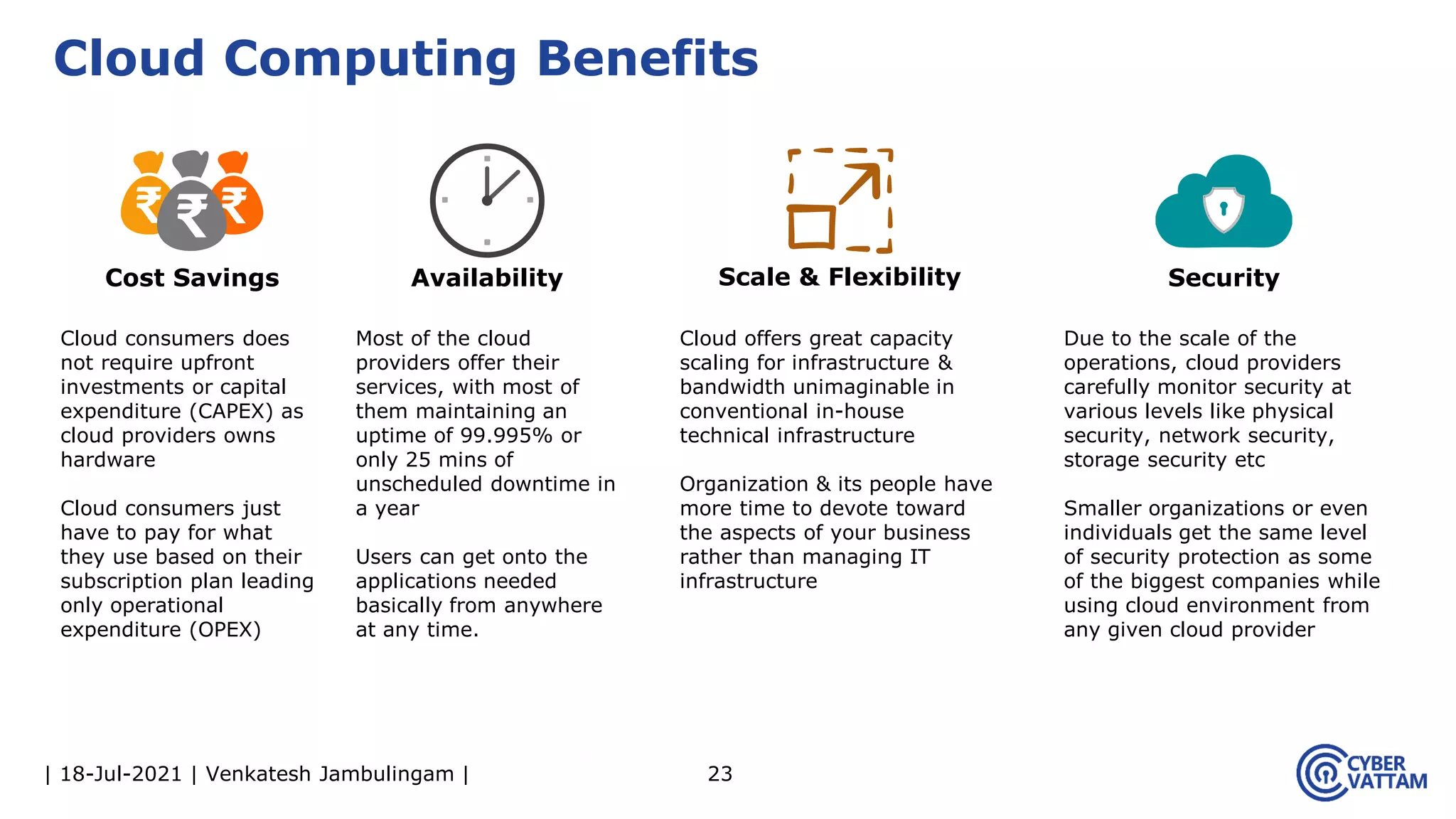
Cloud Computing Benefits
Cloud consumers does
not require upfront
investments or capital
expenditure (CAPEX) as
cloud providers owns
hardware
Cloud consumers just
have to pay for what
they use based on their
subscription plan leading
only operational
expenditure (OPEX)
Cost Savings
Cloud offers great capacity
scaling for infrastructure &
bandwidth unimaginable in
conventional in-house
technical infrastructure
Organization & its people have
more time to devote toward
the aspects of your business
rather than managing IT
infrastructure
Scale & Flexibility
Most of the cloud
providers offer their
services, with most of
them maintaining an
uptime of 99.995% or
only 25 mins of
unscheduled downtime in
a year
Users can get onto the
applications needed
basically from anywhere
at any time.
Availability
Due to the scale of the
operations, cloud providers
carefully monitor security at
various levels like physical
security, network security,
storage security etc
Smaller organizations or even
individuals get the same level
of security protection as some
of the biggest companies while
using cloud environment from
any given cloud provider
Security
| 18-Jul-2021 | Venkatesh Jambulingam | 24
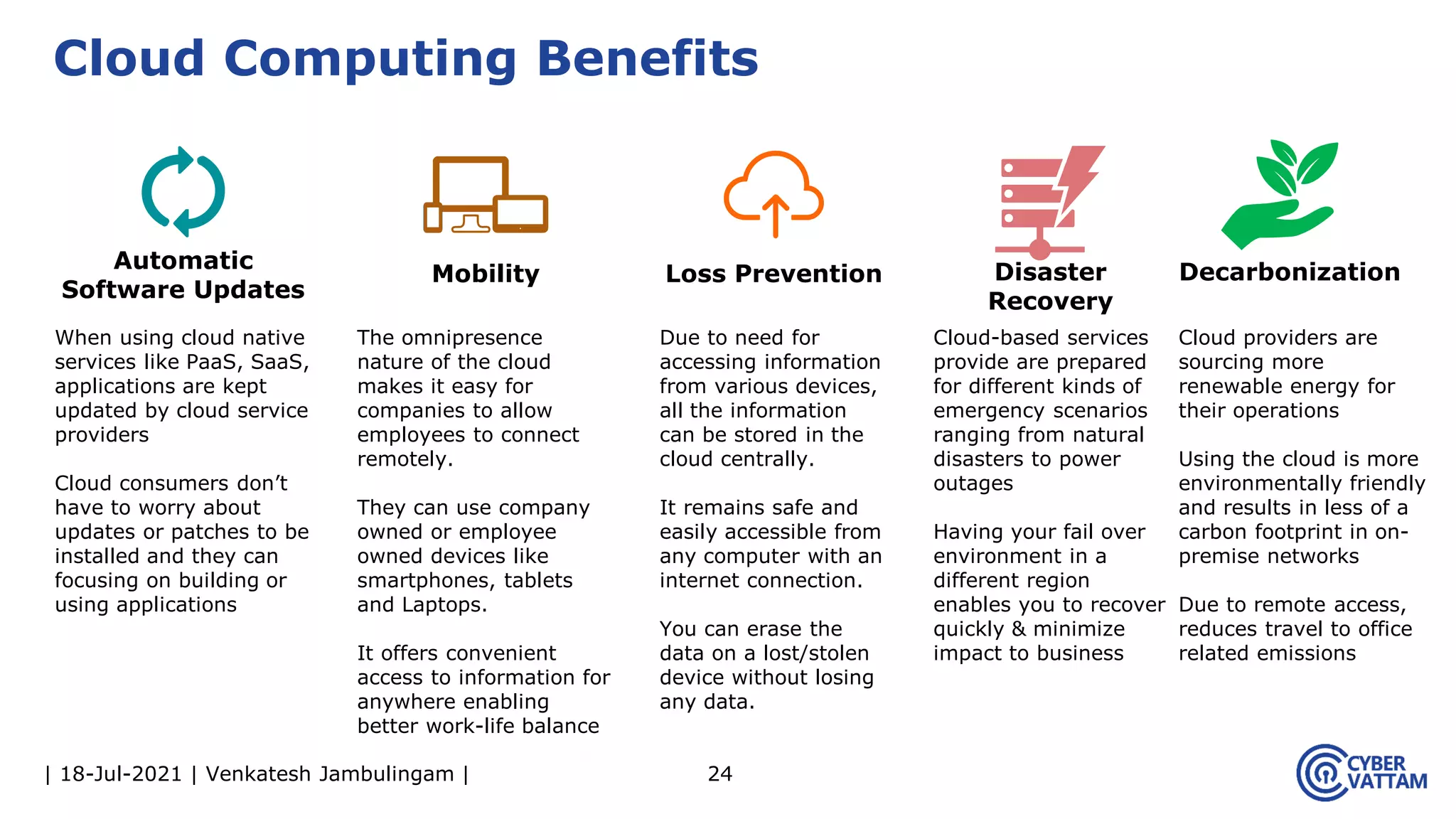
Cloud Computing Benefits
Cloud-based services
provide are prepared
for different kinds of
emergency scenarios
ranging from natural
disasters to power
outages
Having your fail over
environment in a
different region
enables you to recover
quickly & minimize
impact to business
Disaster
Recovery
The omnipresence
nature of the cloud
makes it easy for
companies to allow
employees to connect
remotely.
They can use company
owned or employee
owned devices like
smartphones, tablets
and Laptops.
It offers convenient
access to information for
anywhere enabling
better work-life balance
Mobility
When using cloud native
services like PaaS, SaaS,
applications are kept
updated by cloud service
providers
Cloud consumers don’t
have to worry about
updates or patches to be
installed and they can
focusing on building or
using applications
Automatic
Software Updates
Cloud providers are
sourcing more
renewable energy for
their operations
Using the cloud is more
environmentally friendly
and results in less of a
carbon footprint in on-
premise networks
Due to remote access,
reduces travel to office
related emissions
Decarbonization
Due to need for
accessing information
from various devices,
all the information
can be stored in the
cloud centrally.
It remains safe and
easily accessible from
any computer with an
internet connection.
You can erase the
data on a lost/stolen
device without losing
any data.
Loss Prevention
Cloud Providers
| 18-Jul-2021 | Venkatesh Jambulingam | 26
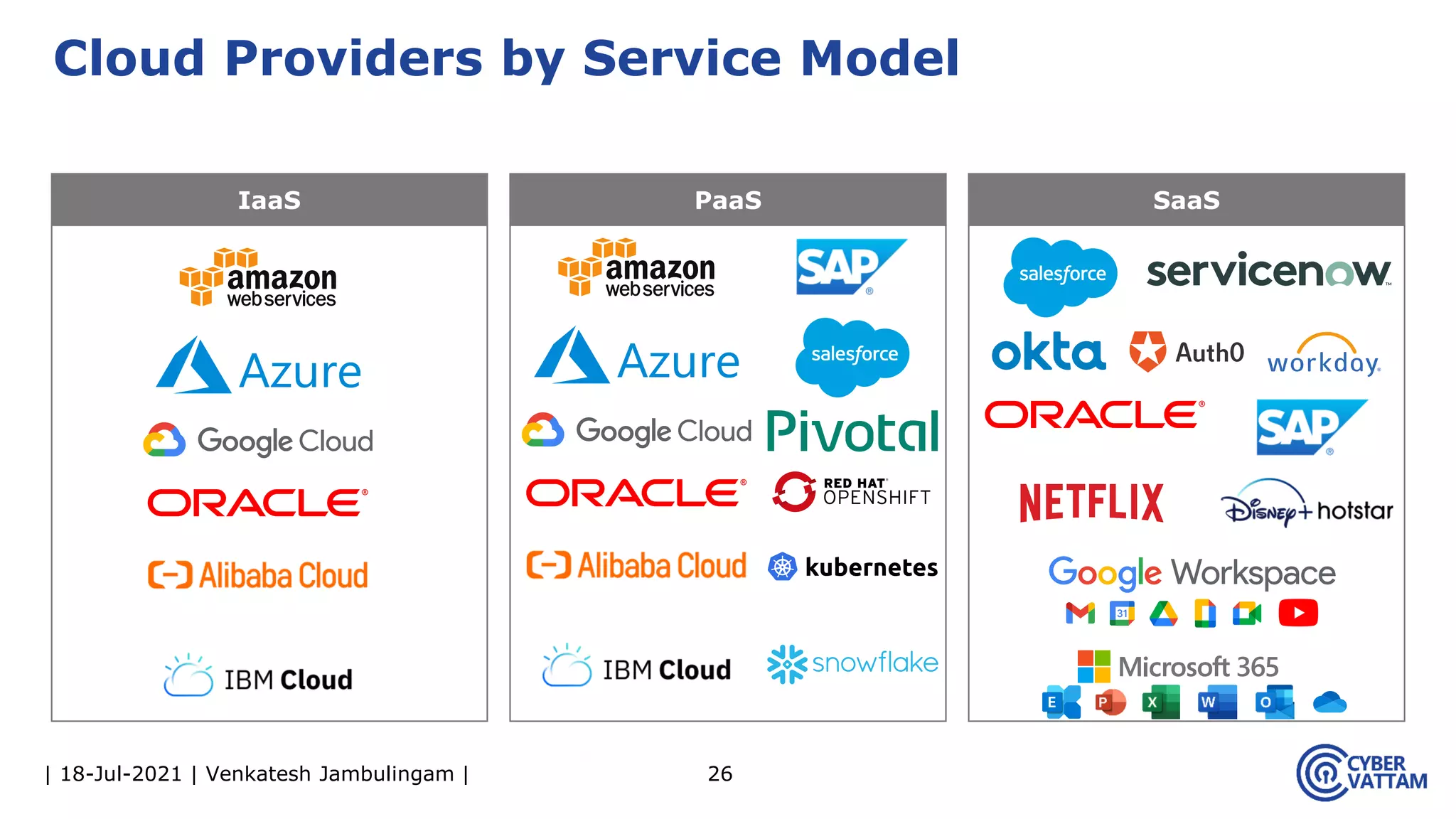
Cloud Providers by Service Model
IaaS SaaS
PaaS
Thank you
Creative
Commons
By Non
Commercial
Share
Alike
This document is shared under
CC BY-NC-SA 4.0 license
| 18-Jul-2021 | Venkatesh Jambulingam | 28
About me
Venkatesh Jambulingam
Cloud Security Expert
Email:
cybervattam@gmail.com
cybervattam@outlook.com
Follow me on

Cloud computing Introduction

  • 1.
    Presented by Venkatesh Jambulingam CloudSecurity Expert 18-Jul-2021 Cloud Computing
  • 2.
    | 18-Jul-2021 |Venkatesh Jambulingam | ▶Cloud Computing Definition ▶Characteristics of Cloud ▶Service Models ▶Deployment Models ▶Cloud Computing Roles ▶Benefits of Cloud Computing ▶Cloud Providers by Service Models 2 Contents
  • 3.
    | 18-Jul-2021 |Venkatesh Jambulingam | ▶In 2011, the National Institute of Standards and Technology defined Cloud computing as –“A model for enabling ubiquitous, convenient, on-demand network access to a shared pool of configurable computing resources (e.g., networks, servers, storage, applications, & services) that can be rapidly provisioned and released with minimal management effort or service provider interaction. ▶This cloud model is composed of 5 essential characteristics, 3 service models, and 4 deployment models.” 3 Cloud Computing Definition Infrastructure as a Service IaaS Rapid Elasticity Measured Service On-Demand Self Service Resource Pooling Multi- Tenancy Platform as a Service PaaS Software as a Service SaaS Public Private Hybrid Community Essential Characteristics Service Models Deployment Models Broad Network Access
  • 4.
  • 5.
    | 18-Jul-2021 |Venkatesh Jambulingam | ▶All cloud resources are available over a network, to manage and use without any need for direct physical access ▶The network is not necessarily part of the service. ▶In Principle, Cloud resources should be accessible from anywhere but can be controlled by access policies ▶In addition to this, they should also have secure network between their physical resources across various regions. 5 Cloud Computing Characteristics Broad Network Access Infrastructure as a Service IaaS Rapid Elasticity Measured Service On-Demand Self Service Resource Pooling Multi- Tenancy Platform as a Service PaaS Software as a Service SaaS Public Private Hybrid Community Essential Characteristics Service Models Deployment Models Broad Network Access
  • 6.
    | 18-Jul-2021 |Venkatesh Jambulingam | ▶Allows consumers to expand or contract the resources they use from the pool (provisioning and deprovisioning), often completely automatically. ▶This allows customers to more closely match resource consumption with demand ▶Rapid Elasticity should support scale up/down & scale in/out ▶Scale up / down: Increasing or decreasing capacity in current set up. It is also called as vertical scaling ▶Scale In/out: Increase or decreasing capacity by adding / removing resources in same location or in a new region or geography. It is also called horizontal scaling 6 Cloud Computing Characteristics Rapid Elasticity Infrastructure as a Service IaaS Rapid Elasticity Measured Service On-Demand Self Service Resource Pooling Multi- Tenancy Platform as a Service PaaS Software as a Service SaaS Public Private Hybrid Community Essential Characteristics Service Models Deployment Models Broad Network Access
  • 7.
    | 18-Jul-2021 |Venkatesh Jambulingam | ▶Ensure that consumers only use the resources they are allotted, and, if necessary, to charge them for it. ▶ This is also called utility computing as computing resources are consumed like water and electricity, with the client only paying for what they use ▶Unit of measure should be clearly defined in the management plan and potential use cost should be displayed for a given billing period 7 Cloud Computing Characteristics Measured Service Infrastructure as a Service IaaS Rapid Elasticity Measured Service On-Demand Self Service Resource Pooling Multi- Tenancy Platform as a Service PaaS Software as a Service SaaS Public Private Hybrid Community Essential Characteristics Service Models Deployment Models Broad Network Access
  • 8.
    | 18-Jul-2021 |Venkatesh Jambulingam | ▶Cloud Consumers manage their resources themselves, without having to talk to a human administrator from cloud service provider ▶Cloud service providers enable this self-service feature via management plane by providing various ways to access and manage the resources –Web Console –Application Program Interface (API) –Software Development Kit (SDK) 8 Cloud Computing Characteristics On-Demand Self Service Infrastructure as a Service IaaS Rapid Elasticity Measured Service On-Demand Self Service Resource Pooling Multi- Tenancy Platform as a Service PaaS Software as a Service SaaS Public Private Hybrid Community Essential Characteristics Service Models Deployment Models Broad Network Access
  • 9.
    | 18-Jul-2021 |Venkatesh Jambulingam | ▶Cloud service provider abstracts the resources from the underlying physical infrastructure to create resource pools. ▶Abstraction is enabled by virtualization. ▶They use orchestration and automation to coordinate carving out and delivering a set of resources from the pools to the consumers as needed 9 Cloud Computing Resource Pooling Infrastructure as a Service IaaS Rapid Elasticity Measured Service On-Demand Self Service Resource Pooling Multi- Tenancy Platform as a Service PaaS Software as a Service SaaS Public Private Hybrid Community Essential Characteristics Service Models Deployment Models Broad Network Access
  • 10.
    | 18-Jul-2021 |Venkatesh Jambulingam | ▶Cloud is multitenant by nature. Multiple different consumers share the same pool of resources but are segregated and isolated from each other. ▶Segregation allows the cloud provider to divide & share resources to the different groups ▶Isolation ensures different consumers can’t see or modify each other’s assets. ▶Multitenancy doesn’t only apply across different organizations as it’s also used to divide & share resources between different units within a single business or organization. 10 Cloud Computing Characteristics Multi-Tenancy Infrastructure as a Service IaaS Rapid Elasticity Measured Service On-Demand Self Service Resource Pooling Multi- Tenancy Platform as a Service PaaS Software as a Service SaaS Public Private Hybrid Community Essential Characteristics Service Models Deployment Models Broad Network Access
  • 11.
  • 12.
    | 18-Jul-2021 |Venkatesh Jambulingam | ▶Cloud provider offers access to a resource pool of fundamental computing infrastructure, such as virtualized compute, network, or storage & manages it themselves ▶Cloud Consumers can install various operating systems & apps on top of that to meet their requirements. 12 Cloud Computing Service Models Infrastructure as a Service (IaaS) Infrastructure as a Service IaaS Rapid Elasticity Measured Service On-Demand Self Service Resource Pooling Multi- Tenancy Platform as a Service PaaS Software as a Service SaaS Public Private Hybrid Community Essential Characteristics Service Models Deployment Models Broad Network Access Data Runtime Middleware O/S Applications Managed by Customer Virtualization Servers Storage Networking Managed by cloud Provider
  • 13.
    | 18-Jul-2021 |Venkatesh Jambulingam | ▶Cloud provider abstracts and provides development or application platforms, such as databases, application platforms ▶Examples: –a place to run Python, PHP, or other code –Database –Datawarehouse –File storage –Machine Learning, –big data processing, or –direct Application Programming Interfaces (API) ▶The key differentiator is that, with PaaS, you don’t manage the underlying servers, networks, or other infrastructure. 13 Cloud Computing Service Models Platform as a Service (PaaS) Infrastructure as a Service IaaS Rapid Elasticity Measured Service On-Demand Self Service Resource Pooling Multi- Tenancy Platform as a Service PaaS Software as a Service SaaS Public Private Hybrid Community Essential Characteristics Service Models Deployment Models Broad Network Access Data Applications managed by Customer Runtime Middleware O/S Virtualization Servers Storage Networking managed by cloud Provider
  • 14.
    | 18-Jul-2021 |Venkatesh Jambulingam | ▶A full application that’s managed and hosted by the provider. ▶Consumers access it with a web browser, mobile app, or a lightweight client app. ▶Personalization / configuration may be available ▶The features or capabilities cannot be modified. ▶Ex: Netflix, Prime Video, Gmail, Youtube, Zoom, Microsoft 365 etc., 14 Cloud Computing Service Models Software as a Service (SaaS) Infrastructure as a Service IaaS Rapid Elasticity Measured Service On-Demand Self Service Resource Pooling Multi- Tenancy Platform as a Service PaaS Software as a Service SaaS Public Private Hybrid Community Essential Characteristics Service Models Deployment Models Broad Network Access Data Runtime Middleware O/S Virtualization Servers Storage Networking Applications managed by cloud Provider
  • 15.
  • 16.
    | 18-Jul-2021 |Venkatesh Jambulingam | ▶The cloud infrastructure is made available to the general public or a large industry group and is owned by an organization selling cloud services. ▶Anyone can subscribe for the cloud services ▶E.g., AWS, Azure, GCP 16 Cloud Computing Deployment Models Public Cloud Infrastructure as a Service IaaS Rapid Elasticity Measured Service On-Demand Self Service Resource Pooling Multi- Tenancy Platform as a Service PaaS Software as a Service SaaS Public Private Hybrid Community Essential Characteristics Service Models Deployment Models Broad Network Access
  • 17.
    | 18-Jul-2021 |Venkatesh Jambulingam | ▶The cloud infrastructure is operated solely for a single organization. ▶It may be managed by the organization or by a third party and may be located on-premises or off premises ▶Ex: Rackspace, VMware vCloud, Azure Stack, IBM Cloud Private 17 Cloud Computing Deployment Models Private Cloud Infrastructure as a Service IaaS Rapid Elasticity Measured Service On-Demand Self Service Resource Pooling Multi- Tenancy Platform as a Service PaaS Software as a Service SaaS Public Private Hybrid Community Essential Characteristics Service Models Deployment Models Broad Network Access
  • 18.
    | 18-Jul-2021 |Venkatesh Jambulingam | ▶The cloud infrastructure is a composition of two or more clouds (private, community, or public) that remain unique entities but are bound together by standardized or proprietary technology that enables data and application portability ▶Hybrid is also commonly used to describe a non-cloud data center bridged directly to a cloud provider 18 Cloud Computing Deployment Models Hybrid Cloud Infrastructure as a Service IaaS Rapid Elasticity Measured Service On-Demand Self Service Resource Pooling Multi- Tenancy Platform as a Service PaaS Software as a Service SaaS Public Private Hybrid Community Essential Characteristics Service Models Deployment Models Broad Network Access
  • 19.
    | 18-Jul-2021 |Venkatesh Jambulingam | ▶From a technical standpoint, community cloud is a multitenant platform that is accessible only for a specific subset of customers. ▶The cloud infrastructure is shared by several organizations and supports a specific community that has shared mission, security requirements, policy, or compliance considerations. ▶It may be managed by the organizations or by a third party and may be located on-premises or off-premises. ▶Example: Gov Cloud 19 Cloud Computing Deployment Models Community Cloud Infrastructure as a Service IaaS Rapid Elasticity Measured Service On-Demand Self Service Resource Pooling Multi- Tenancy Platform as a Service PaaS Software as a Service SaaS Public Private Hybrid Community Essential Characteristics Service Models Deployment Models Broad Network Access
  • 20.
  • 21.
    | 18-Jul-2021 |Venkatesh Jambulingam | 21 Cloud Computing Roles Cloud Carrier An intermediary that provides connectivity and transport of cloud services from Cloud Providers to Cloud Consumers Cloud Provider A person, organization, or entity responsible for making a cloud service available to interested parties Cloud Consumer A person or organization that maintains a business relationship with, and uses service from, Cloud Providers Cloud Access Security Brokers (CASB) These products intercept communications that are directed towards a cloud service or directly connect to the service via API in order to monitor activity, enforce policy, and detect and/or prevent security issues. They are most commonly used to manage an organization’s sanctioned and unsanctioned SaaS services. Cloud Brokers An entity that manages the use, performance and delivery of cloud services, and negotiates relationships between Cloud Providers and Cloud Consumers
  • 22.
  • 23.
    | 18-Jul-2021 |Venkatesh Jambulingam | 23 Cloud Computing Benefits Cloud consumers does not require upfront investments or capital expenditure (CAPEX) as cloud providers owns hardware Cloud consumers just have to pay for what they use based on their subscription plan leading only operational expenditure (OPEX) Cost Savings Cloud offers great capacity scaling for infrastructure & bandwidth unimaginable in conventional in-house technical infrastructure Organization & its people have more time to devote toward the aspects of your business rather than managing IT infrastructure Scale & Flexibility Most of the cloud providers offer their services, with most of them maintaining an uptime of 99.995% or only 25 mins of unscheduled downtime in a year Users can get onto the applications needed basically from anywhere at any time. Availability Due to the scale of the operations, cloud providers carefully monitor security at various levels like physical security, network security, storage security etc Smaller organizations or even individuals get the same level of security protection as some of the biggest companies while using cloud environment from any given cloud provider Security
  • 24.
    | 18-Jul-2021 |Venkatesh Jambulingam | 24 Cloud Computing Benefits Cloud-based services provide are prepared for different kinds of emergency scenarios ranging from natural disasters to power outages Having your fail over environment in a different region enables you to recover quickly & minimize impact to business Disaster Recovery The omnipresence nature of the cloud makes it easy for companies to allow employees to connect remotely. They can use company owned or employee owned devices like smartphones, tablets and Laptops. It offers convenient access to information for anywhere enabling better work-life balance Mobility When using cloud native services like PaaS, SaaS, applications are kept updated by cloud service providers Cloud consumers don’t have to worry about updates or patches to be installed and they can focusing on building or using applications Automatic Software Updates Cloud providers are sourcing more renewable energy for their operations Using the cloud is more environmentally friendly and results in less of a carbon footprint in on- premise networks Due to remote access, reduces travel to office related emissions Decarbonization Due to need for accessing information from various devices, all the information can be stored in the cloud centrally. It remains safe and easily accessible from any computer with an internet connection. You can erase the data on a lost/stolen device without losing any data. Loss Prevention
  • 25.
  • 26.
    | 18-Jul-2021 |Venkatesh Jambulingam | 26 Cloud Providers by Service Model IaaS SaaS PaaS
  • 27.
    Thank you Creative Commons By Non Commercial Share Alike Thisdocument is shared under CC BY-NC-SA 4.0 license
  • 28.
    | 18-Jul-2021 |Venkatesh Jambulingam | 28 About me Venkatesh Jambulingam Cloud Security Expert Email: cybervattam@gmail.com cybervattam@outlook.com Follow me on