Cloud Computing
1
Introduction to Cloud
Definition of Cloud by
NIST
Cloud Architecture
Cloud Reference
Architecture
Applications of
Cloud
https://www.i-softinc.com/
The Power of Thinking
2
 Cloud computing is using the
internet to access someone
else's software running on
someone else's hardware in
someone else's data center.
 Lewis Cunningham
 A large-scale distributed
computing paradigm that is
driven by economies of scale, in
which a pool of abstracted,
virtualized, dynamically scalable,
managed computing power,
storage, platforms, and services
are delivered on demand to
external customers over the
Internet.

 A Cloud is a type of parallel and
distributed system consisting of
a collection of interconnected
and virtualized computers that
are dynamically provisioned and
presented as one or more unified
computing resources based on
service-level agreements
established through negotiation
between the service provider
and consumers.

The Power of Thinking
3
 A cloud is a pool of virtualized
resources that can host a variety
of different workloads, allow
workloads to be deployed and
scaled-out quickly, allocate
resources when needed, and
support redundancy.
 Greg Boss et al.,
IBM
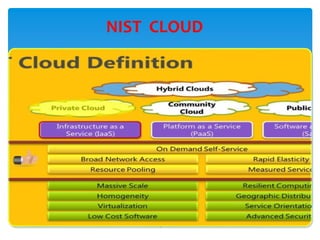
NIST CLOUD
4
NIST
(National Institute of Standard & Technology)
5
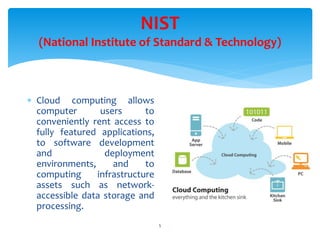
 Cloud computing allows
computer users to
conveniently rent access to
fully featured applications,
to software development
and deployment
environments, and to
computing infrastructure
assets such as network-
accessible data storage and
processing.
NIST
(National Institute of Standard & Technology)
6
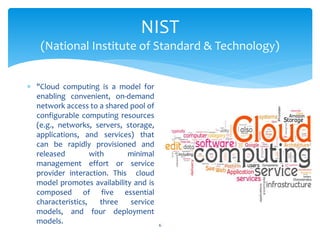
 "Cloud computing is a model for
enabling convenient, on-demand
network access to a shared pool of
configurable computing resources
(e.g., networks, servers, storage,
applications, and services) that
can be rapidly provisioned and
released with minimal
management effort or service
provider interaction. This cloud
model promotes availability and is
composed of five essential
characteristics, three service
models, and four deployment
models.
Essential Characteristics
7
 On-demand self-service - A
consumer can unilaterally provision
computing capabilities, such as
server time and network storage, as
needed automatically without
requiring human interaction with
each service’s provider.
 Broad network access - Capabilities
are available over the network and
accessed through standard
mechanisms that promote use by
heterogeneous thin or thick client
platforms (e.g., mobile phones,
laptops, and personal digital
assistants (PDAs)).
 Resource pooling - The provider’s
computing resources are pooled to
serve multiple consumers using a
multi-tenant model, with different
physical and virtual resources
dynamically assigned and
reassigned according to consumer
demand. There is a sense of
location independence in that the
subscriber generally has no
control or knowledge over the
exact location of the provided
resources but may be able to
specify location at a higher level of
abstraction (e.g., country, state, or
datacenter). Examples of
resources include storage,
processing, memory, network
bandwidth, and virtual machines.
Essential Characteristics
8
 Rapid elasticity - Capabilities
can be rapidly and elastically
provisioned, in some cases
automatically, to quickly
scale out and rapidly
released to quickly scale in.
To the consumer, the
capabilities available for
provisioning often appear to
be unlimited and can be
purchased in any quantity at
any time.
 Measured Service - Cloud
systems automatically control
and optimize resource use by
leveraging a metering
capability at some level of
abstraction appropriate to the
type of service (e.g., storage,
processing, bandwidth, and
active user accounts).
Resource usage can be
monitored, controlled, and
reported providing
transparency for both the
provider and consumer of the
utilized service.
Service Models
9
Service Models
10
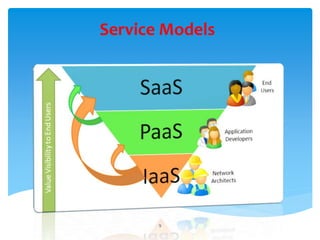
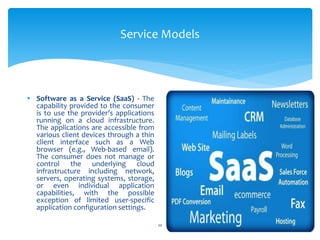
 Software as a Service (SaaS) - The
capability provided to the consumer
is to use the provider’s applications
running on a cloud infrastructure.
The applications are accessible from
various client devices through a thin
client interface such as a Web
browser (e.g., Web-based email).
The consumer does not manage or
control the underlying cloud
infrastructure including network,
servers, operating systems, storage,
or even individual application
capabilities, with the possible
exception of limited user-specific
application configuration settings.
Service Models
11
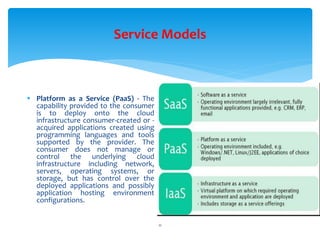
 Platform as a Service (PaaS) - The
capability provided to the consumer
is to deploy onto the cloud
infrastructure consumer-created or -
acquired applications created using
programming languages and tools
supported by the provider. The
consumer does not manage or
control the underlying cloud
infrastructure including network,
servers, operating systems, or
storage, but has control over the
deployed applications and possibly
application hosting environment
configurations.
Service Models
12
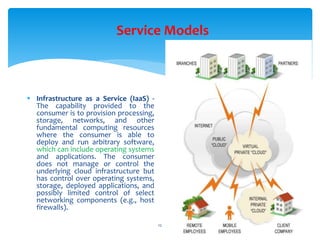
 Infrastructure as a Service (IaaS) -
The capability provided to the
consumer is to provision processing,
storage, networks, and other
fundamental computing resources
where the consumer is able to
deploy and run arbitrary software,
which can include operating systems
and applications. The consumer
does not manage or control the
underlying cloud infrastructure but
has control over operating systems,
storage, deployed applications, and
possibly limited control of select
networking components (e.g., host
firewalls).
 I-Softinc is one of the most development company for
developing mobile application development company
in USA. It is a leading company which provides best
services for mobile apps development in USA.
 I-Softinc Technology has developed 1000+ mobile
apps 250+ happy clients across the world. This
company develop and design cloud and latest
technology based mobile apps development in USA.
13
I-Softinc Technology
14
https://www.i-softinc.com/

Cloud computing

  • 1.
    Cloud Computing 1 Introduction toCloud Definition of Cloud by NIST Cloud Architecture Cloud Reference Architecture Applications of Cloud https://www.i-softinc.com/
  • 2.
    The Power ofThinking 2  Cloud computing is using the internet to access someone else's software running on someone else's hardware in someone else's data center.  Lewis Cunningham  A large-scale distributed computing paradigm that is driven by economies of scale, in which a pool of abstracted, virtualized, dynamically scalable, managed computing power, storage, platforms, and services are delivered on demand to external customers over the Internet.   A Cloud is a type of parallel and distributed system consisting of a collection of interconnected and virtualized computers that are dynamically provisioned and presented as one or more unified computing resources based on service-level agreements established through negotiation between the service provider and consumers. 
  • 3.
    The Power ofThinking 3  A cloud is a pool of virtualized resources that can host a variety of different workloads, allow workloads to be deployed and scaled-out quickly, allocate resources when needed, and support redundancy.  Greg Boss et al., IBM
  • 4.
  • 5.
    NIST (National Institute ofStandard & Technology) 5  Cloud computing allows computer users to conveniently rent access to fully featured applications, to software development and deployment environments, and to computing infrastructure assets such as network- accessible data storage and processing.
  • 6.
    NIST (National Institute ofStandard & Technology) 6  "Cloud computing is a model for enabling convenient, on-demand network access to a shared pool of configurable computing resources (e.g., networks, servers, storage, applications, and services) that can be rapidly provisioned and released with minimal management effort or service provider interaction. This cloud model promotes availability and is composed of five essential characteristics, three service models, and four deployment models.
  • 7.
    Essential Characteristics 7  On-demandself-service - A consumer can unilaterally provision computing capabilities, such as server time and network storage, as needed automatically without requiring human interaction with each service’s provider.  Broad network access - Capabilities are available over the network and accessed through standard mechanisms that promote use by heterogeneous thin or thick client platforms (e.g., mobile phones, laptops, and personal digital assistants (PDAs)).  Resource pooling - The provider’s computing resources are pooled to serve multiple consumers using a multi-tenant model, with different physical and virtual resources dynamically assigned and reassigned according to consumer demand. There is a sense of location independence in that the subscriber generally has no control or knowledge over the exact location of the provided resources but may be able to specify location at a higher level of abstraction (e.g., country, state, or datacenter). Examples of resources include storage, processing, memory, network bandwidth, and virtual machines.
  • 8.
    Essential Characteristics 8  Rapidelasticity - Capabilities can be rapidly and elastically provisioned, in some cases automatically, to quickly scale out and rapidly released to quickly scale in. To the consumer, the capabilities available for provisioning often appear to be unlimited and can be purchased in any quantity at any time.  Measured Service - Cloud systems automatically control and optimize resource use by leveraging a metering capability at some level of abstraction appropriate to the type of service (e.g., storage, processing, bandwidth, and active user accounts). Resource usage can be monitored, controlled, and reported providing transparency for both the provider and consumer of the utilized service.
  • 9.
  • 10.
    Service Models 10  Softwareas a Service (SaaS) - The capability provided to the consumer is to use the provider’s applications running on a cloud infrastructure. The applications are accessible from various client devices through a thin client interface such as a Web browser (e.g., Web-based email). The consumer does not manage or control the underlying cloud infrastructure including network, servers, operating systems, storage, or even individual application capabilities, with the possible exception of limited user-specific application configuration settings.
  • 11.
    Service Models 11  Platformas a Service (PaaS) - The capability provided to the consumer is to deploy onto the cloud infrastructure consumer-created or - acquired applications created using programming languages and tools supported by the provider. The consumer does not manage or control the underlying cloud infrastructure including network, servers, operating systems, or storage, but has control over the deployed applications and possibly application hosting environment configurations.
  • 12.
    Service Models 12  Infrastructureas a Service (IaaS) - The capability provided to the consumer is to provision processing, storage, networks, and other fundamental computing resources where the consumer is able to deploy and run arbitrary software, which can include operating systems and applications. The consumer does not manage or control the underlying cloud infrastructure but has control over operating systems, storage, deployed applications, and possibly limited control of select networking components (e.g., host firewalls).
  • 13.
     I-Softinc isone of the most development company for developing mobile application development company in USA. It is a leading company which provides best services for mobile apps development in USA.  I-Softinc Technology has developed 1000+ mobile apps 250+ happy clients across the world. This company develop and design cloud and latest technology based mobile apps development in USA. 13 I-Softinc Technology
  • 14.