Cloud Computing – An OverviewKannan Subbiah
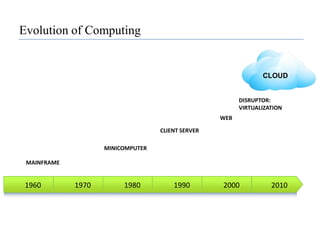
Evolution of ComputingCLOUDDISRUPTOR:  VIRTUALIZATIONWEB197019801990200019602010CLIENT SERVERMINICOMPUTERMAINFRAME
Origin of the term “Cloud Computing”“Comes from the early days of the Internet where we drew the network as a cloud… we didn’t care where the messages went… the cloud hid it from us” – Kevin Marks, Google	First cloud around networking (TCP/IP abstraction) & Second cloud around documents (WWW data abstraction)	The emerging cloud abstracts infrastructure complexities of servers, applications, data, and heterogeneous platforms (“muck” as Amazon’s CEO Jeff Bezos calls it)
Thoughts on Cloud ComputingGalen Gruman, InfoWorld Executive Editor, and Eric Knorr, InfoWorld Editor in Chief“A way to increase capacity or add capabilities on the fly without investing in new infrastructure, training new personnel, or licensing new software.”“The idea of loosely coupled services running on an agile, scalable infrastructure should eventually make every enterprise a node in the cloud.”
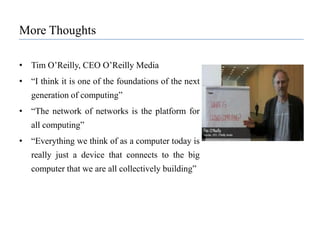
More ThoughtsTim O’Reilly, CEO O’Reilly Media“I think it is one of the foundations of the next generation of computing”“The network of networks is the platform for all computing”“Everything we think of as a computer today is really just a device that connects to the big computer that we are all collectively building”
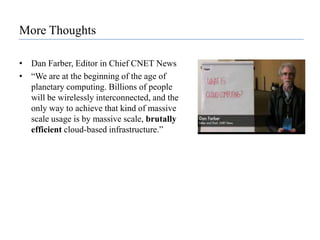
More ThoughtsDan Farber, Editor in Chief CNET News“We are at the beginning of the age of planetary computing. Billions of people will be wirelessly interconnected, and the only way to achieve that kind of massive scale usage is by massive scale, brutally efficient cloud-based infrastructure.”
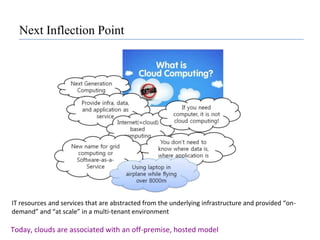
Next Inflection PointIT resources and services that are abstracted from the underlying infrastructure and provided “on-demand” and “at scale” in a multi-tenant environmentToday, clouds are associated with an off-premise, hosted model
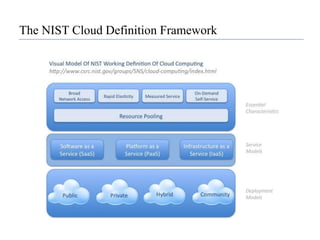
A Working Definition of Cloud ComputingCloud computing is a model for enabling convenient, on-demand network access to a shared pool of configurable computing resources (e.g., networks, servers, storage, applications, and services) that can be rapidly provisioned and released with minimal management effort or service provider interaction. This cloud model promotes availability and is composed of five essential characteristics, three service models, and four deployment models.
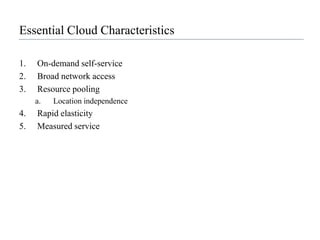
Essential Cloud CharacteristicsOn-demand self-service Broad network accessResource poolingLocation independenceRapid elasticityMeasured service
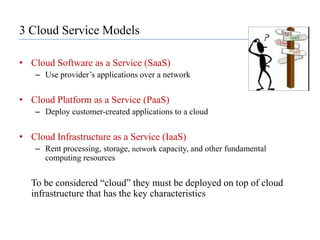
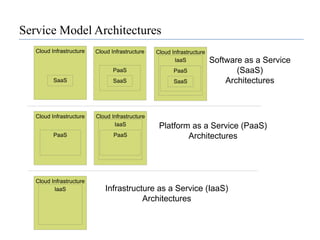
3 Cloud Service ModelsCloud Software as a Service (SaaS)Use provider’s applications over a network Cloud Platform as a Service (PaaS)Deploy customer-created applications to a cloud Cloud Infrastructure as a Service (IaaS)Rent processing, storage, network capacity, and other fundamental computing resources	To be considered “cloud” they must be deployed on top of cloud infrastructure that has the key characteristics
Service Model Architectures
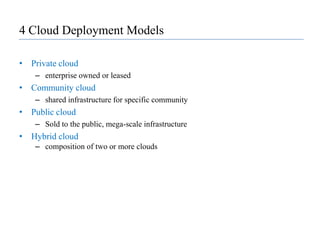
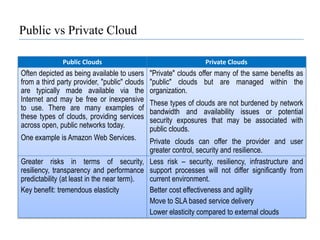
4 Cloud Deployment ModelsPrivate cloud enterprise owned or leasedCommunity cloudshared infrastructure for specific communityPublic cloudSold to the public, mega-scale infrastructureHybrid cloudcomposition of two or more clouds
Public vs Private Cloud
Common Cloud CharacteristicsCloud computing often leverages:Massive scaleHomogeneityVirtualizationResilient computingLow cost softwareGeographic distributionService orientationAdvanced security technologies
The NIST Cloud Definition Framework
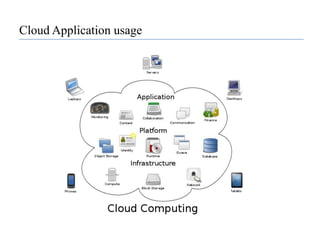
Cloud Application usage
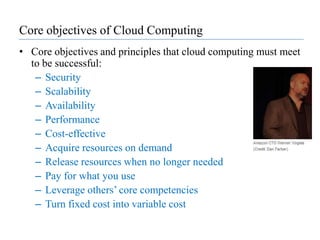
Core objectives of Cloud ComputingCore objectives and principles that cloud computing must meet to be successful: Security ScalabilityAvailability Performance Cost-effective Acquire resources on demand Release resources when no longer needed Pay for what you use Leverage others’ core competencies Turn fixed cost into variable cost
A “sunny” vision of the futureSun Microsystems CTO Greg PapadopoulosUsers will “trust” service providers with their data like they trust banks with their money“Hosting providers [will] bring ‘brutal efficiency’ for utilization, power, security, service levels, and idea-to-deploy time” –CNET articleBecoming cost ineffective to build data centersOrganizations will rent computing resources Envisions grid of 6 cloud infrastructure providers linked to 100 regional providers
Benefits of Cloud ComputingSource: IBSG, 2009
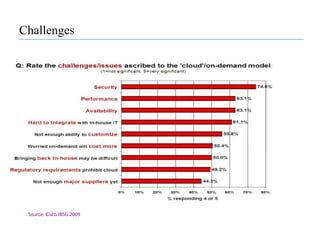
ChallengesSource: Cisco IBSG 2009
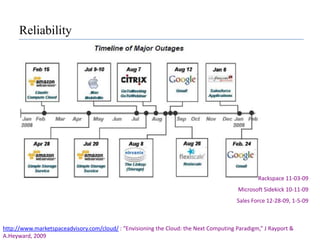
ReliabilityRackspace 11-03-09Microsoft Sidekick 10-11-09Sales Force 12-28-09, 1-5-09http://www.marketspaceadvisory.com/cloud/: “Envisioning the Cloud: the Next Computing Paradigm,” J Rayport & A.Heyward, 2009
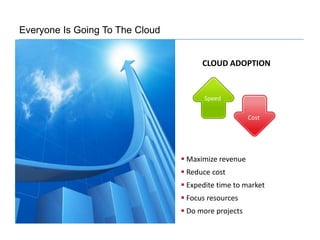
Everyone Is Going To The CloudSpeedCostCLOUD ADOPTION Maximize revenue
 Reduce cost
 Expedite time to market
 Focus resources
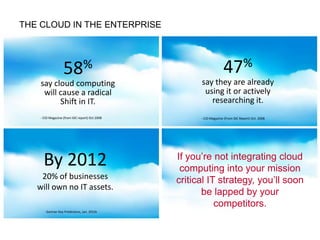
 Do more projectsTHE CLOUD IN THE ENTERPRISE47%say they are already using it or actively researching it.58%say cloud computingwill cause a radicalShift in IT.- CIO Magazine (from IDC report) Oct 2008- CIO Magazine (From IDC Report) Oct. 2008 By 201220% of businesseswill own no IT assets.If you’re not integrating cloud computing into your mission critical IT strategy, you’ll soon be lapped by your competitors.- Gartner Key Predictions, Jan. 2010z
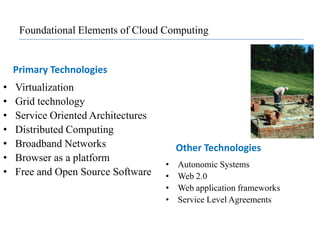
Foundational Elements of Cloud ComputingPrimary TechnologiesVirtualization
Grid technology
Service Oriented Architectures
Distributed Computing
Broadband Networks
Browser as a platform
Free and Open Source SoftwareOther TechnologiesAutonomic Systems
Web 2.0
Web application frameworks
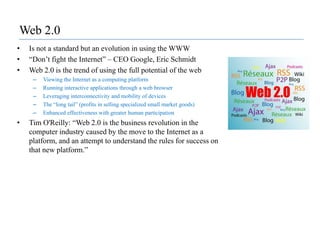
Service Level AgreementsWeb 2.0Is not a standard but an evolution in using the WWW“Don’t fight the Internet” – CEO Google, Eric SchmidtWeb 2.0 is the trend of using the full potential of the webViewing the Internet as a computing platformRunning interactive applications through a web browserLeveraging interconnectivity and mobility of devicesThe “long tail” (profits in selling specialized small market goods) Enhanced effectiveness with greater human participationTim O'Reilly: “Web 2.0 is the business revolution in the computer industry caused by the move to the Internet as a platform, and an attempt to understand the rules for success on that new platform.”
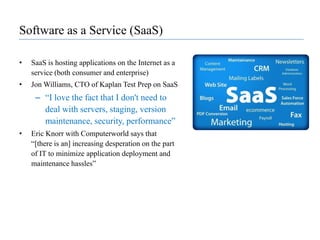
Software as a Service (SaaS)SaaS is hosting applications on the Internet as a service (both consumer and enterprise)Jon Williams, CTO of Kaplan Test Prep on SaaS“I love the fact that I don't need to deal with servers, staging, version maintenance, security, performance”Eric Knorr with Computerworld says that “[there is an] increasing desperation on the part of IT to minimize application deployment and maintenance hassles”
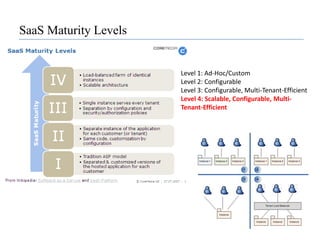
Three Features of Mature SaaS ApplicationsScalableHandle growing amounts of work in a graceful mannerMulti-tenancyOne application instance may be serving hundreds of companiesOpposite of multi-instance where each customer is provisioned their own server running one instanceMetadata driven configurabilityInstead of customizing the application for a customer (requiring code changes), one allows the user to configure the application through metadata
SaaS Maturity LevelsLevel 1: Ad-Hoc/CustomLevel 2: ConfigurableLevel 3: Configurable, Multi-Tenant-EfficientLevel 4: Scalable, Configurable, Multi-Tenant-Efficient
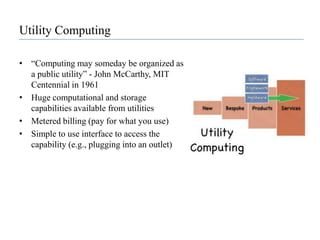
Utility Computing“Computing may someday be organized as a public utility” - John McCarthy, MIT Centennial in 1961 Huge computational and storage capabilities available from utilitiesMetered billing (pay for what you use)Simple to use interface to access the capability (e.g., plugging into an outlet)
Service Level Agreements (SLAs)Contract between customers and service providers of the level of service to be providedContains performance metrics (e.g., uptime, throughput, response time)Problem management detailsDocumented security capabilitiesContains penalties for non-performance
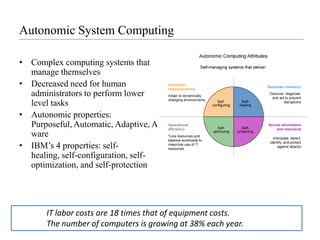
Autonomic System ComputingComplex computing systems that manage themselvesDecreased need for human administrators to perform lower level tasksAutonomic properties: Purposeful, Automatic, Adaptive, AwareIBM’s 4 properties: self-healing, self-configuration, self-optimization, and self-protectionIT labor costs are 18 times that of equipment costs.The number of computers is growing at 38% each year.
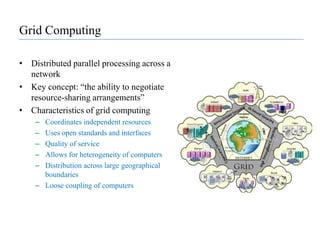
Grid ComputingDistributed parallel processing across a networkKey concept: “the ability to negotiate resource-sharing arrangements”Characteristics of grid computingCoordinates independent resourcesUses open standards and interfacesQuality of serviceAllows for heterogeneity of computersDistribution across large geographical boundariesLoose coupling of computers
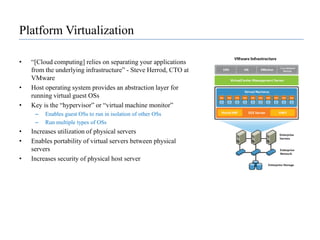
Platform Virtualization“[Cloud computing] relies on separating your applications from the underlying infrastructure” - Steve Herrod, CTO at VMwareHost operating system provides an abstraction layer for running virtual guest OSsKey is the “hypervisor” or “virtual machine monitor”Enables guest OSs to run in isolation of other OSsRun multiple types of OSsIncreases utilization of physical serversEnables portability of virtual servers between physical serversIncreases security of physical host server
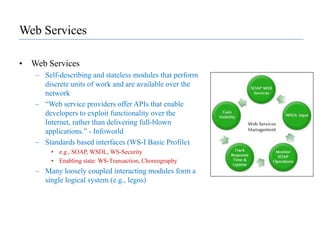
Web ServicesWeb Services
Self-describing and stateless modules that perform discrete units of work and are available over the network
“Web service providers offer APIs that enable developers to exploit functionality over the Internet, rather than delivering full-blown applications.” - Infoworld
Standards based interfaces (WS-I Basic Profile)
e.g., SOAP, WSDL, WS-Security
Enabling state: WS-Transaction, Choreography
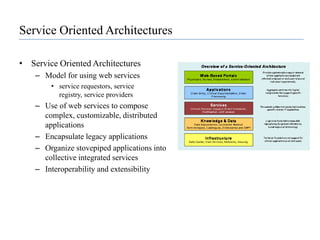
Many loosely coupled interacting modules form a single logical system (e.g., legos)Service Oriented ArchitecturesService Oriented ArchitecturesModel for using web servicesservice requestors, service registry, service providersUse of web services to compose complex, customizable, distributed applicationsEncapsulate legacy applicationsOrganize stovepiped applications into collective integrated servicesInteroperability and extensibility

Cloud computing – An Overview

  • 1.
    Cloud Computing –An OverviewKannan Subbiah
  • 2.
    Evolution of ComputingCLOUDDISRUPTOR: VIRTUALIZATIONWEB197019801990200019602010CLIENT SERVERMINICOMPUTERMAINFRAME
  • 3.
    Origin of theterm “Cloud Computing”“Comes from the early days of the Internet where we drew the network as a cloud… we didn’t care where the messages went… the cloud hid it from us” – Kevin Marks, Google First cloud around networking (TCP/IP abstraction) & Second cloud around documents (WWW data abstraction) The emerging cloud abstracts infrastructure complexities of servers, applications, data, and heterogeneous platforms (“muck” as Amazon’s CEO Jeff Bezos calls it)
  • 4.
    Thoughts on CloudComputingGalen Gruman, InfoWorld Executive Editor, and Eric Knorr, InfoWorld Editor in Chief“A way to increase capacity or add capabilities on the fly without investing in new infrastructure, training new personnel, or licensing new software.”“The idea of loosely coupled services running on an agile, scalable infrastructure should eventually make every enterprise a node in the cloud.”
  • 5.
    More ThoughtsTim O’Reilly,CEO O’Reilly Media“I think it is one of the foundations of the next generation of computing”“The network of networks is the platform for all computing”“Everything we think of as a computer today is really just a device that connects to the big computer that we are all collectively building”
  • 6.
    More ThoughtsDan Farber,Editor in Chief CNET News“We are at the beginning of the age of planetary computing. Billions of people will be wirelessly interconnected, and the only way to achieve that kind of massive scale usage is by massive scale, brutally efficient cloud-based infrastructure.”
  • 7.
    Next Inflection PointITresources and services that are abstracted from the underlying infrastructure and provided “on-demand” and “at scale” in a multi-tenant environmentToday, clouds are associated with an off-premise, hosted model
  • 8.
    A Working Definitionof Cloud ComputingCloud computing is a model for enabling convenient, on-demand network access to a shared pool of configurable computing resources (e.g., networks, servers, storage, applications, and services) that can be rapidly provisioned and released with minimal management effort or service provider interaction. This cloud model promotes availability and is composed of five essential characteristics, three service models, and four deployment models.
  • 9.
    Essential Cloud CharacteristicsOn-demandself-service Broad network accessResource poolingLocation independenceRapid elasticityMeasured service
  • 10.
    3 Cloud ServiceModelsCloud Software as a Service (SaaS)Use provider’s applications over a network Cloud Platform as a Service (PaaS)Deploy customer-created applications to a cloud Cloud Infrastructure as a Service (IaaS)Rent processing, storage, network capacity, and other fundamental computing resources To be considered “cloud” they must be deployed on top of cloud infrastructure that has the key characteristics
  • 11.
  • 12.
    4 Cloud DeploymentModelsPrivate cloud enterprise owned or leasedCommunity cloudshared infrastructure for specific communityPublic cloudSold to the public, mega-scale infrastructureHybrid cloudcomposition of two or more clouds
  • 13.
  • 14.
    Common Cloud CharacteristicsCloudcomputing often leverages:Massive scaleHomogeneityVirtualizationResilient computingLow cost softwareGeographic distributionService orientationAdvanced security technologies
  • 15.
    The NIST CloudDefinition Framework
  • 16.
  • 17.
    Core objectives ofCloud ComputingCore objectives and principles that cloud computing must meet to be successful: Security ScalabilityAvailability Performance Cost-effective Acquire resources on demand Release resources when no longer needed Pay for what you use Leverage others’ core competencies Turn fixed cost into variable cost
  • 18.
    A “sunny” visionof the futureSun Microsystems CTO Greg PapadopoulosUsers will “trust” service providers with their data like they trust banks with their money“Hosting providers [will] bring ‘brutal efficiency’ for utilization, power, security, service levels, and idea-to-deploy time” –CNET articleBecoming cost ineffective to build data centersOrganizations will rent computing resources Envisions grid of 6 cloud infrastructure providers linked to 100 regional providers
  • 19.
    Benefits of CloudComputingSource: IBSG, 2009
  • 20.
  • 21.
    ReliabilityRackspace 11-03-09Microsoft Sidekick10-11-09Sales Force 12-28-09, 1-5-09http://www.marketspaceadvisory.com/cloud/: “Envisioning the Cloud: the Next Computing Paradigm,” J Rayport & A.Heyward, 2009
  • 22.
    Everyone Is GoingTo The CloudSpeedCostCLOUD ADOPTION Maximize revenue
  • 23.
  • 24.
  • 25.
  • 26.
    Do moreprojectsTHE CLOUD IN THE ENTERPRISE47%say they are already using it or actively researching it.58%say cloud computingwill cause a radicalShift in IT.- CIO Magazine (from IDC report) Oct 2008- CIO Magazine (From IDC Report) Oct. 2008 By 201220% of businesseswill own no IT assets.If you’re not integrating cloud computing into your mission critical IT strategy, you’ll soon be lapped by your competitors.- Gartner Key Predictions, Jan. 2010z
  • 27.
    Foundational Elements ofCloud ComputingPrimary TechnologiesVirtualization
  • 28.
  • 29.
  • 30.
  • 31.
  • 32.
    Browser as aplatform
  • 33.
    Free and OpenSource SoftwareOther TechnologiesAutonomic Systems
  • 34.
  • 35.
  • 36.
    Service Level AgreementsWeb2.0Is not a standard but an evolution in using the WWW“Don’t fight the Internet” – CEO Google, Eric SchmidtWeb 2.0 is the trend of using the full potential of the webViewing the Internet as a computing platformRunning interactive applications through a web browserLeveraging interconnectivity and mobility of devicesThe “long tail” (profits in selling specialized small market goods) Enhanced effectiveness with greater human participationTim O'Reilly: “Web 2.0 is the business revolution in the computer industry caused by the move to the Internet as a platform, and an attempt to understand the rules for success on that new platform.”
  • 37.
    Software as aService (SaaS)SaaS is hosting applications on the Internet as a service (both consumer and enterprise)Jon Williams, CTO of Kaplan Test Prep on SaaS“I love the fact that I don't need to deal with servers, staging, version maintenance, security, performance”Eric Knorr with Computerworld says that “[there is an] increasing desperation on the part of IT to minimize application deployment and maintenance hassles”
  • 38.
    Three Features ofMature SaaS ApplicationsScalableHandle growing amounts of work in a graceful mannerMulti-tenancyOne application instance may be serving hundreds of companiesOpposite of multi-instance where each customer is provisioned their own server running one instanceMetadata driven configurabilityInstead of customizing the application for a customer (requiring code changes), one allows the user to configure the application through metadata
  • 39.
    SaaS Maturity LevelsLevel1: Ad-Hoc/CustomLevel 2: ConfigurableLevel 3: Configurable, Multi-Tenant-EfficientLevel 4: Scalable, Configurable, Multi-Tenant-Efficient
  • 40.
    Utility Computing“Computing maysomeday be organized as a public utility” - John McCarthy, MIT Centennial in 1961 Huge computational and storage capabilities available from utilitiesMetered billing (pay for what you use)Simple to use interface to access the capability (e.g., plugging into an outlet)
  • 41.
    Service Level Agreements(SLAs)Contract between customers and service providers of the level of service to be providedContains performance metrics (e.g., uptime, throughput, response time)Problem management detailsDocumented security capabilitiesContains penalties for non-performance
  • 42.
    Autonomic System ComputingComplexcomputing systems that manage themselvesDecreased need for human administrators to perform lower level tasksAutonomic properties: Purposeful, Automatic, Adaptive, AwareIBM’s 4 properties: self-healing, self-configuration, self-optimization, and self-protectionIT labor costs are 18 times that of equipment costs.The number of computers is growing at 38% each year.
  • 43.
    Grid ComputingDistributed parallelprocessing across a networkKey concept: “the ability to negotiate resource-sharing arrangements”Characteristics of grid computingCoordinates independent resourcesUses open standards and interfacesQuality of serviceAllows for heterogeneity of computersDistribution across large geographical boundariesLoose coupling of computers
  • 44.
    Platform Virtualization“[Cloud computing]relies on separating your applications from the underlying infrastructure” - Steve Herrod, CTO at VMwareHost operating system provides an abstraction layer for running virtual guest OSsKey is the “hypervisor” or “virtual machine monitor”Enables guest OSs to run in isolation of other OSsRun multiple types of OSsIncreases utilization of physical serversEnables portability of virtual servers between physical serversIncreases security of physical host server
  • 45.
  • 46.
    Self-describing and statelessmodules that perform discrete units of work and are available over the network
  • 47.
    “Web service providersoffer APIs that enable developers to exploit functionality over the Internet, rather than delivering full-blown applications.” - Infoworld
  • 48.
    Standards based interfaces(WS-I Basic Profile)
  • 49.
  • 50.
  • 51.
    Many loosely coupledinteracting modules form a single logical system (e.g., legos)Service Oriented ArchitecturesService Oriented ArchitecturesModel for using web servicesservice requestors, service registry, service providersUse of web services to compose complex, customizable, distributed applicationsEncapsulate legacy applicationsOrganize stovepiped applications into collective integrated servicesInteroperability and extensibility

Editor's Notes

  • #4 Jeff Bezos’ quote: http://news.cnet.com/8301-13953_3-9977100-80.html?tag=mncol Kevin Marks quote: http://news.cnet.com/8301-13953_3-9938949-80.html?tag=mncol video interview
  • #5 Source: InfoWorld Quote, http://www.infoworld.com/article/08/04/07/15FE-cloud-computing-reality_2.html
  • #6 Source: CNET video interview 5/7/08 http://news.cnet.com/8301-13953_3-9938949-80.html?tag=mncol
  • #9 Note 1: Cloud computing is still an evolving paradigm. Its definitions, use cases, underlying technologies, issues, risks, and benefits will be refined in a spirited debate by the public and private sectors. These definitions, attributes, and characteristics will evolve and change over time.Note 2: The cloud computing industry represents a large ecosystem of many models, vendors, and market niches. This definition attempts to encompass all of the various cloud approaches.
  • #11 Cloud Software as a Service (SaaS). The capability provided to the consumer is to use the provider’s applications running on a cloud infrastructure and accessible from various client devices through a thin client interface such as a Web browser (e.g., web-based email). The consumer does not manage or control the underlying cloud infrastructure, network, servers, operating systems, storage, or even individual application capabilities, with the possible exception of limited user-specific application configuration settings.Cloud Platform as a Service (PaaS). The capability provided to the consumer is to deploy onto the cloud infrastructure consumer-created applications using programming languages and tools supported by the provider (e.g., java, python, .Net). The consumer does not manage or control the underlying cloud infrastructure, network, servers, operating systems, or storage, but the consumer has control over the deployed applications and possibly application hosting environment configurations.Cloud Infrastructure as a Service (IaaS). The capability provided to the consumer is to provision processing, storage, networks, and other fundamental computing resources where the consumer is able to deploy and run arbitrary software, which can include operating systems and applications. The consumer does not manage or control the underlying cloud infrastructure but has control over operating systems, storage, deployed applications, and possibly select networking components (e.g., firewalls, load balancers).
  • #13 Private cloud. The cloud infrastructure is operated solely for an organization. It may be managed by the organization or a third party and may exist on premise or off premise.Community cloud. The cloud infrastructure is shared by several organizations and supports a specific community that has shared concerns (e.g., mission, security requirements, policy, and compliance considerations). It may be managed by the organizations or a third party and may exist on premise or off premise.Public cloud. The cloud infrastructure is made available to the general public or a large industry group and is owned by an organization selling cloud services.Hybrid cloud. The cloud infrastructure is a composition of two or more clouds (private, community, or public) that remain unique entities but are bound together by standardized or proprietary technology that enables data and application portability (e.g., cloud bursting).
  • #18 Source: http://news.cnet.com/8301-13953_3-9977100-80.html?tag=mncol
  • #19 Data source: CNET article 6/25/08 http://news.cnet.com/8301-13953_3-9977517-80.html?tag=mncol
  • #23 AT ITS CORE CLOUD IS ABOUT A CHEAPER AND MORE AGILE COMPUTING PLATFORM – RADICALLY20-50% SAVINGSDEPLOYMENT TIMES FROM WEEKS TO MINUTES
  • #24 DON’T HAVE TO CONVINCE YOU – BUT CLOUD IS EVERYWHERE IN CORPORATE AMERICA AND INCREASINGLY ON THE AGENDA OF THE CIO
  • #26 Source: Long tail, The Long Tail" by Chris Anderson, Wired, Oct. 2004 Source: O’Reilly quote, http://radar.oreilly.com/archives/2006/12/web-20-compact.html
  • #27 Source: Williams and computerworld quotes, Software as a service: The next big thing, Eric Knorr 23/03/06, http://www.computerworld.com.au/index.php/id;889026646;fp;4;fpid;1398720840
  • #28 Source: Three attributes for SaaS, Architecture Strategies for Catching the Long Tail, Frederick Chong and GianpaoloCarraroMicrosoft Corporation April 2006, http://msdn.microsoft.com/en-us/library/aa479069.aspx Also look at the Key Characteristics of SaaS applications http://subbiah-kannan.blogspot.com/2011/09/characteristics-of-saas-applications.html
  • #30 Source: Architecture Strategies for Catching the Long Tail, Frederick Chong and GianpaoloCarraroMicrosoft Corporation April 2006, http://msdn.microsoft.com/en-us/library/aa479069.aspx
  • #31 Source SLA Zone: http://www.sla-zone.co.uk/Wikipedia definition of SLA: http://en.wikipedia.org/wiki/Service_level_agreement
  • #32 Source: 38% statistic, Xiaolong Jin and Jiming Liu, "From Individual Based Modeling to Autonomy Oriented Computation", in Matthias Nickles, Michael Rovatsos, and Gerhard Weiss (editors), Agents and Computational Autonomy: Potential, Risks, and Solutions, pages 151–169, Lecture Notes in Computer Science, vol. 2969, Springer, Berlin, 2004. ISBN 978-3-540-22477-8. Source: 18:1 statistics, Trends in technology’, survey, Berkeley University of California, USA, March 2002 Source: IBM 4 properties, http://www-01.ibm.com/software/tivoli/autonomic/Source: Autonomic properties, Wikipedia entry on autonomic system computing (providing an alternate vision to IBM’s)
  • #33 Source: “What is the Grid? A Three Point Checklist”, Ian Foster, http://www-fp.mcs.anl.gov/~foster/Articles/WhatIsTheGrid.pdf Source: Wikipedia, http://en.wikipedia.org/wiki/Grid_computing
  • #35 Source: ‘Web Services: Principles and Technology’ (Michael Papazoglou) Chapter 1Source: Infoworld quote, http://www.infoworld.com/article/08/04/07/15FE-cloud-computing-reality_2.htmlSource: Rube Goldberg picture, http://en.wikipedia.org/wiki/Rube_Goldberg
  • #36 Source: ‘Web Services: Principles and Technology’ (Michael Papazoglou) Chapter 1
  • #37 Wikipedia list of frameworks: http://en.wikipedia.org/wiki/List_of_web_application_frameworks
  • #39 Source: 11.8 and 15%, Martin MC Brown, Computerworld, http://blogs.computerworld.com/data_center_utilization_15_of_11_8_million_is_a_big_numberSource: $800, Ron Markezich, Vice President Microsoft Online, Microsoft talk at the Booz Allen Hamilton Cloud Computing Summit, 11/20/2008.Source: IBM Report May 2008, Creating a green data center to help reduce energy costs and gain a competitive advantage
  • #40 Source: http://www.cloudave.com/link/global-green-computing-fundhttp://news.cnet.com/8301-11128_3-10140142-54.html?tag=newsEditorsPicksArea.0
  • #41 Source: Gartner stat, ComputerWeekly, 4/11/2008, http://www.computerweekly.com/galleries/233192-8/Gartner-fellow-Brian-Gammage-Align-IT-with-business-and-look-for-cost-savings-in-the-cloud.htmSource: Alchemy Plus, 12/3/08, http://www.infoworld.com/article/08/12/03/Scotland_hotbed_for_green_datacenters_1.htmlSource: Preferred Hotel, 11/24/08, http://www.computerworld.com/action/article.do?command=viewArticleBasic&articleId=9121485 Source: CTO DC, Mike Bradshaw, Google talk at the Booz Allen Hamilton Cloud Computing Summit, 11/20/2008.Patrick Marshall, The power of the cloud. Government Computer News, 9/29/08. http://www.gcn.com/print/27_24/47228-1.html
  • #42 Source: Reese, http://broadcast.oreilly.com/2008/10/the-economics-of-cloud-c.html
  • #43 http://arstechnica.com/software/news/2008/10/washington-dc-latest-to-drop-microsoft-for-web-apps.arsQuote is from http://www.nextgov.com/nextgov/ng_20081126_1117.php
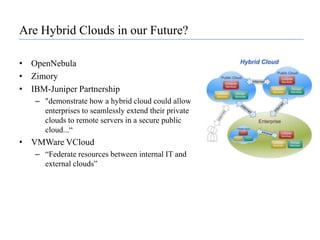
  • #44 Source: IBM hybrid cloud, http://news.cnet.com/8301-19413_3-10161245-240.html?tag=newsFeaturedBlogArea.0
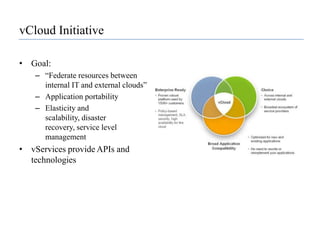
  • #45 Source: vCloud press release, 9/15/08, http://vmware.com/company/news/releases/vcloud_vmworld08.html
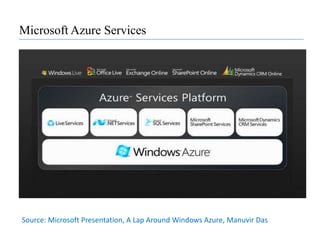
  • #47 http://ekamsoftwares.wordpress.com/2009/11/30/windows-azure-platform/
  • #48 Data taken from CNET news article and interview 8/18/08http://news.cnet.com/8301-13953_3-10027064-80.html?tag=mncol
  • #49 Source: Infoworld Article, http://www.infoworld.com/article/08/08/27/35NF-cloud-providers_2.html Source: IBM cloud presentation at BAH cloud computing summit 10/29/08
  • #50 Source: Infoworld article (availability zones and elastic IP), http://www.infoworld.com/article/08/03/27/Amazon-adds-resilience-to-cloud-computing_1.html
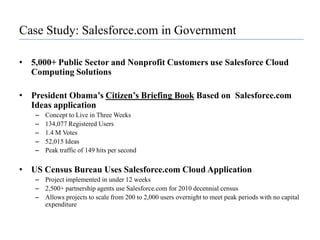
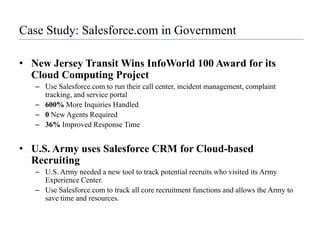
  • #51 Source: Infoworld, http://www.infoworld.com/article/08/04/07/15FE-cloud-computing-utility_1.html
  • #52 http://arstechnica.com/software/news/2008/10/washington-dc-latest-to-drop-microsoft-for-web-apps.arsQuote is from http://www.nextgov.com/nextgov/ng_20081126_1117.php
  • #53 http://arstechnica.com/software/news/2008/10/washington-dc-latest-to-drop-microsoft-for-web-apps.arsQuote is from http://www.nextgov.com/nextgov/ng_20081126_1117.php