Cloud Computing


Presented by:
Robin Aggarwal
Agenda


What, Why?
Services by cloud
Types of cloud
Advantages of cloud
Developer’s point of view
What is cloud computing?

Cloud computing is a set of services that enable companies to
host data and applications on a massive computing utility, either
on- or off-premise or hosted by a third party.

Concepts:
  Virtualization : is the process of hosting servers and
  desktops on cloud-hosted environments. Eg. Google
Why?
What Research agencies say:

A number of companies and government agencies
will rely on the cloud for more than half of their IT
services by 2020, according to Gartner’s 2011 CIO
Agenda Survey.
The global cloud computing market to reach $241
billion in 2020 compared to $40.7 in 2010, according to
a new Forrester report called “Sizing the Cloud”.
According to IDC, by 2015, about 24% of all new
business software purchases will be of service-
enabled software with SaaS delivery being 13.1% of
worldwide software spending.
Services offered

IAAS: Infrastructure-as-a-service
  Virtual Machine and storage
SAAS: Software-as-a-service
  gives companies the ability to install pre-packaged software in
  the cloud, and take advantage of “elasticity”—the ability to
  scale the amount of computing resources based on the
  number of people utilizing the service at any given time.
  Eg: Microsoft Office 365, Gmail etc.
PAAS: Platform-as-a-service
  allows companies to deploy an entire application stack via a cloud
  host.
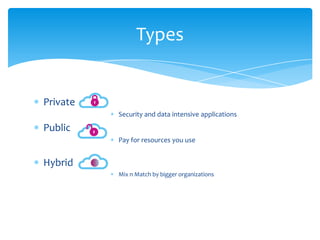
Types


Private
          Security and data intensive applications

Public
          Pay for resources you use


Hybrid
          Mix n Match by bigger organizations
Thought Process

State
  Saving State in shared environment is cumbersome
  Require skilled cloud developer and services like MS Azure AppFabric
  Cache Service or Amazon’s EC2
Storage
  Replicate and offload for DR plan
  Storing binary objects using Windows Azure Blob storage
  DataBase offerings – Scalability, Availability, Replication etc.
Security
Advantages


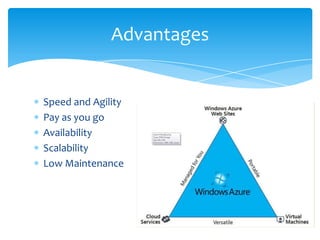
Speed and Agility
Pay as you go
Availability
Scalability
Low Maintenance
For Developers


DataBase Hosting in cloud
Middle Tier of the application
Expose WebServicesWCF services in cloud
Windows Azure
SQL Azure
Authentication using ADFS(Active Directory Fedration
Service)
AppFabric Caching Service
Thank You


  Q&A
Demo


Gartner Says Worldwide Cloud Services Market to
Surpass $109 Billion in 2012 – 18th Sept 2012

Cloud Computing

  • 1.
  • 2.
    Agenda What, Why? Services bycloud Types of cloud Advantages of cloud Developer’s point of view
  • 3.
    What is cloudcomputing? Cloud computing is a set of services that enable companies to host data and applications on a massive computing utility, either on- or off-premise or hosted by a third party. Concepts: Virtualization : is the process of hosting servers and desktops on cloud-hosted environments. Eg. Google Why?
  • 4.
    What Research agenciessay: A number of companies and government agencies will rely on the cloud for more than half of their IT services by 2020, according to Gartner’s 2011 CIO Agenda Survey. The global cloud computing market to reach $241 billion in 2020 compared to $40.7 in 2010, according to a new Forrester report called “Sizing the Cloud”. According to IDC, by 2015, about 24% of all new business software purchases will be of service- enabled software with SaaS delivery being 13.1% of worldwide software spending.
  • 5.
    Services offered IAAS: Infrastructure-as-a-service Virtual Machine and storage SAAS: Software-as-a-service gives companies the ability to install pre-packaged software in the cloud, and take advantage of “elasticity”—the ability to scale the amount of computing resources based on the number of people utilizing the service at any given time. Eg: Microsoft Office 365, Gmail etc. PAAS: Platform-as-a-service allows companies to deploy an entire application stack via a cloud host.
  • 6.
    Types Private Security and data intensive applications Public Pay for resources you use Hybrid Mix n Match by bigger organizations
  • 7.
    Thought Process State Saving State in shared environment is cumbersome Require skilled cloud developer and services like MS Azure AppFabric Cache Service or Amazon’s EC2 Storage Replicate and offload for DR plan Storing binary objects using Windows Azure Blob storage DataBase offerings – Scalability, Availability, Replication etc. Security
  • 8.
    Advantages Speed and Agility Payas you go Availability Scalability Low Maintenance
  • 9.
    For Developers DataBase Hostingin cloud Middle Tier of the application Expose WebServicesWCF services in cloud Windows Azure SQL Azure Authentication using ADFS(Active Directory Fedration Service) AppFabric Caching Service
  • 10.
  • 11.
    Demo Gartner Says WorldwideCloud Services Market to Surpass $109 Billion in 2012 – 18th Sept 2012