SECURITY THREATS AND
COUNTERMEASURES
ABSTRACT
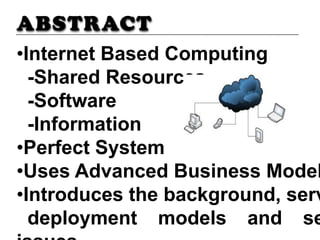
•Internet Based Computing
-Shared Resources
-Software
-Information
•Perfect System
•Uses Advanced Business Model
•Introduces the background, serv
deployment models and se
INTRODUCTION
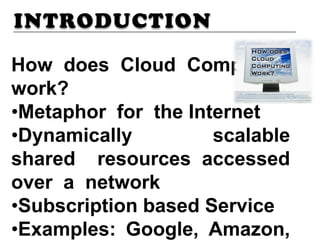
How does Cloud Computing
work?
•Metaphor for the Internet
•Dynamically scalable
shared resources accessed
over a network
•Subscription based Service
•Examples: Google, Amazon,
Characteristics
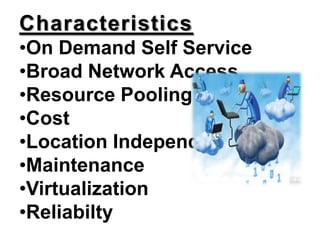
•On Demand Self Service
•Broad Network Access
•Resource Pooling
•Cost
•Location Independence
•Maintenance
•Virtualization
•Reliabilty
Benefits
•Cost Effective
•Almost Unlimited Storage
•Backup and Recovery
•Automatic Software
Integration
•Easy Access to Information
•Quick Deployment
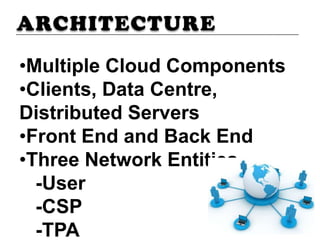
ARCHITECTURE
•Multiple Cloud Components
•Clients, Data Centre,
Distributed Servers
•Front End and Back End
•Three Network Entities
-User
-CSP
-TPA
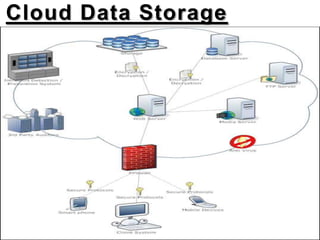
Cloud Data Storage
Architecture
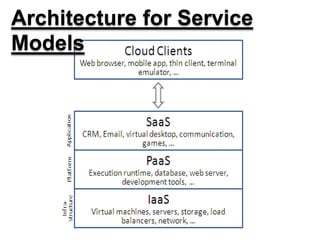
•SaaS(Software as a Service)
•PaaS(Platform as a Service)
•IaaS(Infrastructure as a
Service)
SERVICE MODELS
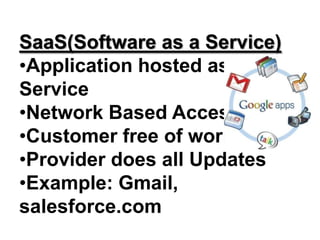
SaaS(Software as a Service)
•Application hosted as
Service
•Network Based Access
•Customer free of worries
•Provider does all Updates
•Example: Gmail,
salesforce.com
PaaS(Platform as a Service)
•Application delivery model
•Supplies Resources
•Application
design, development
environment, testing
•Application
Developers, testers
•Lack of Portability
IaaS(Infrastructure as a
Service)
•Provides Resources
•Server space, Storage space,
CPU cycles
•Scaled up and down based
on need
•Charged by resources
consumed
Architecture for Service
Models
•Public Cloud
•Private Cloud
•Hybrid Cloud
•Community Cloud
DEPLOYMENT MODELS
Public Cloud
•Provide Disk Space and
Computing Power
•Customer has no visibility
about the
infrastructure
•Shared among organizations
•Example: Amazon
Private Cloud
•Solely for single
organizations
•Not shared
•Managed by an organization
or third
party
•Expensive and Secure
•Example: Microsoft Private
Hybrid Cloud
•Composition of at least two
Clouds
•Private, Public or
Community
•Benefits of Multiple
Deployment Models
•Critical, secure applications
in Private
Community Cloud
•Shared between
organizations in the
same community
•Similar Cloud requirements
•All Government Agencies in
a
City
•Example: G-Cloud
SECURITY ISSUES
Security Threats:
Insecure API
-Customers use API to access
the Cloud
-Must be highly secure
Remedy:
-Analyze the Security Model
-Ensure strong Authentication
•Data Loss/Leakage
-Unauthorized Access, Deletion
-Top concerns for business
Remedy:
-Strong API Access Control
-Encrypt and Protect Integrity of
Data
-Implement strong key
generation, storage
•Network Sniffing
-Data monitored in a network
-Attacker hacking passwords
Remedy:
-Encryption methods
Security Issues
•Data Protection
-Data remains private
-SSO technology, Encryption
•Physical and Personnel Security
-Security of Physical Machines
-Customer data not only restric
but also documented
•Availability
-Data available whenever user
needs it
•Application Data
-Applications are secure
•Privacy
-All critical data masked
-Only authorized users have
access
•Infinite Computing Capability
•Provides service on demand
•Pay per use basis
•Offers many benefits
•It is vulnerable to security threats
be
lessened by taking some measu
CONCLUSION
REFERENCE1) Lewis, Grace, Basics About Cloud Computin
2) Chunye Gong, “The Characteristics
Computing”, 39th
international conference on parallel
workshops, 2010.
3) Lianfeng yang “Cloud Computing Research
Issues”,
IEEE 3rd international conference on cloud
2010.
4) en.wikipedia.org/wiki/Cloud_computing
5) http://thecloudcomputing.org/2009/
6) http://www.cloudsecurityalliance.org/topthrea
THANK YOU
Cloud computing

Cloud computing