Cloud Computing: 10
Cloud Security Advantages and Challenges
Prof Neeraj Bhargava
Vaibhav Khanna
Department of Computer Science
School of Engineering and Systems Sciences
Maharshi Dayanand Saraswati University Ajmer
Cloud Security Advantages
• Data Fragmentation and Dispersal
• Dedicated Security Team
• Greater Investment in Security Infrastructure
• Fault Tolerance and Reliability
• Greater Resiliency
• Hypervisor Protection Against Network Attacks
• Possible Reduction of C&A Activities (Access to
Pre-Accredited Clouds)
2
Cloud Security Advantages (Cont.)
• Simplification of Compliance Analysis
• Data Held by Unbiased Party (cloud vendor
assertion)
• Low-Cost Disaster Recovery and Data Storage
Solutions
• On-Demand Security Controls
• Real-Time Detection of System Tampering
• Rapid Re-Constitution of Services
• Advanced Honeynet Capabilities
3
Cloud Security Challenges
• Data dispersal and international privacy laws
– EU Data Protection Directive and U.S. Safe Harbor
program
– Exposure of data to foreign government and data
subpoenas
– Data retention issues
• Need for isolation management
• Multi-tenancy
• Logging challenges
• Data ownership issues
• Quality of service guarantees
4
Cloud Security Challenges (Cont.)
• Dependence on secure hypervisors
• Attraction to hackers (high value target)
• Security of virtual OSs in the cloud
• Possibility for massive outages
• Encryption needs for cloud computing
– Encrypting access to the cloud resource control interface
– Encrypting administrative access to OS instances
– Encrypting access to applications
– Encrypting application data at rest
• Public cloud vs internal cloud security
• Lack of public SaaS version control
5
Additional Issues
• Issues with moving PII and sensitive data to the cloud
– Privacy impact assessments
• Using SLAs to obtain cloud security
– Suggested requirements for cloud SLAs
– Issues with cloud forensics
• Contingency planning and disaster recovery for cloud
implementations
• Handling compliance
– FISMA
– HIPAA
– SOX
– PCI
– SAS 70 Audits
6
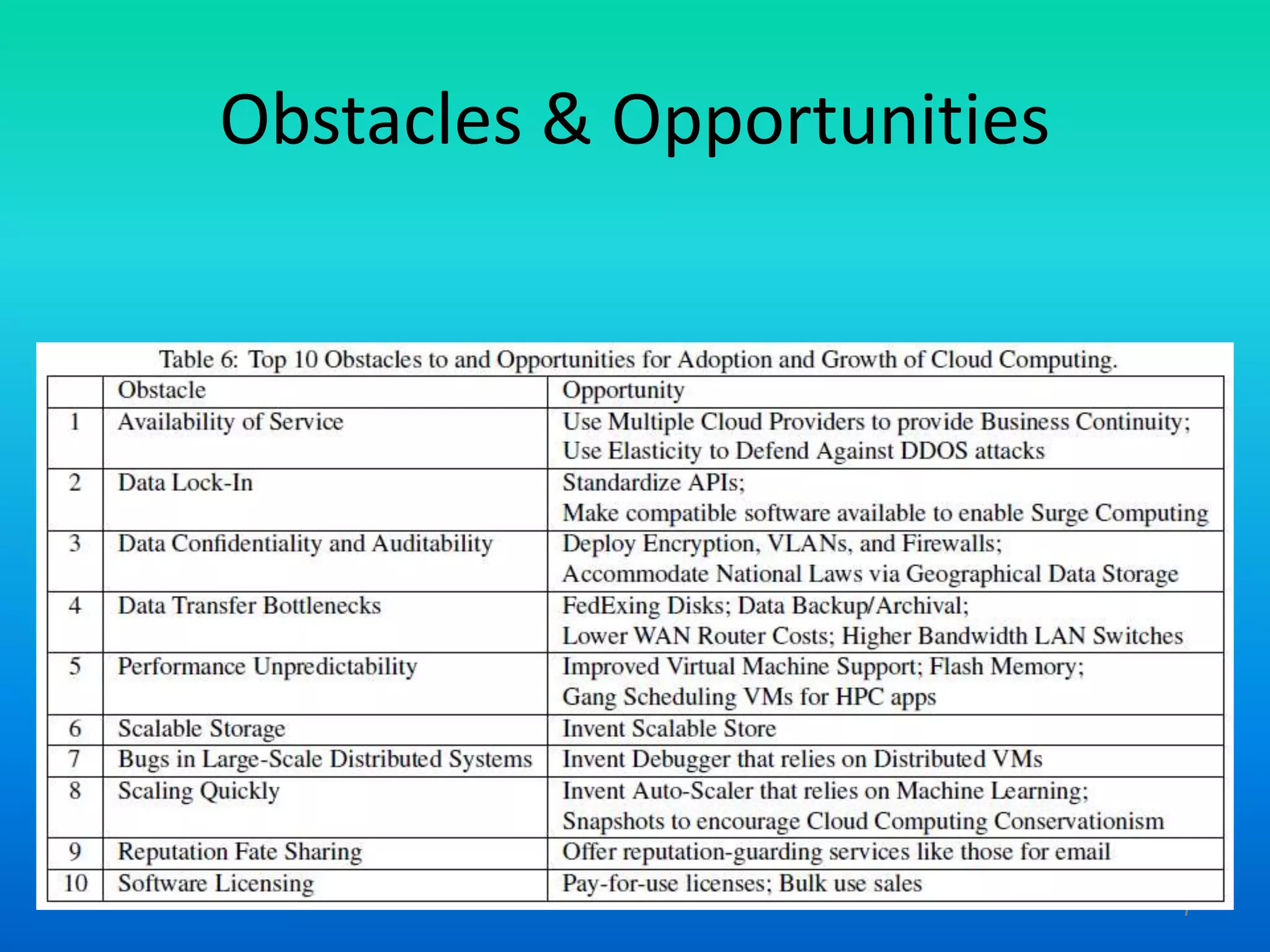
Obstacles & Opportunities
7
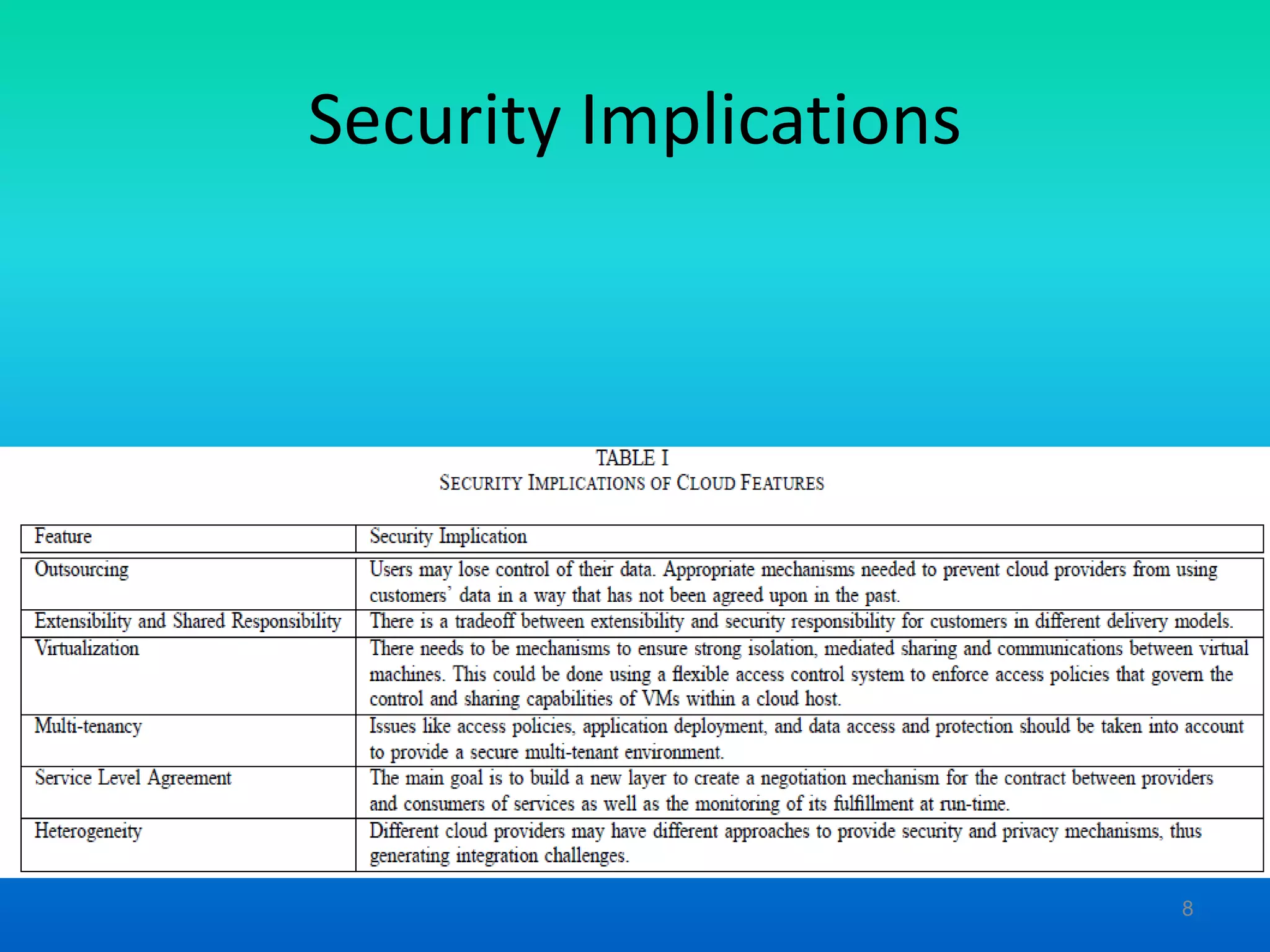
Security Implications
8
Security and Privacy Challenges
• Authentication and Identity Management
– interoperability
– password-based: inherited limitation
– How multi-tenancy can affect the privacy of
identity information isn’t yet well understood.
– multi-jurisdiction issue
– integrated with other security components.
9
Security and Privacy Challenges
• Access Control and Accounting
– Heterogeneity and diversity of services, as well as
the domains’ diverse access requirements
– capture dynamic, context, or attribute- or
credential-based access requirements
– integrate privacy-protection requirements
– interoperability
– capture relevant aspects of SLAs
10
Security and Privacy Challenges
• Trust Management and Policy Integration
– compose multiple services to enable bigger
application services
– efficiently capturing a generic set of parameters
required for establishing trust and to manage
evolving trust and interaction/sharing
requirements
– address challenges such as semantic
heterogeneity, secure interoperability, and policy-
evolution management.
11
Security and Privacy Challenges
• Secure-Service Management
– WSDL can’t fully meet the requirements of cloud
computing services description
– issues such as quality of service, price, and SLAs
– automatic and systematic service provisioning and
composition framework that considers security
and privacy issues
12
Security and Privacy Challenges
• Privacy and Data Protection
– storing data and applications on systems that
reside outside of on-premise datacenters
– shared infrastructure, risk of potential
unauthorized access and exposure.
– Privacy-protection mechanisms must be
embedded in all security solutions.
– Provenance
– Balancing between data provenance and privacy
13
Security and Privacy Challenges
• Organizational Security Management
– shared governance can become a significant issue
if not properly addressed
– Dependence on external entities
– the possibility of an insider threat is significantly
extended when outsourcing data and processes to
clouds.
14
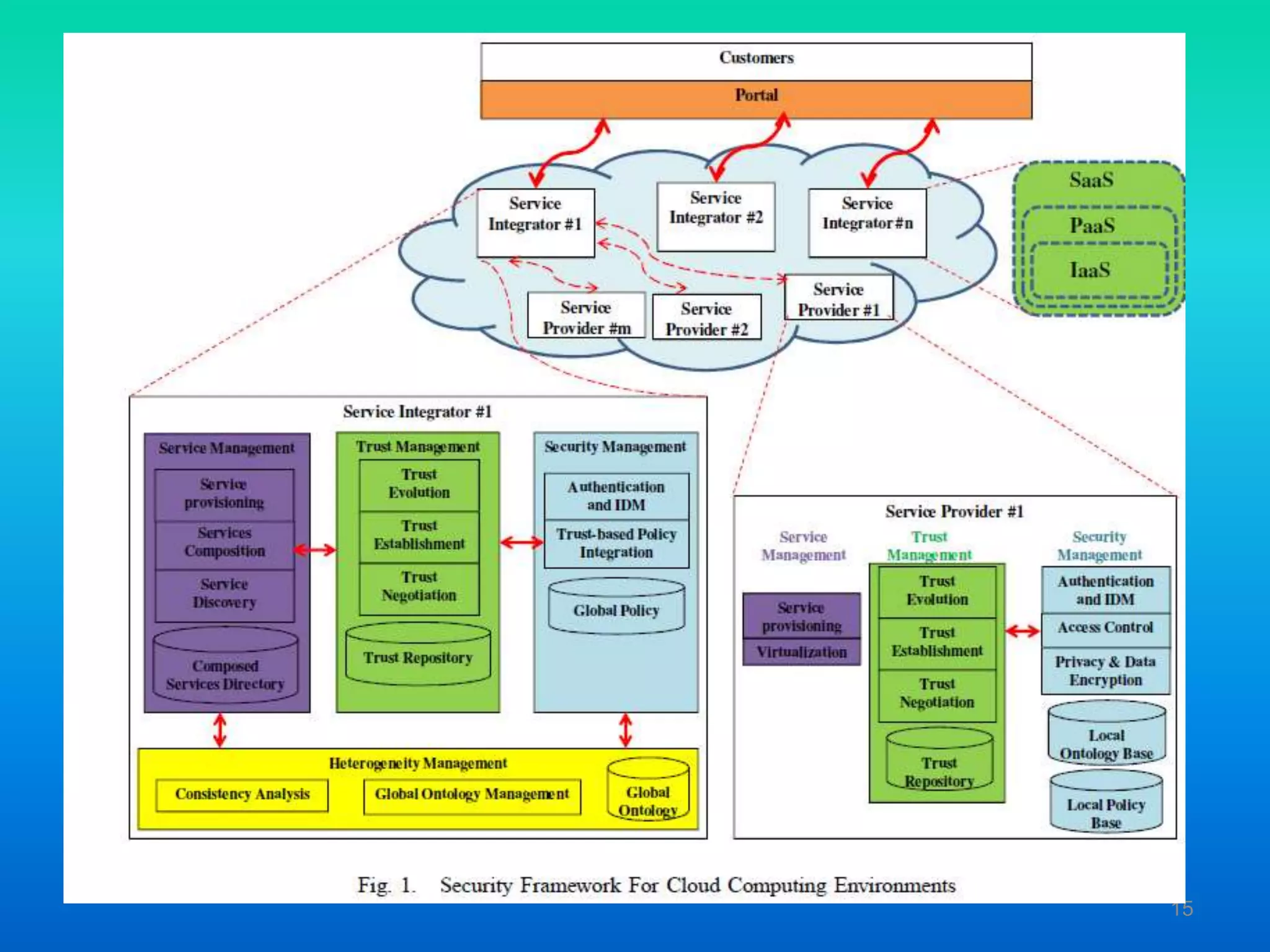
15
Security and Privacy Approaches
• Authentication and Identity Management
– User-centric IDM
– users control their digital identities and takes away
the complexity of IDM from the enterprises
– federated IDM solutions
– privacy-preserving protocols to verify various
identity attributes by using, for example, zero-
knowledge proof-based techniques
16
Security and Privacy Approaches
• Access Control Needs
– RBAC
– policy-integration needs
– credential-based RBAC, GTRBAC,8 location-based
RBAC
17
Security and Privacy Approaches
• Secure Interoperation
– Multi-domain
– centralized approach
– decentralized approaches
– specification frameworks to ensure that the cross-
domain accesses are properly specified, verified,
and enforced
– Policy engineering mechanisms
18
Security and Privacy Approaches
• Secure-Service Provisioning and Composition
– Open Services Gateway Initiative (OSGi)
– Declarative OWL-based language can be used to
provide a service definition manifest, including a
list of distinct component types that make up the
service, functional requirements, component
grouping and topology instructions
19
Security and Privacy Approaches
• Trust Management Framework
– trust-based policy integration
– Delegation
– must be incorporated in service composition
framework
20
Security and Privacy Approaches
• Data-Centric Security and Privacy
– shifts data protection from systems and
applications
– documents must be self-describing and defending
regardless of their environments.
21
Security and Privacy Approaches
• Managing Semantic Heterogeneity
– semantic heterogeneity among policies
– Use of an ontology is the most promising
approach
– policy framework and a policy enforcement
architecture
– inference engines
22
Assignment
• What are the cloud security advantages and
Challenges
• Discuss the cloud security approaches

Cloud computing 10 cloud security advantages and challenges

  • 1.
    Cloud Computing: 10 CloudSecurity Advantages and Challenges Prof Neeraj Bhargava Vaibhav Khanna Department of Computer Science School of Engineering and Systems Sciences Maharshi Dayanand Saraswati University Ajmer
  • 2.
    Cloud Security Advantages •Data Fragmentation and Dispersal • Dedicated Security Team • Greater Investment in Security Infrastructure • Fault Tolerance and Reliability • Greater Resiliency • Hypervisor Protection Against Network Attacks • Possible Reduction of C&A Activities (Access to Pre-Accredited Clouds) 2
  • 3.
    Cloud Security Advantages(Cont.) • Simplification of Compliance Analysis • Data Held by Unbiased Party (cloud vendor assertion) • Low-Cost Disaster Recovery and Data Storage Solutions • On-Demand Security Controls • Real-Time Detection of System Tampering • Rapid Re-Constitution of Services • Advanced Honeynet Capabilities 3
  • 4.
    Cloud Security Challenges •Data dispersal and international privacy laws – EU Data Protection Directive and U.S. Safe Harbor program – Exposure of data to foreign government and data subpoenas – Data retention issues • Need for isolation management • Multi-tenancy • Logging challenges • Data ownership issues • Quality of service guarantees 4
  • 5.
    Cloud Security Challenges(Cont.) • Dependence on secure hypervisors • Attraction to hackers (high value target) • Security of virtual OSs in the cloud • Possibility for massive outages • Encryption needs for cloud computing – Encrypting access to the cloud resource control interface – Encrypting administrative access to OS instances – Encrypting access to applications – Encrypting application data at rest • Public cloud vs internal cloud security • Lack of public SaaS version control 5
  • 6.
    Additional Issues • Issueswith moving PII and sensitive data to the cloud – Privacy impact assessments • Using SLAs to obtain cloud security – Suggested requirements for cloud SLAs – Issues with cloud forensics • Contingency planning and disaster recovery for cloud implementations • Handling compliance – FISMA – HIPAA – SOX – PCI – SAS 70 Audits 6
  • 7.
  • 8.
  • 9.
    Security and PrivacyChallenges • Authentication and Identity Management – interoperability – password-based: inherited limitation – How multi-tenancy can affect the privacy of identity information isn’t yet well understood. – multi-jurisdiction issue – integrated with other security components. 9
  • 10.
    Security and PrivacyChallenges • Access Control and Accounting – Heterogeneity and diversity of services, as well as the domains’ diverse access requirements – capture dynamic, context, or attribute- or credential-based access requirements – integrate privacy-protection requirements – interoperability – capture relevant aspects of SLAs 10
  • 11.
    Security and PrivacyChallenges • Trust Management and Policy Integration – compose multiple services to enable bigger application services – efficiently capturing a generic set of parameters required for establishing trust and to manage evolving trust and interaction/sharing requirements – address challenges such as semantic heterogeneity, secure interoperability, and policy- evolution management. 11
  • 12.
    Security and PrivacyChallenges • Secure-Service Management – WSDL can’t fully meet the requirements of cloud computing services description – issues such as quality of service, price, and SLAs – automatic and systematic service provisioning and composition framework that considers security and privacy issues 12
  • 13.
    Security and PrivacyChallenges • Privacy and Data Protection – storing data and applications on systems that reside outside of on-premise datacenters – shared infrastructure, risk of potential unauthorized access and exposure. – Privacy-protection mechanisms must be embedded in all security solutions. – Provenance – Balancing between data provenance and privacy 13
  • 14.
    Security and PrivacyChallenges • Organizational Security Management – shared governance can become a significant issue if not properly addressed – Dependence on external entities – the possibility of an insider threat is significantly extended when outsourcing data and processes to clouds. 14
  • 15.
  • 16.
    Security and PrivacyApproaches • Authentication and Identity Management – User-centric IDM – users control their digital identities and takes away the complexity of IDM from the enterprises – federated IDM solutions – privacy-preserving protocols to verify various identity attributes by using, for example, zero- knowledge proof-based techniques 16
  • 17.
    Security and PrivacyApproaches • Access Control Needs – RBAC – policy-integration needs – credential-based RBAC, GTRBAC,8 location-based RBAC 17
  • 18.
    Security and PrivacyApproaches • Secure Interoperation – Multi-domain – centralized approach – decentralized approaches – specification frameworks to ensure that the cross- domain accesses are properly specified, verified, and enforced – Policy engineering mechanisms 18
  • 19.
    Security and PrivacyApproaches • Secure-Service Provisioning and Composition – Open Services Gateway Initiative (OSGi) – Declarative OWL-based language can be used to provide a service definition manifest, including a list of distinct component types that make up the service, functional requirements, component grouping and topology instructions 19
  • 20.
    Security and PrivacyApproaches • Trust Management Framework – trust-based policy integration – Delegation – must be incorporated in service composition framework 20
  • 21.
    Security and PrivacyApproaches • Data-Centric Security and Privacy – shifts data protection from systems and applications – documents must be self-describing and defending regardless of their environments. 21
  • 22.
    Security and PrivacyApproaches • Managing Semantic Heterogeneity – semantic heterogeneity among policies – Use of an ontology is the most promising approach – policy framework and a policy enforcement architecture – inference engines 22
  • 23.
    Assignment • What arethe cloud security advantages and Challenges • Discuss the cloud security approaches