1 | P a g e
AN
INTERNSHIP REPORT
ON
CLOTHS STORE MANAGEMENT SYSTEM
PROJECT
BY
KAMAL ACHARYA
(Tribhuvan University)
Date: 2023/04/17
2 | P a g e
ABSTRACT
The purpose of the Clothes store management system is to use the existing
manual systems with the help of computer equipment and complete computer
software to meet their expectations that their valuable data/information is
archived for a longer period of time with easy access and manipulation. The
necessary software and hardware are readily available and easy to use.
The clothing store management system described above can result in an error
free, safe, reliable and fast management system. This can help the user focus on
other activities rather than record keeping. Therefore, the system will help the
organization to make better use of their resources. The organization can
maintain IT records without redundant entries.
This means that you don’t have to be distracted by irrelevant information and
still reach the top. The goal is to automate their existing manual system with
computer equipment and full computer software to meet their needs, allowing
them to store valuable data/information for a longer period of time with easy
access and manipulation. The project describes how to manage to achieve good
performance and better customer service.
3 | P a g e
Introduction
The “Cloth store Management System” was developed to overcome the
problems that prevail in the practical manual system. This software is supported
to eliminate and, in some cases, reduce the difficulties encountered by this
legacy system. Furthermore, this system is designed for the specific business
needs to be implemented.
Smooth and efficient operation. The application is minimized to avoid data
entry errors. It also provides an error message if invalid data is entered. No
formal knowledge is required for the use of this system by the user. So all of
this proves that it is easy to use. The clothing store management system
described above can result in an error free, safe, reliable and fast management
system. It can help you focus on other tasks instead of focusing on keeping
records. Big or small, every business faces challenges and manages
information on products, apparel, businesses, payments, and inventory.
Each clothing store management system has different clothing requirements;
that’s how we design unique employee management systems, tailored to your
management needs. This is intended to support strategic planning and help
ensure your organization is equipped with the right information and details for
your future goals. Plus, for busy executives who are always on the go, our
systems are equipped with remote access capabilities so you can manage your
workforce anytime, anywhere. This proposed system ultimately allows you to
better manage the resources and time of an organization.
4 | P a g e
Purpose
The Software Requirements Specification (SRS) provides a detailed
description of the requirements for the apparel store management
system. This SRS allows for a complete understanding of what to
expect from the MSMS to be built. A clear understanding of the
tissue management system and its capabilities helps develop the
appropriate software for the end user. It will be used for the
development of the future phases of the project.
This SRS serves as the basis for the project. From this SRS the
system can be designed, built and finally tested. This SRS is used by
the software developers who create the system and by the end users
of the clothing store. Software engineers will use SRS to fully
understand the expectations of this apparel store management system
to create the appropriate software. End users of clothing stores can
use this SRS as a “test” to see if the software engineerswill build
the system as they expect. If it does not meet their expectations, end
users can indicate how it does not meet their expectations and the
software engineers modify the SRS to meet theneeds of the end users.
5 | P a g e
Project Scope of Cloth Store Management System
It can help you to collect perfect management in detail. The collection
will be clear, meaningful, and simple in no time. It will helpa person
to fully and clearly see the direction of the passing year. It also helps
with all the ongoing work related to the clothing store management
system. In addition, collection costs will be reduced, and
administration and the collection process will run smoothly.
Our project is aimed at the automation of business processes, i.e. we
have tried
 To computerize various processes of the management system of
clothing stores.
 In a computer system, the person has to fill in multiple forms and the
number of copies of the forms can easily be generated at the same time.
 It is not necessary to create the manifest in a computer system, but we
can do it directly. Print it, which saves us time.
 Helping employees understand the efforts made in their respective
areas of work.
 Use resources efficiently by increasing their productivity through
automation purposes.
 Meet user requirements to allow users and operators to be easily
understood
 It must be easy to use,
 Have an exemplary and scalable database
6 | P a g e
Cloth Store Management System Modules:
 Fabric Management Module: Used to manage fabric details.
 Inventory module: to manage inventory and payment details
 Product management module: used to manage product information
and details.
 Product type form: used to manage product type details
 Company form
 Login form: used to manage credentials used to manage system users
 User form and components
 Easy creation and editing of problems
 List of query issues at any depth and more comprehensive reports and
graphs
 User Accounts to Control Access and Maintain Security Status and
Simple Solutions
 Multi-level priority and severity.
 Goals and milestones to guide programmers
 Robust database
 Different levels of reports available with many filter criteria
 Includes better storage capacity and Accuracy in work
 Quick and easy retrieval of information Well-designed reports
Software Specification Requirements
The software requirements specification is created after the
software analysis task as part of the function engineering and
performance attributed to the detailed description of the functionand
behavior, an indication of the performance requirements anddesign
constraints, appropriate validation criteria, and other data relevant
to the requirement.
 The proposed system has the following requirements:
 The system must store information about the new garment.
 The system is designed to help internal staff stay informed about the
product and
find it based on various questions.
7 | P a g e
 The system must keep a record of quantity.
 The system must keep a record of the product type.
 The system should update and delete the record.
 The system also needs a search field.
Software Requirements:
 Operating system: Windows 98, Windows XP, Windows 7, Linux
 Language: PHP runtime environment
 Database: MySQL
 Browser: Opera, Chrome, etc.
 Web Server: Apache
 Software Development Kit PHP
 Scripting Language Enable JavaScript
 Driver: MySQL Connector
Hardware
 PROCESSOR: Pentium III or higher
 RAM: 128 GB
 HARD DISK: 20 GB
 MONITOR: 15-inch color monito
8 | P a g e
Functional Requirements
Functional requirements define basic actions that the system must execute. The
applicable requirements for the system are divided into three main categories:
Apparel Inventory, Customer and Billing Information, and Sales andSupplier
Information. See use cases for more details.
 Stock of clothing
 The system records the stock of clothing.
 The system needs to be updated when new stock arrives.
 The system must report the inventory of expired drugs.
 The system records drug details,
 customer information, and billing
 The system displays the customer information.
 The system creates the invoice.
 The system must store customer information.
 The system records the billing.
 Sales and Suppliers
 The system displays and updates supplier information from time to
time.
 The system should display the number of sales with a profit and loss
record.
9 | P a g e
Non-Functional Requirements
Functional requirements define performance requirements, database logic
requirements, design constraints, standards compliance, reliability, availability,
security, maintainability, and portability.
Performance Requirements
It defines acceptable response times for the system functionality.
 The UI screens should take ten seconds to load.
 Credentials must be verified within five seconds.
 Queries must return results within five seconds.
10 | P a g e
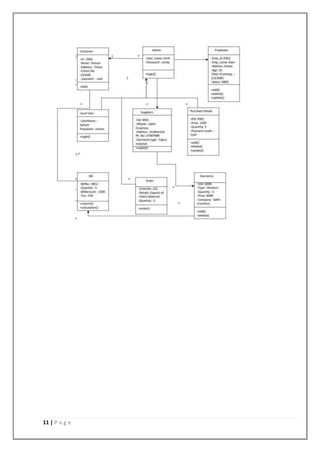
Class Diagram:
Within a technique, the class diagram has become very central
Virtually every technique has included a variation of that technique.
The class diagram is subject to even the most fantastic modeling
concepts. Although everyone needs the essentials, advanced concepts
are used less often. A class diagram describes the types of objects in
the system and the different types of static relationships that exist
between them. There are two main types of fixed relationships:
 Association
 Subtype
The class diagram also shows the attributes and operations of a
class and the constraints that apply to how objects are linked
11 | P a g e
12 | P a g e
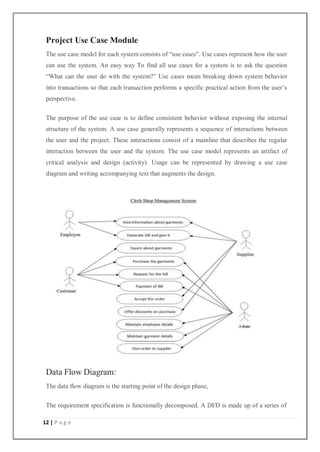
Project Use Case Module
The use case model for each system consists of “use cases”. Use cases represent how the user
can use the system. An easy way To find all use cases for a system is to ask the question
“What can the user do with the system?” Use cases mean breaking down system behavior
into transactions so that each transaction performs a specific practical action from the user’s
perspective.
The purpose of the use case is to define consistent behavior without exposing the internal
structure of the system. A use case generally represents a sequence of interactions between
the user and the project. These interactions consist of a mainline that describes the regular
interaction between the user and the system. The use case model represents an artifact of
critical analysis and design (activity). Usage can be represented by drawing a use case
diagram and writing accompanying text that augments the design.
Data Flow Diagram:
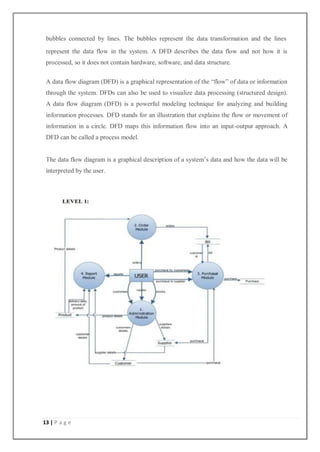
The data flow diagram is the starting point of the design phase,
The requirement specification is functionally decomposed. A DFD is made up of a series of
13 | P a g e
bubbles connected by lines. The bubbles represent the data transformation and the lines
represent the data flow in the system. A DFD describes the data flow and not how it is
processed, so it does not contain hardware, software, and data structure.
A data flow diagram (DFD) is a graphical representation of the “flow” of data or information
through the system. DFDs can also be used to visualize data processing (structured design).
A data flow diagram (DFD) is a powerful modeling technique for analyzing and building
information processes. DFD stands for an illustration that explains the flow or movement of
information in a circle. DFD maps this information flow into an input-output approach. A
DFD can be called a process model.
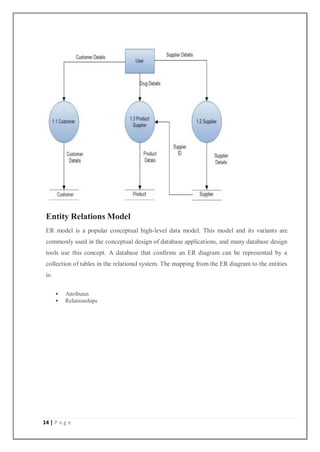
The data flow diagram is a graphical description of a system’s data and how the data will be
interpreted by the user.
14 | P a g e
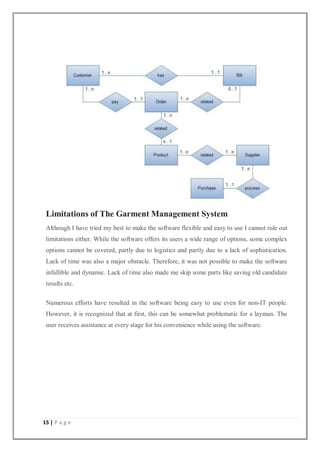
Entity Relations Model
ER model is a popular conceptual high-level data model. This model and its variants are
commonly used in the conceptual design of database applications, and many database design
tools use this concept. A database that confirms an ER diagram can be represented by a
collection of tables in the relational system. The mapping from the ER diagram to the entities
is:
 Attributes
 Relationships
15 | P a g e
Limitations of The Garment Management System
Although I have tried my best to make the software flexible and easy to use I cannot rule out
limitations either. While the software offers its users a wide range of options, some complex
options cannot be covered, partly due to logistics and partly due to a lack of sophistication.
Lack of time was also a major obstacle. Therefore, it was not possible to make the software
infallible and dynamic. Lack of time also made me skip some parts like saving old candidate
results etc.
Numerous efforts have resulted in the software being easy to use even for non-IT people.
However, it is recognized that at first, this can be somewhat problematic for a layman. The
user receives assistance at every stage for his convenience while using the software.
16 | P a g e
Source code
#include<fstream.h>
#include<conio.h>
#include<string.h>
#include<stdio.h>
class dress{
private:
char filename[20]; protected:
char dressname[60];
char dressid[10]; float
price;
void get();
};
void dress::get()
{
cout<<"n ENTER DRESS NAME : ";
cin>>dressname;
cout<<"n ENTER DRESS ID NO : ";
cin>>dressid;
cout<<"n ENTER DRESS PRICE : ";
cin>>price;
strcpy(filename,dressid);
strcat(filename,".txt");
ofstream x(filename);
x<<"nnDRESS NAME :"<<dressname;
x<<"nnDRESS ID :"<<dressid;
x<<"nnPRICE :"<<price;
x.close();
}
class male:protected dress
{
public:
male();
};
17 | P a g e
void male::male()
{
get();
fstream x("MALE.txt",ios::app|ios::out);
x<<dressname;
x<<"t"<<dressid;
x<<"t "<<price<<endl;
x.close();
}
class female:protected dress{
public:
female();
};
void female::female()
{
get();
fstream x("FEMALE.txt",ios::app|ios::out);
x<<dressname;
x<<"t"<<dressid;
x<<"t "<<price<<endl;
x.close();
}
class childrn:protected dress
{
public:
childrn();
};
void childrn::childrn()
{
get();
fstream x("CHILD.txt",ios::app|ios::out);
x<<dressname;
x<<"t"<<dressid;
x<<"t "<<price<<endl;
x.close();
}
18 | P a g e
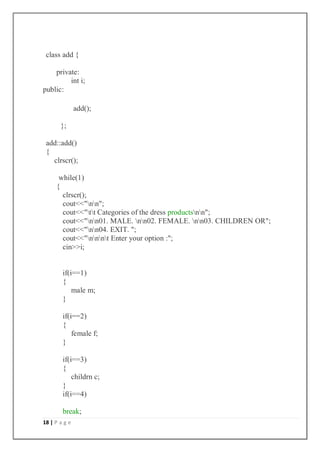
class add {
private:
int i;
public:
add();
};
add::add()
{
clrscr();
while(1)
{
clrscr();
cout<<"nn";
cout<<"tt Categories of the dress productsnn";
cout<<"nn01. MALE. nn02. FEMALE. nn03. CHILDREN OR";
cout<<"nn04. EXIT. ";
cout<<"nnnt Enter your option :";
cin>>i;
if(i==1)
{
male m;
}
if(i==2)
{
female f;
}
if(i==3)
{
childrn c;
}
if(i==4)
break;
19 | P a g e
}
}
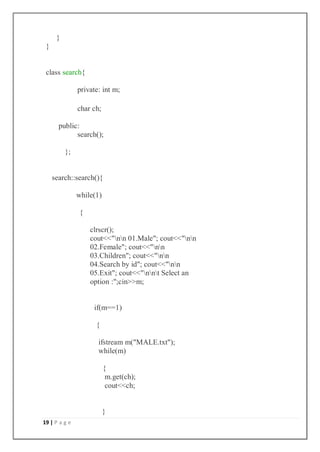
class search{
private: int m;
char ch;
public:
search();
};
search::search(){
while(1)
{
clrscr();
cout<<"nn 01.Male"; cout<<"nn
02.Female"; cout<<"nn
03.Children"; cout<<"nn
04.Search by id"; cout<<"nn
05.Exit"; cout<<"nnt Select an
option :";cin>>m;
if(m==1)
{
ifstream m("MALE.txt");
while(m)
{
m.get(ch);
cout<<ch;
}
20 | P a g e
getch();
}
if(m==2)
{
ifstream m("FEMALE.txt");
while(m)
{
m.get(ch);
cout<<ch;
}
getch();
}
if(m==3)
{
ifstream m("CHILD.txt");
while(m)
{
m.get(ch);
cout<<ch;
}
getch();
}
if(m==4)
{
char id[10],filename[20];
cout<<"input id for search:";
cin>>id;
strcpy(filename,id);
strcat(filename,".txt");
21 | P a g e
ifstream m(filename);
while(m)
{
m.get(ch);
cout<<ch;
}
getch();
}
if(m==5)
break;
}
}
class cut{
public:
cut();
};
cut::cut()
{ char id[20],filename[20];
cout<<"nnEnter the id to delete : ";
cin>>id;
strcpy(filename,id);
strcat(filename,".txt"); fstream
x(filename,ios::out);
x<<"INFORMATION IS UNAVALABLE";
x.close();
}
int main()
{
int i;
22 | P a g e
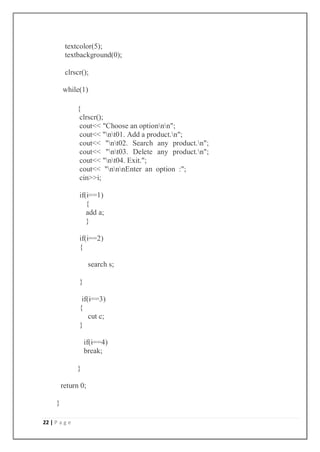
textcolor(5);
textbackground(0);
clrscr();
while(1)
{
clrscr();
cout<< "Choose an optionnn";
cout<< "nt01. Add a product.n";
cout<< "nt02. Search any product.n";
cout<< "nt03. Delete any product.n";
cout<< "nt04. Exit.";
cout<< "nnnEnter an option :";
cin>>i;
if(i==1)
{
add a;
}
if(i==2)
{
search s;
}
if(i==3)
{
cut c;
}
if(i==4)
break;
}
return 0;
}
23 | P a g e
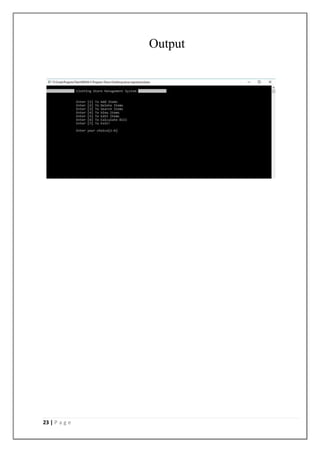
Output
24 | P a g e
TESTING
Testing is an investigation to provide clients with information about the quality of
the product. Testing method can be implemented at eachphase in the development
process, however the most test effort is employed after the requirements have been
defined and coding process has been completed.
25 | P a g e
Conclusion:
To carry out the various user-friendly coding has also been adopted This package will prove
influential when it comes to meeting all of the school’s needs. The purpose of software
planning is to provide the manager with a framework in which reasonable estimates should
be made within a limited time frame at the start of the software project and updated
periodically as the project progresses.
26 | P a g e
References
1. Acharya, Kamal, Attendance Management System Project (April 28, 2024).
Available at
SSRN: https://ssrn.com/abstract=4810251 or http://dx.doi.org/10.2139/ssrn.4810251
2. Acharya, Kamal, Online Food Order System (May 2, 2024). Available at
SSRN: https://ssrn.com/abstract=4814732 or http://dx.doi.org/10.2139/ssrn.4814732
3. Acharya, Kamal, University management system project. (May 1, 2024). Available at
SSRN: https://ssrn.com/abstract=4814103 or http://dx.doi.org/10.2139/ssrn.4814103
4. Acharya, Kamal, Online banking management system. (May 1, 2024). Available at
SSRN: https://ssrn.com/abstract=4813597 or http://dx.doi.org/10.2139/ssrn.4813597
5. Acharya, Kamal, Online Job Portal Management System (May 5, 2024). Available at
SSRN: https://ssrn.com/abstract=4817534 or http://dx.doi.org/10.2139/ssrn.4817534
6. Acharya, Kamal, Employee leave management system. (May 7, 2024). Available
at SSRN: https://ssrn.com/abstract=4819626 or http://dx.doi.org/10.2139/ssrn.4819626
7. Acharya, Kamal, Online electricity billing project report. (May 7, 2024). Available at
SSRN: https://ssrn.com/abstract=4819630 or http://dx.doi.org/10.2139/ssrn.4819630
8. Acharya, Kamal, POLICY MANAGEMENT SYSTEM PROJECT REPORT. (December 10,
2023). Available at
SSRN: https://ssrn.com/abstract=4831694 or http://dx.doi.org/10.2139/ssrn.4831694
9. Acharya, Kamal, Online job placement system project report. (January 10, 2023).
Available at
SSRN: https://ssrn.com/abstract=4831638 or http://dx.doi.org/10.2139/ssrn.4831638
10. Acharya, Kamal, Software testing for project report. (May 16, 2023). Available at
SSRN: https://ssrn.com/abstract=4831028 or http://dx.doi.org/10.2139/ssrn.4831028
11. Acharya, Kamal, ONLINE CRIME REPORTING SYSTEM PROJECT. (August 10, 2022).
Available at
SSRN: https://ssrn.com/abstract=4831015 or http://dx.doi.org/10.2139/ssrn.4831015
12. Acharya, Kamal, Burger ordering system project report. (October 10, 2022). Available at
SSRN: https://ssrn.com/abstract=4832704 or http://dx.doi.org/10.2139/ssrn.4832704
13. Acharya, Kamal, Teachers Record Management System Project Report (December 10,
2023). Available at
SSRN: https://ssrn.com/abstract=4833821 or http://dx.doi.org/10.2139/ssrn.4833821
14. Acharya, Kamal, Dairy Management System Project Report (December 20, 2020).
Available at
SSRN: https://ssrn.com/abstract=4835231 or http://dx.doi.org/10.2139/ssrn.4835231
15. Acharya, Kamal, Electrical Shop Management System Project (December 10, 2019).
Available at
SSRN: https://ssrn.com/abstract=4835238 or http://dx.doi.org/10.2139/ssrn.4835238
16. Acharya, Kamal, Online book store management system project report. (Febuary 10,
2020). Available at
SSRN: https://ssrn.com/abstract=4835277 or http://dx.doi.org/10.2139/ssrn.4835277
27 | P a g e
17. Acharya, Kamal, Paint shop management system project report. (January 10, 2019).
Available at
SSRN: https://ssrn.com/abstract=4835441 or http://dx.doi.org/10.2139/ssrn.4835441
18. Acharya, Kamal, Supermarket billing system project report. (August 10, 2021). Available
at SSRN: https://ssrn.com/abstract=4835474 or http://dx.doi.org/10.2139/ssrn.4835474
19. Acharya, Kamal, Online taxi booking system project report. (March 10, 2022). Available
at SSRN: https://ssrn.com/abstract=4837729 or http://dx.doi.org/10.2139/ssrn.4837729
20. Acharya, Kamal, Online car servicing system project report. (March 10, 2023). Available
at SSRN: https://ssrn.com/abstract=4837832 or http://dx.doi.org/10.2139/ssrn.4837832
21. Acharya, Kamal, School management system project report. (July 10, 2021). Available at
SSRN: https://ssrn.com/abstract=4837837 or http://dx.doi.org/10.2139/ssrn.4837837
22. Acharya, Kamal, Furniture Showroom Management System Project Report (March 21,
2021). Available at
SSRN: https://ssrn.com/abstract=4839422 or http://dx.doi.org/10.2139/ssrn.4839422
23. Acharya, Kamal, Online Vehicle Rental System Project Report (March 21, 2019).
Available at
SSRN: https://ssrn.com/abstract=4839429 or http://dx.doi.org/10.2139/ssrn.4839429
24. Acharya, Kamal, Fruit Shop Management System Project Report (August 10, 2023).
Available at
SSRN: https://ssrn.com/abstract=4841048 or http://dx.doi.org/10.2139/ssrn.4841048
25. Acharya, Kamal, Hall Booking Management System Project Report (December 21, 2023).
Available at
SSRN: https://ssrn.com/abstract=4841055 or http://dx.doi.org/10.2139/ssrn.4841055
26. Acharya, Kamal, Lundry Management System Project Report (October 21, 2023).
Available at
SSRN: https://ssrn.com/abstract=4841059 or http://dx.doi.org/10.2139/ssrn.4841059
27. Acharya, Kamal, A CASE STUDY OF CINEMA MANAGEMENT SYSTEM PROJECT
(September 25, 2023). Available at
SSRN: https://ssrn.com/abstract=4841209 or http://dx.doi.org/10.2139/ssrn.4841209
28. Acharya, Kamal, A CASE STUDY ON ONLINE TICKET BOOKING SYSTEM PROJECT
(May 25, 2024). Available at
SSRN: https://ssrn.com/abstract=4841210 or http://dx.doi.org/10.2139/ssrn.4841210
29. Acharya, Kamal, ONLINE DATING MANAGEMENT SYSTEM PROJECT REPORT.
(April 25, 2023). Available at
SSRN: https://ssrn.com/abstract=4842066 or http://dx.doi.org/10.2139/ssrn.4842066
30. Acharya, Kamal, ONLINE RESUME BUILDER MANAGEMENT SYSTEM PROJECT
REPORT. (April 25, 2021). Available at
SSRN: https://ssrn.com/abstract=4842071 or http://dx.doi.org/10.2139/ssrn.4842071
31. Acharya, Kamal, TOLL TEX MANAGEMENT SYSTEM PROJECT REPORT (August 21,
2023). Available at
SSRN: https://ssrn.com/abstract=4842082 or http://dx.doi.org/10.2139/ssrn.4842082
32. Acharya, Kamal, Chat Application Through Client Server Management System Project
Report (June 25, 2023). Available at
SSRN: https://ssrn.com/abstract=4842761 or http://dx.doi.org/10.2139/ssrn.4842761
28 | P a g e
33. Acharya, Kamal, Web Chatting Application Management System Project Report (April 25,
2022). Available at
SSRN: https://ssrn.com/abstract=4842771 or http://dx.doi.org/10.2139/ssrn.4842771
34. Acharya, Kamal, Automobile management system project report (May 25, 2022).
Available at
SSRN: https://ssrn.com/abstract=4846917 or http://dx.doi.org/10.2139/ssrn.4846917
35. Acharya, Kamal, College bus management system project report (April 25, 2023).
Available at
SSRN: https://ssrn.com/abstract=4846920 or http://dx.doi.org/10.2139/ssrn.4846920
36. Acharya, Kamal, Courier management system project report (May 25, 2023). Available at
SSRN: https://ssrn.com/abstract=4846922 or http://dx.doi.org/10.2139/ssrn.4846922
37. Acharya, Kamal, Event management system project report (April 25, 2021). Available at
SSRN: https://ssrn.com/abstract=4846927 or http://dx.doi.org/10.2139/ssrn.4846927
38. Acharya, Kamal, Library management system project report II (May 25, 2020). Available
at SSRN: https://ssrn.com/abstract=4848857 or http://dx.doi.org/10.2139/ssrn.4848857
39. Kamal Acharya. Teacher record management system project report. Authorea. August 02,
2024.
DOI: https://doi.org/10.22541/au.172261514.46787329/v1
40. Kamal Acharya. POST OFFICE MANAGEMENT SYSTEM PROJECT
REPORT. Authorea. August 02, 2024.
DOI: https://doi.org/10.22541/au.172261514.44494375/v1
41. Kamal Acharya. Fruit shop management system project report. Authorea. August 02,
2024.
DOI: https://doi.org/10.22541/au.172261514.42227675/v1
42. Kamal Acharya. Dairy management system project report. Authorea. August 02, 2024.
DOI: https://doi.org/10.22541/au.172261513.39402347/v1
43. Kamal Acharya. DATA COMMUNICATION AND COMPUTER NETWORK
MANAGEMENT SYSTEM PROJECT REPORT. Authorea. August 01, 2024.
DOI: https://doi.org/10.22541/au.172254873.37480177/v1
44. Kamal Acharya. School management system project report. Authorea. August 01, 2024.
DOI: https://doi.org/10.22541/au.172254873.34023165/v1
45. Kamal Acharya. A CASE STUDY OF CINEMA MANAGEMENT SYSTEM
PROJECT. Authorea. August 01, 2024.
DOI: https://doi.org/10.22541/au.172254873.30191075/v1
46. Kamal Acharya. A CASE STUDY ON ONLINE TICKET BOOKING SYSTEM
PROJECT. Authorea. August 01, 2024
DOI: https://doi.org/10.22541/au.172254872.26972790/v1
47. Kamal Acharya. Web chatting application project report management
system. Authorea. August 01, 2024.
DOI: https://doi.org/10.22541/au.172254871.18588592/v1
48. Kamal Acharya. RETAIL STORE MANAGEMENT SYSTEM PROJECT
REPORT. Authorea. August 01, 2024.
DOI: https://doi.org/10.22541/au.172254871.14590154/v1
49. Kamal Acharya. SUPERMARKET MANAGEMENT SYSTEM PROJECT
REPORT. Authorea. August 01, 2024.
DOI: https://doi.org/10.22541/au.172252491.19145062/v1
50. Kamal Acharya. SOCIAL MEDIA MANAGEMENT SYSTEM PROJECT
REPORT. Authorea. August 01, 2024.
DOI: https://doi.org/10.22541/au.172252491.11210579/v1
29 | P a g e
51. Kamal Acharya. Online music portal management system project report. Authorea. August
01, 2024.
DOI: https://doi.org/10.22541/au.172252488.89734698/v1
52. Kamal Acharya. COLLEGE BUS MANAGEMENT SYSTEM PROJECT
REPORT. Authorea. July 31, 2024.
DOI: https://doi.org/10.22541/au.172245277.70798942/v1
53. Kamal Acharya. AUTOMOBILE MANAGEMENT SYSTEM PROJECT
REPORT. Authorea. July 31, 2024.
DOI: https://doi.org/10.22541/au.172245276.67982593/v1
54. Kamal Acharya. Ludo management system project report. Authorea. July 31, 2024
DOI: https://doi.org/10.22541/au.172243999.98091616/v1
55. Kamal Acharya. Literature online quiz system project report. Authorea. July 31,
2024
DOI: https://doi.org/10.22541/au.172243825.53562953/v1
56. Kamal Acharya. Avoid waste management system project. Authorea. July 29, 2024
DOI: https://doi.org/10.22541/au.172228528.85022205/v1
57. Kamal Acharya. CHAT APPLICATION THROUGH CLIENT SERVER MANAGEMENT
SYSTEM PROJECT. Authorea. July 29, 2024.
DOI: https://doi.org/10.22541/au.172228527.74316529/v1
58. Kamal Acharya. Parking allotment system project report. Authorea. July 29, 2024.
DOI: https://doi.org/10.22541/au.172227078.89966943/v1
59. Kamal Acharya. HEALTH INSURANCE CLAIM MANAGEMENT
SYSTEM. Authorea. July 26, 2024.
DOI: https://doi.org/10.22541/au.172202020.06707762/v1
60. Kamal Acharya. ONLINE TRAIN BOOKING SYSTEM PROJECT
REPORT. Authorea. July 22, 2024.
DOI: https://doi.org/10.22541/au.172167914.45160406/v1
61. Kamal Acharya. COVID MANAGEMENT SYSTEM PROJECT REPORT. Authorea. July
16, 2024.
DOI: https://doi.org/10.22541/au.172116616.60220024/v1
62. Kamal Acharya. COVID MANAGEMENT SYSTEM PROJECT REPORT. Authorea. July
16, 2024.
DOI: https://doi.org/10.22541/au.172116616.60220024/v1

Clothes store management system project report.pdf

  • 1.
    1 | Pa g e AN INTERNSHIP REPORT ON CLOTHS STORE MANAGEMENT SYSTEM PROJECT BY KAMAL ACHARYA (Tribhuvan University) Date: 2023/04/17
  • 2.
    2 | Pa g e ABSTRACT The purpose of the Clothes store management system is to use the existing manual systems with the help of computer equipment and complete computer software to meet their expectations that their valuable data/information is archived for a longer period of time with easy access and manipulation. The necessary software and hardware are readily available and easy to use. The clothing store management system described above can result in an error free, safe, reliable and fast management system. This can help the user focus on other activities rather than record keeping. Therefore, the system will help the organization to make better use of their resources. The organization can maintain IT records without redundant entries. This means that you don’t have to be distracted by irrelevant information and still reach the top. The goal is to automate their existing manual system with computer equipment and full computer software to meet their needs, allowing them to store valuable data/information for a longer period of time with easy access and manipulation. The project describes how to manage to achieve good performance and better customer service.
  • 3.
    3 | Pa g e Introduction The “Cloth store Management System” was developed to overcome the problems that prevail in the practical manual system. This software is supported to eliminate and, in some cases, reduce the difficulties encountered by this legacy system. Furthermore, this system is designed for the specific business needs to be implemented. Smooth and efficient operation. The application is minimized to avoid data entry errors. It also provides an error message if invalid data is entered. No formal knowledge is required for the use of this system by the user. So all of this proves that it is easy to use. The clothing store management system described above can result in an error free, safe, reliable and fast management system. It can help you focus on other tasks instead of focusing on keeping records. Big or small, every business faces challenges and manages information on products, apparel, businesses, payments, and inventory. Each clothing store management system has different clothing requirements; that’s how we design unique employee management systems, tailored to your management needs. This is intended to support strategic planning and help ensure your organization is equipped with the right information and details for your future goals. Plus, for busy executives who are always on the go, our systems are equipped with remote access capabilities so you can manage your workforce anytime, anywhere. This proposed system ultimately allows you to better manage the resources and time of an organization.
  • 4.
    4 | Pa g e Purpose The Software Requirements Specification (SRS) provides a detailed description of the requirements for the apparel store management system. This SRS allows for a complete understanding of what to expect from the MSMS to be built. A clear understanding of the tissue management system and its capabilities helps develop the appropriate software for the end user. It will be used for the development of the future phases of the project. This SRS serves as the basis for the project. From this SRS the system can be designed, built and finally tested. This SRS is used by the software developers who create the system and by the end users of the clothing store. Software engineers will use SRS to fully understand the expectations of this apparel store management system to create the appropriate software. End users of clothing stores can use this SRS as a “test” to see if the software engineerswill build the system as they expect. If it does not meet their expectations, end users can indicate how it does not meet their expectations and the software engineers modify the SRS to meet theneeds of the end users.
  • 5.
    5 | Pa g e Project Scope of Cloth Store Management System It can help you to collect perfect management in detail. The collection will be clear, meaningful, and simple in no time. It will helpa person to fully and clearly see the direction of the passing year. It also helps with all the ongoing work related to the clothing store management system. In addition, collection costs will be reduced, and administration and the collection process will run smoothly. Our project is aimed at the automation of business processes, i.e. we have tried  To computerize various processes of the management system of clothing stores.  In a computer system, the person has to fill in multiple forms and the number of copies of the forms can easily be generated at the same time.  It is not necessary to create the manifest in a computer system, but we can do it directly. Print it, which saves us time.  Helping employees understand the efforts made in their respective areas of work.  Use resources efficiently by increasing their productivity through automation purposes.  Meet user requirements to allow users and operators to be easily understood  It must be easy to use,  Have an exemplary and scalable database
  • 6.
    6 | Pa g e Cloth Store Management System Modules:  Fabric Management Module: Used to manage fabric details.  Inventory module: to manage inventory and payment details  Product management module: used to manage product information and details.  Product type form: used to manage product type details  Company form  Login form: used to manage credentials used to manage system users  User form and components  Easy creation and editing of problems  List of query issues at any depth and more comprehensive reports and graphs  User Accounts to Control Access and Maintain Security Status and Simple Solutions  Multi-level priority and severity.  Goals and milestones to guide programmers  Robust database  Different levels of reports available with many filter criteria  Includes better storage capacity and Accuracy in work  Quick and easy retrieval of information Well-designed reports Software Specification Requirements The software requirements specification is created after the software analysis task as part of the function engineering and performance attributed to the detailed description of the functionand behavior, an indication of the performance requirements anddesign constraints, appropriate validation criteria, and other data relevant to the requirement.  The proposed system has the following requirements:  The system must store information about the new garment.  The system is designed to help internal staff stay informed about the product and find it based on various questions.
  • 7.
    7 | Pa g e  The system must keep a record of quantity.  The system must keep a record of the product type.  The system should update and delete the record.  The system also needs a search field. Software Requirements:  Operating system: Windows 98, Windows XP, Windows 7, Linux  Language: PHP runtime environment  Database: MySQL  Browser: Opera, Chrome, etc.  Web Server: Apache  Software Development Kit PHP  Scripting Language Enable JavaScript  Driver: MySQL Connector Hardware  PROCESSOR: Pentium III or higher  RAM: 128 GB  HARD DISK: 20 GB  MONITOR: 15-inch color monito
  • 8.
    8 | Pa g e Functional Requirements Functional requirements define basic actions that the system must execute. The applicable requirements for the system are divided into three main categories: Apparel Inventory, Customer and Billing Information, and Sales andSupplier Information. See use cases for more details.  Stock of clothing  The system records the stock of clothing.  The system needs to be updated when new stock arrives.  The system must report the inventory of expired drugs.  The system records drug details,  customer information, and billing  The system displays the customer information.  The system creates the invoice.  The system must store customer information.  The system records the billing.  Sales and Suppliers  The system displays and updates supplier information from time to time.  The system should display the number of sales with a profit and loss record.
  • 9.
    9 | Pa g e Non-Functional Requirements Functional requirements define performance requirements, database logic requirements, design constraints, standards compliance, reliability, availability, security, maintainability, and portability. Performance Requirements It defines acceptable response times for the system functionality.  The UI screens should take ten seconds to load.  Credentials must be verified within five seconds.  Queries must return results within five seconds.
  • 10.
    10 | Pa g e Class Diagram: Within a technique, the class diagram has become very central Virtually every technique has included a variation of that technique. The class diagram is subject to even the most fantastic modeling concepts. Although everyone needs the essentials, advanced concepts are used less often. A class diagram describes the types of objects in the system and the different types of static relationships that exist between them. There are two main types of fixed relationships:  Association  Subtype The class diagram also shows the attributes and operations of a class and the constraints that apply to how objects are linked
  • 11.
    11 | Pa g e
  • 12.
    12 | Pa g e Project Use Case Module The use case model for each system consists of “use cases”. Use cases represent how the user can use the system. An easy way To find all use cases for a system is to ask the question “What can the user do with the system?” Use cases mean breaking down system behavior into transactions so that each transaction performs a specific practical action from the user’s perspective. The purpose of the use case is to define consistent behavior without exposing the internal structure of the system. A use case generally represents a sequence of interactions between the user and the project. These interactions consist of a mainline that describes the regular interaction between the user and the system. The use case model represents an artifact of critical analysis and design (activity). Usage can be represented by drawing a use case diagram and writing accompanying text that augments the design. Data Flow Diagram: The data flow diagram is the starting point of the design phase, The requirement specification is functionally decomposed. A DFD is made up of a series of
  • 13.
    13 | Pa g e bubbles connected by lines. The bubbles represent the data transformation and the lines represent the data flow in the system. A DFD describes the data flow and not how it is processed, so it does not contain hardware, software, and data structure. A data flow diagram (DFD) is a graphical representation of the “flow” of data or information through the system. DFDs can also be used to visualize data processing (structured design). A data flow diagram (DFD) is a powerful modeling technique for analyzing and building information processes. DFD stands for an illustration that explains the flow or movement of information in a circle. DFD maps this information flow into an input-output approach. A DFD can be called a process model. The data flow diagram is a graphical description of a system’s data and how the data will be interpreted by the user.
  • 14.
    14 | Pa g e Entity Relations Model ER model is a popular conceptual high-level data model. This model and its variants are commonly used in the conceptual design of database applications, and many database design tools use this concept. A database that confirms an ER diagram can be represented by a collection of tables in the relational system. The mapping from the ER diagram to the entities is:  Attributes  Relationships
  • 15.
    15 | Pa g e Limitations of The Garment Management System Although I have tried my best to make the software flexible and easy to use I cannot rule out limitations either. While the software offers its users a wide range of options, some complex options cannot be covered, partly due to logistics and partly due to a lack of sophistication. Lack of time was also a major obstacle. Therefore, it was not possible to make the software infallible and dynamic. Lack of time also made me skip some parts like saving old candidate results etc. Numerous efforts have resulted in the software being easy to use even for non-IT people. However, it is recognized that at first, this can be somewhat problematic for a layman. The user receives assistance at every stage for his convenience while using the software.
  • 16.
    16 | Pa g e Source code #include<fstream.h> #include<conio.h> #include<string.h> #include<stdio.h> class dress{ private: char filename[20]; protected: char dressname[60]; char dressid[10]; float price; void get(); }; void dress::get() { cout<<"n ENTER DRESS NAME : "; cin>>dressname; cout<<"n ENTER DRESS ID NO : "; cin>>dressid; cout<<"n ENTER DRESS PRICE : "; cin>>price; strcpy(filename,dressid); strcat(filename,".txt"); ofstream x(filename); x<<"nnDRESS NAME :"<<dressname; x<<"nnDRESS ID :"<<dressid; x<<"nnPRICE :"<<price; x.close(); } class male:protected dress { public: male(); };
  • 17.
    17 | Pa g e void male::male() { get(); fstream x("MALE.txt",ios::app|ios::out); x<<dressname; x<<"t"<<dressid; x<<"t "<<price<<endl; x.close(); } class female:protected dress{ public: female(); }; void female::female() { get(); fstream x("FEMALE.txt",ios::app|ios::out); x<<dressname; x<<"t"<<dressid; x<<"t "<<price<<endl; x.close(); } class childrn:protected dress { public: childrn(); }; void childrn::childrn() { get(); fstream x("CHILD.txt",ios::app|ios::out); x<<dressname; x<<"t"<<dressid; x<<"t "<<price<<endl; x.close(); }
  • 18.
    18 | Pa g e class add { private: int i; public: add(); }; add::add() { clrscr(); while(1) { clrscr(); cout<<"nn"; cout<<"tt Categories of the dress productsnn"; cout<<"nn01. MALE. nn02. FEMALE. nn03. CHILDREN OR"; cout<<"nn04. EXIT. "; cout<<"nnnt Enter your option :"; cin>>i; if(i==1) { male m; } if(i==2) { female f; } if(i==3) { childrn c; } if(i==4) break;
  • 19.
    19 | Pa g e } } class search{ private: int m; char ch; public: search(); }; search::search(){ while(1) { clrscr(); cout<<"nn 01.Male"; cout<<"nn 02.Female"; cout<<"nn 03.Children"; cout<<"nn 04.Search by id"; cout<<"nn 05.Exit"; cout<<"nnt Select an option :";cin>>m; if(m==1) { ifstream m("MALE.txt"); while(m) { m.get(ch); cout<<ch; }
  • 20.
    20 | Pa g e getch(); } if(m==2) { ifstream m("FEMALE.txt"); while(m) { m.get(ch); cout<<ch; } getch(); } if(m==3) { ifstream m("CHILD.txt"); while(m) { m.get(ch); cout<<ch; } getch(); } if(m==4) { char id[10],filename[20]; cout<<"input id for search:"; cin>>id; strcpy(filename,id); strcat(filename,".txt");
  • 21.
    21 | Pa g e ifstream m(filename); while(m) { m.get(ch); cout<<ch; } getch(); } if(m==5) break; } } class cut{ public: cut(); }; cut::cut() { char id[20],filename[20]; cout<<"nnEnter the id to delete : "; cin>>id; strcpy(filename,id); strcat(filename,".txt"); fstream x(filename,ios::out); x<<"INFORMATION IS UNAVALABLE"; x.close(); } int main() { int i;
  • 22.
    22 | Pa g e textcolor(5); textbackground(0); clrscr(); while(1) { clrscr(); cout<< "Choose an optionnn"; cout<< "nt01. Add a product.n"; cout<< "nt02. Search any product.n"; cout<< "nt03. Delete any product.n"; cout<< "nt04. Exit."; cout<< "nnnEnter an option :"; cin>>i; if(i==1) { add a; } if(i==2) { search s; } if(i==3) { cut c; } if(i==4) break; } return 0; }
  • 23.
    23 | Pa g e Output
  • 24.
    24 | Pa g e TESTING Testing is an investigation to provide clients with information about the quality of the product. Testing method can be implemented at eachphase in the development process, however the most test effort is employed after the requirements have been defined and coding process has been completed.
  • 25.
    25 | Pa g e Conclusion: To carry out the various user-friendly coding has also been adopted This package will prove influential when it comes to meeting all of the school’s needs. The purpose of software planning is to provide the manager with a framework in which reasonable estimates should be made within a limited time frame at the start of the software project and updated periodically as the project progresses.
  • 26.
    26 | Pa g e References 1. Acharya, Kamal, Attendance Management System Project (April 28, 2024). Available at SSRN: https://ssrn.com/abstract=4810251 or http://dx.doi.org/10.2139/ssrn.4810251 2. Acharya, Kamal, Online Food Order System (May 2, 2024). Available at SSRN: https://ssrn.com/abstract=4814732 or http://dx.doi.org/10.2139/ssrn.4814732 3. Acharya, Kamal, University management system project. (May 1, 2024). Available at SSRN: https://ssrn.com/abstract=4814103 or http://dx.doi.org/10.2139/ssrn.4814103 4. Acharya, Kamal, Online banking management system. (May 1, 2024). Available at SSRN: https://ssrn.com/abstract=4813597 or http://dx.doi.org/10.2139/ssrn.4813597 5. Acharya, Kamal, Online Job Portal Management System (May 5, 2024). Available at SSRN: https://ssrn.com/abstract=4817534 or http://dx.doi.org/10.2139/ssrn.4817534 6. Acharya, Kamal, Employee leave management system. (May 7, 2024). Available at SSRN: https://ssrn.com/abstract=4819626 or http://dx.doi.org/10.2139/ssrn.4819626 7. Acharya, Kamal, Online electricity billing project report. (May 7, 2024). Available at SSRN: https://ssrn.com/abstract=4819630 or http://dx.doi.org/10.2139/ssrn.4819630 8. Acharya, Kamal, POLICY MANAGEMENT SYSTEM PROJECT REPORT. (December 10, 2023). Available at SSRN: https://ssrn.com/abstract=4831694 or http://dx.doi.org/10.2139/ssrn.4831694 9. Acharya, Kamal, Online job placement system project report. (January 10, 2023). Available at SSRN: https://ssrn.com/abstract=4831638 or http://dx.doi.org/10.2139/ssrn.4831638 10. Acharya, Kamal, Software testing for project report. (May 16, 2023). Available at SSRN: https://ssrn.com/abstract=4831028 or http://dx.doi.org/10.2139/ssrn.4831028 11. Acharya, Kamal, ONLINE CRIME REPORTING SYSTEM PROJECT. (August 10, 2022). Available at SSRN: https://ssrn.com/abstract=4831015 or http://dx.doi.org/10.2139/ssrn.4831015 12. Acharya, Kamal, Burger ordering system project report. (October 10, 2022). Available at SSRN: https://ssrn.com/abstract=4832704 or http://dx.doi.org/10.2139/ssrn.4832704 13. Acharya, Kamal, Teachers Record Management System Project Report (December 10, 2023). Available at SSRN: https://ssrn.com/abstract=4833821 or http://dx.doi.org/10.2139/ssrn.4833821 14. Acharya, Kamal, Dairy Management System Project Report (December 20, 2020). Available at SSRN: https://ssrn.com/abstract=4835231 or http://dx.doi.org/10.2139/ssrn.4835231 15. Acharya, Kamal, Electrical Shop Management System Project (December 10, 2019). Available at SSRN: https://ssrn.com/abstract=4835238 or http://dx.doi.org/10.2139/ssrn.4835238 16. Acharya, Kamal, Online book store management system project report. (Febuary 10, 2020). Available at SSRN: https://ssrn.com/abstract=4835277 or http://dx.doi.org/10.2139/ssrn.4835277
  • 27.
    27 | Pa g e 17. Acharya, Kamal, Paint shop management system project report. (January 10, 2019). Available at SSRN: https://ssrn.com/abstract=4835441 or http://dx.doi.org/10.2139/ssrn.4835441 18. Acharya, Kamal, Supermarket billing system project report. (August 10, 2021). Available at SSRN: https://ssrn.com/abstract=4835474 or http://dx.doi.org/10.2139/ssrn.4835474 19. Acharya, Kamal, Online taxi booking system project report. (March 10, 2022). Available at SSRN: https://ssrn.com/abstract=4837729 or http://dx.doi.org/10.2139/ssrn.4837729 20. Acharya, Kamal, Online car servicing system project report. (March 10, 2023). Available at SSRN: https://ssrn.com/abstract=4837832 or http://dx.doi.org/10.2139/ssrn.4837832 21. Acharya, Kamal, School management system project report. (July 10, 2021). Available at SSRN: https://ssrn.com/abstract=4837837 or http://dx.doi.org/10.2139/ssrn.4837837 22. Acharya, Kamal, Furniture Showroom Management System Project Report (March 21, 2021). Available at SSRN: https://ssrn.com/abstract=4839422 or http://dx.doi.org/10.2139/ssrn.4839422 23. Acharya, Kamal, Online Vehicle Rental System Project Report (March 21, 2019). Available at SSRN: https://ssrn.com/abstract=4839429 or http://dx.doi.org/10.2139/ssrn.4839429 24. Acharya, Kamal, Fruit Shop Management System Project Report (August 10, 2023). Available at SSRN: https://ssrn.com/abstract=4841048 or http://dx.doi.org/10.2139/ssrn.4841048 25. Acharya, Kamal, Hall Booking Management System Project Report (December 21, 2023). Available at SSRN: https://ssrn.com/abstract=4841055 or http://dx.doi.org/10.2139/ssrn.4841055 26. Acharya, Kamal, Lundry Management System Project Report (October 21, 2023). Available at SSRN: https://ssrn.com/abstract=4841059 or http://dx.doi.org/10.2139/ssrn.4841059 27. Acharya, Kamal, A CASE STUDY OF CINEMA MANAGEMENT SYSTEM PROJECT (September 25, 2023). Available at SSRN: https://ssrn.com/abstract=4841209 or http://dx.doi.org/10.2139/ssrn.4841209 28. Acharya, Kamal, A CASE STUDY ON ONLINE TICKET BOOKING SYSTEM PROJECT (May 25, 2024). Available at SSRN: https://ssrn.com/abstract=4841210 or http://dx.doi.org/10.2139/ssrn.4841210 29. Acharya, Kamal, ONLINE DATING MANAGEMENT SYSTEM PROJECT REPORT. (April 25, 2023). Available at SSRN: https://ssrn.com/abstract=4842066 or http://dx.doi.org/10.2139/ssrn.4842066 30. Acharya, Kamal, ONLINE RESUME BUILDER MANAGEMENT SYSTEM PROJECT REPORT. (April 25, 2021). Available at SSRN: https://ssrn.com/abstract=4842071 or http://dx.doi.org/10.2139/ssrn.4842071 31. Acharya, Kamal, TOLL TEX MANAGEMENT SYSTEM PROJECT REPORT (August 21, 2023). Available at SSRN: https://ssrn.com/abstract=4842082 or http://dx.doi.org/10.2139/ssrn.4842082 32. Acharya, Kamal, Chat Application Through Client Server Management System Project Report (June 25, 2023). Available at SSRN: https://ssrn.com/abstract=4842761 or http://dx.doi.org/10.2139/ssrn.4842761
  • 28.
    28 | Pa g e 33. Acharya, Kamal, Web Chatting Application Management System Project Report (April 25, 2022). Available at SSRN: https://ssrn.com/abstract=4842771 or http://dx.doi.org/10.2139/ssrn.4842771 34. Acharya, Kamal, Automobile management system project report (May 25, 2022). Available at SSRN: https://ssrn.com/abstract=4846917 or http://dx.doi.org/10.2139/ssrn.4846917 35. Acharya, Kamal, College bus management system project report (April 25, 2023). Available at SSRN: https://ssrn.com/abstract=4846920 or http://dx.doi.org/10.2139/ssrn.4846920 36. Acharya, Kamal, Courier management system project report (May 25, 2023). Available at SSRN: https://ssrn.com/abstract=4846922 or http://dx.doi.org/10.2139/ssrn.4846922 37. Acharya, Kamal, Event management system project report (April 25, 2021). Available at SSRN: https://ssrn.com/abstract=4846927 or http://dx.doi.org/10.2139/ssrn.4846927 38. Acharya, Kamal, Library management system project report II (May 25, 2020). Available at SSRN: https://ssrn.com/abstract=4848857 or http://dx.doi.org/10.2139/ssrn.4848857 39. Kamal Acharya. Teacher record management system project report. Authorea. August 02, 2024. DOI: https://doi.org/10.22541/au.172261514.46787329/v1 40. Kamal Acharya. POST OFFICE MANAGEMENT SYSTEM PROJECT REPORT. Authorea. August 02, 2024. DOI: https://doi.org/10.22541/au.172261514.44494375/v1 41. Kamal Acharya. Fruit shop management system project report. Authorea. August 02, 2024. DOI: https://doi.org/10.22541/au.172261514.42227675/v1 42. Kamal Acharya. Dairy management system project report. Authorea. August 02, 2024. DOI: https://doi.org/10.22541/au.172261513.39402347/v1 43. Kamal Acharya. DATA COMMUNICATION AND COMPUTER NETWORK MANAGEMENT SYSTEM PROJECT REPORT. Authorea. August 01, 2024. DOI: https://doi.org/10.22541/au.172254873.37480177/v1 44. Kamal Acharya. School management system project report. Authorea. August 01, 2024. DOI: https://doi.org/10.22541/au.172254873.34023165/v1 45. Kamal Acharya. A CASE STUDY OF CINEMA MANAGEMENT SYSTEM PROJECT. Authorea. August 01, 2024. DOI: https://doi.org/10.22541/au.172254873.30191075/v1 46. Kamal Acharya. A CASE STUDY ON ONLINE TICKET BOOKING SYSTEM PROJECT. Authorea. August 01, 2024 DOI: https://doi.org/10.22541/au.172254872.26972790/v1 47. Kamal Acharya. Web chatting application project report management system. Authorea. August 01, 2024. DOI: https://doi.org/10.22541/au.172254871.18588592/v1 48. Kamal Acharya. RETAIL STORE MANAGEMENT SYSTEM PROJECT REPORT. Authorea. August 01, 2024. DOI: https://doi.org/10.22541/au.172254871.14590154/v1 49. Kamal Acharya. SUPERMARKET MANAGEMENT SYSTEM PROJECT REPORT. Authorea. August 01, 2024. DOI: https://doi.org/10.22541/au.172252491.19145062/v1 50. Kamal Acharya. SOCIAL MEDIA MANAGEMENT SYSTEM PROJECT REPORT. Authorea. August 01, 2024. DOI: https://doi.org/10.22541/au.172252491.11210579/v1
  • 29.
    29 | Pa g e 51. Kamal Acharya. Online music portal management system project report. Authorea. August 01, 2024. DOI: https://doi.org/10.22541/au.172252488.89734698/v1 52. Kamal Acharya. COLLEGE BUS MANAGEMENT SYSTEM PROJECT REPORT. Authorea. July 31, 2024. DOI: https://doi.org/10.22541/au.172245277.70798942/v1 53. Kamal Acharya. AUTOMOBILE MANAGEMENT SYSTEM PROJECT REPORT. Authorea. July 31, 2024. DOI: https://doi.org/10.22541/au.172245276.67982593/v1 54. Kamal Acharya. Ludo management system project report. Authorea. July 31, 2024 DOI: https://doi.org/10.22541/au.172243999.98091616/v1 55. Kamal Acharya. Literature online quiz system project report. Authorea. July 31, 2024 DOI: https://doi.org/10.22541/au.172243825.53562953/v1 56. Kamal Acharya. Avoid waste management system project. Authorea. July 29, 2024 DOI: https://doi.org/10.22541/au.172228528.85022205/v1 57. Kamal Acharya. CHAT APPLICATION THROUGH CLIENT SERVER MANAGEMENT SYSTEM PROJECT. Authorea. July 29, 2024. DOI: https://doi.org/10.22541/au.172228527.74316529/v1 58. Kamal Acharya. Parking allotment system project report. Authorea. July 29, 2024. DOI: https://doi.org/10.22541/au.172227078.89966943/v1 59. Kamal Acharya. HEALTH INSURANCE CLAIM MANAGEMENT SYSTEM. Authorea. July 26, 2024. DOI: https://doi.org/10.22541/au.172202020.06707762/v1 60. Kamal Acharya. ONLINE TRAIN BOOKING SYSTEM PROJECT REPORT. Authorea. July 22, 2024. DOI: https://doi.org/10.22541/au.172167914.45160406/v1 61. Kamal Acharya. COVID MANAGEMENT SYSTEM PROJECT REPORT. Authorea. July 16, 2024. DOI: https://doi.org/10.22541/au.172116616.60220024/v1 62. Kamal Acharya. COVID MANAGEMENT SYSTEM PROJECT REPORT. Authorea. July 16, 2024. DOI: https://doi.org/10.22541/au.172116616.60220024/v1