Exploring attitudes towards peer-feedback 
in the writing classroom 
ライティングにおけるピア・フェード 
バックに関する学習者側の見解につい 
ての検討 
HAIDEE THOMSON (HAIDEE.THOMSON@GMAIL.COM) 
21 SEP, JALT HOKKAIDO CONFERENCE
Writing class activities 
Model 
Plan 
Draft 
Teacher-check 
Revise and publish 
Problem? 
A lot of marking for the teacher 
Over-reliance on teacher 
Missed opportunity for writer reflection
Solution 
Plan 
Draft 
Self-check 
Peer-check 
Teacher-check 
Revise and publish
Is it good use of class-time? 
• Increases meta-cognitive awareness (Wigglesworth & 
Storch, 2009) 
• Raises audience awareness (Kobayashi, 1988) 
• Giver of feedback benefits more than receiver 
(Lundstrom & Baker, 2009) 
• Get more feedback
Are students willing to share? 
Research question 1: Are students willing to read and 
comment on the writing of others? 
Research question 2: Are students willing to let classmates 
read their writing and comment?
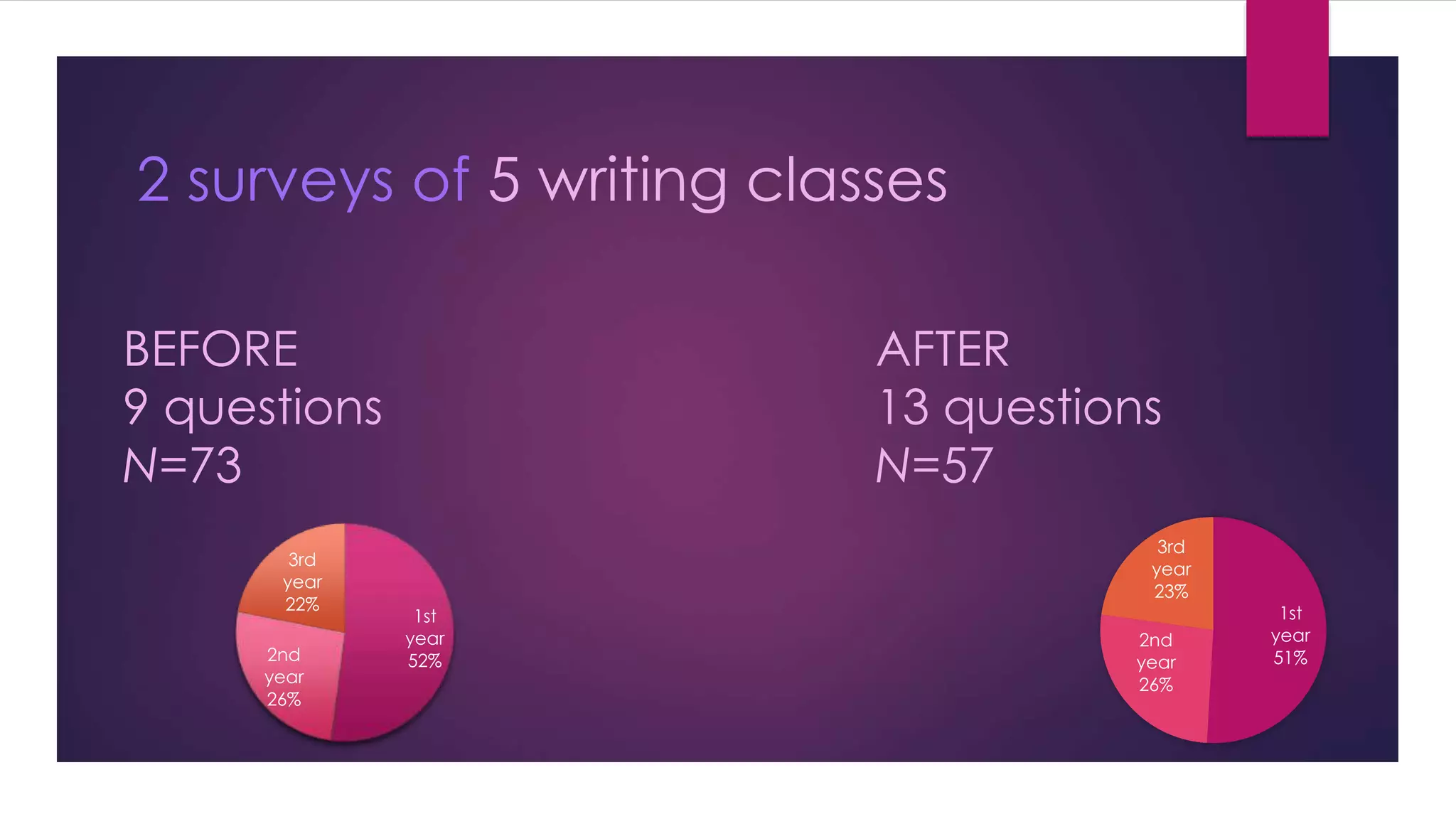
2 surveys of 5 writing classes 
BEFORE 
9 questions 
N=73 
AFTER 
13 questions 
N=57 
1st 
year 
3rd 
year 
22% 
2nd 52% 
year 
26% 
1st 
year 
51% 
3rd 
year 
23% 
2nd 
year 
26%
Have you ever given suggestions to a classmate 
about how to improve their writing? 
ライティング力を向上させる方法を、クラスメート 
にアドバイスしたことがありますか。 
Yes 
14% 
No 
86% 
BEFORE
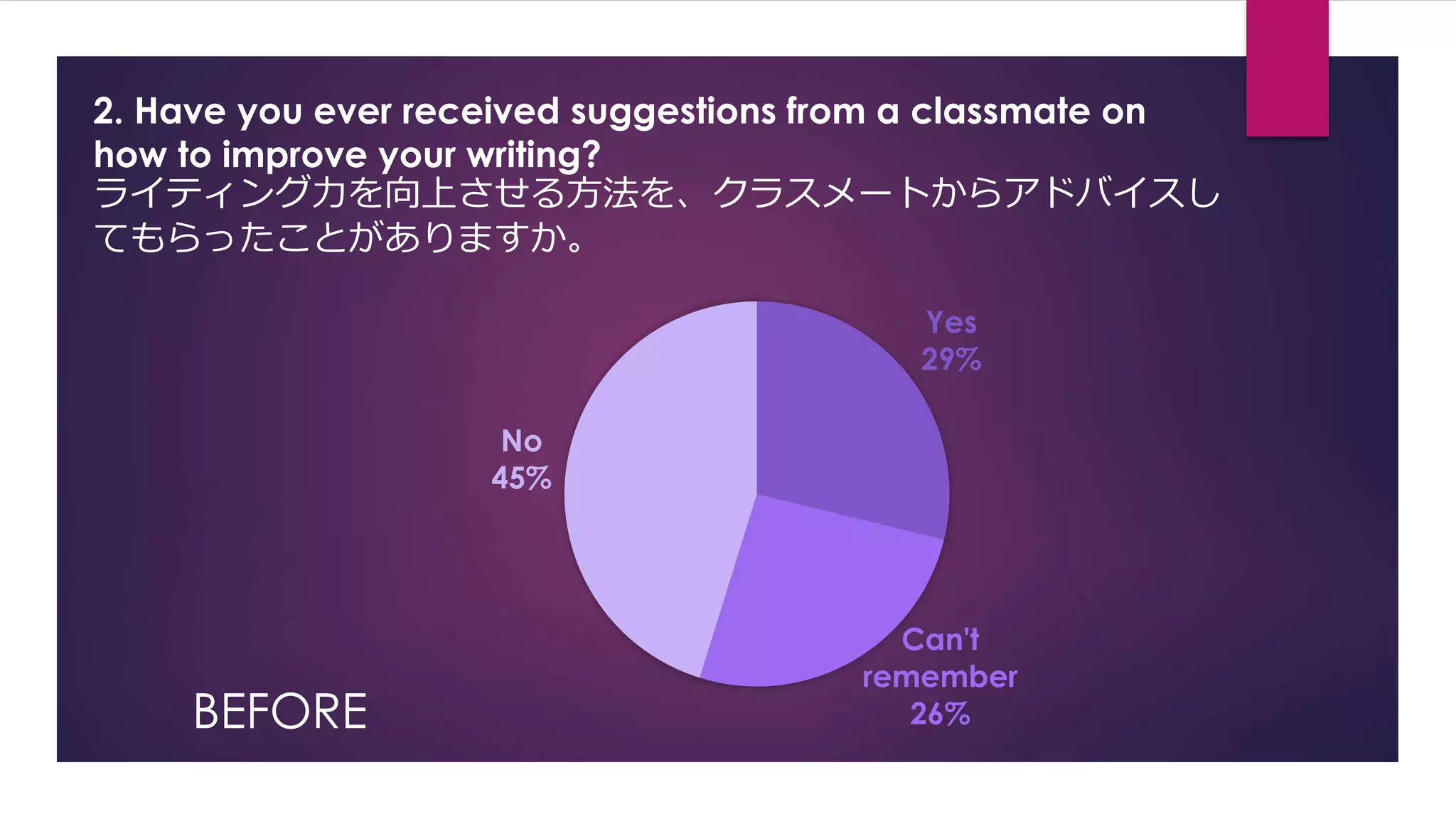
2. Have you ever received suggestions from a classmate on 
how to improve your writing? 
ライティング力を向上させる方法を、クラスメートからアドバイスし 
てもらったことがありますか。 
Yes 
29% 
Can't 
remember 
26% 
No 
45% 
BEFORE
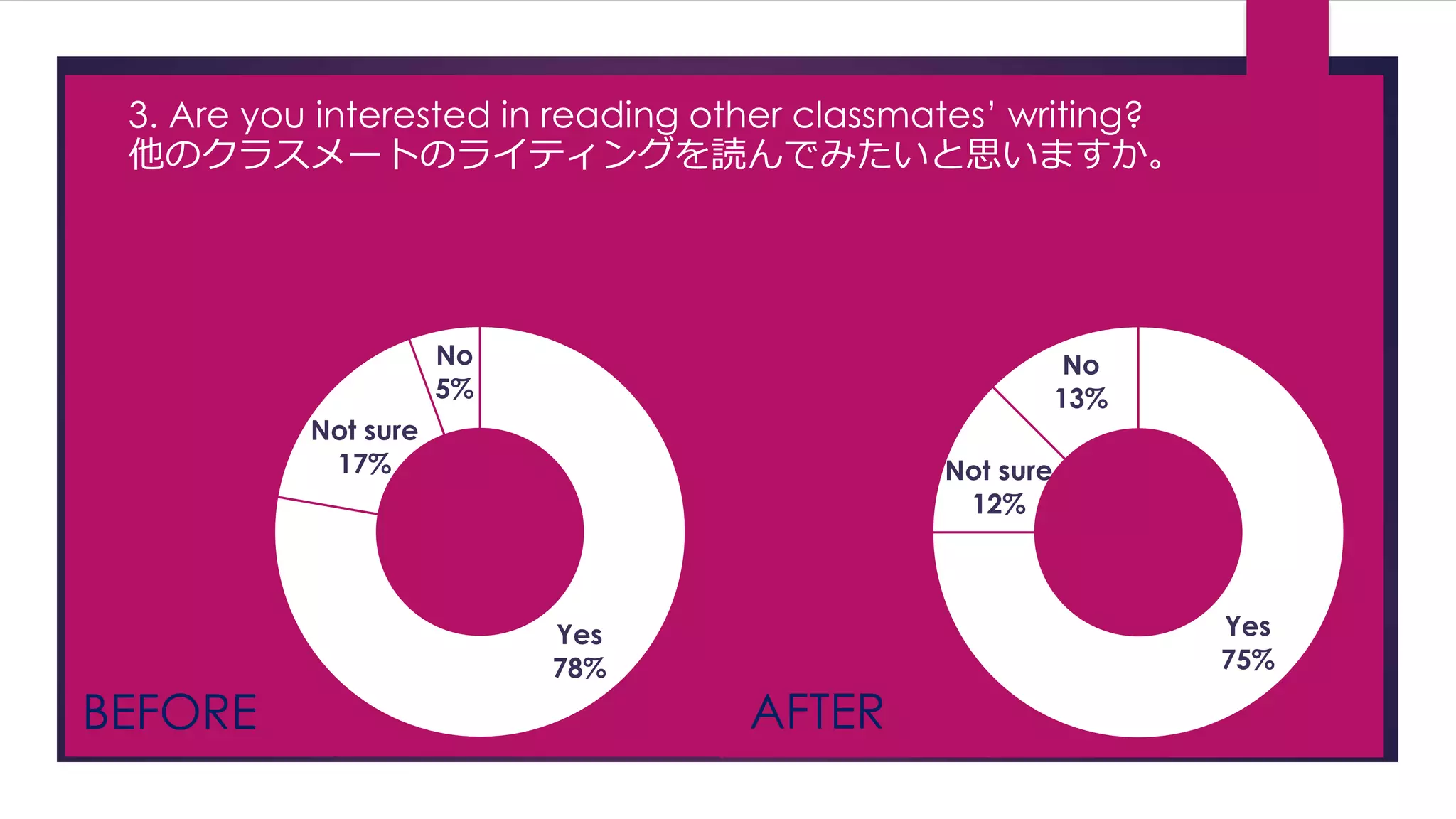
3. Are you interested in reading other classmates’ writing? 
他のクラスメートのライティングを読んでみたいと思いますか。 
Yes 
78% 
Not sure 
17% 
No 
5% 
BEFORE 
Yes 
75% 
Not sure 
12% 
No 
13% 
AFTER
4. How do you feel about other classmates reading your writing? 
他のクラスメートに自分のライティングを読まれることについてどう 
思いますか。 
I like the 
idea 
56% 
Don't like 
the idea 
25% 
Not sure 
19% 
BEFORE 
I like the 
idea 
73% 
Not sure 
7% 
Don't like 
the idea 
20% 
AFTER
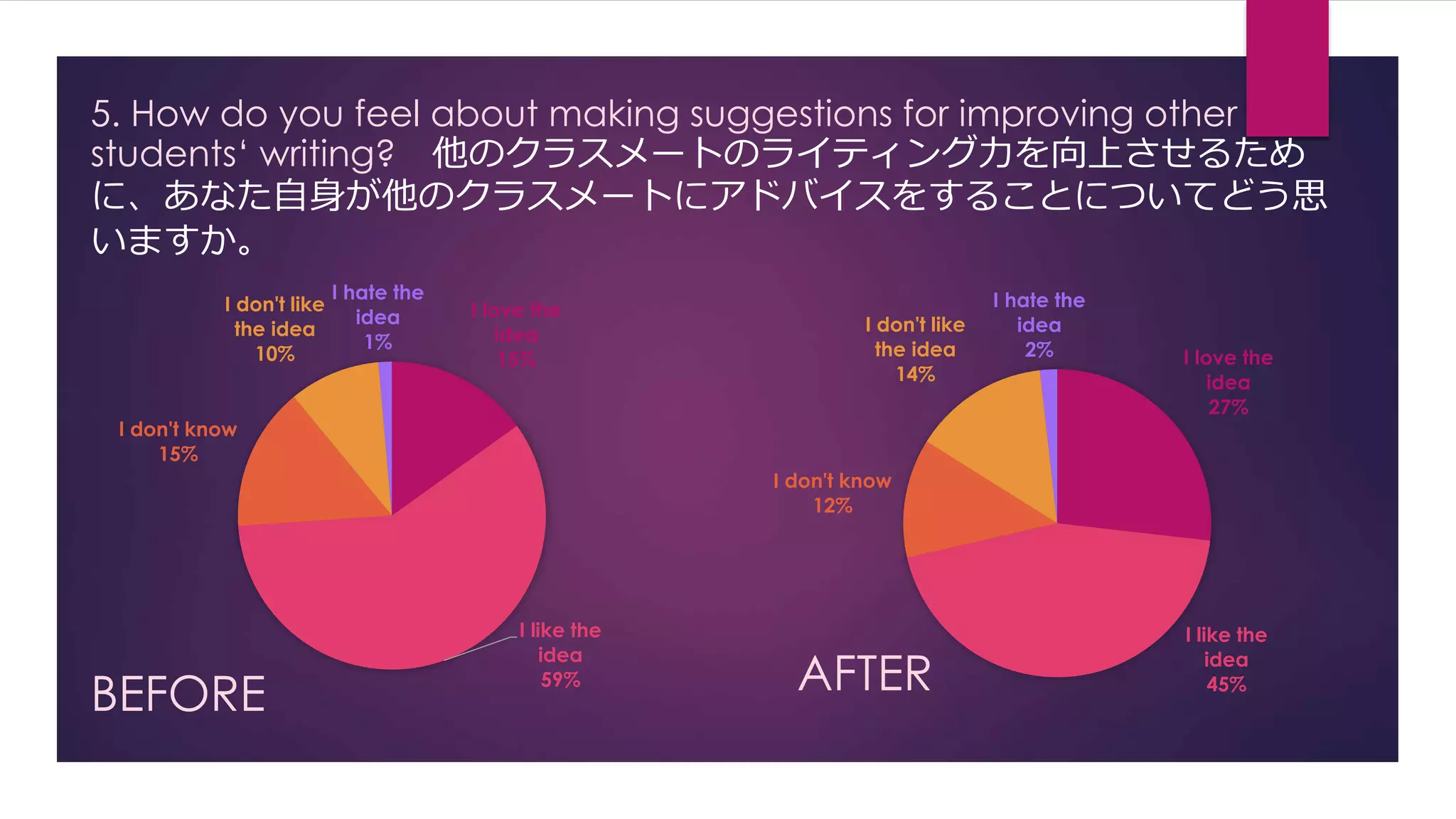
5. How do you feel about making suggestions for improving other 
students‘ writing? 他のクラスメートのライティング力を向上させるため 
に、あなた自身が他のクラスメートにアドバイスをすることについてどう思 
いますか。 
I love the 
idea 
15% 
I like the 
idea 
59% 
I don't know 
15% 
I don't like 
the idea 
10% 
I hate the 
idea 
1% 
BEFORE 
I love the 
idea 
27% 
I like the 
idea 
45% 
I don't know 
12% 
I don't like 
the idea 
14% 
I hate the 
idea 
2% 
AFTER
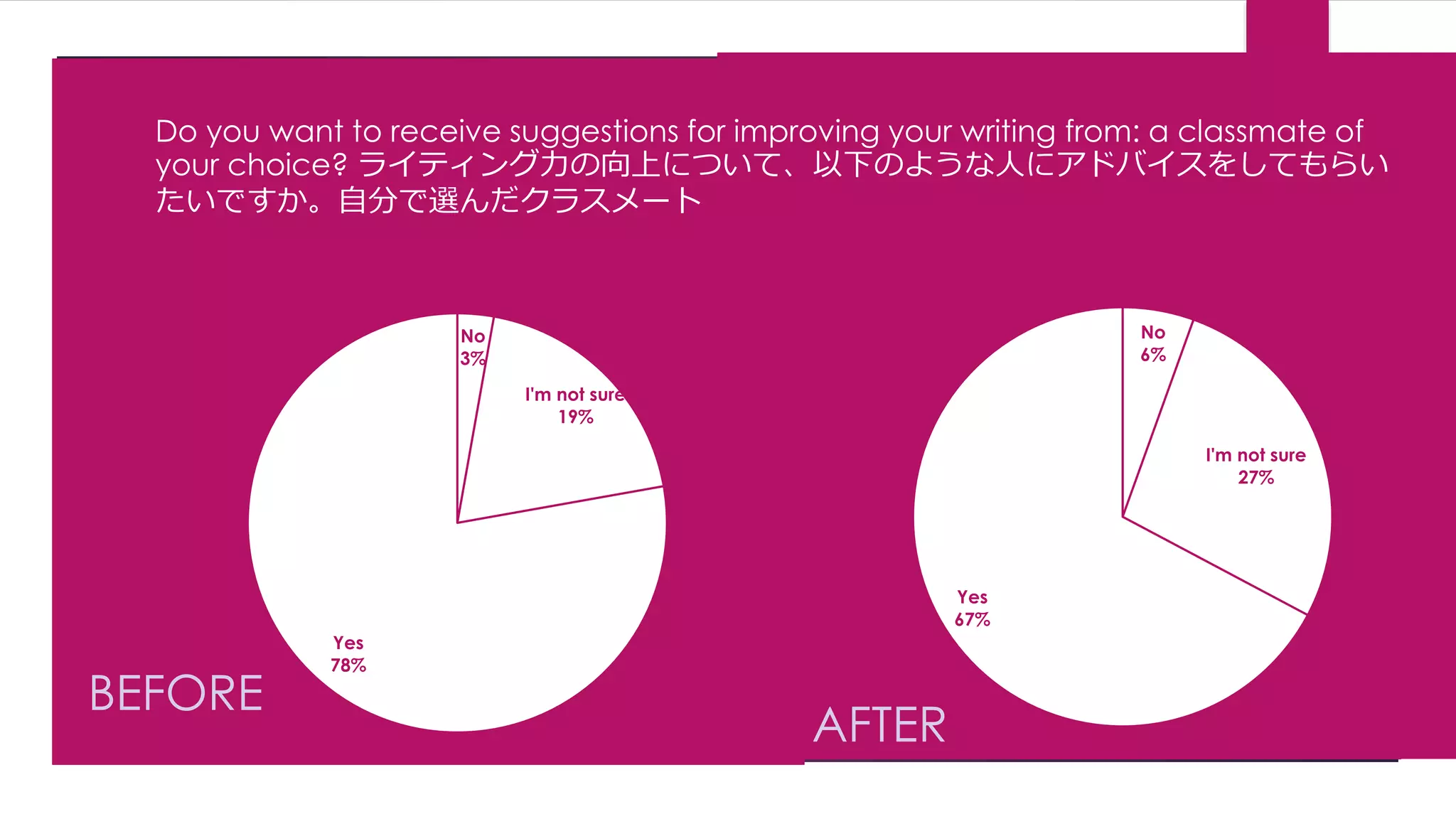
Do you want to receive suggestions for improving your writing from: a classmate of 
your choice? ライティング力の向上について、以下のような人にアドバイスをしてもらい 
たいですか。自分で選んだクラスメート 
No 
3% 
I'm not sure 
19% 
Yes 
78% 
BEFORE 
No 
6% 
I'm not sure 
27% 
Yes 
67% 
AFTER
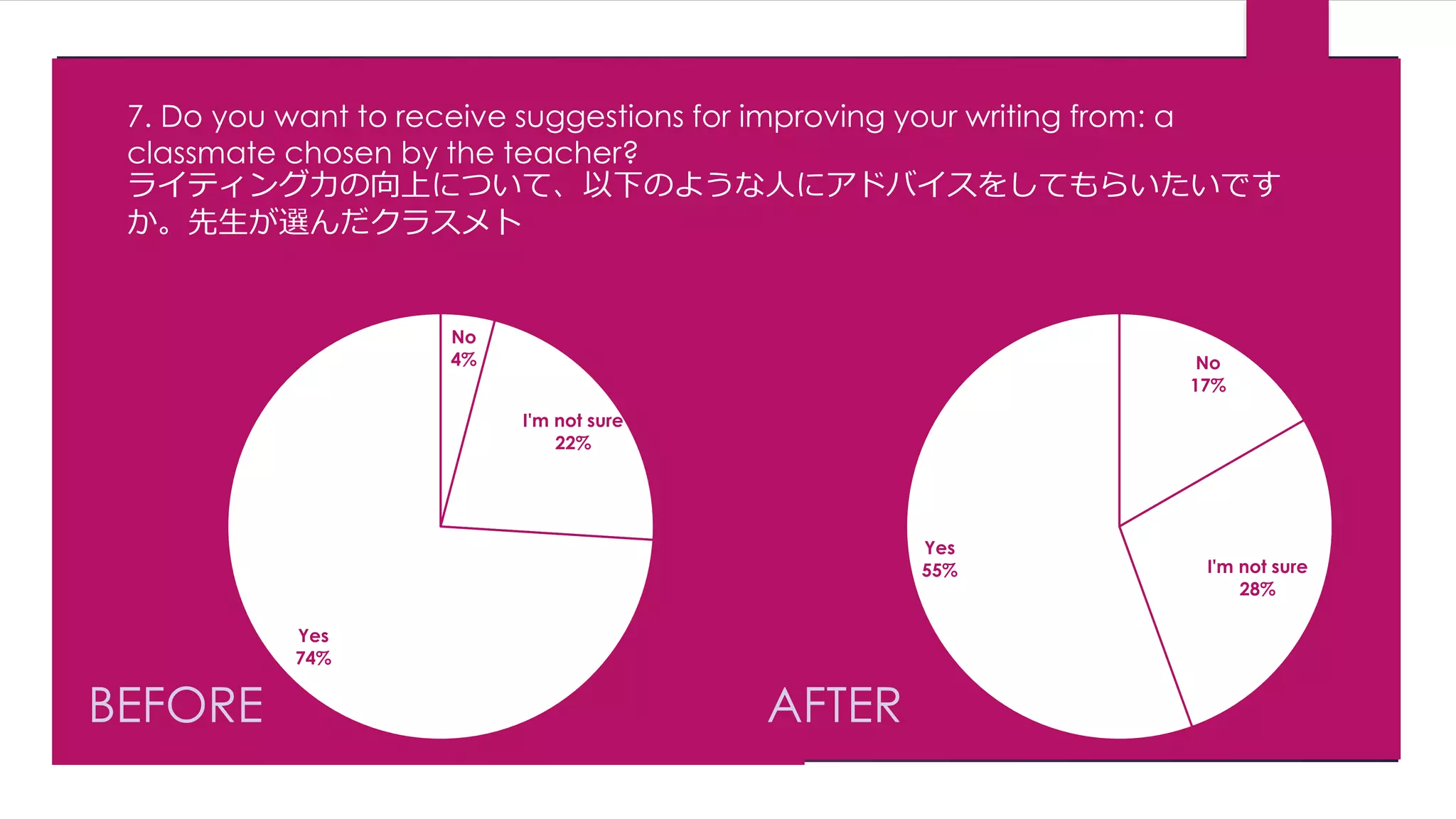
7. Do you want to receive suggestions for improving your writing from: a 
classmate chosen by the teacher? 
ライティング力の向上について、以下のような人にアドバイスをしてもらいたいです 
か。先生が選んだクラスメト 
BEFORE 
No 
4% 
I'm not sure 
22% 
Yes 
74% 
BEFORE 
No 
17% 
I'm not sure 
28% 
Yes 
55% 
AFTER
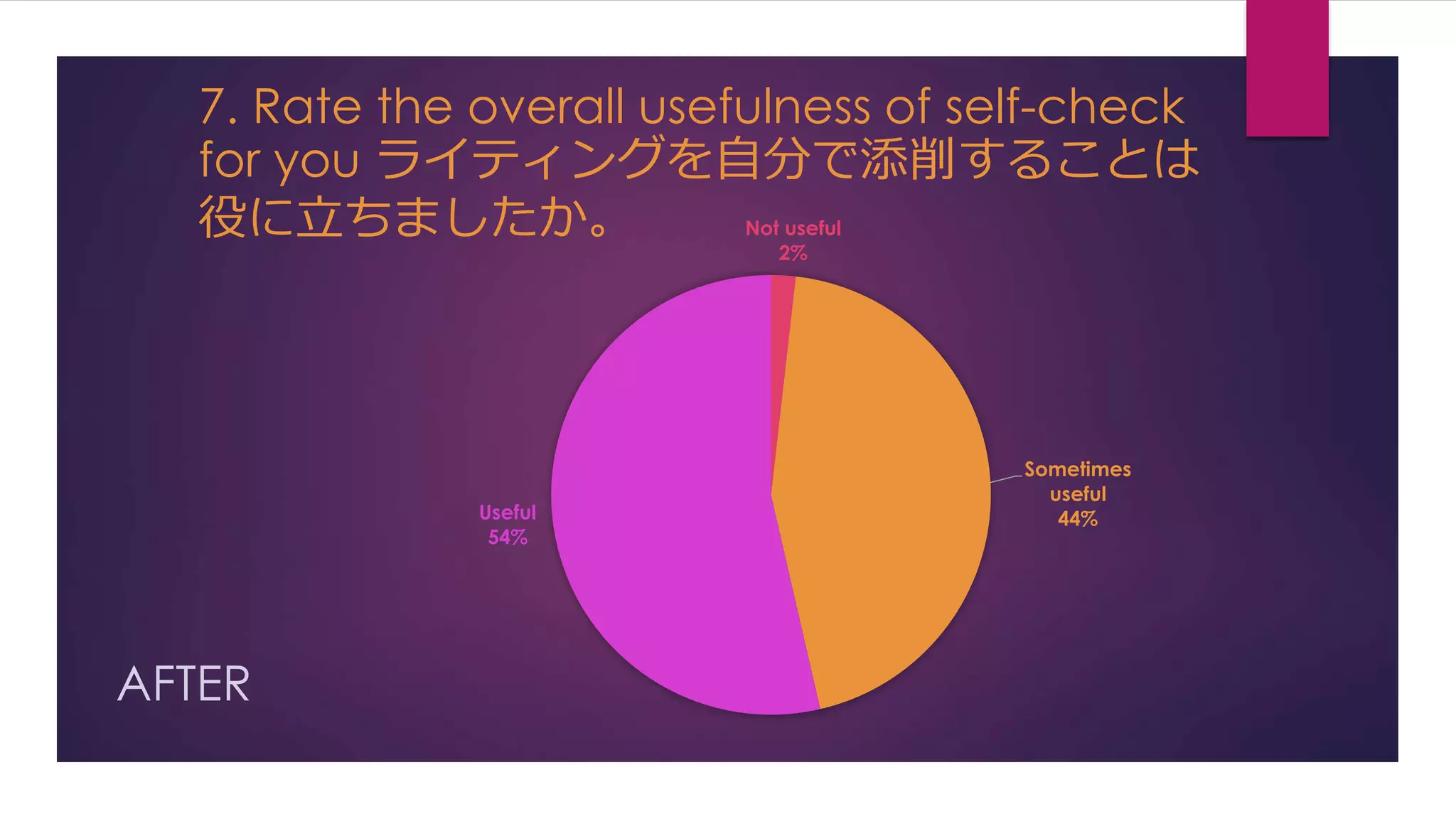
7. Rate the overall usefulness of self-check 
for you ライティングを自分で添削することは 
役に立ちましたか。Not useful 
AFTER 
2% 
Sometimes 
useful 
Useful 44% 
54%
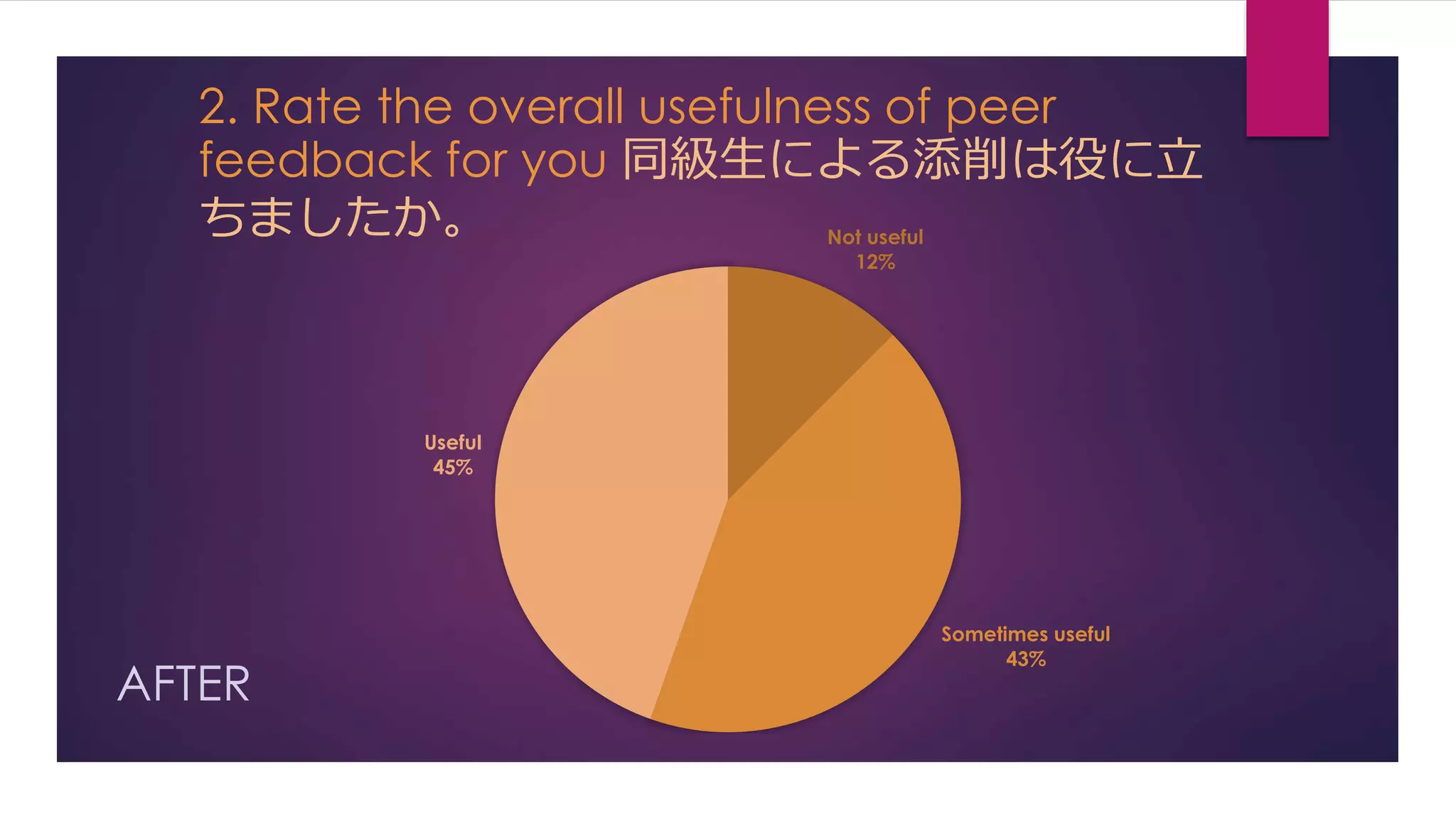
2. Rate the overall usefulness of peer 
feedback for you 同級生による添削は役に立 
ちましたか。Not useful 
AFTER 
12% 
Sometimes useful 
43% 
Useful 
45%
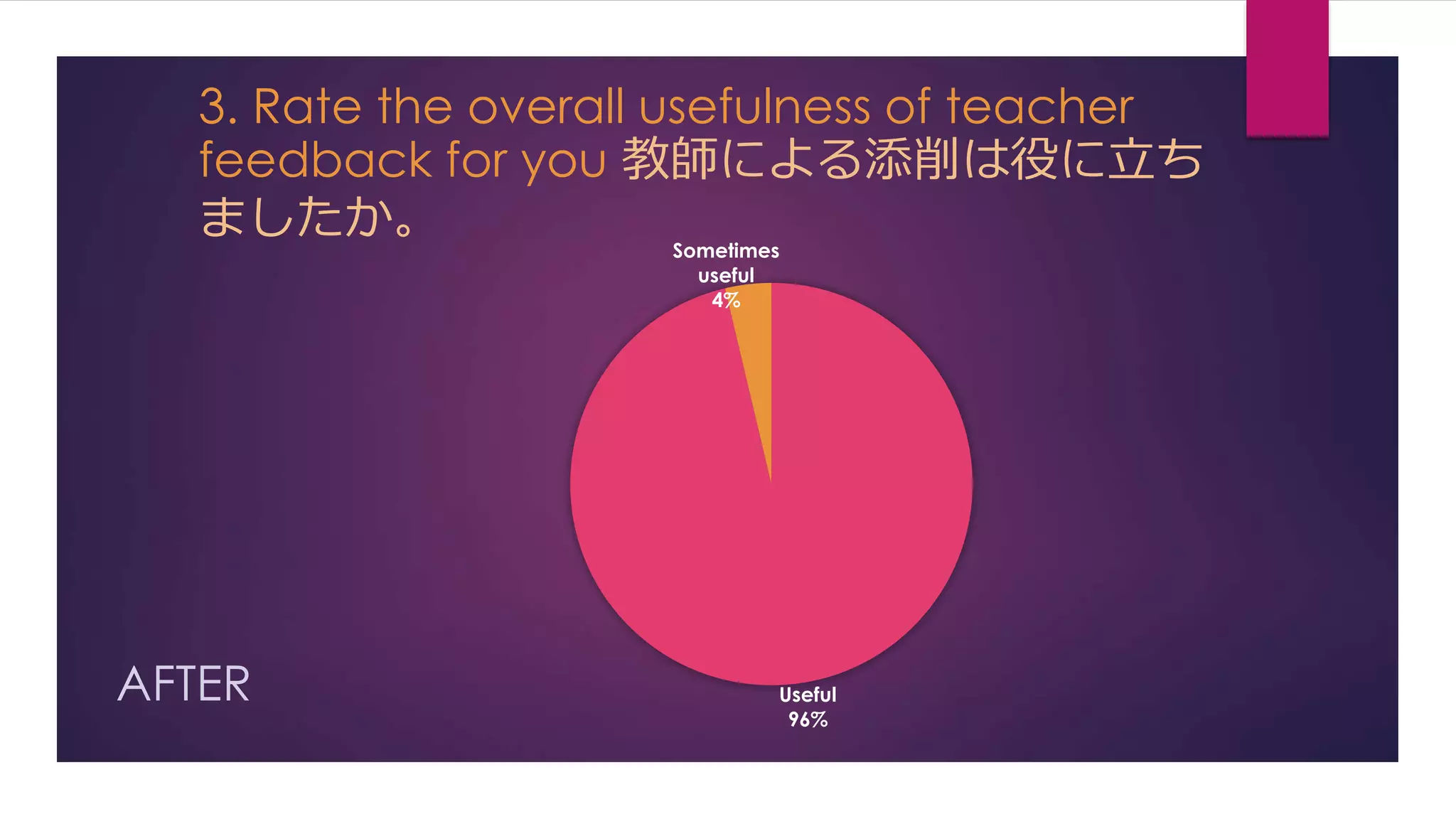
3. Rate the overall usefulness of teacher 
feedback for you 教師による添削は役に立ち 
ましたか。 
AFTER 
Sometimes 
Useful 
96% 
useful 
4%
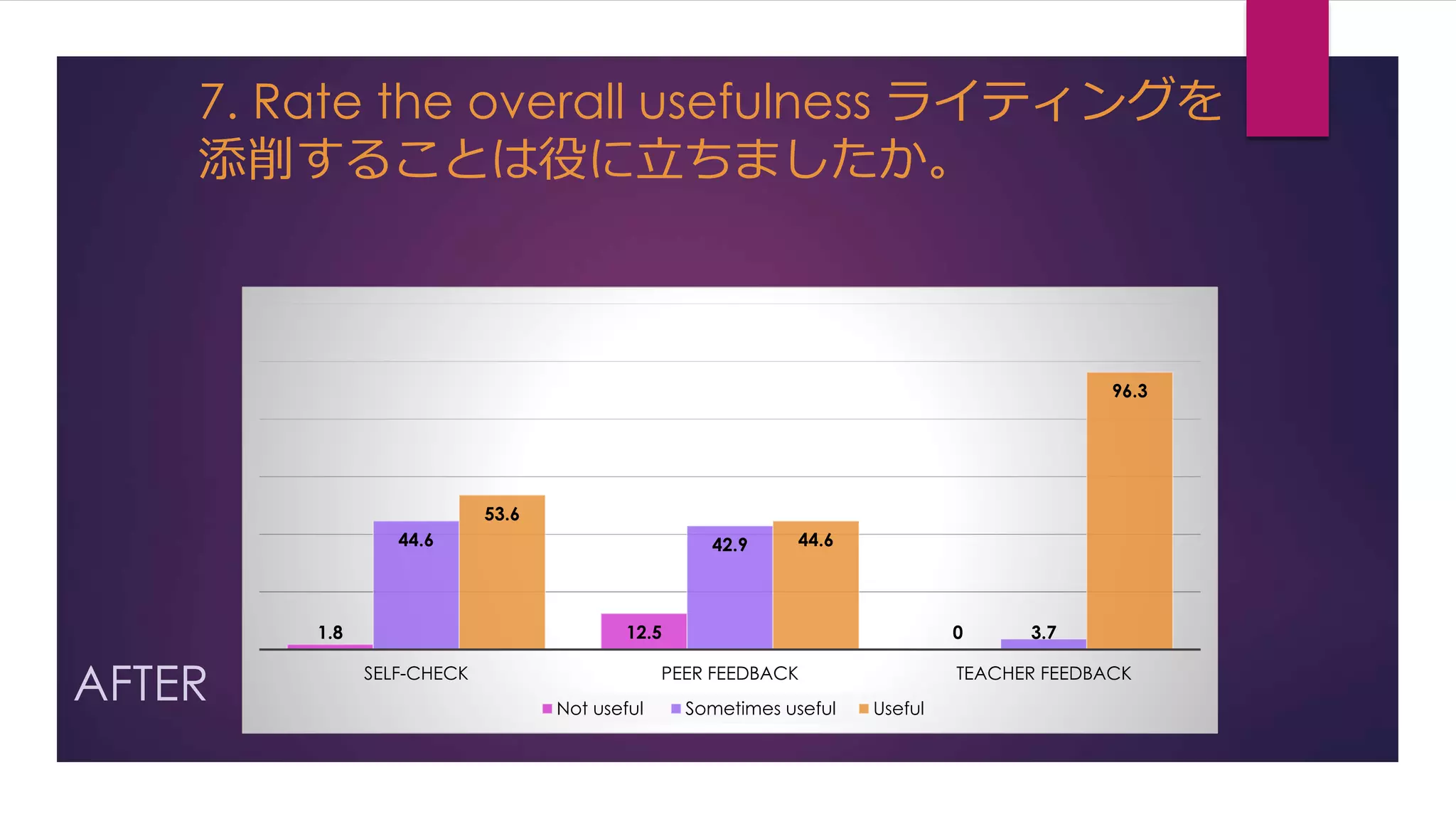
7. Rate the overall usefulness ライティングを 
添削することは役に立ちましたか。 
AFTER 
44.6 42.9 
1.8 12.5 0 
3.7 
53.6 
44.6 
96.3 
SELF-CHECK PEER FEEDBACK TEACHER FEEDBACK 
Not useful Sometimes useful Useful
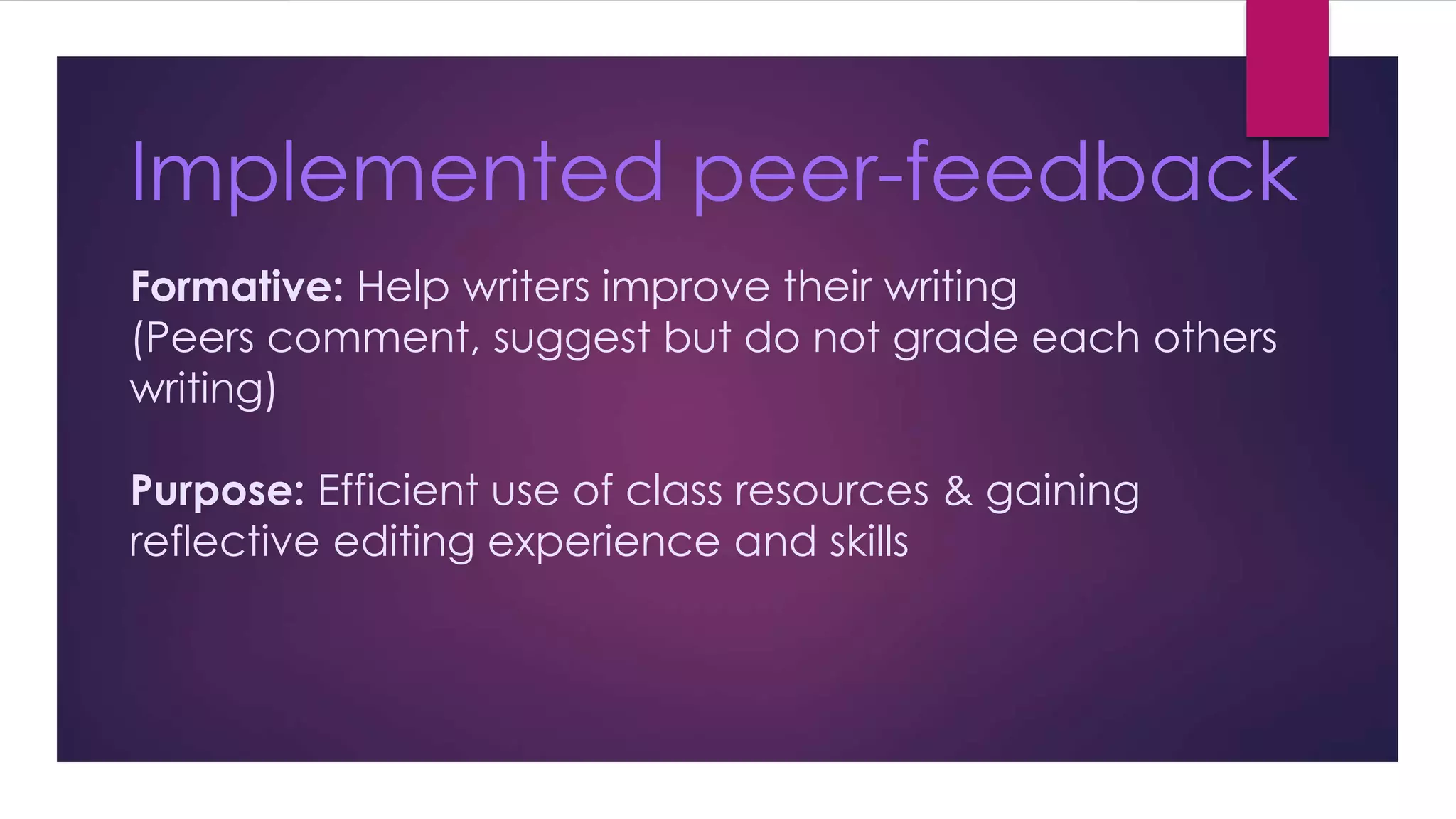
Implemented peer-feedback 
Formative: Help writers improve their writing 
(Peers comment, suggest but do not grade each others 
writing) 
Purpose: Efficient use of class resources & gaining 
reflective editing experience and skills
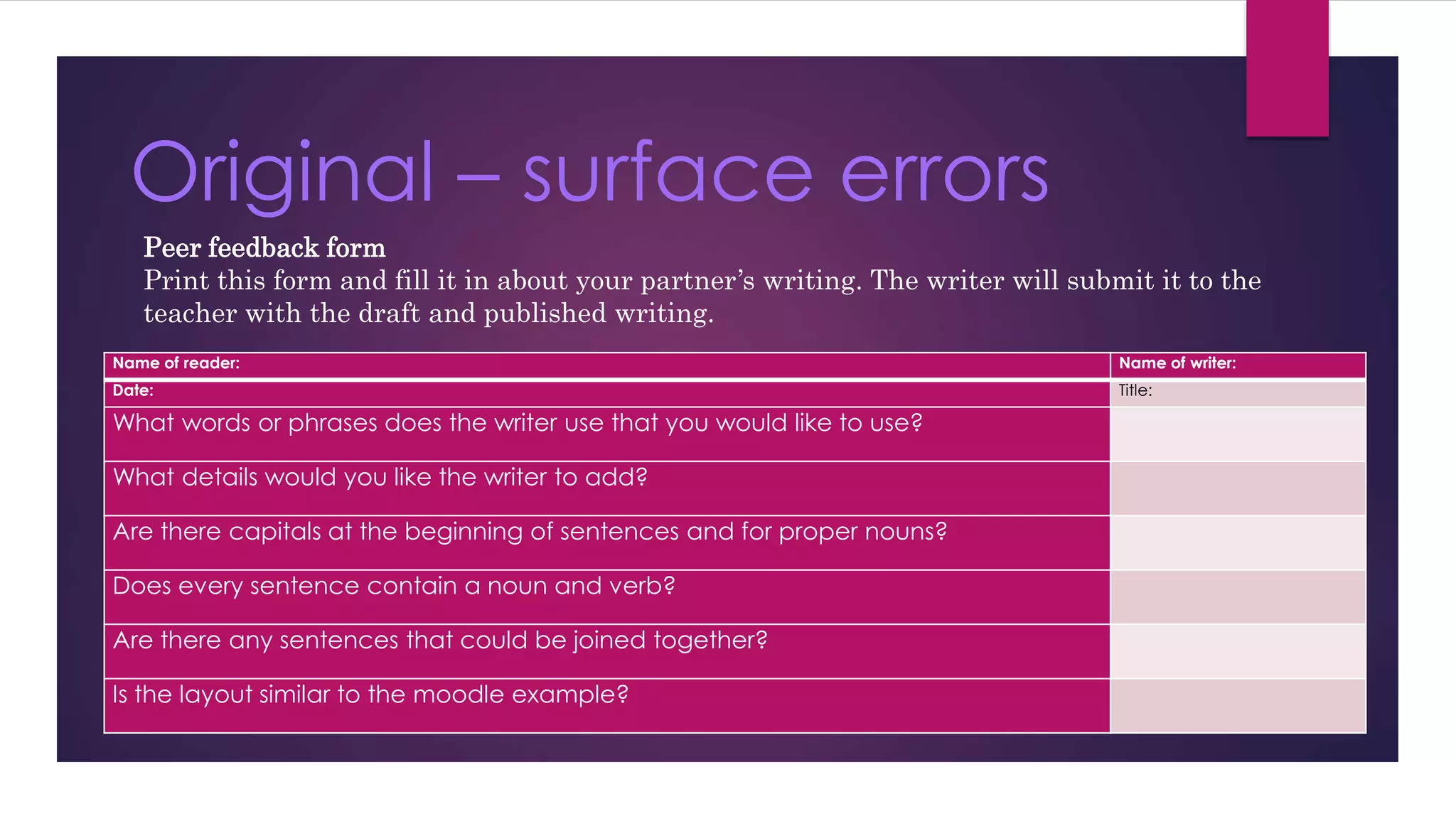
Original – surface errors 
Peer feedback form 
Print this form and fill it in about your partner’s writing. The writer will submit it to the 
teacher with the draft and published writing. 
Name of reader: Name of writer: 
Date: Title: 
What words or phrases does the writer use that you would like to use? 
What details would you like the writer to add? 
Are there capitals at the beginning of sentences and for proper nouns? 
Does every sentence contain a noun and verb? 
Are there any sentences that could be joined together? 
Is the layout similar to the moodle example?
Developed into info gathering 
Error checking done in self-check 
Information gathering in peer-feedback 
Name of reader: Name of writer: 
Date: Title: 
Underline any sentences which are difficult to understand 
Mark any corrections on the essay/email 
Why are they applying? 
What program are they applying for? 
What do they want to know? 
When are they arriving for the homestay?
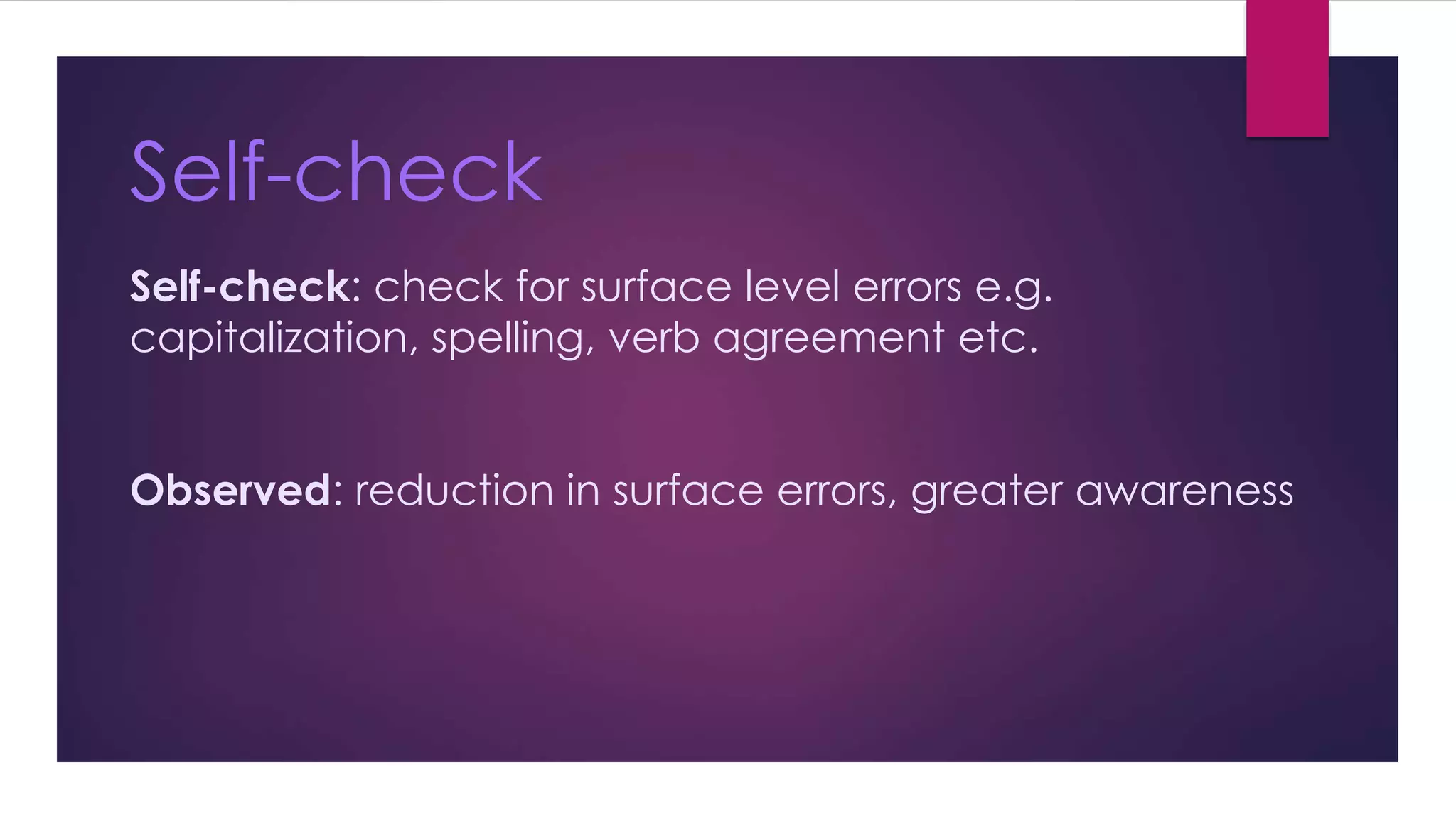
Self-check 
Self-check: check for surface level errors e.g. 
capitalization, spelling, verb agreement etc. 
Observed: reduction in surface errors, greater awareness
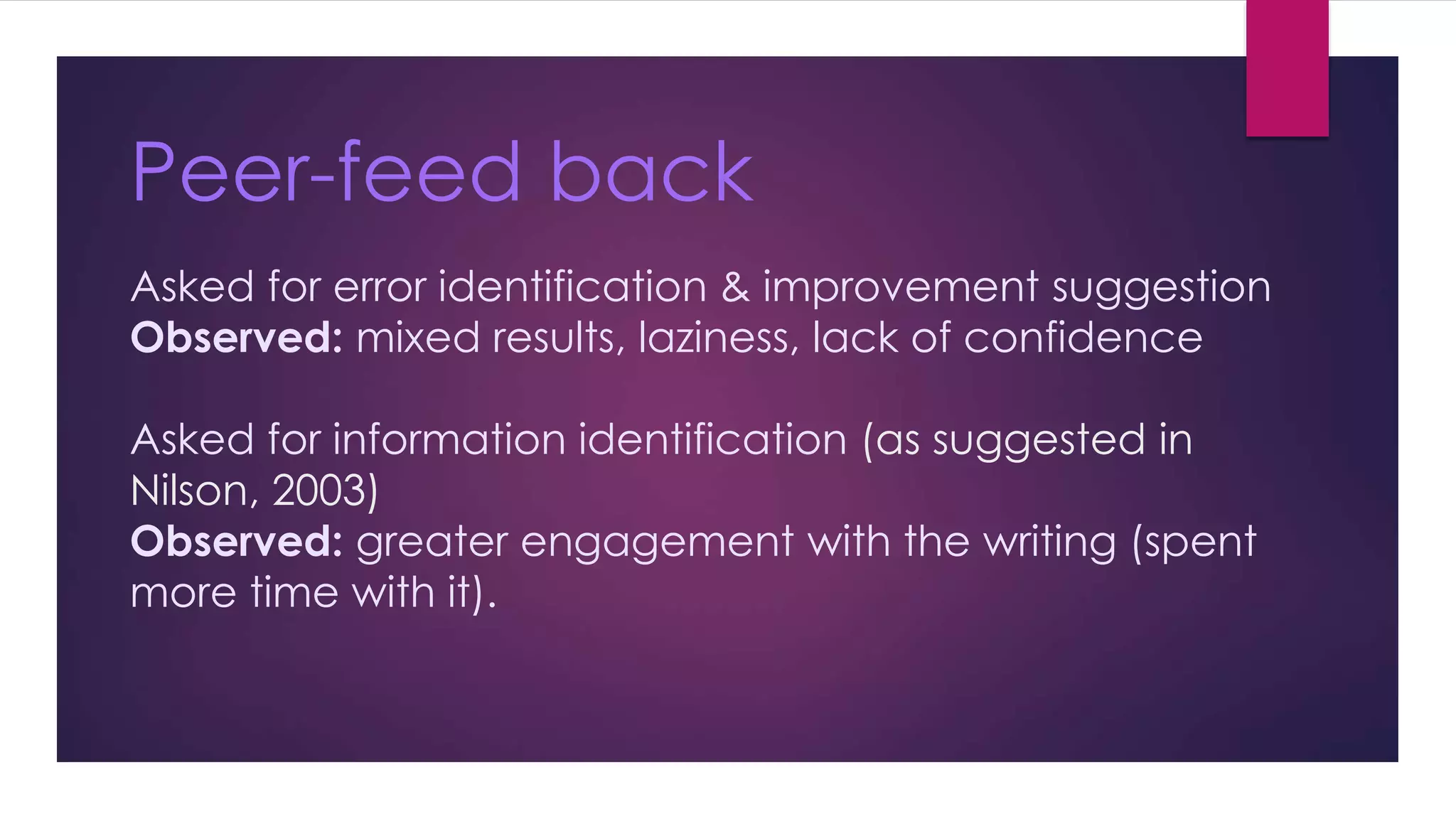
Peer-feed back 
Asked for error identification & improvement suggestion 
Observed: mixed results, laziness, lack of confidence 
Asked for information identification (as suggested in 
Nilson, 2003) 
Observed: greater engagement with the writing (spent 
more time with it).
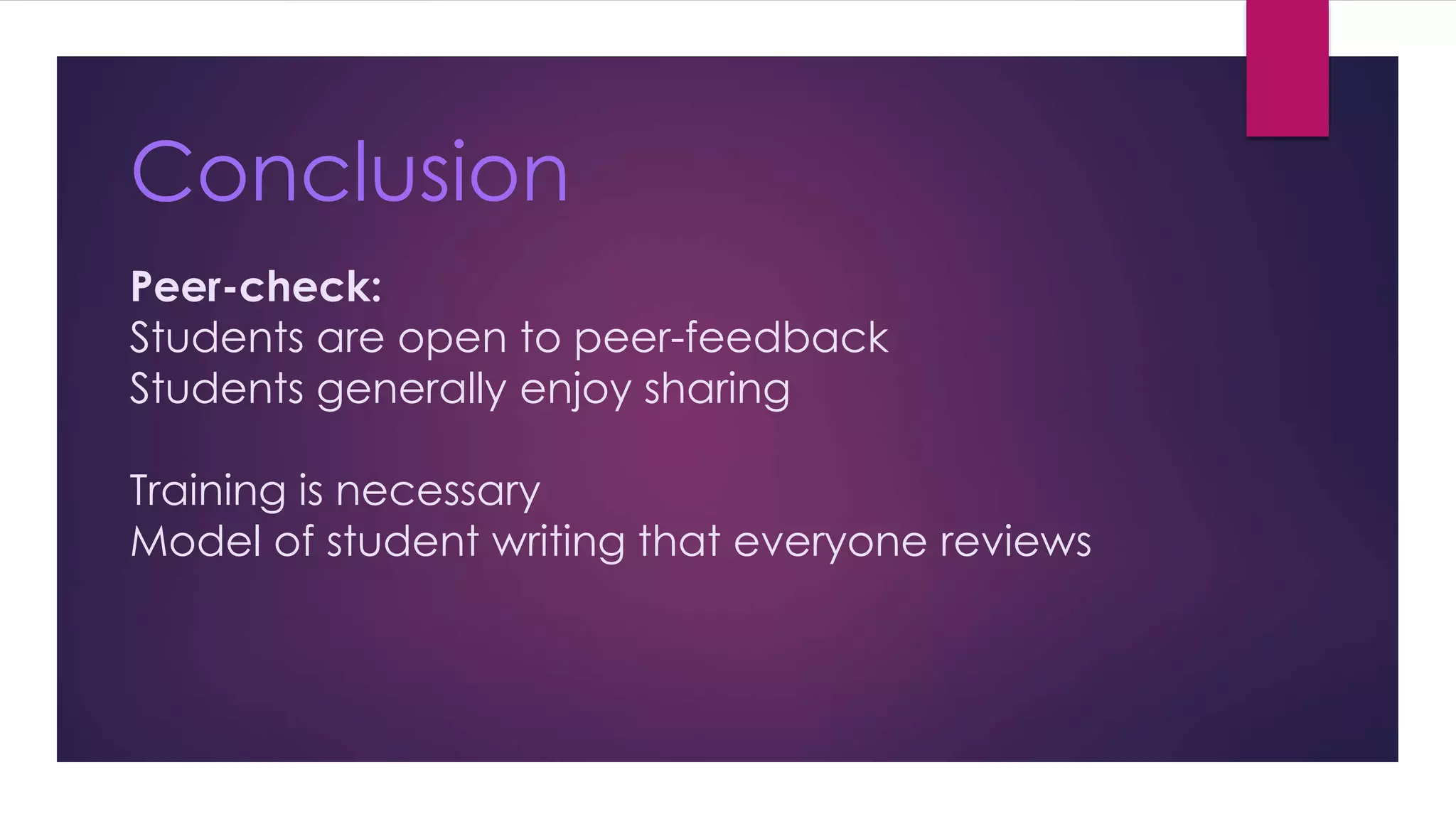
Conclusion 
Peer-check: 
Students are open to peer-feedback 
Students generally enjoy sharing 
Training is necessary 
Model of student writing that everyone reviews
Future classes 
Self-check 
Useful for reducing error 
Experiment with more identification tasks 
Avoid Yes/No questions to reduce laziness 
Peer-check 
Non-evaluative 
Information gathering 
Reaction to writing 
Experiment with mixing partners more
Thank you for listening! 
Do you have any questions, comments or 
suggestions?
References 
Kobayashi, H. (1988). Views of “Audience” and the Teaching of English Writing. 
Studies in Linguistic Culture, 広島大学総合科学部, (14), p. 113–129. 
Lundstrom, K., & Baker, W. (2009). To give is better than to receive: The benefits 
of peer review to the reviewer’s own writing. Journal of Second Language 
Writing, 18(1), 30–43. doi:10.1016/j.jslw.2008.06.002 
Nilson, L. B. (2003). Improving Student Peer Feedback. College Teaching, 
51(1), 34–38. doi:10.1080/87567550309596408 
Wigglesworth, G., & Storch, N. (2009). Pair versus individual writing: Effects on 
fluency, complexity and accuracy. Language Testing, 26(3), 445–466. 
doi:http://dx.doi.org.helicon.vuw.ac.nz/10.1177/0265532209104670
Slides 
For a copy of slide hand-outs see website: 
www.haideethomson.com 
Or email me: 
haidee.thomson@gmail.com

Exploring attitudes towards peer feedback in the writing classroom ライティングにおけるピア・フェードバックに関する学習者側の見解についての検討

  • 1.
    Exploring attitudes towardspeer-feedback in the writing classroom ライティングにおけるピア・フェード バックに関する学習者側の見解につい ての検討 HAIDEE THOMSON (HAIDEE.THOMSON@GMAIL.COM) 21 SEP, JALT HOKKAIDO CONFERENCE
  • 2.
    Writing class activities Model Plan Draft Teacher-check Revise and publish Problem? A lot of marking for the teacher Over-reliance on teacher Missed opportunity for writer reflection
  • 3.
    Solution Plan Draft Self-check Peer-check Teacher-check Revise and publish
  • 4.
    Is it gooduse of class-time? • Increases meta-cognitive awareness (Wigglesworth & Storch, 2009) • Raises audience awareness (Kobayashi, 1988) • Giver of feedback benefits more than receiver (Lundstrom & Baker, 2009) • Get more feedback
  • 5.
    Are students willingto share? Research question 1: Are students willing to read and comment on the writing of others? Research question 2: Are students willing to let classmates read their writing and comment?
  • 6.
    2 surveys of5 writing classes BEFORE 9 questions N=73 AFTER 13 questions N=57 1st year 3rd year 22% 2nd 52% year 26% 1st year 51% 3rd year 23% 2nd year 26%
  • 7.
    Have you evergiven suggestions to a classmate about how to improve their writing? ライティング力を向上させる方法を、クラスメート にアドバイスしたことがありますか。 Yes 14% No 86% BEFORE
  • 8.
    2. Have youever received suggestions from a classmate on how to improve your writing? ライティング力を向上させる方法を、クラスメートからアドバイスし てもらったことがありますか。 Yes 29% Can't remember 26% No 45% BEFORE
  • 9.
    3. Are youinterested in reading other classmates’ writing? 他のクラスメートのライティングを読んでみたいと思いますか。 Yes 78% Not sure 17% No 5% BEFORE Yes 75% Not sure 12% No 13% AFTER
  • 10.
    4. How doyou feel about other classmates reading your writing? 他のクラスメートに自分のライティングを読まれることについてどう 思いますか。 I like the idea 56% Don't like the idea 25% Not sure 19% BEFORE I like the idea 73% Not sure 7% Don't like the idea 20% AFTER
  • 11.
    5. How doyou feel about making suggestions for improving other students‘ writing? 他のクラスメートのライティング力を向上させるため に、あなた自身が他のクラスメートにアドバイスをすることについてどう思 いますか。 I love the idea 15% I like the idea 59% I don't know 15% I don't like the idea 10% I hate the idea 1% BEFORE I love the idea 27% I like the idea 45% I don't know 12% I don't like the idea 14% I hate the idea 2% AFTER
  • 12.
    Do you wantto receive suggestions for improving your writing from: a classmate of your choice? ライティング力の向上について、以下のような人にアドバイスをしてもらい たいですか。自分で選んだクラスメート No 3% I'm not sure 19% Yes 78% BEFORE No 6% I'm not sure 27% Yes 67% AFTER
  • 13.
    7. Do youwant to receive suggestions for improving your writing from: a classmate chosen by the teacher? ライティング力の向上について、以下のような人にアドバイスをしてもらいたいです か。先生が選んだクラスメト BEFORE No 4% I'm not sure 22% Yes 74% BEFORE No 17% I'm not sure 28% Yes 55% AFTER
  • 14.
    7. Rate theoverall usefulness of self-check for you ライティングを自分で添削することは 役に立ちましたか。Not useful AFTER 2% Sometimes useful Useful 44% 54%
  • 15.
    2. Rate theoverall usefulness of peer feedback for you 同級生による添削は役に立 ちましたか。Not useful AFTER 12% Sometimes useful 43% Useful 45%
  • 16.
    3. Rate theoverall usefulness of teacher feedback for you 教師による添削は役に立ち ましたか。 AFTER Sometimes Useful 96% useful 4%
  • 17.
    7. Rate theoverall usefulness ライティングを 添削することは役に立ちましたか。 AFTER 44.6 42.9 1.8 12.5 0 3.7 53.6 44.6 96.3 SELF-CHECK PEER FEEDBACK TEACHER FEEDBACK Not useful Sometimes useful Useful
  • 18.
    Implemented peer-feedback Formative:Help writers improve their writing (Peers comment, suggest but do not grade each others writing) Purpose: Efficient use of class resources & gaining reflective editing experience and skills
  • 19.
    Original – surfaceerrors Peer feedback form Print this form and fill it in about your partner’s writing. The writer will submit it to the teacher with the draft and published writing. Name of reader: Name of writer: Date: Title: What words or phrases does the writer use that you would like to use? What details would you like the writer to add? Are there capitals at the beginning of sentences and for proper nouns? Does every sentence contain a noun and verb? Are there any sentences that could be joined together? Is the layout similar to the moodle example?
  • 20.
    Developed into infogathering Error checking done in self-check Information gathering in peer-feedback Name of reader: Name of writer: Date: Title: Underline any sentences which are difficult to understand Mark any corrections on the essay/email Why are they applying? What program are they applying for? What do they want to know? When are they arriving for the homestay?
  • 21.
    Self-check Self-check: checkfor surface level errors e.g. capitalization, spelling, verb agreement etc. Observed: reduction in surface errors, greater awareness
  • 22.
    Peer-feed back Askedfor error identification & improvement suggestion Observed: mixed results, laziness, lack of confidence Asked for information identification (as suggested in Nilson, 2003) Observed: greater engagement with the writing (spent more time with it).
  • 23.
    Conclusion Peer-check: Studentsare open to peer-feedback Students generally enjoy sharing Training is necessary Model of student writing that everyone reviews
  • 24.
    Future classes Self-check Useful for reducing error Experiment with more identification tasks Avoid Yes/No questions to reduce laziness Peer-check Non-evaluative Information gathering Reaction to writing Experiment with mixing partners more
  • 25.
    Thank you forlistening! Do you have any questions, comments or suggestions?
  • 26.
    References Kobayashi, H.(1988). Views of “Audience” and the Teaching of English Writing. Studies in Linguistic Culture, 広島大学総合科学部, (14), p. 113–129. Lundstrom, K., & Baker, W. (2009). To give is better than to receive: The benefits of peer review to the reviewer’s own writing. Journal of Second Language Writing, 18(1), 30–43. doi:10.1016/j.jslw.2008.06.002 Nilson, L. B. (2003). Improving Student Peer Feedback. College Teaching, 51(1), 34–38. doi:10.1080/87567550309596408 Wigglesworth, G., & Storch, N. (2009). Pair versus individual writing: Effects on fluency, complexity and accuracy. Language Testing, 26(3), 445–466. doi:http://dx.doi.org.helicon.vuw.ac.nz/10.1177/0265532209104670
  • 27.
    Slides For acopy of slide hand-outs see website: www.haideethomson.com Or email me: haidee.thomson@gmail.com

Editor's Notes

  • #3 How can we make the most of the limited resources in the writing classroom? How can we encourage learners to critically review their own work before handing it to the teacher for review?
  • #5 W & S compared the writing of ESL individuals (mixed L1s) with those who produced writing in pairs and found increased accuracy and language related episodes leading to meta-cognitive awareness. Note this was shared writing as opposed to peer-check. Working together – social-cultural theories of cognitive development through interaction. Experience of team work is useful for future academic and work situations.
  • #9 Show by year might be better than class, do 3rd years have more experience than 1st years?
  • #10 Show by year might be better than class, do 3rd years have more experience than 1st years?
  • #11 Show by year might be better than class, do 3rd years have more experience than 1st years? 
  • #13 Did ss prefer to choose their own partner after experiencing peer-check compared to their prior experience responses? (graph corrected to be only ‘before’ cases Sep 17 evening), need to do same for after, then use calculator to see if different – repeated measures? IS THE DIFFERENCE BETWEEN SELF-CHOSEN AND TEACHER-CHOSEN SIG? Do you want to receive suggestions for improving your writing:
  • #14 Did ss prefer to choose their own partner after experiencing peer-check compared to their prior experience responses? (graph corrected to be only ‘before’ cases Sep 17 evening), need to do same for after, then use calculator to see if different – repeated measures? IS THE DIFFERENCE BETWEEN SELF-CHOSEN AND TEACHER-CHOSEN SIG? Do you want to receive suggestions for improving your writing:
  • #18 Selfcheck M=2.5185, SD=.54047, N=54, Peer feedback M=2.3, SD=.67, N=54, Teacher feedback M=2.963, SD=.19063, N=54 A one-way repeated measured analysis of variance (ANOVA) was conducted to evaluate the null hypothesis that there is no difference between ratings of the 3 types of check. The results indicated a significant difference in ratings, Wilks’ Lambda=.423, F(2, 52) = 35.49, p=.000, n2=?) (need to check how to report this and effect size) may have violated mauchly’s test of sphericity since it is significant.004
  • #23 Avoid potentially awkward social situation of evaluating a peer’s writing, lack of confidence for error identification but anyone can look for info. If it is not there or confusing this will be obvious from the reader’s answer – which can prompt the writer to clarify that point
  • #24 Writing can be a very isolated activity so introducing peer feedback or collaborative writing gives more opportunity for shared learning to occur