Name: Jessica Mills EDEL 350 20G
Due Date: Teach Date: March 1st & 3rd
Practicum Teacher: Ms. Koon Grade Level: 4th
LessonTopic: Fact and Opinion with Persuasive Nonfiction
Subject: Reading Foundation, Media Literacy, and Health &Wellness
Email: jnmills@bsu.edu
LessonType: Whole Group (into small groups)
Phone: 260-703-0051
In Standards and Indicator:
Nonfiction Reading Learning Outcome: Reading 4.RN.1 Read and comprehend a
variety of nonfiction within a range of complexity appropriate for grades 4-5. By
the end of grade 4, students interact with texts proficiently and independently at the low
end of the range
and with scaffolding as needed at the high end.
Reading (Nonfiction) 4.RN.4.1 Distinguish between fact and opinion; explain how an
author uses reasons and evidence to support a statement or position (claim) in a text.
Reading Literature Learning Outcome 4.RL.1 Read and comprehend a variety of
literature within a range of complexity appropriate for grades 4-5. By the end of grade 4,
students interact with texts proficiently and independently at the low end of the range and
with scaffolding as needed at the high end.
Reading 4.RL.2.1 Refer to details and examples in a text when explaining what a text
says explicitly and when drawing inferences from the text.
Media Literacy Learning Outcome 4.ML.1 Identify how information found in
electronic, print, and mass media is used to inform, persuade, entertain, and transmit
culture.
Media Literacy 4.ML.2.1 Recognize claims in print, image, and multimedia and identify
evidence used to support these claims.
Health Core Standard 2 Students will analyze the influence of family, peers, culture,
media, technology and other factors on health behaviors.
Health 4.2.3 Determine how peers can influence unhealthy behaviors and promote
wellness.
Health 4.2.5 Describe how media and technology can influence health behaviors.
LessonObjective: Students will select and categorize facts and opinions in a given
nonfiction persuasive passage.
Materials/Media: 6 articles (1 specific article for each reading group), game cards (6
sets- 1 for each matching article), 10 fact/opinion paddle signs (to be shared), 26 papers
for assessments, sticky notes, colored pencils, or highlighters (for students to color code
their assessments), projector, PowerPoint
Motivation: (For this motivation, students will participate with their row mates, as
to save time) Students will play a round of ‘A Truth and a Lie’. Each student will tell one
truth and one lie about themselves. The remainder of the group must state their choice or
opinion about which one they believe is the lie. Then we will discuss at the end what led
us to believe which statement was the lie.
Rationale: Today, we are going to discuss fact and opinion. By the end of this lesson,
you will be able to tell the difference between a fact and an opinion, and be able to
identify them in a persuasive writing.
Teach:
 I will have a PowerPoint shown on the projector/smart board to show the content
below:
-A fact is a statement that can be proven true or false.
-An opinion is a personal belief about something that cannot be proven.
-It is important to know whether or not an author is stating a fact or an
opinion, because it may influence your thinking. Remember, you cannot
change a fact, but you can change an opinion.
-Key fact words: dates, science, numbers, historical events, nonfiction
-Key opinion words: believe, feel, think, most, should, never, always
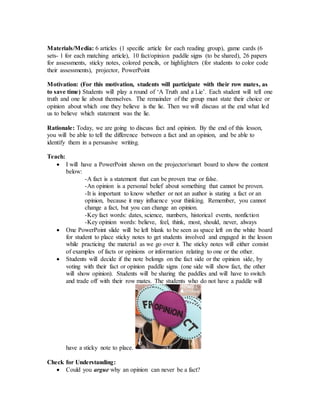
 One PowerPoint slide will be left blank to be seen as space left on the white board
for student to place sticky notes to get students involved and engaged in the lesson
while practicing the material as we go over it. The sticky notes will either consist
of examples of facts or opinions or information relating to one or the other.
 Students will decide if the note belongs on the fact side or the opinion side, by
voting with their fact or opinion paddle signs (one side will show fact, the other
will show opinion). Students will be sharing the paddles and will have to switch
and trade off with their row mates. The students who do not have a paddle will
have a sticky note to place.
Check for Understanding:
 Could you argue why an opinion can never be a fact?
 Can you distinguish between a fact and an opinion?
 Could you propose a way to prove if something is a fact?
Activity:
Students will be playing a short fact or opinion game based upon a reading level
appropriate nonfiction passage that they will read as a group together. There are six
different groups based on reading ability: one 3rd grade level, two 4th grade levels, two 5th
grade levels, and one 6th grade level. Therefore, there will be 6 groups altogether, and
students will already be seated with their group, but can move and adjust seating to see
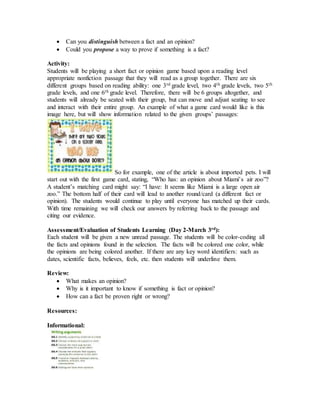
and interact with their entire group. An example of what a game card would like is this
image here, but will show information related to the given groups’ passages:
So for example, one of the article is about imported pets. I will
start out with the first game card, stating, “Who has: an opinion about Miami’s air zoo”?
A student’s matching card might say: “I have: It seems like Miami is a large open air
zoo.” The bottom half of their card will lead to another round/card (a different fact or
opinion). The students would continue to play until everyone has matched up their cards.
With time remaining we will check our answers by referring back to the passage and
citing our evidence.
Assessment/Evaluation of Students Learning (Day 2-March 3rd):
Each student will be given a new unread passage. The students will be color-coding all
the facts and opinions found in the selection. The facts will be colored one color, while
the opinions are being colored another. If there are any key word identifiers: such as
dates, scientific facts, believes, feels, etc. then students will underline them.
Review:
 What makes an opinion?
 Why is it important to know if something is fact or opinion?
 How can a fact be proven right or wrong?
Resources:
Informational:
Practice ninth grade language arts online. (n.d.). Retrieved February 18, 2016, from
https://www.ixl.com/ela/grade-9/distinguish-facts-from-opinions
Ms. Koon told us about IXL and to use it as a resource to match up to our standards when
researching for our lesson plan. It provides research and gives examples for practice as to
where students should be performing by the end of the given lesson. I focused on finding
resources for fact and opinion, which started at the high school level for this website, but
provided research to be used as content. This information will be used during my Teach
section of my lesson plan.
S, K. (2010). Stuff Students Say and Other Classroom Treasures: Great Science Fiction
Reads, Fact vs. Opinion Anchor Chart, and Testing Poster 5-4-Fri! Retrieved
February 18, 2016, from http://schenkgr4.blogspot.com/2014/02/great-science-
fiction-reads-fact-vs.html
I found this teacher's blog through a Pinterest search for fact and opinion. It provides both
informational and instructional strategies to teach fact and opinion. The information here
will be used during my Teach and Activity parts of my lesson.
Instructional:
August, D., Bear, D., & Dole, J. (2014). Wonders: a reading/language arts program.
Chicago, IL: McGraw-Hill Companies.
I found this textbook in Bracken Library in Educational Resources under Reference
Books. This book helps describe ways to explain terms and how to use fact and opinion
that will be used during the Teach and Activity sections of the lesson plan.
Thibault, M. (2004). Children's literature promotes understanding. Retrieved February
17, 2016, from http://www.learnnc.org/lp/pages/635
I found this website by performing a Google search of ways to use children's literature to
promote health learning. The information from this article will be used during the
Activity and Assessment part of my lesson.

fact and opinion lesson plan

  • 1.
    Name: Jessica MillsEDEL 350 20G Due Date: Teach Date: March 1st & 3rd Practicum Teacher: Ms. Koon Grade Level: 4th LessonTopic: Fact and Opinion with Persuasive Nonfiction Subject: Reading Foundation, Media Literacy, and Health &Wellness Email: jnmills@bsu.edu LessonType: Whole Group (into small groups) Phone: 260-703-0051 In Standards and Indicator: Nonfiction Reading Learning Outcome: Reading 4.RN.1 Read and comprehend a variety of nonfiction within a range of complexity appropriate for grades 4-5. By the end of grade 4, students interact with texts proficiently and independently at the low end of the range and with scaffolding as needed at the high end. Reading (Nonfiction) 4.RN.4.1 Distinguish between fact and opinion; explain how an author uses reasons and evidence to support a statement or position (claim) in a text. Reading Literature Learning Outcome 4.RL.1 Read and comprehend a variety of literature within a range of complexity appropriate for grades 4-5. By the end of grade 4, students interact with texts proficiently and independently at the low end of the range and with scaffolding as needed at the high end. Reading 4.RL.2.1 Refer to details and examples in a text when explaining what a text says explicitly and when drawing inferences from the text. Media Literacy Learning Outcome 4.ML.1 Identify how information found in electronic, print, and mass media is used to inform, persuade, entertain, and transmit culture. Media Literacy 4.ML.2.1 Recognize claims in print, image, and multimedia and identify evidence used to support these claims. Health Core Standard 2 Students will analyze the influence of family, peers, culture, media, technology and other factors on health behaviors. Health 4.2.3 Determine how peers can influence unhealthy behaviors and promote wellness. Health 4.2.5 Describe how media and technology can influence health behaviors. LessonObjective: Students will select and categorize facts and opinions in a given nonfiction persuasive passage.
  • 2.
    Materials/Media: 6 articles(1 specific article for each reading group), game cards (6 sets- 1 for each matching article), 10 fact/opinion paddle signs (to be shared), 26 papers for assessments, sticky notes, colored pencils, or highlighters (for students to color code their assessments), projector, PowerPoint Motivation: (For this motivation, students will participate with their row mates, as to save time) Students will play a round of ‘A Truth and a Lie’. Each student will tell one truth and one lie about themselves. The remainder of the group must state their choice or opinion about which one they believe is the lie. Then we will discuss at the end what led us to believe which statement was the lie. Rationale: Today, we are going to discuss fact and opinion. By the end of this lesson, you will be able to tell the difference between a fact and an opinion, and be able to identify them in a persuasive writing. Teach:  I will have a PowerPoint shown on the projector/smart board to show the content below: -A fact is a statement that can be proven true or false. -An opinion is a personal belief about something that cannot be proven. -It is important to know whether or not an author is stating a fact or an opinion, because it may influence your thinking. Remember, you cannot change a fact, but you can change an opinion. -Key fact words: dates, science, numbers, historical events, nonfiction -Key opinion words: believe, feel, think, most, should, never, always  One PowerPoint slide will be left blank to be seen as space left on the white board for student to place sticky notes to get students involved and engaged in the lesson while practicing the material as we go over it. The sticky notes will either consist of examples of facts or opinions or information relating to one or the other.  Students will decide if the note belongs on the fact side or the opinion side, by voting with their fact or opinion paddle signs (one side will show fact, the other will show opinion). Students will be sharing the paddles and will have to switch and trade off with their row mates. The students who do not have a paddle will have a sticky note to place. Check for Understanding:  Could you argue why an opinion can never be a fact?
  • 3.
     Can youdistinguish between a fact and an opinion?  Could you propose a way to prove if something is a fact? Activity: Students will be playing a short fact or opinion game based upon a reading level appropriate nonfiction passage that they will read as a group together. There are six different groups based on reading ability: one 3rd grade level, two 4th grade levels, two 5th grade levels, and one 6th grade level. Therefore, there will be 6 groups altogether, and students will already be seated with their group, but can move and adjust seating to see and interact with their entire group. An example of what a game card would like is this image here, but will show information related to the given groups’ passages: So for example, one of the article is about imported pets. I will start out with the first game card, stating, “Who has: an opinion about Miami’s air zoo”? A student’s matching card might say: “I have: It seems like Miami is a large open air zoo.” The bottom half of their card will lead to another round/card (a different fact or opinion). The students would continue to play until everyone has matched up their cards. With time remaining we will check our answers by referring back to the passage and citing our evidence. Assessment/Evaluation of Students Learning (Day 2-March 3rd): Each student will be given a new unread passage. The students will be color-coding all the facts and opinions found in the selection. The facts will be colored one color, while the opinions are being colored another. If there are any key word identifiers: such as dates, scientific facts, believes, feels, etc. then students will underline them. Review:  What makes an opinion?  Why is it important to know if something is fact or opinion?  How can a fact be proven right or wrong? Resources: Informational:
  • 4.
    Practice ninth gradelanguage arts online. (n.d.). Retrieved February 18, 2016, from https://www.ixl.com/ela/grade-9/distinguish-facts-from-opinions Ms. Koon told us about IXL and to use it as a resource to match up to our standards when researching for our lesson plan. It provides research and gives examples for practice as to where students should be performing by the end of the given lesson. I focused on finding resources for fact and opinion, which started at the high school level for this website, but provided research to be used as content. This information will be used during my Teach section of my lesson plan. S, K. (2010). Stuff Students Say and Other Classroom Treasures: Great Science Fiction Reads, Fact vs. Opinion Anchor Chart, and Testing Poster 5-4-Fri! Retrieved February 18, 2016, from http://schenkgr4.blogspot.com/2014/02/great-science- fiction-reads-fact-vs.html I found this teacher's blog through a Pinterest search for fact and opinion. It provides both informational and instructional strategies to teach fact and opinion. The information here will be used during my Teach and Activity parts of my lesson. Instructional: August, D., Bear, D., & Dole, J. (2014). Wonders: a reading/language arts program. Chicago, IL: McGraw-Hill Companies. I found this textbook in Bracken Library in Educational Resources under Reference Books. This book helps describe ways to explain terms and how to use fact and opinion that will be used during the Teach and Activity sections of the lesson plan. Thibault, M. (2004). Children's literature promotes understanding. Retrieved February 17, 2016, from http://www.learnnc.org/lp/pages/635 I found this website by performing a Google search of ways to use children's literature to promote health learning. The information from this article will be used during the Activity and Assessment part of my lesson.