Clinical Trials: Regulatory & Privacy
Issues
Presented by
Michael A. Swit
Special Counsel, FDA Law, Duane Morris LLP
DISCLAIMERS
• This outline is intended to support an oral briefing and should
not be relied upon solely to support any conclusion of fact or
law.
• The views reflected in this presentation are solely those of
the presenter and do not necessarily reflect the position of
my firm, any of our clients, or any of my friends and
colleagues that contributed their thoughts to this
presentation.
• This webinar and outline are intended to provide general
educational insights and not as a substitute for formal legal
advice.
2
What We Will Cover on Clinical Trials
• FDA Requirements
• Privacy Issues and HIPAA
• Practical Considerations
3
Key FDA Requirements for Clinical Trials
4
Basic Considerations
• Do I need FDA’s “blessing” before I start a clinical study? – INDs
– drugs/biologics -- and IDEs
– When needed?
• What duties do I owe the subjects?
– Human Subject Protection
• Informed Consent
• IRB Prior Review of Clinical Research
• What Duties do I owe FDA?
– Running the study correctly and maintaining IND properly to ensure:
• Reporting and Recordkeeping basics
• Human Subject Protection
• Data Integrity
– Financial Disclosure
5
When FDA Prior Review of a Study is Needed
• Drugs –
– it is illegal to introduce an unapproved drug (or an unlicensed
biologic) into commerce for a clinical study unless an
Investigational New Drug exemption (IND) is effective (or not
required)
– IND regulations – 21 CFR Part 312
• Devices
– a device that otherwise would require an approved Premarket
Approval Application (PMA) or cleared premarket notification
[510(k)] can be shipped lawfully if to be studied in an
investigation to show safety or effectiveness if an Investigational
Device Exemption (IDE) is approved or the study is exempt
– IDE regulations – 21 CFR Part 812
6
Drugs/Biologics – When is an IND Required?
• Unapproved drugs – any clinical investigation in
humans will require an effective IND
– Note: INDs are not “approved” – notwithstanding what
press releases say
7
Drugs/Biologics -- When is an IND required …?
• Studies of approved drugs – no IND needed if all these
apply:
– won’t be reported to FDA to support a new indication or major
labeling change
– if an Rx drug, the study is not intended to support a major
advertising change (e.g., a comparative study)
– study does not involve a change in the drug (e.g., dosage, route
of administration, patient population) that increases the risks
associated with the use of the drug
– informed consent and IRB approval required
– can’t promote the drug as safe or effective for what it is being
studied for in the clinical trial (21 CFR 312.7)
8
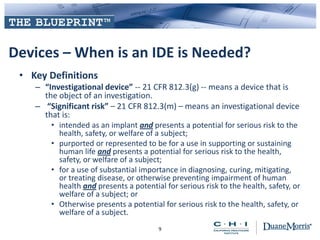
Devices – When is an IDE is Needed?
• Key Definitions
– “Investigational device” -- 21 CFR 812.3(g) -- means a device that is
the object of an investigation.
– “Significant risk” – 21 CFR 812.3(m) – means an investigational device
that is:
• intended as an implant and presents a potential for serious risk to the
health, safety, or welfare of a subject;
• purported or represented to be for a use in supporting or sustaining
human life and presents a potential for serious risk to the health,
safety, or welfare of a subject;
• for a use of substantial importance in diagnosing, curing, mitigating,
or treating disease, or otherwise preventing impairment of human
health and presents a potential for serious risk to the health, safety, or
welfare of a subject; or
• Otherwise presents a potential for serious risk to the health, safety, or
welfare of a subject.
9
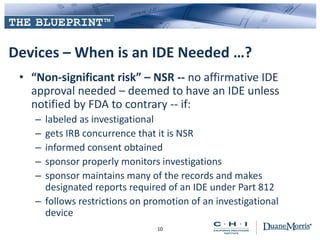
Devices – When is an IDE Needed …?
• “Non-significant risk” – NSR -- no affirmative IDE
approval needed – deemed to have an IDE unless
notified by FDA to contrary -- if:
– labeled as investigational
– gets IRB concurrence that it is NSR
– informed consent obtained
– sponsor properly monitors investigations
– sponsor maintains many of the records and makes
designated reports required of an IDE under Part 812
– follows restrictions on promotion of an investigational
device
10
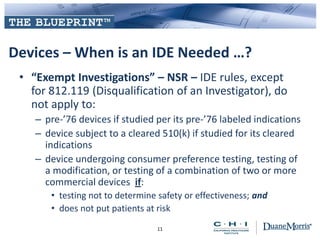
Devices – When is an IDE Needed …?
• “Exempt Investigations” – NSR – IDE rules, except
for 812.119 (Disqualification of an Investigator), do
not apply to:
– pre-’76 devices if studied per its pre-’76 labeled indications
– device subject to a cleared 510(k) if studied for its cleared
indications
– device undergoing consumer preference testing, testing of
a modification, or testing of a combination of two or more
commercial devices if:
• testing not to determine safety or effectiveness; and
• does not put patients at risk
11
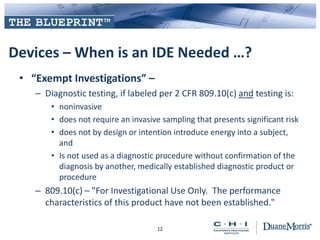
Devices – When is an IDE Needed …?
• “Exempt Investigations” –
– Diagnostic testing, if labeled per 2 CFR 809.10(c) and testing is:
• noninvasive
• does not require an invasive sampling that presents significant risk
• does not by design or intention introduce energy into a subject,
and
• Is not used as a diagnostic procedure without confirmation of the
diagnosis by another, medically established diagnostic product or
procedure
– 809.10(c) – "For Investigational Use Only. The performance
characteristics of this product have not been established."
12
What’s In an IND?
• Format – “Common Technical Document” (CTD) format
established by International Conference on
Harmonization (ICH) –
• 21 CFR 312.23 -- Very detailed requirements –
– Protocol
– Investigator’s Brochure
– Labeling of investigational drug
– Pharmacology and Tox studies that support safe use of drug
– Chemistry, Manufacturing and Controls – amount varies by
study phase
– Previous human experience (e.g., in Europe)
13
What’s In an IDE?
• 21 CFR 812.20(b) -- Very detailed requirements –
– All written information to be given to subjects, including
informed consent forms
– Complete “investigational plan” – protocol, monitoring plan, risk
analysis to subjects, device description
– Investigator’s agreements
– List of IRBs involved
– Labeling
– Complete description of the methods, facilities and controls
used to make (and install, if applicable) the device
– Reports of prior investigations
– “Any other relevant information FDA requests …”
14
Human Subject Protection Duties
• Informed Consent – 21 CFR Part 50
– Required for virtually all investigations
– Exceptions:
• Life Saving Use -- where test article is regarded by
investigator as potentially life saving and no alternative
therapy is available
• Emergency Use – similar to “Life Saving,” but is for scenario
where the research program as a whole is aimed at
emergency medical care and obtaining informed consent will
not be practical
15
Human Subject Protection Duties …
• Informed Consent – Key Elements
– The study involves research, an explanation of the purposes of
the research and the expected duration of the subject's
participation, a description of the procedures to be followed,
and identification of any procedures which are experimental.
– Reasonably foreseeable risks or discomforts to the subject.
– Any benefits to the subject or to others which may reasonably
be expected from the research.
– Disclosure of appropriate alternative procedures or courses of
treatment, if any, that might be advantageous to the subject.
– Statement whether and to what extent records identifying the
subject will be kept confidential and that notes the possibility
that the Food and Drug Administration may inspect the records.
16
Human Subject Protection Duties …
• Informed Consent – Key Elements …
– For research involving more than minimal risk, an explanation as
to whether any compensation and an explanation as to whether
any medical treatments are available if injury occurs and, if so,
what they consist of, or where further information may be
obtained – Subject Compensation
– Whom to contact for answers to pertinent questions about the
research and research subjects' rights, and whom to contact in
the event of a research-related injury to the subject.
– A statement that participation is voluntary, that refusal to
participate will involve no penalty or loss of benefits to which the
subject is otherwise entitled, and that the subject may
discontinue participation at any time without penalty or loss of
benefits to which the subject is otherwise entitled.
17
Human Subject Protection Duties …
• Informed Consent – Other Key Concerns:
– Informed consent is a process – not just signing a form
– Cannot include any language that could be regarded as
exculpatory as to anyone involved in the research (sponsor,
investigator, IRB, etc.)
– Language
• must be understandable to lay reader – General rule (although not
set in stone) – 8th grade reading level
• must be in language of subject – needs verified translation if
foreign language used and IFC “process” must be translated
– “Authorized Representatives” – be sure you have the right one
18
Human Subject Protection Duties …
• Institutional Review Board (IRB) Oversight – 21 CFR
Part 56
– Cannot initiative a clinical investigation unless the study has
been reviewed and approved by an IRB
– Exceptions:
• Emergency use – provided the use is reported to an IRB
within 5 day; thereafter, use of the test article at that same
institution is subject to IRB review (and approval)
• “Taste and food quality evaluations” and “consumer
acceptance studies” of food
19
Human Subject Protection Duties …
• Institutional Review Board (IRB) Oversight – 21 CFR
Part 56 …
– Key Functions
• Initial review, including informed consent
• Continuing review – at least annually; IRB can decide to do
more often if risk of investigation dictates
20
What Duties Do I Owe FDA During a Study?
• IND “Maintenance”
– Protocol amendments – 21 CFR 312.30
• New or changed protocols or new investigators
• Changed protocols require IRB approval before can go
forward
– Information amendments – 21 CFR 312.31
• new tox, chemistry or other technical information
• discontinuance of a study
21
IND Duties …
• IND “Maintenance”
– IND Safety Reports – 21 CFR 312.33
• includes “suspected” adverse events as well – “suspected”
means reasonable possibility drug caused the event
• “serious” -- death, a life-threatening adverse event, inpatient
hospitalization or prolongation of existing hospitalization, a
persistent or significant incapacity or substantial disruption
of the ability to conduct normal life functions, or a
congenital anomaly/birth defect.
• Serious or suspected serious events – reported to FDA and
all investigators in study as soon as possible and no later
than 15 days
22
IND Duties …
• IND “Maintenance”
– Annual Reports – 21 CFR 312.33 – within 60 days of
anniversary of the IND being effective
• IND Operations – Sponsor Duties
– pick qualified investigators
– monitor conduct of study
– ensure investigational plan is followed
– Using CRO – acceptable, but you have to specifically detail
what duties are delegated to the CRO – but can say “all”
• practically – you have to make sure the CRO does its job
23
IDE Duties
• IDE Duties – similar to IND
– Monitoring, selecting qualified investigators
– Ensuring investigators have info they need to do the study
– Ensuring IRB approval and review (not specifically in IND regulations)
• IDE Duties – differing from IND
– Adverse events – less detailed, but broader:
• “unanticipated adverse device event” (UADE) – must be evaluated
“immediately”
• if sponsor determines that the UADE poses “unreasonable risk to
subject,” sponsor shall terminate that aspect of the study no later
than 5 days after determining the UADE poses an unreasonable risk
and no later than 15 days after getting notice of the UADE
– must report to FDA and investigators in study within 10 working days of
getting notice of UADE
24
IDE Duties …
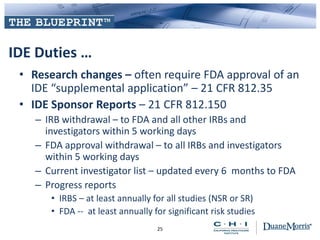
• Research changes – often require FDA approval of an
IDE “supplemental application” – 21 CFR 812.35
• IDE Sponsor Reports – 21 CFR 812.150
– IRB withdrawal – to FDA and all other IRBs and
investigators within 5 working days
– FDA approval withdrawal – to all IRBs and investigators
within 5 working days
– Current investigator list – updated every 6 months to FDA
– Progress reports
• IRBS – at least annually for all studies (NSR or SR)
• FDA -- at least annually for significant risk studies
25
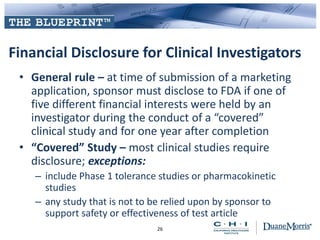
Financial Disclosure for Clinical Investigators
• General rule – at time of submission of a marketing
application, sponsor must disclose to FDA if one of
five different financial interests were held by an
investigator during the conduct of a “covered”
clinical study and for one year after completion
• “Covered” Study – most clinical studies require
disclosure; exceptions:
– include Phase 1 tolerance studies or pharmacokinetic
studies
– any study that is not to be relied upon by sponsor to
support safety or effectiveness of test article
26
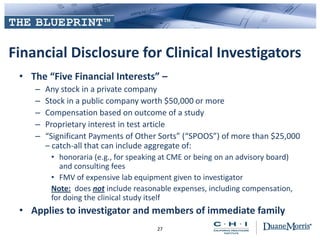
Financial Disclosure for Clinical Investigators
• The “Five Financial Interests” –
– Any stock in a private company
– Stock in a public company worth $50,000 or more
– Compensation based on outcome of a study
– Proprietary interest in test article
– “Significant Payments of Other Sorts” (“SPOOS”) of more than $25,000
– catch-all that can include aggregate of:
• honoraria (e.g., for speaking at CME or being on an advisory board)
and consulting fees
• FMV of expensive lab equipment given to investigator
Note: does not include reasonable expenses, including compensation,
for doing the clinical study itself
• Applies to investigator and members of immediate family
27
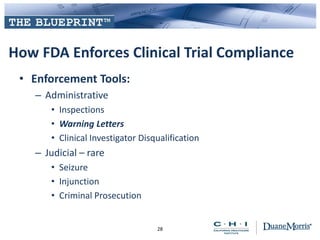
How FDA Enforces Clinical Trial Compliance
• Enforcement Tools:
– Administrative
• Inspections
• Warning Letters
• Clinical Investigator Disqualification
– Judicial – rare
• Seizure
• Injunction
• Criminal Prosecution
28
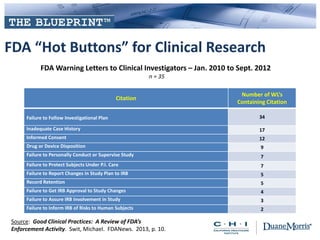
FDA “Hot Buttons” for Clinical Research
FDA Warning Letters to Clinical Investigators – Jan. 2010 to Sept. 2012
n = 35
Citation
Number of WL’s
Containing Citation
Failure to Follow Investigational Plan 34
Inadequate Case History 17
Informed Consent 12
Drug or Device Disposition 9
Failure to Personally Conduct or Supervise Study 7
Failure to Protect Subjects Under P.I. Care 7
Failure to Report Changes in Study Plan to IRB 5
Record Retention 5
Failure to Get IRB Approval to Study Changes 4
Failure to Assure IRB Involvement in Study 3
Failure to Inform IRB of Risks to Human Subjects 2
Source: Good Clinical Practices: A Review of FDA’s
Enforcement Activity. Swit, Michael. FDANews. 2013, p. 10.
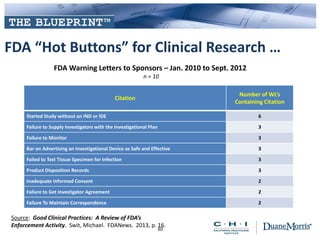
FDA “Hot Buttons” for Clinical Research …
FDA Warning Letters to Sponsors – Jan. 2010 to Sept. 2012
n = 10
Citation
Number of WL’s
Containing Citation
Started Study without an IND or IDE 6
Failure to Supply Investigators with the Investigational Plan 3
Failure to Monitor 3
Bar on Advertising an Investigational Device as Safe and Effective 3
Failed to Test Tissue Specimen for Infection 3
Product Disposition Records 3
Inadequate Informed Consent 2
Failure to Get Investigator Agreement 2
Failure To Maintain Correspondence 2
Source: Good Clinical Practices: A Review of FDA’s
Enforcement Activity. Swit, Michael. FDANews. 2013, p. 16.
30
Privacy and Clinical Trials –
The Role of HIPAA
31
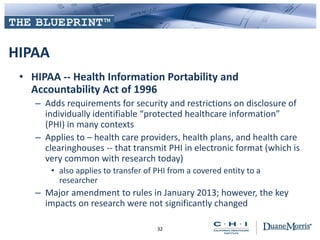
HIPAA
• HIPAA -- Health Information Portability and
Accountability Act of 1996
– Adds requirements for security and restrictions on disclosure of
individually identifiable “protected healthcare information”
(PHI) in many contexts
– Applies to – health care providers, health plans, and health care
clearinghouses -- that transmit PHI in electronic format (which is
very common with research today)
• also applies to transfer of PHI from a covered entity to a
researcher
– Major amendment to rules in January 2013; however, the key
impacts on research were not significantly changed
32
HIPAA …
• To disclose PHI, generally must have authorization
from subject
– Pre-2013 rule – authorization had to be separate from the
Informed Consent process
– Post-2013 rule – authorization can be incorporated into
the Informed Consent
– Note: pre-2013 rule separate authorizations for ongoing
studies are still valid
– Exception on combined authorizations – research involving
psychotherapy notes
33
HIPAA Authorizations -- Core Elements
• A description of the PHI to be used or disclosed, identifying the
information in a specific and meaningful manner.
• The names or other specific identification of the person or persons (or
class of persons) authorized to make the requested use or disclosure.
• The names or other specific identification of the person or persons (or
class of persons) to whom the covered entity may make the requested
use or disclosure.
• A description of each purpose of the requested use or disclosure.
• Authorization expiration date or expiration event that relates to the
individual or to the purpose of the use or disclosure ("end of the
research study" or "none" are permissible for research, including for the
creation and maintenance of a research database or repository).
• Signature of the individual and date.
– If the individual's legally authorized representative signs the Authorization, a
description of the representative's authority to act for the individual must also be
provided.
34
HIPAA Authorizations – Required Statements
• A statement of the individual's right to revoke his/her
Authorization
– how to do so, and,
– if applicable, the exceptions to the right to revoke his/her
Authorization or reference to the corresponding section of the
covered entity's notice of privacy practices.
• Whether treatment, payment, enrollment, or eligibility of
benefits can be conditioned on Authorization, including
research-related treatment and consequences of refusing to
sign the Authorization, if applicable.
• A statement of the potential risk that PHI will be re-disclosed
by the recipient. This may be a general statement that the
Privacy Rule may no longer protect health information
disclosed to the recipient.
35
HIPAA – Disclosure Without Authorization
• IRB or Privacy Board Authorization:
– A covered entity may use or disclose protected health
information for research purposes pursuant to a waiver of
authorization by an IRB or Privacy Board; waiver must reflect
that detailed requirements are satisfied that minimizes the risk
of privacy invasion to the subject and ensures that a plan exists
to prevent misuse of identifiable information
• Preparatory to research – e.g., to help prepare a
protocol
• “Limited Datasets” – per a detailed agreement between
covered entity and researcher
36
A Few Practical Considerations
For Clinical Trials
37
Clinical Trial Execution
• Unfortunate, But Often Accurate Generalization --
failure to design and execute study properly too often
characterizes clinical studies at both small and even
large companies
• Inadequate Toxicology Review Prior to Phase I – use
an outside set of eyes if you can
38
Clinical Trials …
• Poor Design Issues:
– Result -- leads to protocol violations, deviations and half
effective amendments.
– Consequence of deviations, violations -- study “mutates”
–
• progress and treatment of first patient barely resembles last
patient -- study population no longer homogeneous
• Final Mutation -- heterogeneous population defies statistical
analysis
39
Clinical Trials …
• Primary Efficacy Endpoints
– Must do adequate Phase 2 studies…dose, dosing
regimens, etc. so that you aren’t second guessing the
appropriate dose in Phase 3
– Be Sure Endpoint Is Validated And Acceptable to FDA
• this includes Phase 2b studies
• Involve Statisticians In Clinical Design
– Don’t Delay Until Problem Occurs
– Can Help Define The Study Design At The Correct Stage --
speeds clinical development process
40
Clinical Trials …
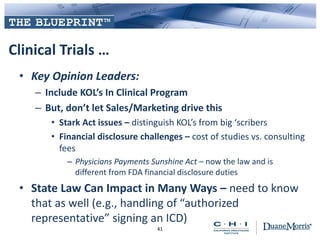
• Key Opinion Leaders:
– Include KOL’s In Clinical Program
– But, don’t let Sales/Marketing drive this
• Stark Act issues – distinguish KOL’s from big ‘scribers
• Financial disclosure challenges – cost of studies vs. consulting
fees
– Physicians Payments Sunshine Act – now the law and is
different from FDA financial disclosure duties
• State Law Can Impact in Many Ways – need to know
that as well (e.g., handling of “authorized
representative” signing an ICD)
41
QUESTIONS???
42
Follow-Up
• If you wish to receive a copy of the slide deck,
please e-mail me at maswit@duanemorris.com
• The audio recording will be available following the
completion of the series on both the Duane Morris
website, and the CHI website
43
THANK YOU!
Michael A. Swit
Special Counsel, FDA Law Practice
Duane Morris LLP
maswit@duanemorris.com
(619) 744-2215
44

Clinical Trials: Regulatory & Privacy Issues

  • 1.
    Clinical Trials: Regulatory& Privacy Issues Presented by Michael A. Swit Special Counsel, FDA Law, Duane Morris LLP
  • 2.
    DISCLAIMERS • This outlineis intended to support an oral briefing and should not be relied upon solely to support any conclusion of fact or law. • The views reflected in this presentation are solely those of the presenter and do not necessarily reflect the position of my firm, any of our clients, or any of my friends and colleagues that contributed their thoughts to this presentation. • This webinar and outline are intended to provide general educational insights and not as a substitute for formal legal advice. 2
  • 3.
    What We WillCover on Clinical Trials • FDA Requirements • Privacy Issues and HIPAA • Practical Considerations 3
  • 4.
    Key FDA Requirementsfor Clinical Trials 4
  • 5.
    Basic Considerations • DoI need FDA’s “blessing” before I start a clinical study? – INDs – drugs/biologics -- and IDEs – When needed? • What duties do I owe the subjects? – Human Subject Protection • Informed Consent • IRB Prior Review of Clinical Research • What Duties do I owe FDA? – Running the study correctly and maintaining IND properly to ensure: • Reporting and Recordkeeping basics • Human Subject Protection • Data Integrity – Financial Disclosure 5
  • 6.
    When FDA PriorReview of a Study is Needed • Drugs – – it is illegal to introduce an unapproved drug (or an unlicensed biologic) into commerce for a clinical study unless an Investigational New Drug exemption (IND) is effective (or not required) – IND regulations – 21 CFR Part 312 • Devices – a device that otherwise would require an approved Premarket Approval Application (PMA) or cleared premarket notification [510(k)] can be shipped lawfully if to be studied in an investigation to show safety or effectiveness if an Investigational Device Exemption (IDE) is approved or the study is exempt – IDE regulations – 21 CFR Part 812 6
  • 7.
    Drugs/Biologics – Whenis an IND Required? • Unapproved drugs – any clinical investigation in humans will require an effective IND – Note: INDs are not “approved” – notwithstanding what press releases say 7
  • 8.
    Drugs/Biologics -- Whenis an IND required …? • Studies of approved drugs – no IND needed if all these apply: – won’t be reported to FDA to support a new indication or major labeling change – if an Rx drug, the study is not intended to support a major advertising change (e.g., a comparative study) – study does not involve a change in the drug (e.g., dosage, route of administration, patient population) that increases the risks associated with the use of the drug – informed consent and IRB approval required – can’t promote the drug as safe or effective for what it is being studied for in the clinical trial (21 CFR 312.7) 8
  • 9.
    Devices – Whenis an IDE is Needed? • Key Definitions – “Investigational device” -- 21 CFR 812.3(g) -- means a device that is the object of an investigation. – “Significant risk” – 21 CFR 812.3(m) – means an investigational device that is: • intended as an implant and presents a potential for serious risk to the health, safety, or welfare of a subject; • purported or represented to be for a use in supporting or sustaining human life and presents a potential for serious risk to the health, safety, or welfare of a subject; • for a use of substantial importance in diagnosing, curing, mitigating, or treating disease, or otherwise preventing impairment of human health and presents a potential for serious risk to the health, safety, or welfare of a subject; or • Otherwise presents a potential for serious risk to the health, safety, or welfare of a subject. 9
  • 10.
    Devices – Whenis an IDE Needed …? • “Non-significant risk” – NSR -- no affirmative IDE approval needed – deemed to have an IDE unless notified by FDA to contrary -- if: – labeled as investigational – gets IRB concurrence that it is NSR – informed consent obtained – sponsor properly monitors investigations – sponsor maintains many of the records and makes designated reports required of an IDE under Part 812 – follows restrictions on promotion of an investigational device 10
  • 11.
    Devices – Whenis an IDE Needed …? • “Exempt Investigations” – NSR – IDE rules, except for 812.119 (Disqualification of an Investigator), do not apply to: – pre-’76 devices if studied per its pre-’76 labeled indications – device subject to a cleared 510(k) if studied for its cleared indications – device undergoing consumer preference testing, testing of a modification, or testing of a combination of two or more commercial devices if: • testing not to determine safety or effectiveness; and • does not put patients at risk 11
  • 12.
    Devices – Whenis an IDE Needed …? • “Exempt Investigations” – – Diagnostic testing, if labeled per 2 CFR 809.10(c) and testing is: • noninvasive • does not require an invasive sampling that presents significant risk • does not by design or intention introduce energy into a subject, and • Is not used as a diagnostic procedure without confirmation of the diagnosis by another, medically established diagnostic product or procedure – 809.10(c) – "For Investigational Use Only. The performance characteristics of this product have not been established." 12
  • 13.
    What’s In anIND? • Format – “Common Technical Document” (CTD) format established by International Conference on Harmonization (ICH) – • 21 CFR 312.23 -- Very detailed requirements – – Protocol – Investigator’s Brochure – Labeling of investigational drug – Pharmacology and Tox studies that support safe use of drug – Chemistry, Manufacturing and Controls – amount varies by study phase – Previous human experience (e.g., in Europe) 13
  • 14.
    What’s In anIDE? • 21 CFR 812.20(b) -- Very detailed requirements – – All written information to be given to subjects, including informed consent forms – Complete “investigational plan” – protocol, monitoring plan, risk analysis to subjects, device description – Investigator’s agreements – List of IRBs involved – Labeling – Complete description of the methods, facilities and controls used to make (and install, if applicable) the device – Reports of prior investigations – “Any other relevant information FDA requests …” 14
  • 15.
    Human Subject ProtectionDuties • Informed Consent – 21 CFR Part 50 – Required for virtually all investigations – Exceptions: • Life Saving Use -- where test article is regarded by investigator as potentially life saving and no alternative therapy is available • Emergency Use – similar to “Life Saving,” but is for scenario where the research program as a whole is aimed at emergency medical care and obtaining informed consent will not be practical 15
  • 16.
    Human Subject ProtectionDuties … • Informed Consent – Key Elements – The study involves research, an explanation of the purposes of the research and the expected duration of the subject's participation, a description of the procedures to be followed, and identification of any procedures which are experimental. – Reasonably foreseeable risks or discomforts to the subject. – Any benefits to the subject or to others which may reasonably be expected from the research. – Disclosure of appropriate alternative procedures or courses of treatment, if any, that might be advantageous to the subject. – Statement whether and to what extent records identifying the subject will be kept confidential and that notes the possibility that the Food and Drug Administration may inspect the records. 16
  • 17.
    Human Subject ProtectionDuties … • Informed Consent – Key Elements … – For research involving more than minimal risk, an explanation as to whether any compensation and an explanation as to whether any medical treatments are available if injury occurs and, if so, what they consist of, or where further information may be obtained – Subject Compensation – Whom to contact for answers to pertinent questions about the research and research subjects' rights, and whom to contact in the event of a research-related injury to the subject. – A statement that participation is voluntary, that refusal to participate will involve no penalty or loss of benefits to which the subject is otherwise entitled, and that the subject may discontinue participation at any time without penalty or loss of benefits to which the subject is otherwise entitled. 17
  • 18.
    Human Subject ProtectionDuties … • Informed Consent – Other Key Concerns: – Informed consent is a process – not just signing a form – Cannot include any language that could be regarded as exculpatory as to anyone involved in the research (sponsor, investigator, IRB, etc.) – Language • must be understandable to lay reader – General rule (although not set in stone) – 8th grade reading level • must be in language of subject – needs verified translation if foreign language used and IFC “process” must be translated – “Authorized Representatives” – be sure you have the right one 18
  • 19.
    Human Subject ProtectionDuties … • Institutional Review Board (IRB) Oversight – 21 CFR Part 56 – Cannot initiative a clinical investigation unless the study has been reviewed and approved by an IRB – Exceptions: • Emergency use – provided the use is reported to an IRB within 5 day; thereafter, use of the test article at that same institution is subject to IRB review (and approval) • “Taste and food quality evaluations” and “consumer acceptance studies” of food 19
  • 20.
    Human Subject ProtectionDuties … • Institutional Review Board (IRB) Oversight – 21 CFR Part 56 … – Key Functions • Initial review, including informed consent • Continuing review – at least annually; IRB can decide to do more often if risk of investigation dictates 20
  • 21.
    What Duties DoI Owe FDA During a Study? • IND “Maintenance” – Protocol amendments – 21 CFR 312.30 • New or changed protocols or new investigators • Changed protocols require IRB approval before can go forward – Information amendments – 21 CFR 312.31 • new tox, chemistry or other technical information • discontinuance of a study 21
  • 22.
    IND Duties … •IND “Maintenance” – IND Safety Reports – 21 CFR 312.33 • includes “suspected” adverse events as well – “suspected” means reasonable possibility drug caused the event • “serious” -- death, a life-threatening adverse event, inpatient hospitalization or prolongation of existing hospitalization, a persistent or significant incapacity or substantial disruption of the ability to conduct normal life functions, or a congenital anomaly/birth defect. • Serious or suspected serious events – reported to FDA and all investigators in study as soon as possible and no later than 15 days 22
  • 23.
    IND Duties … •IND “Maintenance” – Annual Reports – 21 CFR 312.33 – within 60 days of anniversary of the IND being effective • IND Operations – Sponsor Duties – pick qualified investigators – monitor conduct of study – ensure investigational plan is followed – Using CRO – acceptable, but you have to specifically detail what duties are delegated to the CRO – but can say “all” • practically – you have to make sure the CRO does its job 23
  • 24.
    IDE Duties • IDEDuties – similar to IND – Monitoring, selecting qualified investigators – Ensuring investigators have info they need to do the study – Ensuring IRB approval and review (not specifically in IND regulations) • IDE Duties – differing from IND – Adverse events – less detailed, but broader: • “unanticipated adverse device event” (UADE) – must be evaluated “immediately” • if sponsor determines that the UADE poses “unreasonable risk to subject,” sponsor shall terminate that aspect of the study no later than 5 days after determining the UADE poses an unreasonable risk and no later than 15 days after getting notice of the UADE – must report to FDA and investigators in study within 10 working days of getting notice of UADE 24
  • 25.
    IDE Duties … •Research changes – often require FDA approval of an IDE “supplemental application” – 21 CFR 812.35 • IDE Sponsor Reports – 21 CFR 812.150 – IRB withdrawal – to FDA and all other IRBs and investigators within 5 working days – FDA approval withdrawal – to all IRBs and investigators within 5 working days – Current investigator list – updated every 6 months to FDA – Progress reports • IRBS – at least annually for all studies (NSR or SR) • FDA -- at least annually for significant risk studies 25
  • 26.
    Financial Disclosure forClinical Investigators • General rule – at time of submission of a marketing application, sponsor must disclose to FDA if one of five different financial interests were held by an investigator during the conduct of a “covered” clinical study and for one year after completion • “Covered” Study – most clinical studies require disclosure; exceptions: – include Phase 1 tolerance studies or pharmacokinetic studies – any study that is not to be relied upon by sponsor to support safety or effectiveness of test article 26
  • 27.
    Financial Disclosure forClinical Investigators • The “Five Financial Interests” – – Any stock in a private company – Stock in a public company worth $50,000 or more – Compensation based on outcome of a study – Proprietary interest in test article – “Significant Payments of Other Sorts” (“SPOOS”) of more than $25,000 – catch-all that can include aggregate of: • honoraria (e.g., for speaking at CME or being on an advisory board) and consulting fees • FMV of expensive lab equipment given to investigator Note: does not include reasonable expenses, including compensation, for doing the clinical study itself • Applies to investigator and members of immediate family 27
  • 28.
    How FDA EnforcesClinical Trial Compliance • Enforcement Tools: – Administrative • Inspections • Warning Letters • Clinical Investigator Disqualification – Judicial – rare • Seizure • Injunction • Criminal Prosecution 28
  • 29.
    FDA “Hot Buttons”for Clinical Research FDA Warning Letters to Clinical Investigators – Jan. 2010 to Sept. 2012 n = 35 Citation Number of WL’s Containing Citation Failure to Follow Investigational Plan 34 Inadequate Case History 17 Informed Consent 12 Drug or Device Disposition 9 Failure to Personally Conduct or Supervise Study 7 Failure to Protect Subjects Under P.I. Care 7 Failure to Report Changes in Study Plan to IRB 5 Record Retention 5 Failure to Get IRB Approval to Study Changes 4 Failure to Assure IRB Involvement in Study 3 Failure to Inform IRB of Risks to Human Subjects 2 Source: Good Clinical Practices: A Review of FDA’s Enforcement Activity. Swit, Michael. FDANews. 2013, p. 10.
  • 30.
    FDA “Hot Buttons”for Clinical Research … FDA Warning Letters to Sponsors – Jan. 2010 to Sept. 2012 n = 10 Citation Number of WL’s Containing Citation Started Study without an IND or IDE 6 Failure to Supply Investigators with the Investigational Plan 3 Failure to Monitor 3 Bar on Advertising an Investigational Device as Safe and Effective 3 Failed to Test Tissue Specimen for Infection 3 Product Disposition Records 3 Inadequate Informed Consent 2 Failure to Get Investigator Agreement 2 Failure To Maintain Correspondence 2 Source: Good Clinical Practices: A Review of FDA’s Enforcement Activity. Swit, Michael. FDANews. 2013, p. 16. 30
  • 31.
    Privacy and ClinicalTrials – The Role of HIPAA 31
  • 32.
    HIPAA • HIPAA --Health Information Portability and Accountability Act of 1996 – Adds requirements for security and restrictions on disclosure of individually identifiable “protected healthcare information” (PHI) in many contexts – Applies to – health care providers, health plans, and health care clearinghouses -- that transmit PHI in electronic format (which is very common with research today) • also applies to transfer of PHI from a covered entity to a researcher – Major amendment to rules in January 2013; however, the key impacts on research were not significantly changed 32
  • 33.
    HIPAA … • Todisclose PHI, generally must have authorization from subject – Pre-2013 rule – authorization had to be separate from the Informed Consent process – Post-2013 rule – authorization can be incorporated into the Informed Consent – Note: pre-2013 rule separate authorizations for ongoing studies are still valid – Exception on combined authorizations – research involving psychotherapy notes 33
  • 34.
    HIPAA Authorizations --Core Elements • A description of the PHI to be used or disclosed, identifying the information in a specific and meaningful manner. • The names or other specific identification of the person or persons (or class of persons) authorized to make the requested use or disclosure. • The names or other specific identification of the person or persons (or class of persons) to whom the covered entity may make the requested use or disclosure. • A description of each purpose of the requested use or disclosure. • Authorization expiration date or expiration event that relates to the individual or to the purpose of the use or disclosure ("end of the research study" or "none" are permissible for research, including for the creation and maintenance of a research database or repository). • Signature of the individual and date. – If the individual's legally authorized representative signs the Authorization, a description of the representative's authority to act for the individual must also be provided. 34
  • 35.
    HIPAA Authorizations –Required Statements • A statement of the individual's right to revoke his/her Authorization – how to do so, and, – if applicable, the exceptions to the right to revoke his/her Authorization or reference to the corresponding section of the covered entity's notice of privacy practices. • Whether treatment, payment, enrollment, or eligibility of benefits can be conditioned on Authorization, including research-related treatment and consequences of refusing to sign the Authorization, if applicable. • A statement of the potential risk that PHI will be re-disclosed by the recipient. This may be a general statement that the Privacy Rule may no longer protect health information disclosed to the recipient. 35
  • 36.
    HIPAA – DisclosureWithout Authorization • IRB or Privacy Board Authorization: – A covered entity may use or disclose protected health information for research purposes pursuant to a waiver of authorization by an IRB or Privacy Board; waiver must reflect that detailed requirements are satisfied that minimizes the risk of privacy invasion to the subject and ensures that a plan exists to prevent misuse of identifiable information • Preparatory to research – e.g., to help prepare a protocol • “Limited Datasets” – per a detailed agreement between covered entity and researcher 36
  • 37.
    A Few PracticalConsiderations For Clinical Trials 37
  • 38.
    Clinical Trial Execution •Unfortunate, But Often Accurate Generalization -- failure to design and execute study properly too often characterizes clinical studies at both small and even large companies • Inadequate Toxicology Review Prior to Phase I – use an outside set of eyes if you can 38
  • 39.
    Clinical Trials … •Poor Design Issues: – Result -- leads to protocol violations, deviations and half effective amendments. – Consequence of deviations, violations -- study “mutates” – • progress and treatment of first patient barely resembles last patient -- study population no longer homogeneous • Final Mutation -- heterogeneous population defies statistical analysis 39
  • 40.
    Clinical Trials … •Primary Efficacy Endpoints – Must do adequate Phase 2 studies…dose, dosing regimens, etc. so that you aren’t second guessing the appropriate dose in Phase 3 – Be Sure Endpoint Is Validated And Acceptable to FDA • this includes Phase 2b studies • Involve Statisticians In Clinical Design – Don’t Delay Until Problem Occurs – Can Help Define The Study Design At The Correct Stage -- speeds clinical development process 40
  • 41.
    Clinical Trials … •Key Opinion Leaders: – Include KOL’s In Clinical Program – But, don’t let Sales/Marketing drive this • Stark Act issues – distinguish KOL’s from big ‘scribers • Financial disclosure challenges – cost of studies vs. consulting fees – Physicians Payments Sunshine Act – now the law and is different from FDA financial disclosure duties • State Law Can Impact in Many Ways – need to know that as well (e.g., handling of “authorized representative” signing an ICD) 41
  • 42.
  • 43.
    Follow-Up • If youwish to receive a copy of the slide deck, please e-mail me at maswit@duanemorris.com • The audio recording will be available following the completion of the series on both the Duane Morris website, and the CHI website 43
  • 44.
    THANK YOU! Michael A.Swit Special Counsel, FDA Law Practice Duane Morris LLP maswit@duanemorris.com (619) 744-2215 44