Quality Considerations
in Due Diligence for
Pharmaceutical Transactions
Michael A. Swit
Vice President
The Weinberg Group Inc.
Disclaimer
• The views and opinions expressed in the following PowerPoint slides
are those of the individual presenter and should not be attributed to his
firm, any of his firm’s clients, or the Drug Information Association, Inc.
(“DIA”), its directors, officers, employees, volunteers, members,
chapters, councils, Special Interest Area Communities or affiliates, or
any organization with which the presenter is affiliated.
• These slides are the intellectual property of the individual presenter and
are protected under the copyright laws of the United States of America
and other countries. Used by permission. All rights reserved. Drug
Information Association, Drug Information Association Inc., DIA and DIA
logo are registered trademarks. All other trademarks are the property of
their respective owners.
• These slides support an oral briefing and should not be relied upon
solely to support any conclusion of law or fact.
2
What We Will Cover
• General Considerations
• Why Quality Matters
• What Problems to Look For
• How to Find Problems
• Special Considerations
• Helpful Charts/Forms
3
General Considerations
4
The Challenge of Due Diligence
• Less Data -- evaluating someone else’s product is
performed with less information, but the
expectations are the same
• Less Time – assessing in 4 to 8 weeks what the
other firm took 4 to 8 years to develop
• Depth of diligence – varies with deal complexity
– Product
– Deal Structure
• Due diligence -- both art and science
5
Due Diligence Structure
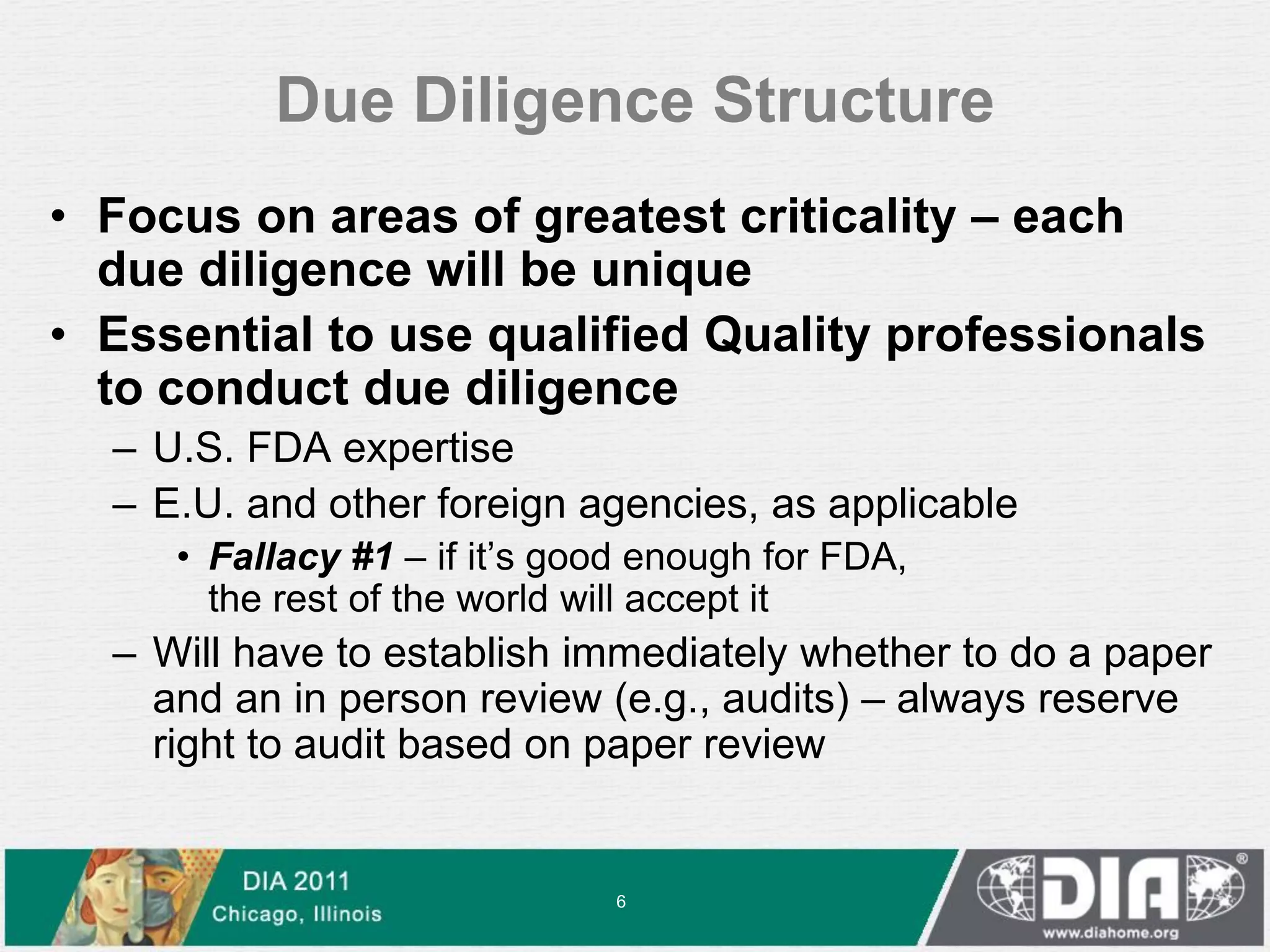
• Focus on areas of greatest criticality – each
due diligence will be unique
• Essential to use qualified Quality professionals
to conduct due diligence
– U.S. FDA expertise
– E.U. and other foreign agencies, as applicable
• Fallacy #1 – if it’s good enough for FDA,
the rest of the world will accept it
– Will have to establish immediately whether to do a paper
and an in person review (e.g., audits) – always reserve
right to audit based on paper review
6
Why Quality Matters
7
Why Quality Matters
• A drug or biologic (D/B) made in a facility that does
not comply with the D/B Good Manufacturing
Practices (GMP) in 21 CFR Part 211 -- is
adulterated under §501(a) of the Federal Food,
Drug, and Cosmetic Act (“the Act”) – even if the
drug is perfectly good
• Shipping an adulterated D/B or causing the
adulteration of a D/B is a “prohibited act” under
Section 301 of the Act
8
Why Quality Matters
• Key consequences of committing a “prohibited
act” under §301:
– Criminal Prosecution
– Injunctions (and consent decrees)
– Seizure
– Civil Penalties
– Debarment (in some cases)
– Disqualification from federal health programs (in some
cases)
– FDA inspections/warning letters
9
What Problems to Look For
10
Manufacturing
• How will the product be supplied or
manufactured?
– Can I make it
– Does any part of manufacturing need to be outsourced?
• What are the implications?
• How much will it cost?
– Are there any particularly sensitive systems involved that
deserve special attention such as:
• Aseptic processing
• Bioreactors
11
Pharmacovigilance
• Ensure AE handling system being properly
handled
– Timeliness
– How medical judgments implemented
• Review hot buttons
– Products with narrow therapeutic ranges
– Products with REMS in place, especially those with black
box warnings
12
History of Compliance
• Does the target have a history of issues with
FDA relating to quality?
– Inspections – 483s
– Warning Letters
– Official action -- consent decrees, injunctions, seizures,
criminal prosecutions
• Assess company responses
– Did they hear FDA’s “D.R.U.M.?”
• Direct, Related, Universal, Monitoring and Management
– Any continued duties?
13
FDA Inspectional History
• When did FDA last inspect?
• How many inspections over five years?
– For cause (e.g., recalls, complaints, AEs)
– Routine
• What is relationship with FDA District Office
• If 483s, are responses great, good or “oh no”
Audits
• Does firm have an internal audit procedure
– Ensure it was followed
– Review reports
• Has the firm had audits commissioned outside
experts to audit its operations?
• Has the firm been the subject of a third-party
audit (e.g., a partner or customer)?
How to Probe
16
Diligence Techniques
• Review FDA “correspondence”
– 483’s
• Company responses
– Warning letters
• Company responses
• Assure yourself that problems have been
corrected
– If necessary, audit the facility to confirm (at least
selected key issues)
17
Diligence Techniques …
• Verify if any litigation exists that raises quality
concerns (e.g., personal injury suits alleging
injury or illness from a defectively-made drug)
– Ask if any exist
– Review complaints/answers if any exist for allegations of
defective operational practices that might have escaped
FDA’s eyes
18
19
Special Considerations
Phase-Specific Concerns
• Phase III to Commercial
– Scale-up validated?
• FDA won’t approve product if commercial scale does not
relate to clinical study supply
– Formulation changes documented and validated?
– Contract labs – did they meet GLP?
• Example: MDS Montreal – out of compliance; 100s of
studies compromised that needed audits
– Contract manufacturers – GMP compliant?
20
Deals Impacted by FDA Quality Issues
• Alza/Abbott – the buyer’s (Abbott) quality issues,
revealed after deal announced, cut share price,
sinking deal based substantially on stock exchange
• Daichii Sankyo/Ranbaxy
– GMP issues at two facilities in India
– Import Alerts
– Application Integrity Program (AIP)
21
A Couple Helpful Charts/Forms
22
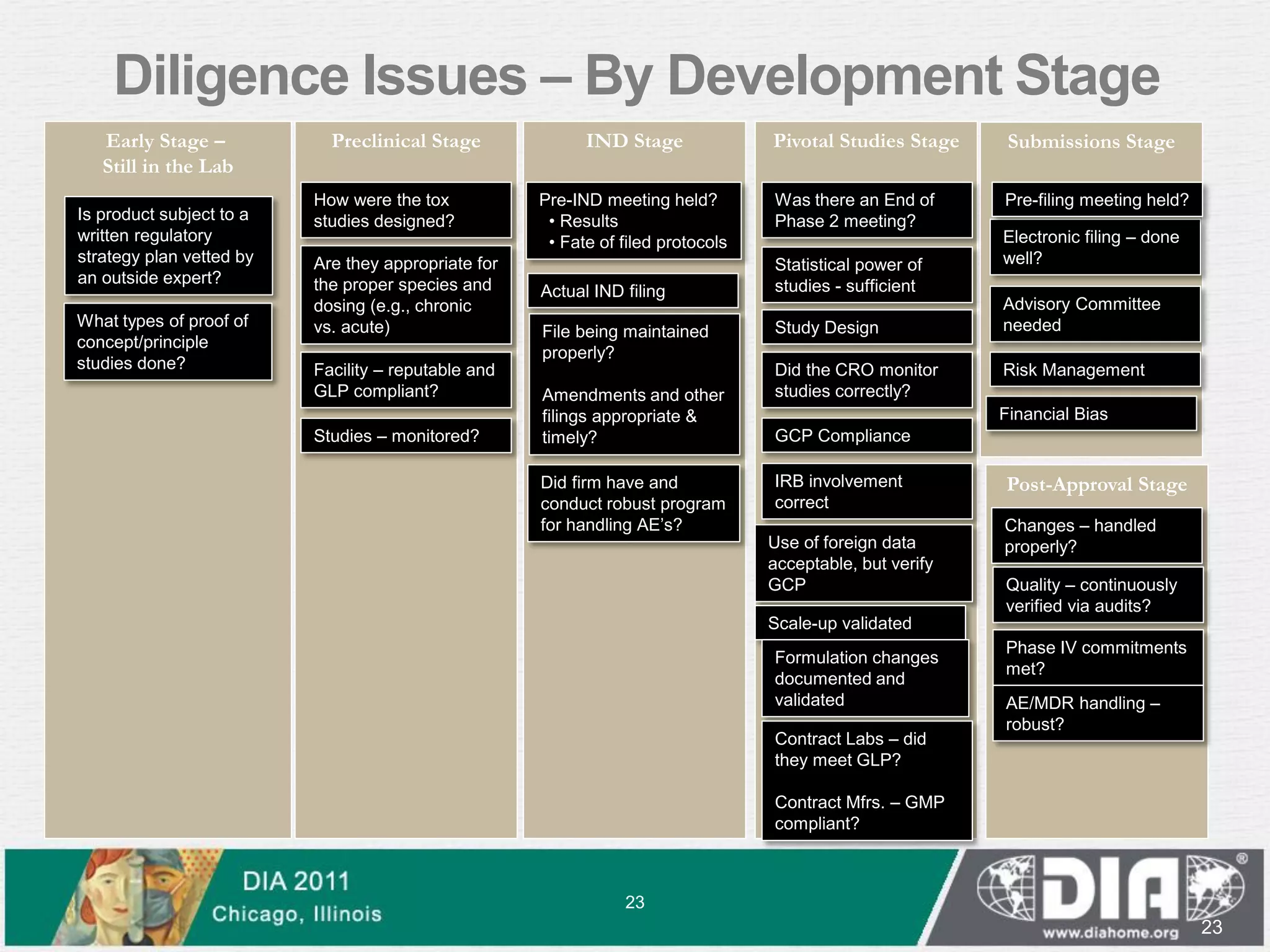
Diligence Issues – By Development Stage
Early Stage –
Still in the Lab
Preclinical Stage Pivotal Studies StageIND Stage Submissions Stage
Is product subject to a
written regulatory
strategy plan vetted by
an outside expert?
How were the tox
studies designed?
23
What types of proof of
concept/principle
studies done?
Are they appropriate for
the proper species and
dosing (e.g., chronic
vs. acute)
Facility – reputable and
GLP compliant?
Studies – monitored?
Pre-IND meeting held?
• Results
• Fate of filed protocols
Actual IND filing
File being maintained
properly?
Amendments and other
filings appropriate &
timely?
Did firm have and
conduct robust program
for handling AE’s?
Was there an End of
Phase 2 meeting?
Statistical power of
studies - sufficient
Study Design
Did the CRO monitor
studies correctly?
GCP Compliance
IRB involvement
correct
Use of foreign data
acceptable, but verify
GCP
Scale-up validated
Formulation changes
documented and
validated
Contract Labs – did
they meet GLP?
Contract Mfrs. – GMP
compliant?
Electronic filing – done
well?
Advisory Committee
needed
Risk Management
Financial Bias
Post-Approval Stage
Changes – handled
properly?
Quality – continuously
verified via audits?
Phase IV commitments
met?
AE/MDR handling –
robust?
23
Pre-filing meeting held?
How to Analyze Identified Diligence Issues
24
Call, e-mail, fax or write:
Michael A. Swit, Esq.
Vice President
The Weinberg Group Inc.
1422 Caminito Septimo
Cardiff by the Sea, CA 92007
Phone 760.452.6568
Fax 760.454.2979
Cell 760.815.4762
michael.swit@weinberggroup.com
www.weinberggroup.com
Questions?
25
About the speaker …
Michael A. Swit, Esq., who is a Vice President at THE WEINBERG GROUP INC., has extensive experience in all aspects of
FDA regulation with a particular emphasis on drugs and medical device regulation.
In addition to his private legal and consulting experience, Mr. Swit also served for three and a half years as vice president and
general counsel of Pharmaceutical Resources, Inc. (PRI) a prominent generic drug company and, thus, brings an industry and
commercial perspective to his representation of FDA-regulated companies. While at PRI from 1990 to late 1993, Mr. Swit
spearheaded the company’s defense of multiple grand jury investigations, other federal and state proceedings, and securities
litigation stemming from the acts of prior management.
Mr. Swit then served from 1994 to 1998 as CEO of Washington Business Information, Inc. (WBII) a premier publisher of FDA
regulatory newsletters and other specialty information products for the FDA publishing company. Before joining THE
WEINBERG GROUP, he served in the FDA Regulatory Law Practices at both Heller Ehrman and McKenna & Cuneo, first in
that firm’s D.C. office and then in its San Diego office. He first practiced FDA regulatory law with the D.C. office of Burditt &
Radzius from 1984 to 1988.
Mr. Swit has taught and written on a wide variety of subjects relating to FDA law including, since 1989, co-directing a three-day
intensive course on the generic drug approval process, serving on the Editorial Board of the Food & Drug Law Journal, and
editing a guide to the generic drug approval process, Getting Your Generic Drug Approved, published by WBII. Mr. Swit holds
an A.B., magna cum laude, with high honors in history, in 1979, from Bowdoin College, and earned his law degree from Emory
University in 1982. He is a member of the California, Virginia and District of Columbia bars.
26

Quality Considerations in Due Diligence for Pharmaceutical Transactions

  • 1.
    Quality Considerations in DueDiligence for Pharmaceutical Transactions Michael A. Swit Vice President The Weinberg Group Inc.
  • 2.
    Disclaimer • The viewsand opinions expressed in the following PowerPoint slides are those of the individual presenter and should not be attributed to his firm, any of his firm’s clients, or the Drug Information Association, Inc. (“DIA”), its directors, officers, employees, volunteers, members, chapters, councils, Special Interest Area Communities or affiliates, or any organization with which the presenter is affiliated. • These slides are the intellectual property of the individual presenter and are protected under the copyright laws of the United States of America and other countries. Used by permission. All rights reserved. Drug Information Association, Drug Information Association Inc., DIA and DIA logo are registered trademarks. All other trademarks are the property of their respective owners. • These slides support an oral briefing and should not be relied upon solely to support any conclusion of law or fact. 2
  • 3.
    What We WillCover • General Considerations • Why Quality Matters • What Problems to Look For • How to Find Problems • Special Considerations • Helpful Charts/Forms 3
  • 4.
  • 5.
    The Challenge ofDue Diligence • Less Data -- evaluating someone else’s product is performed with less information, but the expectations are the same • Less Time – assessing in 4 to 8 weeks what the other firm took 4 to 8 years to develop • Depth of diligence – varies with deal complexity – Product – Deal Structure • Due diligence -- both art and science 5
  • 6.
    Due Diligence Structure •Focus on areas of greatest criticality – each due diligence will be unique • Essential to use qualified Quality professionals to conduct due diligence – U.S. FDA expertise – E.U. and other foreign agencies, as applicable • Fallacy #1 – if it’s good enough for FDA, the rest of the world will accept it – Will have to establish immediately whether to do a paper and an in person review (e.g., audits) – always reserve right to audit based on paper review 6
  • 7.
  • 8.
    Why Quality Matters •A drug or biologic (D/B) made in a facility that does not comply with the D/B Good Manufacturing Practices (GMP) in 21 CFR Part 211 -- is adulterated under §501(a) of the Federal Food, Drug, and Cosmetic Act (“the Act”) – even if the drug is perfectly good • Shipping an adulterated D/B or causing the adulteration of a D/B is a “prohibited act” under Section 301 of the Act 8
  • 9.
    Why Quality Matters •Key consequences of committing a “prohibited act” under §301: – Criminal Prosecution – Injunctions (and consent decrees) – Seizure – Civil Penalties – Debarment (in some cases) – Disqualification from federal health programs (in some cases) – FDA inspections/warning letters 9
  • 10.
    What Problems toLook For 10
  • 11.
    Manufacturing • How willthe product be supplied or manufactured? – Can I make it – Does any part of manufacturing need to be outsourced? • What are the implications? • How much will it cost? – Are there any particularly sensitive systems involved that deserve special attention such as: • Aseptic processing • Bioreactors 11
  • 12.
    Pharmacovigilance • Ensure AEhandling system being properly handled – Timeliness – How medical judgments implemented • Review hot buttons – Products with narrow therapeutic ranges – Products with REMS in place, especially those with black box warnings 12
  • 13.
    History of Compliance •Does the target have a history of issues with FDA relating to quality? – Inspections – 483s – Warning Letters – Official action -- consent decrees, injunctions, seizures, criminal prosecutions • Assess company responses – Did they hear FDA’s “D.R.U.M.?” • Direct, Related, Universal, Monitoring and Management – Any continued duties? 13
  • 14.
    FDA Inspectional History •When did FDA last inspect? • How many inspections over five years? – For cause (e.g., recalls, complaints, AEs) – Routine • What is relationship with FDA District Office • If 483s, are responses great, good or “oh no”
  • 15.
    Audits • Does firmhave an internal audit procedure – Ensure it was followed – Review reports • Has the firm had audits commissioned outside experts to audit its operations? • Has the firm been the subject of a third-party audit (e.g., a partner or customer)?
  • 16.
  • 17.
    Diligence Techniques • ReviewFDA “correspondence” – 483’s • Company responses – Warning letters • Company responses • Assure yourself that problems have been corrected – If necessary, audit the facility to confirm (at least selected key issues) 17
  • 18.
    Diligence Techniques … •Verify if any litigation exists that raises quality concerns (e.g., personal injury suits alleging injury or illness from a defectively-made drug) – Ask if any exist – Review complaints/answers if any exist for allegations of defective operational practices that might have escaped FDA’s eyes 18
  • 19.
  • 20.
    Phase-Specific Concerns • PhaseIII to Commercial – Scale-up validated? • FDA won’t approve product if commercial scale does not relate to clinical study supply – Formulation changes documented and validated? – Contract labs – did they meet GLP? • Example: MDS Montreal – out of compliance; 100s of studies compromised that needed audits – Contract manufacturers – GMP compliant? 20
  • 21.
    Deals Impacted byFDA Quality Issues • Alza/Abbott – the buyer’s (Abbott) quality issues, revealed after deal announced, cut share price, sinking deal based substantially on stock exchange • Daichii Sankyo/Ranbaxy – GMP issues at two facilities in India – Import Alerts – Application Integrity Program (AIP) 21
  • 22.
    A Couple HelpfulCharts/Forms 22
  • 23.
    Diligence Issues –By Development Stage Early Stage – Still in the Lab Preclinical Stage Pivotal Studies StageIND Stage Submissions Stage Is product subject to a written regulatory strategy plan vetted by an outside expert? How were the tox studies designed? 23 What types of proof of concept/principle studies done? Are they appropriate for the proper species and dosing (e.g., chronic vs. acute) Facility – reputable and GLP compliant? Studies – monitored? Pre-IND meeting held? • Results • Fate of filed protocols Actual IND filing File being maintained properly? Amendments and other filings appropriate & timely? Did firm have and conduct robust program for handling AE’s? Was there an End of Phase 2 meeting? Statistical power of studies - sufficient Study Design Did the CRO monitor studies correctly? GCP Compliance IRB involvement correct Use of foreign data acceptable, but verify GCP Scale-up validated Formulation changes documented and validated Contract Labs – did they meet GLP? Contract Mfrs. – GMP compliant? Electronic filing – done well? Advisory Committee needed Risk Management Financial Bias Post-Approval Stage Changes – handled properly? Quality – continuously verified via audits? Phase IV commitments met? AE/MDR handling – robust? 23 Pre-filing meeting held?
  • 24.
    How to AnalyzeIdentified Diligence Issues 24
  • 25.
    Call, e-mail, faxor write: Michael A. Swit, Esq. Vice President The Weinberg Group Inc. 1422 Caminito Septimo Cardiff by the Sea, CA 92007 Phone 760.452.6568 Fax 760.454.2979 Cell 760.815.4762 michael.swit@weinberggroup.com www.weinberggroup.com Questions? 25
  • 26.
    About the speaker… Michael A. Swit, Esq., who is a Vice President at THE WEINBERG GROUP INC., has extensive experience in all aspects of FDA regulation with a particular emphasis on drugs and medical device regulation. In addition to his private legal and consulting experience, Mr. Swit also served for three and a half years as vice president and general counsel of Pharmaceutical Resources, Inc. (PRI) a prominent generic drug company and, thus, brings an industry and commercial perspective to his representation of FDA-regulated companies. While at PRI from 1990 to late 1993, Mr. Swit spearheaded the company’s defense of multiple grand jury investigations, other federal and state proceedings, and securities litigation stemming from the acts of prior management. Mr. Swit then served from 1994 to 1998 as CEO of Washington Business Information, Inc. (WBII) a premier publisher of FDA regulatory newsletters and other specialty information products for the FDA publishing company. Before joining THE WEINBERG GROUP, he served in the FDA Regulatory Law Practices at both Heller Ehrman and McKenna & Cuneo, first in that firm’s D.C. office and then in its San Diego office. He first practiced FDA regulatory law with the D.C. office of Burditt & Radzius from 1984 to 1988. Mr. Swit has taught and written on a wide variety of subjects relating to FDA law including, since 1989, co-directing a three-day intensive course on the generic drug approval process, serving on the Editorial Board of the Food & Drug Law Journal, and editing a guide to the generic drug approval process, Getting Your Generic Drug Approved, published by WBII. Mr. Swit holds an A.B., magna cum laude, with high honors in history, in 1979, from Bowdoin College, and earned his law degree from Emory University in 1982. He is a member of the California, Virginia and District of Columbia bars. 26