INTERACTION & DISCUSSION
PHARMACY PRACTICE
SHARAD CHAND
PHARM D(INTERN)
TVM College of Pharmacy,
Ballari
Introduction
Good Pharmacy Practice (GPP) is at the very heart of the
profession of Pharmacy; indeed it is the very essence of the
profession. Moreover, it expresses our covenant with the
patient not only to ‘do no harm’ but also to facilitate good
therapeutic outcomes with medicines.
practice of pharmacy that responds to the needs of the
people who use the pharmacists’ services to get optimal,
evidence-based care.
The mission of pharmacy practice is to contribute to
health improvement and to help patients with health
problems to make the best use of their medicines.
• being readily available to patients with or without an appointment;
• identifying and managing or triaging health-related problems;
• health promotion;
• assuring effectiveness of medicines;
• preventing harm from medicines; and
• making responsible use of limited health-care resources
GOAL
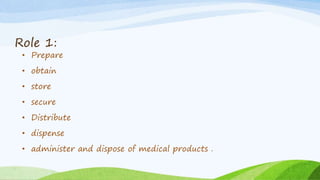
Role 1:
• Prepare
• obtain
• store
• secure
• Distribute
• dispense
• administer and dispose of medical products .
Role 2:
Maintain and improve professional performance.
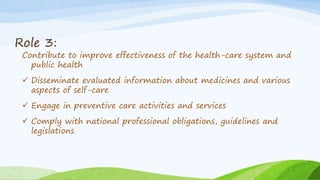
Role 3:
Contribute to improve effectiveness of the health-care system and
public health
 Disseminate evaluated information about medicines and various
aspects of self-care
 Engage in preventive care activities and services
 Comply with national professional obligations, guidelines and
legislations
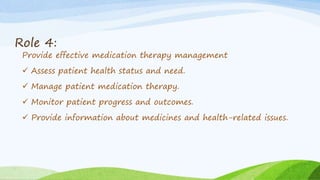
Role 4:
Provide effective medication therapy management
 Assess patient health status and need.
 Manage patient medication therapy.
 Monitor patient progress and outcomes.
 Provide information about medicines and health-related issues.
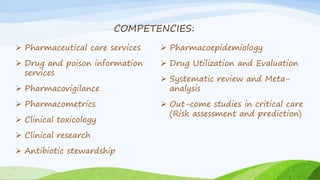
COMPETENCIES:
 Pharmaceutical care services
 Drug and poison information
services
 Pharmacovigilance
 Pharmacometrics
 Clinical toxicology
 Clinical research
 Antibiotic stewardship
 Pharmacoepidemiology
 Drug Utilization and Evaluation
 Systematic review and Meta-
analysis
 Out-come studies in critical care
(Risk assessment and prediction)
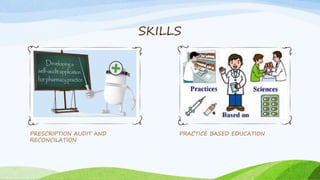
SKILLS
PRESCRIPTION AUDIT AND
RECONCILATION
PRACTICE BASED EDUCATION
SERVICES
• 1. Medication Therapy Management: Customized educational interventions to
prevent underutilization, overutilization, inappropriate use, and abuse of certain
drugs.
• 2. Patient Counselling: Motivational interviews, break communication barriers
with patients and improve their health outcomes by enhancing compliance.
• 3. Drug Information Services: Provides timely, evidence-based drug information
to promote safe, rational use of medications.
• 4. Clinical Toxicology Services: The services include poison informations and
toxicology screening for accidental and intentional overdoses of medicines, illicit
drugs and toxins.
• 5. Medication reconciliation: Compares patient's medication orders to
medication history and helps avoid errors of omission, duplication, incorrect
doses or timing and adverse drug-drug or drug-disease interactions.
• 6. Pharmacovigilance (Adverse drug reaction (ADR) monitoring and reporting):
Ensures patient safety and involves causality assessment of Adverse Events, ADR
reporting and monitoring.
SERVICES
• 7. Periodic Safety Update Report (PSUR): Periodical reporting of the
complete safety experience of newly introduced drugs to regulatory
authorities.
• 8. Health Screening Programme: Enhances access to screening services
to the poor.
• 9. Community outreach Programme: immunization, patient safety and
health education, to raise awareness about drug use and abuse.
• 10. Continuing Pharmacy Education Programme: Clinical skill
development and hands-on training are offered to working
pharmacists
• 11. Clinical Research Support: conduct and monitor clinical research,
support physicians and other healthcare professionals in framing /
executing research protocols and publishing research findings.
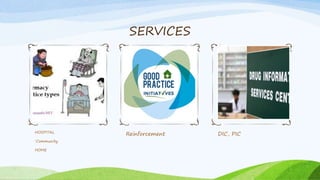
SERVICES
HOSPITAL
‘Community
HOME
Reinforcement DIC, PIC
CONCLUSION
 These roles may vary for each individual pharmacist depending on
their practice responsibilities.
 professional goals to be met in the interest of the patients, As
health professionals, pharmacists have a duty to begin the process
without delay.
REFERENCES
• Annex 8: Joint FIP/WHO guidelines on good pharmacy practice:
standards for quality of pharmacy services from the WHO
technical report series, No. 961.
• 45th report of the WHO Expert Committee on specifications
for pharmaceutical preparations © World Health Organization
2011
• Image source-google.

Interaction & discussion on pharmacy practice, pharmacy practice

  • 1.
    INTERACTION & DISCUSSION PHARMACYPRACTICE SHARAD CHAND PHARM D(INTERN) TVM College of Pharmacy, Ballari
  • 2.
    Introduction Good Pharmacy Practice(GPP) is at the very heart of the profession of Pharmacy; indeed it is the very essence of the profession. Moreover, it expresses our covenant with the patient not only to ‘do no harm’ but also to facilitate good therapeutic outcomes with medicines. practice of pharmacy that responds to the needs of the people who use the pharmacists’ services to get optimal, evidence-based care.
  • 3.
    The mission ofpharmacy practice is to contribute to health improvement and to help patients with health problems to make the best use of their medicines. • being readily available to patients with or without an appointment; • identifying and managing or triaging health-related problems; • health promotion; • assuring effectiveness of medicines; • preventing harm from medicines; and • making responsible use of limited health-care resources
  • 4.
  • 5.
    Role 1: • Prepare •obtain • store • secure • Distribute • dispense • administer and dispose of medical products .
  • 6.
    Role 2: Maintain andimprove professional performance.
  • 7.
    Role 3: Contribute toimprove effectiveness of the health-care system and public health  Disseminate evaluated information about medicines and various aspects of self-care  Engage in preventive care activities and services  Comply with national professional obligations, guidelines and legislations
  • 8.
    Role 4: Provide effectivemedication therapy management  Assess patient health status and need.  Manage patient medication therapy.  Monitor patient progress and outcomes.  Provide information about medicines and health-related issues.
  • 9.
    COMPETENCIES:  Pharmaceutical careservices  Drug and poison information services  Pharmacovigilance  Pharmacometrics  Clinical toxicology  Clinical research  Antibiotic stewardship  Pharmacoepidemiology  Drug Utilization and Evaluation  Systematic review and Meta- analysis  Out-come studies in critical care (Risk assessment and prediction)
  • 10.
  • 11.
    SERVICES • 1. MedicationTherapy Management: Customized educational interventions to prevent underutilization, overutilization, inappropriate use, and abuse of certain drugs. • 2. Patient Counselling: Motivational interviews, break communication barriers with patients and improve their health outcomes by enhancing compliance. • 3. Drug Information Services: Provides timely, evidence-based drug information to promote safe, rational use of medications. • 4. Clinical Toxicology Services: The services include poison informations and toxicology screening for accidental and intentional overdoses of medicines, illicit drugs and toxins. • 5. Medication reconciliation: Compares patient's medication orders to medication history and helps avoid errors of omission, duplication, incorrect doses or timing and adverse drug-drug or drug-disease interactions. • 6. Pharmacovigilance (Adverse drug reaction (ADR) monitoring and reporting): Ensures patient safety and involves causality assessment of Adverse Events, ADR reporting and monitoring.
  • 12.
    SERVICES • 7. PeriodicSafety Update Report (PSUR): Periodical reporting of the complete safety experience of newly introduced drugs to regulatory authorities. • 8. Health Screening Programme: Enhances access to screening services to the poor. • 9. Community outreach Programme: immunization, patient safety and health education, to raise awareness about drug use and abuse. • 10. Continuing Pharmacy Education Programme: Clinical skill development and hands-on training are offered to working pharmacists • 11. Clinical Research Support: conduct and monitor clinical research, support physicians and other healthcare professionals in framing / executing research protocols and publishing research findings.
  • 13.
  • 14.
    CONCLUSION  These rolesmay vary for each individual pharmacist depending on their practice responsibilities.  professional goals to be met in the interest of the patients, As health professionals, pharmacists have a duty to begin the process without delay.
  • 15.
    REFERENCES • Annex 8:Joint FIP/WHO guidelines on good pharmacy practice: standards for quality of pharmacy services from the WHO technical report series, No. 961. • 45th report of the WHO Expert Committee on specifications for pharmaceutical preparations © World Health Organization 2011 • Image source-google.