










Local actions to tackle antimicrobial
resistance (AMR)
FacultyofPublicHealthConference
15June2016
Dr Diane Ashiru-Oredope
Pharmacist Lead;
Antimicrobial Resistance
Programme
Public Health England
Twitter - @DrDianeAshiru
#AntibioticGuardian
Ms Thara Raj
Antimicrobial Resistance
A major threat to future healthcare -
clinical, public health and economic
implications
Antimicrobial use is a recognised
driver
Clinically (all conditions) - appropriate
prescribing improves patient outcomes
2
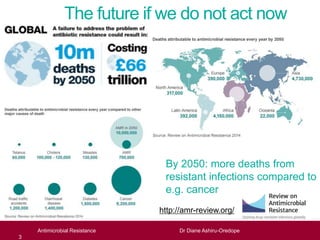
The future if we do not act now
3
By 2050: more deaths from
resistant infections compared to
e.g. cancer
http://amr-review.org/
Antimicrobial Resistance Dr Diane Ashiru-Oredope
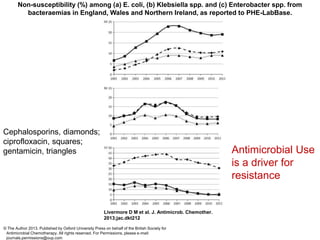
Non-susceptibility (%) among (a) E. coli, (b) Klebsiella spp. and (c) Enterobacter spp. from
bacteraemias in England, Wales and Northern Ireland, as reported to PHE-LabBase.
Livermore D M et al. J. Antimicrob. Chemother.
2013;jac.dkt212
© The Author 2013. Published by Oxford University Press on behalf of the British Society for
Antimicrobial Chemotherapy. All rights reserved. For Permissions, please e-mail:
journals.permissions@oup.com
Cephalosporins, diamonds;
ciprofloxacin, squares;
gentamicin, triangles Antimicrobial Use
is a driver for
resistance
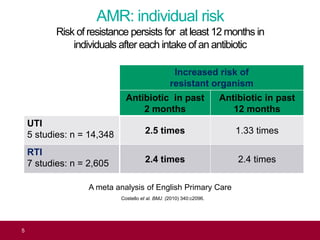
AMR: individual risk
Risk of resistance persists for at least 12 months in
individuals after each intake of an antibiotic
Increased risk of
resistant organism
Antibiotic in past
2 months
Antibiotic in past
12 months
UTI
5 studies: n = 14,348 2.5 times 1.33 times
RTI
7 studies: n = 2,605 2.4 times 2.4 times
A meta analysis of English Primary Care
Costello et al. BMJ. (2010) 340:c2096.
5 Antimicrobial Resistance Dr Diane Ashiru-Oredope5
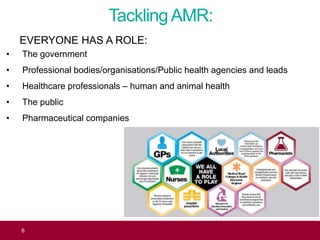
TacklingAMR:
• The government
• Professional bodies/organisations/Public health agencies and leads
• Healthcare professionals – human and animal health
• The public
• Pharmaceutical companies
Antimicrobial Resistance
Dr Diane Ashiru-Oredope6 AMR; WLMHT Physical Health Conference Dr Diane Ashiru-Oredope
EVERYONE HAS A ROLE:
6
Global action onAMR
7
World Health Assembly 2014 resolution
Global Health Security Agenda: AMR action
package - mechanism and collaboration to accelerate
implementation
WHO Global AMR Action Plan 2015 – framework for
action
Antimicrobial Resistance Dr Diane Ashiru-Oredope
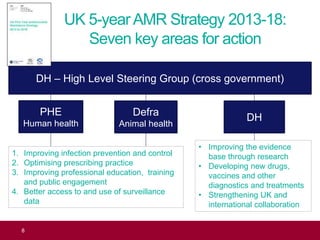
UK 5-yearAMR Strategy 2013-18:
Seven key areas for action
PHE
Human health
DH – High Level Steering Group (cross government)
Defra
Animal health
DH
1. Improving infection prevention and control
2. Optimising prescribing practice
3. Improving professional education, training
and public engagement
4. Better access to and use of surveillance
data
• Improving the evidence
base through research
• Developing new drugs,
vaccines and other
diagnostics and treatments
• Strengthening UK and
international collaboration
Impact of EAAD and Antibiotic Guardian Dr Diane Ashiru-Oredope & Ms Katerina (Aikaterini) ChaintarliEAAD and Antibiotic Guardian Dr Diane Ashiru-Oredope
Antimicrobial Resistance Dr Diane Ashiru-Oredope8
9
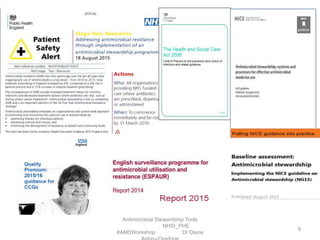
Antimicrobial Stewardship Tools
NHSI_PHE
#AMSWorkshop Dr Diane
What tools are available:
10 Antimicrobial Stewardship Tools NHSI_PHE #AMSWorkshop Dr Diane Ashiru-Oredope
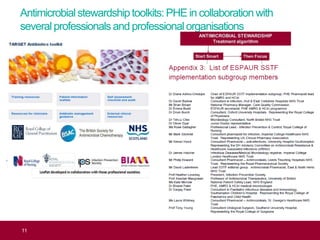
Antimicrobialstewardshiptoolkits:PHE in collaborationwith
severalprofessionalsand professionalorganisations
Antimicrobial Stewardship Tools NHSI_PHE #AMSWorkshop Dr Diane Ashiru-Oredope11
Treating your infection
ntibiotics and always return any unused antibiotics to a pharmacy for safe disposal
Leaflet developed in collaboration with these professional socie
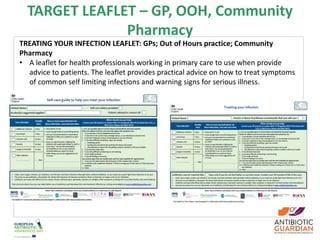
TARGET LEAFLET – GP, OOH, Community
Pharmacy
TREATING YOUR INFECTION LEAFLET: GPs; Out of Hours practice; Community
Pharmacy
• A leaflet for health professionals working in primary care to use when provide
advice to patients. The leaflet provides practical advice on how to treat symptoms
of common self limiting infections and warning signs for serious illness.
Developed by Public Health England 12
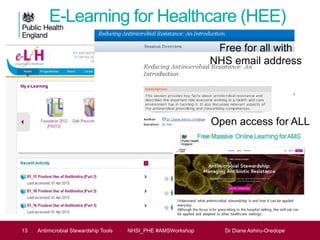
E-Learning for Healthcare (HEE)
Antimicrobial Stewardship Tools NHSI_PHE #AMSWorkshop Dr Diane Ashiru-OredopeAMR; WLMHT Physical Health Conference Dr Diane Ashiru-Oredope
Free for all with
NHS email address
13
Open access for ALL
Antimicrobial Stewardship Tools NHSI_PHE #AMSWorkshop Dr Diane Ashiru-Oredope
Local Action to tackle
antimicrobial resistance
(AMR) using evidence and
knowledge of seasonal
peaks in demand
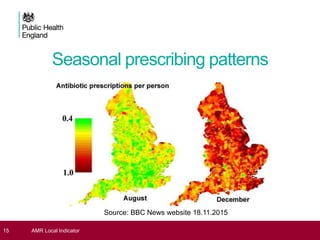
Seasonal prescribing patterns
15 AMR Local Indicator
Source: BBC News website 18.11.2015
How to effect change at a local level
• Local ownership
• Antimicrobial stewardship
• Rigorous scrutiny and use of local indicators
• Financial incentives
- quality premiums
• Leadership and innovation
• Demand management
- engaging the public
- tackling communicable diseases
16 Antimicrobial Stewardship Tools NHSI_PHE #AMSWorkshop Dr Diane Ashiru-Oredope
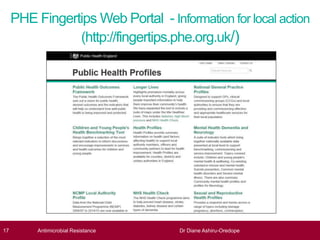
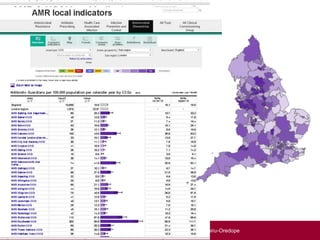
PHE Fingertips Web Portal - Information for local action
(http://fingertips.phe.org.uk/)
17 Antimicrobial Resistance Dr Diane Ashiru-Oredope
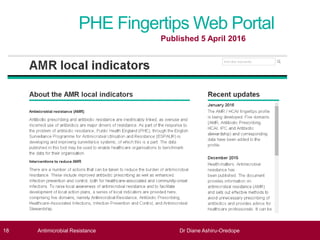
PHE Fingertips Web Portal
18 Antimicrobial Resistance Dr Diane Ashiru-Oredope
Published 5 April 2016
19 Antimicrobial Stewardship Tools NHSI_PHE #AMSWorkshop Dr Diane Ashiru-Oredope
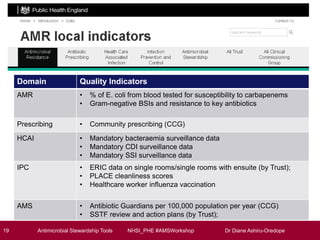
Domain Quality Indicators
AMR • % of E. coli from blood tested for susceptibility to carbapenems
• Gram-negative BSIs and resistance to key antibiotics
Prescribing • Community prescribing (CCG)
HCAI • Mandatory bacteraemia surveillance data
• Mandatory CDI surveillance data
• Mandatory SSI surveillance data
IPC • ERIC data on single rooms/single rooms with ensuite (by Trust);
• PLACE cleanliness scores
• Healthcare worker influenza vaccination
AMS • Antibiotic Guardians per 100,000 population per year (CCG)
• SSTF review and action plans (by Trust);
20 Antimicrobial Resistance Dr Diane Ashiru-Oredope
Examples of Local antimicrobial
stewardship groups
Outer North East London AMR Stewardship
Group using NICE baseline assessment tool
to benchmark progress
Expanding to include inner North East
London
21 Antimicrobial Stewardship Tools NHSI_PHE #AMSWorkshop Dr Diane Ashiru-Oredope
Southwark - method
• Used audit tools to help local practices review
their overall volume of antibiotic prescribing and
prescribing of broad spectrum antibiotics against
local antibiotic guidelines.
• Focused reviews in a number of practices who
were significant outliers in prescribing broad
spectrum antibiotics.
22 Antimicrobial Stewardship Tools NHSI_PHE #AMSWorkshop Dr Diane Ashiru-Oredope
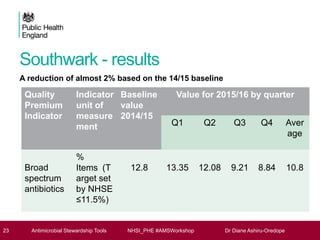
Southwark - results
23 Antimicrobial Stewardship Tools NHSI_PHE #AMSWorkshop Dr Diane Ashiru-Oredope
A reduction of almost 2% based on the 14/15 baseline
Quality
Premium
Indicator
Indicator
unit of
measure
ment
Baseline
value
2014/15
Value for 2015/16 by quarter
Q1 Q2 Q3 Q4 Aver
age
Broad
spectrum
antibiotics
%
Items (T
arget set
by NHSE
≤11.5%)
12.8 13.35 12.08 9.21 8.84 10.8
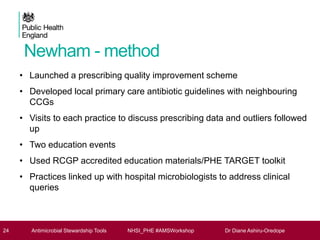
Newham - method
• Launched a prescribing quality improvement scheme
• Developed local primary care antibiotic guidelines with neighbouring
CCGs
• Visits to each practice to discuss prescribing data and outliers followed
up
• Two education events
• Used RCGP accredited education materials/PHE TARGET toolkit
• Practices linked up with hospital microbiologists to address clinical
queries
24 Antimicrobial Stewardship Tools NHSI_PHE #AMSWorkshop Dr Diane Ashiru-Oredope
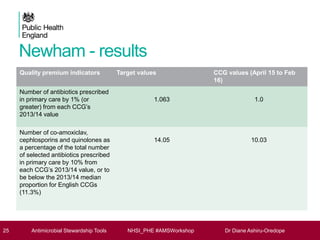
Newham - results
25 Antimicrobial Stewardship Tools NHSI_PHE #AMSWorkshop Dr Diane Ashiru-Oredope
Quality premium indicators Target values CCG values (April 15 to Feb
16)
Number of antibiotics prescribed
in primary care by 1% (or
greater) from each CCG’s
2013/14 value
1.063 1.0
Number of co-amoxiclav,
cephlosporins and quinolones as
a percentage of the total number
of selected antibiotics prescribed
in primary care by 10% from
each CCG’s 2013/14 value, or to
be below the 2013/14 median
proportion for English CCGs
(11.3%)
14.05 10.03
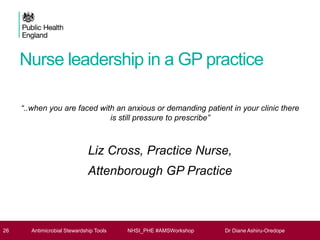
Nurse leadership in a GP practice
“..when you are faced with an anxious or demanding patient in your clinic there
is still pressure to prescribe”
Liz Cross, Practice Nurse,
Attenborough GP Practice
26 Antimicrobial Stewardship Tools NHSI_PHE #AMSWorkshop Dr Diane Ashiru-Oredope
27 Antimicrobial Stewardship Tools NHSI_PHE #AMSWorkshop Dr Diane Ashiru-Oredope
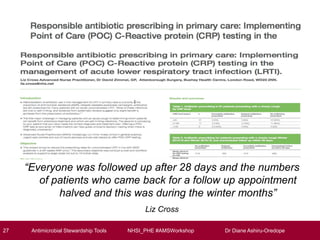
“Everyone was followed up after 28 days and the numbers
of patients who came back for a follow up appointment
halved and this was during the winter months”
Liz Cross
Engaging with
patients & the
public
Developed by Public Health England
18th November
Awareness & engagement campaigns
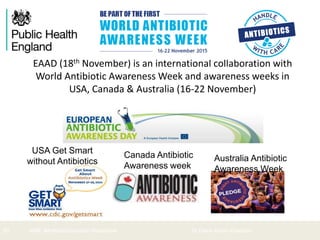
EAAD (18th November) is an international collaboration with
World Antibiotic Awareness Week and awareness weeks in
USA, Canada & Australia (16-22 November)
Australia Antibiotic
Awareness Week
USA Get Smart
without Antibiotics
Canada Antibiotic
Awareness week
AMR: #AntibioticGuardian Roadshow Dr Diane Ashiru-OredopeAntimicrobial Stewardship Dr Diane Ashiru-Oredope
Impact of EAAD and Antibiotic Guardian Dr Diane Ashiru-Oredope & Ms Katerina (Aikaterini) ChaintarliEAAD and Antibiotic Guardian Dr Diane Ashiru-Oredope30 AMR: #AntibioticGuardian Roadshow Dr Diane Ashiru-Oredope
Educating the public: the value of
awareness campaigns
Dr Diane Ashiru-Oredope
31
Local Actions on public and
healthcare professional
awareness and
engagement
Public Engagement –
Devon County Council, Parents & Children’s
centre
Educating the public: the value of awareness campaigns Dr Diane Ashiru-Oredope
The Listen to Your Gut campaign has been developed for parents by parents in
conjunction with Devon County Council’s Public Health Team and My Start
Children’s Centre in Ilfracombe, which is run by Action for Children
33 Antimicrobial Stewardship Dr Diane Ashiru-Oredope33
EAAD &Antibiotic Guardian: children
centres; hospitals; community pharmacies
University College London Hospitals
Awareness and engagement in Hospitals, community pharmacies,
universities, organisations in all UK Countries
Educating the public: the value of awareness campaigns Dr Diane Ashiru-Oredope34
Educating the public: the value of awareness campaigns Dr Diane Ashiru-Oredope
Engagement via social media – e.g pictures
tweeted with #AntibioticGuardian
Educating the public: the value of awareness campaigns Dr Diane Ashiru-Oredope35
Educating the public: the value of awareness campaigns Dr Diane Ashiru-Oredope
Antimicrobial Resistance Dr Diane Ashiru-Oredope
You are invited to become an Antibiotic
Guardian today (available via mobiles)
36 Antimicrobial Resistance Dr Diane Ashiru-Oredope
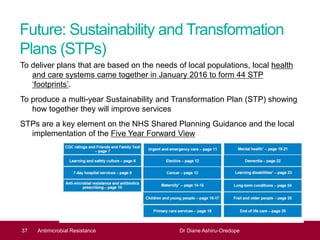
Future: Sustainability and Transformation
Plans (STPs)
To deliver plans that are based on the needs of local populations, local health
and care systems came together in January 2016 to form 44 STP
‘footprints’.
To produce a multi-year Sustainability and Transformation Plan (STP) showing
how together they will improve services
STPs are a key element on the NHS Shared Planning Guidance and the local
implementation of the Five Year Forward View
37 Antimicrobial Resistance Dr Diane Ashiru-Oredope
Acknowledgements
38 Antimicrobial Resistance Dr Diane Ashiru-Oredope

Local actions to tackle antimicrobial resistance

  • 1.
    Local actions totackle antimicrobial resistance (AMR) FacultyofPublicHealthConference 15June2016 Dr Diane Ashiru-Oredope Pharmacist Lead; Antimicrobial Resistance Programme Public Health England Twitter - @DrDianeAshiru #AntibioticGuardian Ms Thara Raj
  • 2.
    Antimicrobial Resistance A majorthreat to future healthcare - clinical, public health and economic implications Antimicrobial use is a recognised driver Clinically (all conditions) - appropriate prescribing improves patient outcomes 2
  • 3.
    The future ifwe do not act now 3 By 2050: more deaths from resistant infections compared to e.g. cancer http://amr-review.org/ Antimicrobial Resistance Dr Diane Ashiru-Oredope
  • 4.
    Non-susceptibility (%) among(a) E. coli, (b) Klebsiella spp. and (c) Enterobacter spp. from bacteraemias in England, Wales and Northern Ireland, as reported to PHE-LabBase. Livermore D M et al. J. Antimicrob. Chemother. 2013;jac.dkt212 © The Author 2013. Published by Oxford University Press on behalf of the British Society for Antimicrobial Chemotherapy. All rights reserved. For Permissions, please e-mail: journals.permissions@oup.com Cephalosporins, diamonds; ciprofloxacin, squares; gentamicin, triangles Antimicrobial Use is a driver for resistance
  • 5.
    AMR: individual risk Riskof resistance persists for at least 12 months in individuals after each intake of an antibiotic Increased risk of resistant organism Antibiotic in past 2 months Antibiotic in past 12 months UTI 5 studies: n = 14,348 2.5 times 1.33 times RTI 7 studies: n = 2,605 2.4 times 2.4 times A meta analysis of English Primary Care Costello et al. BMJ. (2010) 340:c2096. 5 Antimicrobial Resistance Dr Diane Ashiru-Oredope5
  • 6.
    TacklingAMR: • The government •Professional bodies/organisations/Public health agencies and leads • Healthcare professionals – human and animal health • The public • Pharmaceutical companies Antimicrobial Resistance Dr Diane Ashiru-Oredope6 AMR; WLMHT Physical Health Conference Dr Diane Ashiru-Oredope EVERYONE HAS A ROLE: 6
  • 7.
    Global action onAMR 7 WorldHealth Assembly 2014 resolution Global Health Security Agenda: AMR action package - mechanism and collaboration to accelerate implementation WHO Global AMR Action Plan 2015 – framework for action Antimicrobial Resistance Dr Diane Ashiru-Oredope
  • 8.
    UK 5-yearAMR Strategy2013-18: Seven key areas for action PHE Human health DH – High Level Steering Group (cross government) Defra Animal health DH 1. Improving infection prevention and control 2. Optimising prescribing practice 3. Improving professional education, training and public engagement 4. Better access to and use of surveillance data • Improving the evidence base through research • Developing new drugs, vaccines and other diagnostics and treatments • Strengthening UK and international collaboration Impact of EAAD and Antibiotic Guardian Dr Diane Ashiru-Oredope & Ms Katerina (Aikaterini) ChaintarliEAAD and Antibiotic Guardian Dr Diane Ashiru-Oredope Antimicrobial Resistance Dr Diane Ashiru-Oredope8
  • 9.
  • 10.
    What tools areavailable: 10 Antimicrobial Stewardship Tools NHSI_PHE #AMSWorkshop Dr Diane Ashiru-Oredope
  • 11.
    Antimicrobialstewardshiptoolkits:PHE in collaborationwith severalprofessionalsandprofessionalorganisations Antimicrobial Stewardship Tools NHSI_PHE #AMSWorkshop Dr Diane Ashiru-Oredope11 Treating your infection ntibiotics and always return any unused antibiotics to a pharmacy for safe disposal Leaflet developed in collaboration with these professional socie
  • 12.
    TARGET LEAFLET –GP, OOH, Community Pharmacy TREATING YOUR INFECTION LEAFLET: GPs; Out of Hours practice; Community Pharmacy • A leaflet for health professionals working in primary care to use when provide advice to patients. The leaflet provides practical advice on how to treat symptoms of common self limiting infections and warning signs for serious illness. Developed by Public Health England 12
  • 13.
    E-Learning for Healthcare(HEE) Antimicrobial Stewardship Tools NHSI_PHE #AMSWorkshop Dr Diane Ashiru-OredopeAMR; WLMHT Physical Health Conference Dr Diane Ashiru-Oredope Free for all with NHS email address 13 Open access for ALL Antimicrobial Stewardship Tools NHSI_PHE #AMSWorkshop Dr Diane Ashiru-Oredope
  • 14.
    Local Action totackle antimicrobial resistance (AMR) using evidence and knowledge of seasonal peaks in demand
  • 15.
    Seasonal prescribing patterns 15AMR Local Indicator Source: BBC News website 18.11.2015
  • 16.
    How to effectchange at a local level • Local ownership • Antimicrobial stewardship • Rigorous scrutiny and use of local indicators • Financial incentives - quality premiums • Leadership and innovation • Demand management - engaging the public - tackling communicable diseases 16 Antimicrobial Stewardship Tools NHSI_PHE #AMSWorkshop Dr Diane Ashiru-Oredope
  • 17.
    PHE Fingertips WebPortal - Information for local action (http://fingertips.phe.org.uk/) 17 Antimicrobial Resistance Dr Diane Ashiru-Oredope
  • 18.
    PHE Fingertips WebPortal 18 Antimicrobial Resistance Dr Diane Ashiru-Oredope Published 5 April 2016
  • 19.
    19 Antimicrobial StewardshipTools NHSI_PHE #AMSWorkshop Dr Diane Ashiru-Oredope Domain Quality Indicators AMR • % of E. coli from blood tested for susceptibility to carbapenems • Gram-negative BSIs and resistance to key antibiotics Prescribing • Community prescribing (CCG) HCAI • Mandatory bacteraemia surveillance data • Mandatory CDI surveillance data • Mandatory SSI surveillance data IPC • ERIC data on single rooms/single rooms with ensuite (by Trust); • PLACE cleanliness scores • Healthcare worker influenza vaccination AMS • Antibiotic Guardians per 100,000 population per year (CCG) • SSTF review and action plans (by Trust);
  • 20.
    20 Antimicrobial ResistanceDr Diane Ashiru-Oredope
  • 21.
    Examples of Localantimicrobial stewardship groups Outer North East London AMR Stewardship Group using NICE baseline assessment tool to benchmark progress Expanding to include inner North East London 21 Antimicrobial Stewardship Tools NHSI_PHE #AMSWorkshop Dr Diane Ashiru-Oredope
  • 22.
    Southwark - method •Used audit tools to help local practices review their overall volume of antibiotic prescribing and prescribing of broad spectrum antibiotics against local antibiotic guidelines. • Focused reviews in a number of practices who were significant outliers in prescribing broad spectrum antibiotics. 22 Antimicrobial Stewardship Tools NHSI_PHE #AMSWorkshop Dr Diane Ashiru-Oredope
  • 23.
    Southwark - results 23Antimicrobial Stewardship Tools NHSI_PHE #AMSWorkshop Dr Diane Ashiru-Oredope A reduction of almost 2% based on the 14/15 baseline Quality Premium Indicator Indicator unit of measure ment Baseline value 2014/15 Value for 2015/16 by quarter Q1 Q2 Q3 Q4 Aver age Broad spectrum antibiotics % Items (T arget set by NHSE ≤11.5%) 12.8 13.35 12.08 9.21 8.84 10.8
  • 24.
    Newham - method •Launched a prescribing quality improvement scheme • Developed local primary care antibiotic guidelines with neighbouring CCGs • Visits to each practice to discuss prescribing data and outliers followed up • Two education events • Used RCGP accredited education materials/PHE TARGET toolkit • Practices linked up with hospital microbiologists to address clinical queries 24 Antimicrobial Stewardship Tools NHSI_PHE #AMSWorkshop Dr Diane Ashiru-Oredope
  • 25.
    Newham - results 25Antimicrobial Stewardship Tools NHSI_PHE #AMSWorkshop Dr Diane Ashiru-Oredope Quality premium indicators Target values CCG values (April 15 to Feb 16) Number of antibiotics prescribed in primary care by 1% (or greater) from each CCG’s 2013/14 value 1.063 1.0 Number of co-amoxiclav, cephlosporins and quinolones as a percentage of the total number of selected antibiotics prescribed in primary care by 10% from each CCG’s 2013/14 value, or to be below the 2013/14 median proportion for English CCGs (11.3%) 14.05 10.03
  • 26.
    Nurse leadership ina GP practice “..when you are faced with an anxious or demanding patient in your clinic there is still pressure to prescribe” Liz Cross, Practice Nurse, Attenborough GP Practice 26 Antimicrobial Stewardship Tools NHSI_PHE #AMSWorkshop Dr Diane Ashiru-Oredope
  • 27.
    27 Antimicrobial StewardshipTools NHSI_PHE #AMSWorkshop Dr Diane Ashiru-Oredope “Everyone was followed up after 28 days and the numbers of patients who came back for a follow up appointment halved and this was during the winter months” Liz Cross
  • 28.
  • 29.
    Developed by PublicHealth England 18th November Awareness & engagement campaigns
  • 30.
    EAAD (18th November)is an international collaboration with World Antibiotic Awareness Week and awareness weeks in USA, Canada & Australia (16-22 November) Australia Antibiotic Awareness Week USA Get Smart without Antibiotics Canada Antibiotic Awareness week AMR: #AntibioticGuardian Roadshow Dr Diane Ashiru-OredopeAntimicrobial Stewardship Dr Diane Ashiru-Oredope Impact of EAAD and Antibiotic Guardian Dr Diane Ashiru-Oredope & Ms Katerina (Aikaterini) ChaintarliEAAD and Antibiotic Guardian Dr Diane Ashiru-Oredope30 AMR: #AntibioticGuardian Roadshow Dr Diane Ashiru-Oredope
  • 31.
    Educating the public:the value of awareness campaigns Dr Diane Ashiru-Oredope 31
  • 32.
    Local Actions onpublic and healthcare professional awareness and engagement
  • 33.
    Public Engagement – DevonCounty Council, Parents & Children’s centre Educating the public: the value of awareness campaigns Dr Diane Ashiru-Oredope The Listen to Your Gut campaign has been developed for parents by parents in conjunction with Devon County Council’s Public Health Team and My Start Children’s Centre in Ilfracombe, which is run by Action for Children 33 Antimicrobial Stewardship Dr Diane Ashiru-Oredope33
  • 34.
    EAAD &Antibiotic Guardian:children centres; hospitals; community pharmacies University College London Hospitals Awareness and engagement in Hospitals, community pharmacies, universities, organisations in all UK Countries Educating the public: the value of awareness campaigns Dr Diane Ashiru-Oredope34 Educating the public: the value of awareness campaigns Dr Diane Ashiru-Oredope
  • 35.
    Engagement via socialmedia – e.g pictures tweeted with #AntibioticGuardian Educating the public: the value of awareness campaigns Dr Diane Ashiru-Oredope35 Educating the public: the value of awareness campaigns Dr Diane Ashiru-Oredope
  • 36.
    Antimicrobial Resistance DrDiane Ashiru-Oredope You are invited to become an Antibiotic Guardian today (available via mobiles) 36 Antimicrobial Resistance Dr Diane Ashiru-Oredope
  • 37.
    Future: Sustainability andTransformation Plans (STPs) To deliver plans that are based on the needs of local populations, local health and care systems came together in January 2016 to form 44 STP ‘footprints’. To produce a multi-year Sustainability and Transformation Plan (STP) showing how together they will improve services STPs are a key element on the NHS Shared Planning Guidance and the local implementation of the Five Year Forward View 37 Antimicrobial Resistance Dr Diane Ashiru-Oredope
  • 38.

Editor's Notes

  • #3 “Antimicrobial resistance (AMR) is resistance of a microorganism to an antimicrobial medicine to which it was originally sensitive. Resistant organisms (they include bacteria, fungi, viruses and some parasites) are able to withstand attack by antimicrobial medicines, such as antibiotics, antifungals, antivirals, and antimalarials, so that standard treatments become ineffective and infections persist increasing risk of spread to others”.
  • #5  Until 2007, the UK saw major increases in cephalosporin and quinolone resistance amongst Escherichia coli and Klebsiella spp Plateau/ fall in resistance was from 2007 (LabBase and BSAC data) Fall in resistance coincides with the large reduction in cephalosporin and quinolone use due to national antimicrobial stewardship guidance to reduce Clostridium difficile infections nationally Replacement have been penicillin/b-lactamase inhibitors which may be adding to the selection for carbapenamase producers Livermore D M et al. J. Antimicrob. Chemother. 2013;jac.dkt212 The UK saw major increases in cephalosporin and quinolone resistance amongst Enterobacteriaceae from 2001 to 2006, subsequent trends LabBase and BSAC data showed that rates of non-susceptibility to cephalosporins and quinolones rose amongst Escherichia coli and Klebsiella spp. until mid-decade (2004–07) before LabBase and BSAC data showed that rates of non-susceptibility to cephalosporins and quinolones rose amongst Escherichia coli and Klebsiella spp. until mid-decade (2004–07) before plateauing or falling They coincided with large reductions in hospital cephalosporin and quinolone use, owing to concern about Clostridium difficile, with replacement by penicillin/b-lactamase inhibitor combinations, which have borderline activity against ESBL producers, but consistently lack activity against carbapenemase producers. Non-susceptibility to cephalosporins and quinolones has declined among bloodstream Enterobacteriaceae in the UK, probably reflecting prescribing shifts. The penicillin/b-lactamase inhibitor combinations that have largely replaced cephalosporins and quinolones may add to selection for carbapenemase producers. The penicillin/b-lactamase inhibitor combinations that have largely replaced cephalosporins and quinolones may add to selection for carbapenemase produce The changes in prescribing across primary and secondary care may, at least in part, explain the increase of Escherichia coli bacteraemias and emergence of other MDR clones.
  • #6 Presenter notes: The risk of resistance was even greater in the first two months after an antibiotic as shown here for UTIs and Respiratory Tract infections, but was still higher 12 months after antibiotic use for both UTIs and RTIs. Therefore in conclusion, individuals prescribed an antibiotic in primary care for a respiratory or urinary infection have an increased risk of subsequently carrying resistant organisms – so that the next time they have an infection it may be with one of these antibiotic resistant organism. Details of paper: http://www.bmj.com/content/340/bmj.c2096.long The review included 24 studies; 22 involved patients with symptomatic infection and two involved healthy volunteers; 19 were observational studies (of which two were prospective) and five were randomised trials. In five studies of urinary tract bacteria (14 348 participants), the pooled odds ratio (OR) for resistance was 2.5 (95% confidence interval 2.1 to 2.9) within 2 months of antibiotic treatment and 1.33 (1.2 to 1.5) within 12 months. In seven studies of respiratory tract bacteria (2605 participants), pooled ORs were 2.4 (1.4 to 3.9) and 2.4 (1.3 to 4.5) for the same periods, respectively. Studies reporting the quantity of antibiotic prescribed found that longer duration and multiple courses were associated with higher rates of resistance. Studies comparing the potential for different antibiotics to induce resistance showed no consistent effects. Only one prospective study reported changes in resistance over a long period; pooled ORs fell from 12.2 (6.8 to 22.1) at 1 week to 6.1 (2.8 to 13.4) at 1 month, 3.6 (2.2 to 6.0) at 2 months, and 2.2 (1.3 to 3.6) at 6 months. Therefore in conclusion, individuals prescribed an antibiotic in primary care for a respiratory or urinary infection have an increased risk of carrying resistant organisms – so that the next time they have an infection it is with a antibiotic resistant organism. The effect is greatest in the month immediately after treatment but may persist for up to 12 months. This effect not only increases the population carriage of organisms resistant to first line antibiotics, but also creates the conditions for increased use of second line antibiotics in the community.
  • #8 TATFAR Appropriate therapeutic use of antimicrobial drugs in the medical and veterinary communities Prevention of both healthcare and community-associated drug-resistant infections Strategies for improving the pipeline of new antimicrobial drugs
  • #9 Strategic Aims: Improve the knowledge and understanding of AMR Conserve and steward the effectiveness of existing treatments Stimulate the development of new antibiotics, diagnostics and novel therapies
  • #12 TARGET Antimicrobial Stewardship Toolkit for primary care provides guidance to help general practice decide when and what antibiotics to prescribe and tools such as patient leaflets to share during consultations Start Smart Then Focus recommends prompt antibiotic treatment for hospital patients with severe sepsis, documentation of route, indication, dose, duration (RIDD) and post-prescription review at 48-72 hours Optimising Prescribing: Two national AMS toolkits – one each for secondary & primary care
  • #15 Local Action to tackle antimicrobial resistance (AMR) using evidence and knowledge of seasonal peaks in demand
  • #18 These profiles are a rich source of indicators across a range of health and wellbeing themes that has been designed to support JSNA and commissioning to improve health and wellbeing, and reduce inequalities. These profiles have been developed by Public Health England. Browse indicators at different geographical levels Benchmark against the regional or England average Export data to use locally
  • #20 This is how the AMR & HCAI profile will look when it goes live. Within each profile there are several more focussed areas relating to that profile. These are called domains. Within each domain there are more focussed, numerically-quantified indicators specific to the domain that they are in. Step 3 – Introduce the concept of indicators at different geographical layers (Geo legend) Indictors are shown by different geography levels called area type Indictors may or may not be designed to show across multiple area type and this choice depends largely on the nature of the indicator and the type of information which is being shown. Within the geographical legend we have the option to group areas by locality (sub region drop down ) or another defining attribute (area grouped by drop down) Note. These geographical features are applicable to every proceeding step that gets referenced. Domain Quality Indicators AMR % of E. coli from blood tested for susceptibility to carbapenems Gram-negative BSIs and resistance to key antibiotics Prescribing Community prescribing (CCG) HACI Mandatory bacteraemia surveillance data Mandatory CDI surveillance data Mandatory SSI surveillance data IPC ERIC data on single rooms/single rooms with ensuite (by Trust); PLACE cleanliness scores Healthcare worker influenza vaccination AMS Antibiotic Guardians per 100,000 population per year (CCG) SSTF review and action plans (by Trust);
  • #30 Public Engagement: Moving from awareness raising to engagement
  • #32 PHE developed the Antibiotic Guardian and European Antibiotic Awareness Day resources to provide individuals and organisation a key resource to engage, educate encourage others towards positive behaviour change with regards to antibiotic prescribing, expectation and use. How we promote the campaign: National resources for local use
  • #33 Local Action to tackle antimicrobial resistance (AMR) using evidence and knowledge of seasonal peaks in demand
  • #38 supported by six of the national health and care bodies: NHS England, NHS Improvement, the Care Quality Commission (CQC), Health Education England (HEE), Public Health England (PHE) and the National Institute for Health and Care Excellence (NICE).