Clinical Evaluation Statistics with Expended Formulas
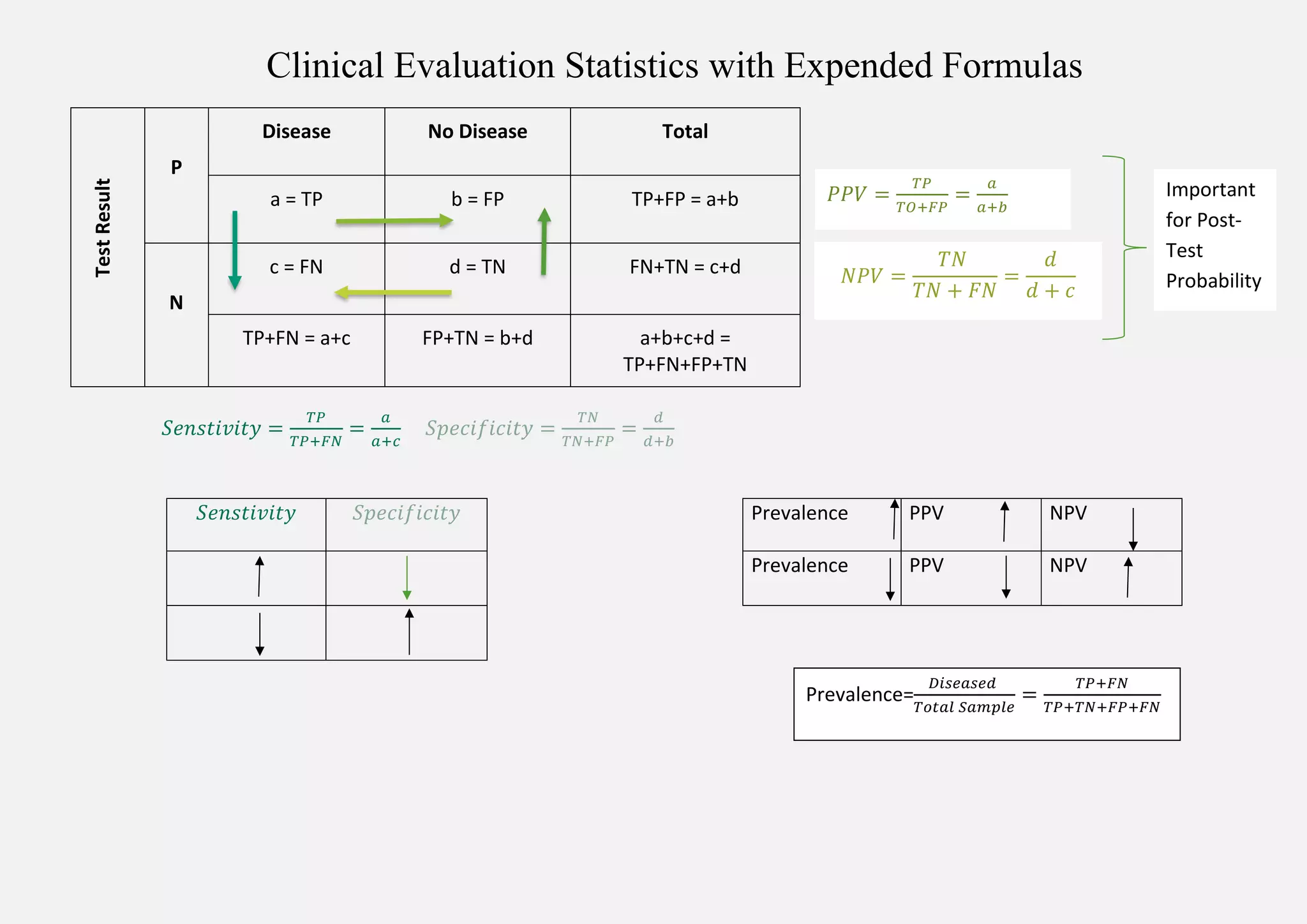
𝑆𝑒𝑛𝑠𝑡𝑖𝑣𝑖𝑡𝑦 =
𝑇𝑃
𝑇𝑃+𝐹𝑁
=
𝑎
𝑎+𝑐
𝑆𝑝𝑒𝑐𝑖𝑓𝑖𝑐𝑖𝑡𝑦 =
𝑇𝑁
𝑇𝑁+𝐹𝑃
=
𝑑
𝑑+𝑏
Test
Result
P
Disease No Disease Total
a = TP b = FP TP+FP = a+b
N
c = FN d = TN FN+TN = c+d
TP+FN = a+c FP+TN = b+d a+b+c+d =
TP+FN+FP+TN
𝑆𝑒𝑛𝑠𝑡𝑖𝑣𝑖𝑡𝑦 𝑆𝑝𝑒𝑐𝑖𝑓𝑖𝑐𝑖𝑡𝑦 Prevalence PPV NPV
Prevalence PPV NPV
𝑃𝑃𝑉 =
𝑇𝑃
𝑇𝑂+𝐹𝑃
=
𝑎
𝑎+𝑏
𝑁𝑃𝑉 =
𝑇𝑁
𝑇𝑁 + 𝐹𝑁
=
𝑑
𝑑 + 𝑐
Important
for Post-
Test
Probability
Prevalence=
𝐷𝑖𝑠𝑒𝑎𝑠𝑒𝑑
𝑇𝑜𝑡𝑎𝑙 𝑆𝑎𝑚𝑝𝑙𝑒
=
𝑇𝑃+𝐹𝑁
𝑇𝑃+𝑇𝑁+𝐹𝑃+𝐹𝑁
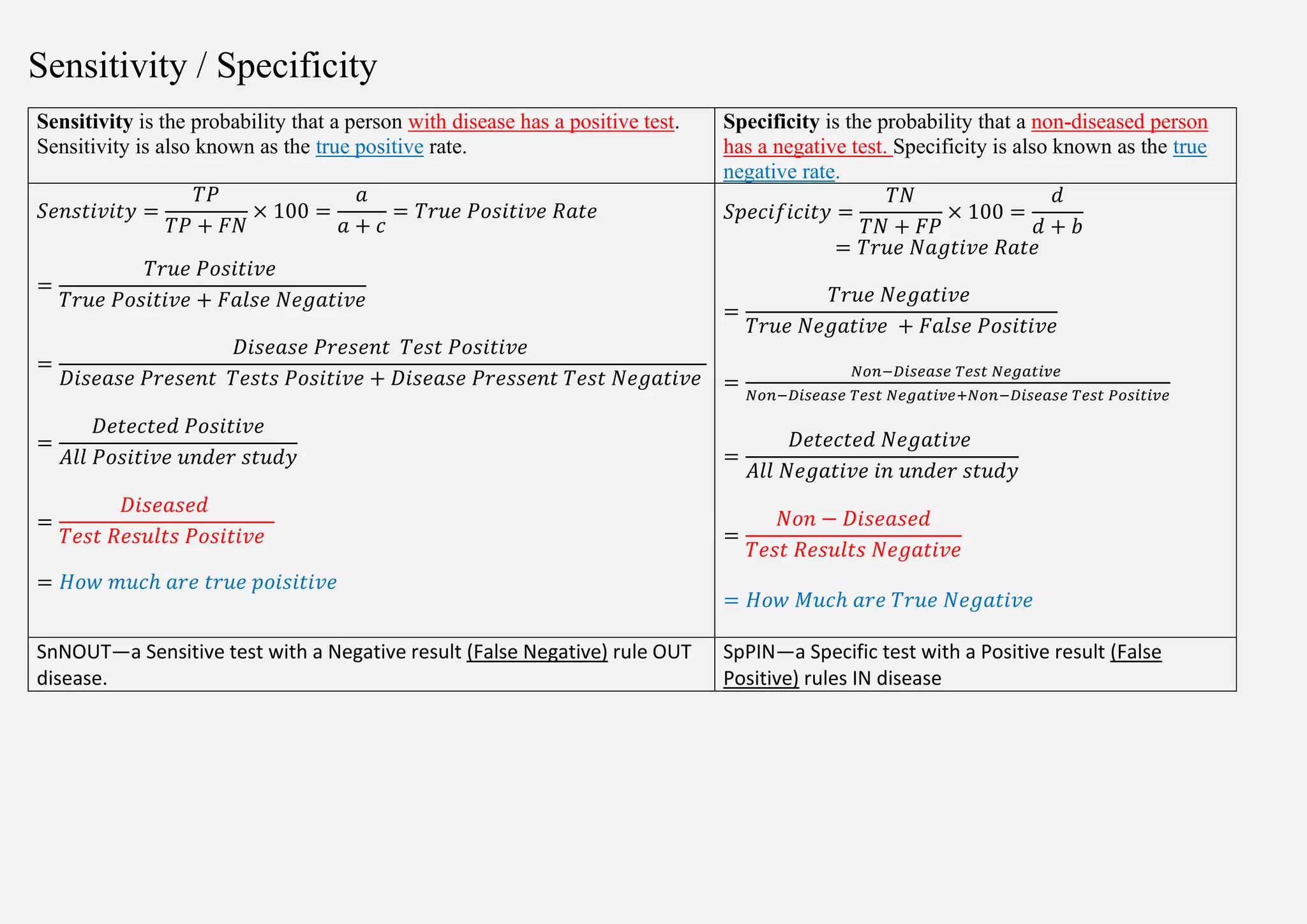
Sensitivity / Specificity
Sensitivity is the probability that a person with disease has a positive test.
Sensitivity is also known as the true positive rate.
Specificity is the probability that a non-diseased person
has a negative test. Specificity is also known as the true
negative rate.
𝑆𝑒𝑛𝑠𝑡𝑖𝑣𝑖𝑡𝑦 =
𝑇𝑃
𝑇𝑃 + 𝐹𝑁
× 100 =
𝑎
𝑎 + 𝑐
= 𝑇𝑟𝑢𝑒 𝑃𝑜𝑠𝑖𝑡𝑖𝑣𝑒 𝑅𝑎𝑡𝑒
=
𝑇𝑟𝑢𝑒 𝑃𝑜𝑠𝑖𝑡𝑖𝑣𝑒
𝑇𝑟𝑢𝑒 𝑃𝑜𝑠𝑖𝑡𝑖𝑣𝑒 + 𝐹𝑎𝑙𝑠𝑒 𝑁𝑒𝑔𝑎𝑡𝑖𝑣𝑒
=
𝐷𝑖𝑠𝑒𝑎𝑠𝑒 𝑃𝑟𝑒𝑠𝑒𝑛𝑡 𝑇𝑒𝑠𝑡 𝑃𝑜𝑠𝑖𝑡𝑖𝑣𝑒
𝐷𝑖𝑠𝑒𝑎𝑠𝑒 𝑃𝑟𝑒𝑠𝑒𝑛𝑡 𝑇𝑒𝑠𝑡𝑠 𝑃𝑜𝑠𝑖𝑡𝑖𝑣𝑒 + 𝐷𝑖𝑠𝑒𝑎𝑠𝑒 𝑃𝑟𝑒𝑠𝑠𝑒𝑛𝑡 𝑇𝑒𝑠𝑡 𝑁𝑒𝑔𝑎𝑡𝑖𝑣𝑒
=
𝐷𝑒𝑡𝑒𝑐𝑡𝑒𝑑 𝑃𝑜𝑠𝑖𝑡𝑖𝑣𝑒
𝐴𝑙𝑙 𝑃𝑜𝑠𝑖𝑡𝑖𝑣𝑒 𝑢𝑛𝑑𝑒𝑟 𝑠𝑡𝑢𝑑𝑦
=
𝐷𝑖𝑠𝑒𝑎𝑠𝑒𝑑
𝑇𝑒𝑠𝑡 𝑅𝑒𝑠𝑢𝑙𝑡𝑠 𝑃𝑜𝑠𝑖𝑡𝑖𝑣𝑒
= 𝐻𝑜𝑤 𝑚𝑢𝑐ℎ 𝑎𝑟𝑒 𝑡𝑟𝑢𝑒 𝑝𝑜𝑖𝑠𝑖𝑡𝑖𝑣𝑒
𝑆𝑝𝑒𝑐𝑖𝑓𝑖𝑐𝑖𝑡𝑦 =
𝑇𝑁
𝑇𝑁 + 𝐹𝑃
× 100 =
𝑑
𝑑 + 𝑏
= 𝑇𝑟𝑢𝑒 𝑁𝑎𝑔𝑡𝑖𝑣𝑒 𝑅𝑎𝑡𝑒
=
𝑇𝑟𝑢𝑒 𝑁𝑒𝑔𝑎𝑡𝑖𝑣𝑒
𝑇𝑟𝑢𝑒 𝑁𝑒𝑔𝑎𝑡𝑖𝑣𝑒 + 𝐹𝑎𝑙𝑠𝑒 𝑃𝑜𝑠𝑖𝑡𝑖𝑣𝑒
=
𝑁𝑜𝑛−𝐷𝑖𝑠𝑒𝑎𝑠𝑒 𝑇𝑒𝑠𝑡 𝑁𝑒𝑔𝑎𝑡𝑖𝑣𝑒
𝑁𝑜𝑛−𝐷𝑖𝑠𝑒𝑎𝑠𝑒 𝑇𝑒𝑠𝑡 𝑁𝑒𝑔𝑎𝑡𝑖𝑣𝑒+𝑁𝑜𝑛−𝐷𝑖𝑠𝑒𝑎𝑠𝑒 𝑇𝑒𝑠𝑡 𝑃𝑜𝑠𝑖𝑡𝑖𝑣𝑒
=
𝐷𝑒𝑡𝑒𝑐𝑡𝑒𝑑 𝑁𝑒𝑔𝑎𝑡𝑖𝑣𝑒
𝐴𝑙𝑙 𝑁𝑒𝑔𝑎𝑡𝑖𝑣𝑒 𝑖𝑛 𝑢𝑛𝑑𝑒𝑟 𝑠𝑡𝑢𝑑𝑦
=
𝑁𝑜𝑛 − 𝐷𝑖𝑠𝑒𝑎𝑠𝑒𝑑
𝑇𝑒𝑠𝑡 𝑅𝑒𝑠𝑢𝑙𝑡𝑠 𝑁𝑒𝑔𝑎𝑡𝑖𝑣𝑒
= 𝐻𝑜𝑤 𝑀𝑢𝑐ℎ 𝑎𝑟𝑒 𝑇𝑟𝑢𝑒 𝑁𝑒𝑔𝑎𝑡𝑖𝑣𝑒
SnNOUT—a Sensitive test with a Negative result (False Negative) rule OUT
disease.
SpPIN—a Specific test with a Positive result (False
Positive) rules IN disease
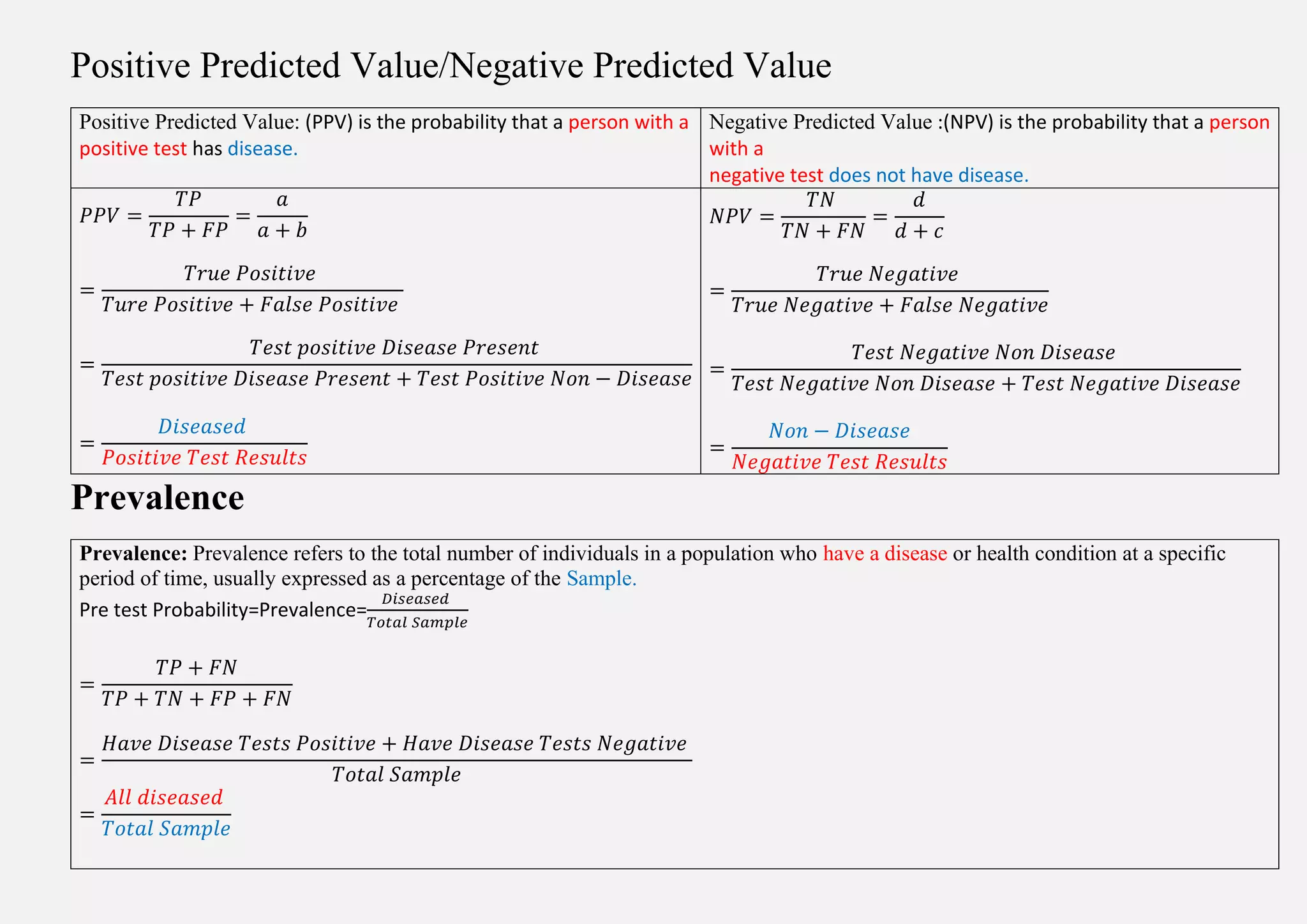
Positive Predicted Value/Negative Predicted Value
Positive Predicted Value: (PPV) is the probability that a person with a
positive test has disease.
Negative Predicted Value :(NPV) is the probability that a person
with a
negative test does not have disease.
𝑃𝑃𝑉 =
𝑇𝑃
𝑇𝑃 + 𝐹𝑃
=
𝑎
𝑎 + 𝑏
=
𝑇𝑟𝑢𝑒 𝑃𝑜𝑠𝑖𝑡𝑖𝑣𝑒
𝑇𝑢𝑟𝑒 𝑃𝑜𝑠𝑖𝑡𝑖𝑣𝑒 + 𝐹𝑎𝑙𝑠𝑒 𝑃𝑜𝑠𝑖𝑡𝑖𝑣𝑒
=
𝑇𝑒𝑠𝑡 𝑝𝑜𝑠𝑖𝑡𝑖𝑣𝑒 𝐷𝑖𝑠𝑒𝑎𝑠𝑒 𝑃𝑟𝑒𝑠𝑒𝑛𝑡
𝑇𝑒𝑠𝑡 𝑝𝑜𝑠𝑖𝑡𝑖𝑣𝑒 𝐷𝑖𝑠𝑒𝑎𝑠𝑒 𝑃𝑟𝑒𝑠𝑒𝑛𝑡 + 𝑇𝑒𝑠𝑡 𝑃𝑜𝑠𝑖𝑡𝑖𝑣𝑒 𝑁𝑜𝑛 − 𝐷𝑖𝑠𝑒𝑎𝑠𝑒
=
𝐷𝑖𝑠𝑒𝑎𝑠𝑒𝑑
𝑃𝑜𝑠𝑖𝑡𝑖𝑣𝑒 𝑇𝑒𝑠𝑡 𝑅𝑒𝑠𝑢𝑙𝑡𝑠
𝑁𝑃𝑉 =
𝑇𝑁
𝑇𝑁 + 𝐹𝑁
=
𝑑
𝑑 + 𝑐
=
𝑇𝑟𝑢𝑒 𝑁𝑒𝑔𝑎𝑡𝑖𝑣𝑒
𝑇𝑟𝑢𝑒 𝑁𝑒𝑔𝑎𝑡𝑖𝑣𝑒 + 𝐹𝑎𝑙𝑠𝑒 𝑁𝑒𝑔𝑎𝑡𝑖𝑣𝑒
=
𝑇𝑒𝑠𝑡 𝑁𝑒𝑔𝑎𝑡𝑖𝑣𝑒 𝑁𝑜𝑛 𝐷𝑖𝑠𝑒𝑎𝑠𝑒
𝑇𝑒𝑠𝑡 𝑁𝑒𝑔𝑎𝑡𝑖𝑣𝑒 𝑁𝑜𝑛 𝐷𝑖𝑠𝑒𝑎𝑠𝑒 + 𝑇𝑒𝑠𝑡 𝑁𝑒𝑔𝑎𝑡𝑖𝑣𝑒 𝐷𝑖𝑠𝑒𝑎𝑠𝑒
=
𝑁𝑜𝑛 − 𝐷𝑖𝑠𝑒𝑎𝑠𝑒
𝑁𝑒𝑔𝑎𝑡𝑖𝑣𝑒 𝑇𝑒𝑠𝑡 𝑅𝑒𝑠𝑢𝑙𝑡𝑠
Prevalence
Prevalence: Prevalence refers to the total number of individuals in a population who have a disease or health condition at a specific
period of time, usually expressed as a percentage of the Sample.
Pre test Probability=Prevalence=
𝐷𝑖𝑠𝑒𝑎𝑠𝑒𝑑
𝑇𝑜𝑡𝑎𝑙 𝑆𝑎𝑚𝑝𝑙𝑒
=
𝑇𝑃 + 𝐹𝑁
𝑇𝑃 + 𝑇𝑁 + 𝐹𝑃 + 𝐹𝑁
=
𝐻𝑎𝑣𝑒 𝐷𝑖𝑠𝑒𝑎𝑠𝑒 𝑇𝑒𝑠𝑡𝑠 𝑃𝑜𝑠𝑖𝑡𝑖𝑣𝑒 + 𝐻𝑎𝑣𝑒 𝐷𝑖𝑠𝑒𝑎𝑠𝑒 𝑇𝑒𝑠𝑡𝑠 𝑁𝑒𝑔𝑎𝑡𝑖𝑣𝑒
𝑇𝑜𝑡𝑎𝑙 𝑆𝑎𝑚𝑝𝑙𝑒
=
𝐴𝑙𝑙 𝑑𝑖𝑠𝑒𝑎𝑠𝑒𝑑
𝑇𝑜𝑡𝑎𝑙 𝑆𝑎𝑚𝑝𝑙𝑒
Accuracy
Accuracy is the degree of degree to true values. over all outcomes
Accuracy =
𝑎 + 𝑑
𝑎 + 𝑏 + 𝑐 + 𝑑
=
𝑇𝑃 + 𝑇𝑁
𝑇𝑃 + 𝑇𝑁 + 𝐹𝑃 + 𝐹𝑁
=
𝑻𝒆𝒔𝒓 𝑷𝒐𝒔𝒊𝒕𝒊𝒗𝒆 𝒅𝒊𝒔𝒆𝒂𝒔𝒆 𝒑𝒓𝒆𝒔𝒆𝒏𝒕 + 𝑻𝒆𝒔𝒕 𝑵𝒆𝒈𝒂𝒕𝒊𝒗𝒆 𝑵𝒐𝒏 − 𝑫𝒊𝒔𝒆𝒂𝒔𝒆
𝑨𝒍𝒍 𝑻𝒆𝒔𝒕 𝑹𝒆𝒔𝒖𝒍𝒕𝒔
=
𝑻𝒓𝒖𝒆 𝑶𝒖𝒕𝒄𝒐𝒎𝒆𝒔
𝑻𝒐𝒕𝒂𝒍 𝑶𝒖𝒕𝒄𝒐𝒎𝒆𝒔
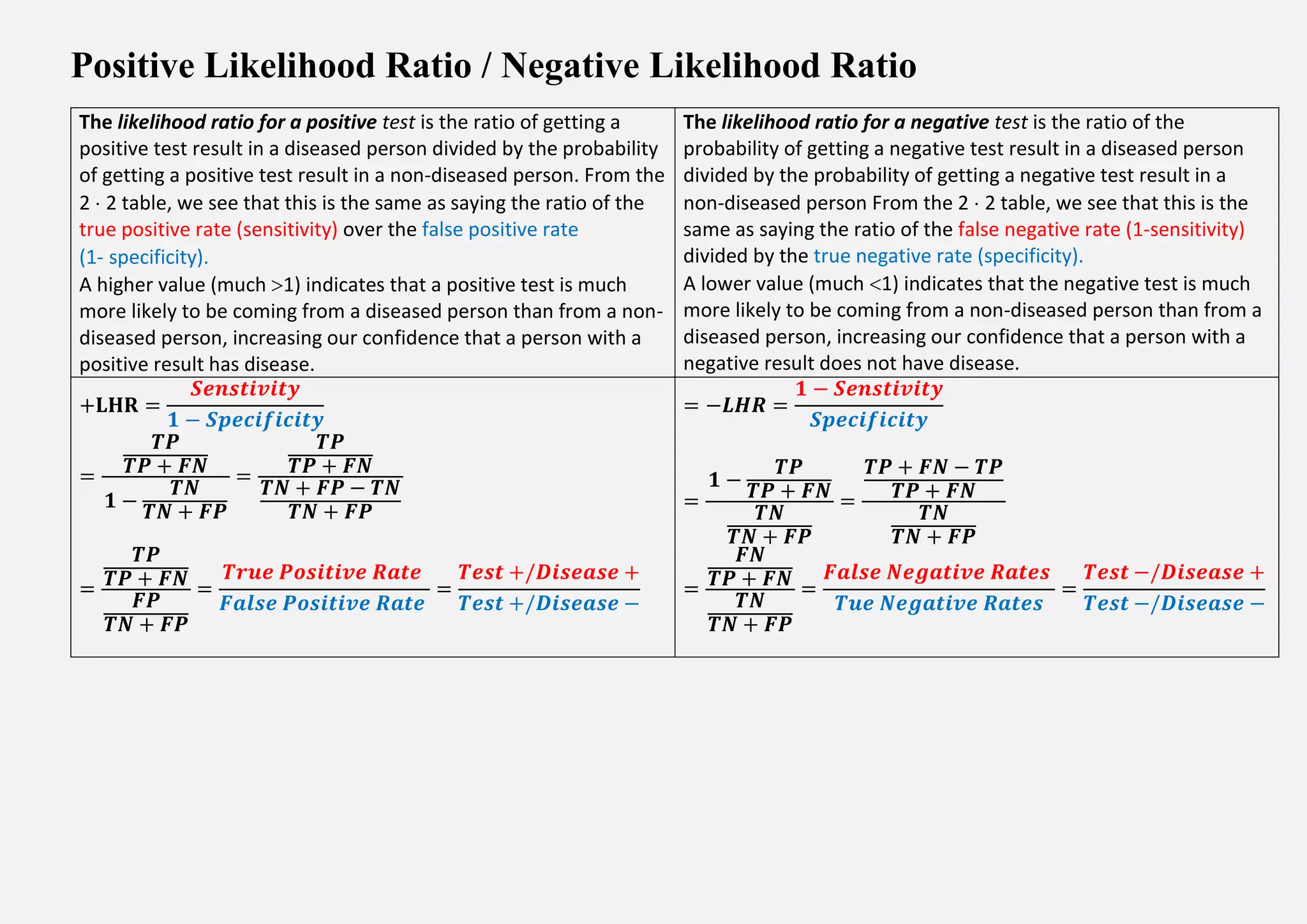
Positive Likelihood Ratio / Negative Likelihood Ratio
The likelihood ratio for a positive test is the ratio of getting a
positive test result in a diseased person divided by the probability
of getting a positive test result in a non-diseased person. From the
2  2 table, we see that this is the same as saying the ratio of the
true positive rate (sensitivity) over the false positive rate
(1- specificity).
A higher value (much 1) indicates that a positive test is much
more likely to be coming from a diseased person than from a non-
diseased person, increasing our confidence that a person with a
positive result has disease.
The likelihood ratio for a negative test is the ratio of the
probability of getting a negative test result in a diseased person
divided by the probability of getting a negative test result in a
non-diseased person From the 2  2 table, we see that this is the
same as saying the ratio of the false negative rate (1-sensitivity)
divided by the true negative rate (specificity).
A lower value (much 1) indicates that the negative test is much
more likely to be coming from a non-diseased person than from a
diseased person, increasing our confidence that a person with a
negative result does not have disease.
+𝐋𝐇𝐑 =
𝑺𝒆𝒏𝒔𝒕𝒊𝒗𝒊𝒕𝒚
𝟏 − 𝑺𝒑𝒆𝒄𝒊𝒇𝒊𝒄𝒊𝒕𝒚
=
𝑻𝑷
𝑻𝑷 + 𝑭𝑵
𝟏 −
𝑻𝑵
𝑻𝑵 + 𝑭𝑷
=
𝑻𝑷
𝑻𝑷 + 𝑭𝑵
𝑻𝑵 + 𝑭𝑷 − 𝑻𝑵
𝑻𝑵 + 𝑭𝑷
=
𝑻𝑷
𝑻𝑷 + 𝑭𝑵
𝑭𝑷
𝑻𝑵 + 𝑭𝑷
=
𝑻𝒓𝒖𝒆 𝑷𝒐𝒔𝒊𝒕𝒊𝒗𝒆 𝑹𝒂𝒕𝒆
𝑭𝒂𝒍𝒔𝒆 𝑷𝒐𝒔𝒊𝒕𝒊𝒗𝒆 𝑹𝒂𝒕𝒆
=
𝑻𝒆𝒔𝒕 +/𝑫𝒊𝒔𝒆𝒂𝒔𝒆 +
𝑻𝒆𝒔𝒕 +/𝑫𝒊𝒔𝒆𝒂𝒔𝒆 −
= −𝑳𝑯𝑹 =
𝟏 − 𝑺𝒆𝒏𝒔𝒕𝒊𝒗𝒊𝒕𝒚
𝑺𝒑𝒆𝒄𝒊𝒇𝒊𝒄𝒊𝒕𝒚
=
𝟏 −
𝑻𝑷
𝑻𝑷 + 𝑭𝑵
𝑻𝑵
𝑻𝑵 + 𝑭𝑷
=
𝑻𝑷 + 𝑭𝑵 − 𝑻𝑷
𝑻𝑷 + 𝑭𝑵
𝑻𝑵
𝑻𝑵 + 𝑭𝑷
=
𝑭𝑵
𝑻𝑷 + 𝑭𝑵
𝑻𝑵
𝑻𝑵 + 𝑭𝑷
=
𝑭𝒂𝒍𝒔𝒆 𝑵𝒆𝒈𝒂𝒕𝒊𝒗𝒆 𝑹𝒂𝒕𝒆𝒔
𝑻𝒖𝒆 𝑵𝒆𝒈𝒂𝒕𝒊𝒗𝒆 𝑹𝒂𝒕𝒆𝒔
=
𝑻𝒆𝒔𝒕 −/𝑫𝒊𝒔𝒆𝒂𝒔𝒆 +
𝑻𝒆𝒔𝒕 −/𝑫𝒊𝒔𝒆𝒂𝒔𝒆 −
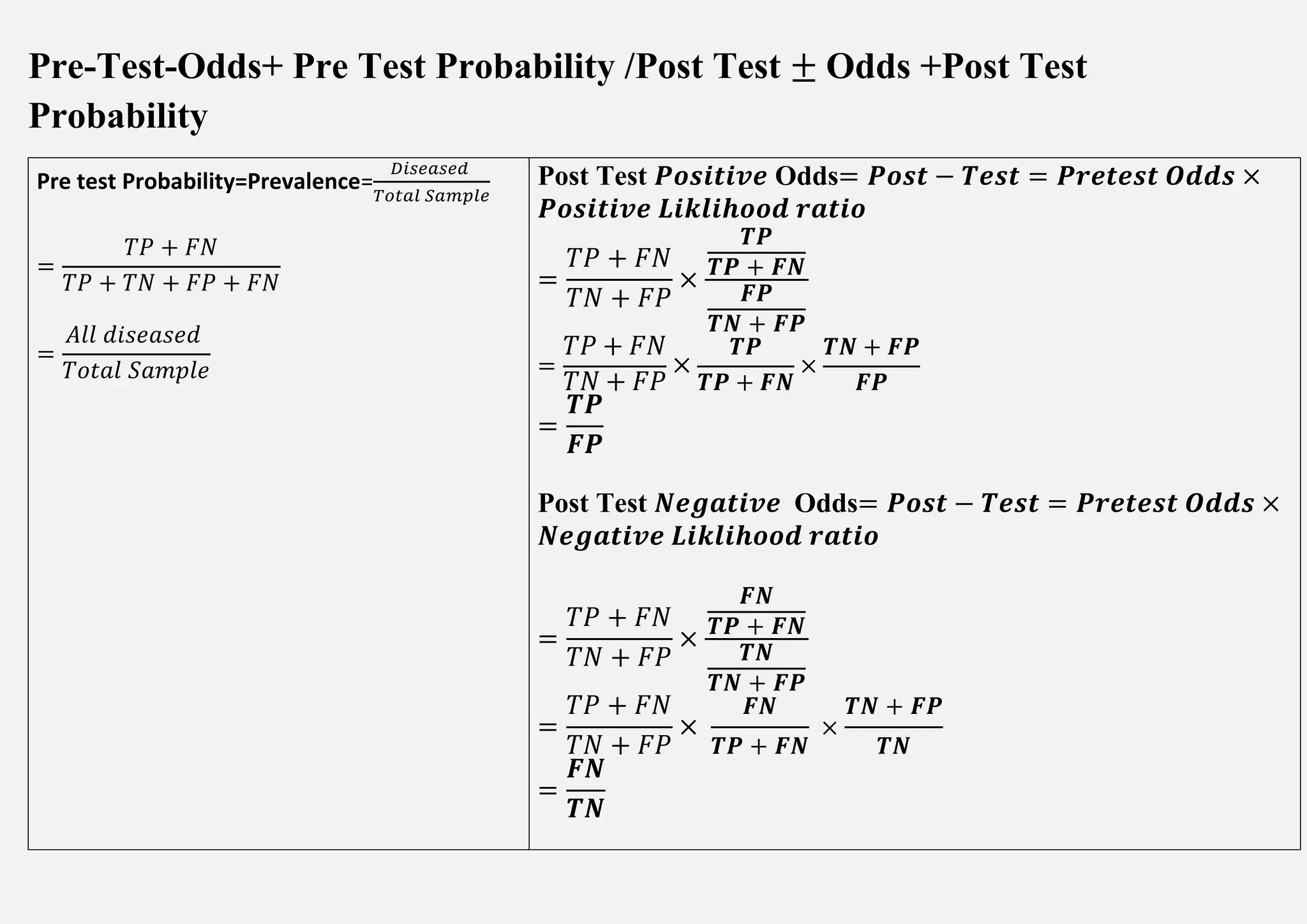
Pre-Test-Odds+ Pre Test Probability /Post Test ± Odds +Post Test
Probability
Pre test Probability=Prevalence=
𝐷𝑖𝑠𝑒𝑎𝑠𝑒𝑑
𝑇𝑜𝑡𝑎𝑙 𝑆𝑎𝑚𝑝𝑙𝑒
=
𝑇𝑃 + 𝐹𝑁
𝑇𝑃 + 𝑇𝑁 + 𝐹𝑃 + 𝐹𝑁
=
𝐴𝑙𝑙 𝑑𝑖𝑠𝑒𝑎𝑠𝑒𝑑
𝑇𝑜𝑡𝑎𝑙 𝑆𝑎𝑚𝑝𝑙𝑒
Post Test 𝑷𝒐𝒔𝒊𝒕𝒊𝒗𝒆 Odds= 𝑷𝒐𝒔𝒕 − 𝑻𝒆𝒔𝒕 = 𝑷𝒓𝒆𝒕𝒆𝒔𝒕 𝑶𝒅𝒅𝒔 ×
𝑷𝒐𝒔𝒊𝒕𝒊𝒗𝒆 𝑳𝒊𝒌𝒍𝒊𝒉𝒐𝒐𝒅 𝒓𝒂𝒕𝒊𝒐
=
𝑇𝑃 + 𝐹𝑁
𝑇𝑁 + 𝐹𝑃
×
𝑻𝑷
𝑻𝑷 + 𝑭𝑵
𝑭𝑷
𝑻𝑵 + 𝑭𝑷
=
𝑇𝑃 + 𝐹𝑁
𝑇𝑁 + 𝐹𝑃
×
𝑻𝑷
𝑻𝑷 + 𝑭𝑵
×
𝑻𝑵 + 𝑭𝑷
𝑭𝑷
=
𝑻𝑷
𝑭𝑷
Post Test 𝑵𝒆𝒈𝒂𝒕𝒊𝒗𝒆 Odds= 𝑷𝒐𝒔𝒕 − 𝑻𝒆𝒔𝒕 = 𝑷𝒓𝒆𝒕𝒆𝒔𝒕 𝑶𝒅𝒅𝒔 ×
𝑵𝒆𝒈𝒂𝒕𝒊𝒗𝒆 𝑳𝒊𝒌𝒍𝒊𝒉𝒐𝒐𝒅 𝒓𝒂𝒕𝒊𝒐
=
𝑇𝑃 + 𝐹𝑁
𝑇𝑁 + 𝐹𝑃
×
𝑭𝑵
𝑻𝑷 + 𝑭𝑵
𝑻𝑵
𝑻𝑵 + 𝑭𝑷
=
𝑇𝑃 + 𝐹𝑁
𝑇𝑁 + 𝐹𝑃
×
𝑭𝑵
𝑻𝑷 + 𝑭𝑵
×
𝑻𝑵 + 𝑭𝑷
𝑻𝑵
=
𝑭𝑵
𝑻𝑵
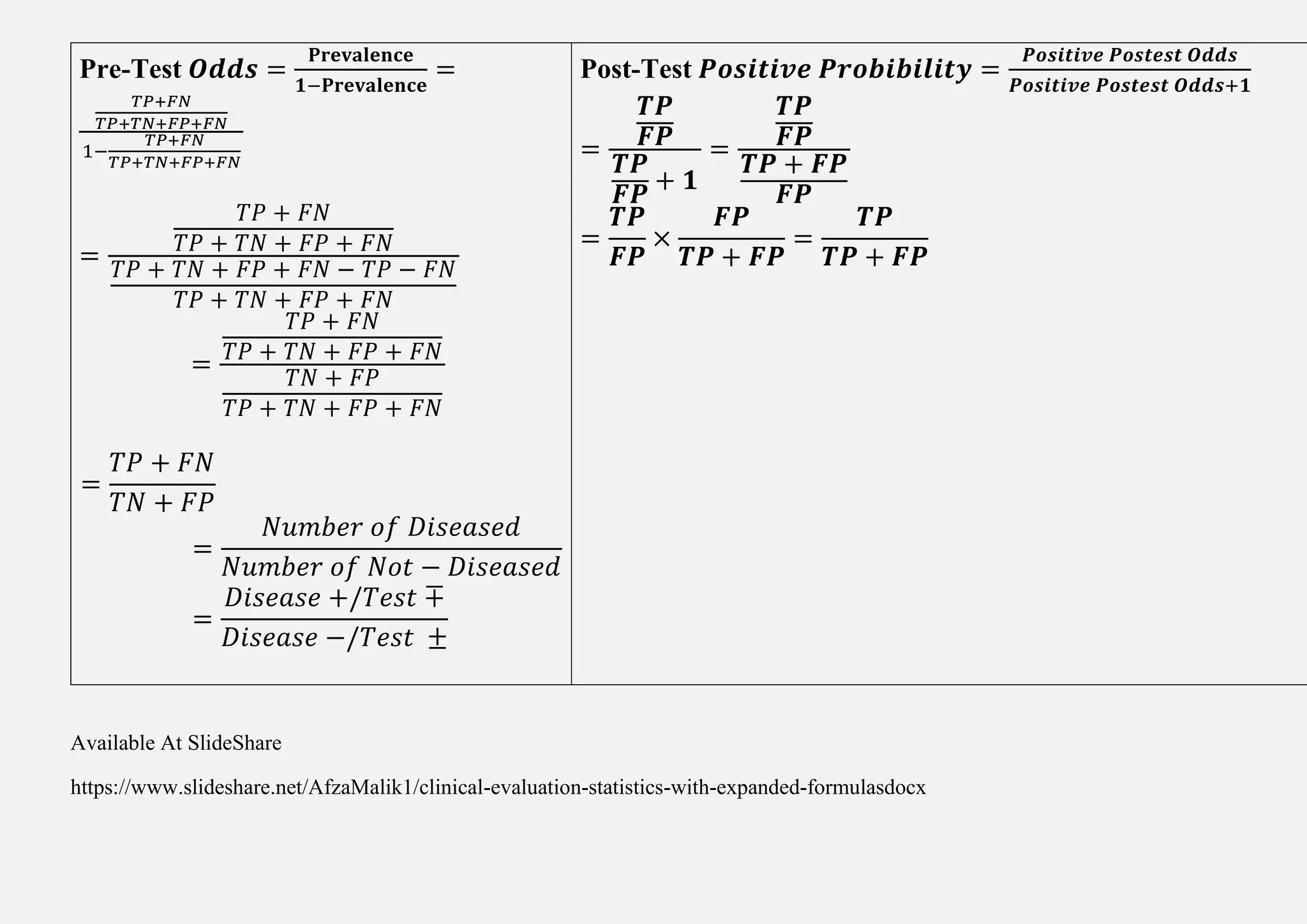
Pre-Test 𝑶𝒅𝒅𝒔 =
𝐏𝐫𝐞𝐯𝐚𝐥𝐞𝐧𝐜𝐞
𝟏−𝐏𝐫𝐞𝐯𝐚𝐥𝐞𝐧𝐜𝐞
=
𝑇𝑃+𝐹𝑁
𝑇𝑃+𝑇𝑁+𝐹𝑃+𝐹𝑁
1−
𝑇𝑃+𝐹𝑁
𝑇𝑃+𝑇𝑁+𝐹𝑃+𝐹𝑁
=
𝑇𝑃 + 𝐹𝑁
𝑇𝑃 + 𝑇𝑁 + 𝐹𝑃 + 𝐹𝑁
𝑇𝑃 + 𝑇𝑁 + 𝐹𝑃 + 𝐹𝑁 − 𝑇𝑃 − 𝐹𝑁
𝑇𝑃 + 𝑇𝑁 + 𝐹𝑃 + 𝐹𝑁
=
𝑇𝑃 + 𝐹𝑁
𝑇𝑃 + 𝑇𝑁 + 𝐹𝑃 + 𝐹𝑁
𝑇𝑁 + 𝐹𝑃
𝑇𝑃 + 𝑇𝑁 + 𝐹𝑃 + 𝐹𝑁
=
𝑇𝑃 + 𝐹𝑁
𝑇𝑁 + 𝐹𝑃
=
𝑁𝑢𝑚𝑏𝑒𝑟 𝑜𝑓 𝐷𝑖𝑠𝑒𝑎𝑠𝑒𝑑
𝑁𝑢𝑚𝑏𝑒𝑟 𝑜𝑓 𝑁𝑜𝑡 − 𝐷𝑖𝑠𝑒𝑎𝑠𝑒𝑑
=
𝐷𝑖𝑠𝑒𝑎𝑠𝑒 +/𝑇𝑒𝑠𝑡 ∓
𝐷𝑖𝑠𝑒𝑎𝑠𝑒 −/𝑇𝑒𝑠𝑡 ±
Post-Test 𝑷𝒐𝒔𝒊𝒕𝒊𝒗𝒆 𝑷𝒓𝒐𝒃𝒊𝒃𝒊𝒍𝒊𝒕𝒚 =
𝑷𝒐𝒔𝒊𝒕𝒊𝒗𝒆 𝑷𝒐𝒔𝒕𝒆𝒔𝒕 𝑶𝒅𝒅𝒔
𝑷𝒐𝒔𝒊𝒕𝒊𝒗𝒆 𝑷𝒐𝒔𝒕𝒆𝒔𝒕 𝑶𝒅𝒅𝒔+𝟏
=
𝑻𝑷
𝑭𝑷
𝑻𝑷
𝑭𝑷
+ 𝟏
=
𝑻𝑷
𝑭𝑷
𝑻𝑷 + 𝑭𝑷
𝑭𝑷
=
𝑻𝑷
𝑭𝑷
×
𝑭𝑷
𝑻𝑷 + 𝑭𝑷
=
𝑻𝑷
𝑻𝑷 + 𝑭𝑷
Available At SlideShare
https://www.slideshare.net/AfzaMalik1/clinical-evaluation-statistics-with-expanded-formulasdocx

Clinical evaluation Statistics with expanded formulas.pdf

  • 1.
    Clinical Evaluation Statisticswith Expended Formulas 𝑆𝑒𝑛𝑠𝑡𝑖𝑣𝑖𝑡𝑦 = 𝑇𝑃 𝑇𝑃+𝐹𝑁 = 𝑎 𝑎+𝑐 𝑆𝑝𝑒𝑐𝑖𝑓𝑖𝑐𝑖𝑡𝑦 = 𝑇𝑁 𝑇𝑁+𝐹𝑃 = 𝑑 𝑑+𝑏 Test Result P Disease No Disease Total a = TP b = FP TP+FP = a+b N c = FN d = TN FN+TN = c+d TP+FN = a+c FP+TN = b+d a+b+c+d = TP+FN+FP+TN 𝑆𝑒𝑛𝑠𝑡𝑖𝑣𝑖𝑡𝑦 𝑆𝑝𝑒𝑐𝑖𝑓𝑖𝑐𝑖𝑡𝑦 Prevalence PPV NPV Prevalence PPV NPV 𝑃𝑃𝑉 = 𝑇𝑃 𝑇𝑂+𝐹𝑃 = 𝑎 𝑎+𝑏 𝑁𝑃𝑉 = 𝑇𝑁 𝑇𝑁 + 𝐹𝑁 = 𝑑 𝑑 + 𝑐 Important for Post- Test Probability Prevalence= 𝐷𝑖𝑠𝑒𝑎𝑠𝑒𝑑 𝑇𝑜𝑡𝑎𝑙 𝑆𝑎𝑚𝑝𝑙𝑒 = 𝑇𝑃+𝐹𝑁 𝑇𝑃+𝑇𝑁+𝐹𝑃+𝐹𝑁
  • 2.
    Sensitivity / Specificity Sensitivityis the probability that a person with disease has a positive test. Sensitivity is also known as the true positive rate. Specificity is the probability that a non-diseased person has a negative test. Specificity is also known as the true negative rate. 𝑆𝑒𝑛𝑠𝑡𝑖𝑣𝑖𝑡𝑦 = 𝑇𝑃 𝑇𝑃 + 𝐹𝑁 × 100 = 𝑎 𝑎 + 𝑐 = 𝑇𝑟𝑢𝑒 𝑃𝑜𝑠𝑖𝑡𝑖𝑣𝑒 𝑅𝑎𝑡𝑒 = 𝑇𝑟𝑢𝑒 𝑃𝑜𝑠𝑖𝑡𝑖𝑣𝑒 𝑇𝑟𝑢𝑒 𝑃𝑜𝑠𝑖𝑡𝑖𝑣𝑒 + 𝐹𝑎𝑙𝑠𝑒 𝑁𝑒𝑔𝑎𝑡𝑖𝑣𝑒 = 𝐷𝑖𝑠𝑒𝑎𝑠𝑒 𝑃𝑟𝑒𝑠𝑒𝑛𝑡 𝑇𝑒𝑠𝑡 𝑃𝑜𝑠𝑖𝑡𝑖𝑣𝑒 𝐷𝑖𝑠𝑒𝑎𝑠𝑒 𝑃𝑟𝑒𝑠𝑒𝑛𝑡 𝑇𝑒𝑠𝑡𝑠 𝑃𝑜𝑠𝑖𝑡𝑖𝑣𝑒 + 𝐷𝑖𝑠𝑒𝑎𝑠𝑒 𝑃𝑟𝑒𝑠𝑠𝑒𝑛𝑡 𝑇𝑒𝑠𝑡 𝑁𝑒𝑔𝑎𝑡𝑖𝑣𝑒 = 𝐷𝑒𝑡𝑒𝑐𝑡𝑒𝑑 𝑃𝑜𝑠𝑖𝑡𝑖𝑣𝑒 𝐴𝑙𝑙 𝑃𝑜𝑠𝑖𝑡𝑖𝑣𝑒 𝑢𝑛𝑑𝑒𝑟 𝑠𝑡𝑢𝑑𝑦 = 𝐷𝑖𝑠𝑒𝑎𝑠𝑒𝑑 𝑇𝑒𝑠𝑡 𝑅𝑒𝑠𝑢𝑙𝑡𝑠 𝑃𝑜𝑠𝑖𝑡𝑖𝑣𝑒 = 𝐻𝑜𝑤 𝑚𝑢𝑐ℎ 𝑎𝑟𝑒 𝑡𝑟𝑢𝑒 𝑝𝑜𝑖𝑠𝑖𝑡𝑖𝑣𝑒 𝑆𝑝𝑒𝑐𝑖𝑓𝑖𝑐𝑖𝑡𝑦 = 𝑇𝑁 𝑇𝑁 + 𝐹𝑃 × 100 = 𝑑 𝑑 + 𝑏 = 𝑇𝑟𝑢𝑒 𝑁𝑎𝑔𝑡𝑖𝑣𝑒 𝑅𝑎𝑡𝑒 = 𝑇𝑟𝑢𝑒 𝑁𝑒𝑔𝑎𝑡𝑖𝑣𝑒 𝑇𝑟𝑢𝑒 𝑁𝑒𝑔𝑎𝑡𝑖𝑣𝑒 + 𝐹𝑎𝑙𝑠𝑒 𝑃𝑜𝑠𝑖𝑡𝑖𝑣𝑒 = 𝑁𝑜𝑛−𝐷𝑖𝑠𝑒𝑎𝑠𝑒 𝑇𝑒𝑠𝑡 𝑁𝑒𝑔𝑎𝑡𝑖𝑣𝑒 𝑁𝑜𝑛−𝐷𝑖𝑠𝑒𝑎𝑠𝑒 𝑇𝑒𝑠𝑡 𝑁𝑒𝑔𝑎𝑡𝑖𝑣𝑒+𝑁𝑜𝑛−𝐷𝑖𝑠𝑒𝑎𝑠𝑒 𝑇𝑒𝑠𝑡 𝑃𝑜𝑠𝑖𝑡𝑖𝑣𝑒 = 𝐷𝑒𝑡𝑒𝑐𝑡𝑒𝑑 𝑁𝑒𝑔𝑎𝑡𝑖𝑣𝑒 𝐴𝑙𝑙 𝑁𝑒𝑔𝑎𝑡𝑖𝑣𝑒 𝑖𝑛 𝑢𝑛𝑑𝑒𝑟 𝑠𝑡𝑢𝑑𝑦 = 𝑁𝑜𝑛 − 𝐷𝑖𝑠𝑒𝑎𝑠𝑒𝑑 𝑇𝑒𝑠𝑡 𝑅𝑒𝑠𝑢𝑙𝑡𝑠 𝑁𝑒𝑔𝑎𝑡𝑖𝑣𝑒 = 𝐻𝑜𝑤 𝑀𝑢𝑐ℎ 𝑎𝑟𝑒 𝑇𝑟𝑢𝑒 𝑁𝑒𝑔𝑎𝑡𝑖𝑣𝑒 SnNOUT—a Sensitive test with a Negative result (False Negative) rule OUT disease. SpPIN—a Specific test with a Positive result (False Positive) rules IN disease
  • 3.
    Positive Predicted Value/NegativePredicted Value Positive Predicted Value: (PPV) is the probability that a person with a positive test has disease. Negative Predicted Value :(NPV) is the probability that a person with a negative test does not have disease. 𝑃𝑃𝑉 = 𝑇𝑃 𝑇𝑃 + 𝐹𝑃 = 𝑎 𝑎 + 𝑏 = 𝑇𝑟𝑢𝑒 𝑃𝑜𝑠𝑖𝑡𝑖𝑣𝑒 𝑇𝑢𝑟𝑒 𝑃𝑜𝑠𝑖𝑡𝑖𝑣𝑒 + 𝐹𝑎𝑙𝑠𝑒 𝑃𝑜𝑠𝑖𝑡𝑖𝑣𝑒 = 𝑇𝑒𝑠𝑡 𝑝𝑜𝑠𝑖𝑡𝑖𝑣𝑒 𝐷𝑖𝑠𝑒𝑎𝑠𝑒 𝑃𝑟𝑒𝑠𝑒𝑛𝑡 𝑇𝑒𝑠𝑡 𝑝𝑜𝑠𝑖𝑡𝑖𝑣𝑒 𝐷𝑖𝑠𝑒𝑎𝑠𝑒 𝑃𝑟𝑒𝑠𝑒𝑛𝑡 + 𝑇𝑒𝑠𝑡 𝑃𝑜𝑠𝑖𝑡𝑖𝑣𝑒 𝑁𝑜𝑛 − 𝐷𝑖𝑠𝑒𝑎𝑠𝑒 = 𝐷𝑖𝑠𝑒𝑎𝑠𝑒𝑑 𝑃𝑜𝑠𝑖𝑡𝑖𝑣𝑒 𝑇𝑒𝑠𝑡 𝑅𝑒𝑠𝑢𝑙𝑡𝑠 𝑁𝑃𝑉 = 𝑇𝑁 𝑇𝑁 + 𝐹𝑁 = 𝑑 𝑑 + 𝑐 = 𝑇𝑟𝑢𝑒 𝑁𝑒𝑔𝑎𝑡𝑖𝑣𝑒 𝑇𝑟𝑢𝑒 𝑁𝑒𝑔𝑎𝑡𝑖𝑣𝑒 + 𝐹𝑎𝑙𝑠𝑒 𝑁𝑒𝑔𝑎𝑡𝑖𝑣𝑒 = 𝑇𝑒𝑠𝑡 𝑁𝑒𝑔𝑎𝑡𝑖𝑣𝑒 𝑁𝑜𝑛 𝐷𝑖𝑠𝑒𝑎𝑠𝑒 𝑇𝑒𝑠𝑡 𝑁𝑒𝑔𝑎𝑡𝑖𝑣𝑒 𝑁𝑜𝑛 𝐷𝑖𝑠𝑒𝑎𝑠𝑒 + 𝑇𝑒𝑠𝑡 𝑁𝑒𝑔𝑎𝑡𝑖𝑣𝑒 𝐷𝑖𝑠𝑒𝑎𝑠𝑒 = 𝑁𝑜𝑛 − 𝐷𝑖𝑠𝑒𝑎𝑠𝑒 𝑁𝑒𝑔𝑎𝑡𝑖𝑣𝑒 𝑇𝑒𝑠𝑡 𝑅𝑒𝑠𝑢𝑙𝑡𝑠 Prevalence Prevalence: Prevalence refers to the total number of individuals in a population who have a disease or health condition at a specific period of time, usually expressed as a percentage of the Sample. Pre test Probability=Prevalence= 𝐷𝑖𝑠𝑒𝑎𝑠𝑒𝑑 𝑇𝑜𝑡𝑎𝑙 𝑆𝑎𝑚𝑝𝑙𝑒 = 𝑇𝑃 + 𝐹𝑁 𝑇𝑃 + 𝑇𝑁 + 𝐹𝑃 + 𝐹𝑁 = 𝐻𝑎𝑣𝑒 𝐷𝑖𝑠𝑒𝑎𝑠𝑒 𝑇𝑒𝑠𝑡𝑠 𝑃𝑜𝑠𝑖𝑡𝑖𝑣𝑒 + 𝐻𝑎𝑣𝑒 𝐷𝑖𝑠𝑒𝑎𝑠𝑒 𝑇𝑒𝑠𝑡𝑠 𝑁𝑒𝑔𝑎𝑡𝑖𝑣𝑒 𝑇𝑜𝑡𝑎𝑙 𝑆𝑎𝑚𝑝𝑙𝑒 = 𝐴𝑙𝑙 𝑑𝑖𝑠𝑒𝑎𝑠𝑒𝑑 𝑇𝑜𝑡𝑎𝑙 𝑆𝑎𝑚𝑝𝑙𝑒
  • 4.
    Accuracy Accuracy is thedegree of degree to true values. over all outcomes Accuracy = 𝑎 + 𝑑 𝑎 + 𝑏 + 𝑐 + 𝑑 = 𝑇𝑃 + 𝑇𝑁 𝑇𝑃 + 𝑇𝑁 + 𝐹𝑃 + 𝐹𝑁 = 𝑻𝒆𝒔𝒓 𝑷𝒐𝒔𝒊𝒕𝒊𝒗𝒆 𝒅𝒊𝒔𝒆𝒂𝒔𝒆 𝒑𝒓𝒆𝒔𝒆𝒏𝒕 + 𝑻𝒆𝒔𝒕 𝑵𝒆𝒈𝒂𝒕𝒊𝒗𝒆 𝑵𝒐𝒏 − 𝑫𝒊𝒔𝒆𝒂𝒔𝒆 𝑨𝒍𝒍 𝑻𝒆𝒔𝒕 𝑹𝒆𝒔𝒖𝒍𝒕𝒔 = 𝑻𝒓𝒖𝒆 𝑶𝒖𝒕𝒄𝒐𝒎𝒆𝒔 𝑻𝒐𝒕𝒂𝒍 𝑶𝒖𝒕𝒄𝒐𝒎𝒆𝒔
  • 5.
    Positive Likelihood Ratio/ Negative Likelihood Ratio The likelihood ratio for a positive test is the ratio of getting a positive test result in a diseased person divided by the probability of getting a positive test result in a non-diseased person. From the 2  2 table, we see that this is the same as saying the ratio of the true positive rate (sensitivity) over the false positive rate (1- specificity). A higher value (much 1) indicates that a positive test is much more likely to be coming from a diseased person than from a non- diseased person, increasing our confidence that a person with a positive result has disease. The likelihood ratio for a negative test is the ratio of the probability of getting a negative test result in a diseased person divided by the probability of getting a negative test result in a non-diseased person From the 2  2 table, we see that this is the same as saying the ratio of the false negative rate (1-sensitivity) divided by the true negative rate (specificity). A lower value (much 1) indicates that the negative test is much more likely to be coming from a non-diseased person than from a diseased person, increasing our confidence that a person with a negative result does not have disease. +𝐋𝐇𝐑 = 𝑺𝒆𝒏𝒔𝒕𝒊𝒗𝒊𝒕𝒚 𝟏 − 𝑺𝒑𝒆𝒄𝒊𝒇𝒊𝒄𝒊𝒕𝒚 = 𝑻𝑷 𝑻𝑷 + 𝑭𝑵 𝟏 − 𝑻𝑵 𝑻𝑵 + 𝑭𝑷 = 𝑻𝑷 𝑻𝑷 + 𝑭𝑵 𝑻𝑵 + 𝑭𝑷 − 𝑻𝑵 𝑻𝑵 + 𝑭𝑷 = 𝑻𝑷 𝑻𝑷 + 𝑭𝑵 𝑭𝑷 𝑻𝑵 + 𝑭𝑷 = 𝑻𝒓𝒖𝒆 𝑷𝒐𝒔𝒊𝒕𝒊𝒗𝒆 𝑹𝒂𝒕𝒆 𝑭𝒂𝒍𝒔𝒆 𝑷𝒐𝒔𝒊𝒕𝒊𝒗𝒆 𝑹𝒂𝒕𝒆 = 𝑻𝒆𝒔𝒕 +/𝑫𝒊𝒔𝒆𝒂𝒔𝒆 + 𝑻𝒆𝒔𝒕 +/𝑫𝒊𝒔𝒆𝒂𝒔𝒆 − = −𝑳𝑯𝑹 = 𝟏 − 𝑺𝒆𝒏𝒔𝒕𝒊𝒗𝒊𝒕𝒚 𝑺𝒑𝒆𝒄𝒊𝒇𝒊𝒄𝒊𝒕𝒚 = 𝟏 − 𝑻𝑷 𝑻𝑷 + 𝑭𝑵 𝑻𝑵 𝑻𝑵 + 𝑭𝑷 = 𝑻𝑷 + 𝑭𝑵 − 𝑻𝑷 𝑻𝑷 + 𝑭𝑵 𝑻𝑵 𝑻𝑵 + 𝑭𝑷 = 𝑭𝑵 𝑻𝑷 + 𝑭𝑵 𝑻𝑵 𝑻𝑵 + 𝑭𝑷 = 𝑭𝒂𝒍𝒔𝒆 𝑵𝒆𝒈𝒂𝒕𝒊𝒗𝒆 𝑹𝒂𝒕𝒆𝒔 𝑻𝒖𝒆 𝑵𝒆𝒈𝒂𝒕𝒊𝒗𝒆 𝑹𝒂𝒕𝒆𝒔 = 𝑻𝒆𝒔𝒕 −/𝑫𝒊𝒔𝒆𝒂𝒔𝒆 + 𝑻𝒆𝒔𝒕 −/𝑫𝒊𝒔𝒆𝒂𝒔𝒆 −
  • 6.
    Pre-Test-Odds+ Pre TestProbability /Post Test ± Odds +Post Test Probability Pre test Probability=Prevalence= 𝐷𝑖𝑠𝑒𝑎𝑠𝑒𝑑 𝑇𝑜𝑡𝑎𝑙 𝑆𝑎𝑚𝑝𝑙𝑒 = 𝑇𝑃 + 𝐹𝑁 𝑇𝑃 + 𝑇𝑁 + 𝐹𝑃 + 𝐹𝑁 = 𝐴𝑙𝑙 𝑑𝑖𝑠𝑒𝑎𝑠𝑒𝑑 𝑇𝑜𝑡𝑎𝑙 𝑆𝑎𝑚𝑝𝑙𝑒 Post Test 𝑷𝒐𝒔𝒊𝒕𝒊𝒗𝒆 Odds= 𝑷𝒐𝒔𝒕 − 𝑻𝒆𝒔𝒕 = 𝑷𝒓𝒆𝒕𝒆𝒔𝒕 𝑶𝒅𝒅𝒔 × 𝑷𝒐𝒔𝒊𝒕𝒊𝒗𝒆 𝑳𝒊𝒌𝒍𝒊𝒉𝒐𝒐𝒅 𝒓𝒂𝒕𝒊𝒐 = 𝑇𝑃 + 𝐹𝑁 𝑇𝑁 + 𝐹𝑃 × 𝑻𝑷 𝑻𝑷 + 𝑭𝑵 𝑭𝑷 𝑻𝑵 + 𝑭𝑷 = 𝑇𝑃 + 𝐹𝑁 𝑇𝑁 + 𝐹𝑃 × 𝑻𝑷 𝑻𝑷 + 𝑭𝑵 × 𝑻𝑵 + 𝑭𝑷 𝑭𝑷 = 𝑻𝑷 𝑭𝑷 Post Test 𝑵𝒆𝒈𝒂𝒕𝒊𝒗𝒆 Odds= 𝑷𝒐𝒔𝒕 − 𝑻𝒆𝒔𝒕 = 𝑷𝒓𝒆𝒕𝒆𝒔𝒕 𝑶𝒅𝒅𝒔 × 𝑵𝒆𝒈𝒂𝒕𝒊𝒗𝒆 𝑳𝒊𝒌𝒍𝒊𝒉𝒐𝒐𝒅 𝒓𝒂𝒕𝒊𝒐 = 𝑇𝑃 + 𝐹𝑁 𝑇𝑁 + 𝐹𝑃 × 𝑭𝑵 𝑻𝑷 + 𝑭𝑵 𝑻𝑵 𝑻𝑵 + 𝑭𝑷 = 𝑇𝑃 + 𝐹𝑁 𝑇𝑁 + 𝐹𝑃 × 𝑭𝑵 𝑻𝑷 + 𝑭𝑵 × 𝑻𝑵 + 𝑭𝑷 𝑻𝑵 = 𝑭𝑵 𝑻𝑵
  • 7.
    Pre-Test 𝑶𝒅𝒅𝒔 = 𝐏𝐫𝐞𝐯𝐚𝐥𝐞𝐧𝐜𝐞 𝟏−𝐏𝐫𝐞𝐯𝐚𝐥𝐞𝐧𝐜𝐞 = 𝑇𝑃+𝐹𝑁 𝑇𝑃+𝑇𝑁+𝐹𝑃+𝐹𝑁 1− 𝑇𝑃+𝐹𝑁 𝑇𝑃+𝑇𝑁+𝐹𝑃+𝐹𝑁 = 𝑇𝑃+ 𝐹𝑁 𝑇𝑃 + 𝑇𝑁 + 𝐹𝑃 + 𝐹𝑁 𝑇𝑃 + 𝑇𝑁 + 𝐹𝑃 + 𝐹𝑁 − 𝑇𝑃 − 𝐹𝑁 𝑇𝑃 + 𝑇𝑁 + 𝐹𝑃 + 𝐹𝑁 = 𝑇𝑃 + 𝐹𝑁 𝑇𝑃 + 𝑇𝑁 + 𝐹𝑃 + 𝐹𝑁 𝑇𝑁 + 𝐹𝑃 𝑇𝑃 + 𝑇𝑁 + 𝐹𝑃 + 𝐹𝑁 = 𝑇𝑃 + 𝐹𝑁 𝑇𝑁 + 𝐹𝑃 = 𝑁𝑢𝑚𝑏𝑒𝑟 𝑜𝑓 𝐷𝑖𝑠𝑒𝑎𝑠𝑒𝑑 𝑁𝑢𝑚𝑏𝑒𝑟 𝑜𝑓 𝑁𝑜𝑡 − 𝐷𝑖𝑠𝑒𝑎𝑠𝑒𝑑 = 𝐷𝑖𝑠𝑒𝑎𝑠𝑒 +/𝑇𝑒𝑠𝑡 ∓ 𝐷𝑖𝑠𝑒𝑎𝑠𝑒 −/𝑇𝑒𝑠𝑡 ± Post-Test 𝑷𝒐𝒔𝒊𝒕𝒊𝒗𝒆 𝑷𝒓𝒐𝒃𝒊𝒃𝒊𝒍𝒊𝒕𝒚 = 𝑷𝒐𝒔𝒊𝒕𝒊𝒗𝒆 𝑷𝒐𝒔𝒕𝒆𝒔𝒕 𝑶𝒅𝒅𝒔 𝑷𝒐𝒔𝒊𝒕𝒊𝒗𝒆 𝑷𝒐𝒔𝒕𝒆𝒔𝒕 𝑶𝒅𝒅𝒔+𝟏 = 𝑻𝑷 𝑭𝑷 𝑻𝑷 𝑭𝑷 + 𝟏 = 𝑻𝑷 𝑭𝑷 𝑻𝑷 + 𝑭𝑷 𝑭𝑷 = 𝑻𝑷 𝑭𝑷 × 𝑭𝑷 𝑻𝑷 + 𝑭𝑷 = 𝑻𝑷 𝑻𝑷 + 𝑭𝑷 Available At SlideShare https://www.slideshare.net/AfzaMalik1/clinical-evaluation-statistics-with-expanded-formulasdocx