Biophysics Note Chapter#06 Biophysical Process
Page 1 of 42
Biophysical Process
Biomechanics
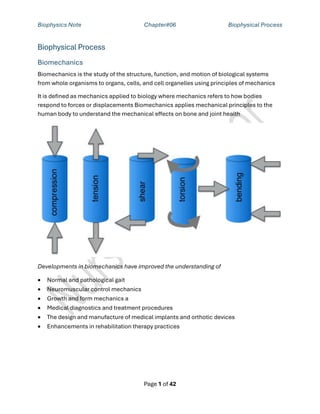
Biomechanics is the study of the structure, function, and motion of biological systems
from whole organisms to organs, cells, and cell organelles using principles of mechanics
It is defined as mechanics applied to biology where mechanics refers to how bodies
respond to forces or displacements Biomechanics applies mechanical principles to the
human body to understand the mechanical effects on bone and joint health
Developments in biomechanics have improved the understanding of
• Normal and pathological gait
• Neuromuscular control mechanics
• Growth and form mechanics a
• Medical diagnostics and treatment procedures
• The design and manufacture of medical implants and orthotic devices
• Enhancements in rehabilitation therapy practices
Biophysics Note Chapter#06 Biophysical Process
Page 2 of 42
Biophysics Note Chapter#06 Biophysical Process
Page 3 of 42
Fundamentals Of Biomechanics
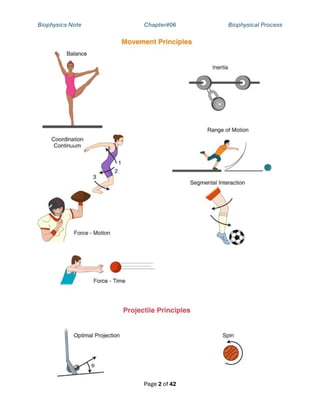
Force Motion Principle
Unbalanced forces are acting on our bodies or objects when we either create or modify
movement.
Force-Time Principle
It is not only the amount of force that can increase the motion of an object the amount of
time over which force can be applied also affects the resulting motion
Range of Motion
Overall motion used in a movement and can be specified by linear or angular motion of the
body segments. Increasing the range of motion in a movement can be an effective way to
increase speed or to gradually slow down from a high speed.
Balance Person's
Ability to control their body position relative to some base of support Stability and mobility
of body postures are inversely related
Coordination Continuum
How the muscle actions and body segment motions are timed in a human movement
Segmental Interaction
Forces acting in a system of linked rigid bodies can be transferred through the links and
joints
Optimal Projection
Optimal range of projection angles for a specific goal.
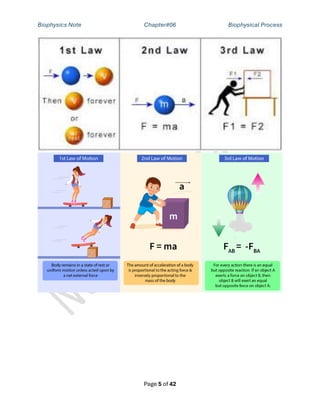
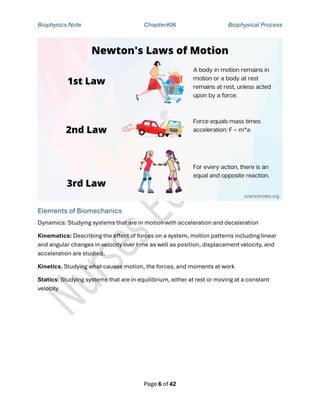
Newton's Laws Of Motions
Newton's three laws of motion are the 3 physical laws, these
1. Newton's First Law (Law of Inertia)
Newton's 1st Law of Motion states that an object at rest remains at rest, or if in motio
remains in motion at a constant velocity unless acted upon by a net external force This la
laid the foundation for classical mechanics, explaining the relationship between forces a
the bodies they act upon. Inertia, the property of matter, is central to this law. It means th
objects do not move by themselves; they require an external force to set them in motion
2. Newton's Second Law (Law of Momentum or Law of Acceleration)
Newton's 2nd Law of Motion links the forces that create motion (kinetics) to the motion its
(kinematics).
Biophysics Note Chapter#06 Biophysical Process
Page 4 of 42
The law is represented as F = ma
where:
• F is the force applied,
• m is the mass of the object,
• a is the acceleration of the object.
This law describes acceleration for any instant in time, stating that.
• The acceleration of an object is proportional to the resultant force applied.
• The acceleration is in the same direction as the force
• The acceleration is inversely proportional to the object's mass
Key implications
If the net force is doubled, the acceleration will also double
If the mass of the object is doubled, the acceleration will be halved
3. Newton's Third Law
• Newton's 3rd Law of Motion states that for every action, there is an equal and opposite
reaction.
• In every interaction, there is a pair of forces acting on the two interacting objects
• The direction of the force on the first object is opposite to the direction of the force on
the second object.
Forces always come in pairs, known as action-reaction force pairs
Biophysics Note Chapter#06 Biophysical Process
Page 5 of 42
Biophysics Note Chapter#06 Biophysical Process
Page 6 of 42
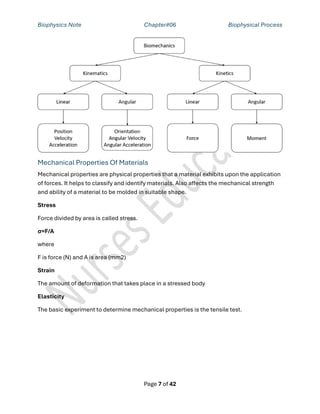
Elements of Biomechanics
Dynamics: Studying systems that are in motion with acceleration and deceleration
Kinematics: Describing the effect of forces on a system, motion patterns including linear
and angular changes in velocity over time as well as position, displacement velocity, and
acceleration are studied.
Kinetics. Studying what causes motion, the forces, and moments at work
Statics: Studying systems that are in equilibrium, either at rest or moving at a constant
velocity
Biophysics Note Chapter#06 Biophysical Process
Page 7 of 42
Mechanical Properties Of Materials
Mechanical properties are physical properties that a material exhibits upon the application
of forces. It helps to classify and identify materials. Also affects the mechanical strength
and ability of a material to be molded in suitable shape.
Stress
Force divided by area is called stress.
σ=F/A
where
F is force (N) and A is area (mm2)
Strain
The amount of deformation that takes place in a stressed body
Elasticity
The basic experiment to determine mechanical properties is the tensile test.
Biophysics Note Chapter#06 Biophysical Process
Page 8 of 42
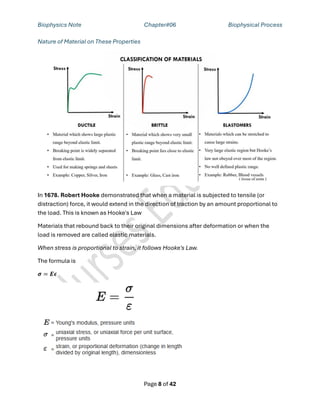
Nature of Material on These Properties
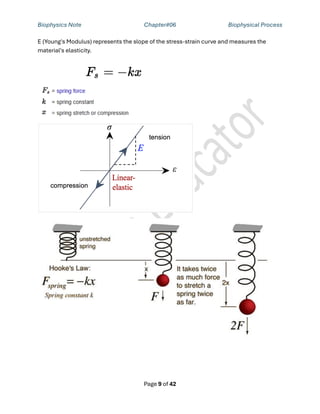
In 1678. Robert Hooke demonstrated that when a material is subjected to tensile (or
distraction) force, it would extend in the direction of traction by an amount proportional to
the load. This is known as Hooke's Law
Materials that rebound back to their original dimensions after deformation or when the
load is removed are called elastic materials.
When stress is proportional to strain, it follows Hooke's Law.
The formula is
𝝈 = 𝑬𝝐
Biophysics Note Chapter#06 Biophysical Process
Page 9 of 42
E (Young's Modulus) represents the slope of the stress-strain curve and measures the
material's elasticity.
Biophysics Note Chapter#06 Biophysical Process
Page 10 of 42
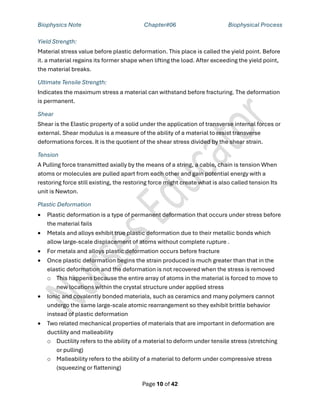
Yield Strength:
Material stress value before plastic deformation. This place is called the yield point. Before
it. a material regains its former shape when lifting the load. After exceeding the yield point,
the material breaks.
Ultimate Tensile Strength:
Indicates the maximum stress a material can withstand before fracturing. The deformation
is permanent.
Shear
Shear is the Elastic property of a solid under the application of transverse internal forces or
external. Shear modulus is a measure of the ability of a material to resist transverse
deformations forces. It is the quotient of the shear stress divided by the shear strain.
Tension
A Pulling force transmitted axially by the means of a string, a cable, chain is tension When
atoms or molecules are pulled apart from each other and gain potential energy with a
restoring force still existing, the restoring force might create what is also called tension Its
unit is Newton.
Plastic Deformation
• Plastic deformation is a type of permanent deformation that occurs under stress before
the material fails
• Metals and alloys exhibit true plastic deformation due to their metallic bonds which
allow large-scale displacement of atoms without complete rupture .
• For metals and alloys plastic deformation occurs before fracture
• Once plastic deformation begins the strain produced is much greater than that in the
elastic deformation and the deformation is not recovered when the stress is removed
o This happens because the entire array of atoms in the material is forced to move to
new locations within the crystal structure under applied stress
• Ionic and covalently bonded materials, such as ceramics and many polymers cannot
undergo the same large-scale atomic rearrangement so they exhibit brittle behavior
instead of plastic deformation
• Two related mechanical properties of materials that are important in deformation are
ductility and malleability
o Ductility refers to the ability of a material to deform under tensile stress (stretching
or pulling)
o Malleability refers to the ability of a material to deform under compressive stress
(squeezing or flattening)
Biophysics Note Chapter#06 Biophysical Process
Page 11 of 42
Ductility
Property of a solid material which indicates that how easily a material gets deformed under
tensile stress. It is expressed as a percent elongation or percent area reduction Malleability
-Property of solid materials which indicates that how easily a material gets deformed under
compressive stress.
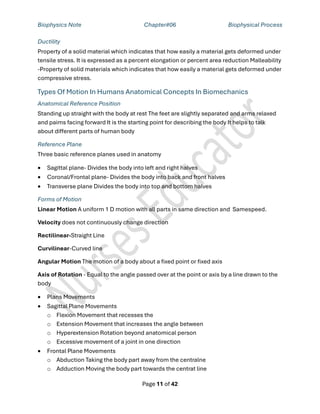
Types Of Motion In Humans Anatomical Concepts In Biomechanics
Anatomical Reference Position
Standing up straight with the body at rest The feet are slightly separated and arms relaxed
and paims facing forward It is the starting point for describing the body It helps to talk
about different parts of human body
Reference Plane
Three basic reference planes used in anatomy
• Sagittal plane- Divides the body into left and right halves
• Coronal/Frontal plane- Divides the body into back and front halves
• Transverse plane Divides the body into top and bottom halves
Forms of Motion
Linear Motion A uniform 1 D motion with all parts in same direction and Samespeed.
Velocity does not continuously change direction
Rectilinear-Straight Line
Curvilinear-Curved line
Angular Motion The motion of a body about a fixed point or fixed axis
Axis of Rotation - Equal to the angle passed over at the point or axis by a line drawn to the
body
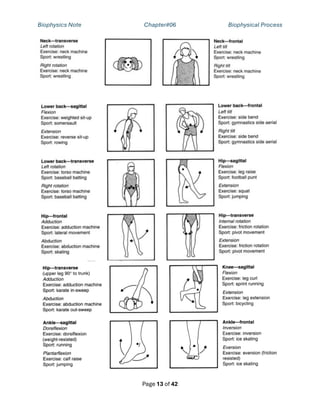
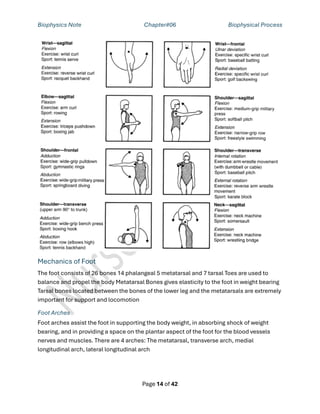
• Plans Movements
• Sagittal Plane Movements
o Flexion Movement that recesses the
o Extension Movement that increases the angle between
o Hyperextension Rotation beyond anatomical person
o Excessive movement of a joint in one direction
• Frontal Plane Movements
o Abduction Taking the body part away from the centralne
o Adduction Moving the body part towards the centrat line
Biophysics Note Chapter#06 Biophysical Process
Page 12 of 42
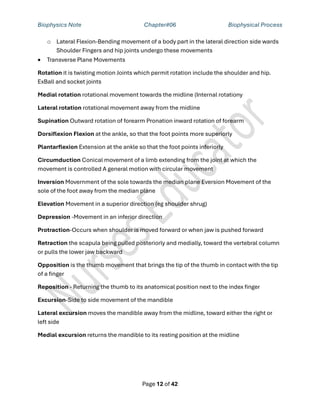
o Lateral Flexion-Bending movement of a body part in the lateral direction side wards
Shoulder Fingers and hip joints undergo these movements
• Transverse Plane Movements
Rotation it is twisting motion Joints which permit rotation include the shoulder and hip.
ExBall and socket joints
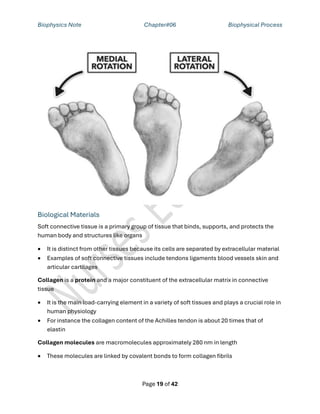
Medial rotation rotational movement towards the midline (Internal rotationy
Lateral rotation rotational movement away from the midline
Supination Outward rotation of forearm Pronation inward rotation of forearm
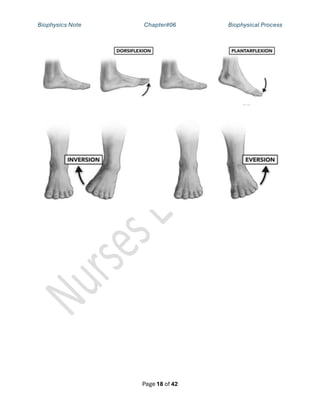
Dorsiflexion Flexion at the ankle, so that the foot points more superiorly
Plantarflexion Extension at the ankle so that the foot points inferiorly
Circumduction Conical movement of a limb extending from the joint at which the
movement is controlled A general motion with circular movement
Inversion Movernment of the sole towards the median plane Eversion Movement of the
sole of the foot away from the median plane
Elevation Movement in a superior direction (eg shoulder shrug)
Depression -Movement in an inferior direction
Protraction-Occurs when shoulder is moved forward or when jaw is pushed forward
Retraction the scapula being pulled posteriorly and medially, toward the vertebral column
or pulls the lower jaw backward
Opposition is the thumb movement that brings the tip of the thumb in contact with the tip
of a finger
Reposition - Returning the thumb to its anatomical position next to the index finger
Excursion-Side to side movement of the mandible
Lateral excursion moves the mandible away from the midline, toward either the right or
left side
Medial excursion returns the mandible to its resting position at the midline
Biophysics Note Chapter#06 Biophysical Process
Page 13 of 42
Biophysics Note Chapter#06 Biophysical Process
Page 14 of 42
Mechanics of Foot
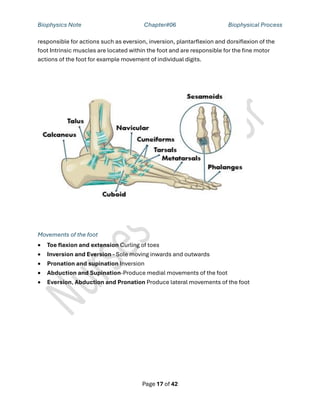
The foot consists of 26 bones 14 phalangeal 5 metatarsal and 7 tarsal Toes are used to
balance and propel the body Metatarsal Bones gives elasticity to the foot in weight bearing
Tarsal bones located between the bones of the lower leg and the metatarsals are extremely
important for support and locomotion
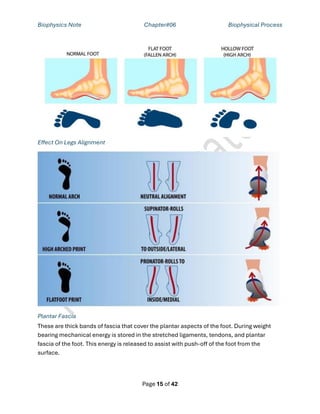
Foot Arches
Foot arches assist the foot in supporting the body weight, in absorbing shock of weight
bearing, and in providing a space on the plantar aspect of the foot for the blood vessels
nerves and muscles. There are 4 arches: The metatarsal, transverse arch, medial
longitudinal arch, lateral longitudinal arch
Biophysics Note Chapter#06 Biophysical Process
Page 15 of 42
Effect On Legs Alignment
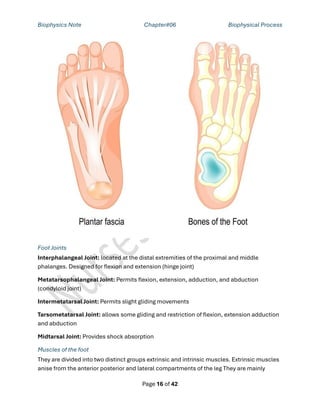
Plantar Fascia
These are thick bands of fascia that cover the plantar aspects of the foot. During weight
bearing mechanical energy is stored in the stretched ligaments, tendons, and plantar
fascia of the foot. This energy is released to assist with push-off of the foot from the
surface.
Biophysics Note Chapter#06 Biophysical Process
Page 16 of 42
Foot Joints
Interphalangeal Joint: located at the distal extremities of the proximal and middle
phalanges. Designed for flexion and extension (hinge joint)
Metatarsophalangeal Joint: Permits flexion, extension, adduction, and abduction
(condyloid joint)
Intermetatarsal Joint: Permits slight gliding movements
Tarsometatarsal Joint: allows some gliding and restriction of flexion, extension adduction
and abduction
Midtarsal Joint: Provides shock absorption
Muscles of the foot
They are divided into two distinct groups extrinsic and intrinsic muscles. Extrinsic muscles
anise from the anterior posterior and lateral compartments of the leg They are mainly
Biophysics Note Chapter#06 Biophysical Process
Page 17 of 42
responsible for actions such as eversion, inversion, plantarflexion and dorsiflexion of the
foot Intrinsic muscles are located within the foot and are responsible for the fine motor
actions of the foot for example movement of individual digits.
Movements of the foot
• Toe flexion and extension Curling of toes
• Inversion and Eversion - Sole moving inwards and outwards
• Pronation and supination Inversion
• Abduction and Supination-Produce medial movements of the foot
• Eversion, Abduction and Pronation Produce lateral movements of the foot
Biophysics Note Chapter#06 Biophysical Process
Page 18 of 42
Biophysics Note Chapter#06 Biophysical Process
Page 19 of 42
Biological Materials
Soft connective tissue is a primary group of tissue that binds, supports, and protects the
human body and structures like organs
• It is distinct from other tissues because its cells are separated by extracellular material
• Examples of soft connective tissues include tendons ligaments blood vessels skin and
articular cartilages
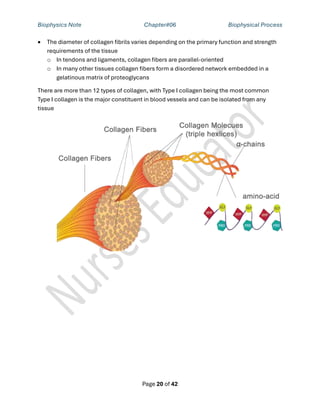
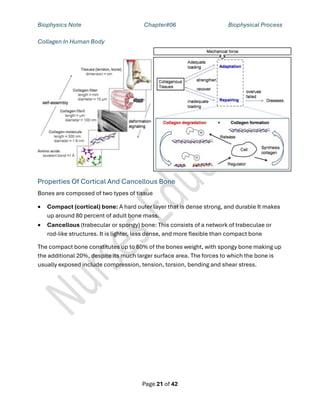
Collagen is a protein and a major constituent of the extracellular matrix in connective
tissue
• It is the main load-carrying element in a variety of soft tissues and plays a crucial role in
human physiology
• For instance the collagen content of the Achilles tendon is about 20 times that of
elastin
Collagen molecules are macromolecules approximately 280 nm in length
• These molecules are linked by covalent bonds to form collagen fibrils
Biophysics Note Chapter#06 Biophysical Process
Page 20 of 42
• The diameter of collagen fibrils varies depending on the primary function and strength
requirements of the tissue
o In tendons and ligaments, collagen fibers are parallel-oriented
o In many other tissues collagen fibers form a disordered network embedded in a
gelatinous matrix of proteoglycans
There are more than 12 types of collagen, with Type I collagen being the most common
Type I collagen is the major constituent in blood vessels and can be isolated from any
tissue
Biophysics Note Chapter#06 Biophysical Process
Page 21 of 42
Collagen In Human Body
Properties Of Cortical And Cancellous Bone
Bones are composed of two types of tissue
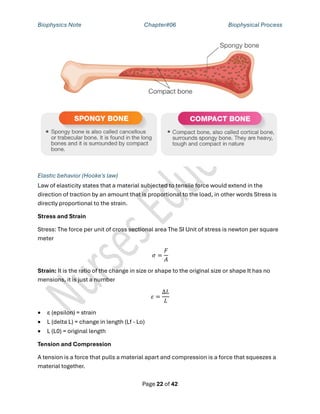
• Compact (cortical) bone: A hard outer layer that is dense strong, and durable It makes
up around 80 percent of adult bone mass.
• Cancellous (trabecular or spongy) bone: This consists of a network of trabeculae or
rod-like structures. It is lighter, less dense, and more flexible than compact bone
The compact bone constitutes up to 80% of the bones weight, with spongy bone making up
the additional 20%, despite its much larger surface area. The forces to which the bone is
usually exposed include compression, tension, torsion, bending and shear stress.
Biophysics Note Chapter#06 Biophysical Process
Page 22 of 42
Elastic behavior (Hooke's law)
Law of elasticity states that a material subjected to tensile force would extend in the
direction of traction by an amount that is proportional to the load, in other words Stress is
directly proportional to the strain.
Stress and Strain
Stress: The force per unit of cross sectional area The SI Unit of stress is newton per square
meter
𝜎 =
𝐹
𝐴
Strain: It is the ratio of the change in size or shape to the original size or shape It has no
mensions, it is just a number
𝜀 =
∆𝐿
𝐿
• ε (epsilon) = strain
• L (delta L) = change in length (Lf - Lo)
• L (L0) = original length
Tension and Compression
A tension is a force that pulls a material apart and compression is a force that squeezes a
material together.
Biophysics Note Chapter#06 Biophysical Process
Page 23 of 42
Shear
if instead of applying a force perpendicular to the surface, we apply parallel but oppo
forces on the two surfaces we are applying a shear stress
Bulk Properties
• Ductility Characteristic of a material that undergoes considerable pla deformation
under tensile load before rupture
• Brittleness-Absence of any plastic deformation prior to failure
• Malleability Characteristic of a material that undergoes considerable plan deformation
under compressive load before rupture
• Resilience- Ability of a material to absorb energy when it is deformed elastically a
release that energy upon unloading
• Toughness-property of a material enabling it to endure high-impact or shock ba ability
to absorb energy during plastic deformation
• Hardness Resistance of a material to scratching wear or penetration
Elastic Properties Of Bones
Young's Modulus
The gradient of the straight-line graph is the Young's modulus.
E is constant and does not change for a given material it in fact represents stiffness
property of the material
Fracture:
Separation of a body into pieces due to stress Depending on the ability of material to
undergo plastic deformation before the fracture two fracture modes can be defined ductile
or brittle
Ductile fracture -most metals
Ductile fracture is a type of fracture characterized by extensive deformation of plastic or
hacking This usually occurs phor to the actual fracture Crack is stable resists further
extension unless applied stress is increased
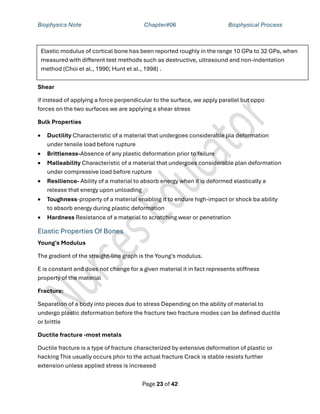
Elastic modulus of cortical bone has been reported roughly in the range 10 GPa to 32 GPa, when
measured with different test methods such as destructive, ultrasound and non-indentation
method (Choi et al., 1990; Hunt et al., 1998) .
Biophysics Note Chapter#06 Biophysical Process
Page 24 of 42
Brittle fracture
Brittle Fracture is the sudden, very rapid cracking of equipment under stress where the
maternal exhibited title or no evidence of ductility or plastic degradation before the fracture
Plastic Deformation:
At some point, the strain is no longer proportional to the applied stress At this point, bonds
with original atom neighbors start to break and reform with a new group of atoms When this
occurs and the stress is relieved, the matenal will no longer turn to its original form, ie the
deformation is permanent and non recoverable. The material has now moved into the
region referred to as plastic deformation. if produces a permanent change in the shape or
size of a solid body without fracture, resulting from the application of sustained stress
beyond the elastic limit
Bioenergetics
Bioenergetics is the study of now energy is transformed in living organisms focusing be how
they acquire and use energy to perform biological work This includes the study of
metabolic pathways that describe energy transformation in cells in living organisms
chemical bonds are broken and made during the exchange and transformation of energy
• Energy becomes available for processes like mechanical work chemical synthesis, and
anabolic processes eg growth) when weaker bonds are broken and stronger bonds are
formed
• The formation of stronger bonds allows the release of usable energy
Biophysics Note Chapter#06 Biophysical Process
Page 25 of 42
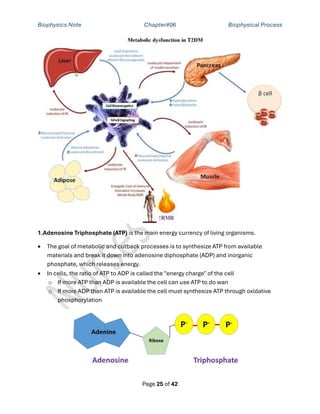
1.Adenosine Triphosphate (ATP) is the main energy currency of living organisms.
• The goal of metabolic and cutback processes is to synthesize ATP from available
materials and break it down into adenosine diphosphate (ADP) and inorganic
phosphate, which releases energy.
• In cells, the ratio of ATP to ADP is called the "energy charge" of the cell
o If more ATP than ADP is available the cell can use ATP to do wan
o If more ADP than ATP is available the cell must synthesize ATP through oxidative
phosphorylation
Biophysics Note Chapter#06 Biophysical Process
Page 26 of 42
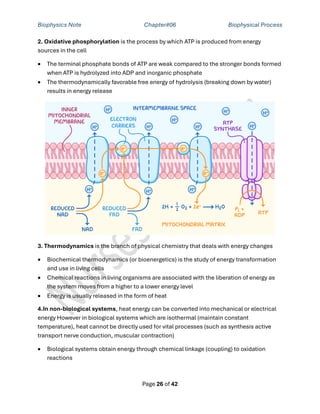
2. Oxidative phosphorylation is the process by which ATP is produced from energy
sources in the cell
• The terminal phosphate bonds of ATP are weak compared to the stronger bonds formed
when ATP is hydrolyzed into ADP and inorganic phosphate
• The thermodynamically favorable free energy of hydrolysis (breaking down by water)
results in energy release
3. Thermodynamics is the branch of physical chemistry that deals with energy changes
• Biochemical thermodynamics (or bioenergetics) is the study of energy transformation
and use in living cells
• Chemical reactions in living organisms are associated with the liberation of energy as
the system moves from a higher to a lower energy level
• Energy is usually released in the form of heat
4.In non-biological systems, heat energy can be converted into mechanical or electrical
energy However in biological systems which are isothermal (maintain constant
temperature), heat cannot be directly used for vital processes (such as synthesis active
transport nerve conduction, muscular contraction)
• Biological systems obtain energy through chemical linkage (coupling) to oxidation
reactions
Biophysics Note Chapter#06 Biophysical Process
Page 27 of 42
Concept Of Energy
Energy is defined as the capacity to do work which is the product of a given force acting
through a given distance
Work =Force x Distance
it is one of the fundamental components of any system. Energy exists in a variety of forms
such as electrical mechanical, chemical heat and light energy. These different forms of
energy are inter-convertible, for example, an electric motor converts electric into
mechanical energy, a battery changes chemical into electrical energy and a steam engine
transforms heat into mechanical energy The various forms of energy are also interrelated
quantitatively for example
1.0 calorie of heat energy = 4.185 x 10⁷ ergs of mechanical energy
Transformation Of Energy in Biological Systems
Energy Conversion Examples
• The running horse represents the conversion of chemical energy (from food) into
mechanical energy (movement)
• The electric fish (Torpedinid) converts chemical energy into electrical energy
• Phosphorescent bacteria convert chemical energy into light energy
Energy Conversion and Loss:
• During energy conversion, there is always some energy loss. For example when an
electric motor transforms electric energy into mechanical energy, the output of useful
energy is always less than the input.
• This loss occurs due to friction in the motor, which generates heat that is dissipated into
the environment and becomes useless
Laws of Thermodynamics
Thermodynamics studies energy conversions and transformations and two fundamental
laws of thermodynamics have been formulated based on observations
First Law of Thermodynamics (Law of Energy Conservation): Energy cannot be created or
destroyed, it can only be transformed
Second Law of Thermodynamics In any energy conversion some energy is lost usually as
heat and the total entropy (disorder) of the system tends to
Thermodynamics helps us understand:
• The direction of a reaction (whether it proceeds from left to right or vice versa)
Biophysics Note Chapter#06 Biophysical Process
Page 28 of 42
• The accomplishment of work, whether it is useful or not
• Whather energy required to drive a reaction must be delivered from an external source
Combining The Laws Of Thermodynamics
• Entropy changes in chemical reactions are difficult to measure directly, so free energy
(G) is used to determine whether a biochemical process can co spontaneously change
in enthalpy (heat content) of the system.
• In 1878 Gibbs formulated the free energy function combining the first and second laws
of thermodynamics into the equation
∆𝐺 = ∆𝐻 − 𝑇∆𝑆
∆𝐺 = Change in free energy of the system
∆𝐻=Change in enthalpy (heat content) of the system
𝑇 = Absolute temperature (in Kelvin) at which the process is occurring
∆𝑆 = change in entropy of the system
Explanation of the Equation:
• T∆ S represents the portion of triangle ∆ H that cannot be converted into useful work
• ∆𝐺 indicates the amount of free energy available to do work it shows how much useful
energy can theoretically be extracted from a reaction
• In biological systems, reactions occur at constant temperature and pressurs to this
equation applies to biochemical processes
Enthalpy Change (∆ H)
∆𝐻 is related to the internal energy ∆ E and the change in volume ∆ V of the reaction
∆𝐻 = ∆𝐸 − 𝑃∆𝑉
• ∆𝐸 = change in internal energy of the reaction
• ∆𝑉 = change in volume during the reaction
• Since volume changes ( ∆𝑉) are small in most biochemical reactions AH approximately
equal to ∆E
Simplified Equation for Biological Systems:
Thus, for biochemical reactions
∆𝐺 ≈ ∆𝐸 − 𝑇∆𝑆
Biophysics Note Chapter#06 Biophysical Process
Page 29 of 42
The ∆𝐺 value indicates if a reaction is spontaneous or non-spontaneous.
Thermodynamic Criteria for Reactions:
If ∆𝑮 is negative: The reaction is spontaneous and exergonic (releases free energy). If the
magnitude of AG is large, the reaction proceeds almost to completion and is essentially
irreversible
If∆𝑯is positive: The reaction is non-spontaneous and endergonic (requires free energy
input). If ∆𝐺 is large, the system is stable with little or no tendency for the reaction to occur.
∆𝑮 is zero: The system is at equilibrium and no net change occurs in the system
Types of Bioenergetics Reactions
Exergonic Reaction
Exergonic reactions are characterized by a negative change in free energy (∆G < 0)
These reactions typically involve the breaking of bonds (such as in the case of catabolic
reactions) and release energy.
The bonds formed during the generation of reaction intermediates or products are stronger
than the bonds that were broken in the reactants.
Cellular respiration is a prime example of exergonic reactions, where energy stored in
glucose is released and used to produce ATP.
In exergonic reactions (at constant temperature and pressure), the release of free energy ( ∆
G ) is denoted as:
∆G = Energy released during the reaction
Exergonic reactions are spontaneous because the free energy of the system decreases (
triangle G is negative), indicating that the products have lower energy than the reactants.
This energy released can be used to perform tasks such as muscle contraction, active
transport, and biosynthesis in the cell. These reactions are fundamental to processes like
metabolism, where energy is harnessed from breaking down molecules for use in cellular
activities.
Endergonic Energy
In endergonic reactions (at constant temperature and pressure), the change in free energy
(∆G) is positive, and the energy required for the reaction is supplied from external sources,
such as light or chemical energy.
Biophysics Note Chapter#06 Biophysical Process
Page 30 of 42
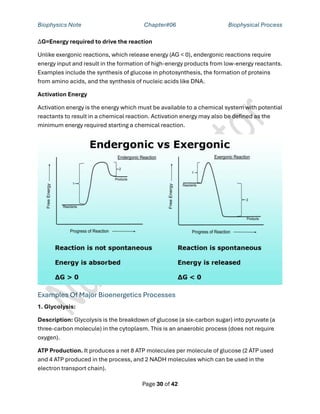
∆G=Energy required to drive the reaction
Unlike exergonic reactions, which release energy (AG < 0), endergonic reactions require
energy input and result in the formation of high-energy products from low-energy reactants.
Examples include the synthesis of glucose in photosynthesis, the formation of proteins
from amino acids, and the synthesis of nucleic acids like DNA.
Activation Energy
Activation energy is the energy which must be available to a chemical system with potential
reactants to result in a chemical reaction. Activation energy may also be defined as the
minimum energy required starting a chemical reaction.
Examples Of Major Bioenergetics Processes
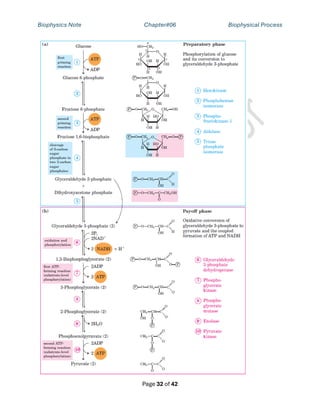
1. Glycolysis:
Description: Glycolysis is the breakdown of glucose (a six-carbon sugar) into pyruvate (a
three-carbon molecule) in the cytoplasm. This is an anaerobic process (does not require
oxygen).
ATP Production. It produces a net 8 ATP molecules per molecule of glucose (2 ATP used
and 4 ATP produced in the process, and 2 NADH molecules which can be used in the
electron transport chain).
Biophysics Note Chapter#06 Biophysical Process
Page 31 of 42
Outcome Pyruvate, NADH, and ATP are the key products of glycolysis The pyruvate
generated can be further processed via the citric acid cycle if oxygen is present (aerobic
conditions) or used in fermentation (anaerobic conditions)
Biophysics Note Chapter#06 Biophysical Process
Page 32 of 42
Biophysics Note Chapter#06 Biophysical Process
Page 33 of 42
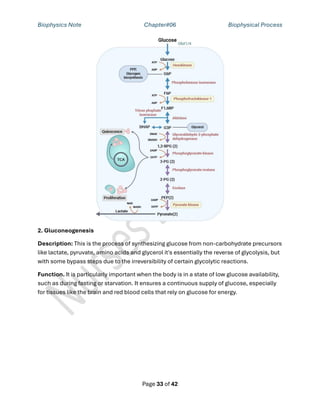
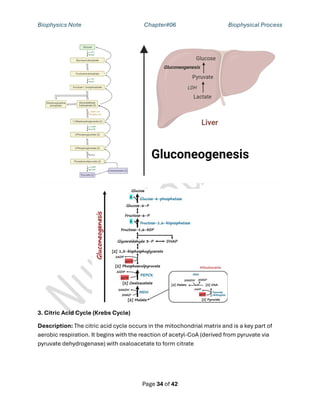
2. Gluconeogenesis
Description: This is the process of synthesizing glucose from non-carbohydrate precursors
like lactate, pyruvate, amino acids and glycerol it's essentially the reverse of glycolysis, but
with some bypass steps due to the irreversibility of certain glycolytic reactions.
Function. It is particularly important when the body is in a state of low glucose availability,
such as during fasting or starvation. It ensures a continuous supply of glucose, especially
for tissues like the brain and red blood cells that rely on glucose for energy.
Biophysics Note Chapter#06 Biophysical Process
Page 34 of 42
3. Citric Acid Cycle (Krebs Cycle)
Description: The citric acid cycle occurs in the mitochondrial matrix and is a key part of
aerobic respiration. It begins with the reaction of acetyl-CoA (derived from pyruvate via
pyruvate dehydrogenase) with oxaloacetate to form citrate
Biophysics Note Chapter#06 Biophysical Process
Page 35 of 42
Energy Production: Through a series of reactions, citrate is oxidized to produce NADH,
FADH2, and ATP. These reducing equivalents (NADH and FADH2) are crucial for the next
stage, the electron transport chain.
Outcome: The cycle produces NADH, FADH2, ATP and CO2. These products play a vital
role in energy production.
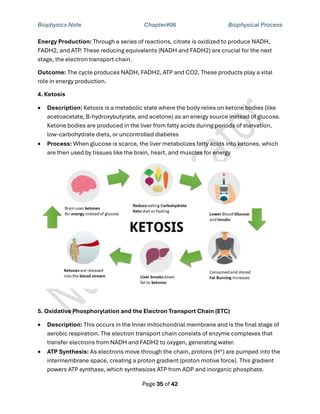
4. Ketosis
• Description: Ketosis is a metabolic state where the body relies on ketone bodies (like
acetoacetate, B-hydroxybutyrate, and acetone) as an energy source instead of glucose.
Ketone bodies are produced in the liver from fatty acids during periods of starvation,
low-carbohydrate diets, or uncontrolled diabetes
• Process: When glucose is scarce, the liver metabolizes fatty acids into ketones. which
are then used by tissues like the brain, heart, and muscles for energy
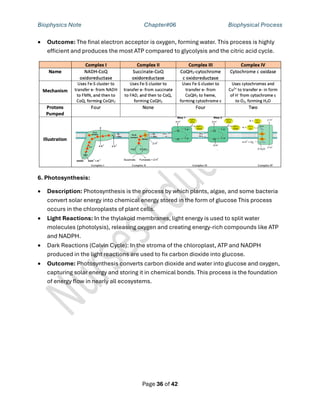
5. Oxidative Phosphorylation and the Electron Transport Chain (ETC)
• Description: This occurs in the Inner mitochondrial membrane and is the final stage of
aerobic respiration. The electron transport chain consists of enzyme complexes that
transfer electrons from NADH and FADH2 to oxygen, generating water.
• ATP Synthesis: As electrons move through the chain, protons (H*) are pumped into the
intermembrane space, creating a proton gradient (proton motive force). This gradient
powers ATP synthase, which synthesizes ATP from ADP and inorganic phosphate.
Biophysics Note Chapter#06 Biophysical Process
Page 36 of 42
• Outcome: The final electron acceptor is oxygen, forming water. This process is highly
efficient and produces the most ATP compared to glycolysis and the citric acid cycle.
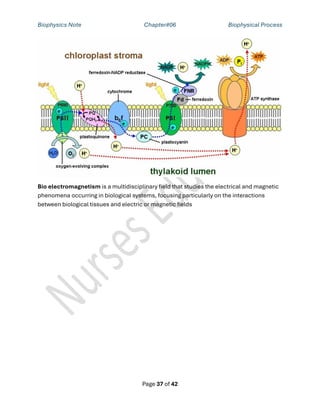
6. Photosynthesis:
• Description: Photosynthesis is the process by which plants, algae, and some bacteria
convert solar energy into chemical energy stored in the form of glucose This process
occurs in the chloroplasts of plant cells.
• Light Reactions: In the thylakoid membranes, light energy is used to split water
molecules (photolysis), releasing oxygen and creating energy-rich compounds like ATP
and NADPH.
• Dark Reactions (Calvin Cycle): In the stroma of the chloroplast, ATP and NADPH
produced in the light reactions are used to fix carbon dioxide into glucose.
• Outcome: Photosynthesis converts carbon dioxide and water into glucose and oxygen,
capturing solar energy and storing it in chemical bonds. This process is the foundation
of energy flow in nearly all ecosystems.
Biophysics Note Chapter#06 Biophysical Process
Page 37 of 42
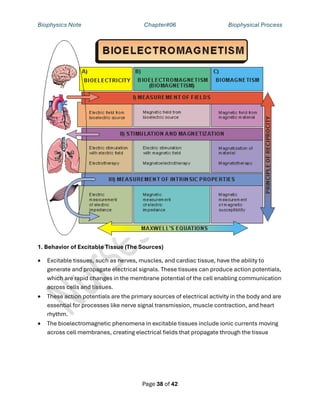
Bio electromagnetism is a multidisciplinary field that studies the electrical and magnetic
phenomena occurring in biological systems, focusing particularly on the interactions
between biological tissues and electric or magnetic fields
Biophysics Note Chapter#06 Biophysical Process
Page 38 of 42
1. Behavior of Excitable Tissue (The Sources)
• Excitable tissues, such as nerves, muscles, and cardiac tissue, have the ability to
generate and propagate electrical signals. These tissues can produce action potentials,
which are rapid changes in the membrane potential of the cell enabling communication
across cells and tissues.
• These action potentials are the primary sources of electrical activity in the body and are
essential for processes like nerve signal transmission, muscle contraction, and heart
rhythm.
• The bioelectromagnetic phenomena in excitable tissues include ionic currents moving
across cell membranes, creating electrical fields that propagate through the tissue
Biophysics Note Chapter#06 Biophysical Process
Page 39 of 42
Biophysics Note Chapter#06 Biophysical Process
Page 40 of 42
2.Electric Currents and Potentials in the Volume Conductor
• A volume conductor is any medium (such as biological tissue) that can conduct
electricity In the body, this includes the extracellular space, where ions carry electric
currents.
• Electrical activity generated by excitable tissues causes voltage potentials to form
across biological tissues. These potentials can spread through the body, influencing
other tissues and organs.
• Electrocardiography (ECG), electroencephalography (EEG), and electro-myography
(EMG) are techniques that record the electric potentials generated by heart, brain, and
muscle tissues, respectively. These measurements reflect the overall electric currents
flowing through the volume conductor.
3. The Magnetic Field at and Beyond the Body
• When electrical currents flow through excitable tissues, they generate magnetic fields
due to the fundamental principles of electromagnetism (Ampère's Law) The magnetic
fields can be measured using sensitive devices such as a magnetometer or
magnetoencephalography (MEG).
• The magnetic fields generated by the body are very weak, but they provide valuable
information about the electrical activity of tissues and can be used in medical
diagnostics. For instance, MEG is used to study brain activity by measuring the
magnetic fields generated by neural electrical currents
• The distribution and strength of these magnetic fields provide insights into, the
functioning of organs like the brain and heart, where the movement of ions in cells
produces detectable magnetic effects.
4. The Response of Excitable Cells to Electric and Magnetic Field Stimulation
• Excitable cells can respond to external electric and magnetic fields through
electromagnetic stimulation. This process is used in various medical treatments such
as transcranial magnetic stimulation (TMS) for the brain, electrotherapy for muscles,
and cardiac pacing using pacemakers.
• External electrical fields can influence the membrane potential of excitable cells
potentially altering their ability to generate action potentials. This effect is crucial for
therapeutic applications, where specific stimulation is used to modify the activity of
tissues.
• Magnetic fields also influence excitable cells. For example, pulsed magnetic fields have
been shown to alter the behavior of neurons and muscle cells, providing the basis for
some non-invasive medical treatments.
Biophysics Note Chapter#06 Biophysical Process
Page 41 of 42
5 Intrinsic Electric and Magnetic Properties of the Tissue
Tissues have intrinsic electrical and magnetic properties that influence their behavior in
the presence of external fields. These properties include conductivity permittivity, and
magnetic permeability.
Conductivity refers to how easily ions can move through the tissue Different tissues (e.g..
muscle, fat, bone, etc.) have varying electrical conductivities.
Permittivity describes how the tissue interacts with an electric field. The ability of
biological tissues to store energy in an electric field depends on their permittivity.
Magnetic permeability relates to how easily the tissue can be magnetized in the presence
of a magnetic field.
These intrinsic properties affect how tissues respond to external electric and magnetic
fields. For example, bone tissue, due to its low conductivity, behaves differently than
muscle or nerve tissue in the presence of electric fields.
Measurement Techniques Of Bio-megnatism
The key measurement technique in biomagnetism relies on incredibly sensitive
instruments called Superconducting Quantum Interference Devices (SQUIDS). These
devices are the workhorses for detecting the faint magnetic fields produced by electrical
currents within biological tissues.
Sensitivity: SQUIDs are incredibly sensitive to magnetic fields. They can detect changes in
magnetic fields billions of times weaker than the Earth's magnetic field. This remarkable
sensitivity is crucial for capturing the subtle magnetic signals generated by biological
activity.
Superconducting Technology: SQUIDs operate at extremely cold temperatures, close to
absolute zero. At these temperatures, certain materials become superconductors,
meaning they offer no resistance to electrical current flow. SQUIDs utilize this property to
achieve their exceptional sensitivity.
Applications Of Bioelectromagnetism:
Medical Imaging: Techniques like magnetic resonance imaging (MRI) and functional
magnetic resonance imaging (fMRI) rely on the interaction of magnetic fields with the body
to produce detailed images of the internal structures and to observe brain activity.
Biophysics Note Chapter#06 Biophysical Process
Page 42 of 42
Neuromodulation: Transcranial magnetic stimulation (TMS) and deep brain stimulation
(DBS) use magnetic or electric fields to influence brain activity, offering potential
treatments for depression, epilepsy, and movement disorders.
Electromagnetic Therapy: Electromagnetic fields are used in therapeutic applications to
promote healing and reduce pain. Examples include pulsed electromagnetic field therapy
(PEMF) and transcutaneous electrical nerve stimulation (TENS).
Electrophysiological Measurements: Tools like ECG, EEG, and EMG provide insights into
the electrical activity of the heart, brain, and muscles, which are critical for diagnosing and
monitoring various diseases.