“Clinical Aspects of Upper and
Lower Motor Neuron Lesions”
Osama Shukir Muhammed Amin
MBChB, MD, MRCP, FACP, FAHA, FCCP(USA), FRCP(Edin),
FRCP(Glasg), FRCP(Ire), FRCP(Lond)
Associate Professor of Neurology
School of Medicine, International Medical University,
Malaysia
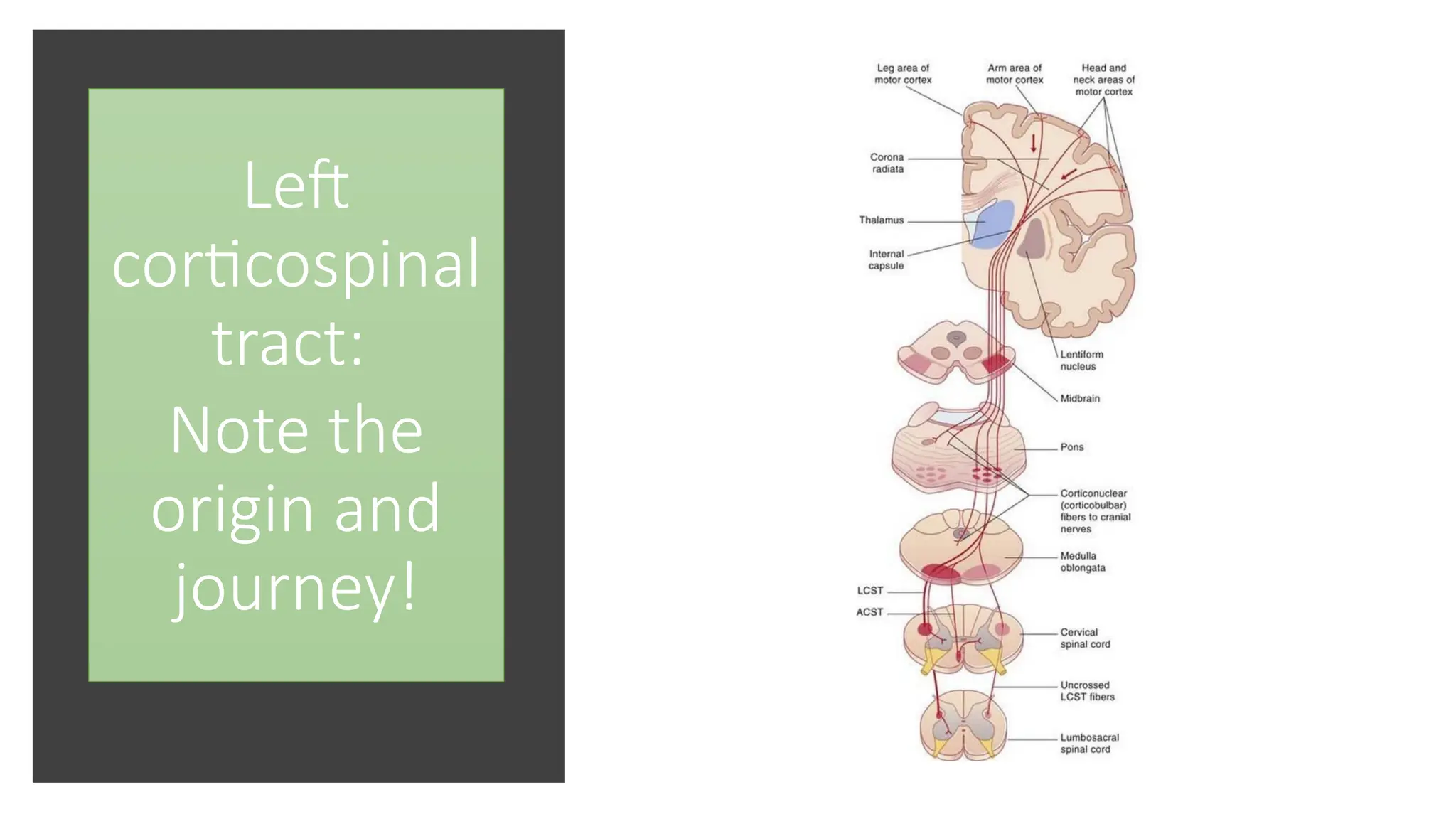
Left
corticospinal
tract:
Note the
origin and
journey!
Function of the corticospinal (pyramidal)
tracts?
The corticospinal tract is
involved in the volitional
activity of skeletal muscle
movements of the
contralateral side.
Antigravity muscles and
movements?
• Upper limbs: shoulder
abduction, as well as elbow,
wrist, and fingers extensions.
• Lower limbs: hip and knee
flexion, as well as ankle dorsi-
flexion and planter eversion.
Note:
These movements are further
controlled/modulated by the
extrapyramidal and cerebellar
systems, with respect to initiation,
coordination, speed, tone, etc.
Lesion(s) of a corticospinal tract?
This would result in loss of
function of that tract with
secondary dominance of
extrapyramidal and other
tracts’ functions; e.g.,
rubrospinal, vestibulospinal,
tectospinal, etc.
The resulting clinical features
depend on the etiology of the
lesion, onset, severity,
multiplicity, and association
with other lesions within and
outside the CNS (i.e.,
peripheral nervous system).
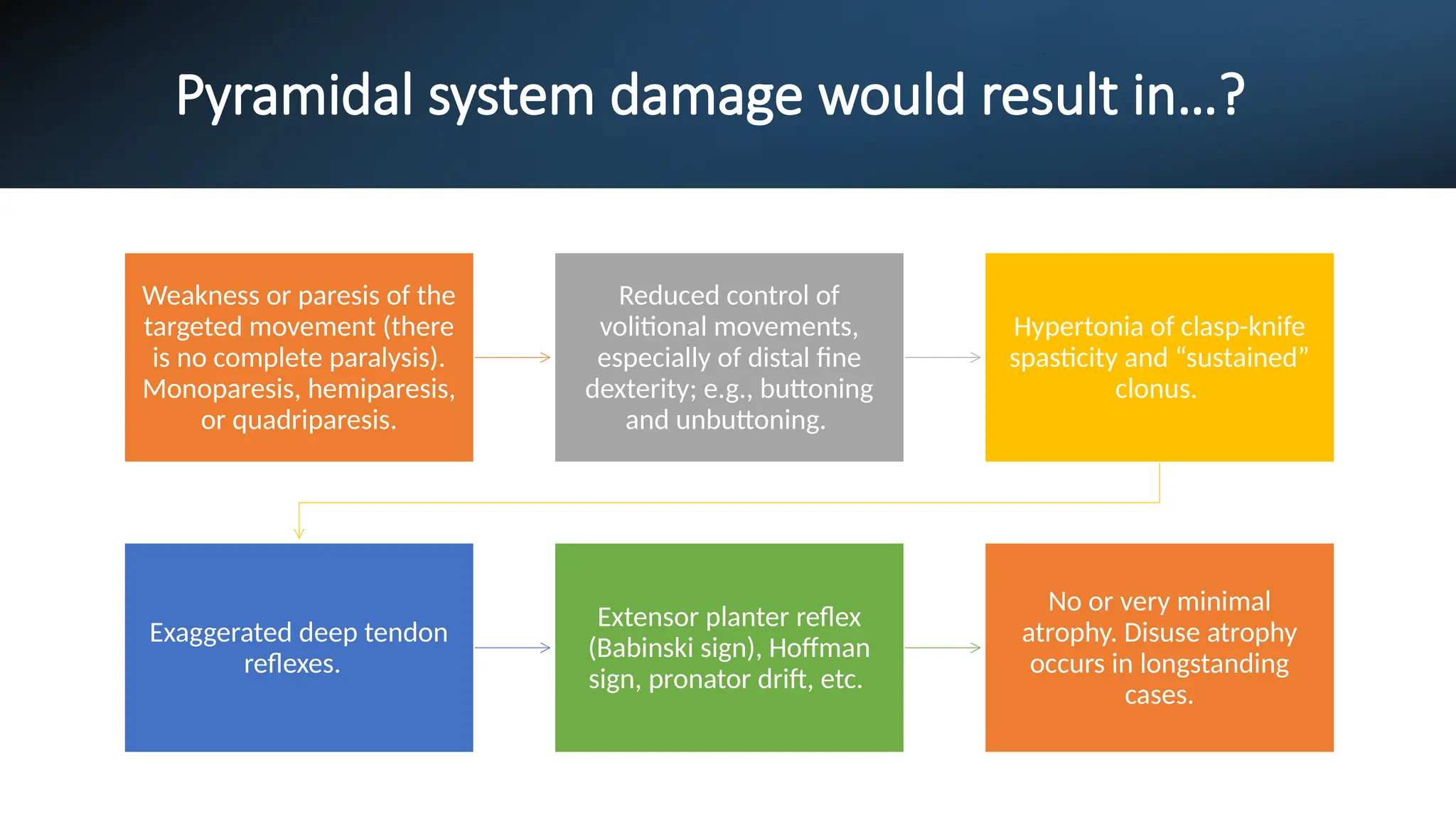
Pyramidal system damage would result in…?
Weakness or paresis of the
targeted movement (there
is no complete paralysis).
Monoparesis, hemiparesis,
or quadriparesis.
Reduced control of
volitional movements,
especially of distal fine
dexterity; e.g., buttoning
and unbuttoning.
Hypertonia of clasp-knife
spasticity and “sustained”
clonus.
Exaggerated deep tendon
reflexes.
Extensor planter reflex
(Babinski sign), Hoffman
sign, pronator drift, etc.
No or very minimal
atrophy. Disuse atrophy
occurs in longstanding
cases.
That is to say:
Signs of upper motor neuron lesion!
And, this reflects what?
Any lesion from the cerebral cortex down to the anterior
horn cells of the spinal cord!
Is it a “patterned” type of weakness?
YES!
The pattern of pyramidal weakness is weakness of upper limbs’
extensors and lower limbs’ flexors.
For instance, left-sided pyramidal weakness, grade 3 power in both
upper and lower limbs.
Note the origin,
course, and target
of lower motor
neurons!
Lower motor neuron lesions’ signs?
The classical signs are:
Weakness or complete paralysis.
Hypotonia (flaccidity).
Hyporeflexia or areflexia.
Fasciculation (involuntary rippling muscle
movements).
Early and prominent atrophy.
Such signs would reflect what?
Any lesion from the spinal
cord’s ventral horn alpha
motor neurons down to the
muscle fibers (i.e., a long
pathway).
How would they present clinically?
The presentation depends on the etiology, site of the
lesion, multiplicity of the lesion, onset, and
progression.
And, if there is any coexistent central nervous system
damage.
Where, localize?
•Spinal cord anterior ventral horn lesions.
•Radiculopathy.
•Plexopathy.
•Motor-end plate diseases.
•Myopathy/myositis.
PS: Each of them depicts a unique constellation of
symptoms and signs.
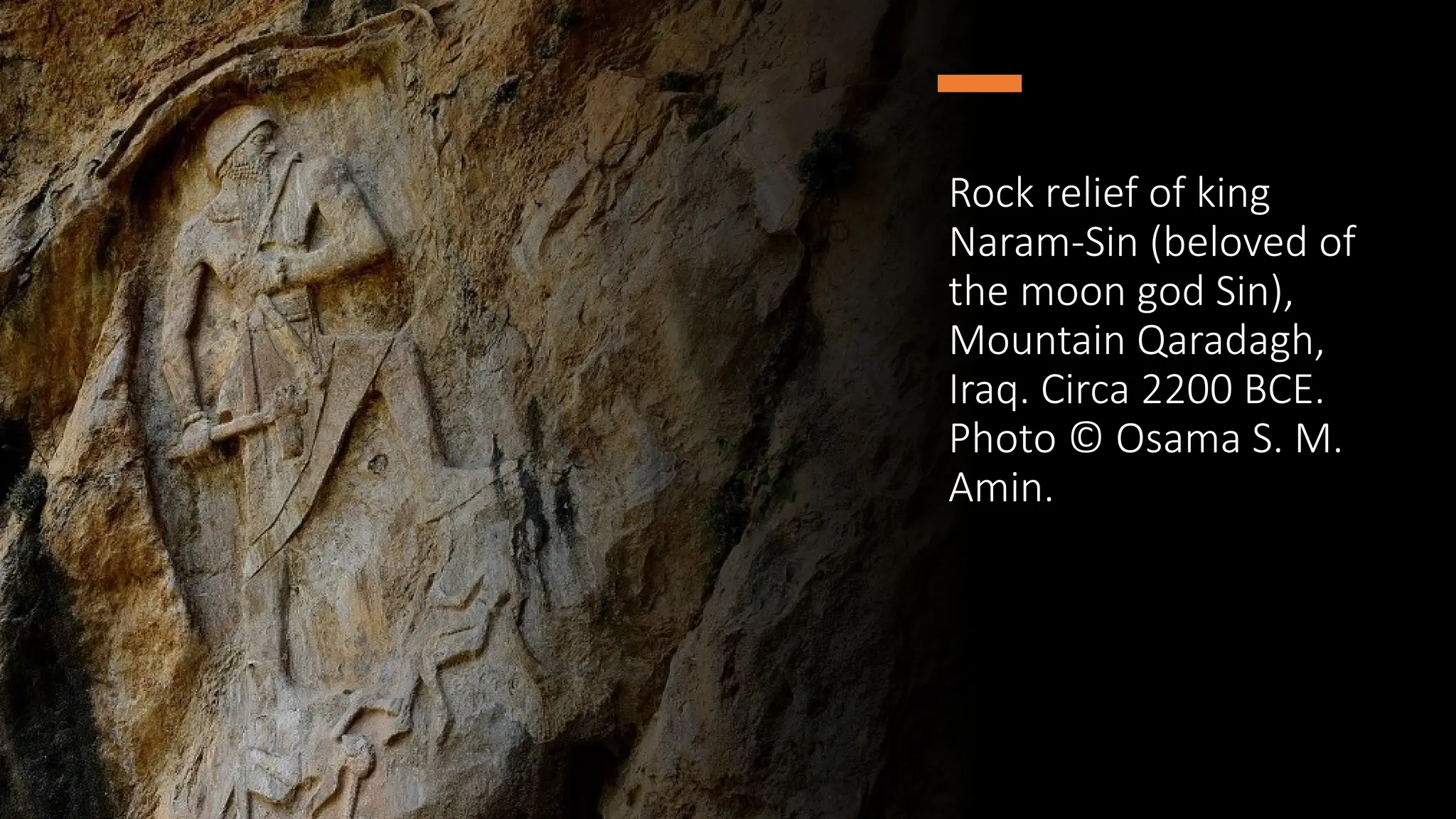
Rock relief of king
Naram-Sin (beloved of
the moon god Sin),
Mountain Qaradagh,
Iraq. Circa 2200 BCE.
Photo © Osama S. M.
Amin.

Clinical Aspects of Upper and Lower Motor Neuron Lesions

  • 1.
    “Clinical Aspects ofUpper and Lower Motor Neuron Lesions” Osama Shukir Muhammed Amin MBChB, MD, MRCP, FACP, FAHA, FCCP(USA), FRCP(Edin), FRCP(Glasg), FRCP(Ire), FRCP(Lond) Associate Professor of Neurology School of Medicine, International Medical University, Malaysia
  • 3.
  • 4.
    Function of thecorticospinal (pyramidal) tracts? The corticospinal tract is involved in the volitional activity of skeletal muscle movements of the contralateral side. Antigravity muscles and movements? • Upper limbs: shoulder abduction, as well as elbow, wrist, and fingers extensions. • Lower limbs: hip and knee flexion, as well as ankle dorsi- flexion and planter eversion.
  • 5.
    Note: These movements arefurther controlled/modulated by the extrapyramidal and cerebellar systems, with respect to initiation, coordination, speed, tone, etc.
  • 6.
    Lesion(s) of acorticospinal tract? This would result in loss of function of that tract with secondary dominance of extrapyramidal and other tracts’ functions; e.g., rubrospinal, vestibulospinal, tectospinal, etc. The resulting clinical features depend on the etiology of the lesion, onset, severity, multiplicity, and association with other lesions within and outside the CNS (i.e., peripheral nervous system).
  • 7.
    Pyramidal system damagewould result in…? Weakness or paresis of the targeted movement (there is no complete paralysis). Monoparesis, hemiparesis, or quadriparesis. Reduced control of volitional movements, especially of distal fine dexterity; e.g., buttoning and unbuttoning. Hypertonia of clasp-knife spasticity and “sustained” clonus. Exaggerated deep tendon reflexes. Extensor planter reflex (Babinski sign), Hoffman sign, pronator drift, etc. No or very minimal atrophy. Disuse atrophy occurs in longstanding cases.
  • 8.
    That is tosay: Signs of upper motor neuron lesion! And, this reflects what? Any lesion from the cerebral cortex down to the anterior horn cells of the spinal cord!
  • 9.
    Is it a“patterned” type of weakness? YES! The pattern of pyramidal weakness is weakness of upper limbs’ extensors and lower limbs’ flexors. For instance, left-sided pyramidal weakness, grade 3 power in both upper and lower limbs.
  • 10.
    Note the origin, course,and target of lower motor neurons!
  • 11.
    Lower motor neuronlesions’ signs? The classical signs are: Weakness or complete paralysis. Hypotonia (flaccidity). Hyporeflexia or areflexia. Fasciculation (involuntary rippling muscle movements). Early and prominent atrophy.
  • 12.
    Such signs wouldreflect what? Any lesion from the spinal cord’s ventral horn alpha motor neurons down to the muscle fibers (i.e., a long pathway).
  • 13.
    How would theypresent clinically? The presentation depends on the etiology, site of the lesion, multiplicity of the lesion, onset, and progression. And, if there is any coexistent central nervous system damage.
  • 14.
    Where, localize? •Spinal cordanterior ventral horn lesions. •Radiculopathy. •Plexopathy. •Motor-end plate diseases. •Myopathy/myositis. PS: Each of them depicts a unique constellation of symptoms and signs.
  • 15.
    Rock relief ofking Naram-Sin (beloved of the moon god Sin), Mountain Qaradagh, Iraq. Circa 2200 BCE. Photo © Osama S. M. Amin.