MRCP(UK) and MRCP(I) Part II
200 Cases
Case Histories, Data Interpretation, & Photographic
Materials
ii
This page was intentionally left blank
MRCP(UK) and MRCP(I) Part II
200 Cases
Case Histories, Data Interpretation, & Photographic
Materials
Osama Shukir Muhammed Amin
MBChB, MD, MRCP, FRCP(Edin), FRCP(Glasg), FRCP(Ire), FRCP(Lond), FACP,
FAHA, FCCP(USA), FRSA
Consultant Neurologist and Director
The Kurdistan Board of Neurology Sulaymaniyah
Formerly, Clinical Associate Professor
International Medical University
Kuala Lumpur, Malaysia
©2022 Osama Shukir Muhammed Amin
iv
This page was intentionally left blank
Copyright © 2022. Osama Shukir Muhammed Amin.
Copyright Notice:
All rights reserved. No part of this publication may be reproduced or transmitted in
any form or by any means, electronic, mechanical, photocopying, recording, or
otherwise, without prior permission of the copyright owner in writing:
Email: dr.osama.amin@gmail.com
First Edition: 2022.
ISBN: 978-1-4717-3582-0
Disclaimer:
This book was written depending on reliable sources. However, while every effort has
been made to ensure its accuracy, no responsibility for loss, damage, or injury
occasioned on any person acting or refraining from action as a result of information
contained herein can be accepted by the author or publisher.
Published and distributed by Lulu Press, Inc. Northern Carolina, USA.
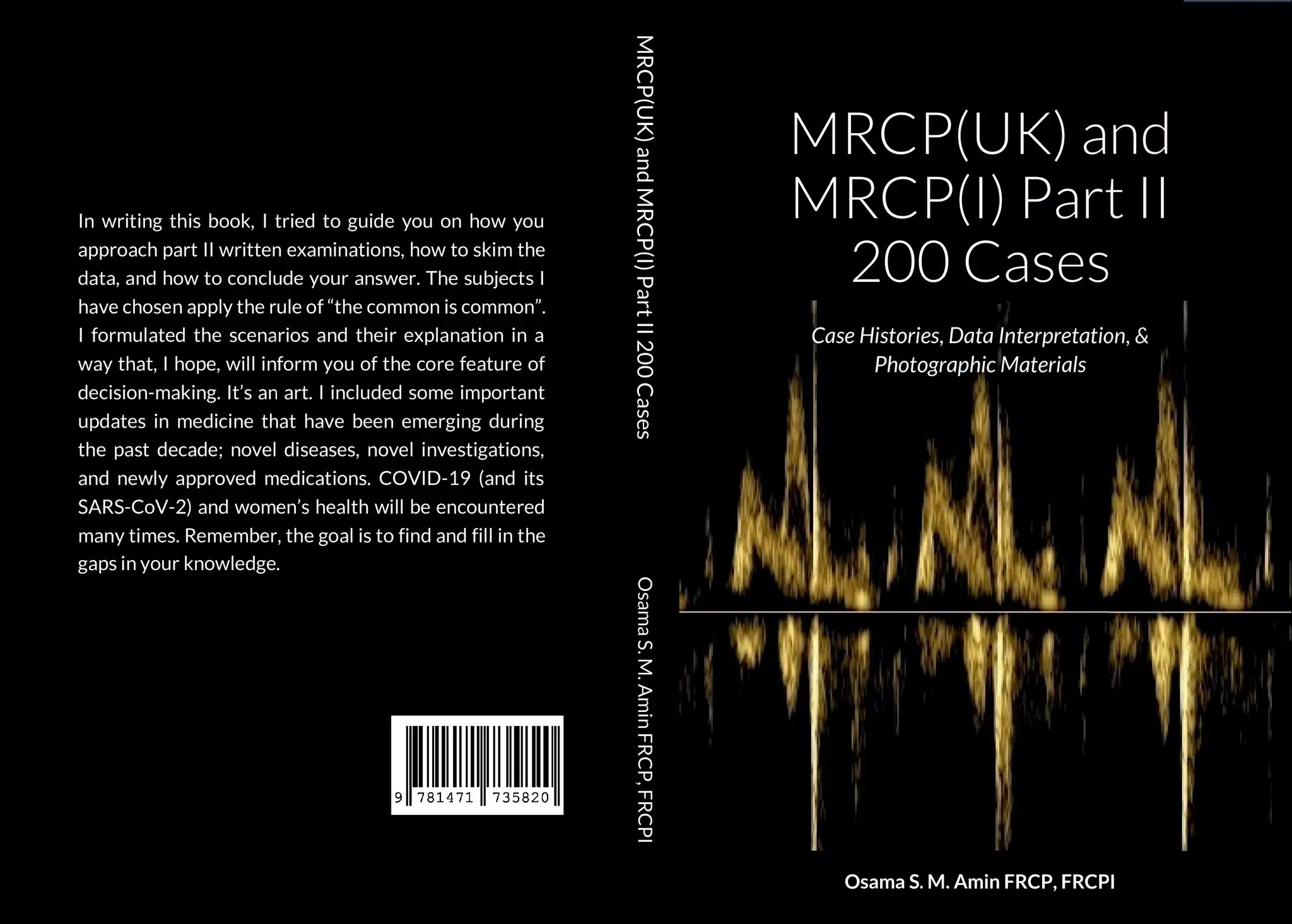
Cover image: Photo © Osama S. M. Amin.
vi
Dedication
My family
Sarah, Awan, and Naz
Acknowledgments
I would like to sincerely thank my dear patients; their clinical scenarios were used to
formulate and generate these questions.
Special gratitude goes to my wife, Sarah, for her endless support and encouragement,
and of course, her extreme patience.
viii
Preface
“Observe, record, tabulate, communicate. Use your five senses. Learn to see, learn to hear, learn to
feel, learn to smell, and know that by practice alone you can become expert.”, Sir William Osler
(b. 1849, d. 1919)
he methods of postgraduate teaching, training, and accreditation have evolved
considerably during the past decade. The strike of the COVID-19 crisis was a
huge blow to this remarkable progression yet has taught us many endless
lessons. I always say, “Even the best-informed trainee cannot answer all the questions.”
The purpose of this book is to self-assess. 100, 1000, or 10000 questions will never
cover the entire curriculum/syllabus. Medicine is a huge ocean, and once you dive in,
you have to swim to stay alive.
In writing this book, I tried my best to guide you on how you approach part II written
examinations, how to skim the data, and how to conclude your answer. The subjects I
have chosen apply the rule of “the common is common”. I formulated the scenarios
and their explanation in a way that, I hope, will inform you of the core feature of
decision-making. It’s an art. I have tried to focus on some important updates in
medicine that have been emerging during the past decade; novel diseases, novel
investigations, and newly approved medications. COVID-19 (and its SARS-CoV-2) and
women’s health will be encountered many times. Remember, the goal is to find and fill in the
gaps in your knowledge.
Undoubtedly, if you are well-prepared, you will pass the examination very easily. No
need to panic when you hear your colleagues’ past [bad] experiences. Lack of
preparation is the single most common reason for failure. Remember, practice makes
perfect. Read, practice, and self-assess; that’s it!
Good luck with your career and exams!
OsamaAmin
Osama S. M. Amin
April 2022
T
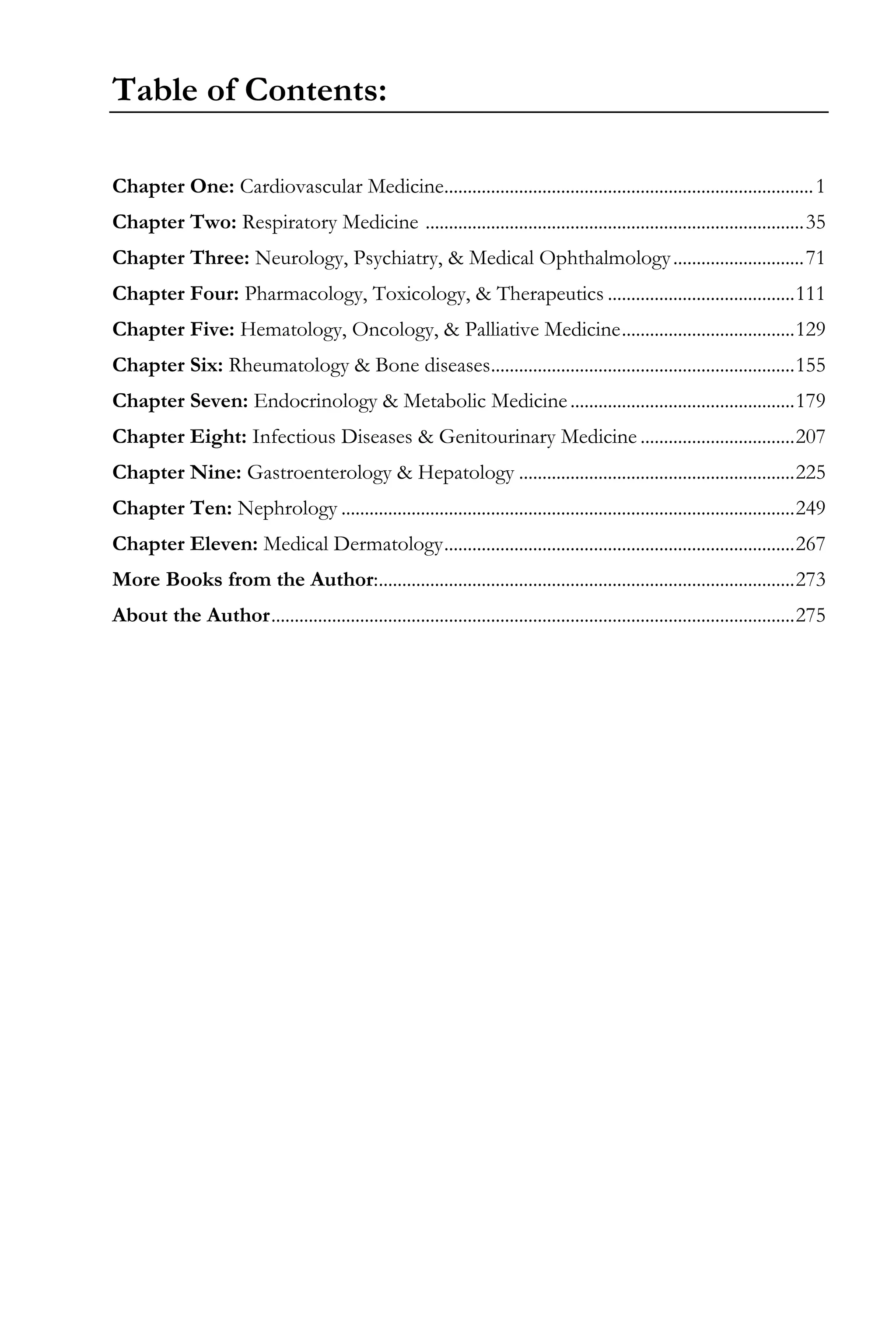
Table of Contents:
Chapter One: Cardiovascular Medicine...............................................................................1
Chapter Two: Respiratory Medicine .................................................................................35
Chapter Three: Neurology, Psychiatry, & Medical Ophthalmology............................71
Chapter Four: Pharmacology, Toxicology, & Therapeutics ........................................111
Chapter Five: Hematology, Oncology, & Palliative Medicine.....................................129
Chapter Six: Rheumatology & Bone diseases.................................................................155
Chapter Seven: Endocrinology & Metabolic Medicine................................................179
Chapter Eight: Infectious Diseases & Genitourinary Medicine .................................207
Chapter Nine: Gastroenterology & Hepatology ...........................................................225
Chapter Ten: Nephrology .................................................................................................249
Chapter Eleven: Medical Dermatology...........................................................................267
More Books from the Author:.........................................................................................273
About the Author................................................................................................................275
x
This page was intentionally left blank
Osama S. M. Amin FRCP MRCP(UK) & MRCP(I) Part II: 200 Cases
273
More Books from the Author:
1. MRCP(UK) and MRCP(I) Part I Best of Fives, Volume I (2022):
In writing this book, I have tried to focus on the most important updates in medicine
that have been emerging during the past decade; novel diseases, novel investigations,
and newly approved medications. Needless to say, COVID-19 and its SARS-CoV-2
will be encountered in each chapter, in addition to occupying a unique position in the
chapter on infectious diseases. The other aspect that I think is very crucial to tackle is
women’s health and pregnancy. Once again, such a topic has been addressed in each
and every chapter. There are no separate chapters for geriatrics, clinical sciences, and
pharmacology (including therapeutics and toxicology); their questions have been
distributed throughout the book’s chapters. Each answer is followed by an explanation
and a reference (source) and/or additional (further) reading. In this way, you can go
there; skim the whole subject if you are interested to get more information. I did my
best to avoid regurgitated subjects and themes (which have been encompassed by many
books, including mine, during the past 20 years). Although many questions appear to
be difficult and may fit part II examinations, I believe these questions (and their
explanation) will strengthen your background and help you prepare well for part II.
Remember, the goal is to find and fill in the gaps in your knowledge.
2. Self-Assessment: 650 BOFs for MRCP(UK) and MRCP(I) Part I (2017):
This is the 2nd edition of my previous book, “Self-Assessment for MRCP(UK) part
1”, which was published in 2009. The book has undergone several changes and updates.
The best initial step is to read accredited textbooks. After then, self-assess yourself.
Read this book, chapter after chapter, try to find out your mistakes and gaps in
knowledge, and then re-read what you have missed. In writing this book, I tried my
best to include the commonest examination themes.
3. Mock Papers for MRCPI Part I, 2nd edition (2016):
In this second edition, you will find 3 mock papers. Each one contains 100 questions
in a Best of Five (BOF) format. Self-assess, try to complete each paper within 3 hours,
check out your answers, read the explanation, and re-read accredited medicine
textbooks to fill in the gap in your knowledge. Each question has an “objective”; try to
review what the objective is about. This is the only self-assessment book specifically
written to imitate the MRCPI Part I examination. Each mock paper in the first edition
of this book contained 50 BOFs and 50 MCQs formats.
274
4. Get Through MRCP Part I: BOFs (2008):
“Get Through MRCP Part 1: BOFs” provides over 600 questions and answers,
allowing the reader to test their knowledge in preparation for the MRCP Part 1
examination. Questions are presented in the style used in the real examination,
and answers are supplemented with useful additional explanatory material to
help the reader understand why their answer was right, or wrong. The book
offers a useful review of all elements of the syllabus, so the reader can feel fully
prepared when they enter the examination room.
Osama S. M. Amin FRCP MRCP(UK) & MRCP(I) Part II: 200 Cases
275
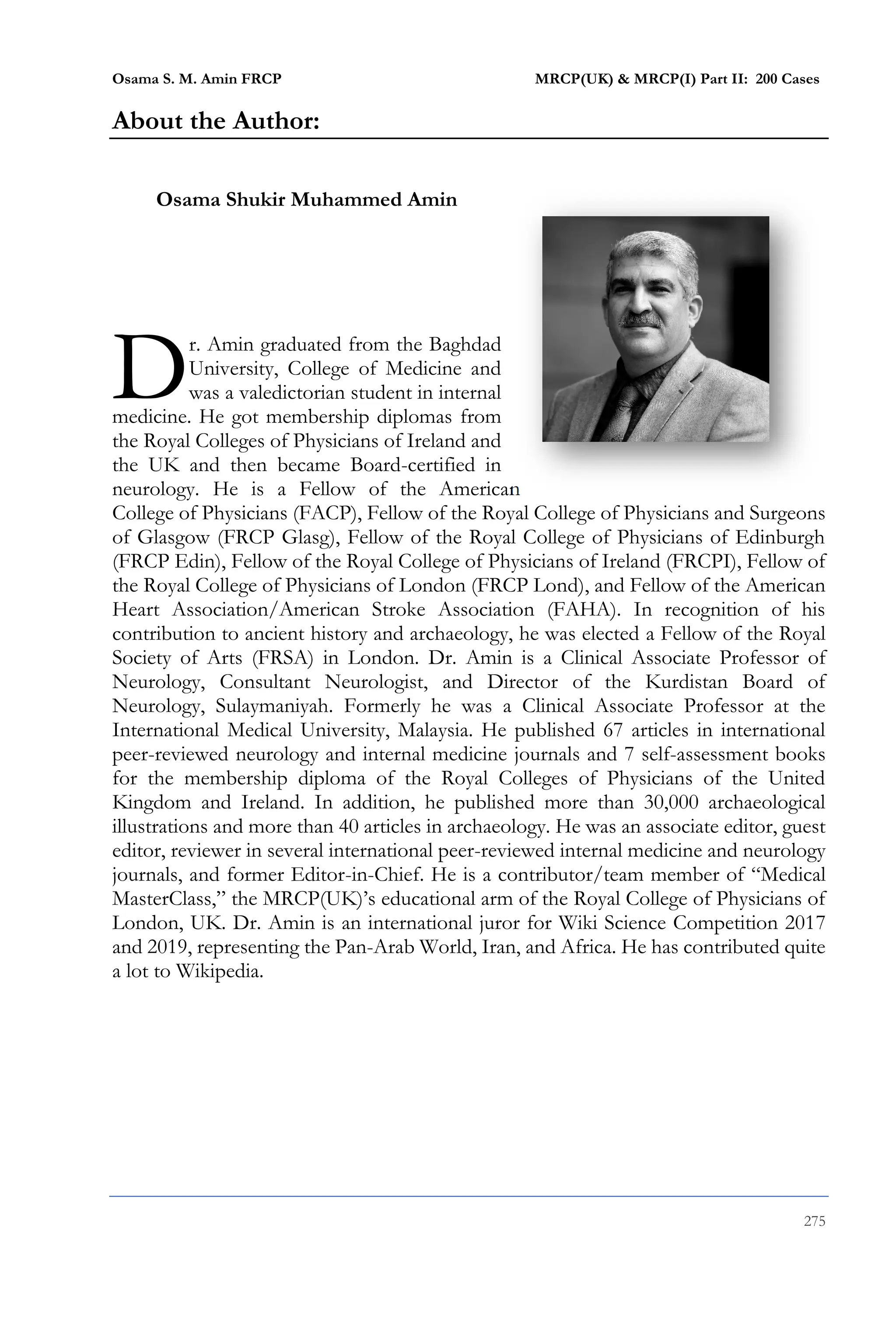
About the Author:
Osama Shukir Muhammed Amin
r. Amin graduated from the Baghdad
University, College of Medicine and
was a valedictorian student in internal
medicine. He got membership diplomas from
the Royal Colleges of Physicians of Ireland and
the UK and then became Board-certified in
neurology. He is a Fellow of the American
College of Physicians (FACP), Fellow of the Royal College of Physicians and Surgeons
of Glasgow (FRCP Glasg), Fellow of the Royal College of Physicians of Edinburgh
(FRCP Edin), Fellow of the Royal College of Physicians of Ireland (FRCPI), Fellow of
the Royal College of Physicians of London (FRCP Lond), and Fellow of the American
Heart Association/American Stroke Association (FAHA). In recognition of his
contribution to ancient history and archaeology, he was elected a Fellow of the Royal
Society of Arts (FRSA) in London. Dr. Amin is a Clinical Associate Professor of
Neurology, Consultant Neurologist, and Director of the Kurdistan Board of
Neurology, Sulaymaniyah. Formerly he was a Clinical Associate Professor at the
International Medical University, Malaysia. He published 67 articles in international
peer-reviewed neurology and internal medicine journals and 7 self-assessment books
for the membership diploma of the Royal Colleges of Physicians of the United
Kingdom and Ireland. In addition, he published more than 30,000 archaeological
illustrations and more than 40 articles in archaeology. He was an associate editor, guest
editor, reviewer in several international peer-reviewed internal medicine and neurology
journals, and former Editor-in-Chief. He is a contributor/team member of “Medical
MasterClass,” the MRCP(UK)’s educational arm of the Royal College of Physicians of
London, UK. Dr. Amin is an international juror for Wiki Science Competition 2017
and 2019, representing the Pan-Arab World, Iran, and Africa. He has contributed quite
a lot to Wikipedia.
D
276
This page was intentionally left blank

MRCP(UK) and MRCP(I) Part II 200 Cases Case Histories, Data Interpretation, & Photographic Materials

  • 2.
    MRCP(UK) and MRCP(I)Part II 200 Cases Case Histories, Data Interpretation, & Photographic Materials
  • 3.
    ii This page wasintentionally left blank
  • 4.
    MRCP(UK) and MRCP(I)Part II 200 Cases Case Histories, Data Interpretation, & Photographic Materials Osama Shukir Muhammed Amin MBChB, MD, MRCP, FRCP(Edin), FRCP(Glasg), FRCP(Ire), FRCP(Lond), FACP, FAHA, FCCP(USA), FRSA Consultant Neurologist and Director The Kurdistan Board of Neurology Sulaymaniyah Formerly, Clinical Associate Professor International Medical University Kuala Lumpur, Malaysia ©2022 Osama Shukir Muhammed Amin
  • 5.
    iv This page wasintentionally left blank
  • 6.
    Copyright © 2022.Osama Shukir Muhammed Amin. Copyright Notice: All rights reserved. No part of this publication may be reproduced or transmitted in any form or by any means, electronic, mechanical, photocopying, recording, or otherwise, without prior permission of the copyright owner in writing: Email: dr.osama.amin@gmail.com First Edition: 2022. ISBN: 978-1-4717-3582-0 Disclaimer: This book was written depending on reliable sources. However, while every effort has been made to ensure its accuracy, no responsibility for loss, damage, or injury occasioned on any person acting or refraining from action as a result of information contained herein can be accepted by the author or publisher. Published and distributed by Lulu Press, Inc. Northern Carolina, USA. Cover image: Photo © Osama S. M. Amin.
  • 7.
  • 8.
    Acknowledgments I would liketo sincerely thank my dear patients; their clinical scenarios were used to formulate and generate these questions. Special gratitude goes to my wife, Sarah, for her endless support and encouragement, and of course, her extreme patience.
  • 9.
    viii Preface “Observe, record, tabulate,communicate. Use your five senses. Learn to see, learn to hear, learn to feel, learn to smell, and know that by practice alone you can become expert.”, Sir William Osler (b. 1849, d. 1919) he methods of postgraduate teaching, training, and accreditation have evolved considerably during the past decade. The strike of the COVID-19 crisis was a huge blow to this remarkable progression yet has taught us many endless lessons. I always say, “Even the best-informed trainee cannot answer all the questions.” The purpose of this book is to self-assess. 100, 1000, or 10000 questions will never cover the entire curriculum/syllabus. Medicine is a huge ocean, and once you dive in, you have to swim to stay alive. In writing this book, I tried my best to guide you on how you approach part II written examinations, how to skim the data, and how to conclude your answer. The subjects I have chosen apply the rule of “the common is common”. I formulated the scenarios and their explanation in a way that, I hope, will inform you of the core feature of decision-making. It’s an art. I have tried to focus on some important updates in medicine that have been emerging during the past decade; novel diseases, novel investigations, and newly approved medications. COVID-19 (and its SARS-CoV-2) and women’s health will be encountered many times. Remember, the goal is to find and fill in the gaps in your knowledge. Undoubtedly, if you are well-prepared, you will pass the examination very easily. No need to panic when you hear your colleagues’ past [bad] experiences. Lack of preparation is the single most common reason for failure. Remember, practice makes perfect. Read, practice, and self-assess; that’s it! Good luck with your career and exams! OsamaAmin Osama S. M. Amin April 2022 T
  • 10.
    Table of Contents: ChapterOne: Cardiovascular Medicine...............................................................................1 Chapter Two: Respiratory Medicine .................................................................................35 Chapter Three: Neurology, Psychiatry, & Medical Ophthalmology............................71 Chapter Four: Pharmacology, Toxicology, & Therapeutics ........................................111 Chapter Five: Hematology, Oncology, & Palliative Medicine.....................................129 Chapter Six: Rheumatology & Bone diseases.................................................................155 Chapter Seven: Endocrinology & Metabolic Medicine................................................179 Chapter Eight: Infectious Diseases & Genitourinary Medicine .................................207 Chapter Nine: Gastroenterology & Hepatology ...........................................................225 Chapter Ten: Nephrology .................................................................................................249 Chapter Eleven: Medical Dermatology...........................................................................267 More Books from the Author:.........................................................................................273 About the Author................................................................................................................275
  • 11.
    x This page wasintentionally left blank
  • 12.
    Osama S. M.Amin FRCP MRCP(UK) & MRCP(I) Part II: 200 Cases 273 More Books from the Author: 1. MRCP(UK) and MRCP(I) Part I Best of Fives, Volume I (2022): In writing this book, I have tried to focus on the most important updates in medicine that have been emerging during the past decade; novel diseases, novel investigations, and newly approved medications. Needless to say, COVID-19 and its SARS-CoV-2 will be encountered in each chapter, in addition to occupying a unique position in the chapter on infectious diseases. The other aspect that I think is very crucial to tackle is women’s health and pregnancy. Once again, such a topic has been addressed in each and every chapter. There are no separate chapters for geriatrics, clinical sciences, and pharmacology (including therapeutics and toxicology); their questions have been distributed throughout the book’s chapters. Each answer is followed by an explanation and a reference (source) and/or additional (further) reading. In this way, you can go there; skim the whole subject if you are interested to get more information. I did my best to avoid regurgitated subjects and themes (which have been encompassed by many books, including mine, during the past 20 years). Although many questions appear to be difficult and may fit part II examinations, I believe these questions (and their explanation) will strengthen your background and help you prepare well for part II. Remember, the goal is to find and fill in the gaps in your knowledge. 2. Self-Assessment: 650 BOFs for MRCP(UK) and MRCP(I) Part I (2017): This is the 2nd edition of my previous book, “Self-Assessment for MRCP(UK) part 1”, which was published in 2009. The book has undergone several changes and updates. The best initial step is to read accredited textbooks. After then, self-assess yourself. Read this book, chapter after chapter, try to find out your mistakes and gaps in knowledge, and then re-read what you have missed. In writing this book, I tried my best to include the commonest examination themes. 3. Mock Papers for MRCPI Part I, 2nd edition (2016): In this second edition, you will find 3 mock papers. Each one contains 100 questions in a Best of Five (BOF) format. Self-assess, try to complete each paper within 3 hours, check out your answers, read the explanation, and re-read accredited medicine textbooks to fill in the gap in your knowledge. Each question has an “objective”; try to review what the objective is about. This is the only self-assessment book specifically written to imitate the MRCPI Part I examination. Each mock paper in the first edition of this book contained 50 BOFs and 50 MCQs formats.
  • 13.
    274 4. Get ThroughMRCP Part I: BOFs (2008): “Get Through MRCP Part 1: BOFs” provides over 600 questions and answers, allowing the reader to test their knowledge in preparation for the MRCP Part 1 examination. Questions are presented in the style used in the real examination, and answers are supplemented with useful additional explanatory material to help the reader understand why their answer was right, or wrong. The book offers a useful review of all elements of the syllabus, so the reader can feel fully prepared when they enter the examination room.
  • 14.
    Osama S. M.Amin FRCP MRCP(UK) & MRCP(I) Part II: 200 Cases 275 About the Author: Osama Shukir Muhammed Amin r. Amin graduated from the Baghdad University, College of Medicine and was a valedictorian student in internal medicine. He got membership diplomas from the Royal Colleges of Physicians of Ireland and the UK and then became Board-certified in neurology. He is a Fellow of the American College of Physicians (FACP), Fellow of the Royal College of Physicians and Surgeons of Glasgow (FRCP Glasg), Fellow of the Royal College of Physicians of Edinburgh (FRCP Edin), Fellow of the Royal College of Physicians of Ireland (FRCPI), Fellow of the Royal College of Physicians of London (FRCP Lond), and Fellow of the American Heart Association/American Stroke Association (FAHA). In recognition of his contribution to ancient history and archaeology, he was elected a Fellow of the Royal Society of Arts (FRSA) in London. Dr. Amin is a Clinical Associate Professor of Neurology, Consultant Neurologist, and Director of the Kurdistan Board of Neurology, Sulaymaniyah. Formerly he was a Clinical Associate Professor at the International Medical University, Malaysia. He published 67 articles in international peer-reviewed neurology and internal medicine journals and 7 self-assessment books for the membership diploma of the Royal Colleges of Physicians of the United Kingdom and Ireland. In addition, he published more than 30,000 archaeological illustrations and more than 40 articles in archaeology. He was an associate editor, guest editor, reviewer in several international peer-reviewed internal medicine and neurology journals, and former Editor-in-Chief. He is a contributor/team member of “Medical MasterClass,” the MRCP(UK)’s educational arm of the Royal College of Physicians of London, UK. Dr. Amin is an international juror for Wiki Science Competition 2017 and 2019, representing the Pan-Arab World, Iran, and Africa. He has contributed quite a lot to Wikipedia. D
  • 15.
    276 This page wasintentionally left blank