
USAID Climate Change Adaptation Project Preparation Facility for Asia and the
Pacific
(USAID Adapt Asia-Pacific)
Session 3
Climate Change Processes and
Impacts
January 16, 2017
USAID Adapt Asia-Pacific
Session 3 Outcomes
• Understand sources of climate information relevant
to project design and how to access these sources
of information
• Develop a localized climate change narrative
describing physical processes that can be used in a
project design document
• Describe climate change impacts and justify why
adaptation is necessary, and what might result if
adaptation does not happen
USAID Adapt Asia-Pacific
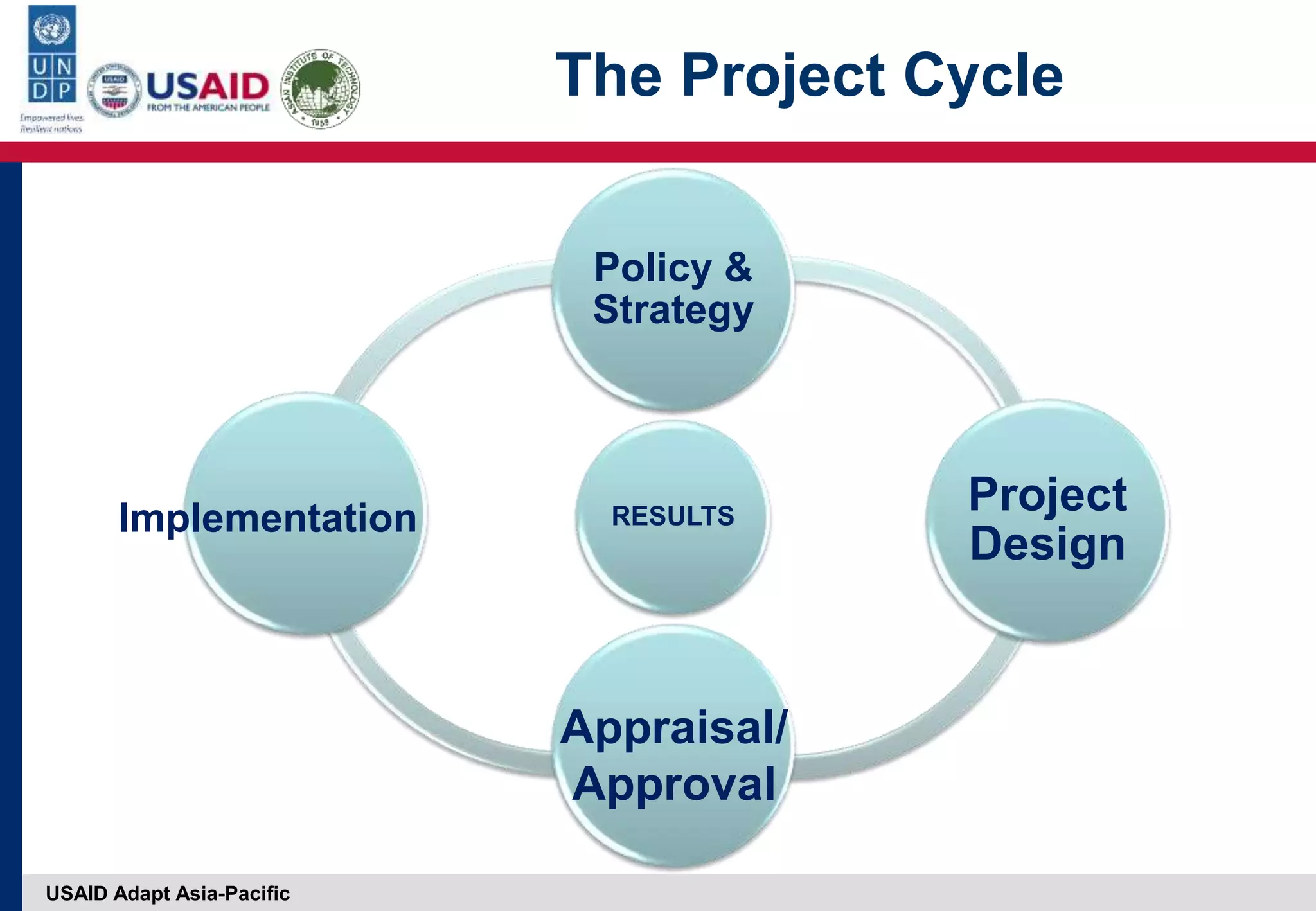
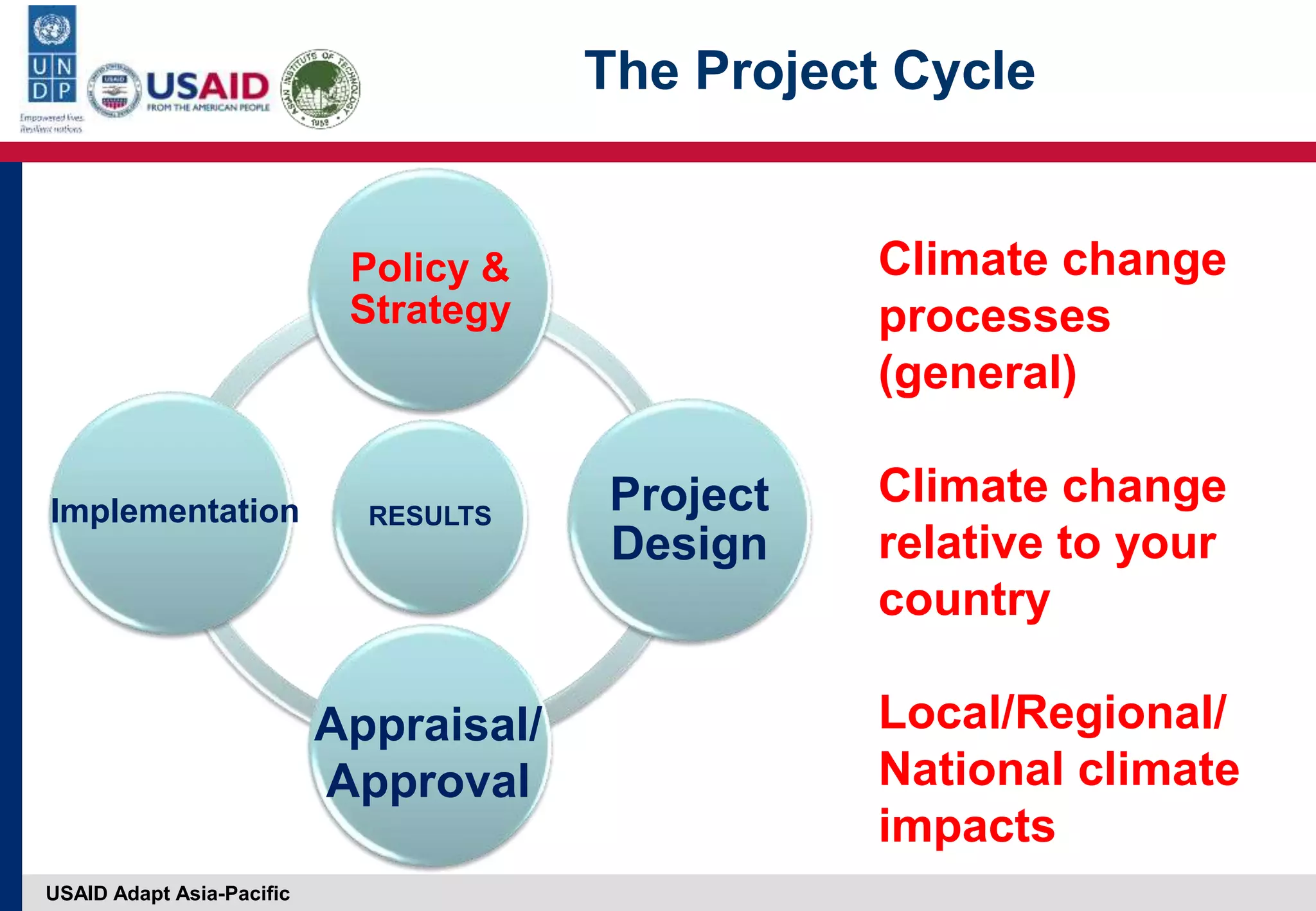
The Project Cycle
RESULTS
Policy &
Strategy
Project
Design
Implementation
Appraisal/
Approval
USAID Adapt Asia-Pacific
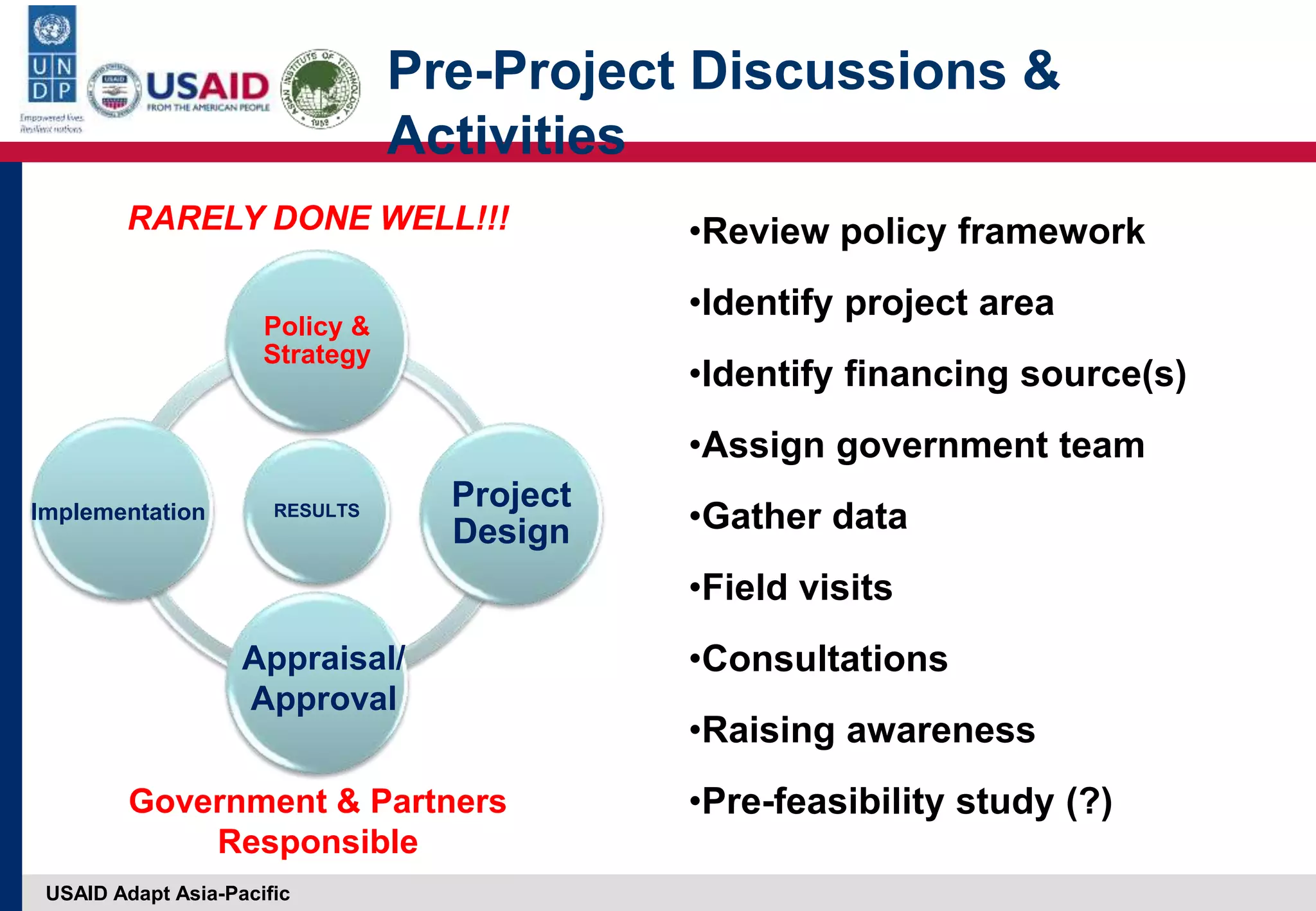
Pre-Project Discussions &
Activities
•Review policy framework
•Identify project area
•Identify financing source(s)
•Assign government team
•Gather data
•Field visits
•Consultations
•Raising awareness
•Pre-feasibility study (?)
RESULTS
Policy &
Strategy
Project
Design
RARELY DONE WELL!!!
Government & Partners
Responsible
Implementation
Appraisal/
Approval
USAID Adapt Asia-Pacific
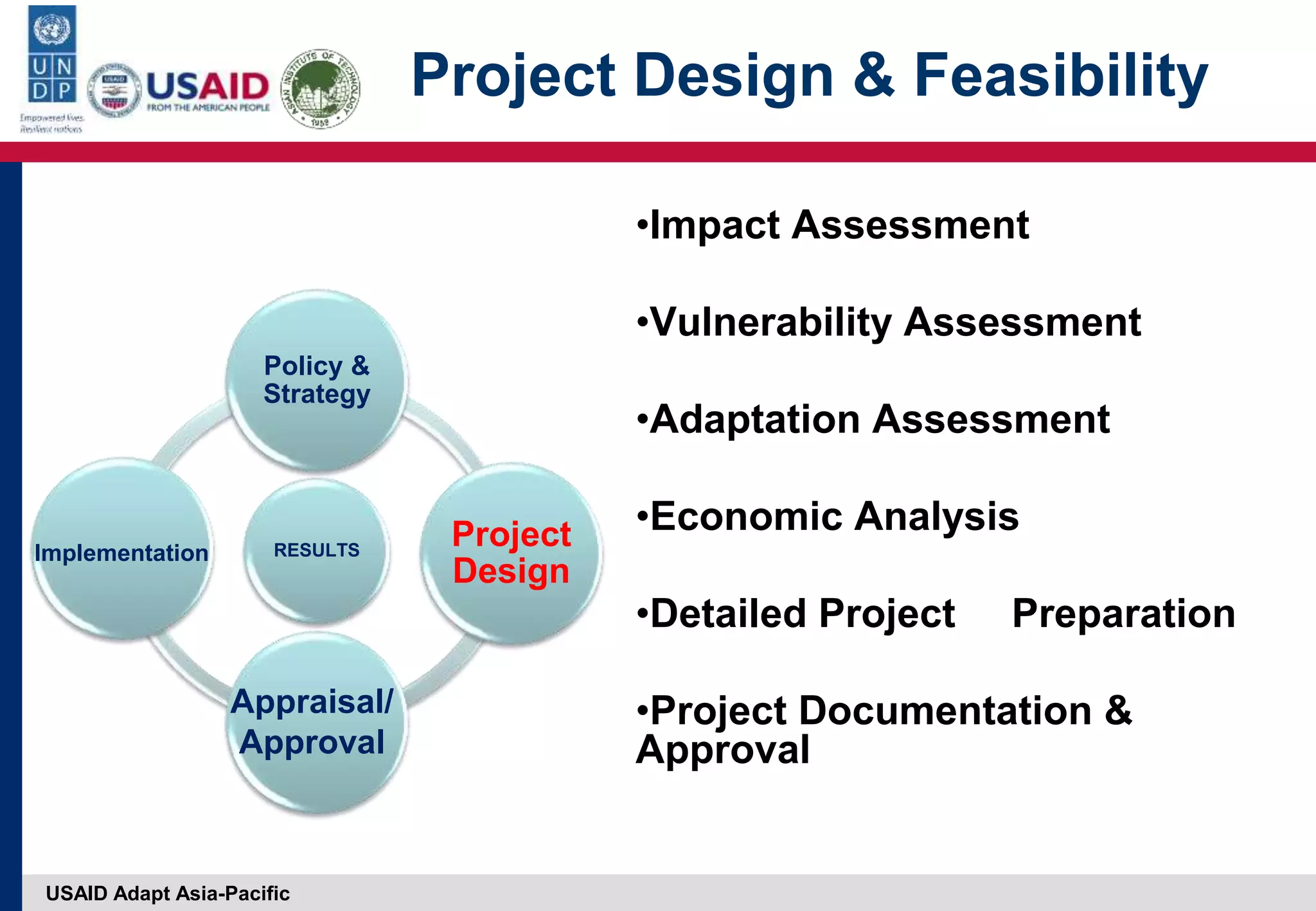
Project Design & Feasibility
•Impact Assessment
•Vulnerability Assessment
•Adaptation Assessment
•Economic Analysis
•Detailed Project Preparation
•Project Documentation &
Approval
RESULTS
Policy &
Strategy
Project
Design
Implementation
Appraisal/
Approval
USAID Adapt Asia-Pacific
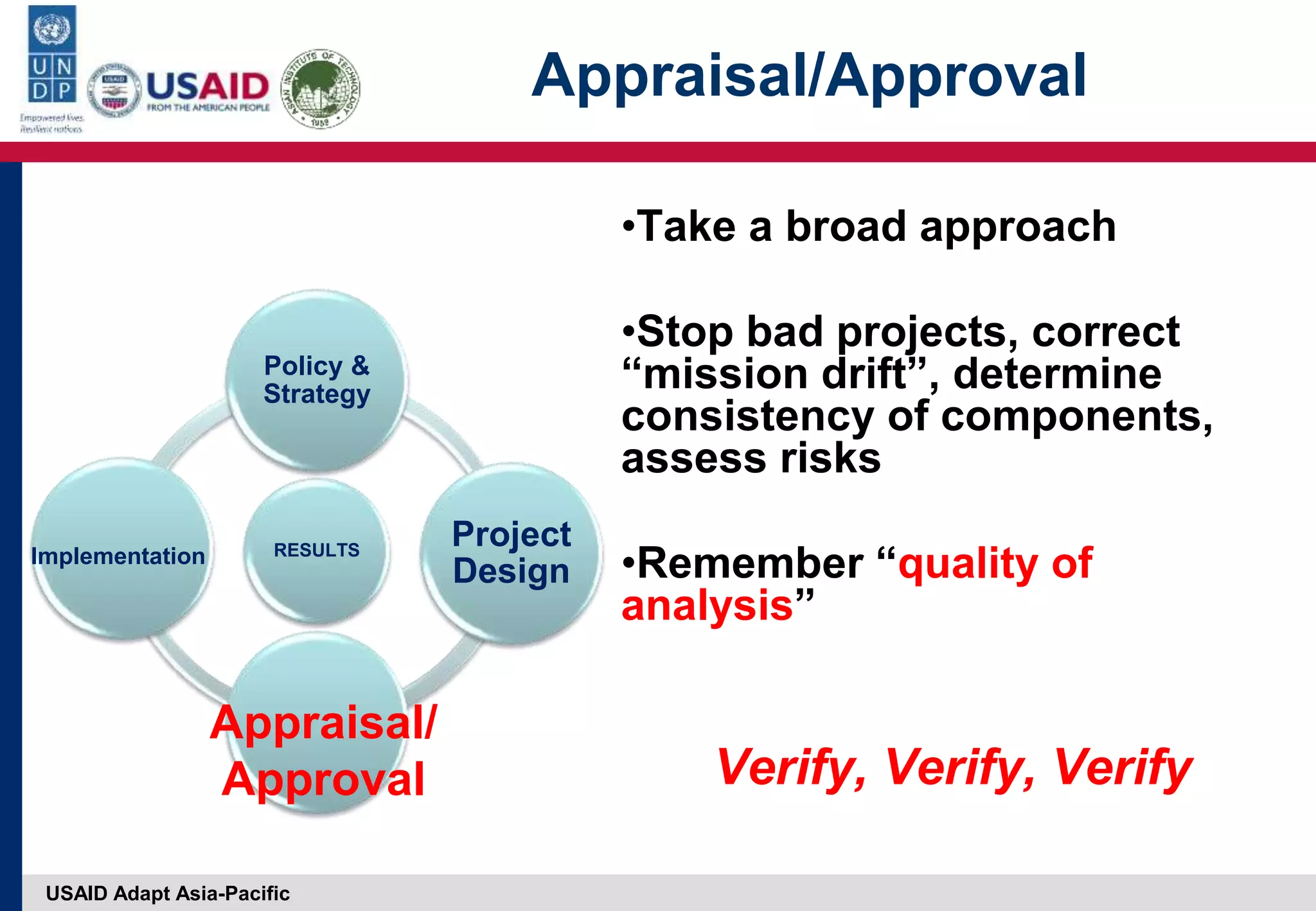
Appraisal/Approval
•Take a broad approach
•Stop bad projects, correct
“mission drift”, determine
consistency of components,
assess risks
•Remember “quality of
analysis”
Verify, Verify, Verify
RESULTS
Policy &
Strategy
Project
Design
Implementation
Appraisal/
Approval
USAID Adapt Asia-Pacific
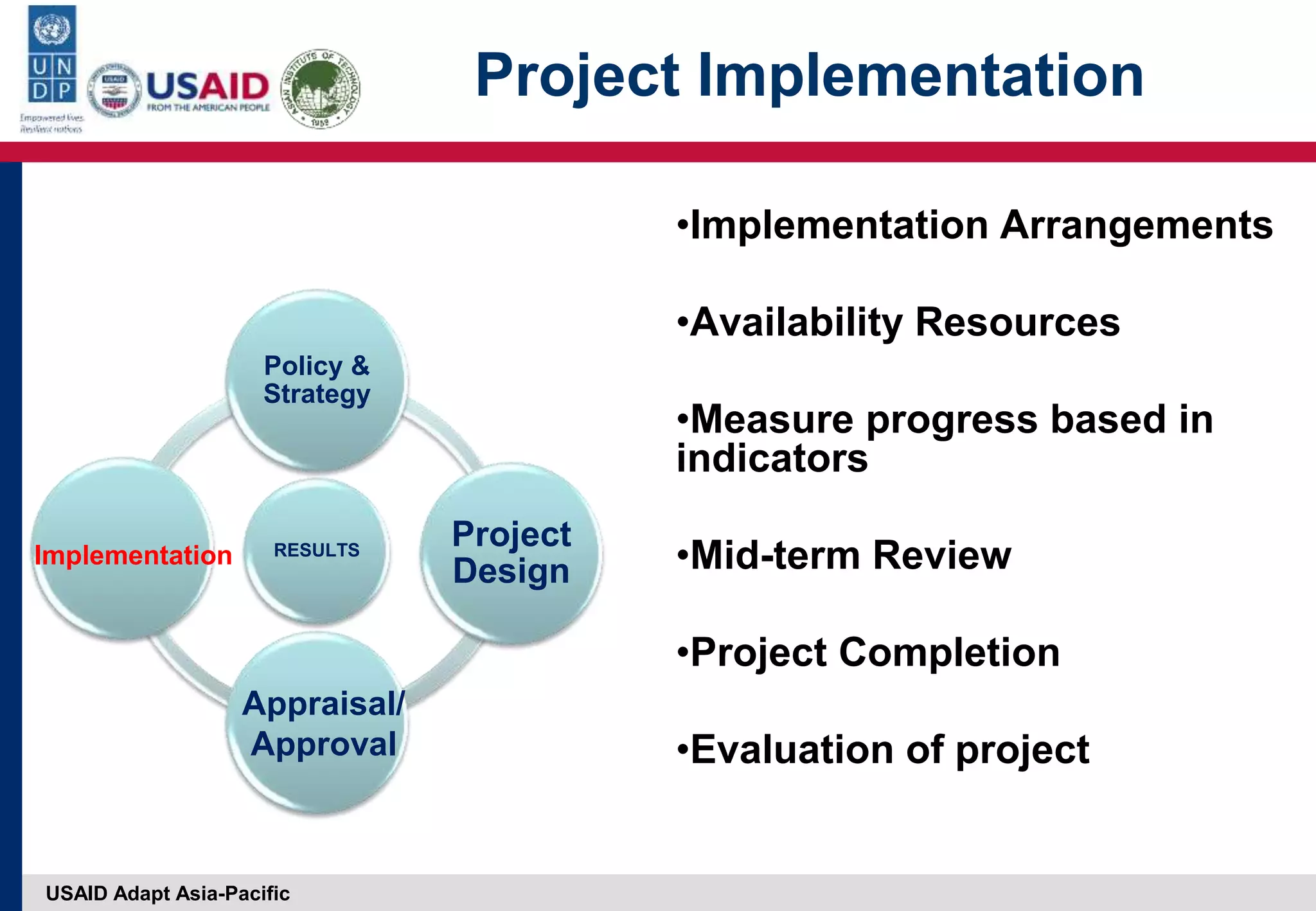
Project Implementation
•Implementation Arrangements
•Availability Resources
•Measure progress based in
indicators
•Mid-term Review
•Project Completion
•Evaluation of project
RESULTS
Policy &
Strategy
Project
Design
Implementation
Appraisal/
Approval
USAID Adapt Asia-Pacific
PART 1: INTRODUCTION TO CLIMATE
CHANGE AND ITS IMPACTS
USAID Adapt Asia-Pacific
The Project Cycle
RESULTS
Policy &
Strategy
Project
Design
Implementation
Appraisal/
Approval
Climate change
processes
(general)
Climate change
relative to your
country
Local/Regional/
National climate
impacts
USAID Adapt Asia-Pacific
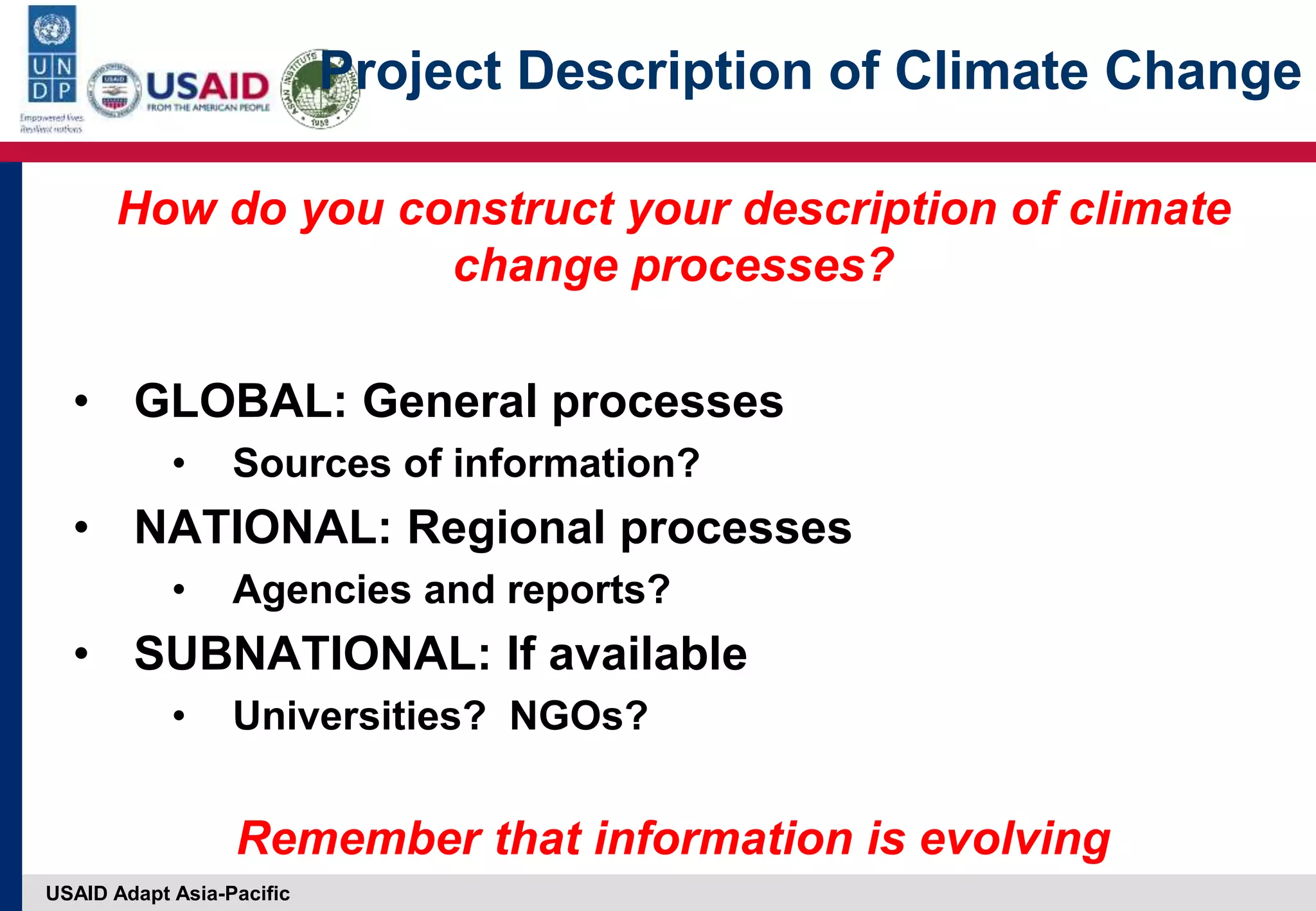
Project Description of Climate Change
How do you construct your description of climate
change processes?
• GLOBAL: General processes
• Sources of information?
• NATIONAL: Regional processes
• Agencies and reports?
• SUBNATIONAL: If available
• Universities? NGOs?
Remember that information is evolving
USAID Adapt Asia-Pacific
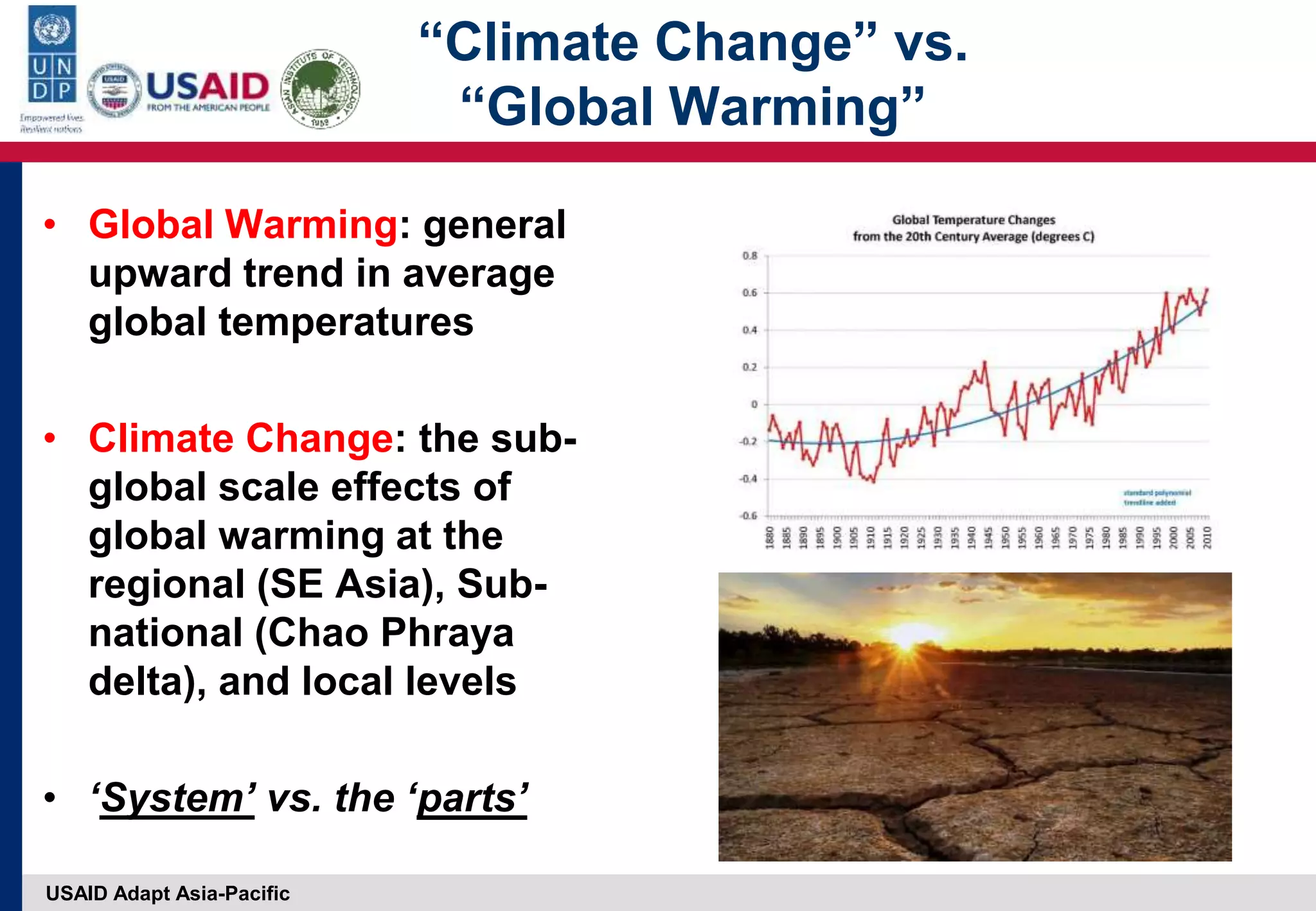
“Climate Change” vs.
“Global Warming”
• Global Warming: general
upward trend in average
global temperatures
• Climate Change: the sub-
global scale effects of
global warming at the
regional (SE Asia), Sub-
national (Chao Phraya
delta), and local levels
• ‘System’ vs. the ‘parts’
USAID Adapt Asia-Pacific
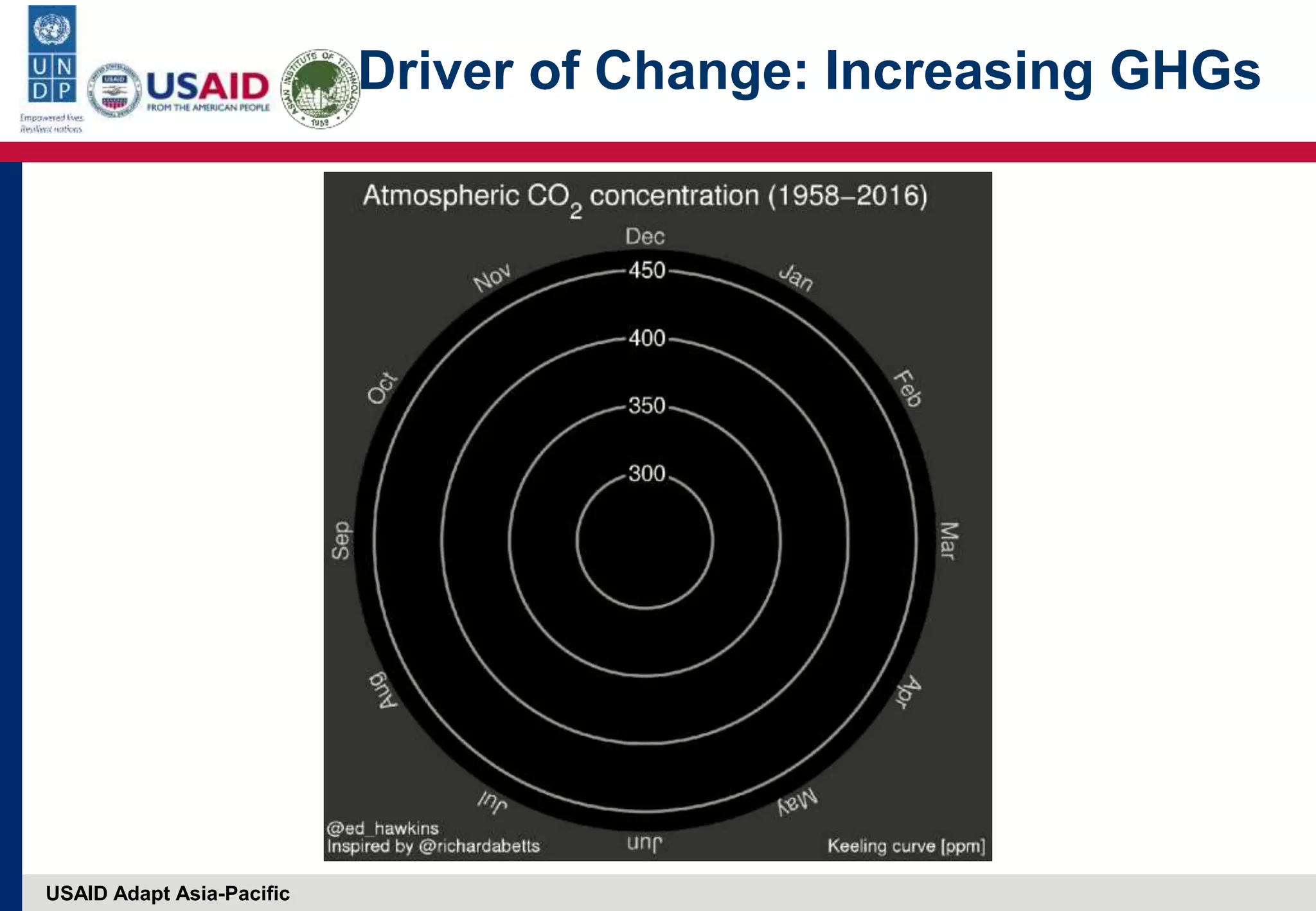
Driver of Change: Increasing GHGs
USAID Adapt Asia-Pacific
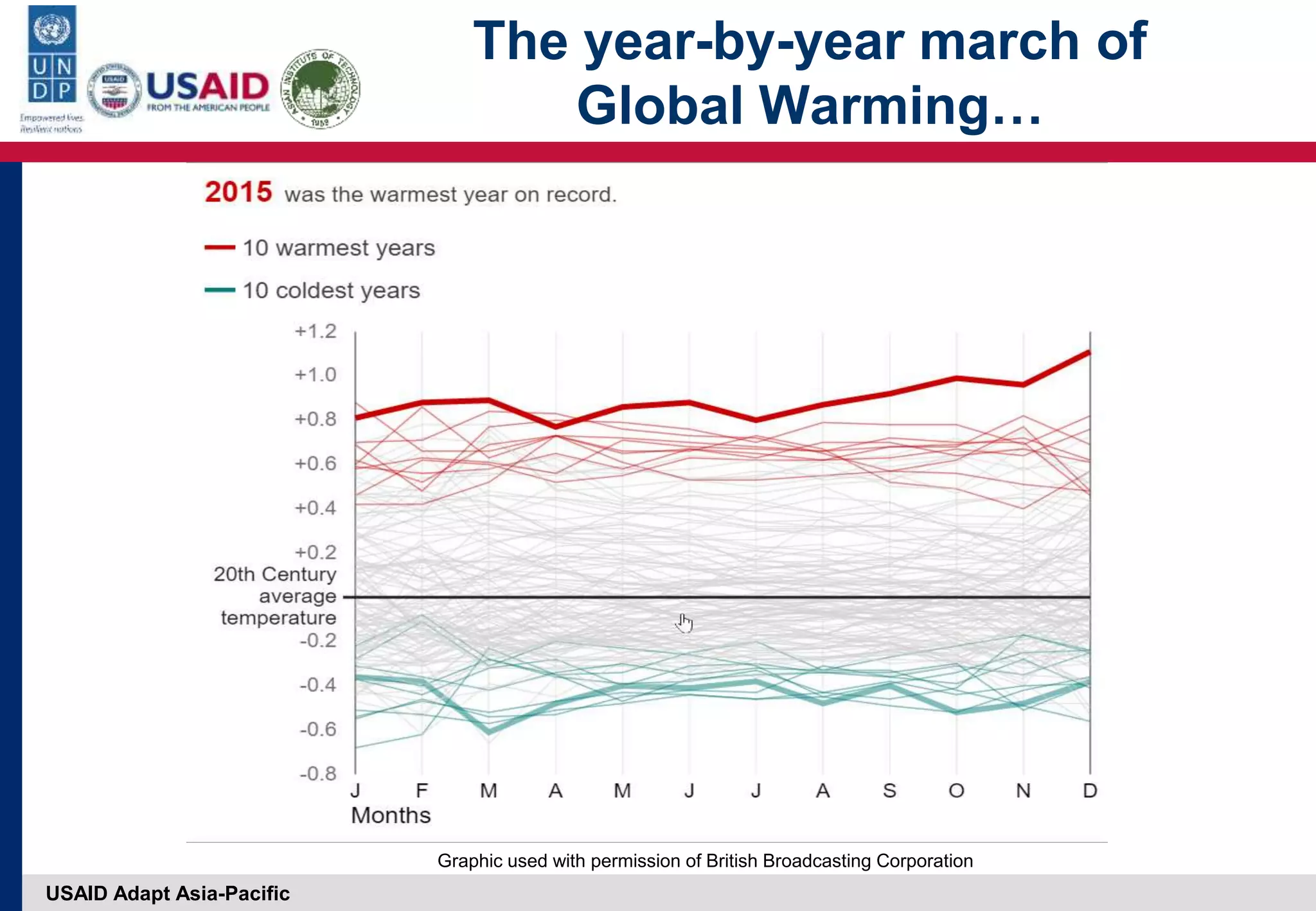
The year-by-year march of
Global Warming…
Graphic used with permission of British Broadcasting Corporation
USAID Adapt Asia-Pacific
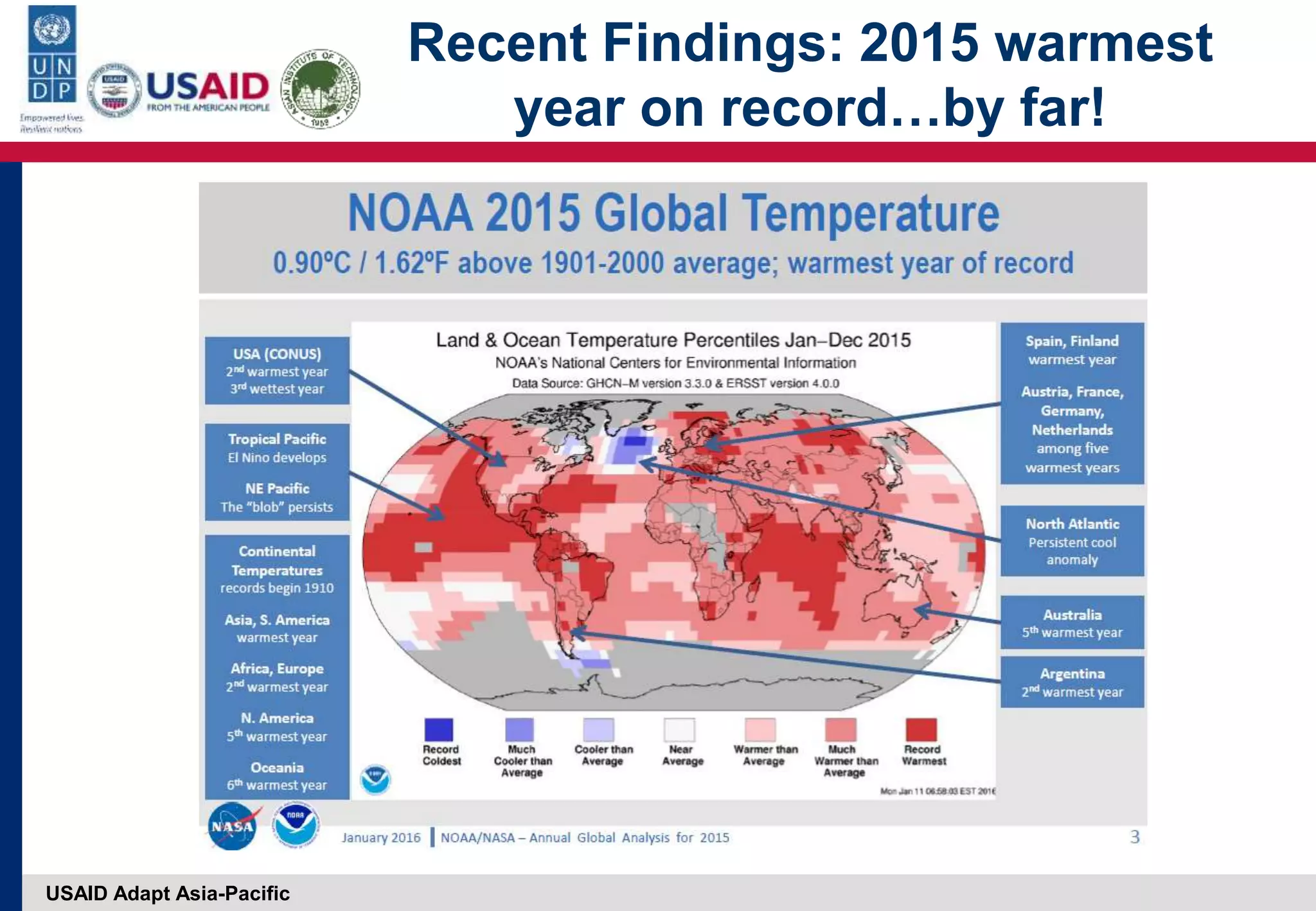
Recent Findings: 2015 warmest
year on record…by far!
USAID Adapt Asia-Pacific
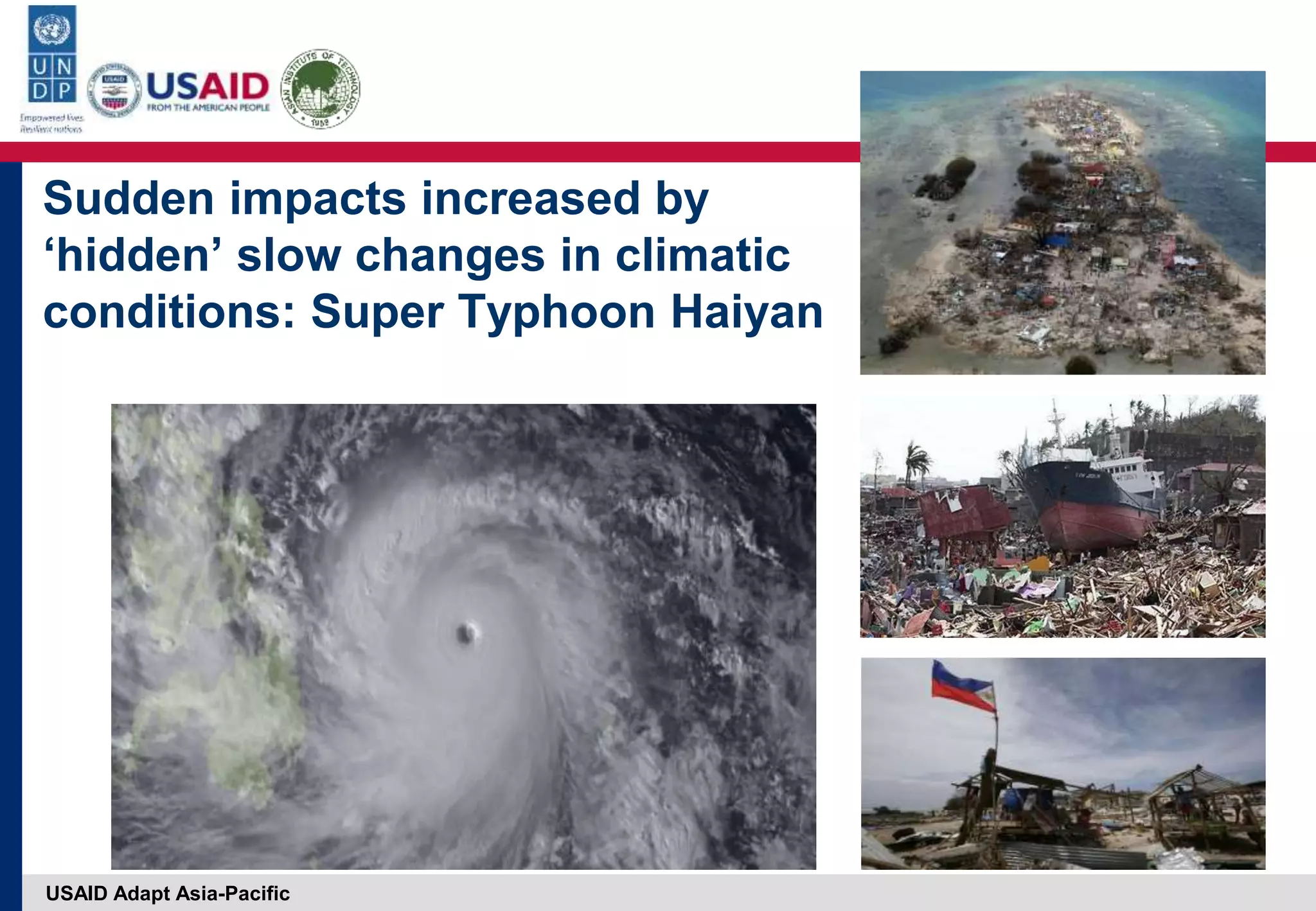
Sudden impacts increased by
‘hidden’ slow changes in climatic
conditions: Super Typhoon Haiyan
USAID Adapt Asia-Pacific
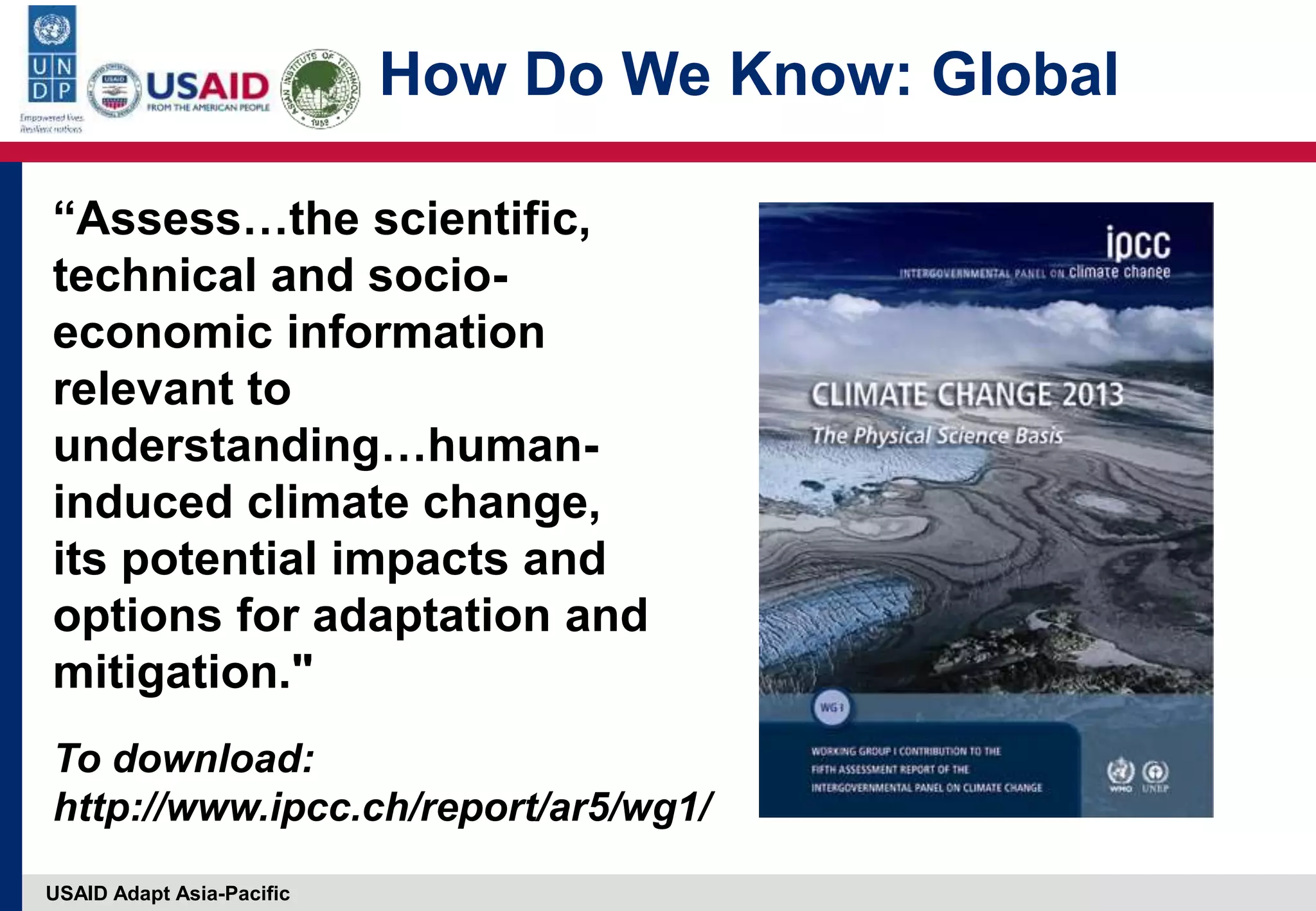
How Do We Know: Global
“Assess…the scientific,
technical and socio-
economic information
relevant to
understanding…human-
induced climate change,
its potential impacts and
options for adaptation and
mitigation."
To download:
http://www.ipcc.ch/report/ar5/wg1/
USAID Adapt Asia-Pacific
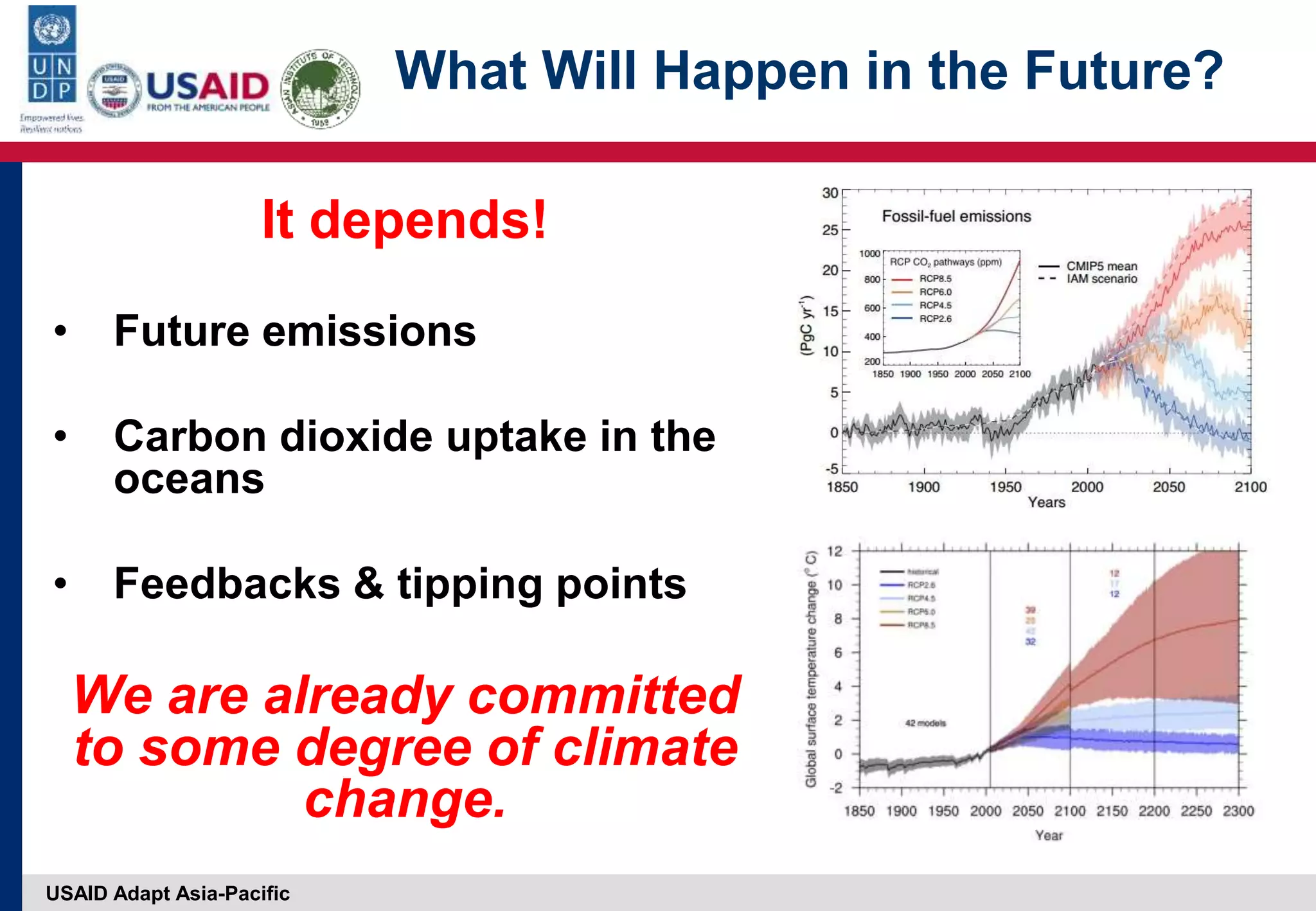
What Will Happen in the Future?
It depends!
• Future emissions
• Carbon dioxide uptake in the
oceans
• Feedbacks & tipping points
We are already committed
to some degree of climate
change.
USAID Adapt Asia-Pacific
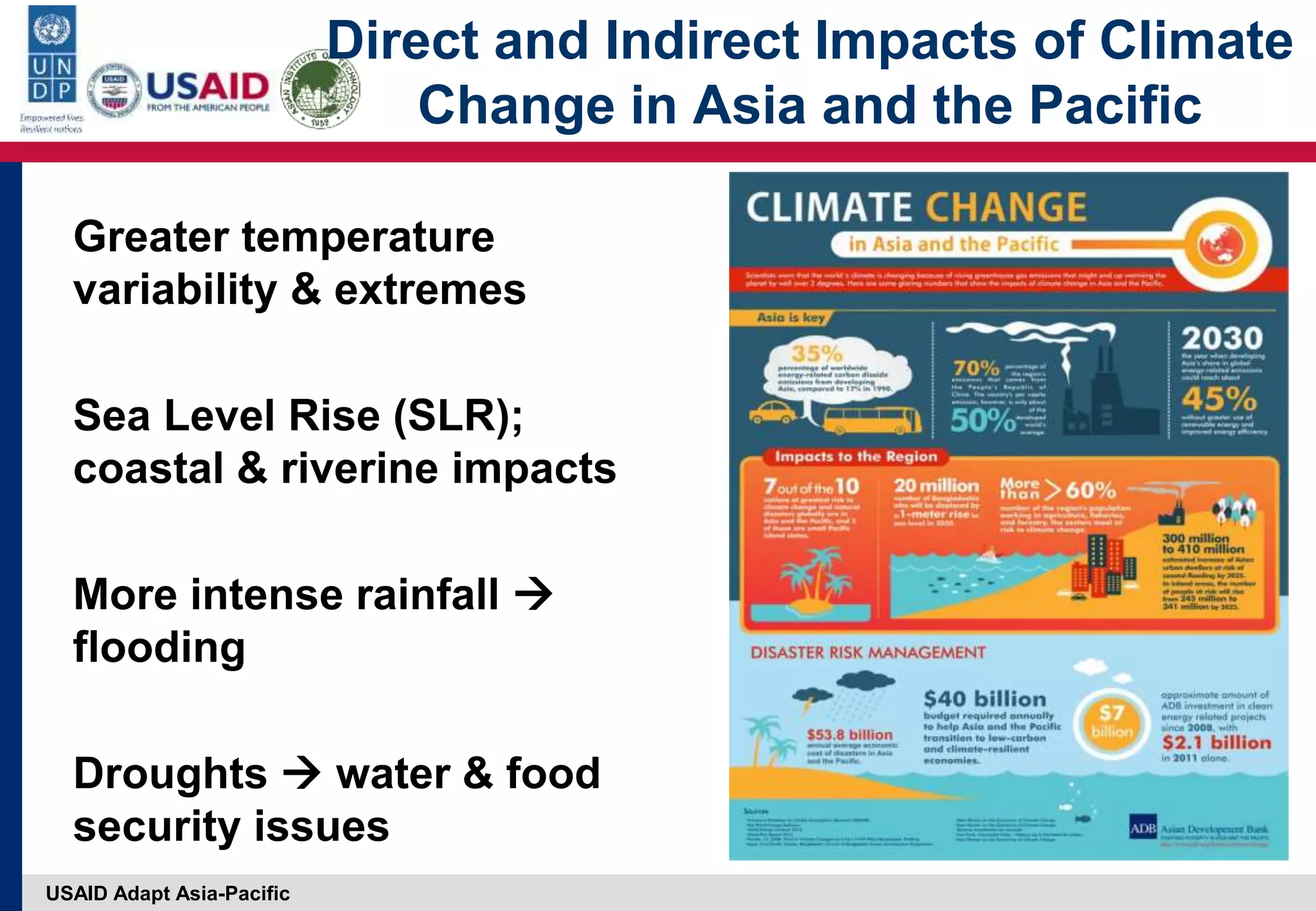
Direct and Indirect Impacts of Climate
Change in Asia and the Pacific
Greater temperature
variability & extremes
Sea Level Rise (SLR);
coastal & riverine impacts
More intense rainfall 
flooding
Droughts  water & food
security issues
USAID Adapt Asia-Pacific
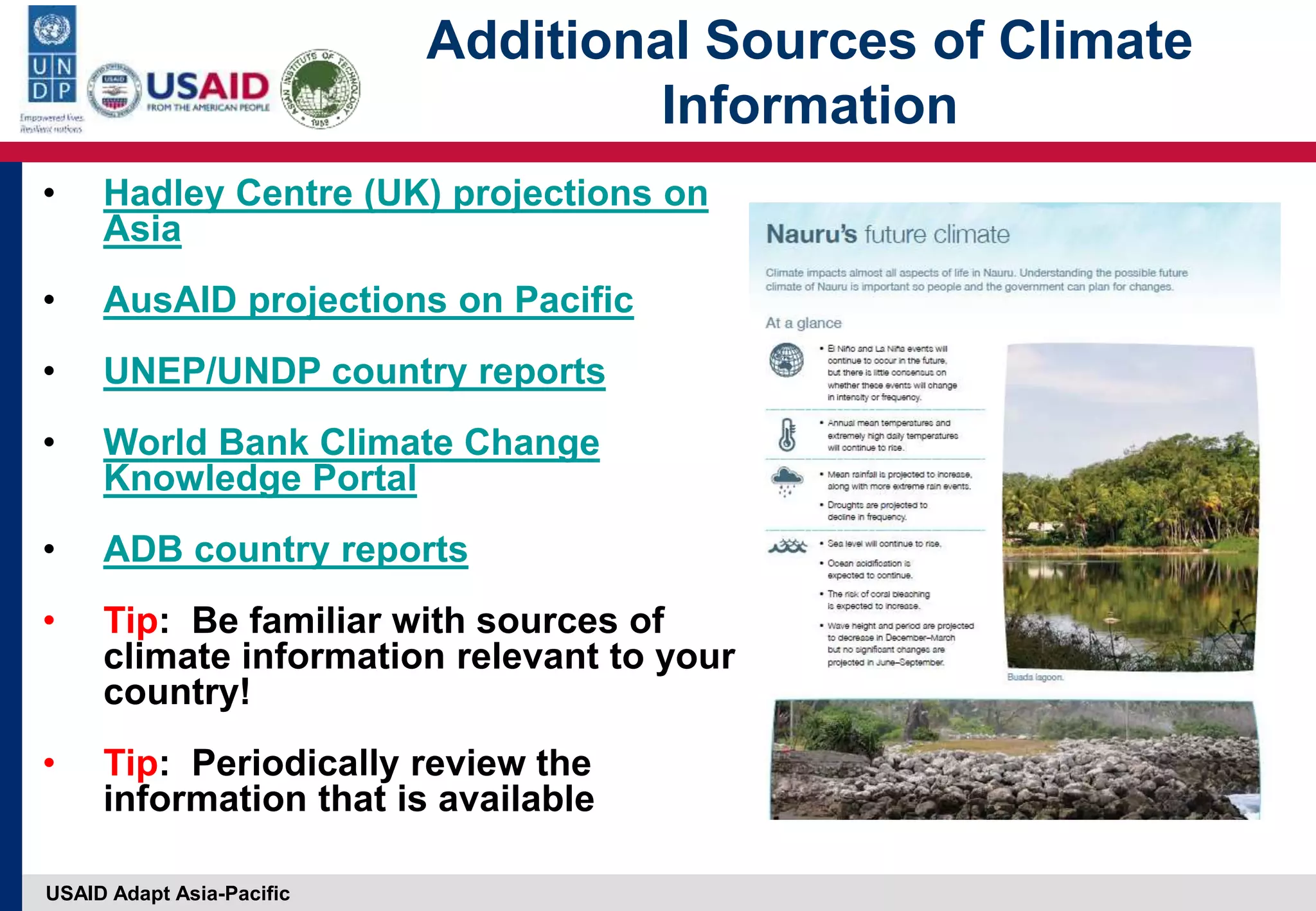
Additional Sources of Climate
Information
• Hadley Centre (UK) projections on
Asia
• AusAID projections on Pacific
• UNEP/UNDP country reports
• World Bank Climate Change
Knowledge Portal
• ADB country reports
• Tip: Be familiar with sources of
climate information relevant to your
country!
• Tip: Periodically review the
information that is available
USAID Adapt Asia-Pacific
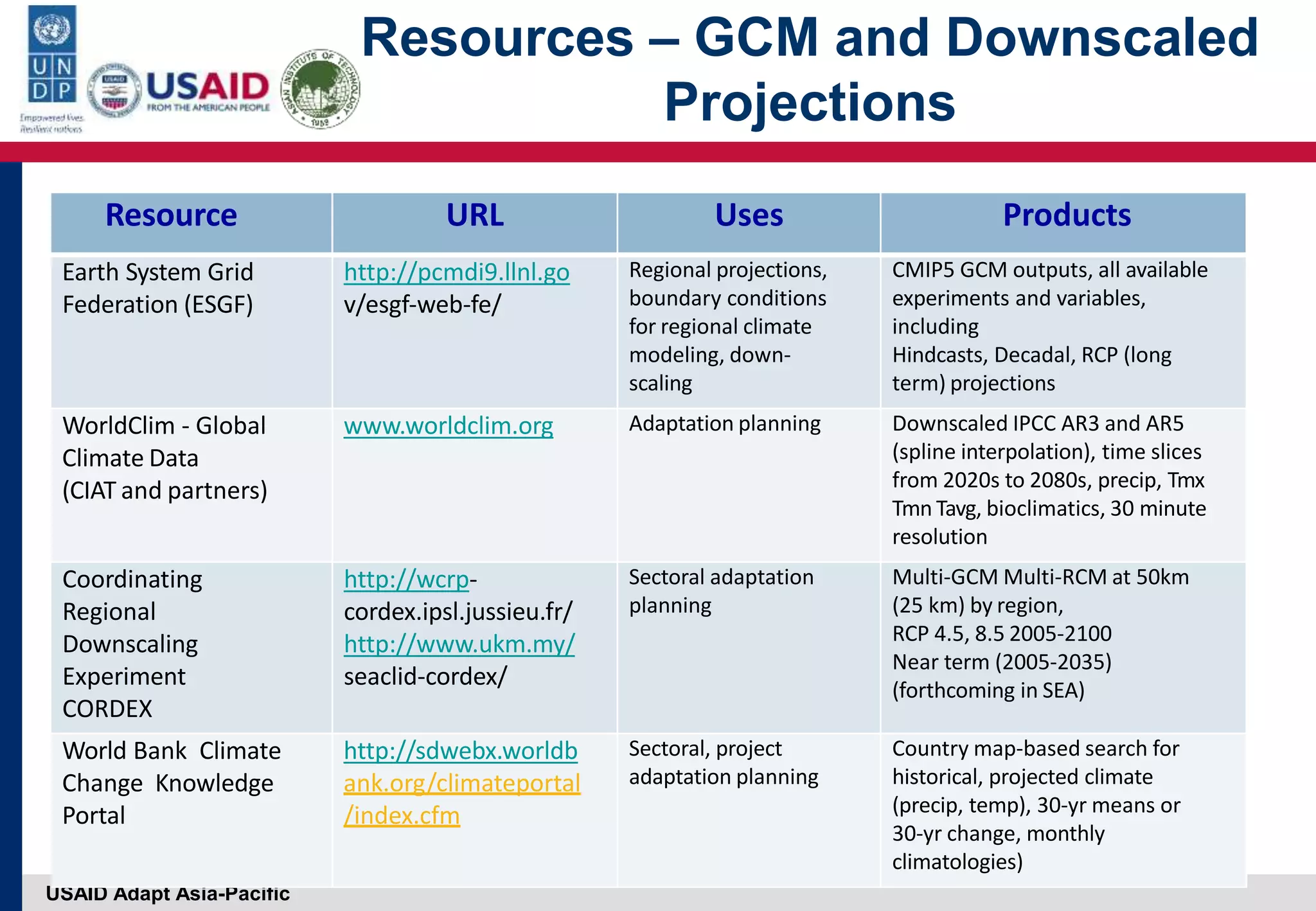
Resource URL Uses Products
Earth System Grid
Federation (ESGF)
http://pcmdi9.llnl.go
v/esgf‐web‐fe/
Regional projections,
boundary conditions
for regional climate
modeling, down‐
scaling
CMIP5 GCM outputs, all available
experiments and variables,
including
Hindcasts, Decadal, RCP (long
term) projections
WorldClim ‐ Global
Climate Data
(CIAT and partners)
www.worldclim.org Adaptation planning Downscaled IPCC AR3 and AR5
(spline interpolation), time slices
from 2020s to 2080s, precip, Tmx
Tmn Tavg, bioclimatics, 30 minute
resolution
Coordinating
Regional
Downscaling
Experiment
CORDEX
http://wcrp‐
cordex.ipsl.jussieu.fr/
http://www.ukm.my/
seaclid‐cordex/
Sectoral adaptation
planning
Multi‐GCM Multi‐RCM at 50km
(25 km) by region,
RCP 4.5, 8.5 2005‐2100
Near term (2005‐2035)
(forthcoming in SEA)
World Bank Climate
Change Knowledge
Portal
http://sdwebx.worldb
ank.org/climateportal
/index.cfm
Sectoral, project
adaptation planning
Country map‐based search for
historical, projected climate
(precip, temp), 30‐yr means or
30‐yr change, monthly
climatologies)
Resources – GCM and Downscaled
Projections
USAID Adapt Asia-Pacific
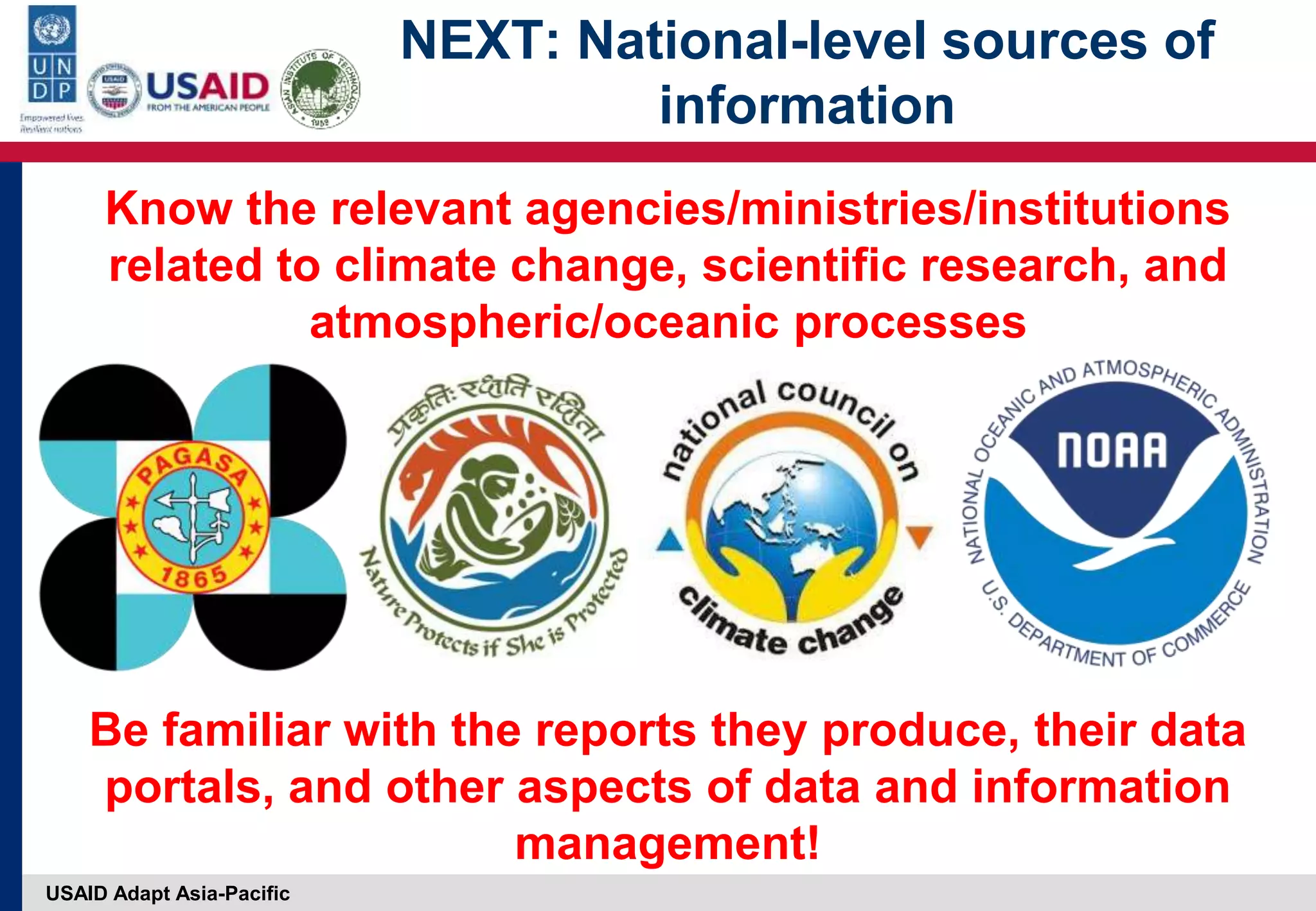
NEXT: National-level sources of
information
Know the relevant agencies/ministries/institutions
related to climate change, scientific research, and
atmospheric/oceanic processes
Be familiar with the reports they produce, their data
portals, and other aspects of data and information
management!
USAID Adapt Asia-Pacific
NEXT: Subnational Sources of
Information
Are there subnational plans in place?
Research/Downscaled projections/vulnerability
assessments?
 University studies
 International NGOs
 Local NGOs
USAID Adapt Asia-Pacific
Quiz: Climate Change in your country
What are the physical changes expected in your
country?
What data are these projections based on?
Where do you go to find more information?
Answering these questions will help prepare
you to develop adaptation projects!
USAID Adapt Asia-Pacific
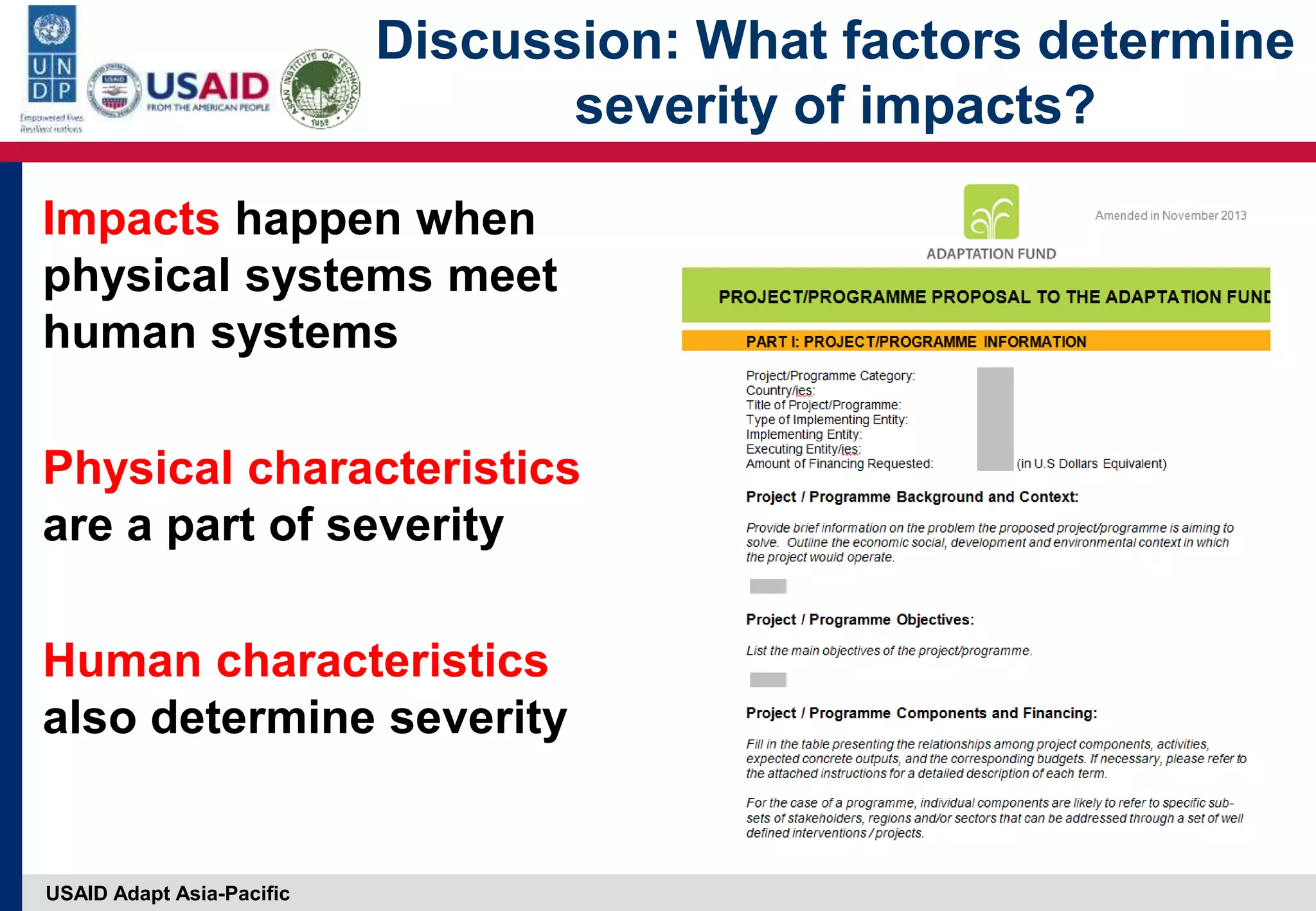
Discussion: What factors determine
severity of impacts?
Impacts happen when
physical systems meet
human systems
Physical characteristics
are a part of severity
Human characteristics
also determine severity
USAID Adapt Asia-Pacific
Describing the impacts
How do you describe the issue you want to
address?
• Baseline socioeconomic/demographic
conditions
• Current trends (e.g. marketization,
urbanization)
• How are the physical processes changing the
situation?
USAID Adapt Asia-Pacific
The degree to which ultimately affected by
climate change impacts.
Vulnerability = Impact /Adaptive Capacity
What is Vulnerability?
Understanding Vulnerability
USAID Adapt Asia-Pacific
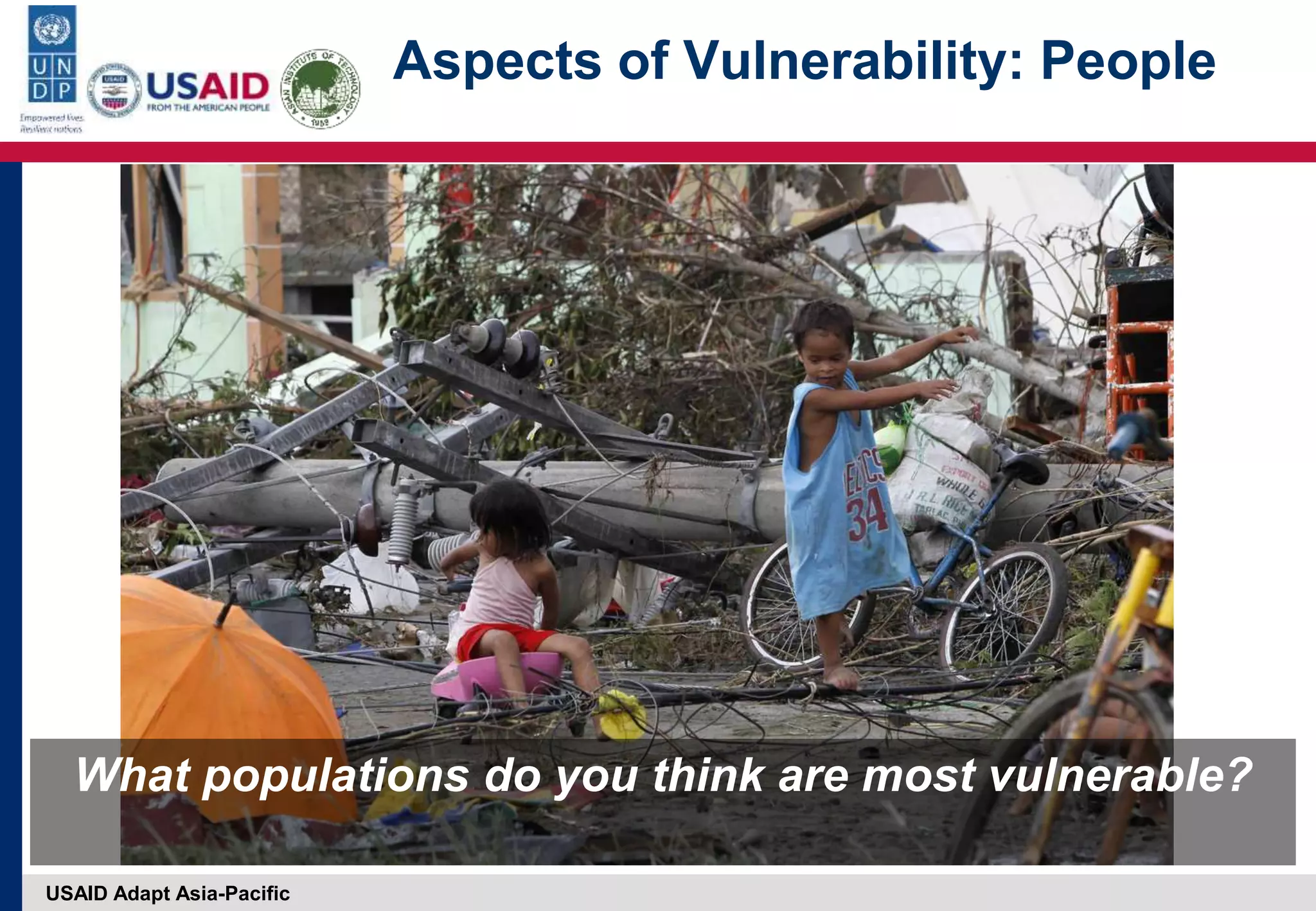
What populations do you think are most vulnerable?
Aspects of Vulnerability: People
USAID Adapt Asia-Pacific
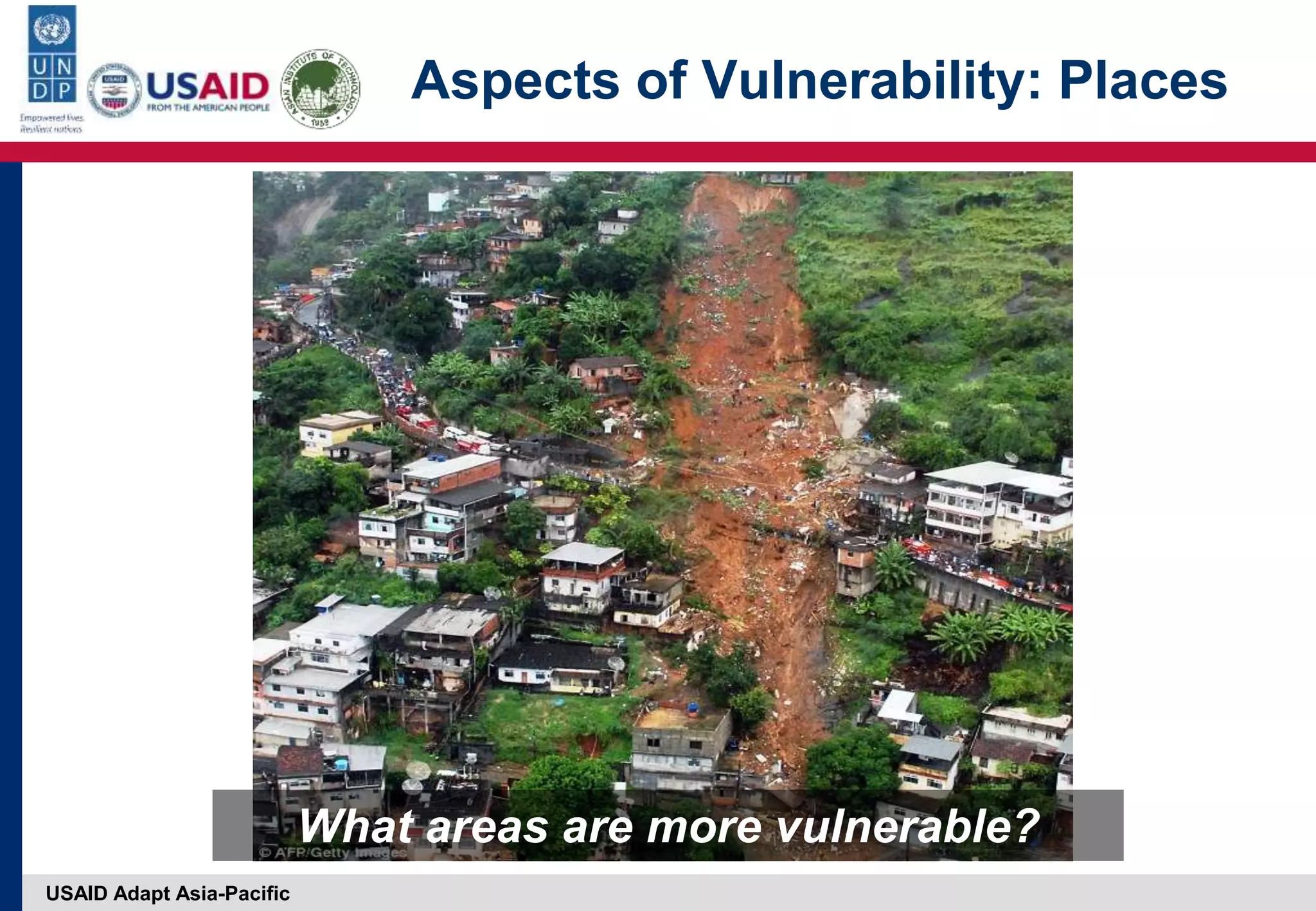
What areas are more vulnerable?
Aspects of Vulnerability: Places
USAID Adapt Asia-Pacific
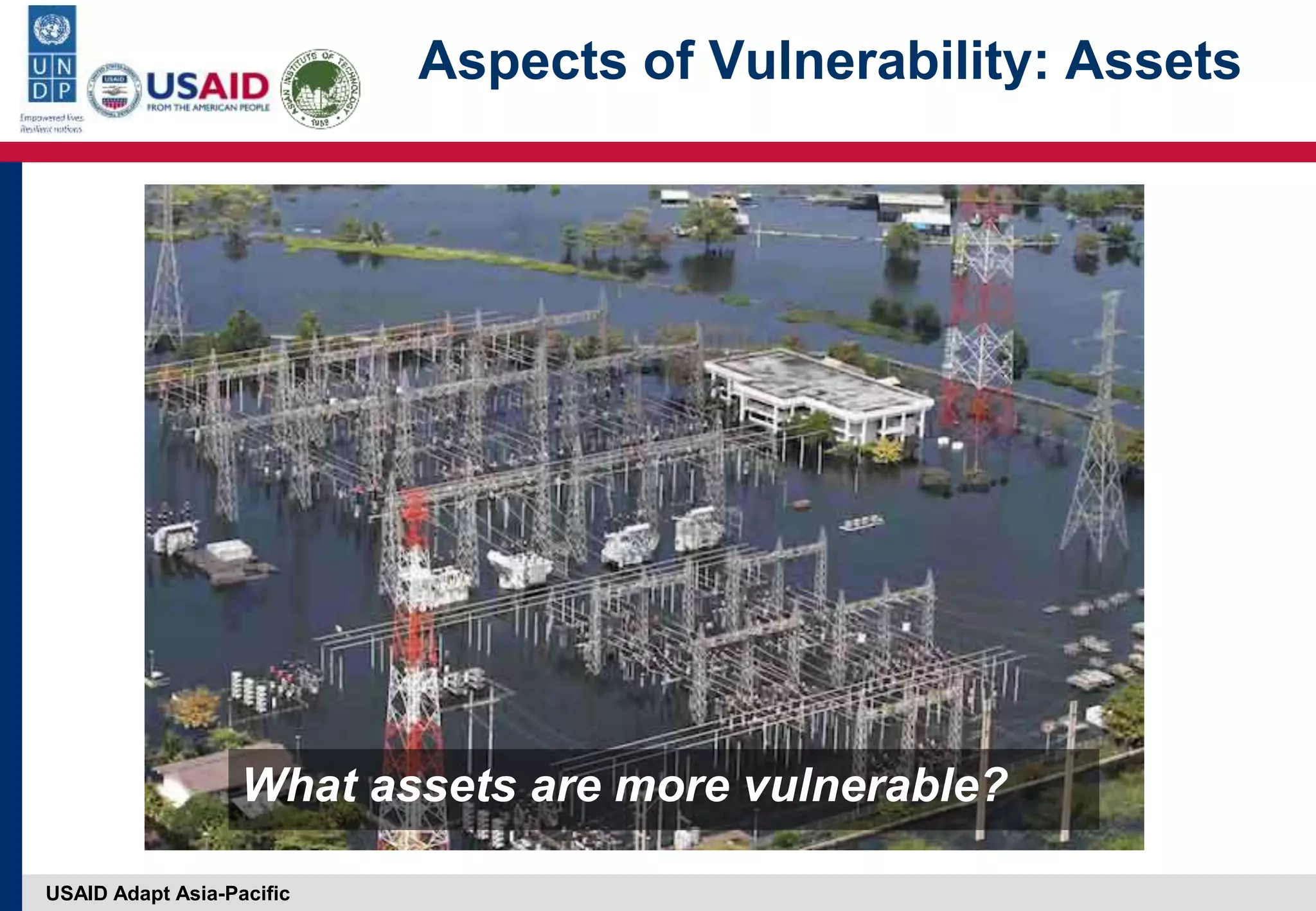
What assets are more vulnerable?
Aspects of Vulnerability: Assets
USAID Adapt Asia-Pacific
A measure of the extent to which people,
places, and things or assets are subjected to
potential threats or existing hazards
What is Exposure?
Step 1: Exposure
USAID Adapt Asia-Pacific
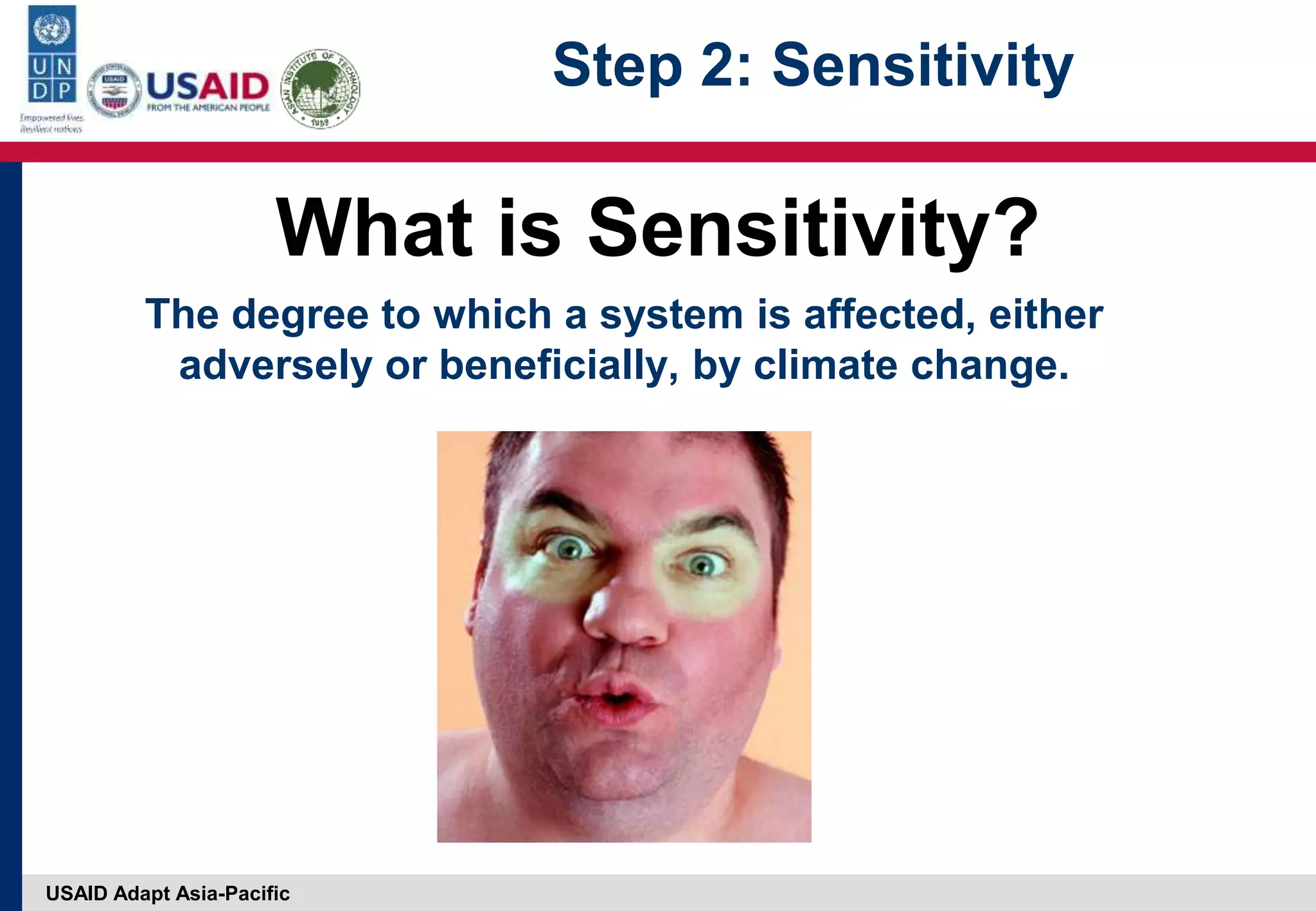
The degree to which a system is affected, either
adversely or beneficially, by climate change.
What is Sensitivity?
Step 2: Sensitivity
USAID Adapt Asia-Pacific
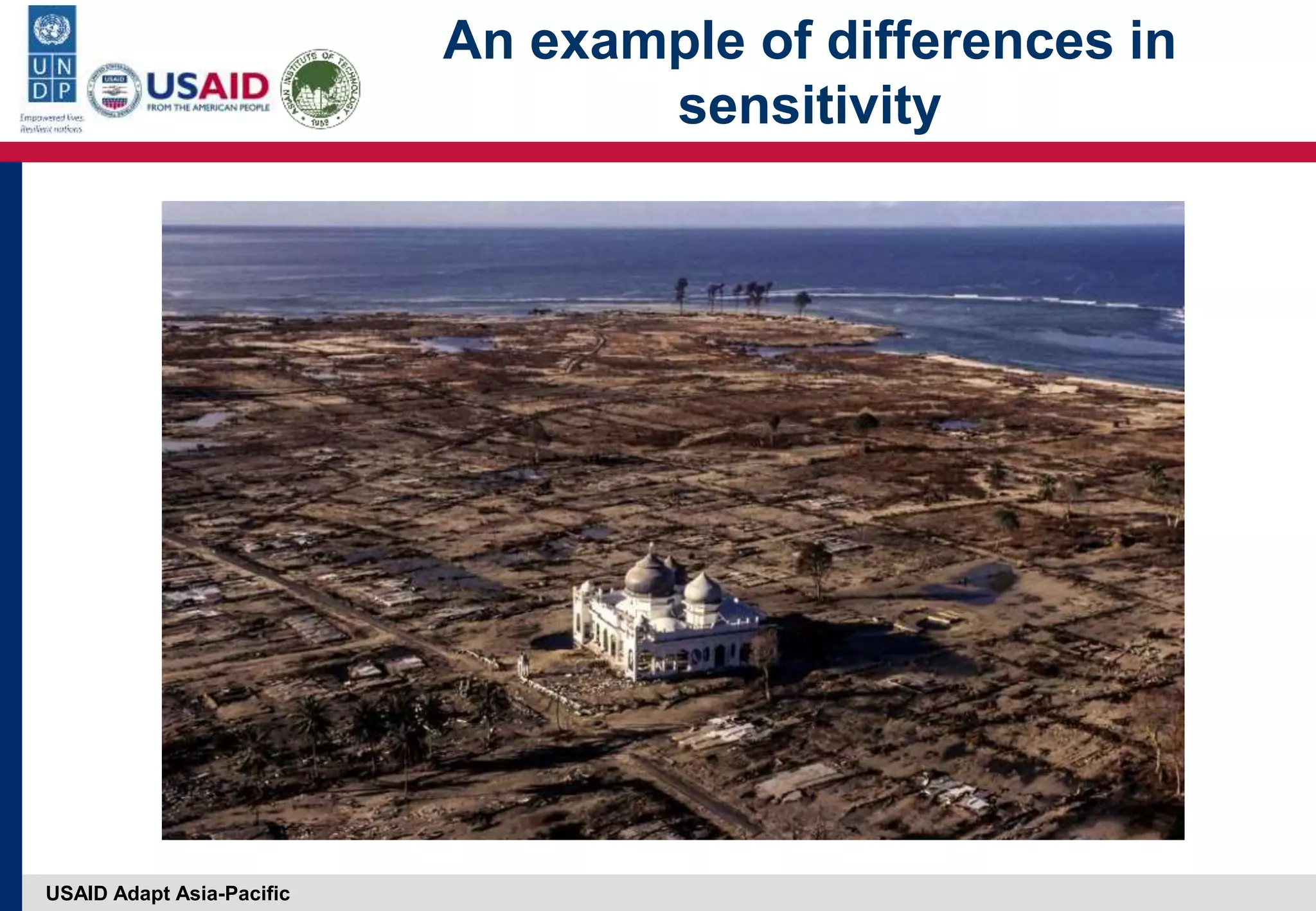
An example of differences in
sensitivity
USAID Adapt Asia-Pacific
Differential Sensitivity leads to increased
Vulnerability for some groups
USAID Adapt Asia-Pacific
The result of exposure and sensitivity of affected
people, places, and things to climate change threats.
I = E x S
Direct impacts: affect people, area, or things or assets
in a clear, often highly visible manner.
Indirect impacts: include “ripple,” “cascading,” or
“downstream” effects that are not always immediately
obvious
What are Impacts?
Step 3: Impacts
USAID Adapt Asia-Pacific
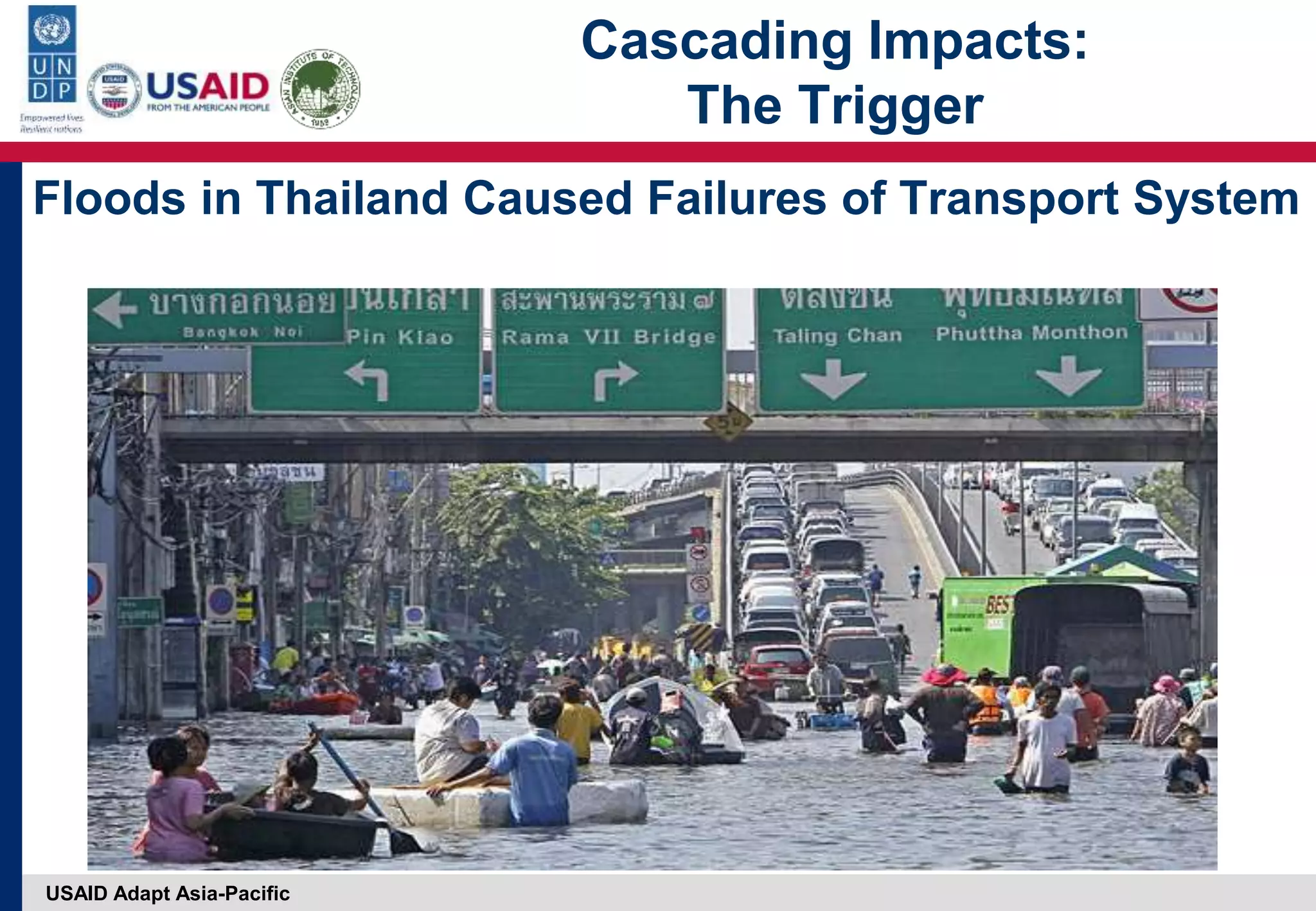
Floods in Thailand Caused Failures of Transport System
Cascading Impacts:
The Trigger
USAID Adapt Asia-Pacific
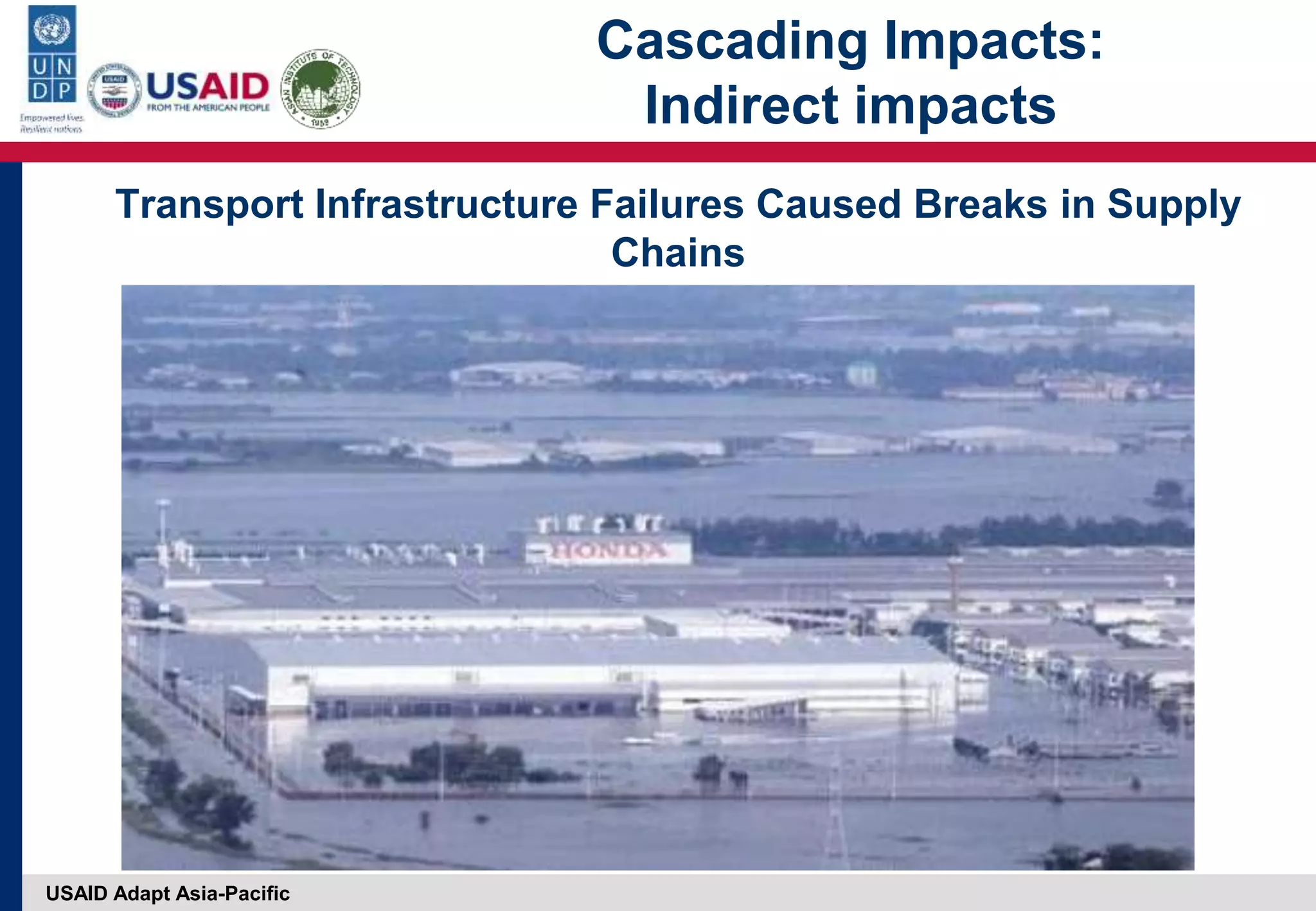
Transport Infrastructure Failures Caused Breaks in Supply
Chains
Cascading Impacts:
Indirect impacts
USAID Adapt Asia-Pacific
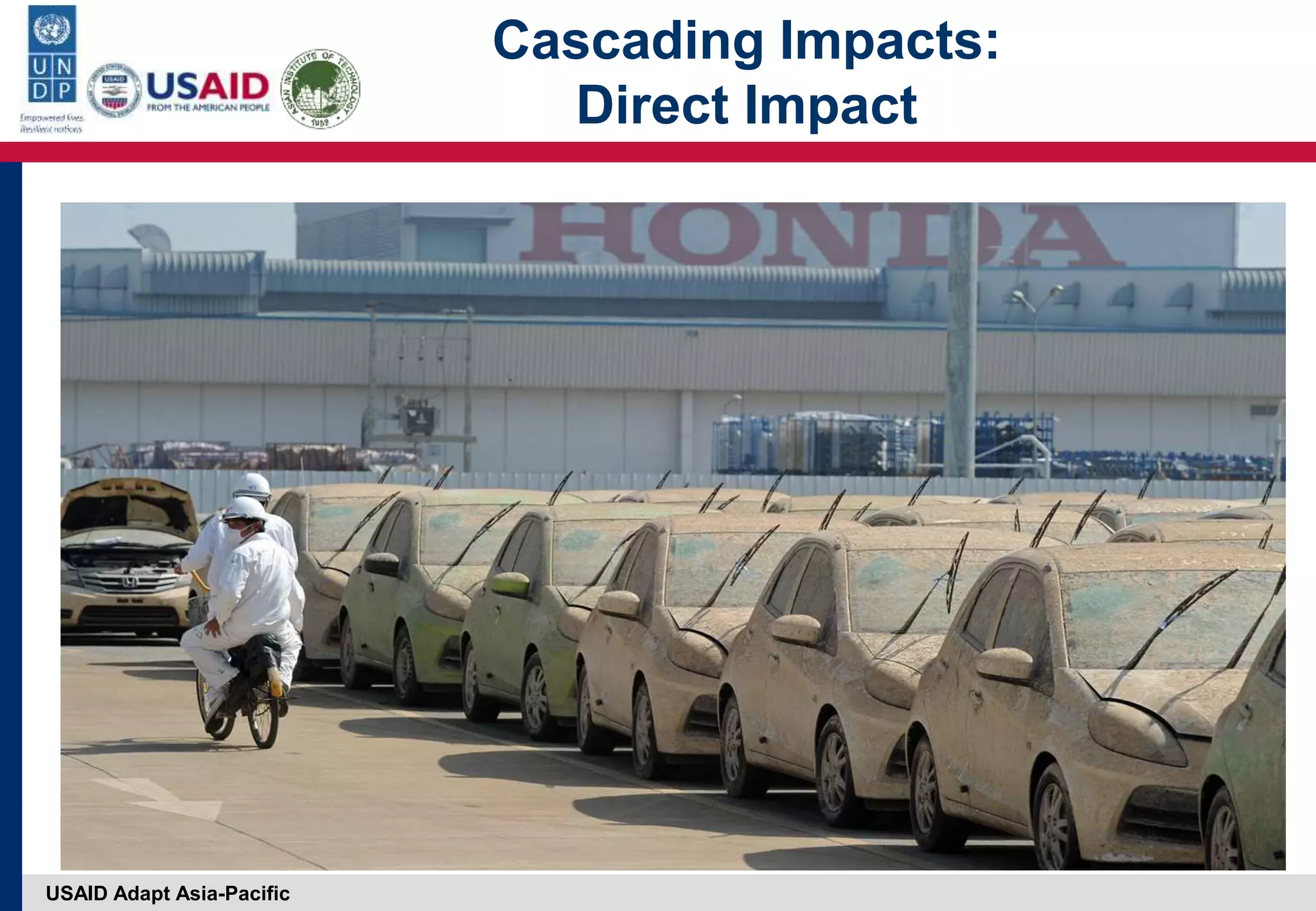
Cascading Impacts:
Direct Impact
USAID Adapt Asia-Pacific
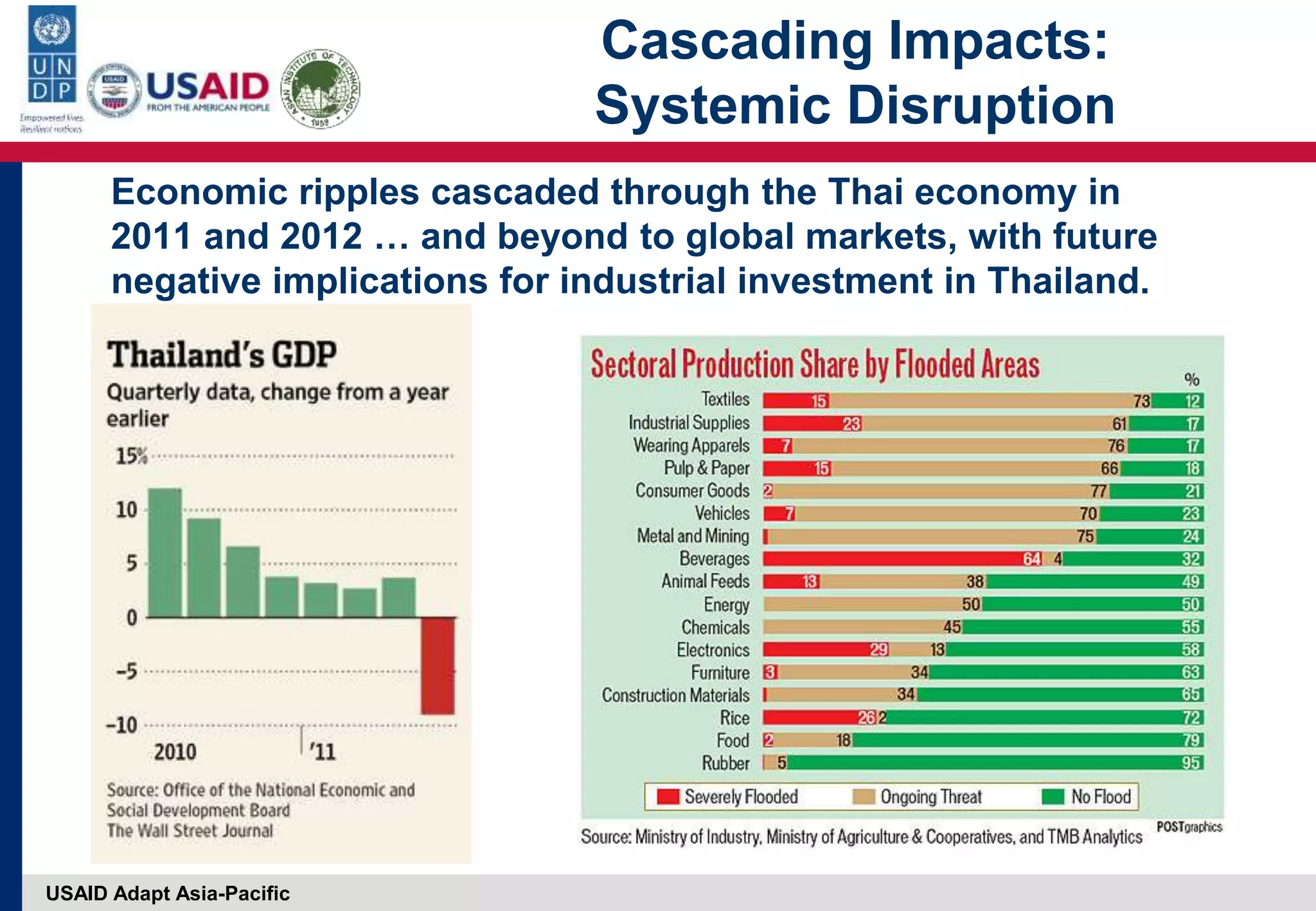
Economic ripples cascaded through the Thai economy in
2011 and 2012 … and beyond to global markets, with future
negative implications for industrial investment in Thailand.
38Cascading Impacts:
Systemic Disruption
USAID Adapt Asia-Pacific
The ability of people, places, and things to adapt
to climate change and reduce risks and take
advantage of new opportunities.
What is Adaptive
Capacity?
Step 4: Adaptive Capacity
USAID Adapt Asia-Pacific
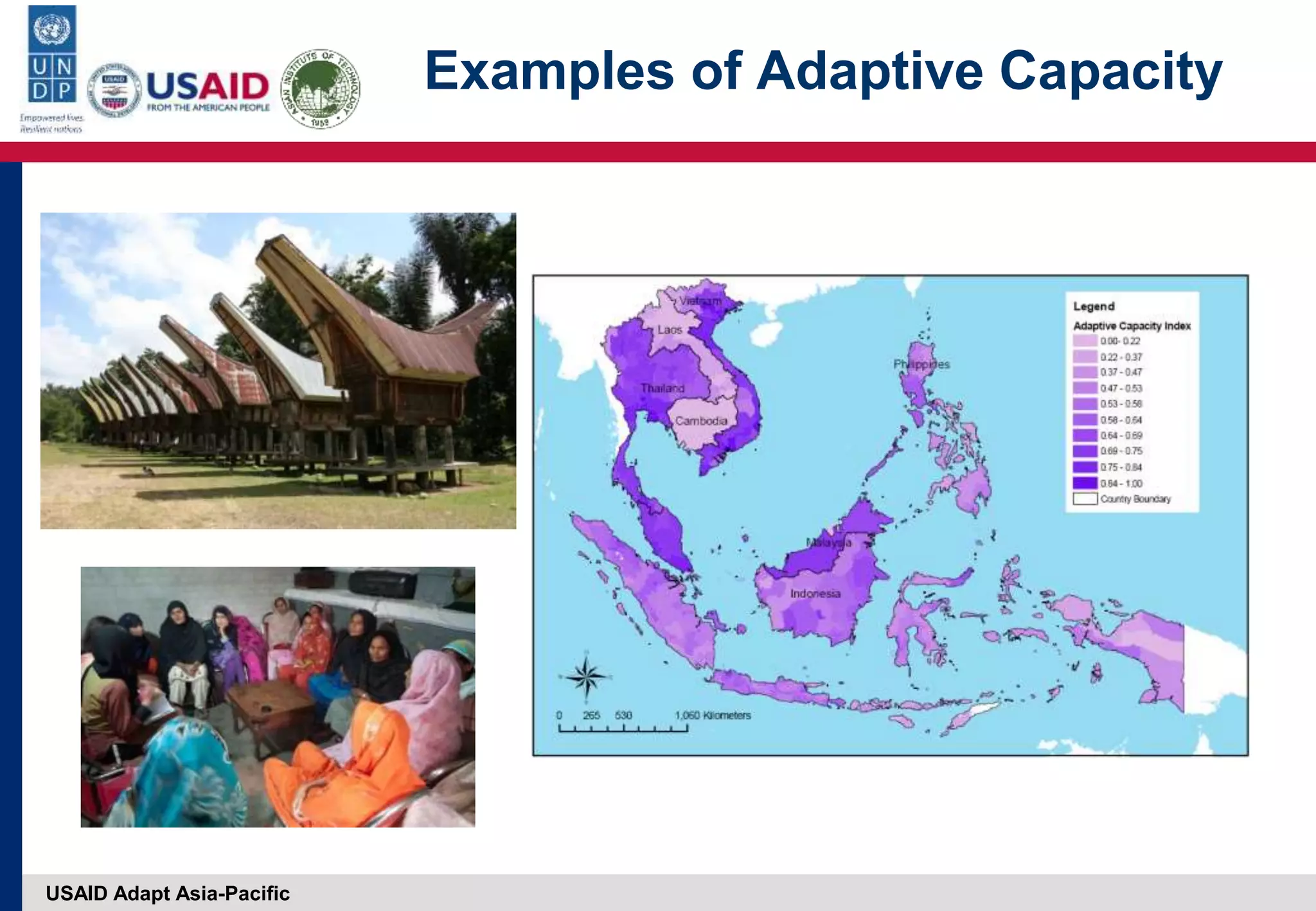
Examples of Adaptive Capacity
USAID Adapt Asia-Pacific
KEY POINT:
UNDERSTAND AND
ARTICULATE THE
PROBLEM
USAID Adapt Asia-Pacific
Knowledge Check
All of the following are experienced/potential impacts
of climate change South and Southeast Asia except:
A. Increased mortality from heat waves
B. Decreased crop yields
C. Increased internal migration
D. Improved fisheries production
E. Increased seasonal flooding
USAID Adapt Asia-Pacific
Conclusions and Summary
of Part 1
The direct, indirect and cascading impacts of climate
change are connected
Vulnerability to climate change is influenced by
exposure, sensitivity, and adaptive capacity
Impacts of climate change vary from place to place.
Some impacts currently being experienced or expected
include sea level rise, changing seasonal patterns, and
heat waves
An informed understanding of these impacts is a crucial
first step in developing strategies and projects!!!
USAID Adapt Asia-Pacific
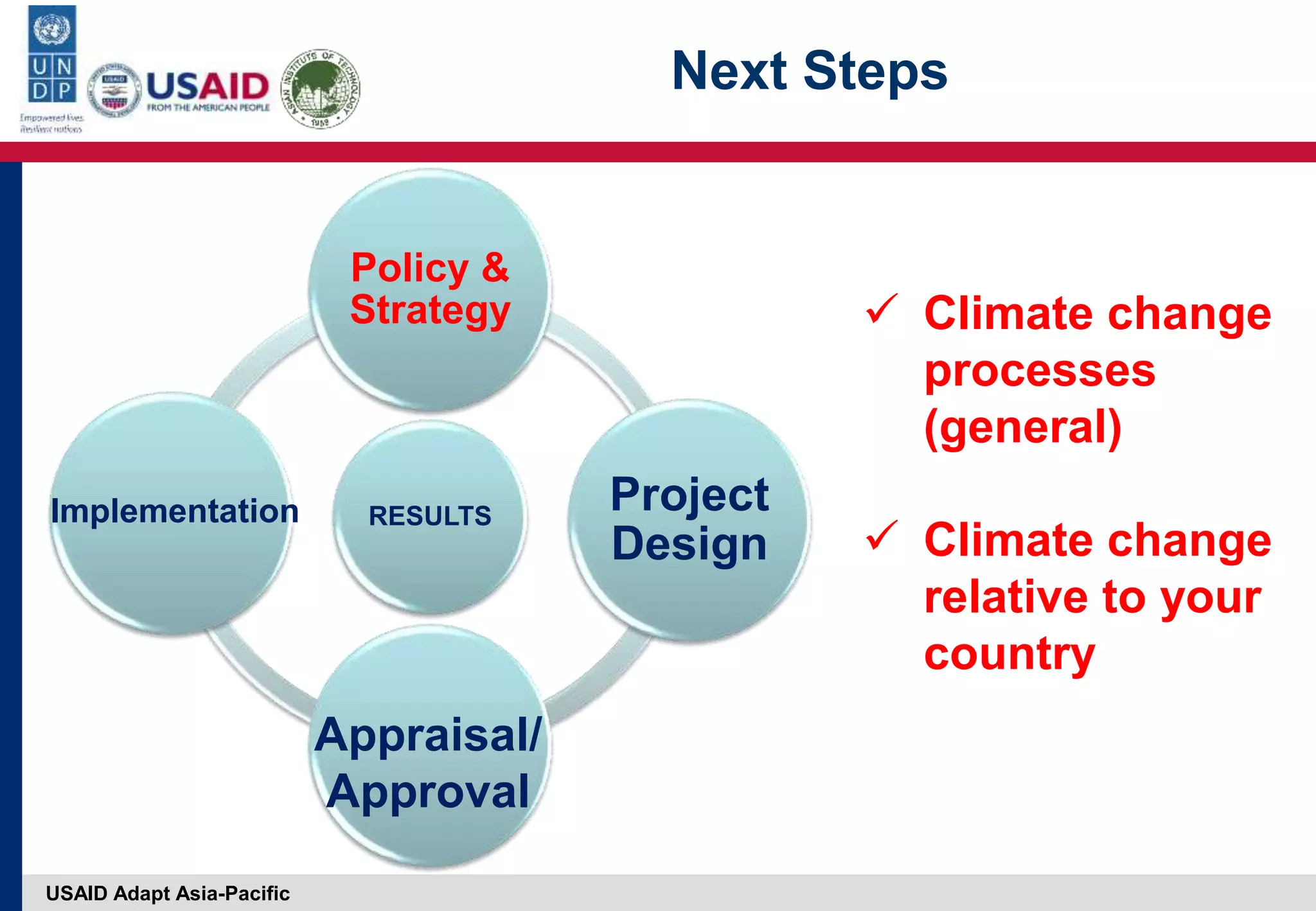
Next Steps
RESULTS
Policy &
Strategy
Project
Design
Implementation
Appraisal/
Approval
 Climate change
processes
(general)
 Climate change
relative to your
country
USAID Adapt Asia-Pacific
Resources and Tools
for Section 1
• Addressing Climate Change and Migration in Asia
and the Pacific. ADB 2012.
• Climate Change 2013: Physical Science Basis.
IPCC AR5 WGI Summary for Policymakers
• Development and Climate Change. World Bank
2010.
• IPCC WGII AR5 Asia report. 2014.
• The Economics of Climate Change in Southeast
Asia: A Regional Review. ADB 2009.
USAID Adapt Asia-Pacific
PART 2: WHAT IS CLIMATE
CHANGE ADAPTATION?
USAID Adapt Asia-Pacific
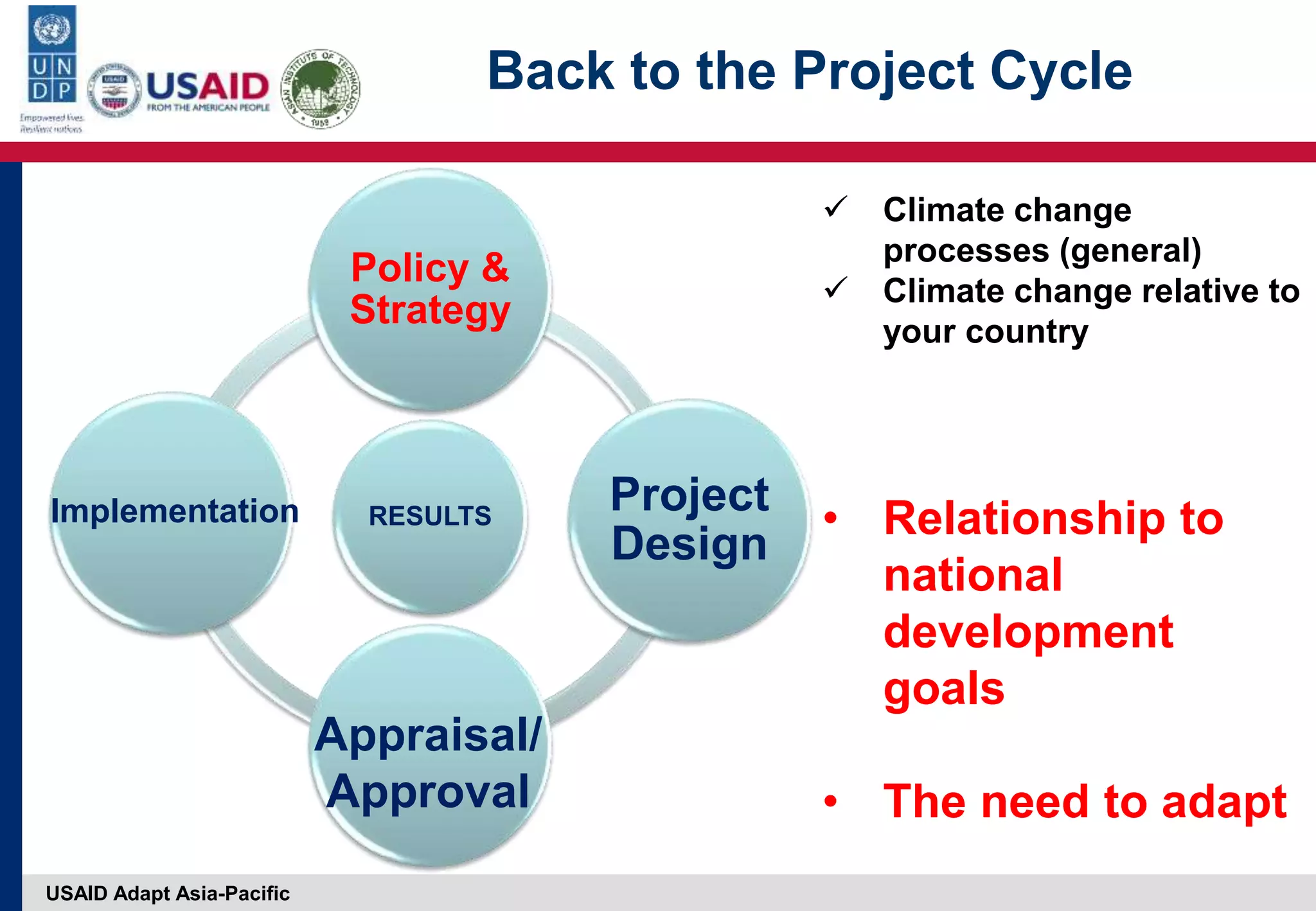
Back to the Project Cycle
RESULTS
Policy &
Strategy
Project
Design
Implementation
Appraisal/
Approval
 Climate change
processes (general)
 Climate change relative to
your country
• Relationship to
national
development
goals
• The need to adapt
USAID Adapt Asia-Pacific
The Questions to Address…
Adaptation Fund: Part II Question A: “Describe the
project/programme components, particularly focusing on
the concrete adaptation activities of the project, and how
these activities contribute to climate resilience.”
Part II Question D: “Describe how the project/programme
is consistent with national or sub-national sustainable
development strategies, including, where appropriate,
national or subnational development plans, poverty
reduction strategies, national communications, or
national adaptation programs of action, or other relevant
instruments, where they exist.”
USAID Adapt Asia-Pacific
The Questions to Address…
Green Climate Fund: Part C Question 1: “Please
describe relevant national, sub-national, regional, global,
political, and/or economic factors that help to
contextualize the proposal, including existing national
and sector policies and strategies.
Part C Question 2: “Describe the baseline scenario (i.e.
emissions baseline, climate vulnerability baseline, key
barriers, challenges and/or policies) and the outcomes
and the impacts that the project/programme will aim to
achieve in improving the baseline scenario.”
USAID Adapt Asia-Pacific
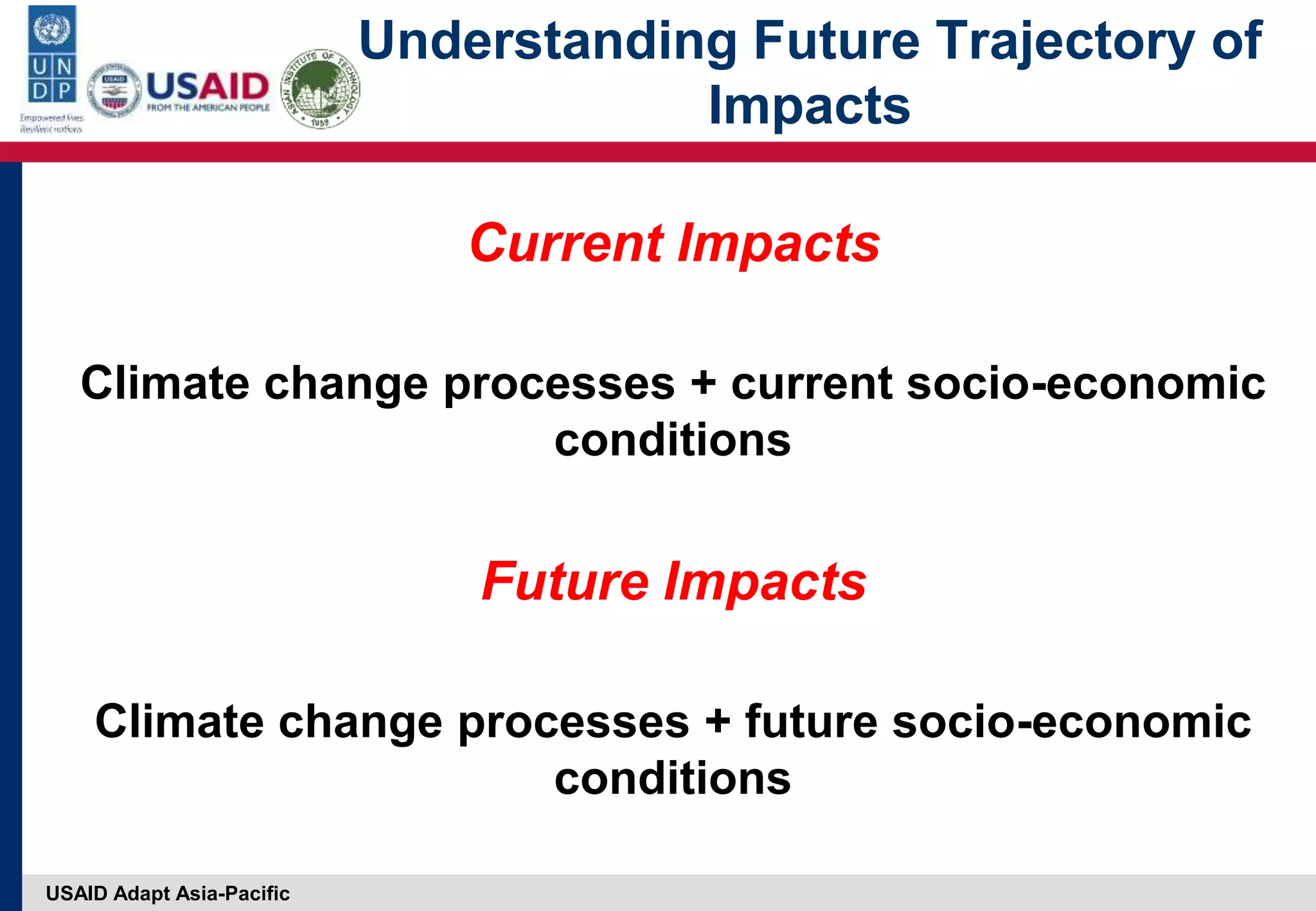
Understanding Future Trajectory of
Impacts
Current Impacts
Climate change processes + current socio-economic
conditions
Future Impacts
Climate change processes + future socio-economic
conditions
USAID Adapt Asia-Pacific
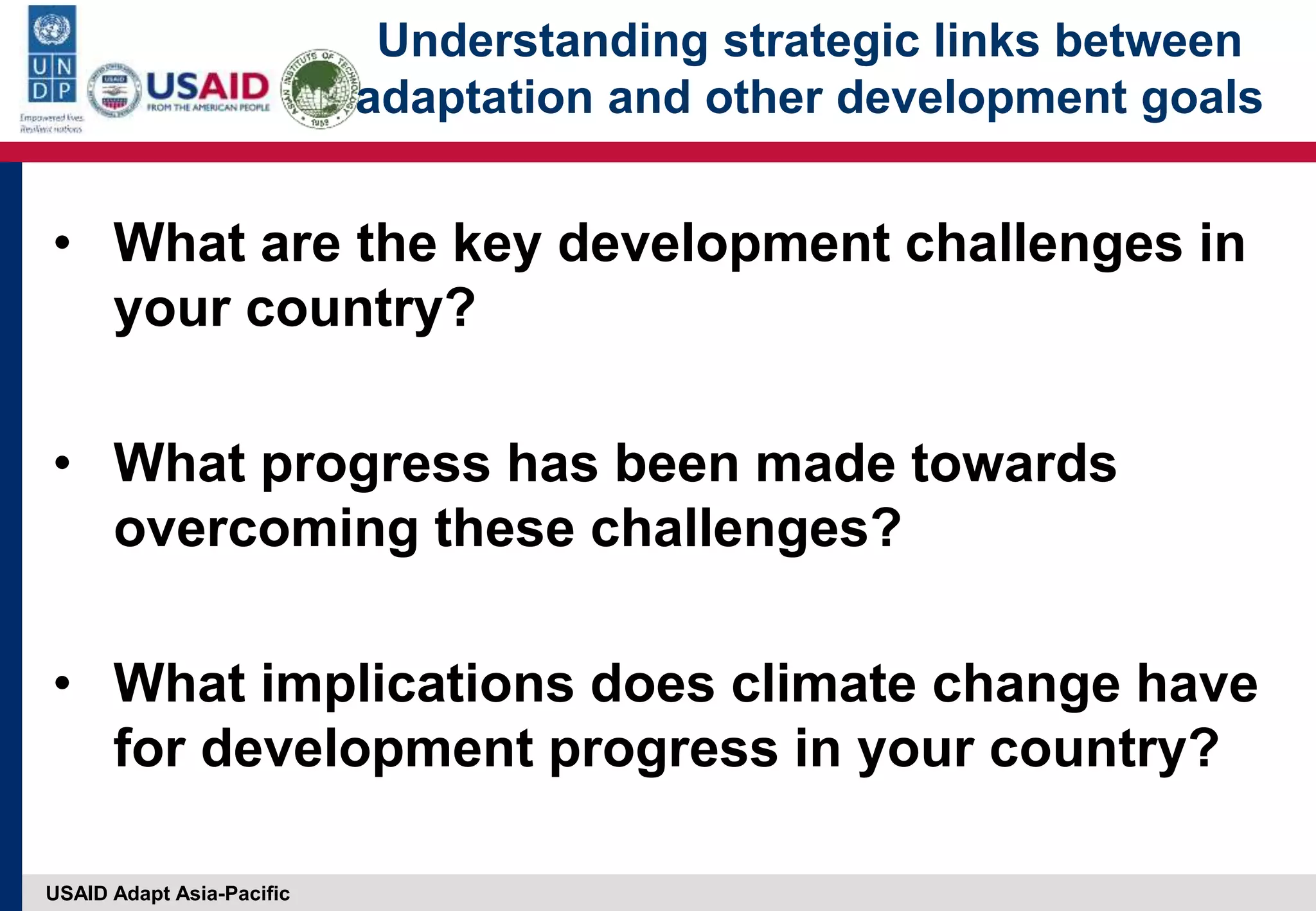
Understanding strategic links between
adaptation and other development goals
• What are the key development challenges in
your country?
• What progress has been made towards
overcoming these challenges?
• What implications does climate change have
for development progress in your country?
USAID Adapt Asia-Pacific
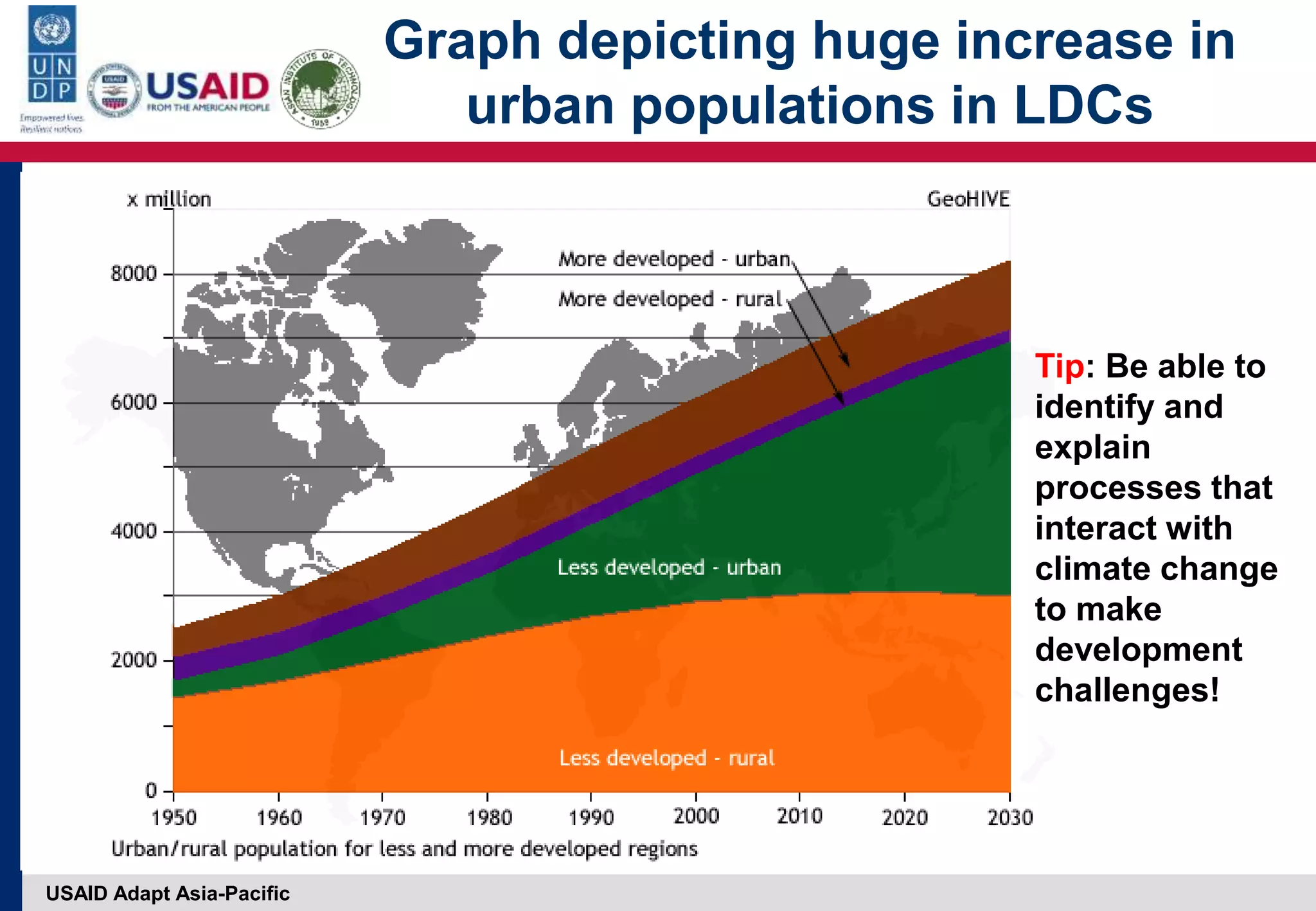
Graph depicting huge increase in
urban populations in LDCs
Tip: Be able to
identify and
explain
processes that
interact with
climate change
to make
development
challenges!
USAID Adapt Asia-Pacific
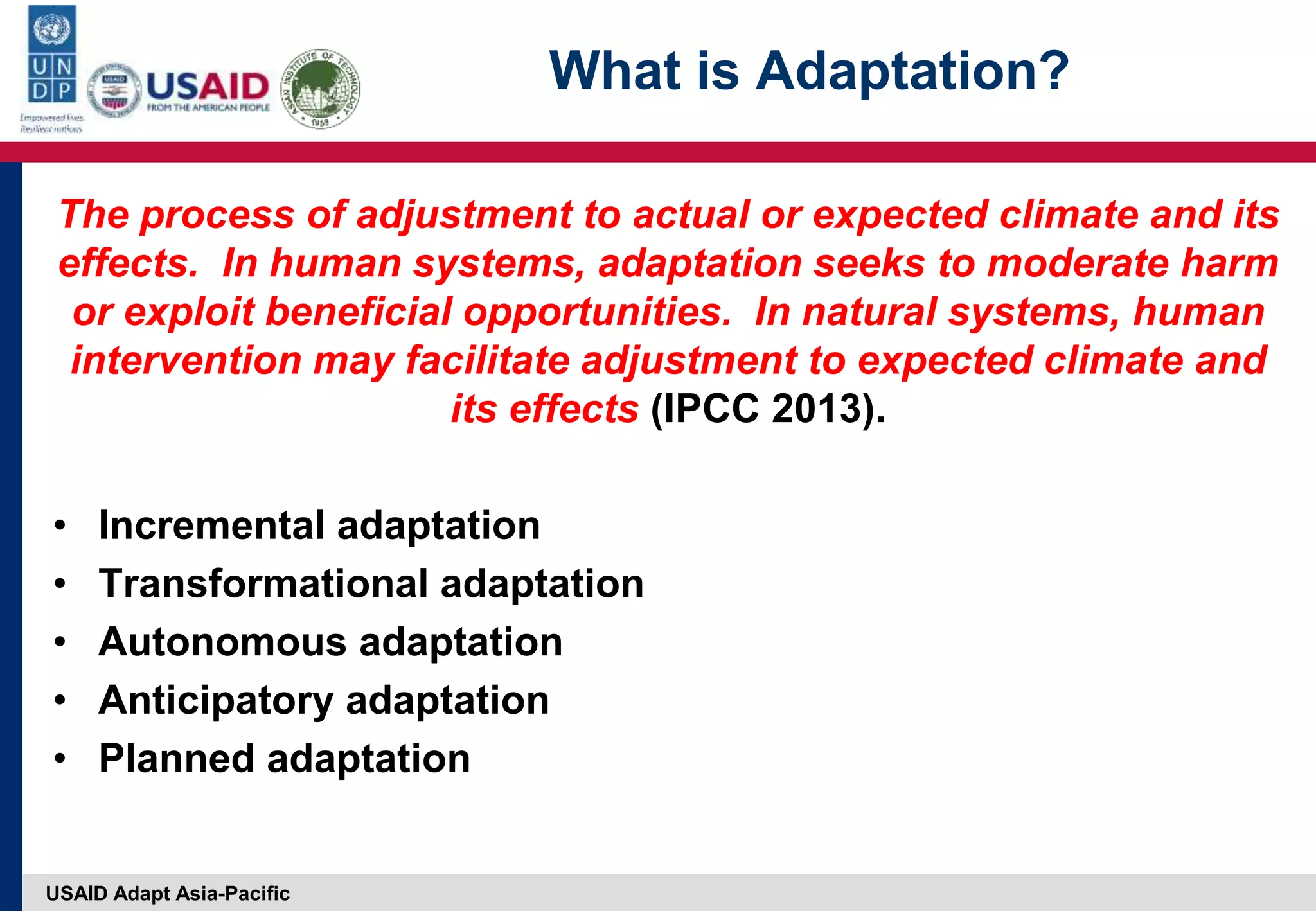
What is Adaptation?
The process of adjustment to actual or expected climate and its
effects. In human systems, adaptation seeks to moderate harm
or exploit beneficial opportunities. In natural systems, human
intervention may facilitate adjustment to expected climate and
its effects (IPCC 2013).
• Incremental adaptation
• Transformational adaptation
• Autonomous adaptation
• Anticipatory adaptation
• Planned adaptation
USAID Adapt Asia-Pacific
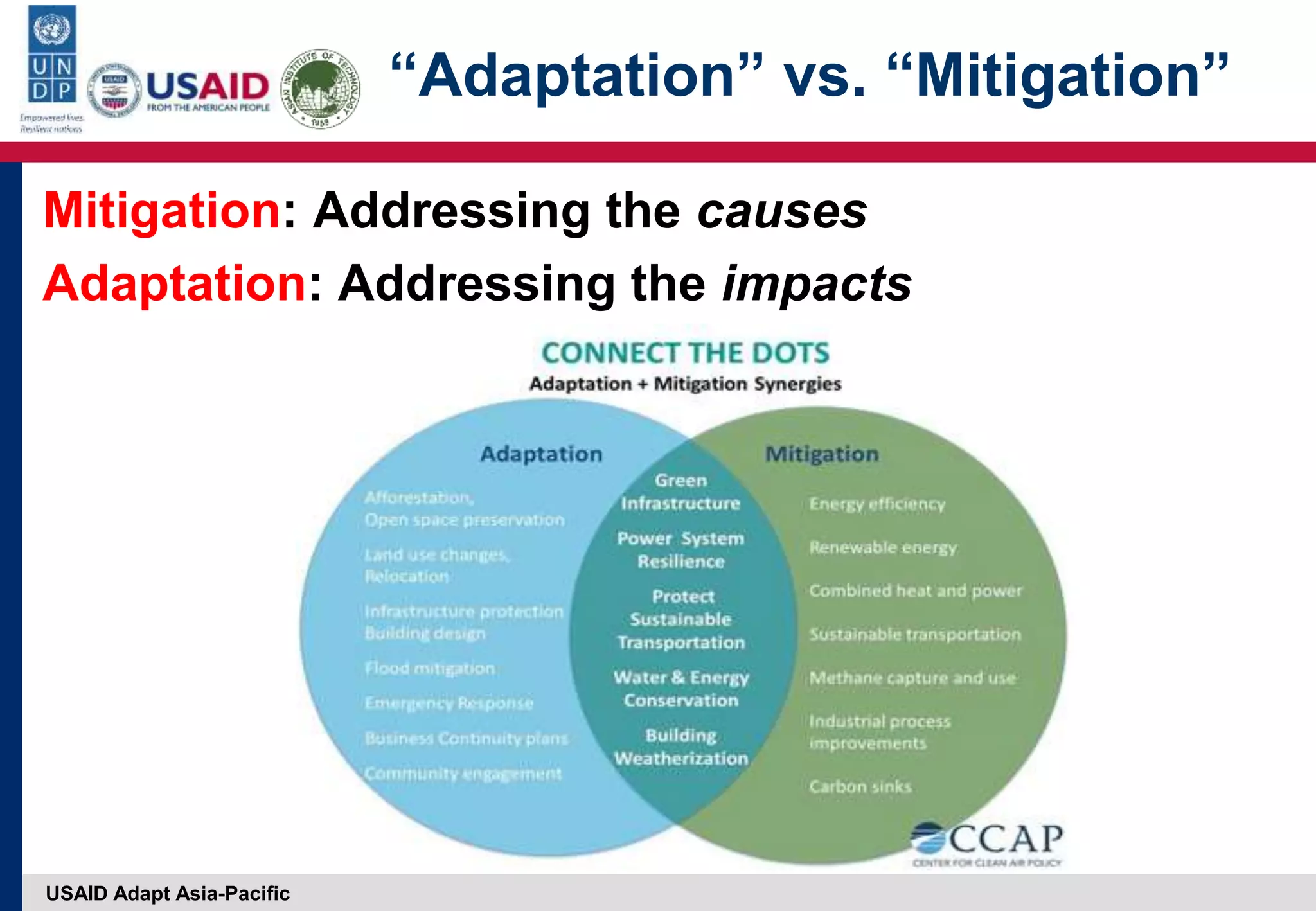
“Adaptation” vs. “Mitigation”
Mitigation: Addressing the causes
Adaptation: Addressing the impacts
USAID Adapt Asia-Pacific
Adaptation and Development
Explained
USAID Adapt Asia-Pacific
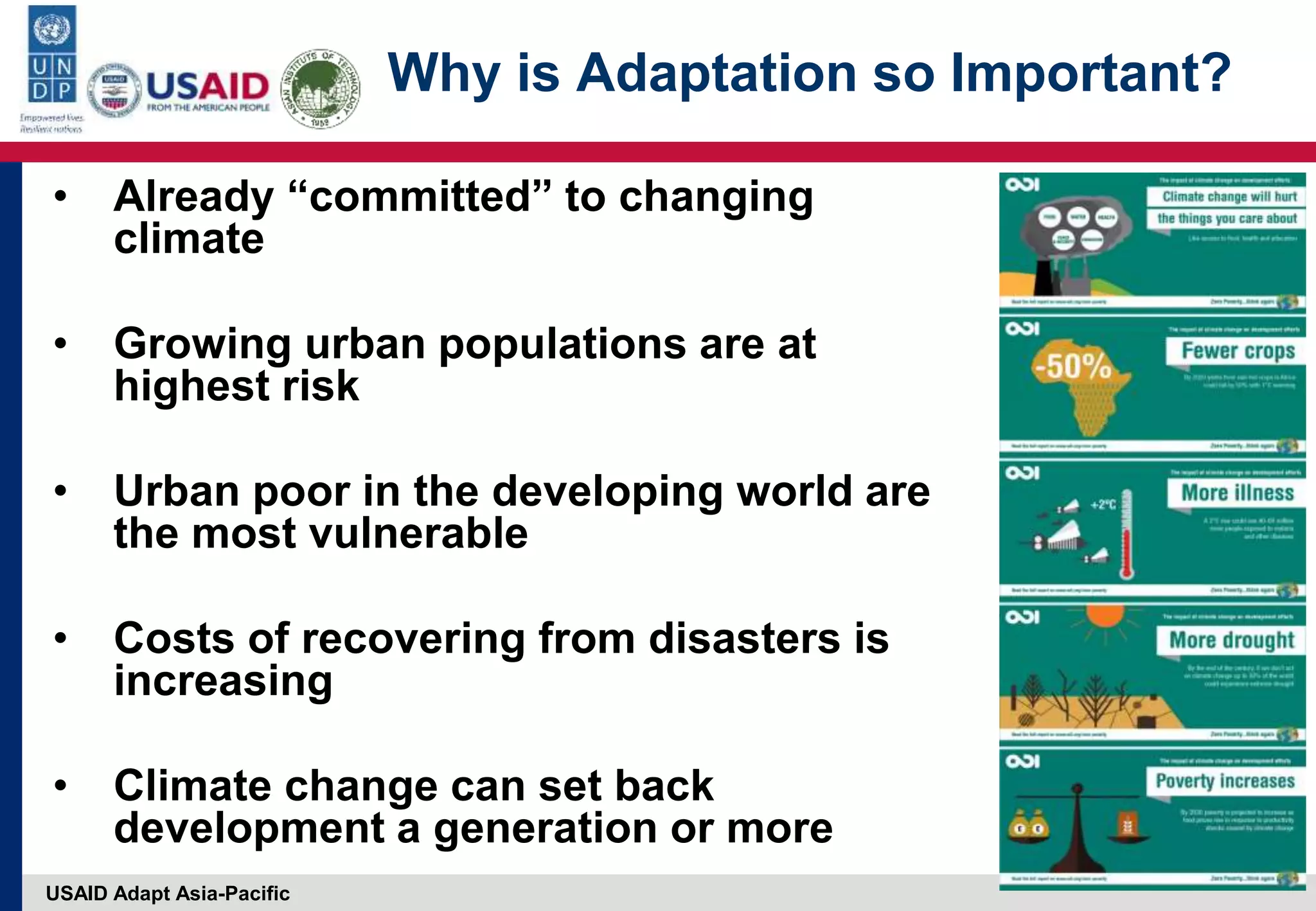
Why is Adaptation so Important?
• Already “committed” to changing
climate
• Growing urban populations are at
highest risk
• Urban poor in the developing world are
the most vulnerable
• Costs of recovering from disasters is
increasing
• Climate change can set back
development a generation or more
USAID Adapt Asia-Pacific
What does adaptation look like?
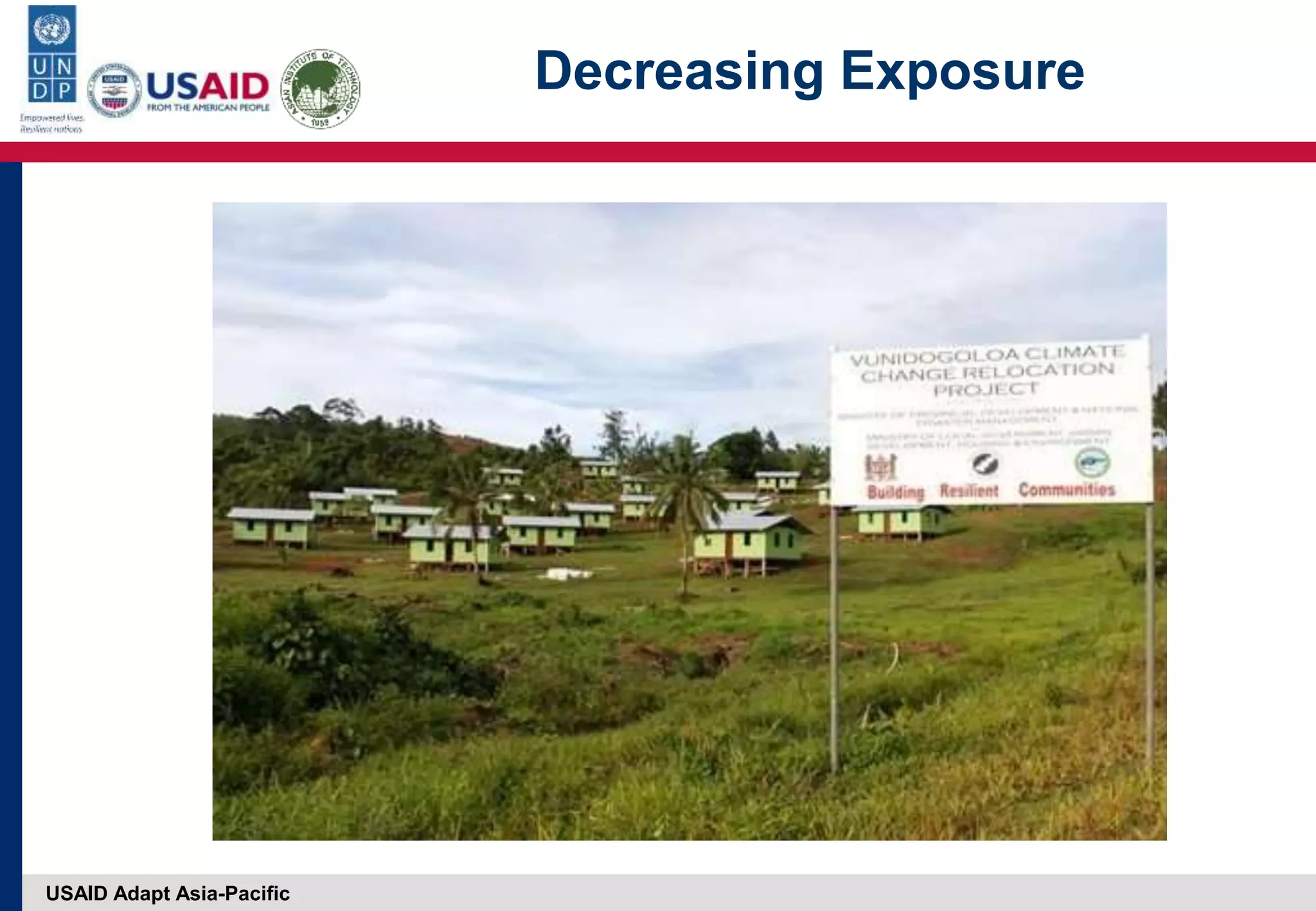
• Decreasing Exposure
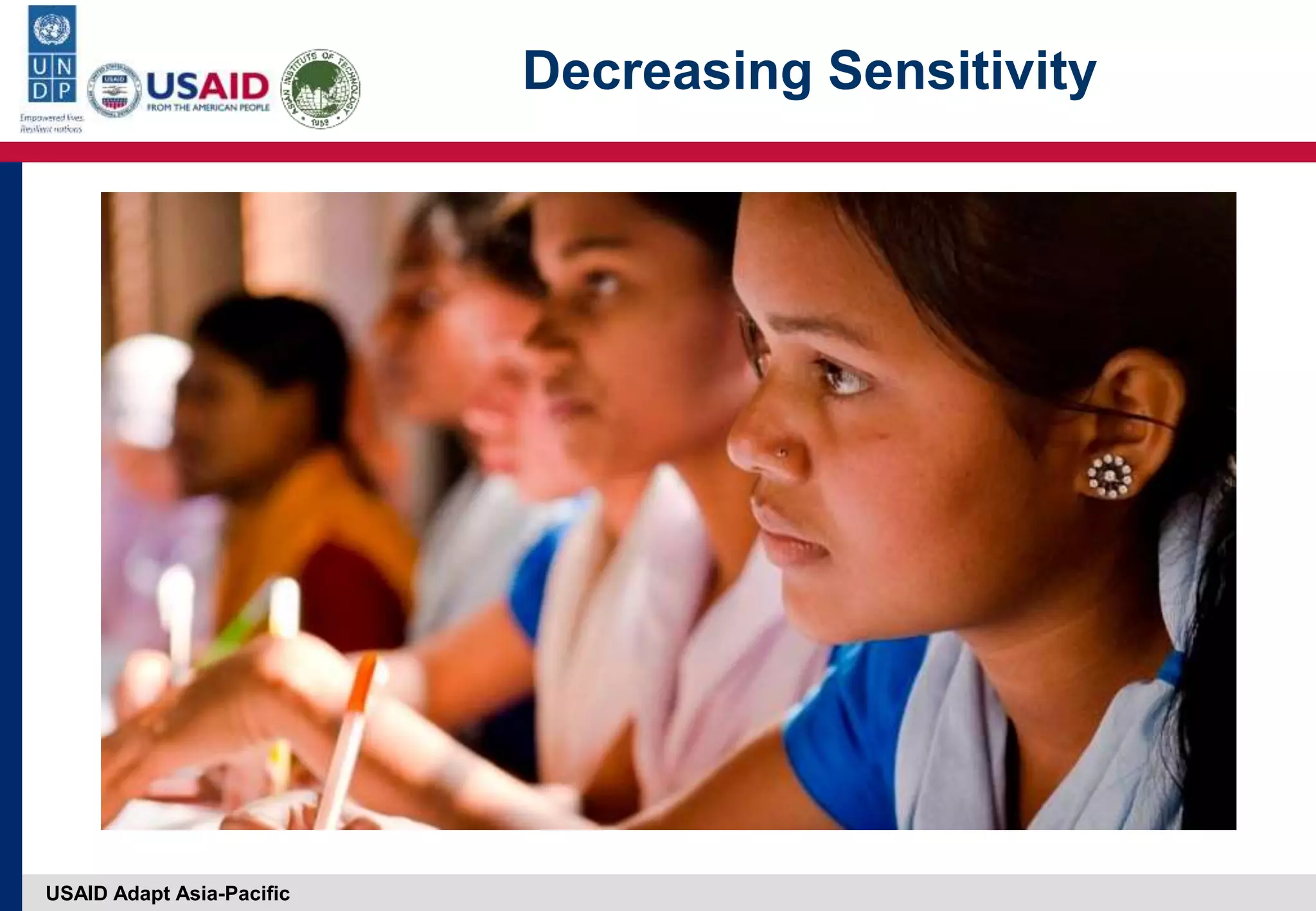
• Decreasing Sensitivity
• Increasing Adaptive Capacity
– Autonomous Adaptive Capacity
– Institutional Adaptive Capacity
– Collective Adaptive capacity
• Adaptive management and institutions
• Mainstreaming adaptation into existing
policies & institutions
USAID Adapt Asia-Pacific
Decreasing Exposure
USAID Adapt Asia-Pacific
Decreasing Sensitivity
USAID Adapt Asia-Pacific
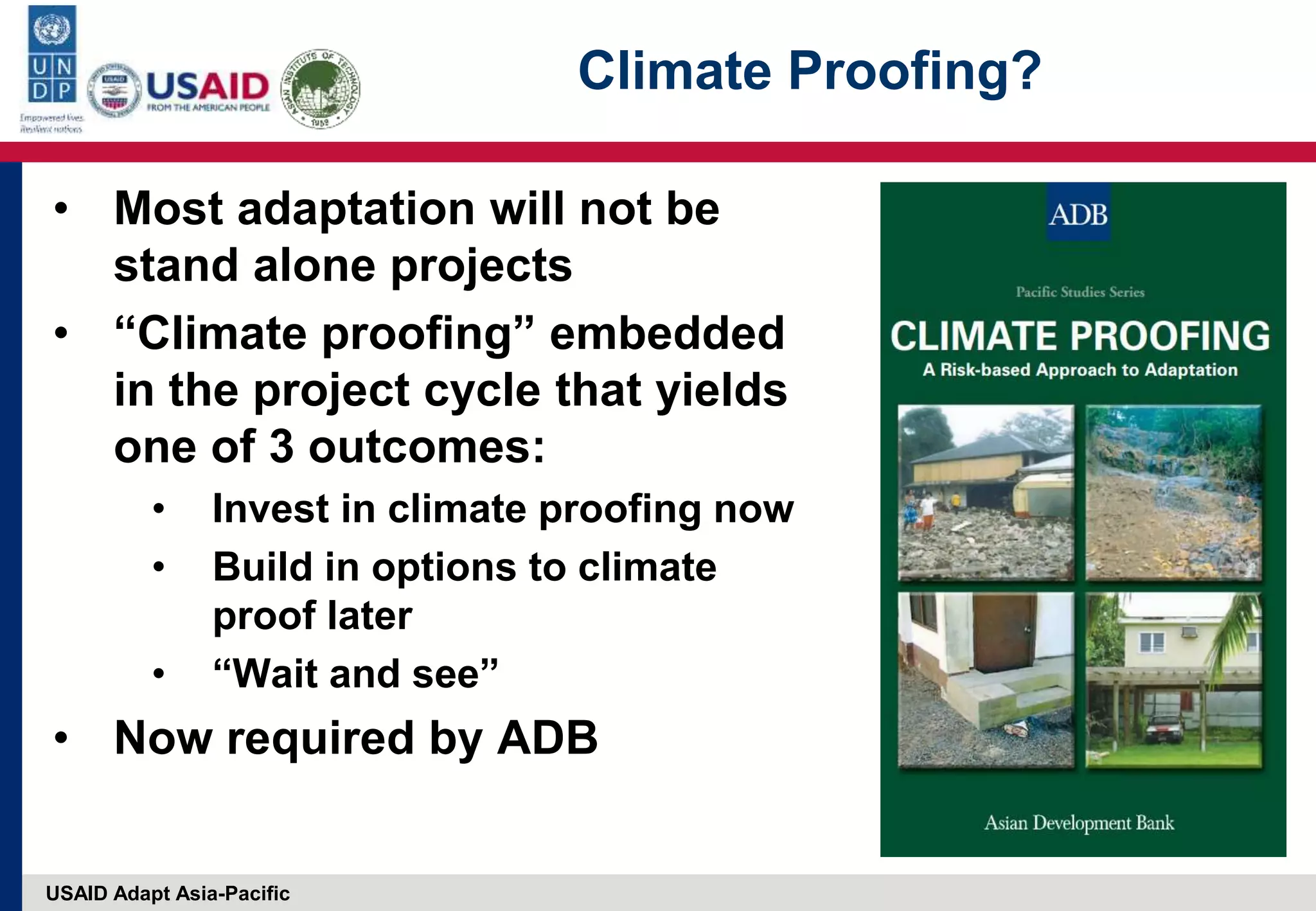
Climate Proofing?
• Most adaptation will not be
stand alone projects
• “Climate proofing” embedded
in the project cycle that yields
one of 3 outcomes:
• Invest in climate proofing now
• Build in options to climate
proof later
• “Wait and see”
• Now required by ADB
USAID Adapt Asia-Pacific
Video: The Need for Adaptation
USAID Adapt Asia-Pacific
Common Barriers to Effective
Adaptation
• “Silo thinking”
• Attitudes and values
• Lack of commitment to addressing CC
• Lack of statutory authority
• Non-mandatory screening for climate change
USAID Adapt Asia-Pacific
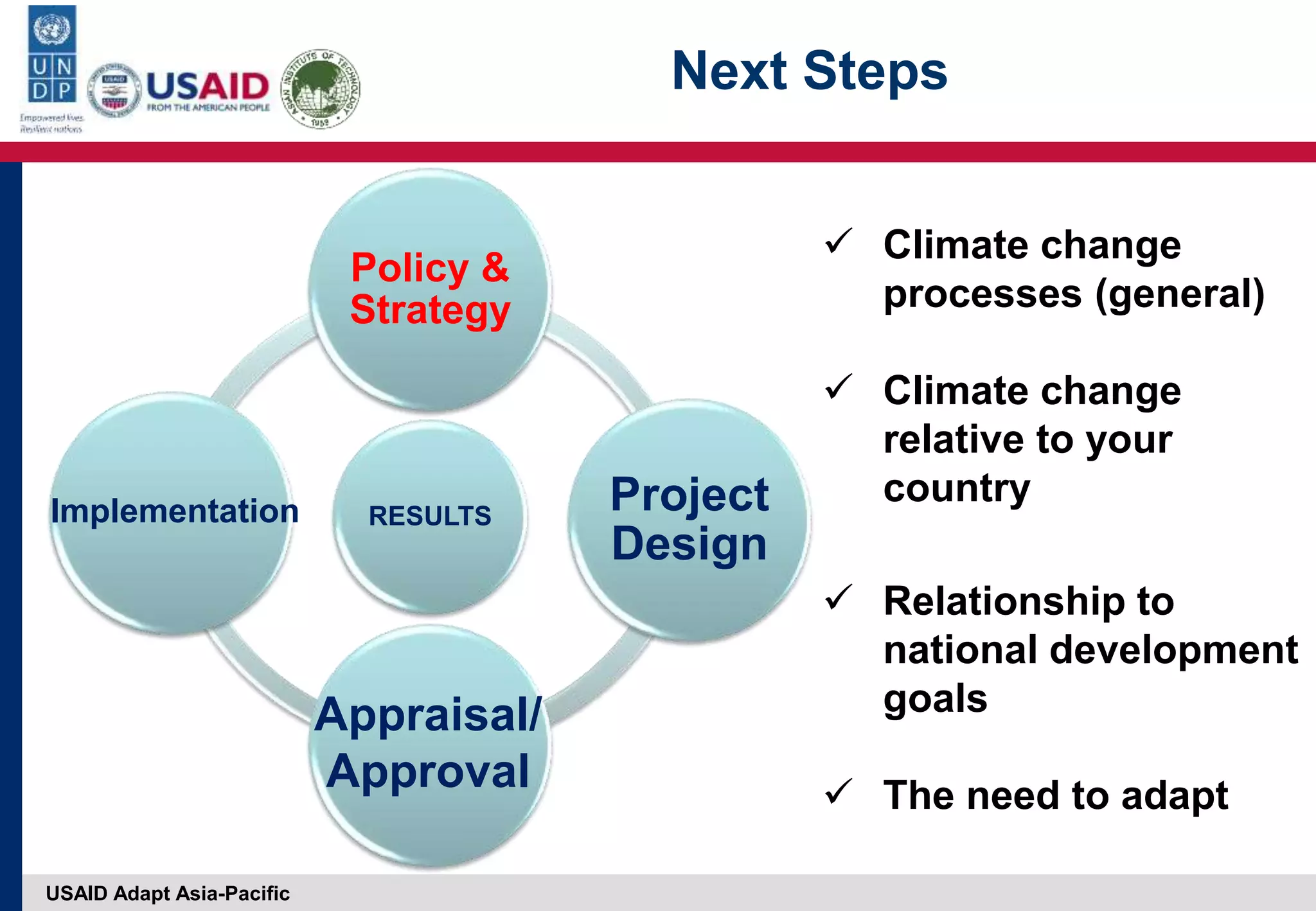
Next Steps
RESULTS
Policy &
Strategy
Project
Design
Implementation
Appraisal/
Approval
 Climate change
processes (general)
 Climate change
relative to your
country
 Relationship to
national development
goals
 The need to adapt
USAID Adapt Asia-Pacific
Resources and Tools for Part 2
• Accessing Resources from the Adaptation Fund:
The Handbook. Adaptation Fund.
• Assessing the Costs of Climate Change and
Adaptation in South Asia. ADB 2014.
• Economics of Adaptation to Climate Change
Synthesis Report. World Bank 2014
• The Adaptation Gap: A Preliminary Assessment.
UNEP 2014.
USAID Adapt Asia-Pacific
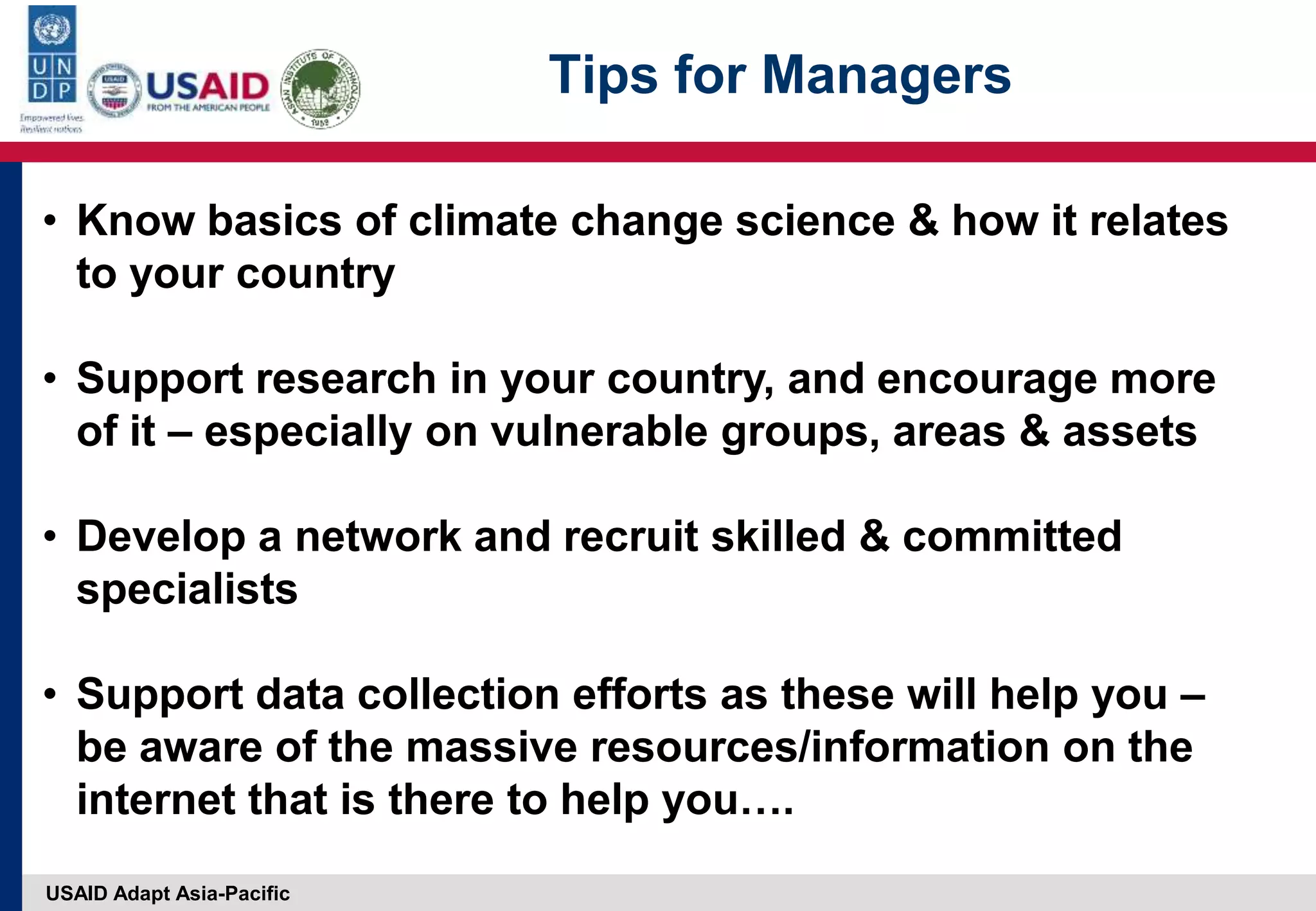
Tips for Managers
• Know basics of climate change science & how it relates
to your country
• Support research in your country, and encourage more
of it – especially on vulnerable groups, areas & assets
• Develop a network and recruit skilled & committed
specialists
• Support data collection efforts as these will help you –
be aware of the massive resources/information on the
internet that is there to help you….
USAID Adapt Asia-Pacific
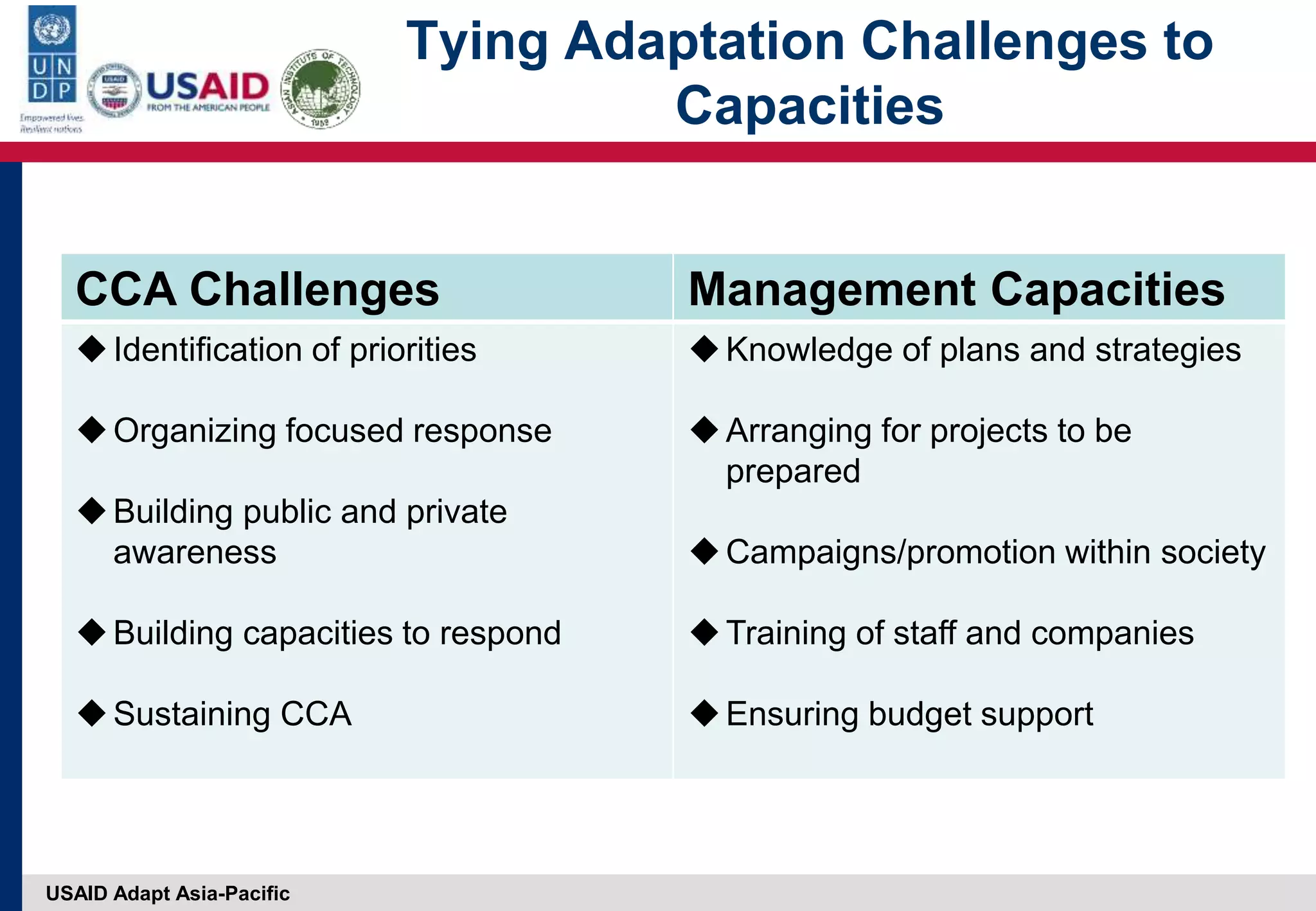
Tying Adaptation Challenges to
Capacities
CCA Challenges Management Capacities
Identification of priorities
Organizing focused response
Building public and private
awareness
Building capacities to respond
Sustaining CCA
Knowledge of plans and strategies
Arranging for projects to be
prepared
Campaigns/promotion within society
Training of staff and companies
Ensuring budget support
USAID Adapt Asia-Pacific
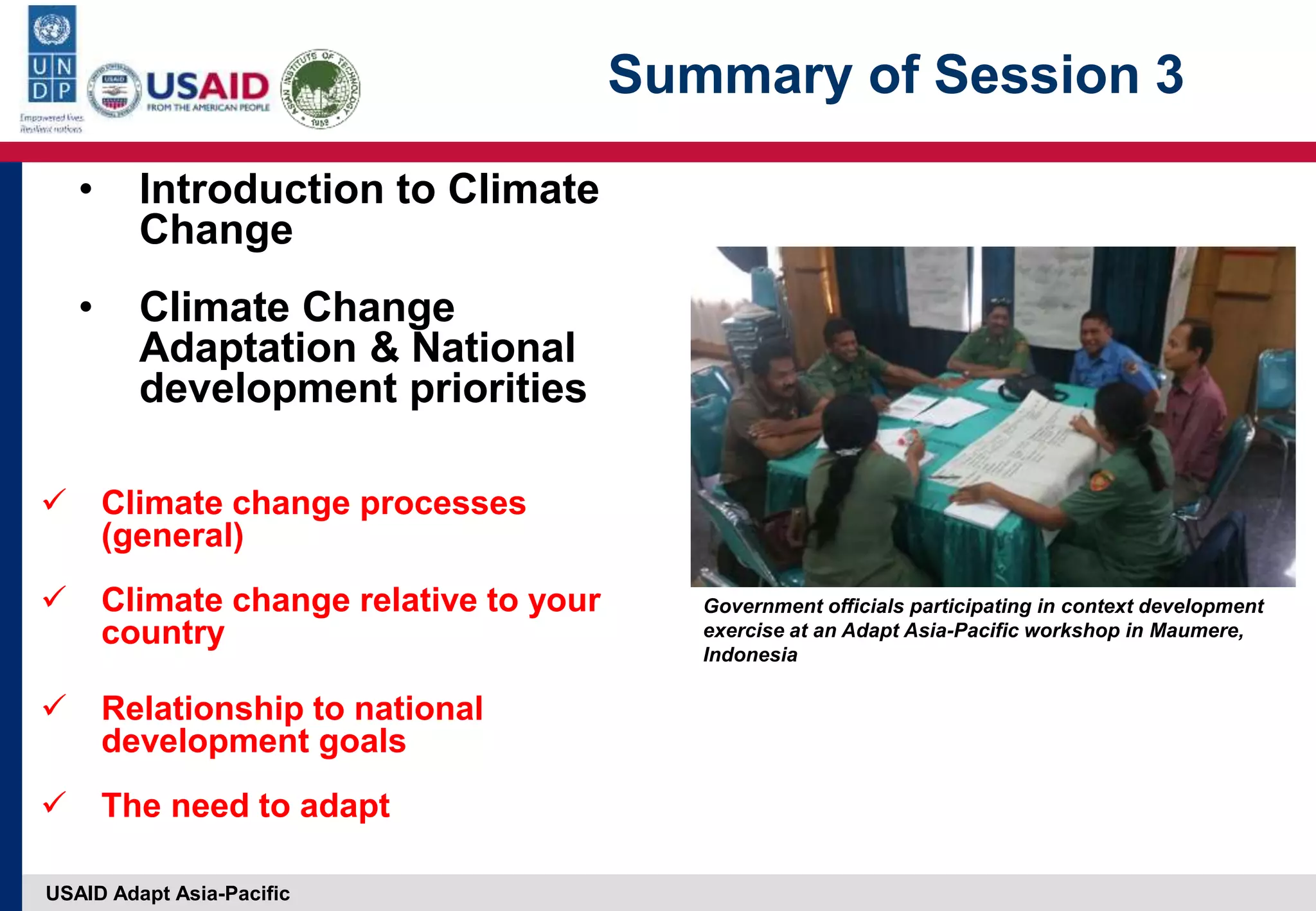
Summary of Session 3
• Introduction to Climate
Change
• Climate Change
Adaptation & National
development priorities
 Climate change processes
(general)
 Climate change relative to your
country
 Relationship to national
development goals
 The need to adapt
Government officials participating in context development
exercise at an Adapt Asia-Pacific workshop in Maumere,
Indonesia
USAID Adapt Asia-Pacific
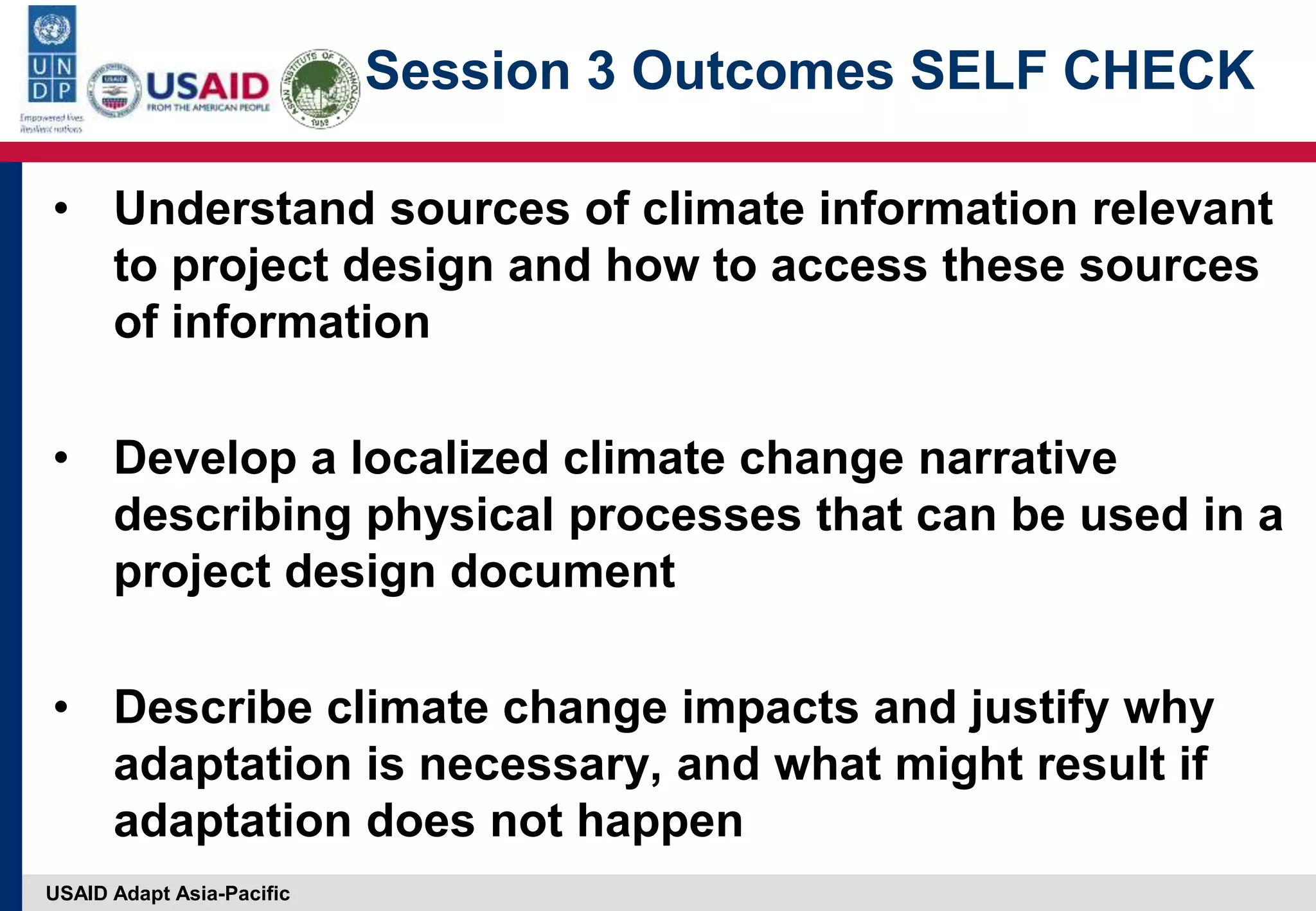
Session 3 Outcomes SELF CHECK
• Understand sources of climate information relevant
to project design and how to access these sources
of information
• Develop a localized climate change narrative
describing physical processes that can be used in a
project design document
• Describe climate change impacts and justify why
adaptation is necessary, and what might result if
adaptation does not happen
USAID Adapt Asia-Pacific
A Hui Hou!

Climate Change Processes and Impacts - Session 3 Managing Project Preparation for Climate Change Adaptation

  • 1.
    USAID Climate ChangeAdaptation Project Preparation Facility for Asia and the Pacific (USAID Adapt Asia-Pacific) Session 3 Climate Change Processes and Impacts January 16, 2017
  • 2.
    USAID Adapt Asia-Pacific Session3 Outcomes • Understand sources of climate information relevant to project design and how to access these sources of information • Develop a localized climate change narrative describing physical processes that can be used in a project design document • Describe climate change impacts and justify why adaptation is necessary, and what might result if adaptation does not happen
  • 3.
    USAID Adapt Asia-Pacific TheProject Cycle RESULTS Policy & Strategy Project Design Implementation Appraisal/ Approval
  • 4.
    USAID Adapt Asia-Pacific Pre-ProjectDiscussions & Activities •Review policy framework •Identify project area •Identify financing source(s) •Assign government team •Gather data •Field visits •Consultations •Raising awareness •Pre-feasibility study (?) RESULTS Policy & Strategy Project Design RARELY DONE WELL!!! Government & Partners Responsible Implementation Appraisal/ Approval
  • 5.
    USAID Adapt Asia-Pacific ProjectDesign & Feasibility •Impact Assessment •Vulnerability Assessment •Adaptation Assessment •Economic Analysis •Detailed Project Preparation •Project Documentation & Approval RESULTS Policy & Strategy Project Design Implementation Appraisal/ Approval
  • 6.
    USAID Adapt Asia-Pacific Appraisal/Approval •Takea broad approach •Stop bad projects, correct “mission drift”, determine consistency of components, assess risks •Remember “quality of analysis” Verify, Verify, Verify RESULTS Policy & Strategy Project Design Implementation Appraisal/ Approval
  • 7.
    USAID Adapt Asia-Pacific ProjectImplementation •Implementation Arrangements •Availability Resources •Measure progress based in indicators •Mid-term Review •Project Completion •Evaluation of project RESULTS Policy & Strategy Project Design Implementation Appraisal/ Approval
  • 8.
    USAID Adapt Asia-Pacific PART1: INTRODUCTION TO CLIMATE CHANGE AND ITS IMPACTS
  • 9.
    USAID Adapt Asia-Pacific TheProject Cycle RESULTS Policy & Strategy Project Design Implementation Appraisal/ Approval Climate change processes (general) Climate change relative to your country Local/Regional/ National climate impacts
  • 10.
    USAID Adapt Asia-Pacific ProjectDescription of Climate Change How do you construct your description of climate change processes? • GLOBAL: General processes • Sources of information? • NATIONAL: Regional processes • Agencies and reports? • SUBNATIONAL: If available • Universities? NGOs? Remember that information is evolving
  • 11.
    USAID Adapt Asia-Pacific “ClimateChange” vs. “Global Warming” • Global Warming: general upward trend in average global temperatures • Climate Change: the sub- global scale effects of global warming at the regional (SE Asia), Sub- national (Chao Phraya delta), and local levels • ‘System’ vs. the ‘parts’
  • 12.
    USAID Adapt Asia-Pacific Driverof Change: Increasing GHGs
  • 13.
    USAID Adapt Asia-Pacific Theyear-by-year march of Global Warming… Graphic used with permission of British Broadcasting Corporation
  • 14.
    USAID Adapt Asia-Pacific RecentFindings: 2015 warmest year on record…by far!
  • 15.
    USAID Adapt Asia-Pacific Suddenimpacts increased by ‘hidden’ slow changes in climatic conditions: Super Typhoon Haiyan
  • 16.
    USAID Adapt Asia-Pacific HowDo We Know: Global “Assess…the scientific, technical and socio- economic information relevant to understanding…human- induced climate change, its potential impacts and options for adaptation and mitigation." To download: http://www.ipcc.ch/report/ar5/wg1/
  • 17.
    USAID Adapt Asia-Pacific WhatWill Happen in the Future? It depends! • Future emissions • Carbon dioxide uptake in the oceans • Feedbacks & tipping points We are already committed to some degree of climate change.
  • 18.
    USAID Adapt Asia-Pacific Directand Indirect Impacts of Climate Change in Asia and the Pacific Greater temperature variability & extremes Sea Level Rise (SLR); coastal & riverine impacts More intense rainfall  flooding Droughts  water & food security issues
  • 19.
    USAID Adapt Asia-Pacific AdditionalSources of Climate Information • Hadley Centre (UK) projections on Asia • AusAID projections on Pacific • UNEP/UNDP country reports • World Bank Climate Change Knowledge Portal • ADB country reports • Tip: Be familiar with sources of climate information relevant to your country! • Tip: Periodically review the information that is available
  • 20.
    USAID Adapt Asia-Pacific ResourceURL Uses Products Earth System Grid Federation (ESGF) http://pcmdi9.llnl.go v/esgf‐web‐fe/ Regional projections, boundary conditions for regional climate modeling, down‐ scaling CMIP5 GCM outputs, all available experiments and variables, including Hindcasts, Decadal, RCP (long term) projections WorldClim ‐ Global Climate Data (CIAT and partners) www.worldclim.org Adaptation planning Downscaled IPCC AR3 and AR5 (spline interpolation), time slices from 2020s to 2080s, precip, Tmx Tmn Tavg, bioclimatics, 30 minute resolution Coordinating Regional Downscaling Experiment CORDEX http://wcrp‐ cordex.ipsl.jussieu.fr/ http://www.ukm.my/ seaclid‐cordex/ Sectoral adaptation planning Multi‐GCM Multi‐RCM at 50km (25 km) by region, RCP 4.5, 8.5 2005‐2100 Near term (2005‐2035) (forthcoming in SEA) World Bank Climate Change Knowledge Portal http://sdwebx.worldb ank.org/climateportal /index.cfm Sectoral, project adaptation planning Country map‐based search for historical, projected climate (precip, temp), 30‐yr means or 30‐yr change, monthly climatologies) Resources – GCM and Downscaled Projections
  • 21.
    USAID Adapt Asia-Pacific NEXT:National-level sources of information Know the relevant agencies/ministries/institutions related to climate change, scientific research, and atmospheric/oceanic processes Be familiar with the reports they produce, their data portals, and other aspects of data and information management!
  • 22.
    USAID Adapt Asia-Pacific NEXT:Subnational Sources of Information Are there subnational plans in place? Research/Downscaled projections/vulnerability assessments?  University studies  International NGOs  Local NGOs
  • 23.
    USAID Adapt Asia-Pacific Quiz:Climate Change in your country What are the physical changes expected in your country? What data are these projections based on? Where do you go to find more information? Answering these questions will help prepare you to develop adaptation projects!
  • 24.
    USAID Adapt Asia-Pacific Discussion:What factors determine severity of impacts? Impacts happen when physical systems meet human systems Physical characteristics are a part of severity Human characteristics also determine severity
  • 25.
    USAID Adapt Asia-Pacific Describingthe impacts How do you describe the issue you want to address? • Baseline socioeconomic/demographic conditions • Current trends (e.g. marketization, urbanization) • How are the physical processes changing the situation?
  • 26.
    USAID Adapt Asia-Pacific Thedegree to which ultimately affected by climate change impacts. Vulnerability = Impact /Adaptive Capacity What is Vulnerability? Understanding Vulnerability
  • 27.
    USAID Adapt Asia-Pacific Whatpopulations do you think are most vulnerable? Aspects of Vulnerability: People
  • 28.
    USAID Adapt Asia-Pacific Whatareas are more vulnerable? Aspects of Vulnerability: Places
  • 29.
    USAID Adapt Asia-Pacific Whatassets are more vulnerable? Aspects of Vulnerability: Assets
  • 30.
    USAID Adapt Asia-Pacific Ameasure of the extent to which people, places, and things or assets are subjected to potential threats or existing hazards What is Exposure? Step 1: Exposure
  • 31.
    USAID Adapt Asia-Pacific Thedegree to which a system is affected, either adversely or beneficially, by climate change. What is Sensitivity? Step 2: Sensitivity
  • 32.
    USAID Adapt Asia-Pacific Anexample of differences in sensitivity
  • 33.
    USAID Adapt Asia-Pacific DifferentialSensitivity leads to increased Vulnerability for some groups
  • 34.
    USAID Adapt Asia-Pacific Theresult of exposure and sensitivity of affected people, places, and things to climate change threats. I = E x S Direct impacts: affect people, area, or things or assets in a clear, often highly visible manner. Indirect impacts: include “ripple,” “cascading,” or “downstream” effects that are not always immediately obvious What are Impacts? Step 3: Impacts
  • 35.
    USAID Adapt Asia-Pacific Floodsin Thailand Caused Failures of Transport System Cascading Impacts: The Trigger
  • 36.
    USAID Adapt Asia-Pacific TransportInfrastructure Failures Caused Breaks in Supply Chains Cascading Impacts: Indirect impacts
  • 37.
    USAID Adapt Asia-Pacific CascadingImpacts: Direct Impact
  • 38.
    USAID Adapt Asia-Pacific Economicripples cascaded through the Thai economy in 2011 and 2012 … and beyond to global markets, with future negative implications for industrial investment in Thailand. 38Cascading Impacts: Systemic Disruption
  • 39.
    USAID Adapt Asia-Pacific Theability of people, places, and things to adapt to climate change and reduce risks and take advantage of new opportunities. What is Adaptive Capacity? Step 4: Adaptive Capacity
  • 40.
  • 41.
    USAID Adapt Asia-Pacific KEYPOINT: UNDERSTAND AND ARTICULATE THE PROBLEM
  • 42.
    USAID Adapt Asia-Pacific KnowledgeCheck All of the following are experienced/potential impacts of climate change South and Southeast Asia except: A. Increased mortality from heat waves B. Decreased crop yields C. Increased internal migration D. Improved fisheries production E. Increased seasonal flooding
  • 43.
    USAID Adapt Asia-Pacific Conclusionsand Summary of Part 1 The direct, indirect and cascading impacts of climate change are connected Vulnerability to climate change is influenced by exposure, sensitivity, and adaptive capacity Impacts of climate change vary from place to place. Some impacts currently being experienced or expected include sea level rise, changing seasonal patterns, and heat waves An informed understanding of these impacts is a crucial first step in developing strategies and projects!!!
  • 44.
    USAID Adapt Asia-Pacific NextSteps RESULTS Policy & Strategy Project Design Implementation Appraisal/ Approval  Climate change processes (general)  Climate change relative to your country
  • 45.
    USAID Adapt Asia-Pacific Resourcesand Tools for Section 1 • Addressing Climate Change and Migration in Asia and the Pacific. ADB 2012. • Climate Change 2013: Physical Science Basis. IPCC AR5 WGI Summary for Policymakers • Development and Climate Change. World Bank 2010. • IPCC WGII AR5 Asia report. 2014. • The Economics of Climate Change in Southeast Asia: A Regional Review. ADB 2009.
  • 46.
    USAID Adapt Asia-Pacific PART2: WHAT IS CLIMATE CHANGE ADAPTATION?
  • 47.
    USAID Adapt Asia-Pacific Backto the Project Cycle RESULTS Policy & Strategy Project Design Implementation Appraisal/ Approval  Climate change processes (general)  Climate change relative to your country • Relationship to national development goals • The need to adapt
  • 48.
    USAID Adapt Asia-Pacific TheQuestions to Address… Adaptation Fund: Part II Question A: “Describe the project/programme components, particularly focusing on the concrete adaptation activities of the project, and how these activities contribute to climate resilience.” Part II Question D: “Describe how the project/programme is consistent with national or sub-national sustainable development strategies, including, where appropriate, national or subnational development plans, poverty reduction strategies, national communications, or national adaptation programs of action, or other relevant instruments, where they exist.”
  • 49.
    USAID Adapt Asia-Pacific TheQuestions to Address… Green Climate Fund: Part C Question 1: “Please describe relevant national, sub-national, regional, global, political, and/or economic factors that help to contextualize the proposal, including existing national and sector policies and strategies. Part C Question 2: “Describe the baseline scenario (i.e. emissions baseline, climate vulnerability baseline, key barriers, challenges and/or policies) and the outcomes and the impacts that the project/programme will aim to achieve in improving the baseline scenario.”
  • 50.
    USAID Adapt Asia-Pacific UnderstandingFuture Trajectory of Impacts Current Impacts Climate change processes + current socio-economic conditions Future Impacts Climate change processes + future socio-economic conditions
  • 51.
    USAID Adapt Asia-Pacific Understandingstrategic links between adaptation and other development goals • What are the key development challenges in your country? • What progress has been made towards overcoming these challenges? • What implications does climate change have for development progress in your country?
  • 52.
    USAID Adapt Asia-Pacific Graphdepicting huge increase in urban populations in LDCs Tip: Be able to identify and explain processes that interact with climate change to make development challenges!
  • 53.
    USAID Adapt Asia-Pacific Whatis Adaptation? The process of adjustment to actual or expected climate and its effects. In human systems, adaptation seeks to moderate harm or exploit beneficial opportunities. In natural systems, human intervention may facilitate adjustment to expected climate and its effects (IPCC 2013). • Incremental adaptation • Transformational adaptation • Autonomous adaptation • Anticipatory adaptation • Planned adaptation
  • 54.
    USAID Adapt Asia-Pacific “Adaptation”vs. “Mitigation” Mitigation: Addressing the causes Adaptation: Addressing the impacts
  • 55.
    USAID Adapt Asia-Pacific Adaptationand Development Explained
  • 56.
    USAID Adapt Asia-Pacific Whyis Adaptation so Important? • Already “committed” to changing climate • Growing urban populations are at highest risk • Urban poor in the developing world are the most vulnerable • Costs of recovering from disasters is increasing • Climate change can set back development a generation or more
  • 57.
    USAID Adapt Asia-Pacific Whatdoes adaptation look like? • Decreasing Exposure • Decreasing Sensitivity • Increasing Adaptive Capacity – Autonomous Adaptive Capacity – Institutional Adaptive Capacity – Collective Adaptive capacity • Adaptive management and institutions • Mainstreaming adaptation into existing policies & institutions
  • 58.
  • 59.
  • 60.
    USAID Adapt Asia-Pacific ClimateProofing? • Most adaptation will not be stand alone projects • “Climate proofing” embedded in the project cycle that yields one of 3 outcomes: • Invest in climate proofing now • Build in options to climate proof later • “Wait and see” • Now required by ADB
  • 61.
    USAID Adapt Asia-Pacific Video:The Need for Adaptation
  • 62.
    USAID Adapt Asia-Pacific CommonBarriers to Effective Adaptation • “Silo thinking” • Attitudes and values • Lack of commitment to addressing CC • Lack of statutory authority • Non-mandatory screening for climate change
  • 63.
    USAID Adapt Asia-Pacific NextSteps RESULTS Policy & Strategy Project Design Implementation Appraisal/ Approval  Climate change processes (general)  Climate change relative to your country  Relationship to national development goals  The need to adapt
  • 64.
    USAID Adapt Asia-Pacific Resourcesand Tools for Part 2 • Accessing Resources from the Adaptation Fund: The Handbook. Adaptation Fund. • Assessing the Costs of Climate Change and Adaptation in South Asia. ADB 2014. • Economics of Adaptation to Climate Change Synthesis Report. World Bank 2014 • The Adaptation Gap: A Preliminary Assessment. UNEP 2014.
  • 65.
    USAID Adapt Asia-Pacific Tipsfor Managers • Know basics of climate change science & how it relates to your country • Support research in your country, and encourage more of it – especially on vulnerable groups, areas & assets • Develop a network and recruit skilled & committed specialists • Support data collection efforts as these will help you – be aware of the massive resources/information on the internet that is there to help you….
  • 66.
    USAID Adapt Asia-Pacific TyingAdaptation Challenges to Capacities CCA Challenges Management Capacities Identification of priorities Organizing focused response Building public and private awareness Building capacities to respond Sustaining CCA Knowledge of plans and strategies Arranging for projects to be prepared Campaigns/promotion within society Training of staff and companies Ensuring budget support
  • 67.
    USAID Adapt Asia-Pacific Summaryof Session 3 • Introduction to Climate Change • Climate Change Adaptation & National development priorities  Climate change processes (general)  Climate change relative to your country  Relationship to national development goals  The need to adapt Government officials participating in context development exercise at an Adapt Asia-Pacific workshop in Maumere, Indonesia
  • 68.
    USAID Adapt Asia-Pacific Session3 Outcomes SELF CHECK • Understand sources of climate information relevant to project design and how to access these sources of information • Develop a localized climate change narrative describing physical processes that can be used in a project design document • Describe climate change impacts and justify why adaptation is necessary, and what might result if adaptation does not happen
  • 69.