Universidade de Lisboa
Instituto Superior de Agronomia
Preliminary assessment of climate change impact on optimized
strategic plans of eucalyptus plantations in Brazil
Palma JHN1, Lemos C2, Weber K2, Hakamada R2, Nobre S3, Estraviz LC4
October 2014
1 Forest Research Centre, School of Agronomy, University of Lisbon, Portugal
2 International Paper, Mogi Guaçu, São Paulo, Brazil
3 Atrium Forest Consulting Ltda, Piracicaba, São Paulo, Brasil
4 Departamento de Ciências Florestais, Escola Superior de Agronomia Luiz Queiroz, Piracicaba, São Paulo, Brasil
Universidade de Lisboa
Instituto Superior de Agronomia
Evaluate the impact of climate change in the optimized
management plan wood supplying for International Paper
Brasil pulp mills
Access information on climate change
Use of 3PG to assess impact of climate change in tree growth
Integration of tree growth information in WoodStock© optimization model
Evaluation of main differences in the optimized plan
Objectives
Universidade de Lisboa
Instituto Superior de Agronomia
IP – 5 Distinct regions
5 distinct climate datasets
5 coordinates were sent to the Instituto Nacional de
Pesquisa Espacial to retrieve daily datasets for future
climate:
1) Control Dataset (current climate)
2) MIDI dataset (Moderate changes in climate)
Climate Model: HadRM3Q, scenario A1B (Chou et al,
2011; Marengo et al, 2011)
Monthly averaging and formatting for 3PG
Methodology – Climate datasets
CHOU, S.C., MARENGO, J.A., LYRA, A.A., SUEIRO, G., PESQUERO, J.F., ALVES, L.M., KAY, G., BETTS, R., CHAGAS, D.J., GOMES, J.L., BUSTAMANTE, J.F.,
TAVARES, P., 2011. Downscaling of South America present climate driven by 4-member HadCM3 runs. CLIMATE DYNAMICS 38 635-653.
Marengo, J.A., Chou, S.C., Kay, G., Alves, L.M., Pesquero, J.F., Soares, W.R., Santos, D.C., Lyra, A.A., Sueiro, G., Betts, R., Chagas, D.J., Gomes, J.L.,
Bustamante, J.F., Tavares, P., 2011. Development of regional future climate change scenarios in South America using the Eta CPTEC/HadCM3 climate
change projections: climatology and regional analyses for the Amazon, São Francisco and the Paraná River basins. Climate Dynamics DOI:
10.1007/s00382-00011-01155-00385.
Universidade de Lisboa
Instituto Superior de Agronomia
Definition of hypothetical stands for testing each region climate
scenario
Clay soils
Sandy Soils
Plantation density: 1212 trees ha-1
Calibration of 3PG
PhD thesis from Lemos (2012) calibration was used
Set of parameters for one clone and for each soil type
This study assumes all clones having the same relative growth response to changing
climate
Methodology – 3PG
Lemos, C, 2012, Aprimoramento, teste e uso do modelo 3-PG em plantios clonais de eucalyptus no nordeste do Estado de São Paulo, Escola
Superior de Agronomia Luiz Queiroz, São Paulo, Brasil. PhD Thesis. In portuguese
Universidade de Lisboa
Instituto Superior de Agronomia
Woodstock was used to prepare the optimization datasets and CPLEX
was used as the solver. Current objective function maintained.
Yields section of Woodstock had a section for applying volume and cellulose ratios
for genetic improvements accounting
The integration of climate change used this section to apply the ratios of climate
change impacts
The existing section was divided per
Region
Ownership (with genetic improvements) and third party areas (no genetic improvement)
Current optimization report graphs were used for the comparison with
the new optimization results
Methodology – Optimizer
Universidade de Lisboa
Instituto Superior de Agronomia
More rain when less needed (summer), Less rain when more needed (winter)
Results – Climate
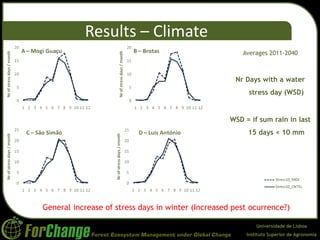
Averages 2011-2040
Universidade de Lisboa
Instituto Superior de Agronomia
General increase of stress days in winter (Increased pest ocurrence?)
Results – Climate
Averages 2011-2040
Nr Days with a water
stress day (WSD)
WSD = if sum rain in last
15 days < 10 mm
Universidade de Lisboa
Instituto Superior de Agronomia
Results – 3PG, Climate
Monthly data 2011-2018
7 years (1 rotation)
Monthly values.
More rain when less
needed. (summer)
Universidade de Lisboa
Instituto Superior de Agronomia
Results – Tree Growth
Monthly data 2011-2018
7 years (1 rotation)
0
100
200
300
400
500
600
700
800
1 2 3 4 5 6 7
MgDryMatterha-1
Age
Brotas
Stem DM (CL-CNTRL) Stem DM (CL-MIDI)
0
100
200
300
400
500
600
700
1 2 3 4 5 6 7
MgDryMatterha-1
Age
Brotas
Stem DM (S-CNTRL) Stem DM (S-MIDI)
Differences in year 7
Mogi Guaçu CL - 4%
Mogi Guaçu S - 3%
Brotas CL - 5%
Brotas S - 6%
São Simão CL - 2%
São Simão S - 3%
Luis Antonio CL - 3%
Luis Antonio S - 4%
Fomento CL - 3%
Fomento S - 3%
Similar graphical results for other areas. Brotas region has the highest reduction.
Universidade de Lisboa
Instituto Superior de Agronomia
Results – Tree Growth
Behind the Scenes… Modifiers’ dynamics.
0.8
0.85
0.9
0.95
1
1 2 3 4 5 6 7
fT
Age
Temperature modifier
0
0.2
0.4
0.6
0.8
1
1 2 3 4 5 6 7
fSW
Age
Soil Water Modifier
CNTRL
MIDI
0.6
0.65
0.7
0.75
0.8
0.85
0.9
0.95
1
1 2 3 4 5 6 7
fVPD
Age
Vapour Pressure Deficit
Brotas, Sandy Soil
0
0.2
0.4
0.6
0.8
1
1 2 3 4 5 6 7fPhysMod
Age
Physiology Modifier (efficiency)
Universidade de Lisboa
Instituto Superior de Agronomia
Results – Man. Plan Optimization
Main differences identified
current
1) % Supply by forest type
66%8%
26%
Own Partnership LOAP
99.5
%
0.3%
0.2%
Own Partnership LOAP
38%
2%
60%
Own Partnership LOAP
MG LA OverallBoiler
66%6%
28%
Own Partnership LOAP
98.7
%
0.9%
0.4%
Own Partnership LOAP
42%
1%
57%
Own Partnership LOAP
82%
3% 15%
Own Partnership LOAP
82%
4% 14%
Own Partnership LOAP
climate
change
Universidade de Lisboa
Instituto Superior de Agronomia
0
100
200
300
400
500
2012 2013 2014 2015 2016 2017 2018 2019 2020 2021 2022 2023 2024 2025 2026 2027 2028 2029 2030 2031 AVG
m3
Partnership Own
Results – Man. Plan Optimization
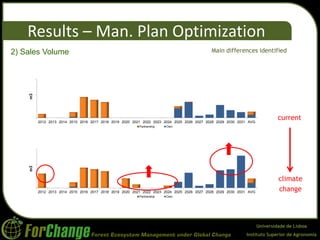
Main differences identified2) Sales Volume
current
climate
change
0
100
200
300
400
500
2012 2013 2014 2015 2016 2017 2018 2019 2020 2021 2022 2023 2024 2025 2026 2027 2028 2029 2030 2031 AVG
m3
Partnership Own
Universidade de Lisboa
Instituto Superior de Agronomia
0.0
1.0
2.0
3.0
4.0
5.0
2012 2013 2014 2015 2016 2017 2018 2019 2020 2021 2022 2023 2024 2025 2026 2027 2028 2029 2030
Area
Results – Man. Plan Optimization
Main differences identified3) Sold Area
current
climate
change
0.0
1.0
2.0
3.0
4.0
5.0
2012 2013 2014 2015 2016 2017 2018 2019 2020 2021 2022 2023 2024 2025 2026 2027 2028 2029 2030
Area
Universidade de Lisboa
Instituto Superior de Agronomia
1 1.2
0
0 0 0
0.0
0.5
1.0
1.5
2.0
2.5
3.0
3.5
4.0
2012 2013 2014 2015 2016 2017 2018 2019 2020 2021 2022 2023 2024 2025 2026 2027 2028 2029 2030
Area
Implantação Reforma
Results – Man. Plan Optimization
Main differences identified4) LOAP Planting and Coppice
(Land Owner Assistance Program)
current
climate
change
0.0
0.5
1.0
1.5
2.0
2.5
3.0
3.5
4.0
2012 2013 2014 2015 2016 2017 2018 2019 2020 2021 2022 2023 2024 2025 2026 2027 2028 2029 2030
Area
Implantação Reforma
Universidade de Lisboa
Instituto Superior de Agronomia
0.0
0.5
1.0
1.5
2.0
2.5
2012 2013 2014 2015 2016 2017 2018 2019 2020 2021 2022 2023 2024 2025 2026 2027 2028 2029 2030 2031 AVG
Area
Results – Man. Plan Optimization
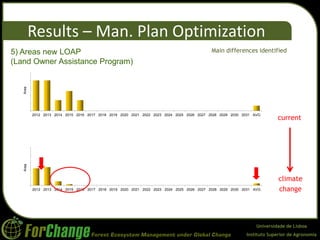
Main differences identified5) Areas new LOAP
(Land Owner Assistance Program)
current
climate
change
0.0
0.5
1.0
1.5
2.0
2.5
2012 2013 2014 2015 2016 2017 2018 2019 2020 2021 2022 2023 2024 2025 2026 2027 2028 2029 2030 2031 AVG
Area
Universidade de Lisboa
Instituto Superior de Agronomia
Results – Man. Plan Optimization
Main differences identified6) Capital Program Costs
About 1-2 Million R$ y-1
0
10
20
30
40
50
60
2012 2013 2014 2015 2016 2017 2018 2019 2020 2021 2022 2023 2024 2025 2026 2027 2028 2029 2030 2031 AVG
R$
Planting current Coppice current Maintenace current Total Current
Planting CC Coppice CC Maintenace CC Total CC
Total
Planting
Maintenance
Coppice
Universidade de Lisboa
Instituto Superior de Agronomia
Results – Man. Plan Optimization
Main differences identified7) Cumulated Net Present value
0.0
0.2
0.4
0.6
0.8
1.0
1.2
1.4
2012 2013 2014 2015 2016 2017 2018 2019 2020 2021 2022 2023 2024 2025 2026 2027 2028 2029 2030
R$
Current
Climate Change
-15%
-10%
-7% -6%
Universidade de Lisboa
Instituto Superior de Agronomia
Results – Man. Plan Optimization
Identified Optimization Dynamics
Climate change
3-5% lower forest
productivity
Optimization
Cost per Wood/Cellulose ton
Kept
(model constraint)
Reduce new LOAP areas
Medium term: increasing
wood selling from LOAP areas
Long term: increasing wood
selling from OWN areas
Forcing to:
Avoid selling own areas
Explained by
Genetic
improvement on
own areas
Resulting in:
Overall decrease of cumulated NPV
(Initial 15% but stabilizing at 6-8%)
Increase costs on own areas
(capital program) +1 to 2 Million $R y-1
Universidade de Lisboa
Instituto Superior de Agronomia
Preliminary conclusions
Climate change suggests overall higher rain depth
Higher in summer (when less needed)
Lower in winter (when more needed)
Climate change decreases 3-5% forest productivity
Optimization suggesting:
Decrease in area sold
Lower sales volume in Partnership
Higher sales volume in Own forest
Decrease in area sold
Maintenance of own areas
Decrease in new LOAP areas
Decrease in cumulated NPV, increase in costs (1-2 millions y-1)
Universidade de Lisboa
Instituto Superior de Agronomia
Final considerations
Uncertainty
Climate model error
Forest growth error
No absolute values should be interpreted
Suggested trends should be considered
Universidade de Lisboa
Instituto Superior de Agronomia
Further Research
Dryer winters
higher impact of pest incidence
higher fire ocurrences
Spatial optimization (changes in optimization model structure)
Reduce fire ocurrence (Increase landscape fire resistance)
Reduce wind damage
?
Landscape fire resistance (also wind resistance?)
Universidade de Lisboa
Instituto Superior de Agronomia
Acknowledgements
We thank the support of ForEAdapt (Knowledge exchange between
Europe and America on forest growth models and optimization for
adaptive forestry), a Marie Curie International Research Staff
Exchange Scheme within the 7th European Community
Framework Programme (FP7-PEOPLE-2009-IRSES).
Also the kind support of:
Adriano Almeida
Sebastião Oliveira Filho
João Morato
Chin Sou
Adan Silva
Henrique Andrade, Vinicius Bellumath, Thalita Faria, Bruno
Piana, Isis de Almeida, ...
... International Paper in General for the excelent working
conditions

IUFRO - Preliminary assessment of climate change impact on optimized strategic plans of eucalyptus plantations in Brazil

  • 1.
    Universidade de Lisboa InstitutoSuperior de Agronomia Preliminary assessment of climate change impact on optimized strategic plans of eucalyptus plantations in Brazil Palma JHN1, Lemos C2, Weber K2, Hakamada R2, Nobre S3, Estraviz LC4 October 2014 1 Forest Research Centre, School of Agronomy, University of Lisbon, Portugal 2 International Paper, Mogi Guaçu, São Paulo, Brazil 3 Atrium Forest Consulting Ltda, Piracicaba, São Paulo, Brasil 4 Departamento de Ciências Florestais, Escola Superior de Agronomia Luiz Queiroz, Piracicaba, São Paulo, Brasil
  • 2.
    Universidade de Lisboa InstitutoSuperior de Agronomia Evaluate the impact of climate change in the optimized management plan wood supplying for International Paper Brasil pulp mills Access information on climate change Use of 3PG to assess impact of climate change in tree growth Integration of tree growth information in WoodStock© optimization model Evaluation of main differences in the optimized plan Objectives
  • 3.
    Universidade de Lisboa InstitutoSuperior de Agronomia IP – 5 Distinct regions 5 distinct climate datasets 5 coordinates were sent to the Instituto Nacional de Pesquisa Espacial to retrieve daily datasets for future climate: 1) Control Dataset (current climate) 2) MIDI dataset (Moderate changes in climate) Climate Model: HadRM3Q, scenario A1B (Chou et al, 2011; Marengo et al, 2011) Monthly averaging and formatting for 3PG Methodology – Climate datasets CHOU, S.C., MARENGO, J.A., LYRA, A.A., SUEIRO, G., PESQUERO, J.F., ALVES, L.M., KAY, G., BETTS, R., CHAGAS, D.J., GOMES, J.L., BUSTAMANTE, J.F., TAVARES, P., 2011. Downscaling of South America present climate driven by 4-member HadCM3 runs. CLIMATE DYNAMICS 38 635-653. Marengo, J.A., Chou, S.C., Kay, G., Alves, L.M., Pesquero, J.F., Soares, W.R., Santos, D.C., Lyra, A.A., Sueiro, G., Betts, R., Chagas, D.J., Gomes, J.L., Bustamante, J.F., Tavares, P., 2011. Development of regional future climate change scenarios in South America using the Eta CPTEC/HadCM3 climate change projections: climatology and regional analyses for the Amazon, São Francisco and the Paraná River basins. Climate Dynamics DOI: 10.1007/s00382-00011-01155-00385.
  • 4.
    Universidade de Lisboa InstitutoSuperior de Agronomia Definition of hypothetical stands for testing each region climate scenario Clay soils Sandy Soils Plantation density: 1212 trees ha-1 Calibration of 3PG PhD thesis from Lemos (2012) calibration was used Set of parameters for one clone and for each soil type This study assumes all clones having the same relative growth response to changing climate Methodology – 3PG Lemos, C, 2012, Aprimoramento, teste e uso do modelo 3-PG em plantios clonais de eucalyptus no nordeste do Estado de São Paulo, Escola Superior de Agronomia Luiz Queiroz, São Paulo, Brasil. PhD Thesis. In portuguese
  • 5.
    Universidade de Lisboa InstitutoSuperior de Agronomia Woodstock was used to prepare the optimization datasets and CPLEX was used as the solver. Current objective function maintained. Yields section of Woodstock had a section for applying volume and cellulose ratios for genetic improvements accounting The integration of climate change used this section to apply the ratios of climate change impacts The existing section was divided per Region Ownership (with genetic improvements) and third party areas (no genetic improvement) Current optimization report graphs were used for the comparison with the new optimization results Methodology – Optimizer
  • 6.
    Universidade de Lisboa InstitutoSuperior de Agronomia More rain when less needed (summer), Less rain when more needed (winter) Results – Climate Averages 2011-2040
  • 7.
    Universidade de Lisboa InstitutoSuperior de Agronomia General increase of stress days in winter (Increased pest ocurrence?) Results – Climate Averages 2011-2040 Nr Days with a water stress day (WSD) WSD = if sum rain in last 15 days < 10 mm
  • 8.
    Universidade de Lisboa InstitutoSuperior de Agronomia Results – 3PG, Climate Monthly data 2011-2018 7 years (1 rotation) Monthly values. More rain when less needed. (summer)
  • 9.
    Universidade de Lisboa InstitutoSuperior de Agronomia Results – Tree Growth Monthly data 2011-2018 7 years (1 rotation) 0 100 200 300 400 500 600 700 800 1 2 3 4 5 6 7 MgDryMatterha-1 Age Brotas Stem DM (CL-CNTRL) Stem DM (CL-MIDI) 0 100 200 300 400 500 600 700 1 2 3 4 5 6 7 MgDryMatterha-1 Age Brotas Stem DM (S-CNTRL) Stem DM (S-MIDI) Differences in year 7 Mogi Guaçu CL - 4% Mogi Guaçu S - 3% Brotas CL - 5% Brotas S - 6% São Simão CL - 2% São Simão S - 3% Luis Antonio CL - 3% Luis Antonio S - 4% Fomento CL - 3% Fomento S - 3% Similar graphical results for other areas. Brotas region has the highest reduction.
  • 10.
    Universidade de Lisboa InstitutoSuperior de Agronomia Results – Tree Growth Behind the Scenes… Modifiers’ dynamics. 0.8 0.85 0.9 0.95 1 1 2 3 4 5 6 7 fT Age Temperature modifier 0 0.2 0.4 0.6 0.8 1 1 2 3 4 5 6 7 fSW Age Soil Water Modifier CNTRL MIDI 0.6 0.65 0.7 0.75 0.8 0.85 0.9 0.95 1 1 2 3 4 5 6 7 fVPD Age Vapour Pressure Deficit Brotas, Sandy Soil 0 0.2 0.4 0.6 0.8 1 1 2 3 4 5 6 7fPhysMod Age Physiology Modifier (efficiency)
  • 11.
    Universidade de Lisboa InstitutoSuperior de Agronomia Results – Man. Plan Optimization Main differences identified current 1) % Supply by forest type 66%8% 26% Own Partnership LOAP 99.5 % 0.3% 0.2% Own Partnership LOAP 38% 2% 60% Own Partnership LOAP MG LA OverallBoiler 66%6% 28% Own Partnership LOAP 98.7 % 0.9% 0.4% Own Partnership LOAP 42% 1% 57% Own Partnership LOAP 82% 3% 15% Own Partnership LOAP 82% 4% 14% Own Partnership LOAP climate change
  • 12.
    Universidade de Lisboa InstitutoSuperior de Agronomia 0 100 200 300 400 500 2012 2013 2014 2015 2016 2017 2018 2019 2020 2021 2022 2023 2024 2025 2026 2027 2028 2029 2030 2031 AVG m3 Partnership Own Results – Man. Plan Optimization Main differences identified2) Sales Volume current climate change 0 100 200 300 400 500 2012 2013 2014 2015 2016 2017 2018 2019 2020 2021 2022 2023 2024 2025 2026 2027 2028 2029 2030 2031 AVG m3 Partnership Own
  • 13.
    Universidade de Lisboa InstitutoSuperior de Agronomia 0.0 1.0 2.0 3.0 4.0 5.0 2012 2013 2014 2015 2016 2017 2018 2019 2020 2021 2022 2023 2024 2025 2026 2027 2028 2029 2030 Area Results – Man. Plan Optimization Main differences identified3) Sold Area current climate change 0.0 1.0 2.0 3.0 4.0 5.0 2012 2013 2014 2015 2016 2017 2018 2019 2020 2021 2022 2023 2024 2025 2026 2027 2028 2029 2030 Area
  • 14.
    Universidade de Lisboa InstitutoSuperior de Agronomia 1 1.2 0 0 0 0 0.0 0.5 1.0 1.5 2.0 2.5 3.0 3.5 4.0 2012 2013 2014 2015 2016 2017 2018 2019 2020 2021 2022 2023 2024 2025 2026 2027 2028 2029 2030 Area Implantação Reforma Results – Man. Plan Optimization Main differences identified4) LOAP Planting and Coppice (Land Owner Assistance Program) current climate change 0.0 0.5 1.0 1.5 2.0 2.5 3.0 3.5 4.0 2012 2013 2014 2015 2016 2017 2018 2019 2020 2021 2022 2023 2024 2025 2026 2027 2028 2029 2030 Area Implantação Reforma
  • 15.
    Universidade de Lisboa InstitutoSuperior de Agronomia 0.0 0.5 1.0 1.5 2.0 2.5 2012 2013 2014 2015 2016 2017 2018 2019 2020 2021 2022 2023 2024 2025 2026 2027 2028 2029 2030 2031 AVG Area Results – Man. Plan Optimization Main differences identified5) Areas new LOAP (Land Owner Assistance Program) current climate change 0.0 0.5 1.0 1.5 2.0 2.5 2012 2013 2014 2015 2016 2017 2018 2019 2020 2021 2022 2023 2024 2025 2026 2027 2028 2029 2030 2031 AVG Area
  • 16.
    Universidade de Lisboa InstitutoSuperior de Agronomia Results – Man. Plan Optimization Main differences identified6) Capital Program Costs About 1-2 Million R$ y-1 0 10 20 30 40 50 60 2012 2013 2014 2015 2016 2017 2018 2019 2020 2021 2022 2023 2024 2025 2026 2027 2028 2029 2030 2031 AVG R$ Planting current Coppice current Maintenace current Total Current Planting CC Coppice CC Maintenace CC Total CC Total Planting Maintenance Coppice
  • 17.
    Universidade de Lisboa InstitutoSuperior de Agronomia Results – Man. Plan Optimization Main differences identified7) Cumulated Net Present value 0.0 0.2 0.4 0.6 0.8 1.0 1.2 1.4 2012 2013 2014 2015 2016 2017 2018 2019 2020 2021 2022 2023 2024 2025 2026 2027 2028 2029 2030 R$ Current Climate Change -15% -10% -7% -6%
  • 18.
    Universidade de Lisboa InstitutoSuperior de Agronomia Results – Man. Plan Optimization Identified Optimization Dynamics Climate change 3-5% lower forest productivity Optimization Cost per Wood/Cellulose ton Kept (model constraint) Reduce new LOAP areas Medium term: increasing wood selling from LOAP areas Long term: increasing wood selling from OWN areas Forcing to: Avoid selling own areas Explained by Genetic improvement on own areas Resulting in: Overall decrease of cumulated NPV (Initial 15% but stabilizing at 6-8%) Increase costs on own areas (capital program) +1 to 2 Million $R y-1
  • 19.
    Universidade de Lisboa InstitutoSuperior de Agronomia Preliminary conclusions Climate change suggests overall higher rain depth Higher in summer (when less needed) Lower in winter (when more needed) Climate change decreases 3-5% forest productivity Optimization suggesting: Decrease in area sold Lower sales volume in Partnership Higher sales volume in Own forest Decrease in area sold Maintenance of own areas Decrease in new LOAP areas Decrease in cumulated NPV, increase in costs (1-2 millions y-1)
  • 20.
    Universidade de Lisboa InstitutoSuperior de Agronomia Final considerations Uncertainty Climate model error Forest growth error No absolute values should be interpreted Suggested trends should be considered
  • 21.
    Universidade de Lisboa InstitutoSuperior de Agronomia Further Research Dryer winters higher impact of pest incidence higher fire ocurrences Spatial optimization (changes in optimization model structure) Reduce fire ocurrence (Increase landscape fire resistance) Reduce wind damage ? Landscape fire resistance (also wind resistance?)
  • 22.
    Universidade de Lisboa InstitutoSuperior de Agronomia Acknowledgements We thank the support of ForEAdapt (Knowledge exchange between Europe and America on forest growth models and optimization for adaptive forestry), a Marie Curie International Research Staff Exchange Scheme within the 7th European Community Framework Programme (FP7-PEOPLE-2009-IRSES). Also the kind support of: Adriano Almeida Sebastião Oliveira Filho João Morato Chin Sou Adan Silva Henrique Andrade, Vinicius Bellumath, Thalita Faria, Bruno Piana, Isis de Almeida, ... ... International Paper in General for the excelent working conditions