04/02/2015
1
Economic sustainability
of Industrial plantations in Brazil
Silvana Nobre
silvana@atriumforest.com
UPM – Universidad Politécnica de Madrid
February - 2015
Economic sustainability of
industrial plantations in Brazil
Definitions & concepts
History
New Scenario
How is it today?
(1)
(2)
(3)
(4)
04/02/2015
2
(1) Definitions
Economic Sustainability:
The use of various strategies for employing existing resources
optimally so that a responsible and beneficial balance can be
achieved over the longer term.
Within a business context, economic sustainability involves using the
assorted assets of the company efficiently to allow it to continue
functioning profitability over time.
http://www.businessdictionary.com/definition/economic-sustainability
Forest as raw material to industry
Timberland Investments
Raw Material:
Basic substance in its natural,
modified, or semi-processed
state, used as an input to a
production process for
subsequent modification or
transformation into a finished
good.
www.businessdictionary.com
An investment instrument used primarily by large
institutional investors (such as public and private
pension funds). The two main assets that underlie
timberland investments are tree farms and
managed natural forests. The returns on these
forestland investments come from biological
growth, upward product class movement, timber
price appreciation and land price appreciation.
www.investopedia.com
04/02/2015
3
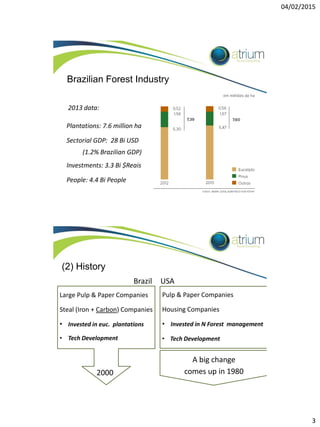
Brazilian Forest Industry
Plantations: 7.6 million ha
Sectorial GDP: 28 Bi USD
(1.2% Brazilian GDP)
Investments: 3.3 Bi $Reais
People: 4.4 Bi People
2013 data:
(2) History
Pulp & Paper Companies
Housing Companies
• Invested in N Forest management
• Tech Development
Large Pulp & Paper Companies
Steal (Iron + Carbon) Companies
• Invested in euc. plantations
• Tech Development
2000
Brazil USA
A big change
comes up in 1980
04/02/2015
4
Fact A: New Law (late 70s):
Institutional Investors (Pension Funds) must diversify investments
(2) History in USA
Fact B: New need (early 80s):
Based Forest Industry need resources to invest in Industry (itself)
Fact A + Fact B =
Large Companies sold their forest assets to institutional investors
(2) History in USA
• In 2000 Institutional Investors had
14,4 billion USD invested in
Timberland
• A new type of Company:
• TIMO: Timberland Investment
Management Organization
USA has a established market of 4 billion USD transactions a year
60 Billion USD Invested until 2013
04/02/2015
5
High Productivity (m3/ha.year)
Brazil Risk (in points)
(2) History: Meanwhile in Brazil….
Increase in Productivity in SP
m3/ha.year
(2) History:
So… US TIMOs came after 2000
2.3 Billion R$
Forest Industry Area in Brazil
American TIMOs Invested in Brazil until 2010
They showed how to do it
However…. s. happens
04/02/2015
6
(3) New Scenario
0
1,000
2,000
3,000
4,000
5,000
6,000
7,000
8,000
9,000
2002 2003 2004 2005 2006 2007 2008 2009 2010 2011 2012 2013
landPricesinR$
Land Prices in Brazil
Nominal Prices
Real Prices
Real Land appreciation 7.65% a year
New Land Acquisition Regulations:
Foreign companies can’t buy land
(3) New Scenario
04/02/2015
7
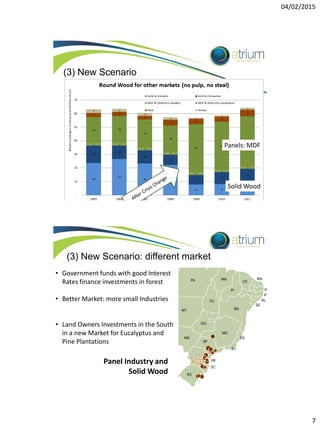
(3) New Scenario
Panels: MDF
Solid Wood
• Government funds with good Interest
Rates finance investments in forest
• Better Market: more small Industries
• Land Owners Investments in the South
in a new Market for Eucalyptus and
Pine Plantations
Panel Industry and
Solid Wood
(3) New Scenario: different market
04/02/2015
8
(3) Scenario changes >> our turn
(b) Pension funds must diversify
(c) Industry can not invest in land any more
• Land prices are high
• Social movements
% per year rate
(d) New Industry options
(a) Brazilian basic Interest rate (SELIC) is decreasing
11,15%
(4) How is it today? - who
Industry : they are selling their assets to TIMOs,
they still have 60% of the forest assets they need
Land owners and Families:
Looking for funds or Government funds like ABC fund, climate fund…
Institutional Investors as Brazilian TIMOs:
looking for “good” IRR,
has to be more than our SELIC 8% (basic interest rate)
04/02/2015
9
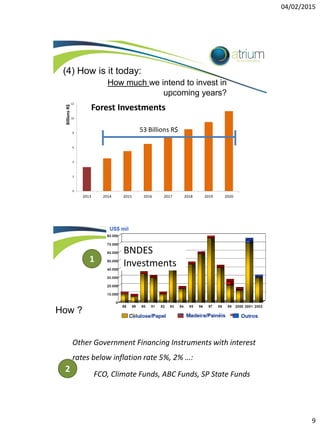
(4) How is it today:
How much we intend to invest in
upcoming years?
0
2
4
6
8
10
12
2013 2014 2015 2016 2017 2018 2019 2020
BillionsR$
Forest Investments
53 Billions R$
How ?
BNDES
Investments
Other Government Financing Instruments with interest
rates below inflation rate 5%, 2% …:
FCO, Climate Funds, ABC Funds, SP State Funds
1
2
04/02/2015
10
(4) How is it today? – How
3
$Pension funds &
other Institutional
Investors
Brazilian TIMOs
Investment Management
Forest
Management
Company 1
Forest
Management
Company 2
$$
Where?
Main variables:
Land price
Productivity
Development status
Market:
Pulp,
Steal,
Panels,
Agribusiness
04/02/2015
11
-3% -2% -1% 1% 2% 3%
Wood Price
Inicial Land Price
%Land Appreciation
Costs
Forest Productivity
% of Land Rent
When you buy Land
Project with high risk
-2% -1% 0% 1% 2%
Wood Price
Inicial Land Price
%Land Appreciation
Costs
Forest Productivity
% of Land Rent
When you buy Land
Project with low risk
silvana@atriumforest.com
www.atriumforest.com
Gracias

Eucalyptus sustainability

  • 1.
    04/02/2015 1 Economic sustainability of Industrialplantations in Brazil Silvana Nobre silvana@atriumforest.com UPM – Universidad Politécnica de Madrid February - 2015 Economic sustainability of industrial plantations in Brazil Definitions & concepts History New Scenario How is it today? (1) (2) (3) (4)
  • 2.
    04/02/2015 2 (1) Definitions Economic Sustainability: Theuse of various strategies for employing existing resources optimally so that a responsible and beneficial balance can be achieved over the longer term. Within a business context, economic sustainability involves using the assorted assets of the company efficiently to allow it to continue functioning profitability over time. http://www.businessdictionary.com/definition/economic-sustainability Forest as raw material to industry Timberland Investments Raw Material: Basic substance in its natural, modified, or semi-processed state, used as an input to a production process for subsequent modification or transformation into a finished good. www.businessdictionary.com An investment instrument used primarily by large institutional investors (such as public and private pension funds). The two main assets that underlie timberland investments are tree farms and managed natural forests. The returns on these forestland investments come from biological growth, upward product class movement, timber price appreciation and land price appreciation. www.investopedia.com
  • 3.
    04/02/2015 3 Brazilian Forest Industry Plantations:7.6 million ha Sectorial GDP: 28 Bi USD (1.2% Brazilian GDP) Investments: 3.3 Bi $Reais People: 4.4 Bi People 2013 data: (2) History Pulp & Paper Companies Housing Companies • Invested in N Forest management • Tech Development Large Pulp & Paper Companies Steal (Iron + Carbon) Companies • Invested in euc. plantations • Tech Development 2000 Brazil USA A big change comes up in 1980
  • 4.
    04/02/2015 4 Fact A: NewLaw (late 70s): Institutional Investors (Pension Funds) must diversify investments (2) History in USA Fact B: New need (early 80s): Based Forest Industry need resources to invest in Industry (itself) Fact A + Fact B = Large Companies sold their forest assets to institutional investors (2) History in USA • In 2000 Institutional Investors had 14,4 billion USD invested in Timberland • A new type of Company: • TIMO: Timberland Investment Management Organization USA has a established market of 4 billion USD transactions a year 60 Billion USD Invested until 2013
  • 5.
    04/02/2015 5 High Productivity (m3/ha.year) BrazilRisk (in points) (2) History: Meanwhile in Brazil…. Increase in Productivity in SP m3/ha.year (2) History: So… US TIMOs came after 2000 2.3 Billion R$ Forest Industry Area in Brazil American TIMOs Invested in Brazil until 2010 They showed how to do it However…. s. happens
  • 6.
    04/02/2015 6 (3) New Scenario 0 1,000 2,000 3,000 4,000 5,000 6,000 7,000 8,000 9,000 20022003 2004 2005 2006 2007 2008 2009 2010 2011 2012 2013 landPricesinR$ Land Prices in Brazil Nominal Prices Real Prices Real Land appreciation 7.65% a year New Land Acquisition Regulations: Foreign companies can’t buy land (3) New Scenario
  • 7.
    04/02/2015 7 (3) New Scenario Panels:MDF Solid Wood • Government funds with good Interest Rates finance investments in forest • Better Market: more small Industries • Land Owners Investments in the South in a new Market for Eucalyptus and Pine Plantations Panel Industry and Solid Wood (3) New Scenario: different market
  • 8.
    04/02/2015 8 (3) Scenario changes>> our turn (b) Pension funds must diversify (c) Industry can not invest in land any more • Land prices are high • Social movements % per year rate (d) New Industry options (a) Brazilian basic Interest rate (SELIC) is decreasing 11,15% (4) How is it today? - who Industry : they are selling their assets to TIMOs, they still have 60% of the forest assets they need Land owners and Families: Looking for funds or Government funds like ABC fund, climate fund… Institutional Investors as Brazilian TIMOs: looking for “good” IRR, has to be more than our SELIC 8% (basic interest rate)
  • 9.
    04/02/2015 9 (4) How isit today: How much we intend to invest in upcoming years? 0 2 4 6 8 10 12 2013 2014 2015 2016 2017 2018 2019 2020 BillionsR$ Forest Investments 53 Billions R$ How ? BNDES Investments Other Government Financing Instruments with interest rates below inflation rate 5%, 2% …: FCO, Climate Funds, ABC Funds, SP State Funds 1 2
  • 10.
    04/02/2015 10 (4) How isit today? – How 3 $Pension funds & other Institutional Investors Brazilian TIMOs Investment Management Forest Management Company 1 Forest Management Company 2 $$ Where? Main variables: Land price Productivity Development status Market: Pulp, Steal, Panels, Agribusiness
  • 11.
    04/02/2015 11 -3% -2% -1%1% 2% 3% Wood Price Inicial Land Price %Land Appreciation Costs Forest Productivity % of Land Rent When you buy Land Project with high risk -2% -1% 0% 1% 2% Wood Price Inicial Land Price %Land Appreciation Costs Forest Productivity % of Land Rent When you buy Land Project with low risk silvana@atriumforest.com www.atriumforest.com Gracias