Institutionen för skoglig resurshushållning
Department of Forest Rescouce Management
Potential untapped? – the use
of forest Decision Support
Systems
Ljusk Ola Eriksson, Silvana Nobre, Renats Trubins
Climate change and effects (COST Action
ECHOES)
Climate change is
Temperature +
Precipitation +/-
Variability +
Influences
Drought +
Waterlogging +
Wind +
Snow +
Seasonal length
Extreme events +
Affects incidence/magnitude of
Fire
Wind throw
Pathogens
Primary growth
Soil carbon pool
Aboveground biomass
Timber quality
Thawing
Snow breakage
Frost damage
Species composition
Biodiversity
Erosion control
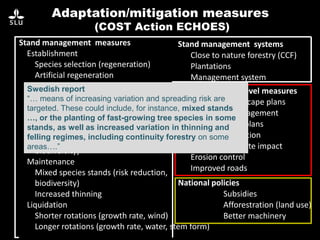
Adaptation/mitigation measures
(COST Action ECHOES)
Stand management measures
Establishment
Species selection (regeneration)
Artificial regeneration
Exotic species
Natural regeneration
Less seedlings in plantations
Increased regeneration efforts
Fast growing species
Mixed species stands (risk reduction,
biodiversity)
Maintenance
Mixed species stands (risk reduction,
biodiversity)
Increased thinning
Liquidation
Shorter rotations (growth rate, wind)
Longer rotations (growth rate, water, stem form)
Stand management systems
Close to nature forestry (CCF)
Plantations
Management system
Landscape/forest level measures
Ecological landscape plans
Landscape management
Fire landscape plans
Wildfire prevention
Reduced ungulate impact
Erosion control
Improved roads
National policies
Subsidies
Afforestration (land use)
Better machinery
Swedish report
“… means of increasing variation and spreading risk are
targeted. These could include, for instance, mixed stands
…, or the planting of fast-growing tree species in some
stands, as well as increased variation in thinning and
felling regimes, including continuity forestry on some
areas….”
Contents = Gap analysis
A. What is a gap?
B. Is there a gap?
C. What causes the gap?
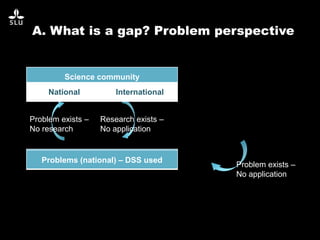
A. What is a gap? Problem perspective
Science community
Problems - IRLProblems (national) – DSS used
Problem exists –
No research
Research exists –
No application
Problem exists –
No application
National International
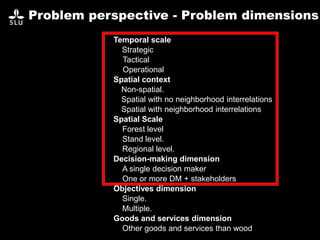
Problem perspective - Problem dimensions
Temporal scale
•Strategic
Tactical
Operational
Spatial context
•Non-spatial.
•Spatial with no neighborhood interrelations
•Spatial with neighborhood interrelations
Spatial Scale
•Forest level
•Stand level.
•Regional level.
Decision-making dimension
•A single decision maker
•One or more DM + stakeholders
Objectives dimension
•Single.
•Multiple.
Goods and services dimension
•Other goods and services than wood
A. What is a gap? M&M perspective
Ontology built model of a DSS
A. What is a gap? M&M perspective
Refer to
o (The methods base)
o The model base
Methods perspective
• Simulation (”Assessment”; ”What if”)
• Optimiization
o LP, MIP, DP, NLP
o Heuristics
o Other
• MCDA
o AHP, Outranking, Simple ranking, MAUT, Voting
o Other
B. Is there a gap? FORSYS material
• Country Reports (CR)
• Scientific journals (ScJ)
• DSS articles (DSS)
Country reports (CR)
• 25 countries – 178 problems
• What problem types are represented?
• What DSS are used?
• What descriptive models are used?
• What analytical methods are used?
• What participatory techniques?
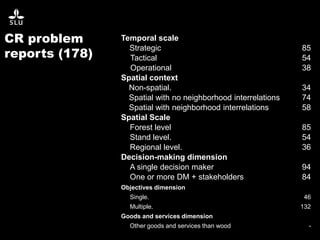
CR problem
reports (178)
Temporal scale
•Strategic 85
Tactical 54
Operational 38
Spatial context
•Non-spatial. 34
•Spatial with no neighborhood interrelations 74
•Spatial with neighborhood interrelations 58
Spatial Scale
•Forest level 85
•Stand level. 54
•Regional level. 36
Decision-making dimension
•A single decision maker 94
•One or more DM + stakeholders 84
Objectives dimension
•Single. 46
•Multiple. 132
Goods and services dimension
•Other goods and services than wood -
Science material – journal analysis
• Peer reviewed journals
• Search criteria: Title/keywords/abstract – contains – forest
support system OR forest decision support
• Articles year 2000-2012
 ~2000 articles screened
• Strategic (not tactical or operational)
• Application of a DSS
 The article base: 94
Semantic wiki
• DSS articles
B. Is there a gap?
• Problem perspective  Country-wise
• Methods perspective  Problem-wise
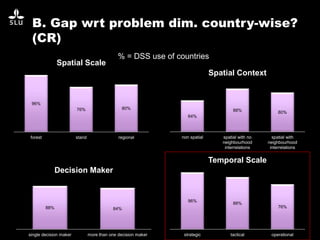
B. Gap wrt problem dim. country-wise?
(CR)
96%
88%
76%
strategic tactical operational
Temporal Scale
64%
88% 80%
non spatial spatial with no
neighbourhood
interrelations
spatial with
neighbourhood
interrelations
Spatial Context
88% 84%
single decision maker more than one decision maker
Decision Maker
% = DSS use of countries
96%
76% 80%
forest stand regional
Spatial Scale
Spatial Scale Decision Maker
Country forest stand regional 1 DM >1 DM
Turkey O O O
Chile O O
Morocco O
Greece O O
China O O
Brazil O O O
South Africa O
Estonia O
United States O
Hungary
Austria O
Canada O
Denmark O
Finland
Germany
Ireland
Italy
Norway
Portugal
Russia
Slovenia
Spain
Sweden
Switzerland
United Kingdom
No. of O 1 6 5 3 4
B. Gap wrt problem dim. country-wise? (CR)
O = DSS not in use
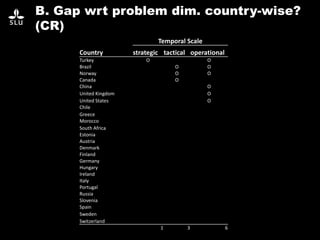
B. Gap wrt problem dim. country-wise?
(CR)
Temporal Scale
Country strategic tactical operational
Turkey O O
Brazil O O
Norway O O
Canada O
China O
United Kingdom O
United States O
Chile
Greece
Morocco
South Africa
Estonia
Austria
Denmark
Finland
Germany
Hungary
Ireland
Italy
Portugal
Russia
Slovenia
Spain
Sweden
Switzerland
1 3 6
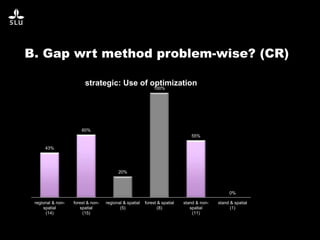
B. Gap wrt method problem-wise? (CR)
43%
60%
20%
100%
55%
0%
regional & non-
spatial
(14)
forest & non-
spatial
(15)
regional & spatial
(5)
forest & spatial
(8)
stand & non-
spatial
(11)
stand & spatial
(1)
strategic: Use of optimization
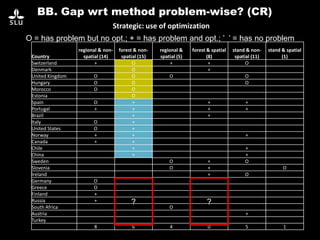
BB. Gap wrt method problem-wise? (CR)
Country
regional & non-
spatial (14)
forest & non-
spatial (15)
regional &
spatial (5)
forest & spatial
(8)
stand & non-
spatial (11)
stand & spatial
(1)
Switzerland + O + + O
Denmark O +
United Kingdom O O O O
Hungary O O O
Morocco O O
Estonia O
Spain O + + +
Portugal + + + +
Brazil + +
Italy O +
United States O +
Norway + + +
Canada + +
Chile + +
China + +
Sweden O + O
Slovenia O + O
Ireland + O
Germany O
Greece O
Finland +
Russia +
South Africa O
Austria +
Turkey
8 6 4 0 5 1
O = has problem but no opt.; + = has problem and opt.; ’ ’ = has no problem
? ?
Strategic: use of optimization
B. Gap wrt method problem-wise?
Method
Problem LP MIP DP NLP Heuristics Other
CR: regional & non-spatial 4 1 1 2 2
CR: forest & non-spatial 6 2 1 3 4
ScJ: regional/forest & non-spatial 6 1 2
CR: regional & spatial 1
CR: forest & spatial 2 3 1 1 1 6
ScJ: regional/forest & spatial 2 4 2 7
CR: stand & non-spatial 2 1 2 1 2
ScJ: stand & non-spatial 1
CR: stand & spatial
ScJ: stand & spatial
Strategic: use of optimization – CR vs ScJ
B. Gap wrt method problem-wise?
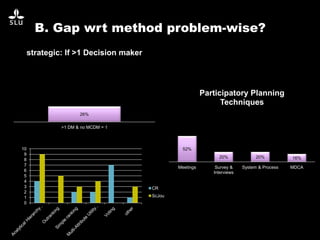
26%
>1 DM & no MCDM = 1
strategic: If >1 Decision maker
0
1
2
3
4
5
6
7
8
9
10
CR
ScJou
52%
20% 20% 16%
Meetings Survey &
Interviews
System & Process MDCA
Participatory Planning
Techniques
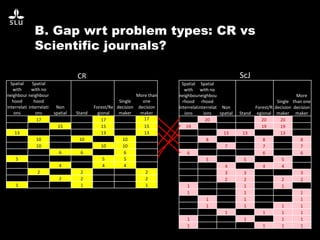
B. Gap wrt problem types: CR vs
Scientific journals?
CR
Spatial
with
neighbour
hood
interrelati
ons
Spatial
with no
neighbour
hood
interrelati
ons
Non
spatial Stand
Forest/Re
gional
Single
decision
maker
More than
one
decision
maker
17 17 17
15 15 15
13 13 13
10 10 10
10 10 10
6 6 6
5 5 5
4 4 4
2 2 2
2 2 2
1 1 1
ScJ
Spatial
with
neighbou
rhood
interrelat
ions
Spatial
with no
neighbou
rhood
interrelat
ions
Non
spatial Stand
Forest/R
egional
Single
decision
maker
More
than one
decision
maker
20 20 20
19 19 19
13 13 13
8 8 8
7 7 7
6 6 6
5 5 5
4 4 4
3 3 3
2 2 2 2
1 1 1
1 1 1
1 1 1
1 1 1 1
1 1 1 1
1 1 1 1
1 1 1 1
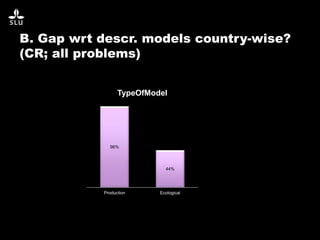
B. Gap wrt descr. models country-wise?
(CR; all problems)
96%
44%
Production Ecological
TypeOfModel
B. Is there a gap – summary?
Use of DSS (country-wise)?
• Strategic > Operational
• Forest > Stand
• Spatial contexts & Decision makers ~>80%
• Limited use: a few Meditteranean + a few non-European
• Big gap – ecological models
Use of optimization in DSS (strategic)?
• Forest > Regional
• Limited use: a few mid-European?
• Matches science
Use of MCDA in DSS (strategic)?
• Big gap – but is there a need?
• CR and ScJou: advanced methods
Problem types in use and science (strategic)
• Good match but Problems on DM>1 vs. Science more on
DM=1
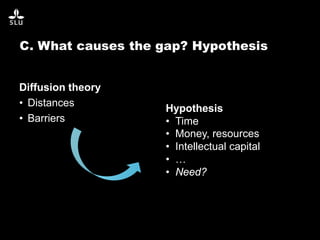
C. What causes the gap? Hypothesis
Diffusion theory
• Distances
• Barriers
Hypothesis
• Time
• Money, resources
• Intellectual capital
• …
• Need?
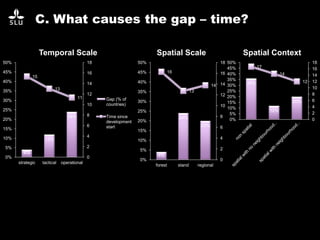
C. What causes the gap – time?
4%
12%
24%
15
13
11
0
2
4
6
8
10
12
14
16
18
0%
5%
10%
15%
20%
25%
30%
35%
40%
45%
50%
strategic tactical operational
Temporal Scale
Gap (% of
countries)
Time since
development
start
4%
24%
20%
16
13
14
0
2
4
6
8
10
12
14
16
18
0%
5%
10%
15%
20%
25%
30%
35%
40%
45%
50%
forest stand regional
Spatial Scale
36%
12%
20%
17
14
12
0
2
4
6
8
10
12
14
16
18
0%
5%
10%
15%
20%
25%
30%
35%
40%
45%
50%
Spatial Context
C. What causes the DSS use gap –
resources?
0
1
2
3
4
5
6
7
0 20000 40000 60000 80000
Use of DSS: Gap vs. GDP/c (corr. -
0.39)
0
1
2
3
4
5
6
7
350 400 450 500 550 600 650
Use of DSS: Gap vs. PISA/math (corr. -
0.32)
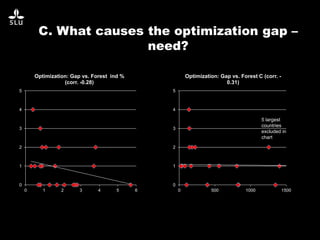
C. What causes the optimization gap –
need?
0
1
2
3
4
5
0 1 2 3 4 5 6
Optimization: Gap vs. Forest ind %
(corr. -0.28)
0
1
2
3
4
5
0 500 1000 1500
Optimization: Gap vs. Forest C (corr. -
0.31)
5 largest
countries
excluded in
chart
C. What causes the gap – ???
• Owner structure
• Forest institutions
• The production line of DSS
• The scientific production
RESERVATION - QUALIFICATION- RESERVATION - QUALIFICATION-
RESERVATION - QUALIFICATION- ……………….
Thank you for your patience!

15º Simpósio sobre Análise de Sistemas em Recursos Florestais - SSAFR

  • 1.
    Institutionen för skogligresurshushållning Department of Forest Rescouce Management Potential untapped? – the use of forest Decision Support Systems Ljusk Ola Eriksson, Silvana Nobre, Renats Trubins
  • 2.
    Climate change andeffects (COST Action ECHOES) Climate change is Temperature + Precipitation +/- Variability + Influences Drought + Waterlogging + Wind + Snow + Seasonal length Extreme events + Affects incidence/magnitude of Fire Wind throw Pathogens Primary growth Soil carbon pool Aboveground biomass Timber quality Thawing Snow breakage Frost damage Species composition Biodiversity Erosion control
  • 3.
    Adaptation/mitigation measures (COST ActionECHOES) Stand management measures Establishment Species selection (regeneration) Artificial regeneration Exotic species Natural regeneration Less seedlings in plantations Increased regeneration efforts Fast growing species Mixed species stands (risk reduction, biodiversity) Maintenance Mixed species stands (risk reduction, biodiversity) Increased thinning Liquidation Shorter rotations (growth rate, wind) Longer rotations (growth rate, water, stem form) Stand management systems Close to nature forestry (CCF) Plantations Management system Landscape/forest level measures Ecological landscape plans Landscape management Fire landscape plans Wildfire prevention Reduced ungulate impact Erosion control Improved roads National policies Subsidies Afforestration (land use) Better machinery Swedish report “… means of increasing variation and spreading risk are targeted. These could include, for instance, mixed stands …, or the planting of fast-growing tree species in some stands, as well as increased variation in thinning and felling regimes, including continuity forestry on some areas….”
  • 4.
    Contents = Gapanalysis A. What is a gap? B. Is there a gap? C. What causes the gap?
  • 5.
    A. What isa gap? Problem perspective Science community Problems - IRLProblems (national) – DSS used Problem exists – No research Research exists – No application Problem exists – No application National International
  • 6.
    Problem perspective -Problem dimensions Temporal scale •Strategic Tactical Operational Spatial context •Non-spatial. •Spatial with no neighborhood interrelations •Spatial with neighborhood interrelations Spatial Scale •Forest level •Stand level. •Regional level. Decision-making dimension •A single decision maker •One or more DM + stakeholders Objectives dimension •Single. •Multiple. Goods and services dimension •Other goods and services than wood
  • 7.
    A. What isa gap? M&M perspective Ontology built model of a DSS
  • 8.
    A. What isa gap? M&M perspective Refer to o (The methods base) o The model base
  • 9.
    Methods perspective • Simulation(”Assessment”; ”What if”) • Optimiization o LP, MIP, DP, NLP o Heuristics o Other • MCDA o AHP, Outranking, Simple ranking, MAUT, Voting o Other
  • 10.
    B. Is therea gap? FORSYS material • Country Reports (CR) • Scientific journals (ScJ) • DSS articles (DSS)
  • 11.
    Country reports (CR) •25 countries – 178 problems • What problem types are represented? • What DSS are used? • What descriptive models are used? • What analytical methods are used? • What participatory techniques?
  • 12.
    CR problem reports (178) Temporalscale •Strategic 85 Tactical 54 Operational 38 Spatial context •Non-spatial. 34 •Spatial with no neighborhood interrelations 74 •Spatial with neighborhood interrelations 58 Spatial Scale •Forest level 85 •Stand level. 54 •Regional level. 36 Decision-making dimension •A single decision maker 94 •One or more DM + stakeholders 84 Objectives dimension •Single. 46 •Multiple. 132 Goods and services dimension •Other goods and services than wood -
  • 13.
    Science material –journal analysis • Peer reviewed journals • Search criteria: Title/keywords/abstract – contains – forest support system OR forest decision support • Articles year 2000-2012  ~2000 articles screened • Strategic (not tactical or operational) • Application of a DSS  The article base: 94
  • 14.
  • 15.
    B. Is therea gap? • Problem perspective  Country-wise • Methods perspective  Problem-wise
  • 16.
    B. Gap wrtproblem dim. country-wise? (CR) 96% 88% 76% strategic tactical operational Temporal Scale 64% 88% 80% non spatial spatial with no neighbourhood interrelations spatial with neighbourhood interrelations Spatial Context 88% 84% single decision maker more than one decision maker Decision Maker % = DSS use of countries 96% 76% 80% forest stand regional Spatial Scale
  • 17.
    Spatial Scale DecisionMaker Country forest stand regional 1 DM >1 DM Turkey O O O Chile O O Morocco O Greece O O China O O Brazil O O O South Africa O Estonia O United States O Hungary Austria O Canada O Denmark O Finland Germany Ireland Italy Norway Portugal Russia Slovenia Spain Sweden Switzerland United Kingdom No. of O 1 6 5 3 4 B. Gap wrt problem dim. country-wise? (CR) O = DSS not in use
  • 18.
    B. Gap wrtproblem dim. country-wise? (CR) Temporal Scale Country strategic tactical operational Turkey O O Brazil O O Norway O O Canada O China O United Kingdom O United States O Chile Greece Morocco South Africa Estonia Austria Denmark Finland Germany Hungary Ireland Italy Portugal Russia Slovenia Spain Sweden Switzerland 1 3 6
  • 19.
    B. Gap wrtmethod problem-wise? (CR) 43% 60% 20% 100% 55% 0% regional & non- spatial (14) forest & non- spatial (15) regional & spatial (5) forest & spatial (8) stand & non- spatial (11) stand & spatial (1) strategic: Use of optimization
  • 20.
    BB. Gap wrtmethod problem-wise? (CR) Country regional & non- spatial (14) forest & non- spatial (15) regional & spatial (5) forest & spatial (8) stand & non- spatial (11) stand & spatial (1) Switzerland + O + + O Denmark O + United Kingdom O O O O Hungary O O O Morocco O O Estonia O Spain O + + + Portugal + + + + Brazil + + Italy O + United States O + Norway + + + Canada + + Chile + + China + + Sweden O + O Slovenia O + O Ireland + O Germany O Greece O Finland + Russia + South Africa O Austria + Turkey 8 6 4 0 5 1 O = has problem but no opt.; + = has problem and opt.; ’ ’ = has no problem ? ? Strategic: use of optimization
  • 21.
    B. Gap wrtmethod problem-wise? Method Problem LP MIP DP NLP Heuristics Other CR: regional & non-spatial 4 1 1 2 2 CR: forest & non-spatial 6 2 1 3 4 ScJ: regional/forest & non-spatial 6 1 2 CR: regional & spatial 1 CR: forest & spatial 2 3 1 1 1 6 ScJ: regional/forest & spatial 2 4 2 7 CR: stand & non-spatial 2 1 2 1 2 ScJ: stand & non-spatial 1 CR: stand & spatial ScJ: stand & spatial Strategic: use of optimization – CR vs ScJ
  • 22.
    B. Gap wrtmethod problem-wise? 26% >1 DM & no MCDM = 1 strategic: If >1 Decision maker 0 1 2 3 4 5 6 7 8 9 10 CR ScJou 52% 20% 20% 16% Meetings Survey & Interviews System & Process MDCA Participatory Planning Techniques
  • 23.
    B. Gap wrtproblem types: CR vs Scientific journals? CR Spatial with neighbour hood interrelati ons Spatial with no neighbour hood interrelati ons Non spatial Stand Forest/Re gional Single decision maker More than one decision maker 17 17 17 15 15 15 13 13 13 10 10 10 10 10 10 6 6 6 5 5 5 4 4 4 2 2 2 2 2 2 1 1 1 ScJ Spatial with neighbou rhood interrelat ions Spatial with no neighbou rhood interrelat ions Non spatial Stand Forest/R egional Single decision maker More than one decision maker 20 20 20 19 19 19 13 13 13 8 8 8 7 7 7 6 6 6 5 5 5 4 4 4 3 3 3 2 2 2 2 1 1 1 1 1 1 1 1 1 1 1 1 1 1 1 1 1 1 1 1 1 1 1 1 1
  • 24.
    B. Gap wrtdescr. models country-wise? (CR; all problems) 96% 44% Production Ecological TypeOfModel
  • 25.
    B. Is therea gap – summary? Use of DSS (country-wise)? • Strategic > Operational • Forest > Stand • Spatial contexts & Decision makers ~>80% • Limited use: a few Meditteranean + a few non-European • Big gap – ecological models Use of optimization in DSS (strategic)? • Forest > Regional • Limited use: a few mid-European? • Matches science Use of MCDA in DSS (strategic)? • Big gap – but is there a need? • CR and ScJou: advanced methods Problem types in use and science (strategic) • Good match but Problems on DM>1 vs. Science more on DM=1
  • 26.
    C. What causesthe gap? Hypothesis Diffusion theory • Distances • Barriers Hypothesis • Time • Money, resources • Intellectual capital • … • Need?
  • 27.
    C. What causesthe gap – time? 4% 12% 24% 15 13 11 0 2 4 6 8 10 12 14 16 18 0% 5% 10% 15% 20% 25% 30% 35% 40% 45% 50% strategic tactical operational Temporal Scale Gap (% of countries) Time since development start 4% 24% 20% 16 13 14 0 2 4 6 8 10 12 14 16 18 0% 5% 10% 15% 20% 25% 30% 35% 40% 45% 50% forest stand regional Spatial Scale 36% 12% 20% 17 14 12 0 2 4 6 8 10 12 14 16 18 0% 5% 10% 15% 20% 25% 30% 35% 40% 45% 50% Spatial Context
  • 28.
    C. What causesthe DSS use gap – resources? 0 1 2 3 4 5 6 7 0 20000 40000 60000 80000 Use of DSS: Gap vs. GDP/c (corr. - 0.39) 0 1 2 3 4 5 6 7 350 400 450 500 550 600 650 Use of DSS: Gap vs. PISA/math (corr. - 0.32)
  • 29.
    C. What causesthe optimization gap – need? 0 1 2 3 4 5 0 1 2 3 4 5 6 Optimization: Gap vs. Forest ind % (corr. -0.28) 0 1 2 3 4 5 0 500 1000 1500 Optimization: Gap vs. Forest C (corr. - 0.31) 5 largest countries excluded in chart
  • 30.
    C. What causesthe gap – ??? • Owner structure • Forest institutions • The production line of DSS • The scientific production RESERVATION - QUALIFICATION- RESERVATION - QUALIFICATION- RESERVATION - QUALIFICATION- RESERVATION - QUALIFICATION- RESERVATION - QUALIFICATION- ……………….
  • 31.
    Thank you foryour patience!