Climate Change and
Conservation Silviculture
Forests and Climate Change: Forest
responses and vulnerabilities to climate
change mitigation
Shubham Shah
M.Sc. Forest Resource Management
Introduction
• Forests are the world’s most important terrestrial storehouses of carbon, and
they play an important role in controlling its climate.
• Forests have a three fold in climate change :
o Driver of climate change
o Victim of climate change
o Solution for climate change
Forests as Drivers of Climate Change
• Natural emissions :
o Decomposition
o Natural fires
o Soil respiration
• Anthropogenic emissions :
o Deforestation and land use change
Natural Emissions from Forest
• Each time a tree dies, whether by disease, old age, competition with other
species or by being brought down in a storm, the process of decomposition
begins, with subsequent release of CO2 and CH4 into the atmosphere.
• Another source of emissions of greenhouse gases is when forests are
burned.
• Soil respiration is decomposition of soil organic matter releasing carbon
dioxide in the atmosphere.
Anthropogenic Emissions
• Land use change is the 2nd largest source of greenhouse gas emissions; first
being fossil fuel combustion. (IPCC, 2007)
Anthropogenic Emissions
• In countries such as Brazil and
Australia, deforestation accounts for
75% of total GHG emissions.
• GHG emissions also arise from
decomposition of biomass resulting
from logging and deforestation,
decay of peat and peat burning.
Forests as Victims of Climate Change
• Forest disturbances under climate change :
o Fire
o Invasive Species
o Incident of insect, pest and diseases
• Impact on forest processes
o Nutrient availability
Forests as Victims of Climate Change
• Forest composition, growth and productivity :
o Increased temperature and rainfall
o Increased CO2
o Extreme events
Forest Disturbances under Climate Change
• Fire :
o Increase in temperatures create conditions that dramatically elevate the risk and severity
of forest fires.
o Climate change is increasing the likelihood of fire ignition and propagation with
phenomenon such as, extreme temperatures and plant biomass accumulation.
Forest Disturbances under Climate Change
• Invasive species :
o Climate change will have the effect of increasing the extent, frequency, and severity of
invasive species, as well as facilitating a shift toward invasion in species that have not
historically been invasive.
o Invasive species have strong dispersal abilities and broad environmental tolerances,
which will allow them to cope with rapid changes.
o Species range shifts will also lead to becoming rare and creates ecological space for
non-native invasive species to increase in abundance and move in.
Forest Disturbances under Climate Change
• Incident of insects, pests and diseases :
o Forest ecosystem pests and pathogens are likely to increase, either through the direct
effect of climate change on their abundance or distribution, or the indirect effect of
increased water stress or wind damage which will increase the susceptibility of trees to
attack.
o With long dry spells and more intense rainfall, the resulting decline in water quality will
lead to greater risk of waterborne diseases.
Impact on Forest Composition, Growth and
Productivity
Impact on Forest Processes
• Changes in nutrient availability :
o Increasing temperature is likely to affect nutrient availability in the soil through the
stimulation of organic matter decomposition and mineralization of soil nutrients.
o With increasing carbon dioxide levels in the atmosphere more microbes are becoming
nitrogen limited and releasing less nutrients to the trees.
o Increase in temperature can lead to reductions in nutrient availability.
Carbon Stocks
• The total forest carbon stock is estimated at
662 Gt.(FAO-FRA, 2020)
o Living biomass- 300 Gt
o Soil organic matter- 295 Gt
o Dead wood and litter- 68 Gt
• The global forest carbon stock decreased
from 668 Gt in 1990 to 662 Gt in 2020.
(Change in carbon stocks from the year 1990 to 2020, FAO-FRA,2020)
Role of Forests in Climate Change Mitigation
• REDD+
• Afforestation/Reforestation (A/R)
• Sustainable Forest Management (SFM)
• Forest products
• Forest biodiversity
REDD+
• It stands for Reducing Emissions from Deforestation and Forest
Degradation plus the sustainable management of forests, and the
conservation and enhancement of forest carbon stocks.
• At the core of this work are forests and the fundamental role they play in
climate change mitigation, by removing CO2 from the atmosphere and
storing it in biomass and soils.
Afforestation/Reforestation
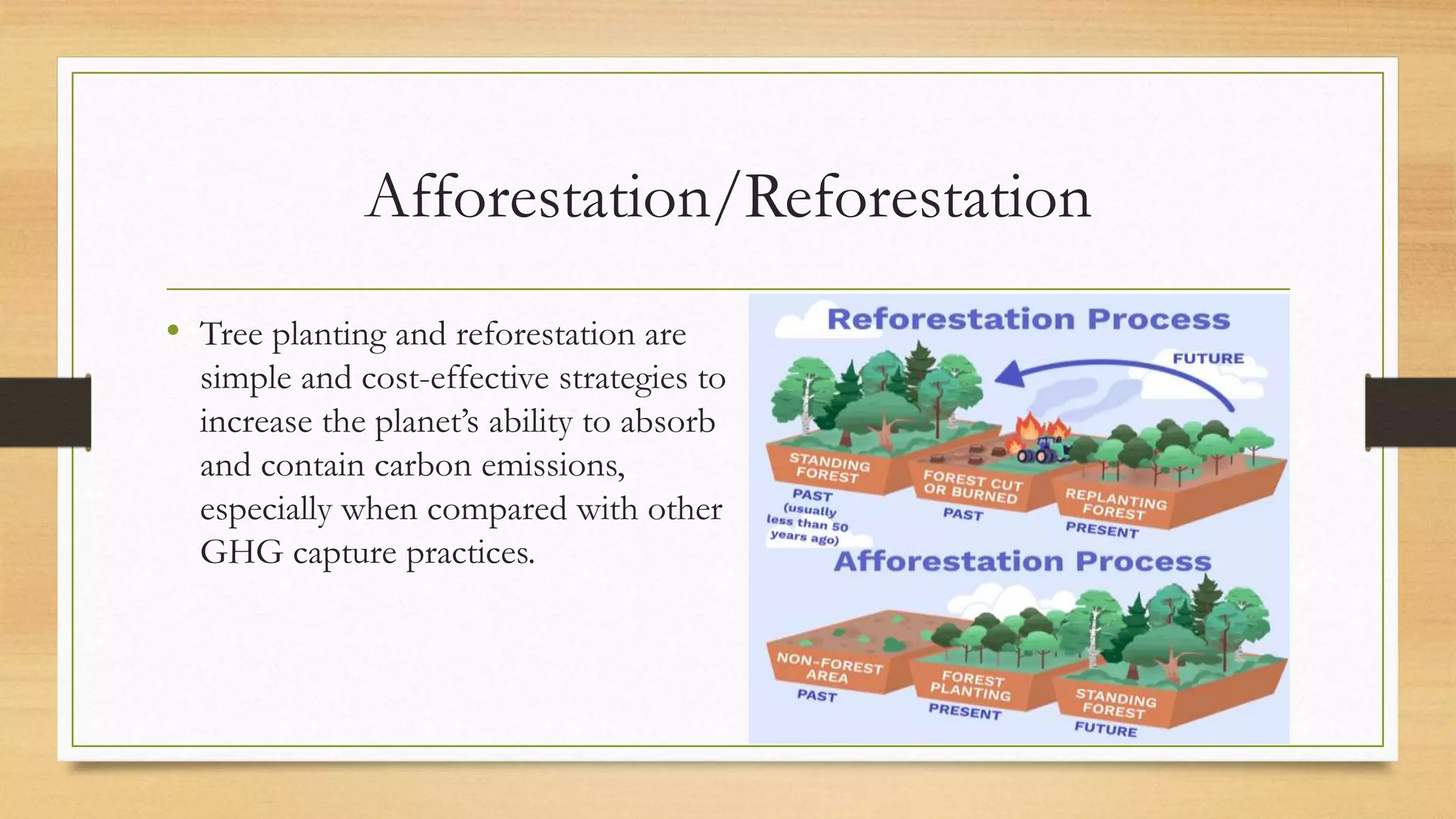
• Tree planting and reforestation are
simple and cost-effective strategies to
increase the planet’s ability to absorb
and contain carbon emissions,
especially when compared with other
GHG capture practices.
Forest Products
• Use of forest products from sustainably managed forests as substitutes for :
o Fossil fuels
o More carbon intensive products such as steel, aluminium and plastic
• The carbon captured by trees from the atmosphere can be stored for decades
in long-lived wood products such as construction timber and furniture; thus,
a wood-based carbon pool exists outside forests in the form of finished
wood products.
Forest Biodiversity and Climate Change
• Biodiversity encompasses the variety of existing life forms, the ecological
roles they perform and the genetic diversity they contain.
• It is the key to forest ecosystem resilience and the adaptation of forest
species to climate change, and it will also underpin the role of forests in
mitigating climate change.
• The actions to conserve biodiversity will help mitigate the effect of climate
change.
Thankyou

Forests and Climate Change

  • 1.
    Climate Change and ConservationSilviculture Forests and Climate Change: Forest responses and vulnerabilities to climate change mitigation Shubham Shah M.Sc. Forest Resource Management
  • 2.
    Introduction • Forests arethe world’s most important terrestrial storehouses of carbon, and they play an important role in controlling its climate. • Forests have a three fold in climate change : o Driver of climate change o Victim of climate change o Solution for climate change
  • 3.
    Forests as Driversof Climate Change • Natural emissions : o Decomposition o Natural fires o Soil respiration • Anthropogenic emissions : o Deforestation and land use change
  • 4.
  • 5.
    Natural Emissions fromForest • Each time a tree dies, whether by disease, old age, competition with other species or by being brought down in a storm, the process of decomposition begins, with subsequent release of CO2 and CH4 into the atmosphere. • Another source of emissions of greenhouse gases is when forests are burned. • Soil respiration is decomposition of soil organic matter releasing carbon dioxide in the atmosphere.
  • 6.
    Anthropogenic Emissions • Landuse change is the 2nd largest source of greenhouse gas emissions; first being fossil fuel combustion. (IPCC, 2007)
  • 7.
    Anthropogenic Emissions • Incountries such as Brazil and Australia, deforestation accounts for 75% of total GHG emissions. • GHG emissions also arise from decomposition of biomass resulting from logging and deforestation, decay of peat and peat burning.
  • 8.
    Forests as Victimsof Climate Change • Forest disturbances under climate change : o Fire o Invasive Species o Incident of insect, pest and diseases • Impact on forest processes o Nutrient availability
  • 9.
    Forests as Victimsof Climate Change • Forest composition, growth and productivity : o Increased temperature and rainfall o Increased CO2 o Extreme events
  • 10.
    Forest Disturbances underClimate Change • Fire : o Increase in temperatures create conditions that dramatically elevate the risk and severity of forest fires. o Climate change is increasing the likelihood of fire ignition and propagation with phenomenon such as, extreme temperatures and plant biomass accumulation.
  • 12.
    Forest Disturbances underClimate Change • Invasive species : o Climate change will have the effect of increasing the extent, frequency, and severity of invasive species, as well as facilitating a shift toward invasion in species that have not historically been invasive. o Invasive species have strong dispersal abilities and broad environmental tolerances, which will allow them to cope with rapid changes. o Species range shifts will also lead to becoming rare and creates ecological space for non-native invasive species to increase in abundance and move in.
  • 14.
    Forest Disturbances underClimate Change • Incident of insects, pests and diseases : o Forest ecosystem pests and pathogens are likely to increase, either through the direct effect of climate change on their abundance or distribution, or the indirect effect of increased water stress or wind damage which will increase the susceptibility of trees to attack. o With long dry spells and more intense rainfall, the resulting decline in water quality will lead to greater risk of waterborne diseases.
  • 16.
    Impact on ForestComposition, Growth and Productivity
  • 17.
    Impact on ForestProcesses • Changes in nutrient availability : o Increasing temperature is likely to affect nutrient availability in the soil through the stimulation of organic matter decomposition and mineralization of soil nutrients. o With increasing carbon dioxide levels in the atmosphere more microbes are becoming nitrogen limited and releasing less nutrients to the trees. o Increase in temperature can lead to reductions in nutrient availability.
  • 19.
    Carbon Stocks • Thetotal forest carbon stock is estimated at 662 Gt.(FAO-FRA, 2020) o Living biomass- 300 Gt o Soil organic matter- 295 Gt o Dead wood and litter- 68 Gt • The global forest carbon stock decreased from 668 Gt in 1990 to 662 Gt in 2020.
  • 20.
    (Change in carbonstocks from the year 1990 to 2020, FAO-FRA,2020)
  • 21.
    Role of Forestsin Climate Change Mitigation • REDD+ • Afforestation/Reforestation (A/R) • Sustainable Forest Management (SFM) • Forest products • Forest biodiversity
  • 22.
    REDD+ • It standsfor Reducing Emissions from Deforestation and Forest Degradation plus the sustainable management of forests, and the conservation and enhancement of forest carbon stocks. • At the core of this work are forests and the fundamental role they play in climate change mitigation, by removing CO2 from the atmosphere and storing it in biomass and soils.
  • 24.
    Afforestation/Reforestation • Tree plantingand reforestation are simple and cost-effective strategies to increase the planet’s ability to absorb and contain carbon emissions, especially when compared with other GHG capture practices.
  • 25.
    Forest Products • Useof forest products from sustainably managed forests as substitutes for : o Fossil fuels o More carbon intensive products such as steel, aluminium and plastic • The carbon captured by trees from the atmosphere can be stored for decades in long-lived wood products such as construction timber and furniture; thus, a wood-based carbon pool exists outside forests in the form of finished wood products.
  • 26.
    Forest Biodiversity andClimate Change • Biodiversity encompasses the variety of existing life forms, the ecological roles they perform and the genetic diversity they contain. • It is the key to forest ecosystem resilience and the adaptation of forest species to climate change, and it will also underpin the role of forests in mitigating climate change. • The actions to conserve biodiversity will help mitigate the effect of climate change.
  • 27.