Contents
1. Climate changeand its impacts
2. Global forests and climate change
3. Ecosystem services of forests
4. Forests and mitigation
5. Forests and adaptation
6. Conclusion
3.
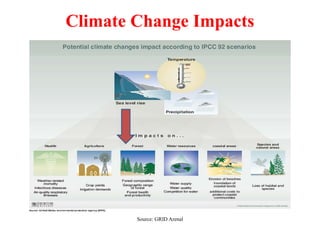
1. Climate Changeand its impacts
Our understanding of climate change is largely the result of the
Intergovernmental Panel on Climate Change (IPCC), which was
created in 1988.
Climate change occurs when long-term weather patterns are altered,
caused by trapping excess carbon in Earth’s atmosphere
Global warming is one measure of climate change, and is a rise in
the average global temperature
It is due to greenhouse effect, which is a natural phenomenon,
essential for life on Earth
2. Global forestsand climate change
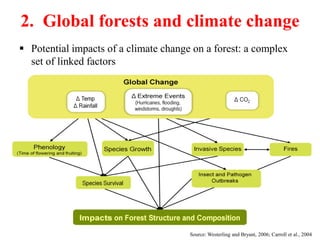
Potential impacts of a climate change on a forest: a complex
set of linked factors
Source: Westerling and Bryant, 2006; Carroll et al., 2004
6.
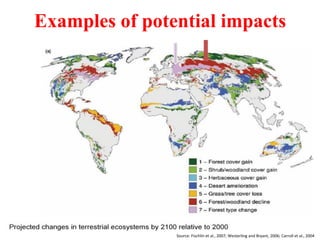
Examples of potentialimpacts
Source: Fischlin et al., 2007; Westerling and Bryant, 2006; Carroll et al., 2004
7.
3. Forest ecosystemservices and
climate change
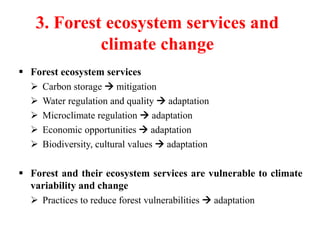
Forest ecosystem services
Carbon storage mitigation
Water regulation and quality adaptation
Microclimate regulation adaptation
Economic opportunities adaptation
Biodiversity, cultural values adaptation
Forest and their ecosystem services are vulnerable to climate
variability and change
Practices to reduce forest vulnerabilities adaptation
8.
4. Forests andmitigation: Storing
carbon on land
I. Forests and carbon at the global scale
II. Forests and carbon at the ecosystem scale
III. Forests activities that mitigate climate change
9.
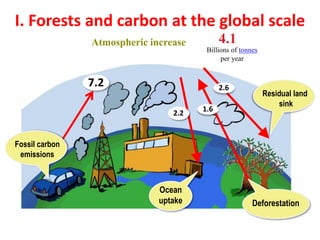
I. Forests andcarbon at the global scale
Atmospheric increase 4.1
Billions of tonnes
per year
Fossil carbon
emissions
Ocean
uptake Deforestation
Residual land
sink
7.2 2.6
2.2
1.6
10.
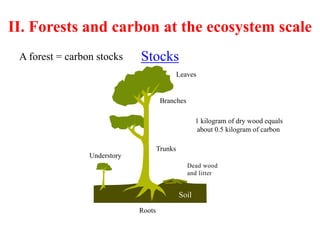
II. Forests andcarbon at the ecosystem scale
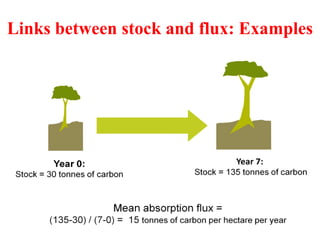
A forest = carbon stocks
Leaves
Branches
Dead wood
and litter
Soil
Roots
Trunks
Understory
1 kilogram of dry wood equals
about 0.5 kilogram of carbon
Stocks
11.
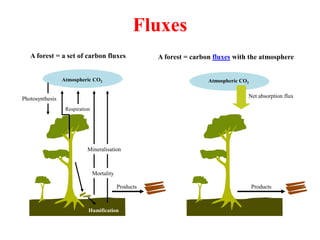
Fluxes
Atmospheric CO2
Net absorptionflux
A forest = carbon fluxes with the atmosphere
Products
A forest = a set of carbon fluxes
Atmospheric CO2
Products
Photosynthesis
Respiration
Mortality
Mineralisation
Humification
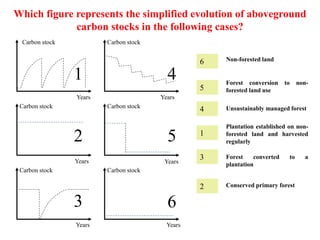
Which figure representsthe simplified evolution of aboveground
carbon stocks in the following cases?
Years
Carbon stock
Years
Carbon stock
Years
Carbon stock
Years
Carbon stock
Years
Carbon stock
Years
Carbon stock
1
2
3
4
5
6
Non-forested land
Forest conversion to non-
forested land use
Unsustainably managed forest
Plantation established on non-
forested land and harvested
regularly
Forest converted to a
plantation
Conserved primary forest
6
5
4
1
3
2
15.
Comparing scenarios
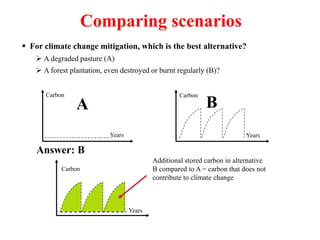
Forclimate change mitigation, which is the best alternative?
A degraded pasture (A)
A forest plantation, even destroyed or burnt regularly (B)?
Years
Carbon
A
Years
Carbon
B
Answer: B
Additional stored carbon in alternative
B compared to A = carbon that does not
contribute to climate change
Years
Carbon
16.
Years
Carbon
A
Years
Carbon
B
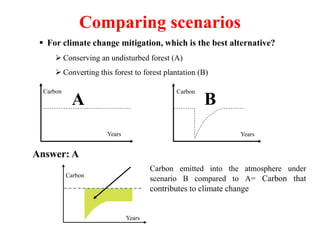
For climatechange mitigation, which is the best alternative?
Conserving an undisturbed forest (A)
Converting this forest to forest plantation (B)
Carbon emitted into the atmosphere under
scenario B compared to A= Carbon that
contributes to climate change
Answer: A
Years
Carbon
Comparing scenarios
17.
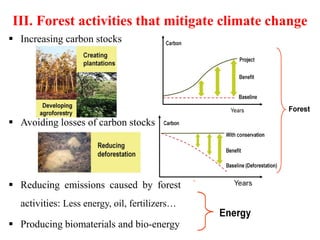
III. Forest activitiesthat mitigate climate change
Increasing carbon stocks
Avoiding losses of carbon stocks
Reducing emissions caused by forest
activities: Less energy, oil, fertilizers…
Producing biomaterials and bio-energy
5. Forests andadaptation: Supportive
ecosystem services
I. Mitigation vs Adaptation
II. Why is adaptation?
III. The adaptive capacity of ecosystems
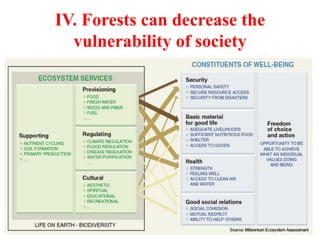
IV. Forests for adaptation of society
20.
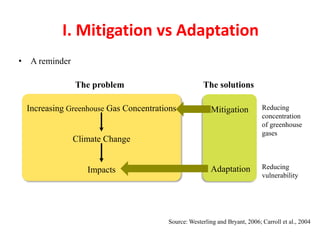
I. Mitigation vsAdaptation
• A reminder
The problem
Increasing Greenhouse Gas Concentrations
Climate Change
Impacts
Reducing
concentration
of greenhouse
gases
Reducing
vulnerability
The solutions
Mitigation
Adaptation
Source: Westerling and Bryant, 2006; Carroll et al., 2004
21.
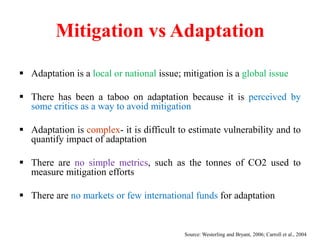
Mitigation vs Adaptation
Adaptation is a local or national issue; mitigation is a global issue
There has been a taboo on adaptation because it is perceived by
some critics as a way to avoid mitigation
Adaptation is complex- it is difficult to estimate vulnerability and to
quantify impact of adaptation
There are no simple metrics, such as the tonnes of CO2 used to
measure mitigation efforts
There are no markets or few international funds for adaptation
Source: Westerling and Bryant, 2006; Carroll et al., 2004
22.
II. Why isadaptation important?
Mitigation measures alone are insufficient
Even with an immediate end to emissions of
green house gases, climate change will occur
Climate change will continue to occur because
of the inertia of the climate system
Source: Westerling and Bryant, 2006; Carroll et al., 2004
23.
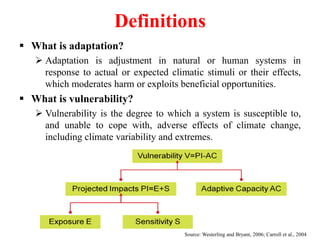
Definitions
What isadaptation?
Adaptation is adjustment in natural or human systems in
response to actual or expected climatic stimuli or their effects,
which moderates harm or exploits beneficial opportunities.
What is vulnerability?
Vulnerability is the degree to which a system is susceptible to,
and unable to cope with, adverse effects of climate change,
including climate variability and extremes.
Source: Westerling and Bryant, 2006; Carroll et al., 2004
24.
III. The adaptivecapacity of
ecosystems
The adaptive capacity of ecosystems
depends on:
Biodiversity
More biodiversity=more potential for species
to occupy new environmental niches
More biodiversity=more organism with
phenotypic plasticity
Migration capacity
Limited by plant life cycle duration, seed
dispersal ability and landscape connectivity
Source: Westerling and Bryant, 2006; Carroll et al., 2004
25.
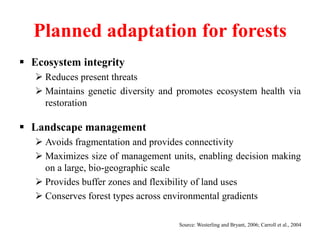
Planned adaptation forforests
Ecosystem integrity
Reduces present threats
Maintains genetic diversity and promotes ecosystem health via
restoration
Landscape management
Avoids fragmentation and provides connectivity
Maximizes size of management units, enabling decision making
on a large, bio-geographic scale
Provides buffer zones and flexibility of land uses
Conserves forest types across environmental gradients
Source: Westerling and Bryant, 2006; Carroll et al., 2004
26.
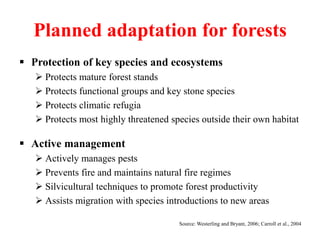
Planned adaptation forforests
Protection of key species and ecosystems
Protects mature forest stands
Protects functional groups and key stone species
Protects climatic refugia
Protects most highly threatened species outside their own habitat
Active management
Actively manages pests
Prevents fire and maintains natural fire regimes
Silvicultural techniques to promote forest productivity
Assists migration with species introductions to new areas
Source: Westerling and Bryant, 2006; Carroll et al., 2004
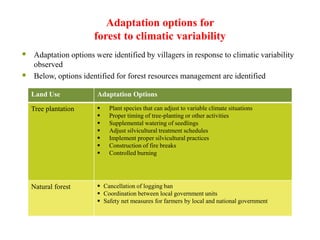
Adaptation options for
forestto climatic variability
Land Use Adaptation Options
Tree plantation Plant species that can adjust to variable climate situations
Proper timing of tree-planting or other activities
Supplemental watering of seedlings
Adjust silvicultural treatment schedules
Implement proper silvicultural practices
Construction of fire breaks
Controlled burning
Natural forest Cancellation of logging ban
Coordination between local government units
Safety net measures for farmers by local and national government
Adaptation options were identified by villagers in response to climatic variability
observed
Below, options identified for forest resources management are identified
29.
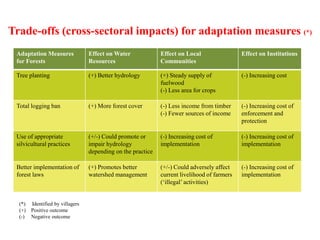
Trade-offs (cross-sectoral impacts)for adaptation measures (*)
Adaptation Measures
for Forests
Effect on Water
Resources
Effect on Local
Communities
Effect on Institutions
Tree planting (+) Better hydrology (+) Steady supply of
fuelwood
(-) Less area for crops
(-) Increasing cost
Total logging ban (+) More forest cover (-) Less income from timber
(-) Fewer sources of income
(-) Increasing cost of
enforcement and
protection
Use of appropriate
silvicultural practices
(+/-) Could promote or
impair hydrology
depending on the practice
(-) Increasing cost of
implementation
(-) Increasing cost of
implementation
Better implementation of
forest laws
(+) Promotes better
watershed management
(+/-) Could adversely affect
current livelihood of farmers
(‘illegal’activities)
(-) Increasing cost of
implementation
(*) Identified by villagers
(+) Positive outcome
(-) Negative outcome
30.
Conclusion
Climate changeoccurs when long-term weather patterns are altered, caused
by trapping excess carbon in Earth’s atmosphere.
The potential impacts of climate change on forests results from a complex
set of linked factors and is generally accepted as a major determinant of
forest ecosystems structure and productivity.
Forested landscapes provide a variety of ecosystem services which can
either be enhanced and protected by management or can be degraded.
Many forest activities can contribute to climate change mitigation which
includes carbon sequestration in the ecosystem and energy-related
emissions reduction.
Adaptation measures reduce the vulnerability of society and ecosystems. It
includes ecosystem integrity, landscape connectivity, protection of key
species and ecosystems and active management.
31.
References
Mitigation
Brown, S.1997 Estimating biomass and biomass change of tropical forests. A primer. FAO Forestry
Paper no. 137. Rome, IT. 55p.
Brown, S. 1999 Guidelines for Inventorying and Monitoring Carbon Offsets in Forest-Based Projects.
Winrock International. 14p.
Brown, S. 2002a Measuring carbon in forests: current status and future challenges. Environmental
Pollution 116: 363-372. http://www.winrock.org/ecosystems/files/2002ForestCarbon.pdf
Brown, S. 2002b Measuring, monitoring, and verification of carbon benefits for forest-based projects.
Philosophical Transactions of The Royal Society London A 360: 1669-1683.
http://www.winrock.org/ecosystems
Brown, S. and Gaston, G. 1995 Use of Forest Inventories and Geographic Information Systems to
Estimate Biomass Density of Tropical Forests: Application to Tropical Africa.Environmental Monitoring
and Assessment 38: 157-168. http://www.winrock.org/ecosystems
CO2FIX V3.1 Manual. http://www.efi.int/projects/casfor/downloads/co2fix3_1_manual.pdf
IPCC. 2003 Good Practice Guidance for Land Use, Land-use Change and Forestry (GPG LULUCF).
http://www.ipccnggip.iges.or.jp/public/gpglulucf
MacDicken. 1997 A Guide to Monitoring Carbon Storage in Forestry and Agroforestry Projects.
Winrock.
Masera et al. 2003 Modelling carbon sequestration in afforestation, agroforestry and forest management
projects: the CO2FIX V.2 approach. Ecological modelling 164:177-199.
32.
Adaptation
Adger, W.N.,Huq, S., Brown, K., Conway, D. and Hulme, M. 2003 Adaptation to climate change in the
developing world. Prog. Dev. Studies 3(3):179-195.
Burton, I. et al. 2006 Adaptation to climate change: International policy options. Pew Center.
Naess, L.O., Bang, G., Eriksen, S. and Vevatne, J. 2005 Institutional adaptation to climate change: Flood
responses at the municipal level in Norway. Global Environ. Change 15:125-138.
UNDP. 2004 Adaptation policy framework for climate change: Developing strategies, policies and
measures. www.undp.org
UNEP. 1998 Handbook on methods for climate change impact assessment and adaptation strategies.
www.unep.org
USAID. 2007 Adapting to climate change variability and change: A guidance manual for development
planning. www.usaid.gov
33.
Forests for Adaptation
Andreassian, V. 2004 Waters and forests: From historical controversy to scientific debate. Journal of
Hydrology 291:1-27.
Bruijnzeel, L.A. 2004 Hydrological functions of tropical forests: Not seeing the soil for the trees?
Agriculture, Ecosystems and the Environment 104:185-228.
Daily, G.C. (ed.). 1997 Nature’s services: Societal dependence on natural ecosystems. Island Press,
Washington D.C. p. 1-10.
Enderlein, R. and Bernardini, F. 2005 Nature for water: Ecosystem services and water management. Natural
Resources Forum 29:253-255.
IISD. 2004 Livelihoods and climate change: Combining disaster risk reduction, natural resource
management and climate change adaptation in a new approach to the reduction of vulnerability and poverty.
International Institute for Sustainable Development (IISD), Winnipeg, Manitoba, Canada. 24p.
Innes. 2006 Importance of climate change when considering forests in poverty alleviation. Intern. Forestry
Review 8(4).
MEA (Millennium Ecosystem Assessment). 2005 Ecosystems and human well-being: Synthesis. Island
Press, Washington, DC. 155p.
Metzger. 2006 Vulnerability assessment of environmental change in Europe. Reg. Environ. Change 6:201-
216.
Postel, S. and Thompson, B.H. 2005 Watershed protection: Capturing the benefits of nature’s water supply
services. Natural Resources Forum 29(2):98-108.
Pyke. 2007 Land use for climate adaptation. Climatic Change 80:239-251.
34.
Adger, W.N.and Vincent, K. 2005 Uncertainty in adaptive capacity. C. R. Geoscience 337:399-410.
Bazzaz, F. 1998 Tropical forests in a future climate: Changes in biological diversity and impact on the global carbon cycle. Climatic
Change 39(2-3):317-336.
Biringer, J.L. 2003 Forest ecosystems threatened by climate change: promoting long-term forest resilience. In: Hansen, L.J., Biringer, J.L.
and Hoffman, J.R. (eds.) Buying time – a user´s manual for building resistance and resilience to climate change in natural systems. WWF,
Gland, Switzerland. p. 43-72.
Biringer, J. 2004 Forest ecosystems threatened by climate change: Promoting long-term forest resilience. In: Hansen, L.J., Biringer, J.L.
and Hoffmann, J.R. (eds.) A user's manual for building resistance and resilience to climate Change. WWF Climate Change Program,
Berlin. p. 43-71.
Borchert, R. 1998 Responses of tropical trees to rainfall seasonality and its longterm changes. Climatic Change 39:381-393.
Carroll A.L., Taylor, S.W., Régnière, J. and Safranyik, L. 2004 Effects of climate change on range expansion by the mountain pine beetle
in British Columbia. In: Shore, T.L., Brooks, J.E. and Stone, J.E. (eds.) Mountain Pine Beetle Symposium: Challenges and solutions.
Natural Resources Canada, Can. For. Serv., Pacific Forestry Centre, Victoria, B.C., Information Report BC-X-399. p. 223–232.
CBD (Convention on Biological Diversity). 2003 Interlinkages between biological diversity and climate change. Technical Series no. 10.
Montreal, CA.
Dudley, N. 1998 Forests and climate change. A report for WWF International, Forest Innovations, IUCN, GTZ, WWF. Gland,
Switzerland. 19p.
Fearnside, P.M. 1995 Potential impacts of climatic change on natural forests and forestry in Brazilian Amazonia. Forest Ecology and
Management 78(199.5):51-70.
Fischlin, A., Midgley, G.F., Price, J.T., Leemans, R., Gopal, B., Turley, C., Rounsevell, M.D.A., Dube, O.P., Tarazona, J. and Velichko,
A.A. 2007 Ecosystems, their properties, goods, and services. In: Parry, M.L., Canziani, O.F., Palutikof, J.P., van der Linden, P.J. and
Hanson, C.E. (eds.) Climate change 2007: Impacts, adaptation and vulnerability. Contribution of Working Group II to the Fourth
Assessment Report of the Intergovernmental Panel on Climate Change, Cambridge University Press, Cambridge. p. 211-272.
IUCN (World Conservation Union). 2003 Climate change and nature – Adapting for the future. Gland, Switzerland. 6p.
Kirilenko, A., Belotelov, N. and Bogatyrev, B. 2000 Global model of vegetation migration: Incorporation of climatic variability.
Ecological Modelling 132:125-133.
Loreau, M., Mouquet, N. and González, A. 2003 Biodiversity as spatial insurance in heterogeneous landscapes. PNAS 100:12765-127.
Lucht,W., S. Schaphoff, T. Erbrecht, U. Heyder and Cramer, W. 2006 Terrestrial vegetation redistribution and carbon balance under
climate change. Carbon Balance Manage., 1:6 doi:10.1186/1750-0680-1-6.
McCarty, J.P. 2001 Ecological consequences of recent climate change. Conservation Biology 15(2):320-331.
35.
Moss, R.H.,Brenkert, A.L. and Malone, E.L. 2001 Vulnerability to climate change: A quantitative
approach. U.S. Department of Energy, Springfield.
Nepstad, D., Lefebvre, O., da Silva, U.L., Tomasella, J., Schlesinger, P., Solorzano, L., Moutinho, P., Ray,
D. and Guerreira Benito, J. 2004 Amazon drought and its implications for forest flammability and tree
growth: A basin-wide analysis. Global Change Biology 10:704-717.
Noss, R. 2001 Beyond Kyoto: Forest management in a time of rapid climate change. Conservation
Biology 15(3):578-590.
Noss. 2001 Forest management in a time of rapid climate change. Conservation Biology 15(3).
Pearson, R.G. 2006 Climate change and the migration capacity of species. Trends in Ecology and
Evolution 21(3):111-113.
Ravindranath. 2007 Mitigation and adaptation synergy in forest sector. Mitig. Adapt. Strat. Glob. Change.
Robledo, C. and Forner, C. 2005 Adaptation of forest ecosystems and the forest sector to climate change.
Forests and climate change Working Paper no. 2. FAO, Rome. 96p.
Running, S.W. 2006 Is global warming causing more, larger wildfires? Science 313:927-928.
Schaphoff, S., Lucht, W., Gerten, D., Sitch, S., Cramer, W. and Prentice, I.C. 2006 Terrestrial biosphere
carbon storage under alternative climate projections. Climatic Change 74: 97-122.
Scholze. 2006 Climate-change risk analysis for world ecosystems. PNAS 103(35).
Spittlehouse, D.L. 2005 Integrating climate change adaptation into forest management. Forestry Chronicle
81:691-695.
Spittlehouse, D.L. and Stewart, R.B. 2003 Adaptation to climate change in forest management. BC
Journal of Ecosystems and Management 4(1):1-11.
Spittlehouse. 2005 Adaptation to climate change in forest management. BC Journal of Ecosystems and
Management 4(1).
Westerling, A. and Bryant, B. 2005 Climate change and wildfire in and around California: Fire modeling
and loss modeling. California Climate Change Center, California.