Climate Change
Definition of Climate Change
• “ It is a change which is attributed directly or
indirectly to human activity that alters the
composition of the global atmosphere and
which is in addition to natural climate
variability observed over comparative time
periods”
Major Causes of Climate
Change
Natural Causes
• the arctic tundra and wetlands
release methane, a greenhouse gas
• Earth naturally has a cycle of
climate change that occurs every
40, 000 years
• the sun’s solar energy output is
changing and naturally increases
Earth’s average temperature by
about 1ºC every century
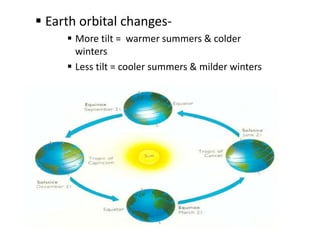
• Earth’s orbit and tilt alter in relation
to the sun, which changes solar
energy output
Human Causes
• Increasing green house gas
emissions from burning fossil fuels-
oil, coal, gas
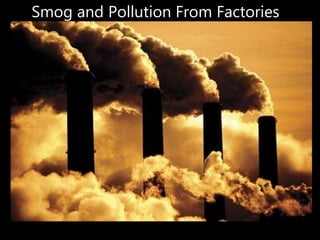
• Pollution, smog from factories
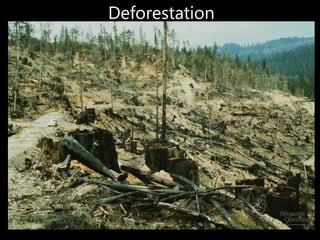
• Large forests have been cut down
(trees absorb CO2 and pollution,
deforestation creates about 6 billion
tons of CO2 per year)
• Increasing world population-more
people requires more food, energy,
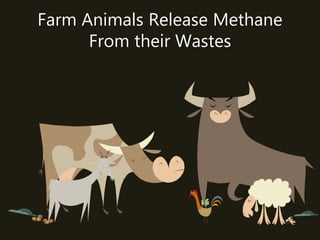
transportation, etc. Farms animals
release methane from their wastes.
• More people also means more CO2
production from respiration and less
trees to make room for human
population
Causes of Climate Change
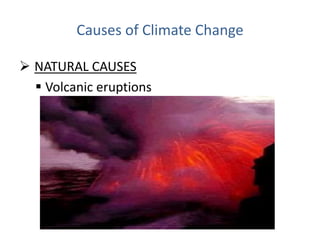
 NATURAL CAUSES
 Volcanic eruptions
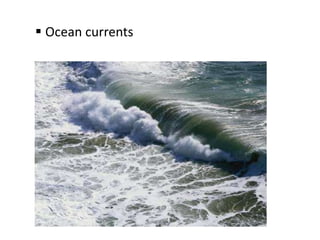
 Ocean currents
 Earth orbital changes-
 More tilt = warmer summers & colder
winters
 Less tilt = cooler summers & milder winters
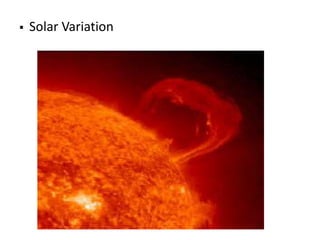
 Solar Variation
HUMAN CAUSES (Anthropogenic or Man-
made causes)
 Greenhouse gases
 Deforestation
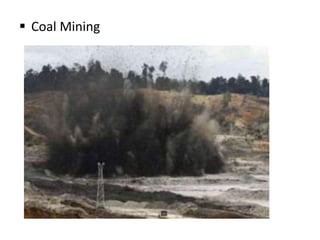
 Coal mining
 Burning of fossil fuels
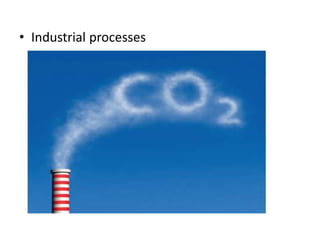
 Industrial processes
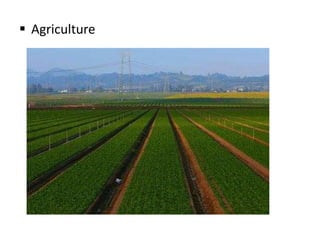
 Agriculture
•Water vapor
•Carbon dioxide
•Methane
•Nitrous oxide
A number of greenhouse gases
occur naturally in the Earth’s
atmosphere
Deforestation
 Coal Mining
Smog and Pollution From Factories
• Industrial processes
 Agriculture
Farm Animals Release Methane
From their Wastes
Some Effects of Climate Change
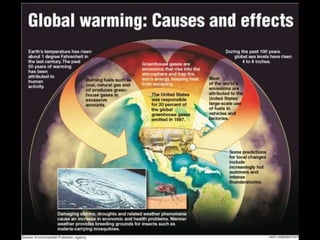
• An average increase in Earth’s temperature during the last century
• Melting of polar ice—polar bears and other animals are drowning
• Migrating birds are forced to change their time and place of migration
• Melting of glaciers will lead to higher sea level, which will cause floods and
put many low-elevation regions at risk of disappearing under water
• Longer summers can disrupt animal habitation
• New and widespread diseases because of warm climate
• Damaged crops due to sudden climate change and floods
• Average precipitation increase around the world
• Droughts, heat waves, extreme winters and storms, hurricanes, typhoons
• More wildfires
Effects of Climate Change
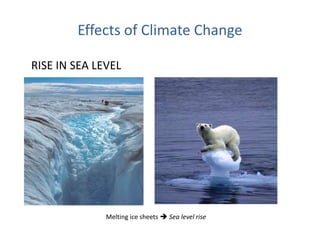
RISE IN SEA LEVEL
Melting ice sheets  Sea level rise
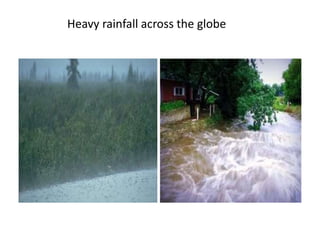
Heavy rainfall across the globe
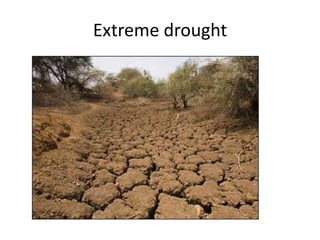
Extreme drought
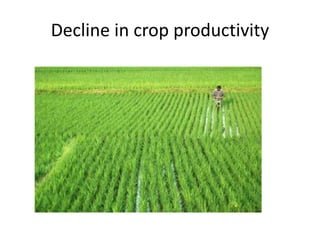
Decline in crop productivity
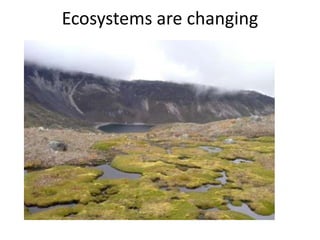
Ecosystems are changing
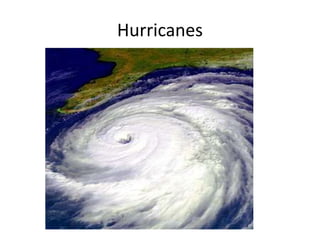
Hurricanes
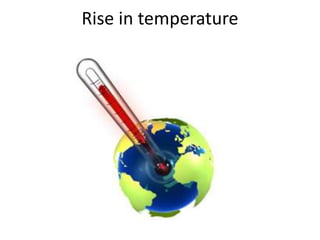
Rise in temperature
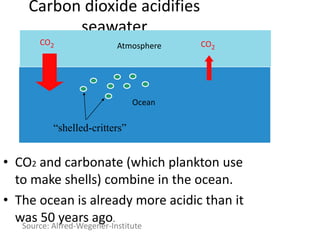
Carbon dioxide acidifies
seawater
• CO2 and carbonate (which plankton use
to make shells) combine in the ocean.
• The ocean is already more acidic than it
was 50 years ago.
Source: Alfred-Wegener-Institute
CO2 CO2
Ocean
Atmosphere
“shelled-critters”
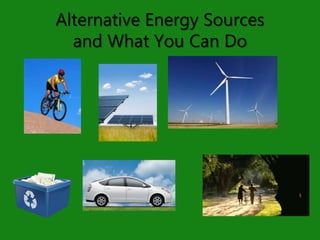
Alternative Energy Sources
and What You Can Do
Help Save Earth
Works Cited
• http://www.edugreen.teri.res.in/EXPLORE/climate/causes.htm
• http://www.direct.gov.uk/en/Environmentandgreenerliving/Thewider
environment/Climatechange/DG_072920
• http://library.thinkquest.org/J003411/causes.htm
• http://www.tropical-rainforest-animals.com/Global-Warming-
Causes.html
• http://www.globalwarming.org.in/global-warming-facts.php
• http://environment.nationalgeographic.com/environment/global-
warming/gw-effects.html
• http://www.effectofglobalwarming.com/images/What-is-global-
warming-img.jpg
• http://www.hickerphoto.com/global-warming-pictures-photos.htm
• http://support.nature.org/site/PageServer?pagename=contest_ph6

climate-change-pres231865830900896-3.ppt

  • 1.
  • 2.
    Definition of ClimateChange • “ It is a change which is attributed directly or indirectly to human activity that alters the composition of the global atmosphere and which is in addition to natural climate variability observed over comparative time periods”
  • 3.
    Major Causes ofClimate Change Natural Causes • the arctic tundra and wetlands release methane, a greenhouse gas • Earth naturally has a cycle of climate change that occurs every 40, 000 years • the sun’s solar energy output is changing and naturally increases Earth’s average temperature by about 1ºC every century • Earth’s orbit and tilt alter in relation to the sun, which changes solar energy output Human Causes • Increasing green house gas emissions from burning fossil fuels- oil, coal, gas • Pollution, smog from factories • Large forests have been cut down (trees absorb CO2 and pollution, deforestation creates about 6 billion tons of CO2 per year) • Increasing world population-more people requires more food, energy, transportation, etc. Farms animals release methane from their wastes. • More people also means more CO2 production from respiration and less trees to make room for human population
  • 4.
    Causes of ClimateChange  NATURAL CAUSES  Volcanic eruptions
  • 5.
  • 6.
     Earth orbitalchanges-  More tilt = warmer summers & colder winters  Less tilt = cooler summers & milder winters
  • 7.
  • 8.
    HUMAN CAUSES (Anthropogenicor Man- made causes)  Greenhouse gases  Deforestation  Coal mining  Burning of fossil fuels  Industrial processes  Agriculture
  • 9.
    •Water vapor •Carbon dioxide •Methane •Nitrousoxide A number of greenhouse gases occur naturally in the Earth’s atmosphere
  • 10.
  • 11.
  • 12.
    Smog and PollutionFrom Factories
  • 13.
  • 14.
  • 15.
    Farm Animals ReleaseMethane From their Wastes
  • 16.
    Some Effects ofClimate Change • An average increase in Earth’s temperature during the last century • Melting of polar ice—polar bears and other animals are drowning • Migrating birds are forced to change their time and place of migration • Melting of glaciers will lead to higher sea level, which will cause floods and put many low-elevation regions at risk of disappearing under water • Longer summers can disrupt animal habitation • New and widespread diseases because of warm climate • Damaged crops due to sudden climate change and floods • Average precipitation increase around the world • Droughts, heat waves, extreme winters and storms, hurricanes, typhoons • More wildfires
  • 17.
    Effects of ClimateChange RISE IN SEA LEVEL Melting ice sheets  Sea level rise
  • 18.
  • 19.
  • 20.
    Decline in cropproductivity
  • 21.
  • 22.
  • 23.
  • 24.
    Carbon dioxide acidifies seawater •CO2 and carbonate (which plankton use to make shells) combine in the ocean. • The ocean is already more acidic than it was 50 years ago. Source: Alfred-Wegener-Institute CO2 CO2 Ocean Atmosphere “shelled-critters”
  • 26.
  • 27.
  • 28.
    Works Cited • http://www.edugreen.teri.res.in/EXPLORE/climate/causes.htm •http://www.direct.gov.uk/en/Environmentandgreenerliving/Thewider environment/Climatechange/DG_072920 • http://library.thinkquest.org/J003411/causes.htm • http://www.tropical-rainforest-animals.com/Global-Warming- Causes.html • http://www.globalwarming.org.in/global-warming-facts.php • http://environment.nationalgeographic.com/environment/global- warming/gw-effects.html • http://www.effectofglobalwarming.com/images/What-is-global- warming-img.jpg • http://www.hickerphoto.com/global-warming-pictures-photos.htm • http://support.nature.org/site/PageServer?pagename=contest_ph6

Editor's Notes