What is climate?
•Climate is the average weather conditions
over a long period of time
– Includes average temperatures and
precipitation, wind patterns, humidity,
air pressure
• Weather is what it is NOW, climate is what
it SHOULD BE.
3.
How is thisdifferent from
“weather”?
• Weather changes day to day.
• Weather can fall inside normal ranges or
outside of what is expected from the
climate- “above or below average”
• Climate is the benchmark; what we expect
4.
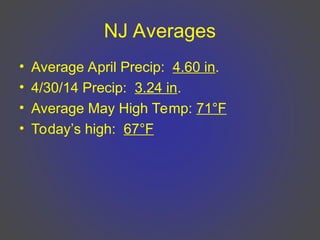
NJ Averages
• AverageApril Precip: 4.60 in.
• 4/30/14 Precip: 3.24 in.
• Average May High Temp: 71°F
• Today’s high: 67°F
5.
Climate Factors
Temperature Factors(LADBWOC!)
•Latitude
•Altitude
•Distance to a Body of Water
•Ocean Currents
Precipitation Factors (TP)
•Topography
•Prevailing Winds
6.
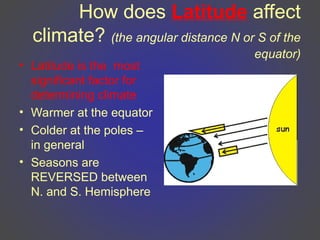
How does Latitudeaffect
climate? (the angular distance N or S of the
equator)
• Latitude is the most
significant factor for
determining climate
• Warmer at the equator
• Colder at the poles –
in general
• Seasons are
REVERSED between
N. and S. Hemisphere
7.
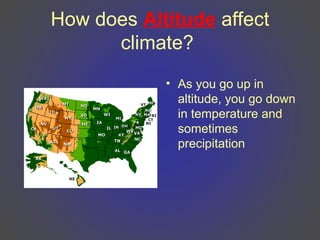
How does Altitudeaffect
climate?
• As you go up in
altitude, you go down
in temperature and
sometimes
precipitation
8.
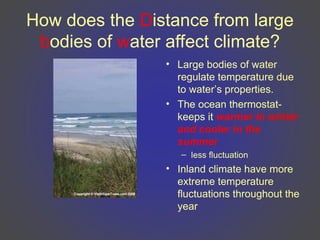
How does theDistance from large
bodies of water affect climate?
• Large bodies of water
regulate temperature due
to water’s properties.
• The ocean thermostat-
keeps it warmer in winter
and cooler in the
summer
– less fluctuation
• Inland climate have more
extreme temperature
fluctuations throughout the
year
9.
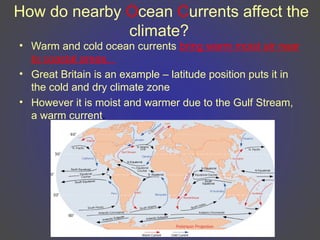
How do nearbyOcean Currents affect the
climate?
• Warm and cold ocean currents bring warm moist air near
to coastal areas.
• Great Britain is an example – latitude position puts it in
the cold and dry climate zone
• However it is moist and warmer due to the Gulf Stream,
a warm current.
10.
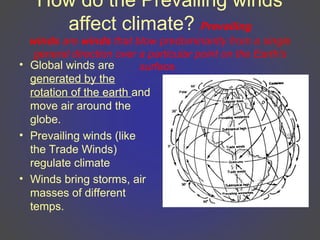
How do thePrevailing winds
affect climate? Prevailing
winds are winds that blow predominantly from a single
general direction over a particular point on the Earth's
surface.
• Global winds are
generated by the
rotation of the earth and
move air around the
globe.
• Prevailing winds (like
the Trade Winds)
regulate climate
• Winds bring storms, air
masses of different
temps.
11.
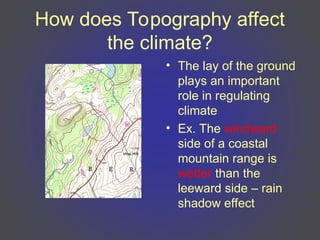
How does Topographyaffect
the climate?
• The lay of the ground
plays an important
role in regulating
climate
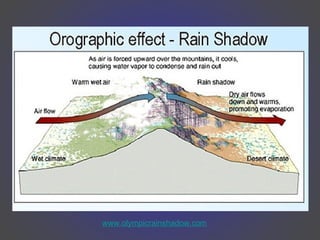
• Ex. The windward
side of a coastal
mountain range is
wetter than the
leeward side – rain
shadow effect
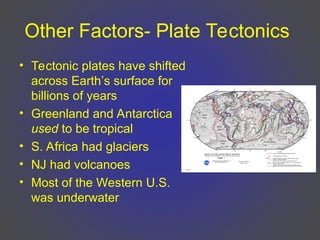
Other Factors- PlateTectonics
• Tectonic plates have shifted
across Earth’s surface for
billions of years
• Greenland and Antarctica
used to be tropical
• S. Africa had glaciers
• NJ had volcanoes
• Most of the Western U.S.
was underwater
14.
Other Factors- VolcanicEruptions
• Volcanoes can warm AND cool the planet
• Volcanoes emit CO2 which is a
greenhouse gas global warming
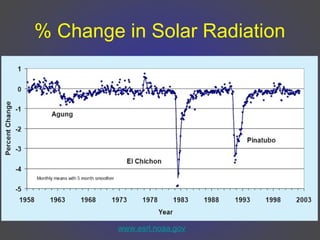
• But volcanoes also emit SO2 and aerosols
(tiny solid particles) that REFLECT
sunlight back into space
– Less radiation reaches Earth COOLING
Ice Ages
• Earthnaturally fluctuates between ice
ages and interglacial periods
• ICE AGE- an era of cooler than normal
global temperatures
• INTERGLACIAL PERIOD- era of warmer
than normal temps.
• Scientists claim the next ice age is 50,000
years away
17.
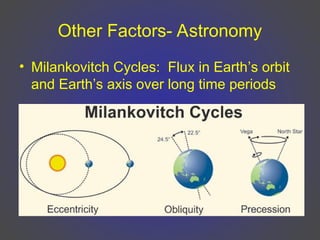
Other Factors- Astronomy
•Milankovitch Cycles: Flux in Earth’s orbit
and Earth’s axis over long time periods
18.
What We Know-Facts
• Earth’s climate HAS changed many times
over time naturally
• Our climate IS changing right NOW, but
it’s different than ever documented before
– WHY????
• Humans adding GHGs has warmed the
planet in the past 200 yrs This is FACT
19.
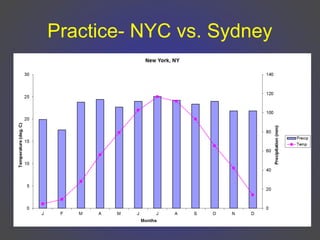
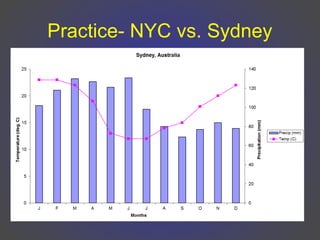
Looking at Climatograms
•Your group will get “pairs” of cities to compare
climates
• Write down a list of observations from each graph
for each city: highest temp, highest precip.,
trends, patterns, etc.
• Determine which climate factor is affecting the
climates of these cities and provide at least 1
piece of factual evidence to support your claim.
• You can use Google maps to help locate
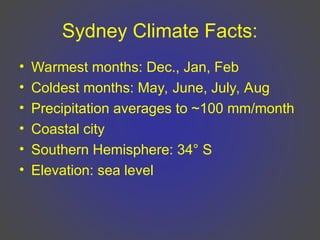
Sydney Climate Facts:
•Warmest months: Dec., Jan, Feb
• Coldest months: May, June, July, Aug
• Precipitation averages to ~100 mm/month
• Coastal city
• Southern Hemisphere: 34° S
• Elevation: sea level
24.
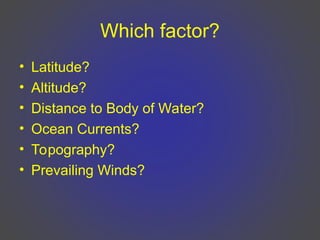
Which factor?
• Latitude?
•Altitude?
• Distance to Body of Water?
• Ocean Currents?
• Topography?
• Prevailing Winds?
25.
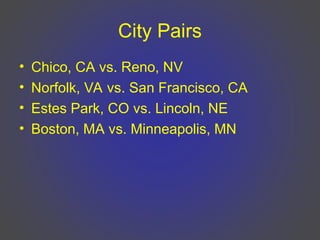
City Pairs
• Chico,CA vs. Reno, NV
• Norfolk, VA vs. San Francisco, CA
• Estes Park, CO vs. Lincoln, NE
• Boston, MA vs. Minneapolis, MN