CLIL in Spain: Willing to give communication,
motivation and cognitive skills a boost
Brief view of CLIL implementation in the Canary Islands
AICLE en España: Buscando dar un impulso a la
comunicación, la motivación y las destrezas
cognitivas
21th Century LANGUAGE
LEARNING PRIORITY:
COMMUNICATION rather than
accuracy and grammar
CLIL implementation process
* 1995:
One of the first UE legislative references on CLIL cooperation is the Council
Resolution of 1995 which refers to the promotion of new innovative methods
and in particular teaching no linguistic subjects using a foreign language to
facilitate a bilingual education. (Eurydice: 2006).
White book of the Commission (1995): <<Secondary Schools should consider
teaching contents through the first foreign language, as it has been done at
the European Schools where the children of the UE workers are educated”.
* 1995-2012:
From 1995 European Programs and National Policies on Education have
increasingly implemented CLIL in the educational systems (Eurydice 2012).
* 2003:
UE Commission establish a plan to promote language learning and linguistic
diversity: measures to support national, regional and local authorities actions.
* 2004: The Bureau of Education of the Canary Islands Government set new
actions to promote foreign languages learning (mainly English) according to the
EU plan.
CLIL implementation process
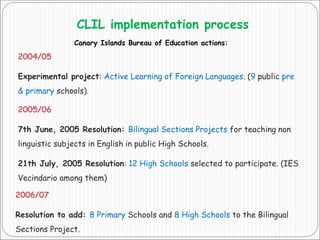
Canary Islands Bureau of Education actions:
2004/05
Experimental project: Active Learning of Foreign Languages. (9 public pre
& primary schools).
2005/06
7th June, 2005 Resolution: Bilingual Sections Projects for teaching non
linguistic subjects in English in public High Schools.
21th July, 2005 Resolution: 12 High Schools selected to participate. (IES
Vecindario among them)
2006/07
Resolution to add: 8 Primary Schools and 8 High Schools to the Bilingual
Sections Project.
CLIL implementation process
Canary Islands Bureau of Education actions:
2007/08
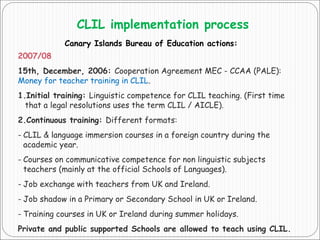
15th, December, 2006: Cooperation Agreement MEC - CCAA (PALE):
Money for teacher training in CLIL.
1.Initial training: Linguistic competence for CLIL teaching. (First time
that a legal resolutions uses the term CLIL / AICLE).
2.Continuous training: Different formats:
- CLIL & language immersion courses in a foreign country during the
academic year.
- Courses on communicative competence for non linguistic subjects
teachers (mainly at the official Schools of Languages).
- Job exchange with teachers from UK and Ireland.
- Job shadow in a Primary or Secondary School in UK or Ireland.
- Training courses in UK or Ireland during summer holidays.
Private and public supported Schools are allowed to teach using CLIL.
CLIL implementation process
Canary Islands Bureau of Education actions:
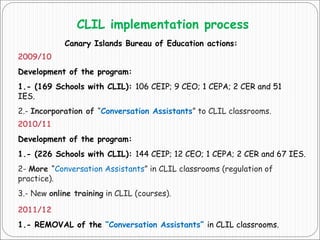
2009/10
Development of the program:
1.- (169 Schools with CLIL): 106 CEIP; 9 CEO; 1 CEPA; 2 CER and 51
IES.
2.- Incorporation of “Conversation Assistants” to CLIL classrooms.
2010/11
Development of the program:
1.- (226 Schools with CLIL): 144 CEIP; 12 CEO; 1 CEPA; 2 CER and 67 IES.
2- More “Conversation Assistants” in CLIL classrooms (regulation of
practice).
3.- New online training in CLIL (courses).
2011/12
1.- REMOVAL of the “Conversation Assistants” in CLIL classrooms.
CLIL implementation process
Canary Islands Bureau of Education actions:
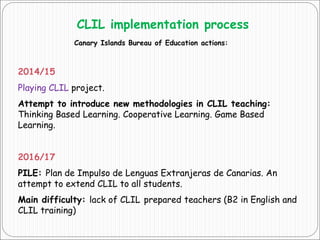
2014/15
Playing CLIL project.
Attempt to introduce new methodologies in CLIL teaching:
Thinking Based Learning. Cooperative Learning. Game Based
Learning.
2016/17
PILE: Plan de Impulso de Lenguas Extranjeras de Canarias. An
attempt to extend CLIL to all students.
Main difficulty: lack of CLIL prepared teachers (B2 in English and
CLIL training)
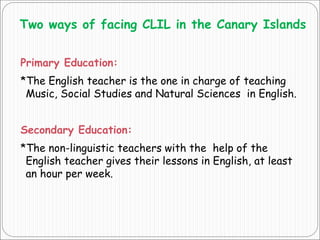
Two ways of facing CLIL in the Canary Islands
Primary Education:
*The English teacher is the one in charge of teaching
Music, Social Studies and Natural Sciences in English.
Secondary Education:
*The non-linguistic teachers with the help of the
English teacher gives their lessons in English, at least
an hour per week.
The beginning of CLIL in the Canary Islands
2005/06 Secondary Education
Teaching practice:
*Target students: 2º ESO (2nd Secondary year = low level in English)
*Traditional teaching: Use of Spanish text book together with some self-
designed activities.
*CLIL strategy: Explain and introduce contents in L1 (Spanish) using the
text book and design some worksheets in English to review and
consolidate knowledge in L2 (English), or sometimes to introduce specific
vocabulary in English.
Main concerns of teachers & families:
• Not to leave subject contents behind due to the use of L2.
• Should we consider L2 when setting student´s marks?
• Is going the use of L2 to affect somewhow student´s learning and
succeed in subjects?
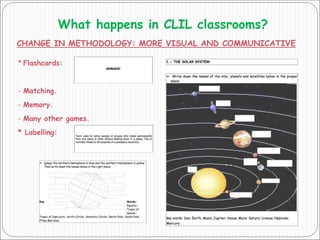
What happens in CLIL classrooms?
CHANGE IN METHODOLOGY: MORE VISUAL AND COMMUNICATIVE
* Flashcards:
- Matching.
- Memory.
- Many other games.
* Labelling:
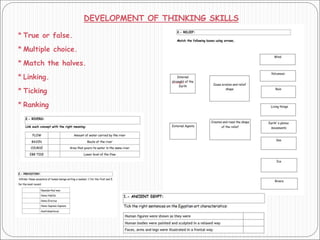
DEVELOPMENT OF THINKING SKILLS
* True or false.
* Multiple choice.
* Match the halves.
* Linking.
* Ticking
* Ranking
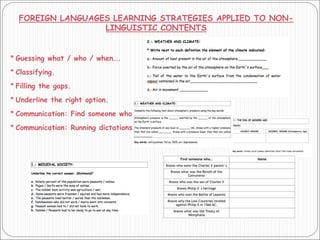
FOREIGN LANGUAGES LEARNING STRATEGIES APPLIED TO NON-
LINGUISTIC CONTENTS
* Guessing what / who / when….
* Classifying.
* Filling the gaps.
* Underline the right option.
* Communication: Find someone who…
* Communication: Running dictations…
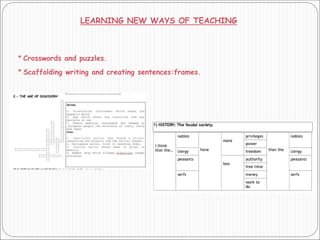
LEARNING NEW WAYS OF TEACHING
* Crosswords and puzzles.
* Scaffolding writing and creating sentences:frames.
CLIL
Communication
Content Cognition
CLIL 4c (Coyle)
Teaching & Learning through a foreign language
Culture
??
Without forgetting the CLIL proposals
What are the main obstacles to improvement?
Tradicional teaching strategy: Book focused & individual learning
(communication is not a must of the teaching-learning process)
Some group activities fostered communication, but… was it
enough?
What about students motivation when most of the tasks were
worksheet centered?
How to develop cognition skills? Any planned strategy?
How can we foster?…
1.- COMMUNICATION In L2 (English)
3.- MOTIVATION
2.- COGNITIVE SKILLS
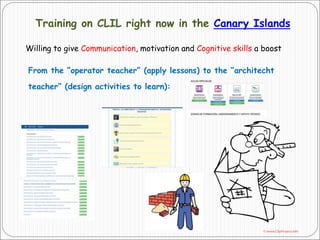
Training in “New Methodologies”
From the “operator teacher” (apply lessons) to the “architecht
teacher” (design activities to learn):
* Multiple intelligences theory
* Thinking Based Learning
* Game Based Learning
* Cooperative Learning
* Project Based Learning
* Problem Based Learning
* ITC (Information and Communications Technologies) in education
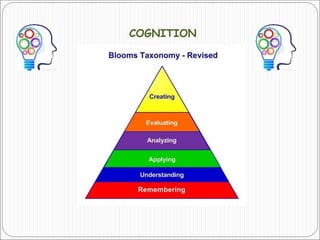
COGNITION
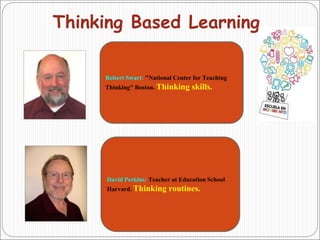
Thinking Based Learning
Robert Swart: "National Center for Teaching
Thinking" Boston. Thinking skills.
David Perkins: Teacher at Education School
Harvard. Thinking routines.
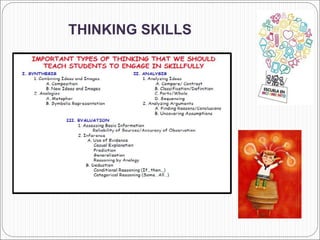
THINKING SKILLS
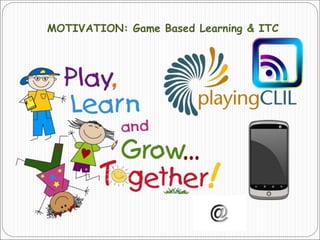
MOTIVATION: Game Based Learning & ITC
COMMUNICATION: Cooperative learning & ITC
AICLE
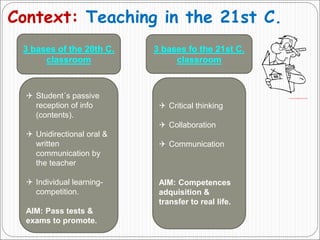
Context: Teaching in the 21st C.
3 bases of the 20th C.
classroom
3 bases fo the 21st C.
classroom
 Student´s passive
reception of info
(contents).
 Unidirectional oral &
written
communication by
the teacher
 Individual learning-
competition.
AIM: Pass tests &
exams to promote.
 Critical thinking
 Collaboration
 Communication
AIM: Competences
adquisition &
transfer to real life.
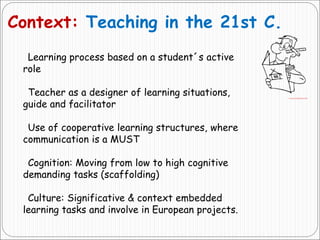
Context: Teaching in the 21st C.
Learning process based on a student´s active
role
Teacher as a designer of learning situations,
guide and facilitator
Use of cooperative learning structures, where
communication is a MUST
Cognition: Moving from low to high cognitive
demanding tasks (scaffolding)
Culture: Significative & context embedded
learning tasks and involve in European projects.
Training on CLIL right now in the Canary Islands
From the “operator teacher” (apply lessons) to the “architecht
teacher” (design activities to learn):
Willing to give Communication, motivation and Cognitive skills a boost
¡¡¡MUCHAS GRACIAS POR TU ATENCIÓN!!!
THANK YOU VERY MUCH!!!

CLIL Canarias

  • 1.
    CLIL in Spain:Willing to give communication, motivation and cognitive skills a boost Brief view of CLIL implementation in the Canary Islands AICLE en España: Buscando dar un impulso a la comunicación, la motivación y las destrezas cognitivas
  • 2.
    21th Century LANGUAGE LEARNINGPRIORITY: COMMUNICATION rather than accuracy and grammar
  • 3.
    CLIL implementation process *1995: One of the first UE legislative references on CLIL cooperation is the Council Resolution of 1995 which refers to the promotion of new innovative methods and in particular teaching no linguistic subjects using a foreign language to facilitate a bilingual education. (Eurydice: 2006). White book of the Commission (1995): <<Secondary Schools should consider teaching contents through the first foreign language, as it has been done at the European Schools where the children of the UE workers are educated”. * 1995-2012: From 1995 European Programs and National Policies on Education have increasingly implemented CLIL in the educational systems (Eurydice 2012). * 2003: UE Commission establish a plan to promote language learning and linguistic diversity: measures to support national, regional and local authorities actions. * 2004: The Bureau of Education of the Canary Islands Government set new actions to promote foreign languages learning (mainly English) according to the EU plan.
  • 4.
    CLIL implementation process CanaryIslands Bureau of Education actions: 2004/05 Experimental project: Active Learning of Foreign Languages. (9 public pre & primary schools). 2005/06 7th June, 2005 Resolution: Bilingual Sections Projects for teaching non linguistic subjects in English in public High Schools. 21th July, 2005 Resolution: 12 High Schools selected to participate. (IES Vecindario among them) 2006/07 Resolution to add: 8 Primary Schools and 8 High Schools to the Bilingual Sections Project.
  • 5.
    CLIL implementation process CanaryIslands Bureau of Education actions: 2007/08 15th, December, 2006: Cooperation Agreement MEC - CCAA (PALE): Money for teacher training in CLIL. 1.Initial training: Linguistic competence for CLIL teaching. (First time that a legal resolutions uses the term CLIL / AICLE). 2.Continuous training: Different formats: - CLIL & language immersion courses in a foreign country during the academic year. - Courses on communicative competence for non linguistic subjects teachers (mainly at the official Schools of Languages). - Job exchange with teachers from UK and Ireland. - Job shadow in a Primary or Secondary School in UK or Ireland. - Training courses in UK or Ireland during summer holidays. Private and public supported Schools are allowed to teach using CLIL.
  • 6.
    CLIL implementation process CanaryIslands Bureau of Education actions: 2009/10 Development of the program: 1.- (169 Schools with CLIL): 106 CEIP; 9 CEO; 1 CEPA; 2 CER and 51 IES. 2.- Incorporation of “Conversation Assistants” to CLIL classrooms. 2010/11 Development of the program: 1.- (226 Schools with CLIL): 144 CEIP; 12 CEO; 1 CEPA; 2 CER and 67 IES. 2- More “Conversation Assistants” in CLIL classrooms (regulation of practice). 3.- New online training in CLIL (courses). 2011/12 1.- REMOVAL of the “Conversation Assistants” in CLIL classrooms.
  • 7.
    CLIL implementation process CanaryIslands Bureau of Education actions: 2014/15 Playing CLIL project. Attempt to introduce new methodologies in CLIL teaching: Thinking Based Learning. Cooperative Learning. Game Based Learning. 2016/17 PILE: Plan de Impulso de Lenguas Extranjeras de Canarias. An attempt to extend CLIL to all students. Main difficulty: lack of CLIL prepared teachers (B2 in English and CLIL training)
  • 8.
    Two ways offacing CLIL in the Canary Islands Primary Education: *The English teacher is the one in charge of teaching Music, Social Studies and Natural Sciences in English. Secondary Education: *The non-linguistic teachers with the help of the English teacher gives their lessons in English, at least an hour per week.
  • 9.
    The beginning ofCLIL in the Canary Islands 2005/06 Secondary Education Teaching practice: *Target students: 2º ESO (2nd Secondary year = low level in English) *Traditional teaching: Use of Spanish text book together with some self- designed activities. *CLIL strategy: Explain and introduce contents in L1 (Spanish) using the text book and design some worksheets in English to review and consolidate knowledge in L2 (English), or sometimes to introduce specific vocabulary in English. Main concerns of teachers & families: • Not to leave subject contents behind due to the use of L2. • Should we consider L2 when setting student´s marks? • Is going the use of L2 to affect somewhow student´s learning and succeed in subjects?
  • 10.
    What happens inCLIL classrooms? CHANGE IN METHODOLOGY: MORE VISUAL AND COMMUNICATIVE * Flashcards: - Matching. - Memory. - Many other games. * Labelling:
  • 11.
    DEVELOPMENT OF THINKINGSKILLS * True or false. * Multiple choice. * Match the halves. * Linking. * Ticking * Ranking
  • 12.
    FOREIGN LANGUAGES LEARNINGSTRATEGIES APPLIED TO NON- LINGUISTIC CONTENTS * Guessing what / who / when…. * Classifying. * Filling the gaps. * Underline the right option. * Communication: Find someone who… * Communication: Running dictations…
  • 13.
    LEARNING NEW WAYSOF TEACHING * Crosswords and puzzles. * Scaffolding writing and creating sentences:frames.
  • 14.
    CLIL Communication Content Cognition CLIL 4c(Coyle) Teaching & Learning through a foreign language Culture ?? Without forgetting the CLIL proposals
  • 15.
    What are themain obstacles to improvement? Tradicional teaching strategy: Book focused & individual learning (communication is not a must of the teaching-learning process) Some group activities fostered communication, but… was it enough? What about students motivation when most of the tasks were worksheet centered? How to develop cognition skills? Any planned strategy?
  • 16.
    How can wefoster?… 1.- COMMUNICATION In L2 (English) 3.- MOTIVATION 2.- COGNITIVE SKILLS
  • 17.
    Training in “NewMethodologies” From the “operator teacher” (apply lessons) to the “architecht teacher” (design activities to learn): * Multiple intelligences theory * Thinking Based Learning * Game Based Learning * Cooperative Learning * Project Based Learning * Problem Based Learning * ITC (Information and Communications Technologies) in education
  • 18.
  • 19.
    Thinking Based Learning RobertSwart: "National Center for Teaching Thinking" Boston. Thinking skills. David Perkins: Teacher at Education School Harvard. Thinking routines.
  • 20.
  • 21.
    MOTIVATION: Game BasedLearning & ITC
  • 22.
  • 23.
    Context: Teaching inthe 21st C. 3 bases of the 20th C. classroom 3 bases fo the 21st C. classroom  Student´s passive reception of info (contents).  Unidirectional oral & written communication by the teacher  Individual learning- competition. AIM: Pass tests & exams to promote.  Critical thinking  Collaboration  Communication AIM: Competences adquisition & transfer to real life.
  • 24.
    Context: Teaching inthe 21st C. Learning process based on a student´s active role Teacher as a designer of learning situations, guide and facilitator Use of cooperative learning structures, where communication is a MUST Cognition: Moving from low to high cognitive demanding tasks (scaffolding) Culture: Significative & context embedded learning tasks and involve in European projects.
  • 25.
    Training on CLILright now in the Canary Islands From the “operator teacher” (apply lessons) to the “architecht teacher” (design activities to learn): Willing to give Communication, motivation and Cognitive skills a boost
  • 26.
    ¡¡¡MUCHAS GRACIAS PORTU ATENCIÓN!!! THANK YOU VERY MUCH!!!