
CHANGE MANAGEMENT


       By,
       AYUSH KUMAR
       MANMAN JEE GUPTA
       IBM, C.S.J.M. UNIVERSITY,
       KANPUR U.P.
• Organisational Change may be defined as the adoption
  of a new idea or a behaviour by an Organisation.

• “A change is a shift in some condition or situation from
  its present state to a new and different state.”

• Change Management is an organized, systematic
  application of the knowledge, tools, and resources of
  change that provides organizations with a key process
  to achieve their business strategy.
                                            ----Lamarsh
•   Technology
•   Business Scenario
•   Environmental and National factors
•   Social Changes
•   Change in the top management
•   Performance gap
•   Employee needs and values
•   Deficiency in existing organisation
 Mr. A.K. Singh has been an employee in major commercial bank for the
  past 15 years. Recently the bank reengineered and introduced ICT into
  their system. He was not computer literate to understand this software
  and he feel comfortable with his normal written records.                The
  management spent huge amount in training for one month on him but
  because of old age, most of them find it difficult to understand the
  process. The management has given a directive, use this software or
  resign. In trying to learn by doing, he used the software and it has made
  him inefficient that he was now lost over 1.5 Million to wrong data entry
  and over paying some clients (all of which you cannot prove). His
  retirement benefits is just 2.5 Million. If he resign now, the management
  will deduct 1.5 Million from his expected severance benefits of 1.7 Million.
 What type of force is acting inside this case?
 Advice the management?
CHANGE
Individual            Organisational
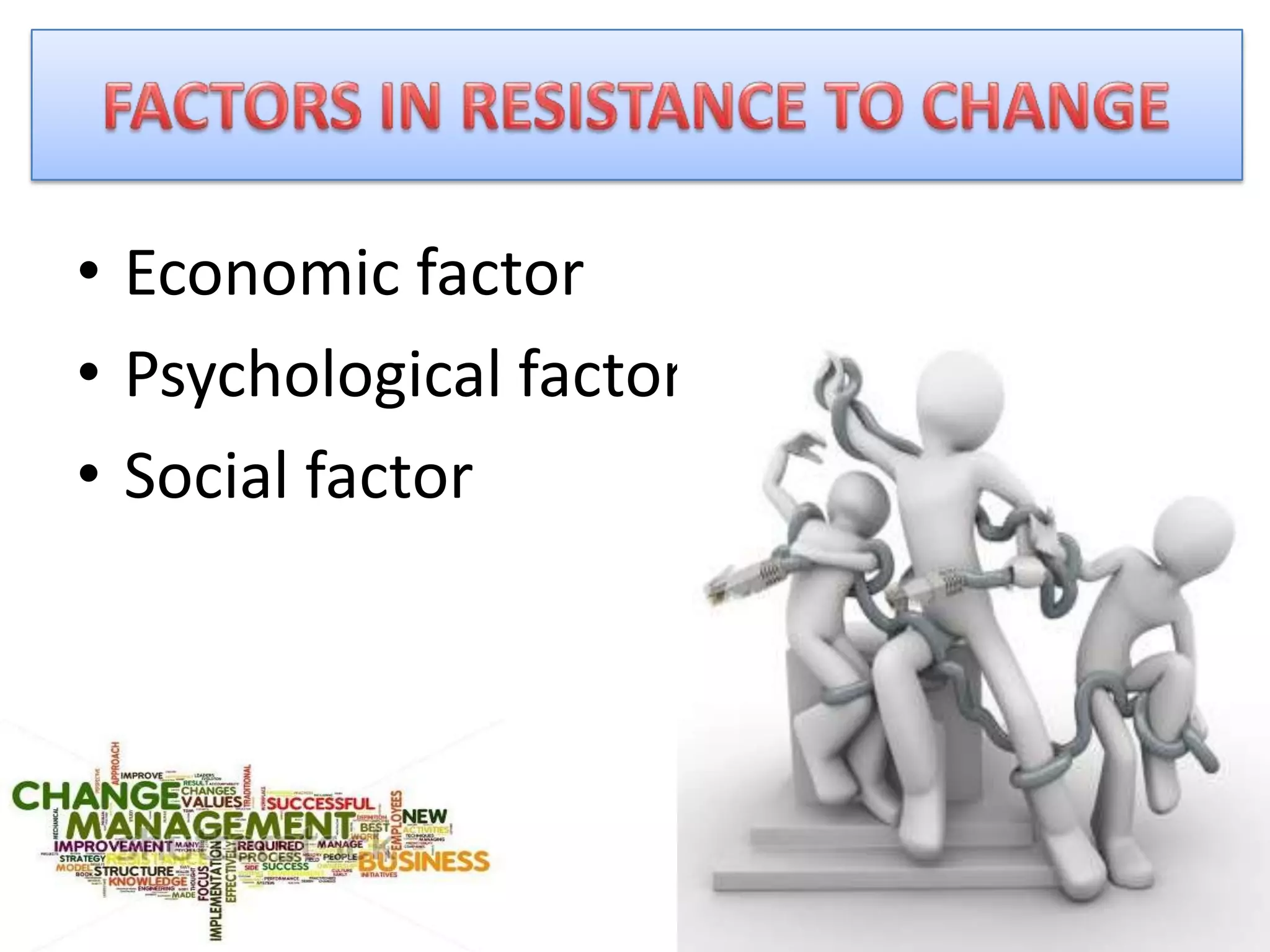
• Economic factor
• Psychological factor
• Social factor
Denial


Anger            Acceptance


        CHANGE
Education and communication
Employee participation and involvement
Facilitation and support
Negotiation and agreement
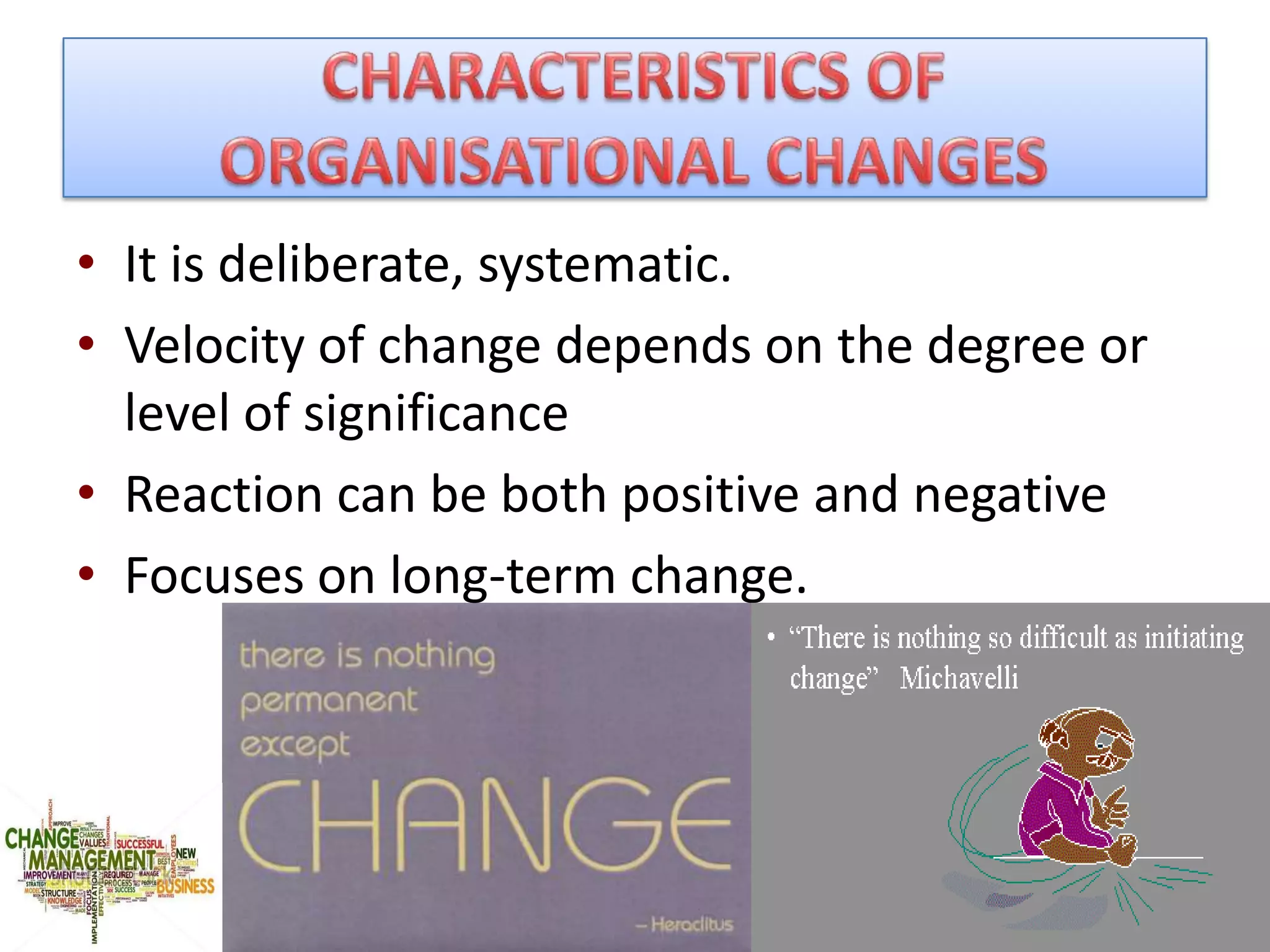
• It is deliberate, systematic.
• Velocity of change depends on the degree or
  level of significance
• Reaction can be both positive and negative
• Focuses on long-term change.
• Kurt Lewins (1958) described the change
  process of an organizational system as a series
  of transitions between three different states:
  unfreezing-change-refreezing.
• The model describes change as a series of
  transitions between different states. No
  change will occur unless the system is
  unfrozen, and no change will last unless the
  system is refrozen.
Unfreezing             Transition State              Refreezing
• Creates the             • Motivation to change     • Personal, behavioural
  motivation to change      has disrupted the          and technical
• Removing confusions,      present equilibrium,       integration for stable
  Hesitations and           but the desired state      operation
  providing whole info.     has not yet been         • Extra support is
                            formed.                    provided to remove
                          • Contd. With next slide     the difficulties.
This “implementation dip” represents not only a drop in performance, but also
the uncertainty and unfamiliarity with in individuals with new environment. So it
requires the change leaders to not panic when things do not go smoothly during
this phase of the change process. Effective leaders recognize that change is a
process, not an event, and show empathy towards individuals who display
anxiety, confusion and uncertainty during the transition portion of the change
process.
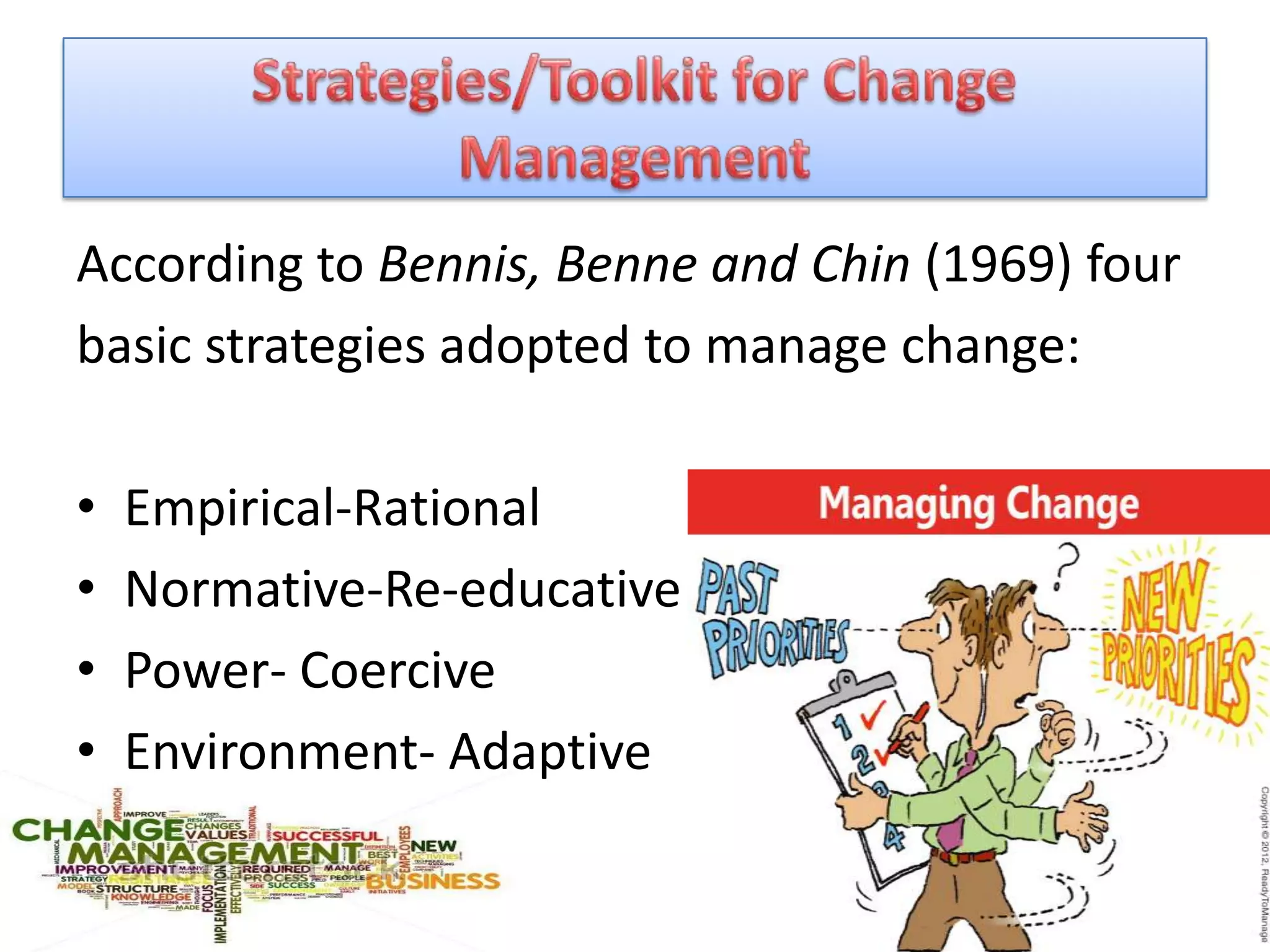
According to Bennis, Benne and Chin (1969) four
basic strategies adopted to manage change:

•   Empirical-Rational
•   Normative-Re-educative
•   Power- Coercive
•   Environment- Adaptive
• “Welcome Home” is a manufacturing unit
  dealing in Home Furniture, with the growing
  competition; it wishes to incorporate certain
  change in the system and culture. But the
  degree of resistance is too high.

• Suggest the right mix of strategy, to overcome
  resistance.
Reference
• http://www.pcrest.com/PC/FacDev/2010/FI_r
  eading.htm
• http://www.change-management-
  coach.com/definition-of-change-
  management.html
• http://assignmenthelpexperts.blogspot.in/201
  1/08/change-management.html
Change Management
Change Management

Change Management

  • 1.
    CHANGE MANAGEMENT By, AYUSH KUMAR MANMAN JEE GUPTA IBM, C.S.J.M. UNIVERSITY, KANPUR U.P.
  • 3.
    • Organisational Changemay be defined as the adoption of a new idea or a behaviour by an Organisation. • “A change is a shift in some condition or situation from its present state to a new and different state.” • Change Management is an organized, systematic application of the knowledge, tools, and resources of change that provides organizations with a key process to achieve their business strategy. ----Lamarsh
  • 5.
    Technology • Business Scenario • Environmental and National factors • Social Changes
  • 6.
    Change in the top management • Performance gap • Employee needs and values • Deficiency in existing organisation
  • 7.
     Mr. A.K.Singh has been an employee in major commercial bank for the past 15 years. Recently the bank reengineered and introduced ICT into their system. He was not computer literate to understand this software and he feel comfortable with his normal written records. The management spent huge amount in training for one month on him but because of old age, most of them find it difficult to understand the process. The management has given a directive, use this software or resign. In trying to learn by doing, he used the software and it has made him inefficient that he was now lost over 1.5 Million to wrong data entry and over paying some clients (all of which you cannot prove). His retirement benefits is just 2.5 Million. If he resign now, the management will deduct 1.5 Million from his expected severance benefits of 1.7 Million.  What type of force is acting inside this case?  Advice the management?
  • 8.
    CHANGE Individual Organisational
  • 9.
    • Economic factor •Psychological factor • Social factor
  • 10.
    Denial Anger Acceptance CHANGE
  • 11.
    Education and communication Employeeparticipation and involvement Facilitation and support Negotiation and agreement
  • 12.
    • It isdeliberate, systematic. • Velocity of change depends on the degree or level of significance • Reaction can be both positive and negative • Focuses on long-term change.
  • 13.
    • Kurt Lewins(1958) described the change process of an organizational system as a series of transitions between three different states: unfreezing-change-refreezing. • The model describes change as a series of transitions between different states. No change will occur unless the system is unfrozen, and no change will last unless the system is refrozen.
  • 14.
    Unfreezing Transition State Refreezing • Creates the • Motivation to change • Personal, behavioural motivation to change has disrupted the and technical • Removing confusions, present equilibrium, integration for stable Hesitations and but the desired state operation providing whole info. has not yet been • Extra support is formed. provided to remove • Contd. With next slide the difficulties.
  • 15.
    This “implementation dip”represents not only a drop in performance, but also the uncertainty and unfamiliarity with in individuals with new environment. So it requires the change leaders to not panic when things do not go smoothly during this phase of the change process. Effective leaders recognize that change is a process, not an event, and show empathy towards individuals who display anxiety, confusion and uncertainty during the transition portion of the change process.
  • 16.
    According to Bennis,Benne and Chin (1969) four basic strategies adopted to manage change: • Empirical-Rational • Normative-Re-educative • Power- Coercive • Environment- Adaptive
  • 17.
    • “Welcome Home”is a manufacturing unit dealing in Home Furniture, with the growing competition; it wishes to incorporate certain change in the system and culture. But the degree of resistance is too high. • Suggest the right mix of strategy, to overcome resistance.
  • 18.
    Reference • http://www.pcrest.com/PC/FacDev/2010/FI_r eading.htm • http://www.change-management- coach.com/definition-of-change- management.html • http://assignmenthelpexperts.blogspot.in/201 1/08/change-management.html