GOOD
AFTERNOON
CASE PRESENTATION
INTRODUCTION
Danage to the skin or deeper tissues caused by
sun, hot liquids, fire, electricity or chemicals.
The latest data shows that the
unintentional injury is a leading cause of death
among children under age14 year. Toddler and
children are often burned by a scalding or flames.
Most children ages 4 and under.
Cont…
Who hospitalized for burn related injuries suffer
from scald burn(65%) or contact burn(20%).
Babies an young children are especially at risk-
because they are curious, small and have sensitive
skin that needs extra protection.
DEFINITION
Cutaneous injury caused by heat, electricity,
chemicals, friction, or radiation.
CAUSES
 Burns and Scalds
 Electrical
 Chemical
 House fire
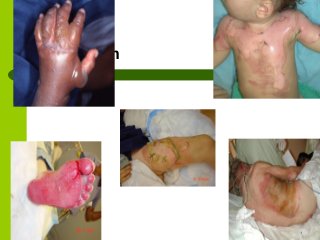
CLASSIFICATION/TYPES
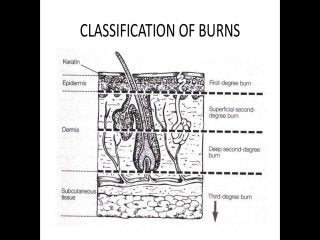
Burn Depth
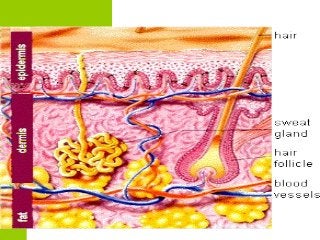
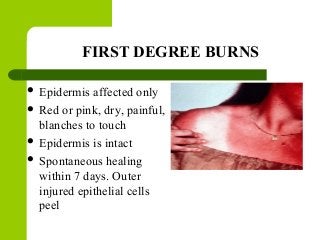
FIRST DEGREE BURNS
 Epidermis affected only
 Red or pink, dry, painful,
blanches to touch
 Epidermis is intact
 Spontaneous healing
within 7 days. Outer
injured epithelial cells
peel
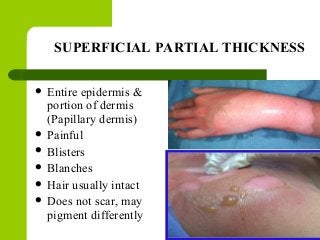
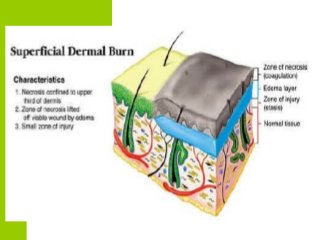
SUPERFICIAL PARTIAL THICKNESS
 Entire epidermis &
portion of dermis
(Papillary dermis)
 Painful
 Blisters
 Blanches
 Hair usually intact
 Does not scar, may
pigment differently
Sup 2nd degree
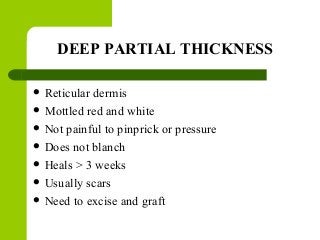
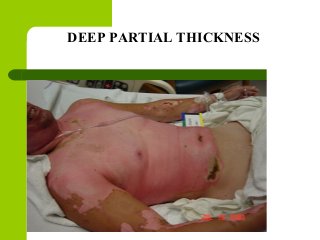
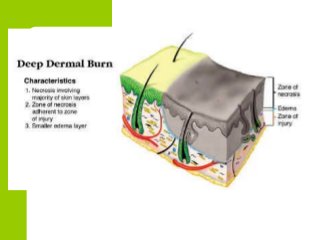
DEEP PARTIAL THICKNESS
 Reticular dermis
 Mottled red and white
 Not painful to pinprick or pressure
 Does not blanch
 Heals > 3 weeks
 Usually scars
 Need to excise and graft
DEEP PARTIAL THICKNESS
Deep dermal
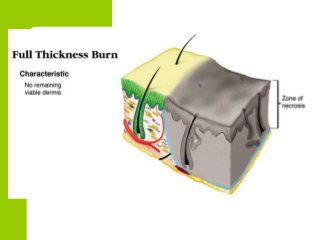
FULL THICKNESS:
3RD
DEGREE
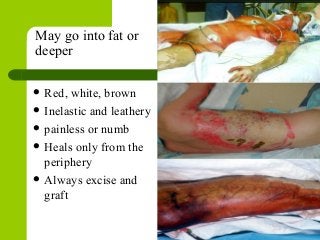
May go into fat or
deeper
 Red, white, brown
 Inelastic and leathery
 painless or numb
 Heals only from the
periphery
 Always excise and
graft
Full-thickness
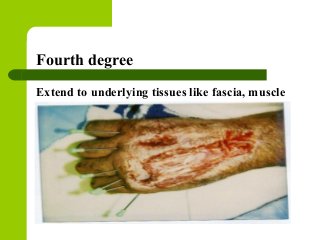
Fourth degree
Extend to underlying tissues like fascia, muscle
INHALATION INJURY
Exposure to heat and toxic products of combustion
 50% of fire deaths are related to inhalation injuries
 Asphyxia/Carbon Monoxide displacement of oxygen
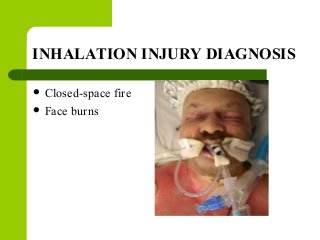
INHALATION INJURY DIAGNOSIS
 Closed-space fire
 Face burns
PATHOPHYSIOLOGY
 Loss of fluids
 Inability to maintain body temperature
 Infection
Cont…
 Patients with large burns (≥15 percent TBSA for
young children and ≥20 percent for older children
and adolescents) develop systemic responses to
these mediators.
 For patients with 40 percent TBSA or more,
myocardial depression can occur .
 As a result, patients with major burns may
become hypotensive (burn shock) and edematous
(burn edema).
PATHOPHYSIOLOGY
METABOLIC RESPONSE
 Following resuscitation, children with major
burns develop a hypermetabolic response that
results in a dramatic increase in energy
expenditure and protein metabolism .
 Evidence suggests that modulation of the
hypermetabolic response with therapies such as
beta blockers and human growth hormone may
improve outcomes for severely burned children
 Systemic capillary leak usually persists for 18 to
24 hours. Protein is lost from the intravascular
space during the first 12 to 18 hours after a burn,
after which vascular integrity improves.
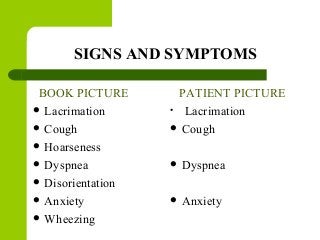
SIGNS AND SYMPTOMS
BOOK PICTURE
 Lacrimation
 Cough
 Hoarseness
 Dyspnea
 Disorientation
 Anxiety
 Wheezing
PATIENT PICTURE
• Lacrimation
 Cough
 Dyspnea
 Anxiety
Cont…
 Conjunctivitis
 Carbonaceous sputum
 Singed hairs
 Stridor
 Bronchorrhea
DIAGNOSTIC EVALUATION
 History collection
 Physical examination
 Blood test
 Ph level
ASSESSMENT
BURN EXTENT
Total Body Surface Area (TBSA)?
1. Rule of nines
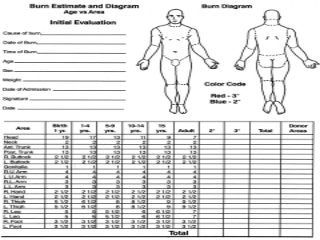
2. Lund and Browder chart
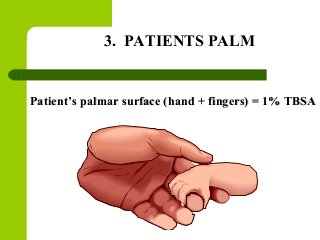
3. Patients palm = about 1% TBSA
1. RULE OF NINES
 Pediatric Rule of Nines
– For each year over 1 year of age, subtract 1%
from head,
– add equally to legs.
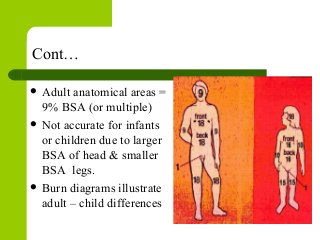
Cont…
 Adult anatomical areas =
9% BSA (or multiple)
 Not accurate for infants
or children due to larger
BSA of head & smaller
BSA legs.
 Burn diagrams illustrate
adult – child differences
2. LUND & BROWDER CHART
3. PATIENTS PALM
Patient’s palmar surface (hand + fingers) = 1% TBSAPatient’s palmar surface (hand + fingers) = 1% TBSA
BURN DEPTH
Factors:
 Temperature
 Duration of contact
 Dermal thickness
 Blood supply
 Special Consideration: Very young and very old
have thinner skin
MANAGEMENT
FIRST AIDS
Stop Burning Process
 Remove patient from source of injury
 Remove clothing unless stuck to burn
 Cut around clothing stuck to burn, leave in
place
MEDICAL MANAGEMENT
PAIN CONTROL
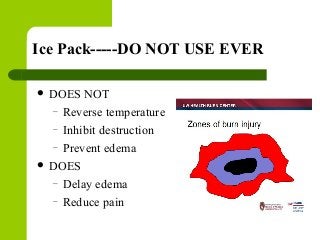
Ice Pack-----DO NOT USE EVER
 DOES NOT
– Reverse temperature
– Inhibit destruction
– Prevent edema
 DOES
– Delay edema
– Reduce pain
NON-MEDICATION METHODS
 Cover burns with plastic wrap
– Wet dressings will stick and cause more pain
– Other burn dressings are expensive and not
necessary
– Quik Clot is expensive and will not provide
any patient benefit
MEDICATION
 Medications
– Opioids
– Narcotics
– Pain medications
– IV Analgesia
RESUSCITATION
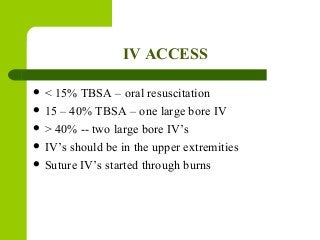
IV ACCESS
 < 15% TBSA – oral resuscitation
 15 – 40% TBSA – one large bore IV
 > 40% -- two large bore IV’s
 IV’s should be in the upper extremities
 Suture IV’s started through burns
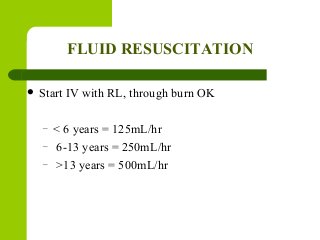
FLUID RESUSCITATION
 Start IV with RL, through burn OK
– < 6 years = 125mL/hr
– 6-13 years = 250mL/hr
– >13 years = 500mL/hr
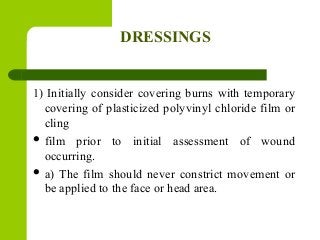
DRESSINGS
1) Initially consider covering burns with temporary
covering of plasticized polyvinyl chloride film or
cling
 film prior to initial assessment of wound
occurring.
 a) The film should never constrict movement or
be applied to the face or head area.
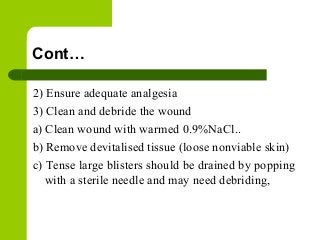
Cont…
2) Ensure adequate analgesia
3) Clean and debride the wound
a) Clean wound with warmed 0.9%NaCl..
b) Remove devitalised tissue (loose nonviable skin)
c) Tense large blisters should be drained by popping
with a sterile needle and may need debriding,
Cont…
d) Blisters over digits should not be debrided
4) Definitive dressing
a) The preferred acute burns dressing in CED is a
nanocrystalline silver dressing (eg Acticoat).
b) Nanocrystalline silver
NURSING MANAGEMENT
WITH NURSING THEORY
NURSING THEORY
 Varginia Henderson theory
 Metaparadigms
 Components
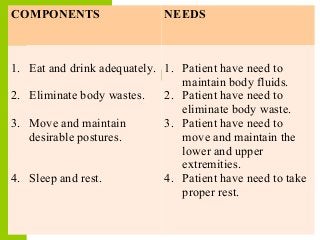
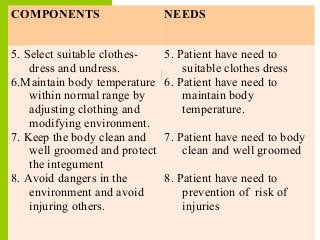
NEEDS AND PROBLEMS AS PER
HENDERSON’S THEORY
COMPONENTS NEEDS
1. Eat and drink adequately.
2. Eliminate body wastes.
3. Move and maintain
desirable postures.
4. Sleep and rest.
1. Patient have need to
maintain body fluids.
2. Patient have need to
eliminate body waste.
3. Patient have need to
move and maintain the
lower and upper
extremities.
4. Patient have need to take
proper rest.
COMPONENTS NEEDS
5. Select suitable clothes-
dress and undress.
6.Maintain body temperature
within normal range by
adjusting clothing and
modifying environment.
7. Keep the body clean and
well groomed and protect
the integument
8. Avoid dangers in the
environment and avoid
injuring others.
5. Patient have need to
suitable clothes dress
6. Patient have need to
maintain body
temperature.
7. Patient have need to body
clean and well groomed
8. Patient have need to
prevention of risk of
injuries
NURSING DIAGNOSIS
DIET
AND
HEALTH EDUCATION
CONCLUSION
SUMMERIZATION
BIBLIOGAPHY
 Wong’s Hockenberry J. Marilyn. Wilson David.
Essentials of Pediatric Nursing. 8th
Edition. New
Delhi: Published by Elsevier Pvt. Ltd.
 https:// Burn-India.com
 https:// en.m.wikipedia.org/wiki/burn
 http://www. mayoclinic.org// burn
THANKS
THANKS

Burn

  • 1.
  • 2.
  • 3.
    INTRODUCTION Danage to theskin or deeper tissues caused by sun, hot liquids, fire, electricity or chemicals. The latest data shows that the unintentional injury is a leading cause of death among children under age14 year. Toddler and children are often burned by a scalding or flames. Most children ages 4 and under.
  • 4.
    Cont… Who hospitalized forburn related injuries suffer from scald burn(65%) or contact burn(20%). Babies an young children are especially at risk- because they are curious, small and have sensitive skin that needs extra protection.
  • 6.
    DEFINITION Cutaneous injury causedby heat, electricity, chemicals, friction, or radiation.
  • 7.
    CAUSES  Burns andScalds  Electrical  Chemical  House fire
  • 8.
  • 9.
  • 10.
    FIRST DEGREE BURNS Epidermis affected only  Red or pink, dry, painful, blanches to touch  Epidermis is intact  Spontaneous healing within 7 days. Outer injured epithelial cells peel
  • 11.
    SUPERFICIAL PARTIAL THICKNESS Entire epidermis & portion of dermis (Papillary dermis)  Painful  Blisters  Blanches  Hair usually intact  Does not scar, may pigment differently
  • 12.
  • 13.
    DEEP PARTIAL THICKNESS Reticular dermis  Mottled red and white  Not painful to pinprick or pressure  Does not blanch  Heals > 3 weeks  Usually scars  Need to excise and graft
  • 14.
  • 15.
  • 16.
  • 17.
    May go intofat or deeper  Red, white, brown  Inelastic and leathery  painless or numb  Heals only from the periphery  Always excise and graft
  • 18.
  • 19.
    Fourth degree Extend tounderlying tissues like fascia, muscle
  • 21.
    INHALATION INJURY Exposure toheat and toxic products of combustion  50% of fire deaths are related to inhalation injuries  Asphyxia/Carbon Monoxide displacement of oxygen
  • 22.
    INHALATION INJURY DIAGNOSIS Closed-space fire  Face burns
  • 23.
    PATHOPHYSIOLOGY  Loss offluids  Inability to maintain body temperature  Infection
  • 24.
    Cont…  Patients withlarge burns (≥15 percent TBSA for young children and ≥20 percent for older children and adolescents) develop systemic responses to these mediators.  For patients with 40 percent TBSA or more, myocardial depression can occur .  As a result, patients with major burns may become hypotensive (burn shock) and edematous (burn edema).
  • 25.
    PATHOPHYSIOLOGY METABOLIC RESPONSE  Followingresuscitation, children with major burns develop a hypermetabolic response that results in a dramatic increase in energy expenditure and protein metabolism .  Evidence suggests that modulation of the hypermetabolic response with therapies such as beta blockers and human growth hormone may improve outcomes for severely burned children

  • 26.
     Systemic capillaryleak usually persists for 18 to 24 hours. Protein is lost from the intravascular space during the first 12 to 18 hours after a burn, after which vascular integrity improves.
  • 27.
    SIGNS AND SYMPTOMS BOOKPICTURE  Lacrimation  Cough  Hoarseness  Dyspnea  Disorientation  Anxiety  Wheezing PATIENT PICTURE • Lacrimation  Cough  Dyspnea  Anxiety
  • 28.
    Cont…  Conjunctivitis  Carbonaceoussputum  Singed hairs  Stridor  Bronchorrhea
  • 29.
    DIAGNOSTIC EVALUATION  Historycollection  Physical examination  Blood test  Ph level
  • 30.
  • 31.
    BURN EXTENT Total BodySurface Area (TBSA)? 1. Rule of nines 2. Lund and Browder chart 3. Patients palm = about 1% TBSA
  • 32.
    1. RULE OFNINES  Pediatric Rule of Nines – For each year over 1 year of age, subtract 1% from head, – add equally to legs.
  • 33.
    Cont…  Adult anatomicalareas = 9% BSA (or multiple)  Not accurate for infants or children due to larger BSA of head & smaller BSA legs.  Burn diagrams illustrate adult – child differences
  • 34.
    2. LUND &BROWDER CHART
  • 36.
    3. PATIENTS PALM Patient’spalmar surface (hand + fingers) = 1% TBSAPatient’s palmar surface (hand + fingers) = 1% TBSA
  • 37.
    BURN DEPTH Factors:  Temperature Duration of contact  Dermal thickness  Blood supply  Special Consideration: Very young and very old have thinner skin
  • 38.
  • 39.
  • 40.
    Stop Burning Process Remove patient from source of injury  Remove clothing unless stuck to burn  Cut around clothing stuck to burn, leave in place
  • 41.
  • 42.
  • 43.
    Ice Pack-----DO NOTUSE EVER  DOES NOT – Reverse temperature – Inhibit destruction – Prevent edema  DOES – Delay edema – Reduce pain
  • 44.
    NON-MEDICATION METHODS  Coverburns with plastic wrap – Wet dressings will stick and cause more pain – Other burn dressings are expensive and not necessary – Quik Clot is expensive and will not provide any patient benefit
  • 45.
    MEDICATION  Medications – Opioids –Narcotics – Pain medications – IV Analgesia
  • 46.
  • 47.
    IV ACCESS  <15% TBSA – oral resuscitation  15 – 40% TBSA – one large bore IV  > 40% -- two large bore IV’s  IV’s should be in the upper extremities  Suture IV’s started through burns
  • 48.
    FLUID RESUSCITATION  StartIV with RL, through burn OK – < 6 years = 125mL/hr – 6-13 years = 250mL/hr – >13 years = 500mL/hr
  • 49.
    DRESSINGS 1) Initially considercovering burns with temporary covering of plasticized polyvinyl chloride film or cling  film prior to initial assessment of wound occurring.  a) The film should never constrict movement or be applied to the face or head area.
  • 50.
    Cont… 2) Ensure adequateanalgesia 3) Clean and debride the wound a) Clean wound with warmed 0.9%NaCl.. b) Remove devitalised tissue (loose nonviable skin) c) Tense large blisters should be drained by popping with a sterile needle and may need debriding,
  • 51.
    Cont… d) Blisters overdigits should not be debrided 4) Definitive dressing a) The preferred acute burns dressing in CED is a nanocrystalline silver dressing (eg Acticoat). b) Nanocrystalline silver
  • 52.
  • 53.
    NURSING THEORY  VarginiaHenderson theory  Metaparadigms  Components
  • 54.
    NEEDS AND PROBLEMSAS PER HENDERSON’S THEORY
  • 55.
    COMPONENTS NEEDS 1. Eatand drink adequately. 2. Eliminate body wastes. 3. Move and maintain desirable postures. 4. Sleep and rest. 1. Patient have need to maintain body fluids. 2. Patient have need to eliminate body waste. 3. Patient have need to move and maintain the lower and upper extremities. 4. Patient have need to take proper rest.
  • 56.
    COMPONENTS NEEDS 5. Selectsuitable clothes- dress and undress. 6.Maintain body temperature within normal range by adjusting clothing and modifying environment. 7. Keep the body clean and well groomed and protect the integument 8. Avoid dangers in the environment and avoid injuring others. 5. Patient have need to suitable clothes dress 6. Patient have need to maintain body temperature. 7. Patient have need to body clean and well groomed 8. Patient have need to prevention of risk of injuries
  • 57.
  • 58.
  • 59.
  • 60.
  • 61.
    BIBLIOGAPHY  Wong’s HockenberryJ. Marilyn. Wilson David. Essentials of Pediatric Nursing. 8th Edition. New Delhi: Published by Elsevier Pvt. Ltd.  https:// Burn-India.com  https:// en.m.wikipedia.org/wiki/burn  http://www. mayoclinic.org// burn
  • 62.