Classroom Object
Oriented Language:
COOL
S. M. M. Sadrnezhaad, R. Yazdanian, S. Karimi
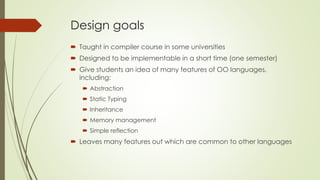
Design goals
 Taught in compiler course in some universities
 Designed to be implementable in a short time (one semester)
 Give students an idea of many features of OO languages,
including:
 Abstraction
 Static Typing
 Inheritance
 Memory management
 Simple reflection
 Leaves many features out which are common to other languages
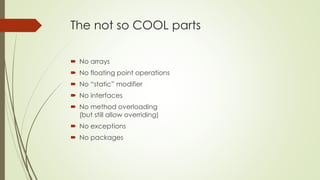
The not so COOL parts
 No arrays
 No floating point operations
 No “static” modifier
 No interfaces
 No method overloading
(but still allow overriding)
 No exceptions
 No packages
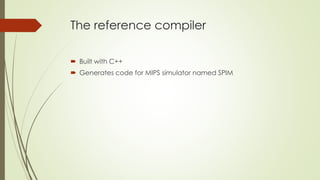
The reference compiler
 Built with C++
 Generates code for MIPS simulator named SPIM
Where does execution start?
 A class “Main” must be defined
 Containing a no-args “main” method
 Starts program execution
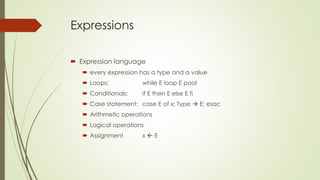
Expressions
 Expression language
 every expression has a type and a value
 Loops: while E loop E pool
 Conditionals: if E then E else E fi
 Case statement: case E of x: Type  E; esac
 Arithmetic operations
 Logical operations
 Assignment x  E
Basic structure and classes
 Basically, a COOL program is a set of classes
 Similar to Java
 Almost every type is a class (next slide)
 Blocks defined using { and }.
 Each COOL class has a set of features
 Methods
 No explicit return
 Attributes (variables)
Classes and types: continued
 Primitive types: Boolean, Int, String
 Built-in types: The above, + Null, Nothing, Unit, Any
 Every type except Null and Nothing is a class
 Int, Boolean, Unit cannot be superclass
 “Any” class is the root of class hierarchy
 Similar to “Object” in Java
 Each type “conforms” to ancestors
 “Nothing” conforms to all
 “Null” conforms to all but Int, Boolean, Unit
 Null and Nothing cannot be superclass (obviously)
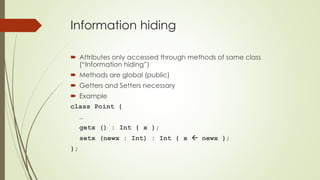
Information hiding
 Attributes only accessed through methods of same class
(“Information hiding”)
 Methods are global (public)
 Getters and Setters necessary
 Example
class Point {
…
getx () : Int { x };
setx (newx : Int) : Int { x  newx };
};
18
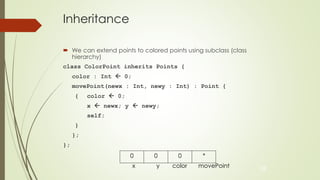
Inheritance
 We can extend points to colored points using subclass (class
hierarchy)
class ColorPoint inherits Points {
color : Int  0;
movePoint(newx : Int, newy : Int) : Point {
{ color  0;
x  newx; y  newy;
self;
}
};
};
0 0
y color
*
movePoint
0
x
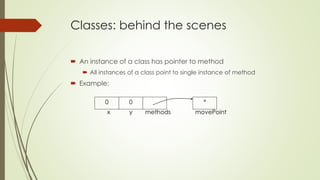
Classes: behind the scenes
 An instance of a class has pointer to method
 All instances of a class point to single instance of method
 Example:
0 0
x y
*
movePointmethods
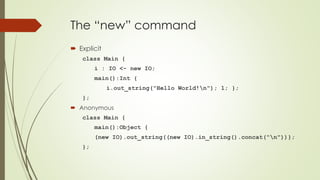
The “new” command
 Explicit
class Main {
i : IO <- new IO;
main():Int {
i.out_string("Hello World!n"); 1; };
};
 Anonymous
class Main {
main():Object {
(new IO).out_string((new IO).in_string().concat("n"))};
};
Typing
 Static typing: Type defined at variable definition time
 Static type inferred at compile time for each expression
 Bottom-up
 Dynamic, exec time type may differ
 But dynamic type “conforms” to static type
 Errs on the conservative side
 Attributes of classes initialized
 Boolean: false, Unit: (), Int: 0
 Others: Null
Method invocation
 Dynamic type may differ from static
 Methods invoked instead of calling -> Late binding
 Invoked by dispatch
 Find class of the instance
 Find the method
 Eval args
 Bind the method and the object
 Run method
Memory Management: Environment
and Store
 Environment: Mapping of identifiers to locations
 i.e. symbol table
 Store: Where the values are stored -> Heap
 Looking up a variable’s value:
 Look its location up in environment
 Look up the value at location in store
 When new is invoked
 New env. and store created, new identifier added to them
 Dynamic allocation w/ Garbage Collector
Conclusion
 Object oriented
 Objects, virtual method calls, but no overloading
 Strongly typed
 Primitives for int, boolean, string
 Reference types
 Dynamic allocation and Garbage Collection
 Heap allocation, automatic deallocation
 Many things are left out
 short time implementation
Question time!
Thank you for (if) your attention! :)

Classroom Object Oriented Language (COOL)

  • 1.
    Classroom Object Oriented Language: COOL S.M. M. Sadrnezhaad, R. Yazdanian, S. Karimi
  • 2.
    Design goals  Taughtin compiler course in some universities  Designed to be implementable in a short time (one semester)  Give students an idea of many features of OO languages, including:  Abstraction  Static Typing  Inheritance  Memory management  Simple reflection  Leaves many features out which are common to other languages
  • 3.
    The not soCOOL parts  No arrays  No floating point operations  No “static” modifier  No interfaces  No method overloading (but still allow overriding)  No exceptions  No packages
  • 4.
    The reference compiler Built with C++  Generates code for MIPS simulator named SPIM
  • 5.
    Where does executionstart?  A class “Main” must be defined  Containing a no-args “main” method  Starts program execution
  • 6.
    Expressions  Expression language every expression has a type and a value  Loops: while E loop E pool  Conditionals: if E then E else E fi  Case statement: case E of x: Type  E; esac  Arithmetic operations  Logical operations  Assignment x  E
  • 7.
    Basic structure andclasses  Basically, a COOL program is a set of classes  Similar to Java  Almost every type is a class (next slide)  Blocks defined using { and }.  Each COOL class has a set of features  Methods  No explicit return  Attributes (variables)
  • 8.
    Classes and types:continued  Primitive types: Boolean, Int, String  Built-in types: The above, + Null, Nothing, Unit, Any  Every type except Null and Nothing is a class  Int, Boolean, Unit cannot be superclass  “Any” class is the root of class hierarchy  Similar to “Object” in Java  Each type “conforms” to ancestors  “Nothing” conforms to all  “Null” conforms to all but Int, Boolean, Unit  Null and Nothing cannot be superclass (obviously)
  • 9.
    Information hiding  Attributesonly accessed through methods of same class (“Information hiding”)  Methods are global (public)  Getters and Setters necessary  Example class Point { … getx () : Int { x }; setx (newx : Int) : Int { x  newx }; };
  • 10.
    18 Inheritance  We canextend points to colored points using subclass (class hierarchy) class ColorPoint inherits Points { color : Int  0; movePoint(newx : Int, newy : Int) : Point { { color  0; x  newx; y  newy; self; } }; }; 0 0 y color * movePoint 0 x
  • 11.
    Classes: behind thescenes  An instance of a class has pointer to method  All instances of a class point to single instance of method  Example: 0 0 x y * movePointmethods
  • 12.
    The “new” command Explicit class Main { i : IO <- new IO; main():Int { i.out_string("Hello World!n"); 1; }; };  Anonymous class Main { main():Object { (new IO).out_string((new IO).in_string().concat("n"))}; };
  • 13.
    Typing  Static typing:Type defined at variable definition time  Static type inferred at compile time for each expression  Bottom-up  Dynamic, exec time type may differ  But dynamic type “conforms” to static type  Errs on the conservative side  Attributes of classes initialized  Boolean: false, Unit: (), Int: 0  Others: Null
  • 14.
    Method invocation  Dynamictype may differ from static  Methods invoked instead of calling -> Late binding  Invoked by dispatch  Find class of the instance  Find the method  Eval args  Bind the method and the object  Run method
  • 15.
    Memory Management: Environment andStore  Environment: Mapping of identifiers to locations  i.e. symbol table  Store: Where the values are stored -> Heap  Looking up a variable’s value:  Look its location up in environment  Look up the value at location in store  When new is invoked  New env. and store created, new identifier added to them  Dynamic allocation w/ Garbage Collector
  • 16.
    Conclusion  Object oriented Objects, virtual method calls, but no overloading  Strongly typed  Primitives for int, boolean, string  Reference types  Dynamic allocation and Garbage Collection  Heap allocation, automatic deallocation  Many things are left out  short time implementation
  • 17.
  • 18.
    Thank you for(if) your attention! :)