Epistemic
Justification
Presented by
Masoud Sadrnezhaad
December 24, 2023
Philosophy in English Course
Instructor: Mohammad Maarefi
Table of contents
01
04
02
05
03
06
Types of Justification
Relationship between
Truth and Justification
Justification Activities
and Justification States
Relative Nature of
Justification
Degrees of Epistemic
Justification
Knowledge and
Well-Founded Beliefs
Types of Justification
01
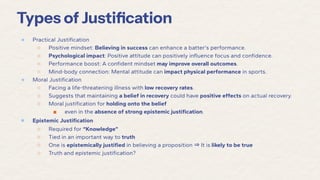
● Practical Justification
○ Positive mindset: Believing in success can enhance a batter's performance.
○ Psychological impact: Positive attitude can positively influence focus and confidence.
○ Performance boost: A confident mindset may improve overall outcomes.
○ Mind-body connection: Mental attitude can impact physical performance in sports.
● Moral Justification
○ Facing a life-threatening illness with low recovery rates.
○ Suggests that maintaining a belief in recovery could have positive effects on actual recovery.
○ Moral justification for holding onto the belief
■ even in the absence of strong epistemic justification.
● Epistemic Justification
○ Required for “Knowledge”
○ Tied in an important way to truth
○ One is epistemically justified in believing a proposition ⇒ It is likely to be true
○ Truth and epistemic justification?
Types of Justification
02
Relationship between
Truth and Justification
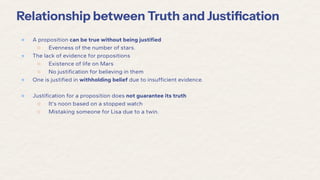
● A proposition can be true without being justified
○ Evenness of the number of stars.
● The lack of evidence for propositions
○ Existence of life on Mars
○ No justification for believing in them
● One is justified in withholding belief due to insufficient evidence.
● Justification for a proposition does not guarantee its truth
○ It's noon based on a stopped watch
○ Mistaking someone for Lisa due to a twin.
Relationship between Truth and Justification
03
Justification Activities
and Justification States
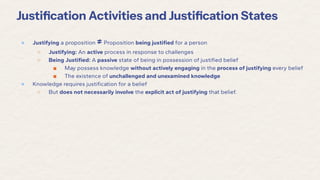
● Justifying a proposition ≠ Proposition being justified for a person
○ Justifying: An active process in response to challenges
○ Being Justified: A passive state of being in possession of justified belief
■ May possess knowledge without actively engaging in the process of justifying every belief
■ The existence of unchallenged and unexamined knowledge
● Knowledge requires justification for a belief
○ But does not necessarily involve the explicit act of justifying that belief.
Justification Activities and Justification States
04
Relative Nature of
Justification
● Justification is relative, unlike truth
○ It can vary among individuals based on the evidence each person possesses.
● Examples
○ Smith being justified in the belief that he is not a thief (despite being one)
○ While others lack this justification.
● Dynamic nature of justification
○ It can change over time for an individual depending on the evolving evidence available.
Relative Nature of Justification
05
Degrees of Epistemic
Justification
Degrees of Epistemic Justification
● A spectrum ranging
○ From certain or maximally justified propositions
○ T
o those just barely reasonable to accept.
● Examples
○ Certain propositions: such as 2 = 2, "I think," or "I exist,"
○ "I will be alive in three months" is not maximally justified, it is more justified
■ than other less supported propositions like:
● "There is life on Mars" or "The number of stars is even."
● What degree of justification is required for knowledge?
○ Not any level of justification is sufficient for knowledge
■ predicting one's own future or drawing a marble from an urn
● Knowledge requires certainty?
○ Most defenders of the Justified True Belief (JTB) account would agree that knowledge
necessitates a high degree of justification, even if not maximal.
06
Knowledge and
Well-Founded Beliefs
● A proposition being 'justified' for a person ≠ being 'well-founded' for a person.
● Well-founded for an individual
○ It must be justified for them, and they must believe it based on their evidence for it.
○ Not only do they have good reasons for believing it
■ But they also believe it based on those good reasons
● Example of Jones and his serious illness.
○ Despite having excellent evidence for a full recovery
■ Jones believes in his recovery based on a poor reason (e.g., a tea-leaf reader's prediction or wishful
thinking).
○ While the proposition that Jones will recover is justified for him
■ His belief is not well-founded
● because it is not based on the strong evidence available to him.
○ It raises doubts about whether his belief qualifies as knowledge.
● A modification to the account of knowledge
○ Revised definition: S knows that p if (1) S believes that p, (2) p is true, and (3) S's belief that p is
well-founded, indicating that knowledge requires belief based on supporting evidence.
Knowledge and Well-Founded Beliefs
Resources
● Lemos, Noah. An introduction to the theory of knowledge. Cambridge
University Press, 2007.
Thanks :)
Do you have any questions?
masoud@hbc.ir
smm.sadrn.com

Epistemic Justification

  • 1.
    Epistemic Justification Presented by Masoud Sadrnezhaad December24, 2023 Philosophy in English Course Instructor: Mohammad Maarefi
  • 2.
    Table of contents 01 04 02 05 03 06 Typesof Justification Relationship between Truth and Justification Justification Activities and Justification States Relative Nature of Justification Degrees of Epistemic Justification Knowledge and Well-Founded Beliefs
  • 3.
  • 4.
    ● Practical Justification ○Positive mindset: Believing in success can enhance a batter's performance. ○ Psychological impact: Positive attitude can positively influence focus and confidence. ○ Performance boost: A confident mindset may improve overall outcomes. ○ Mind-body connection: Mental attitude can impact physical performance in sports. ● Moral Justification ○ Facing a life-threatening illness with low recovery rates. ○ Suggests that maintaining a belief in recovery could have positive effects on actual recovery. ○ Moral justification for holding onto the belief ■ even in the absence of strong epistemic justification. ● Epistemic Justification ○ Required for “Knowledge” ○ Tied in an important way to truth ○ One is epistemically justified in believing a proposition ⇒ It is likely to be true ○ Truth and epistemic justification? Types of Justification
  • 5.
  • 6.
    ● A propositioncan be true without being justified ○ Evenness of the number of stars. ● The lack of evidence for propositions ○ Existence of life on Mars ○ No justification for believing in them ● One is justified in withholding belief due to insufficient evidence. ● Justification for a proposition does not guarantee its truth ○ It's noon based on a stopped watch ○ Mistaking someone for Lisa due to a twin. Relationship between Truth and Justification
  • 7.
  • 8.
    ● Justifying aproposition ≠ Proposition being justified for a person ○ Justifying: An active process in response to challenges ○ Being Justified: A passive state of being in possession of justified belief ■ May possess knowledge without actively engaging in the process of justifying every belief ■ The existence of unchallenged and unexamined knowledge ● Knowledge requires justification for a belief ○ But does not necessarily involve the explicit act of justifying that belief. Justification Activities and Justification States
  • 9.
  • 10.
    ● Justification isrelative, unlike truth ○ It can vary among individuals based on the evidence each person possesses. ● Examples ○ Smith being justified in the belief that he is not a thief (despite being one) ○ While others lack this justification. ● Dynamic nature of justification ○ It can change over time for an individual depending on the evolving evidence available. Relative Nature of Justification
  • 11.
  • 12.
    Degrees of EpistemicJustification ● A spectrum ranging ○ From certain or maximally justified propositions ○ T o those just barely reasonable to accept. ● Examples ○ Certain propositions: such as 2 = 2, "I think," or "I exist," ○ "I will be alive in three months" is not maximally justified, it is more justified ■ than other less supported propositions like: ● "There is life on Mars" or "The number of stars is even." ● What degree of justification is required for knowledge? ○ Not any level of justification is sufficient for knowledge ■ predicting one's own future or drawing a marble from an urn ● Knowledge requires certainty? ○ Most defenders of the Justified True Belief (JTB) account would agree that knowledge necessitates a high degree of justification, even if not maximal.
  • 13.
  • 14.
    ● A propositionbeing 'justified' for a person ≠ being 'well-founded' for a person. ● Well-founded for an individual ○ It must be justified for them, and they must believe it based on their evidence for it. ○ Not only do they have good reasons for believing it ■ But they also believe it based on those good reasons ● Example of Jones and his serious illness. ○ Despite having excellent evidence for a full recovery ■ Jones believes in his recovery based on a poor reason (e.g., a tea-leaf reader's prediction or wishful thinking). ○ While the proposition that Jones will recover is justified for him ■ His belief is not well-founded ● because it is not based on the strong evidence available to him. ○ It raises doubts about whether his belief qualifies as knowledge. ● A modification to the account of knowledge ○ Revised definition: S knows that p if (1) S believes that p, (2) p is true, and (3) S's belief that p is well-founded, indicating that knowledge requires belief based on supporting evidence. Knowledge and Well-Founded Beliefs
  • 15.
    Resources ● Lemos, Noah.An introduction to the theory of knowledge. Cambridge University Press, 2007.
  • 16.
    Thanks :) Do youhave any questions? masoud@hbc.ir smm.sadrn.com