27 Jan 2016
Sequence-to-sequence models
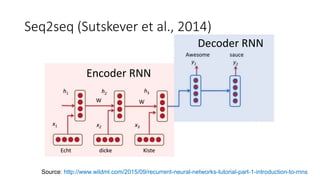
Seq2seq (Sutskever et al., 2014)
Source: http://www.wildml.com/2015/09/recurrent-neural-networks-tutorial-part-1-introduction-to-rnns
Encoder RNN
Decoder RNN
Seq2seq overview and applications
• Encoder-decoder
• Two RNNs (typically LSTMs or GRUs)
• Can be deterministic or variational
• Applications:
• Machine translation
• Question answering
• Dialogue models (conversational agents)
• Summarization
• Etc.
LSTM cell
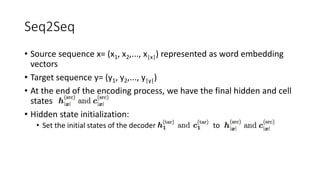
Seq2Seq
• Source sequence x= (x1, x2,..., x|x|) represented as word embedding
vectors
• Target sequence y= (y1, y2,..., y|y|)
• At the end of the encoding process, we have the final hidden and cell
states
• Hidden state initialization:
• Set the initial states of the decoder to
Seq2seq (cont.)
• At each step of the decoder, compute
• yj-1 – ground truth previous word during training (“teacher forcing”),
and previously predicted word at inference time.
• θ – parameters (weights) of the network
Seq2seq (cont.)
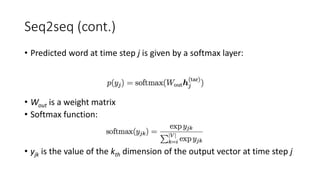
• Predicted word at time step j is given by a softmax layer:
• Wout is a weight matrix
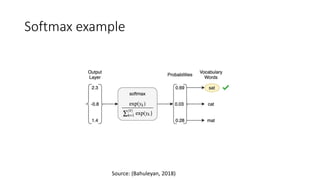
• Softmax function:
• yjk is the value of the kth dimension of the output vector at time step j
Softmax example
Source: (Bahuleyan, 2018)
Seq2seq model
Source: (Bahuleyan, 2018)
Selecting the word at each time step of the
decoder
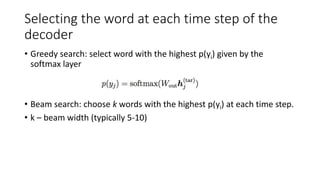
• Greedy search: select word with the highest p(yi) given by the
softmax layer
• Beam search: choose k words with the highest p(yi) at each time step.
• k – beam width (typically 5-10)
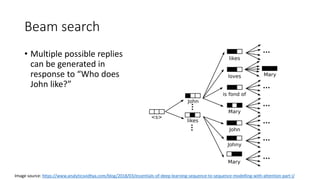
Beam search
• Multiple possible replies
can be generated in
response to “Who does
John like?”
Image source: https://www.analyticsvidhya.com/blog/2018/03/essentials-of-deep-learning-sequence-to-sequence-modelling-with-attention-part-i/
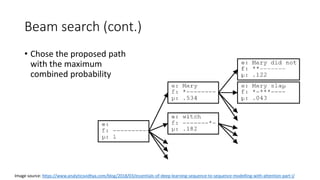
Beam search (cont.)
Image source: https://www.analyticsvidhya.com/blog/2018/03/essentials-of-deep-learning-sequence-to-sequence-modelling-with-attention-part-i/
• Chose the proposed path
with the maximum
combined probability
Seq2seq resources
• https://blog.keras.io/a-ten-minute-introduction-to-sequence-to-
sequence-learning-in-keras.html
Attention mechanism in RNN encoder-
decoder networks – Intuitions
• Dynamically align target sequence with source sequence in the
decoder
• Pay different level of attention to words in the input sequence at each
time step in the decoder
• At each time step, the decoder is provided access to all encoded
source tokens
• The decoder gives higher weights to certain and lower to others
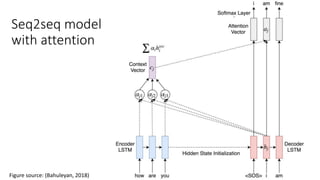
Attention mechanism – Formal definition
• Compute a probabilistic distribution at each decoding time step j
where is the weight given to source output i and
is a pre-normalized score
• Two methods to compute :
• Multiplicative (Luong et al., 2015)
• Additive (Bahdanau et al., 2014)
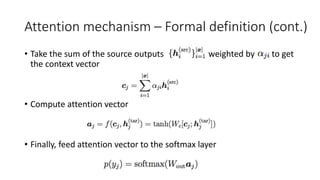
Attention mechanism – Formal definition (cont.)
• Take the sum of the source outputs weighted by to get
the context vector
• Compute attention vector
• Finally, feed attention vector to the softmax layer
Attention mechanism – Formal definition (cont.)
Seq2seq model
with attention
Figure source: (Bahuleyan, 2018)
Visualizing Attention in Machine Translation (1)
Source: https://aws.amazon.com/blogs/machine-learning/train-neural-machine-translation-models-with-sockeye/
Visualizing Attention in Machine Translation (2)
Source: https://aws.amazon.com/blogs/machine-learning/train-neural-machine-translation-models-with-sockeye/
Variational Attention for
Sequence-to-Sequence Models
Hareesh Bahuleyan, Lili Mou, Olga Vechtomova, Pascal Poupart
In Proc. COLING 2018
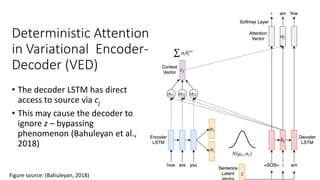
Figure source: (Bahuleyan, 2018)
• The decoder LSTM has direct
access to source via cj
• This may cause the decoder to
ignore z – bypassing
phenomenon (Bahuleyan et al.,
2018)
Deterministic Attention
in Variational Encoder-
Decoder (VED)
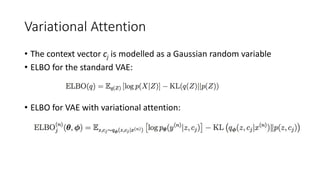
Variational Attention
• The context vector cj is modelled as a Gaussian random variable
• ELBO for the standard VAE:
• ELBO for VAE with variational attention:
Variational Attention (continued)
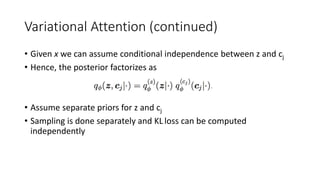
• Given x we can assume conditional independence between z and cj
• Hence, the posterior factorizes as
• Assume separate priors for z and cj
• Sampling is done separately and KL loss can be computed
independently
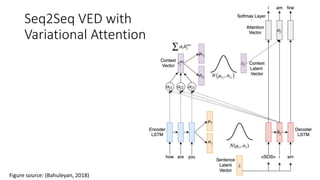
Seq2Seq VED with
Variational Attention
Figure source: (Bahuleyan, 2018)
Seq2Seq VED with Variational Attention
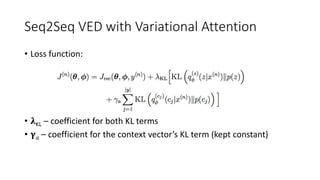
• Loss function:
• 𝛌KL – coefficient for both KL terms
• 𝛄𝑎 – coefficient for the context vector’s KL term (kept constant)
Seq2Seq VED with Variational Attention – Prior
• Sentence latent code z prior: p(z)=N(0,I) (same as in the VAE)
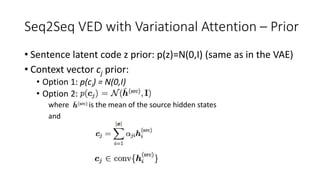
• Context vector cj prior:
• Option 1: p(cj) = N(0,I)
• Option 2:
where is the mean of the source hidden states
and
Seq2Seq VED with Variational Attention –
Posterior
• Both posterior distributions q(z|x) and q(cj|x) are
parameterized by the encoder LSTM
• For the sentence latent space (same as VAE):
• For the context vector cj at time step j:
Where , and is computed using feed-forward neural
network
Evaluation
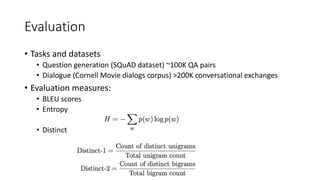
• Tasks and datasets
• Question generation (SQuAD dataset) ~100K QA pairs
• Dialogue (Cornell Movie dialogs corpus) >200K conversational exchanges
• Evaluation measures:
• BLEU scores
• Entropy
• Distinct
Results on the question generation task
Source: Bahuleyan et al (2018) https://arxiv.org/abs/1712.08207
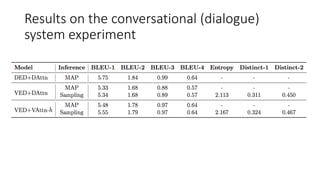
Results on the conversational (dialogue)
system experiment
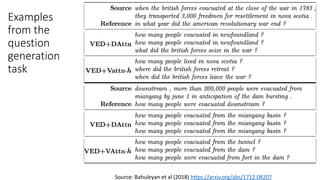
Examples
from the
question
generation
task
Source: Bahuleyan et al (2018) https://arxiv.org/abs/1712.08207

Week9_Seq2seq.pptx

  • 1.
  • 2.
    Seq2seq (Sutskever etal., 2014) Source: http://www.wildml.com/2015/09/recurrent-neural-networks-tutorial-part-1-introduction-to-rnns Encoder RNN Decoder RNN
  • 3.
    Seq2seq overview andapplications • Encoder-decoder • Two RNNs (typically LSTMs or GRUs) • Can be deterministic or variational • Applications: • Machine translation • Question answering • Dialogue models (conversational agents) • Summarization • Etc.
  • 4.
  • 5.
    Seq2Seq • Source sequencex= (x1, x2,..., x|x|) represented as word embedding vectors • Target sequence y= (y1, y2,..., y|y|) • At the end of the encoding process, we have the final hidden and cell states • Hidden state initialization: • Set the initial states of the decoder to
  • 6.
    Seq2seq (cont.) • Ateach step of the decoder, compute • yj-1 – ground truth previous word during training (“teacher forcing”), and previously predicted word at inference time. • θ – parameters (weights) of the network
  • 7.
    Seq2seq (cont.) • Predictedword at time step j is given by a softmax layer: • Wout is a weight matrix • Softmax function: • yjk is the value of the kth dimension of the output vector at time step j
  • 8.
  • 9.
  • 10.
    Selecting the wordat each time step of the decoder • Greedy search: select word with the highest p(yi) given by the softmax layer • Beam search: choose k words with the highest p(yi) at each time step. • k – beam width (typically 5-10)
  • 11.
    Beam search • Multiplepossible replies can be generated in response to “Who does John like?” Image source: https://www.analyticsvidhya.com/blog/2018/03/essentials-of-deep-learning-sequence-to-sequence-modelling-with-attention-part-i/
  • 12.
    Beam search (cont.) Imagesource: https://www.analyticsvidhya.com/blog/2018/03/essentials-of-deep-learning-sequence-to-sequence-modelling-with-attention-part-i/ • Chose the proposed path with the maximum combined probability
  • 13.
  • 14.
    Attention mechanism inRNN encoder- decoder networks – Intuitions • Dynamically align target sequence with source sequence in the decoder • Pay different level of attention to words in the input sequence at each time step in the decoder • At each time step, the decoder is provided access to all encoded source tokens • The decoder gives higher weights to certain and lower to others
  • 15.
    Attention mechanism –Formal definition • Compute a probabilistic distribution at each decoding time step j where is the weight given to source output i and is a pre-normalized score
  • 16.
    • Two methodsto compute : • Multiplicative (Luong et al., 2015) • Additive (Bahdanau et al., 2014) Attention mechanism – Formal definition (cont.)
  • 17.
    • Take thesum of the source outputs weighted by to get the context vector • Compute attention vector • Finally, feed attention vector to the softmax layer Attention mechanism – Formal definition (cont.)
  • 18.
    Seq2seq model with attention Figuresource: (Bahuleyan, 2018)
  • 19.
    Visualizing Attention inMachine Translation (1) Source: https://aws.amazon.com/blogs/machine-learning/train-neural-machine-translation-models-with-sockeye/
  • 20.
    Visualizing Attention inMachine Translation (2) Source: https://aws.amazon.com/blogs/machine-learning/train-neural-machine-translation-models-with-sockeye/
  • 21.
    Variational Attention for Sequence-to-SequenceModels Hareesh Bahuleyan, Lili Mou, Olga Vechtomova, Pascal Poupart In Proc. COLING 2018
  • 22.
    Figure source: (Bahuleyan,2018) • The decoder LSTM has direct access to source via cj • This may cause the decoder to ignore z – bypassing phenomenon (Bahuleyan et al., 2018) Deterministic Attention in Variational Encoder- Decoder (VED)
  • 23.
    Variational Attention • Thecontext vector cj is modelled as a Gaussian random variable • ELBO for the standard VAE: • ELBO for VAE with variational attention:
  • 24.
    Variational Attention (continued) •Given x we can assume conditional independence between z and cj • Hence, the posterior factorizes as • Assume separate priors for z and cj • Sampling is done separately and KL loss can be computed independently
  • 25.
    Seq2Seq VED with VariationalAttention Figure source: (Bahuleyan, 2018)
  • 26.
    Seq2Seq VED withVariational Attention • Loss function: • 𝛌KL – coefficient for both KL terms • 𝛄𝑎 – coefficient for the context vector’s KL term (kept constant)
  • 27.
    Seq2Seq VED withVariational Attention – Prior • Sentence latent code z prior: p(z)=N(0,I) (same as in the VAE) • Context vector cj prior: • Option 1: p(cj) = N(0,I) • Option 2: where is the mean of the source hidden states and
  • 28.
    Seq2Seq VED withVariational Attention – Posterior • Both posterior distributions q(z|x) and q(cj|x) are parameterized by the encoder LSTM • For the sentence latent space (same as VAE): • For the context vector cj at time step j: Where , and is computed using feed-forward neural network
  • 29.
    Evaluation • Tasks anddatasets • Question generation (SQuAD dataset) ~100K QA pairs • Dialogue (Cornell Movie dialogs corpus) >200K conversational exchanges • Evaluation measures: • BLEU scores • Entropy • Distinct
  • 30.
    Results on thequestion generation task Source: Bahuleyan et al (2018) https://arxiv.org/abs/1712.08207
  • 31.
    Results on theconversational (dialogue) system experiment
  • 32.
    Examples from the question generation task Source: Bahuleyanet al (2018) https://arxiv.org/abs/1712.08207

Editor's Notes

  • #7 Problem with “teacher forcing”: exposure bias From “Adversarial generation of natural language” (Rajeswar et al, 2017) https://arxiv.org/pdf/1705.10929.pdf: “However this one-step ahead prediction during training makes the model prone to exposure bias (Ranzato et al.,2015;Bengio et al.,2015). Exposure bias occurs when a model is only trained conditioned on ground-truth contexts and is not exposed to its own errors (Wiseman and Rush,2016). An important consequence to exposure bias is that generated sequences can degenerate as small errors accumulate.” Alternative to “teacher forcing”: scheduled sampling
  • #8 The output vector at each time step has |V| dimensions
  • #30 -- Entropy. Generate k samples for a given input, and compute entropy of unigram probability distribution. P(w) = count(w)/total number of tokens A higher value of entropy corresponds to more randomness in the system. -- Distinct. The higher the distinct score, the more diverse the output sentences will be.
  • #31 MAP - max a posteriori inference