Classroom Environment Presentation
Learning Team - Group 1
University of Phoenix
Secondary Effective Learning Climates/APS 523v1
August 10, 2020
Dr. C. Deeter
Characteristics that make an ineffective classroom:
★ An ineffective classroom will not have enough room for the teacher and students to
move around.
○ By not providing space for the teacher, some students will get more attention and help from the
teacher while others will not. This could lead to off-task behavior or sub-par work because a
teacher is not paying attention to them often.
○ Additionally, a lack of room between furniture makes it difficult for students to get to where they
need to be quickly. The longer students are up and moving, the more opportunities there are for
distractions and inappropriate behavior.
★ An ineffective classroom will have a seating chart that doesn’t take into account
social dynamics, academic performance, and special needs of the students.
○ Students who are talkative with each other should be seated further away from each other to
minimize distractions due to off-topic conversations.
○ When teachers place higher-achieving students at the front, this leaves lower-achieving students
to stagnate and not receive the level of attention and support that can help them thrive.
○ If students with special needs are not given proper accommodations, this can lead to disruptive
behaviors or difficulty for them to move around as they need.
Characteristics that make an ineffective classroom:
★ An ineffective classroom includes students who do not have visual access to the
teacher or the whiteboard.
○ When students have their backs turned to the teacher, whiteboard, or projector, they are more
likely to engage in off-task behaviors and distractions such as passing notes, texting, etc.
○ Additionally, students without visual access to the source of the lesson may miss out on important
information that could lead to later frustration and declining academic performance. This means
that distracting behaviors could continue into student work time because they are unsure what
they are supposed to be doing or are not equipped to do it.
★ An unequal distribution of students across work tables, or a need for a lot of moving
around to create equal groupings is another factor in an ineffective classroom.
○ If students are not in groups of equal sizes, this will lead to difficulty in student collaboration and
inequity in the support that students will have. Additionally, larger group sizes could lead to
disruptive behaviors.
○ If students must do a lot of moving or rearranging in order to be in equally sized groupings, this
takes up valuable learning time and provides opportunities for distractions and inappropriate
behaviors.
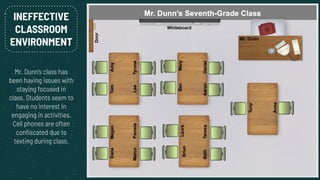
INEFFECTIVE
CLASSROOM
ENVIRONMENT
Mr. Dunn’s class has
been having issues with
staying focused in
class. Students seem to
have no interest in
engaging in activities.
Cell phones are often
confiscated due to
texting during class.
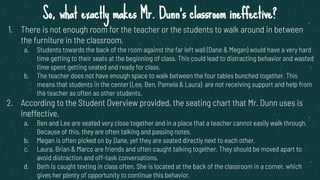
So, what exactly makes Mr. Dunn’s classroom ineffective?
1. There is not enough room for the teacher or the students to walk around in between
the furniture in the classroom.
a. Students towards the back of the room against the far left wall (Dane & Megan) would have a very hard
time getting to their seats at the beginning of class. This could lead to distracting behavior and wasted
time spent getting seated and ready for class.
b. The teacher does not have enough space to walk between the four tables bunched together. This
means that students in the center (Lee, Ben, Pamela & Laura) are not receiving support and help from
the teacher as often as other students.
2. According to the Student Overview provided, the seating chart that Mr. Dunn uses is
ineffective.
a. Ben and Lee are seated very close together and in a place that a teacher cannot easily walk through.
Because of this, they are often talking and passing notes.
b. Megan is often picked on by Dane, yet they are seated directly next to each other.
c. Laura, Brian & Marco are friends and often caught talking together. They should be moved apart to
avoid distraction and off-task conversations.
d. Beth is caught texting in class often. She is located at the back of the classroom in a corner, which
gives her plenty of opportunity to continue this behavior.
So, what exactly makes Mr. Dunn’s classroom ineffective?
3. In Mr. Dunn’s classroom, there are several students without visual access to the
whiteboard.
a. In this classroom, almost all of the students have limited visual access to the whiteboard.
b. Tyrone and Lee will have a very difficult time seeing the board without completely turning around in
their seats.
c. Tony also cannot see the board at all without turning completely around.
4. Student groupings are unequal in Mr. Dunn’s classroom. This means that student
groups will either be unequal and students will not receive proper support, or it will
waste class time transitioning into equal groupings.
a. Most groups in Mr. Dunn’s class have four students, which is a fine number for groups. However, there is
one table on the side which only has two students. This makes things unequal, and groups would be
rearranged to a mixture of groups of three and groups of four to even out student groupings. This
would waste valuable learning time and increase the likelihood that students will engage in distracting
behavior during transition time.
Characteristics that make an effective classroom
★ An effective classroom has high student engagement.
○ Classrooms should be student-centered which indicates that the activities should be intended
towards things they are interested in. In today’s time, scholars are excited about technology so the
use of it should be used to its full capacity so that students are invested in their learning.
○ Students enjoy decision-making. When scholars are able to “choose” what assignment they
execute, they are willing instead of against assignments. Students want to show their creativity in
all ways. Students will feel as if what they want is important rather than being told to do the same
assignment as everyone else.
★ An effective classroom has clear rules and expectations.
○ Classroom rules should be thought of from the student’s perspective and their input can be
included so that everyone can be in agreeance. Scholars should know what they are doing in your
classroom and how they should act in your classroom.
○ Consequences should be clear and understandable so that scholars know what to expect when the
rules are not followed. Redirecting scholars should be consistent.
Characteristics that make an effective classroom
★ An effective classroom has persistent and successful data.
○ Assessments and its data should be communicated to scholars so they know what is expected of
them academically. Scholars should see their growth as they matriculate through the school year.
○ Scholars should know how their are being graded so they can know how to successfully be
assessed.
○ Feedback should be provided regardless if the assignment is graded or not so scholars can make
improvements and/or perfect their work.
★ An effective classroom is relatable and purposeful.
○ Building relationships with scholars should be evident. When scholars see the importance of
learning for themselves instead of everyone else, learning will not just be a routine but an
investment.
○ When content is relatable to students, the content becomes meaningful which makes the scholar
more interested. If they do not see how it pertains to them personally, they may not see why it is
being taught.
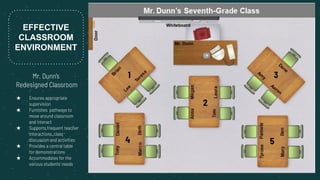
EFFECTIVE
CLASSROOM
ENVIRONMENT
Mr. Dunn’s
Redesigned Classroom
★ Ensures appropriate
supervision
★ Furnishes pathways to
move around classroom
and interact
★ Supports frequent teacher
interactions, class
discussion and activities
★ Provides a central table
for demonstrations
★ Accommodates for the
various students’ needs
1
2
3
4 5
So, what makes this new arrangement effective?
1. There is enough room for the teacher and students to walk around the classroom.
a. Scholars will be able to get to their desks easily and switch groups, if needed.
b. Mr. Dunn will be able to monitor the class and provide all scholars with the support needed.
2. The seating chart is effective for the teacher and students.
a. All scholars are able to see the whiteboard clearly from any angle of the room.
b. Scholars are placed in groups according to their achievement-levels which means groups are
intentionally thought out.
Seating Chart Info
★ High, average, and low -achieving students were interspersed throughout the seating chart
★ Seating arrangement promotes on-task student behavior
★ Students with disabilities were placed toward the front and center of the classroom
★ Helpful students were placed near low achieving students
★ Students that exhibit off-task behavior, sleep in class, or text in class were seated in highly
visible and actively engaging areas
★ Students that have difficulty expressing themselves or speaking up were seated in the front
and/or the center of the classroom
★ Negative or disruptive social interactions were diminished by separating students with a
history of such interactions
★ Every attempt was made to find appropriate and non-discriminating seating for all students
Seating Chart Rationale
★ Table 1: High, average, and low-achieving students placed together to distribute student involvement. Teresa has upfront
seating to help her attention. Brian has upfront seating near the door to prevent sleeping. Lee is seated away from Ben.
★ Table 2: Anna, a student that offers to help, is seated at the same table and nearby other tables with students that need extra
support. Meagan is seated in front of the teacher where she can better communicate when answering questions. Also, she is
seated away from Dane. Upfront seating helps to provide the necessary accommodations for Tom. Laura is seated away from
Brian and Marco.
★ Table 3: High/average-achieving and outgoing/shy students are placed together to distribute student involvement. Dane is
seated near the front of the room to prevent off-task behavior.
★ Table 4: High, average, and low-achieving are students placed together to distribute student involvement. Marco and Beth
have more opportunity for engagement near the center of the seating arrangement. Tony and Daniel will continue to ask
questions from these seats.
★ Table 5: High and average-achieving students are placed together to distribute student involvement and promote learning.
Mary may find it necessary to raise her hand from this location. Also, she may be able to focus on higher level differentiated
instruction and materials in this location. Ben is seated away from Lee. Tyrone and Pamela have more opportunity for
engagement near the center of the seating arrangement. Pam may not feel like she can sleep in this highly visible seat.
Strategies for improving an ineffective classroom environment
1. Good relationships. As a teacher get started early on creating a classroom of
community with both the teacher to students and students to students. Build
positive relationships.
2. Have clear communication. Speak the students language. Use humor,
technology, and other strategies. Meet the students at their level.
3. Trust. Let the students make choices. Let the students make decisions about
in depth study. Let them study what they are interested in.
Summary
The classroom is very important in education. Effective classrooms are organized and
are about community, effort, and learning. The way a classroom is arranged can make
the classroom effective. However, the structure of the the class and the teaching
philosophy of the teacher is just as important. In an effective classroom there should be
room for students to move, opportunities for group work, and common areas. The
teacher should be able to create ‘community’ in the classroom. The teacher should be
able to relate to all the students and help the class understand that all of the students
have strengths that can impact the community of the class. This style of learning
creates cooperative learning that encourages learning for students from all cultures and
learning styles. Learning that values what the students know yet gives them a chance to
go above and beyond. That is real education.
References
Classroom Management Stategies - pedagogiayandragogia2016.
https://sites.google.com/site/pedagogiayandragogia2016/classroom-management-stategies.
Edutopia Follow. (2015, June 4). 32 Strategies for Building a Positive Learning Environment. LinkedIn SlideShare.
https://www.slideshare.net/edutopia/32-strategies-for-building-a-positive-learning-environment.
Free Spirit Author. (2020, March 19). 10 Ways Teachers Can Create a Positive Learning Environment. Free Spirit Publishing Blog.
https://freespiritpublishingblog.com/2016/11/29/ten-ways-teachers-can-create-a-positive-learning-environment/.
Jones, V. F., & Jones, L. S. (2015). Comprehensive classroom management: creating communities of support and solving problems (11th
ed.). Pearson.

Classroom Environment Presentation

  • 1.
    Classroom Environment Presentation LearningTeam - Group 1 University of Phoenix Secondary Effective Learning Climates/APS 523v1 August 10, 2020 Dr. C. Deeter
  • 2.
    Characteristics that makean ineffective classroom: ★ An ineffective classroom will not have enough room for the teacher and students to move around. ○ By not providing space for the teacher, some students will get more attention and help from the teacher while others will not. This could lead to off-task behavior or sub-par work because a teacher is not paying attention to them often. ○ Additionally, a lack of room between furniture makes it difficult for students to get to where they need to be quickly. The longer students are up and moving, the more opportunities there are for distractions and inappropriate behavior. ★ An ineffective classroom will have a seating chart that doesn’t take into account social dynamics, academic performance, and special needs of the students. ○ Students who are talkative with each other should be seated further away from each other to minimize distractions due to off-topic conversations. ○ When teachers place higher-achieving students at the front, this leaves lower-achieving students to stagnate and not receive the level of attention and support that can help them thrive. ○ If students with special needs are not given proper accommodations, this can lead to disruptive behaviors or difficulty for them to move around as they need.
  • 3.
    Characteristics that makean ineffective classroom: ★ An ineffective classroom includes students who do not have visual access to the teacher or the whiteboard. ○ When students have their backs turned to the teacher, whiteboard, or projector, they are more likely to engage in off-task behaviors and distractions such as passing notes, texting, etc. ○ Additionally, students without visual access to the source of the lesson may miss out on important information that could lead to later frustration and declining academic performance. This means that distracting behaviors could continue into student work time because they are unsure what they are supposed to be doing or are not equipped to do it. ★ An unequal distribution of students across work tables, or a need for a lot of moving around to create equal groupings is another factor in an ineffective classroom. ○ If students are not in groups of equal sizes, this will lead to difficulty in student collaboration and inequity in the support that students will have. Additionally, larger group sizes could lead to disruptive behaviors. ○ If students must do a lot of moving or rearranging in order to be in equally sized groupings, this takes up valuable learning time and provides opportunities for distractions and inappropriate behaviors.
  • 4.
    INEFFECTIVE CLASSROOM ENVIRONMENT Mr. Dunn’s classhas been having issues with staying focused in class. Students seem to have no interest in engaging in activities. Cell phones are often confiscated due to texting during class.
  • 5.
    So, what exactlymakes Mr. Dunn’s classroom ineffective? 1. There is not enough room for the teacher or the students to walk around in between the furniture in the classroom. a. Students towards the back of the room against the far left wall (Dane & Megan) would have a very hard time getting to their seats at the beginning of class. This could lead to distracting behavior and wasted time spent getting seated and ready for class. b. The teacher does not have enough space to walk between the four tables bunched together. This means that students in the center (Lee, Ben, Pamela & Laura) are not receiving support and help from the teacher as often as other students. 2. According to the Student Overview provided, the seating chart that Mr. Dunn uses is ineffective. a. Ben and Lee are seated very close together and in a place that a teacher cannot easily walk through. Because of this, they are often talking and passing notes. b. Megan is often picked on by Dane, yet they are seated directly next to each other. c. Laura, Brian & Marco are friends and often caught talking together. They should be moved apart to avoid distraction and off-task conversations. d. Beth is caught texting in class often. She is located at the back of the classroom in a corner, which gives her plenty of opportunity to continue this behavior.
  • 6.
    So, what exactlymakes Mr. Dunn’s classroom ineffective? 3. In Mr. Dunn’s classroom, there are several students without visual access to the whiteboard. a. In this classroom, almost all of the students have limited visual access to the whiteboard. b. Tyrone and Lee will have a very difficult time seeing the board without completely turning around in their seats. c. Tony also cannot see the board at all without turning completely around. 4. Student groupings are unequal in Mr. Dunn’s classroom. This means that student groups will either be unequal and students will not receive proper support, or it will waste class time transitioning into equal groupings. a. Most groups in Mr. Dunn’s class have four students, which is a fine number for groups. However, there is one table on the side which only has two students. This makes things unequal, and groups would be rearranged to a mixture of groups of three and groups of four to even out student groupings. This would waste valuable learning time and increase the likelihood that students will engage in distracting behavior during transition time.
  • 7.
    Characteristics that makean effective classroom ★ An effective classroom has high student engagement. ○ Classrooms should be student-centered which indicates that the activities should be intended towards things they are interested in. In today’s time, scholars are excited about technology so the use of it should be used to its full capacity so that students are invested in their learning. ○ Students enjoy decision-making. When scholars are able to “choose” what assignment they execute, they are willing instead of against assignments. Students want to show their creativity in all ways. Students will feel as if what they want is important rather than being told to do the same assignment as everyone else. ★ An effective classroom has clear rules and expectations. ○ Classroom rules should be thought of from the student’s perspective and their input can be included so that everyone can be in agreeance. Scholars should know what they are doing in your classroom and how they should act in your classroom. ○ Consequences should be clear and understandable so that scholars know what to expect when the rules are not followed. Redirecting scholars should be consistent.
  • 8.
    Characteristics that makean effective classroom ★ An effective classroom has persistent and successful data. ○ Assessments and its data should be communicated to scholars so they know what is expected of them academically. Scholars should see their growth as they matriculate through the school year. ○ Scholars should know how their are being graded so they can know how to successfully be assessed. ○ Feedback should be provided regardless if the assignment is graded or not so scholars can make improvements and/or perfect their work. ★ An effective classroom is relatable and purposeful. ○ Building relationships with scholars should be evident. When scholars see the importance of learning for themselves instead of everyone else, learning will not just be a routine but an investment. ○ When content is relatable to students, the content becomes meaningful which makes the scholar more interested. If they do not see how it pertains to them personally, they may not see why it is being taught.
  • 9.
    EFFECTIVE CLASSROOM ENVIRONMENT Mr. Dunn’s Redesigned Classroom ★Ensures appropriate supervision ★ Furnishes pathways to move around classroom and interact ★ Supports frequent teacher interactions, class discussion and activities ★ Provides a central table for demonstrations ★ Accommodates for the various students’ needs 1 2 3 4 5
  • 10.
    So, what makesthis new arrangement effective? 1. There is enough room for the teacher and students to walk around the classroom. a. Scholars will be able to get to their desks easily and switch groups, if needed. b. Mr. Dunn will be able to monitor the class and provide all scholars with the support needed. 2. The seating chart is effective for the teacher and students. a. All scholars are able to see the whiteboard clearly from any angle of the room. b. Scholars are placed in groups according to their achievement-levels which means groups are intentionally thought out.
  • 11.
    Seating Chart Info ★High, average, and low -achieving students were interspersed throughout the seating chart ★ Seating arrangement promotes on-task student behavior ★ Students with disabilities were placed toward the front and center of the classroom ★ Helpful students were placed near low achieving students ★ Students that exhibit off-task behavior, sleep in class, or text in class were seated in highly visible and actively engaging areas ★ Students that have difficulty expressing themselves or speaking up were seated in the front and/or the center of the classroom ★ Negative or disruptive social interactions were diminished by separating students with a history of such interactions ★ Every attempt was made to find appropriate and non-discriminating seating for all students
  • 12.
    Seating Chart Rationale ★Table 1: High, average, and low-achieving students placed together to distribute student involvement. Teresa has upfront seating to help her attention. Brian has upfront seating near the door to prevent sleeping. Lee is seated away from Ben. ★ Table 2: Anna, a student that offers to help, is seated at the same table and nearby other tables with students that need extra support. Meagan is seated in front of the teacher where she can better communicate when answering questions. Also, she is seated away from Dane. Upfront seating helps to provide the necessary accommodations for Tom. Laura is seated away from Brian and Marco. ★ Table 3: High/average-achieving and outgoing/shy students are placed together to distribute student involvement. Dane is seated near the front of the room to prevent off-task behavior. ★ Table 4: High, average, and low-achieving are students placed together to distribute student involvement. Marco and Beth have more opportunity for engagement near the center of the seating arrangement. Tony and Daniel will continue to ask questions from these seats. ★ Table 5: High and average-achieving students are placed together to distribute student involvement and promote learning. Mary may find it necessary to raise her hand from this location. Also, she may be able to focus on higher level differentiated instruction and materials in this location. Ben is seated away from Lee. Tyrone and Pamela have more opportunity for engagement near the center of the seating arrangement. Pam may not feel like she can sleep in this highly visible seat.
  • 13.
    Strategies for improvingan ineffective classroom environment 1. Good relationships. As a teacher get started early on creating a classroom of community with both the teacher to students and students to students. Build positive relationships. 2. Have clear communication. Speak the students language. Use humor, technology, and other strategies. Meet the students at their level. 3. Trust. Let the students make choices. Let the students make decisions about in depth study. Let them study what they are interested in.
  • 14.
    Summary The classroom isvery important in education. Effective classrooms are organized and are about community, effort, and learning. The way a classroom is arranged can make the classroom effective. However, the structure of the the class and the teaching philosophy of the teacher is just as important. In an effective classroom there should be room for students to move, opportunities for group work, and common areas. The teacher should be able to create ‘community’ in the classroom. The teacher should be able to relate to all the students and help the class understand that all of the students have strengths that can impact the community of the class. This style of learning creates cooperative learning that encourages learning for students from all cultures and learning styles. Learning that values what the students know yet gives them a chance to go above and beyond. That is real education.
  • 15.
    References Classroom Management Stategies- pedagogiayandragogia2016. https://sites.google.com/site/pedagogiayandragogia2016/classroom-management-stategies. Edutopia Follow. (2015, June 4). 32 Strategies for Building a Positive Learning Environment. LinkedIn SlideShare. https://www.slideshare.net/edutopia/32-strategies-for-building-a-positive-learning-environment. Free Spirit Author. (2020, March 19). 10 Ways Teachers Can Create a Positive Learning Environment. Free Spirit Publishing Blog. https://freespiritpublishingblog.com/2016/11/29/ten-ways-teachers-can-create-a-positive-learning-environment/. Jones, V. F., & Jones, L. S. (2015). Comprehensive classroom management: creating communities of support and solving problems (11th ed.). Pearson.