Classification System of
Organisms
Once upon a time, all living things were
lumped together into two kingdoms,
namely plants and animals
Plant and Animal
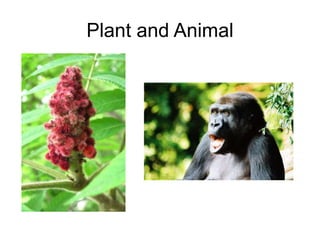
• Animals included every living thing that
moved, ate, and grew to a certain size and
stopped growing.
• Plants included every living thing that did
not move or eat and that continued to
grow throughout life.
Five Kingdom Classification
System
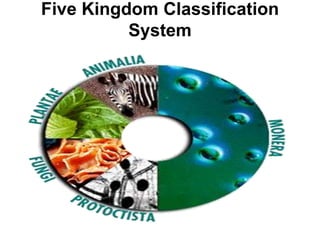
• It became very difficult to group some
living things into one or the other, so early
in the past century the two kingdoms were
expanded into five kingdoms:
• Protista (the single-celled eukaryotes);
• Fungi (fungus and related organisms);
• Plantae (the plants);
• Animalia (the animals);
• Monera (the prokaryotes).
• Kingdoms are divided into categories
called phyla, each phylum is divided into
classes, each class into orders, each order
into families, each family into genera, and
each genus into species.
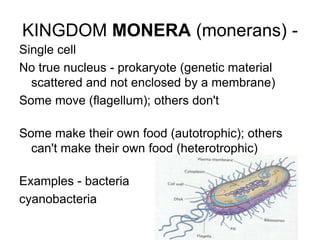
KINGDOM MONERA (monerans) -
Single cell
No true nucleus - prokaryote (genetic material
scattered and not enclosed by a membrane)
Some move (flagellum); others don't
Some make their own food (autotrophic); others
can't make their own food (heterotrophic)
Examples - bacteria
cyanobacteria
KINGDOM PROTISTA (protists)
Single cell
Have a true nucleus – eukaryote
Some move (cilia, flagella, pseudopodia);
others don't
Some are autotrophic; others are
heterotrophic
Examples - amoeba, diatom, euglena,
paramecium, some algae (unicellular), etc
KINGDOM FUNGI
Multi cellular
Have nuclei
Mainly do not move from place to place
Heterotrophic (food is digested outside of
fungus)
Examples - mushroom, mold, puffball,
shelf/bracket fungus, yeast, etc
KINGDOM PLANTAE (plants)
Multicellular
Have nuclei
Do not move
Autotrophic
Examples - multicellular algae, mosses,
ferns, flowering plants (dandelions, roses,
etc.), trees, etc
KINGDOM ANIMALIA (animals )
Multicellular
Have nuclei
Do move
Heterotrophic
Examples - sponge, jellyfish, insect, fish,
frog, bird, man
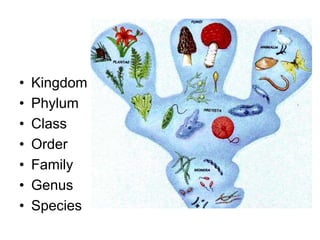
• Kingdom
• Phylum
• Class
• Order
• Family
• Genus
• Species
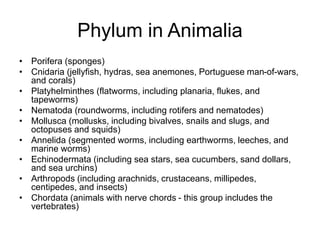
Phylum in Animalia
• Porifera (sponges)
• Cnidaria (jellyfish, hydras, sea anemones, Portuguese man-of-wars,
and corals)
• Platyhelminthes (flatworms, including planaria, flukes, and
tapeworms)
• Nematoda (roundworms, including rotifers and nematodes)
• Mollusca (mollusks, including bivalves, snails and slugs, and
octopuses and squids)
• Annelida (segmented worms, including earthworms, leeches, and
marine worms)
• Echinodermata (including sea stars, sea cucumbers, sand dollars,
and sea urchins)
• Arthropods (including arachnids, crustaceans, millipedes,
centipedes, and insects)
• Chordata (animals with nerve chords - this group includes the
vertebrates)
Classes in Cordata
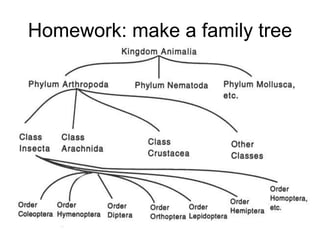
Homework: make a family tree
Homework
List of organisms:
Worm, turtle, mouse, centipede, kangaroo,
jellyfish, spider, horse, frog, snake, bird,
cow, whale, shark, gold fish, coral,
Squirrel, dolphin, beetle, snail, starfish and
sponge.
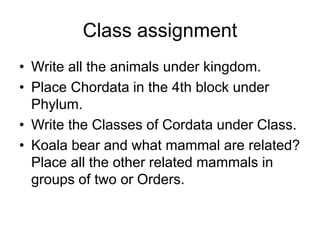
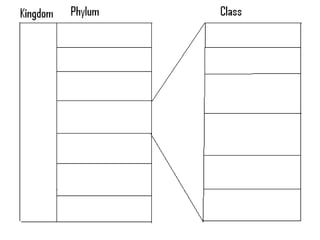
Class assignment
• Write all the animals under kingdom.
• Place Chordata in the 4th block under
Phylum.
• Write the Classes of Cordata under Class.
• Koala bear and what mammal are related?
Place all the other related mammals in
groups of two or Orders.
Orders
#1 #2 #3 #4

Classification.ppt

  • 2.
    Classification System of Organisms Onceupon a time, all living things were lumped together into two kingdoms, namely plants and animals
  • 3.
  • 4.
    • Animals includedevery living thing that moved, ate, and grew to a certain size and stopped growing. • Plants included every living thing that did not move or eat and that continued to grow throughout life.
  • 5.
  • 6.
    • It becamevery difficult to group some living things into one or the other, so early in the past century the two kingdoms were expanded into five kingdoms: • Protista (the single-celled eukaryotes); • Fungi (fungus and related organisms); • Plantae (the plants); • Animalia (the animals); • Monera (the prokaryotes).
  • 7.
    • Kingdoms aredivided into categories called phyla, each phylum is divided into classes, each class into orders, each order into families, each family into genera, and each genus into species.
  • 8.
    KINGDOM MONERA (monerans)- Single cell No true nucleus - prokaryote (genetic material scattered and not enclosed by a membrane) Some move (flagellum); others don't Some make their own food (autotrophic); others can't make their own food (heterotrophic) Examples - bacteria cyanobacteria
  • 9.
    KINGDOM PROTISTA (protists) Singlecell Have a true nucleus – eukaryote Some move (cilia, flagella, pseudopodia); others don't Some are autotrophic; others are heterotrophic Examples - amoeba, diatom, euglena, paramecium, some algae (unicellular), etc
  • 10.
    KINGDOM FUNGI Multi cellular Havenuclei Mainly do not move from place to place Heterotrophic (food is digested outside of fungus) Examples - mushroom, mold, puffball, shelf/bracket fungus, yeast, etc
  • 11.
    KINGDOM PLANTAE (plants) Multicellular Havenuclei Do not move Autotrophic Examples - multicellular algae, mosses, ferns, flowering plants (dandelions, roses, etc.), trees, etc
  • 12.
    KINGDOM ANIMALIA (animals) Multicellular Have nuclei Do move Heterotrophic Examples - sponge, jellyfish, insect, fish, frog, bird, man
  • 13.
    • Kingdom • Phylum •Class • Order • Family • Genus • Species
  • 14.
    Phylum in Animalia •Porifera (sponges) • Cnidaria (jellyfish, hydras, sea anemones, Portuguese man-of-wars, and corals) • Platyhelminthes (flatworms, including planaria, flukes, and tapeworms) • Nematoda (roundworms, including rotifers and nematodes) • Mollusca (mollusks, including bivalves, snails and slugs, and octopuses and squids) • Annelida (segmented worms, including earthworms, leeches, and marine worms) • Echinodermata (including sea stars, sea cucumbers, sand dollars, and sea urchins) • Arthropods (including arachnids, crustaceans, millipedes, centipedes, and insects) • Chordata (animals with nerve chords - this group includes the vertebrates)
  • 15.
  • 16.
    Homework: make afamily tree
  • 17.
    Homework List of organisms: Worm,turtle, mouse, centipede, kangaroo, jellyfish, spider, horse, frog, snake, bird, cow, whale, shark, gold fish, coral, Squirrel, dolphin, beetle, snail, starfish and sponge.
  • 18.
    Class assignment • Writeall the animals under kingdom. • Place Chordata in the 4th block under Phylum. • Write the Classes of Cordata under Class. • Koala bear and what mammal are related? Place all the other related mammals in groups of two or Orders.
  • 20.