

E ssay  S tyles by Piet van der Laan
C ommon  E ssay  S tyles L ogical division of ideas essays P rocess essays C ause/effect essays C omparison/contrast essays
P rocess  E ssays C hronological   Order is: A  way of organizing ideas in the order of their occurrence in time.
P rocess  E ssays T his type of essay is used to: E xplain processes E xplain procedures
P rocess  E ssays H ow to organize this essay D iscuss the steps in your process in the order in which they occur. Divide the steps into separate paragraphs where natural breaks or groups of steps occur.
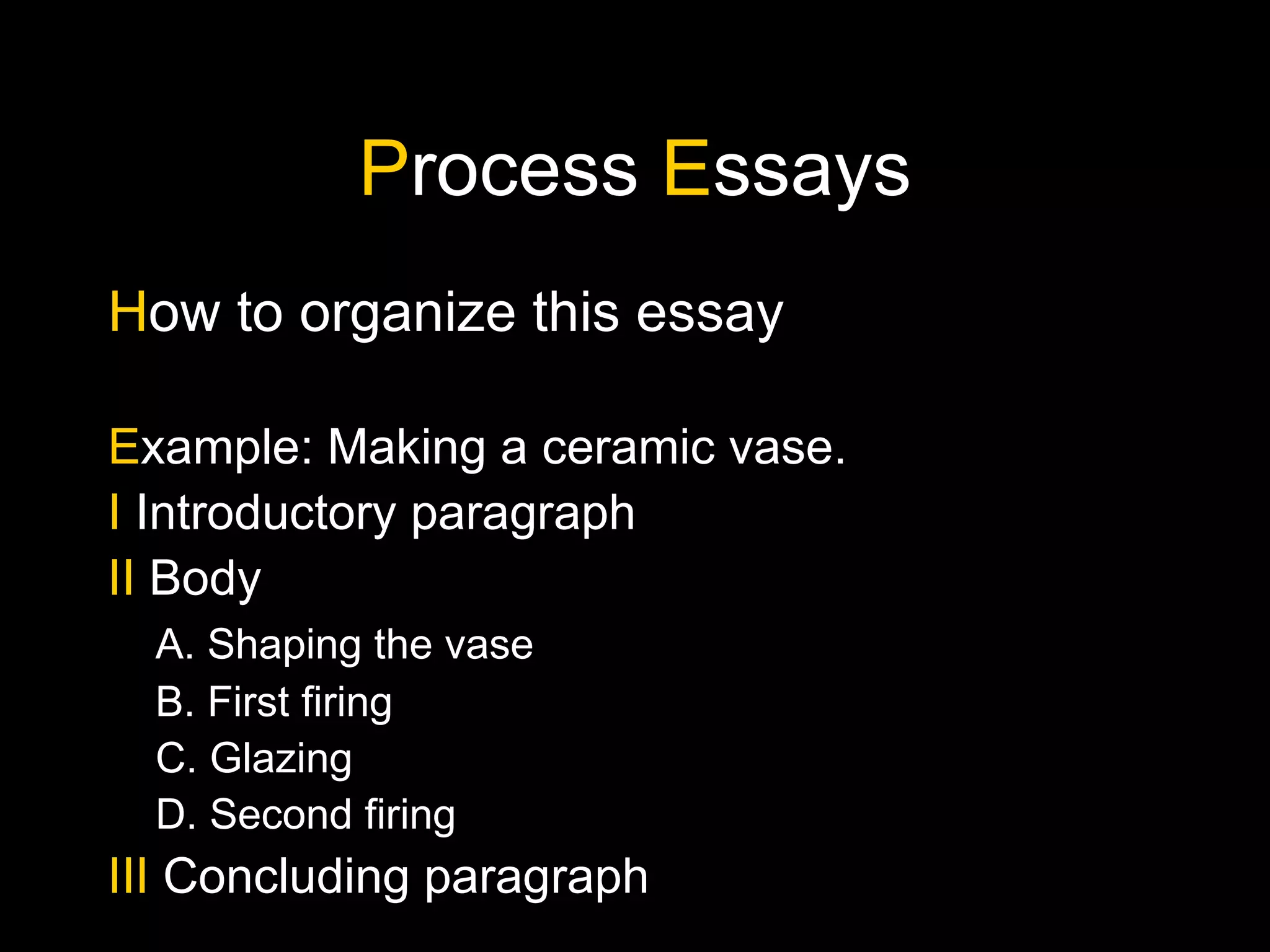
P rocess  E ssays H ow to organize this essay E xample: Making a ceramic vase. I  Introductory paragraph II  Body A. Shaping the vase B. First firing C. Glazing D. Second firing III  Concluding paragraph
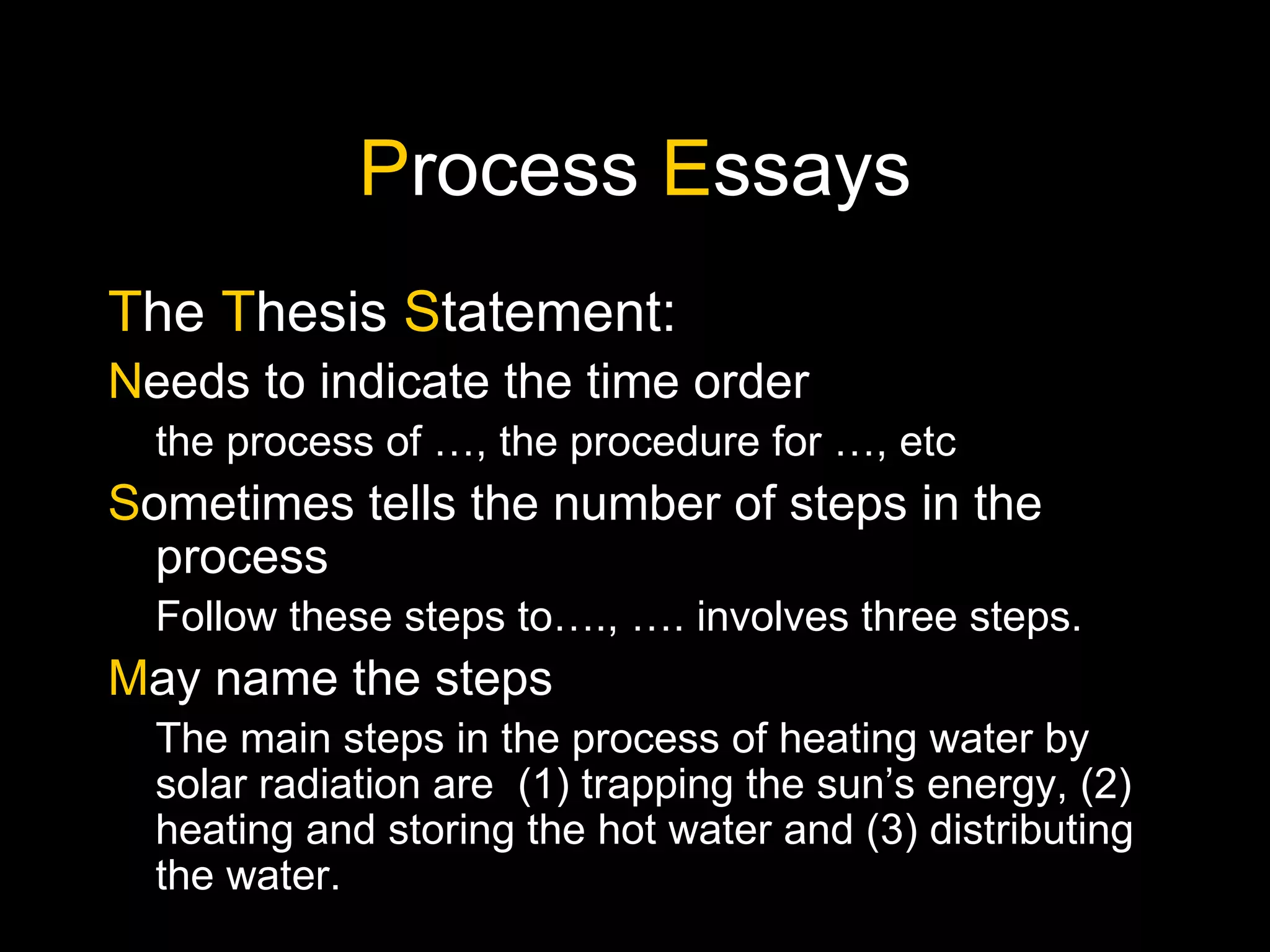
P rocess  E ssays T he  T hesis  S tatement: N eeds to indicate the time order the process of …, the procedure for …, etc S ometimes tells the number of steps in the process Follow these steps to…., …. involves three steps. M ay name the steps The main steps in the process of heating water by solar radiation are  (1) trapping the sun’s energy, (2) heating and storing the hot water and (3) distributing the water.
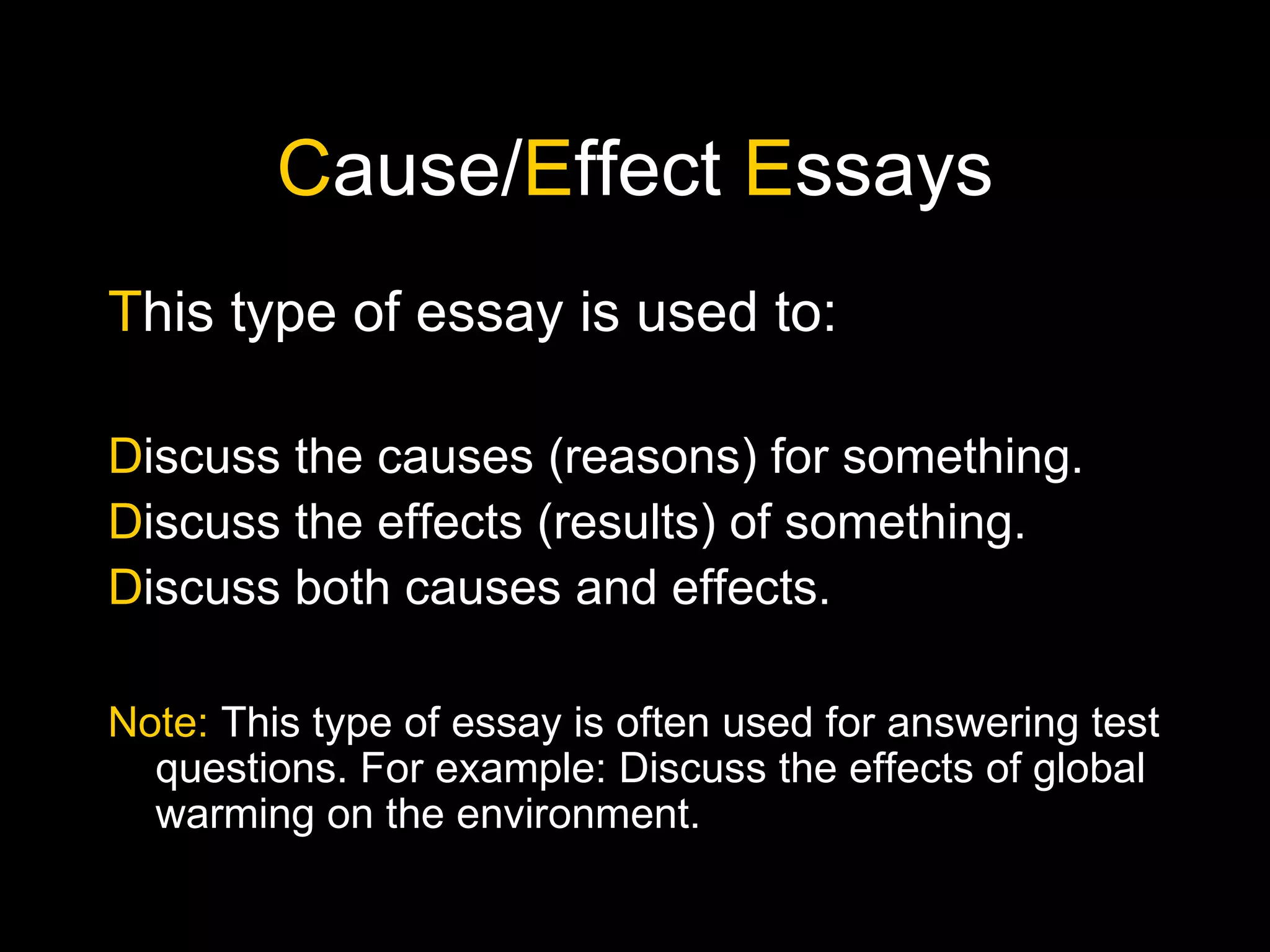
C ause/ E ffect  E ssays T his type of essay is used to: D iscuss the causes (reasons) for something. D iscuss the effects (results) of something. D iscuss both causes and effects. Note:  This type of essay is often used for answering test questions. For example: Discuss the effects of global warming on the environment.
C ause/ E ffect  E ssays H ow to organize this essay: B lock organization C hain organization
C ause/ E ffect  E ssays B lock  O rganization D iscuss all the causes as a block. (one paragraph for each cause) D iscuss all the effects as a block.  Y ou can also discuss only effects or only causes. S ometimes you need a transition paragraph to conclude a section and introduce another section.
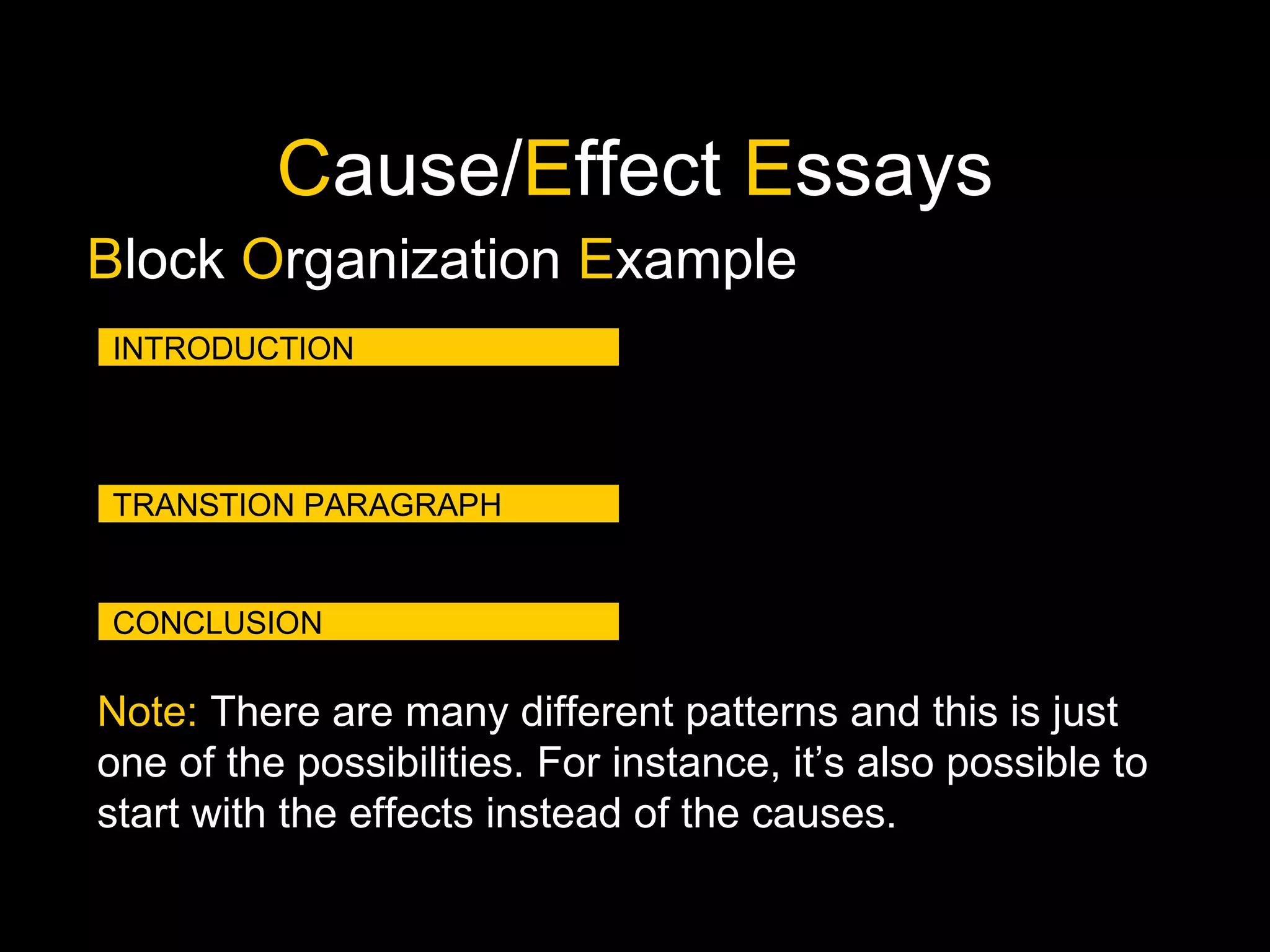
C ause/ E ffect  E ssays B lock  O rganization  E xample Note:  There are many different patterns and this is just one of the possibilities. For instance, it’s also possible to start with the effects instead of the causes.
C ause/ E ffect  E ssays C hain  O rganization T he causes and effects are linked to each other in a chain. O ne event causes a second event, which leads to a third event, and so on. E ach cause and its effect are links in the chain Y ou can devote either one or more links to one paragraph.
C ause/ E ffect  E ssays C hain  O rganization  E xample
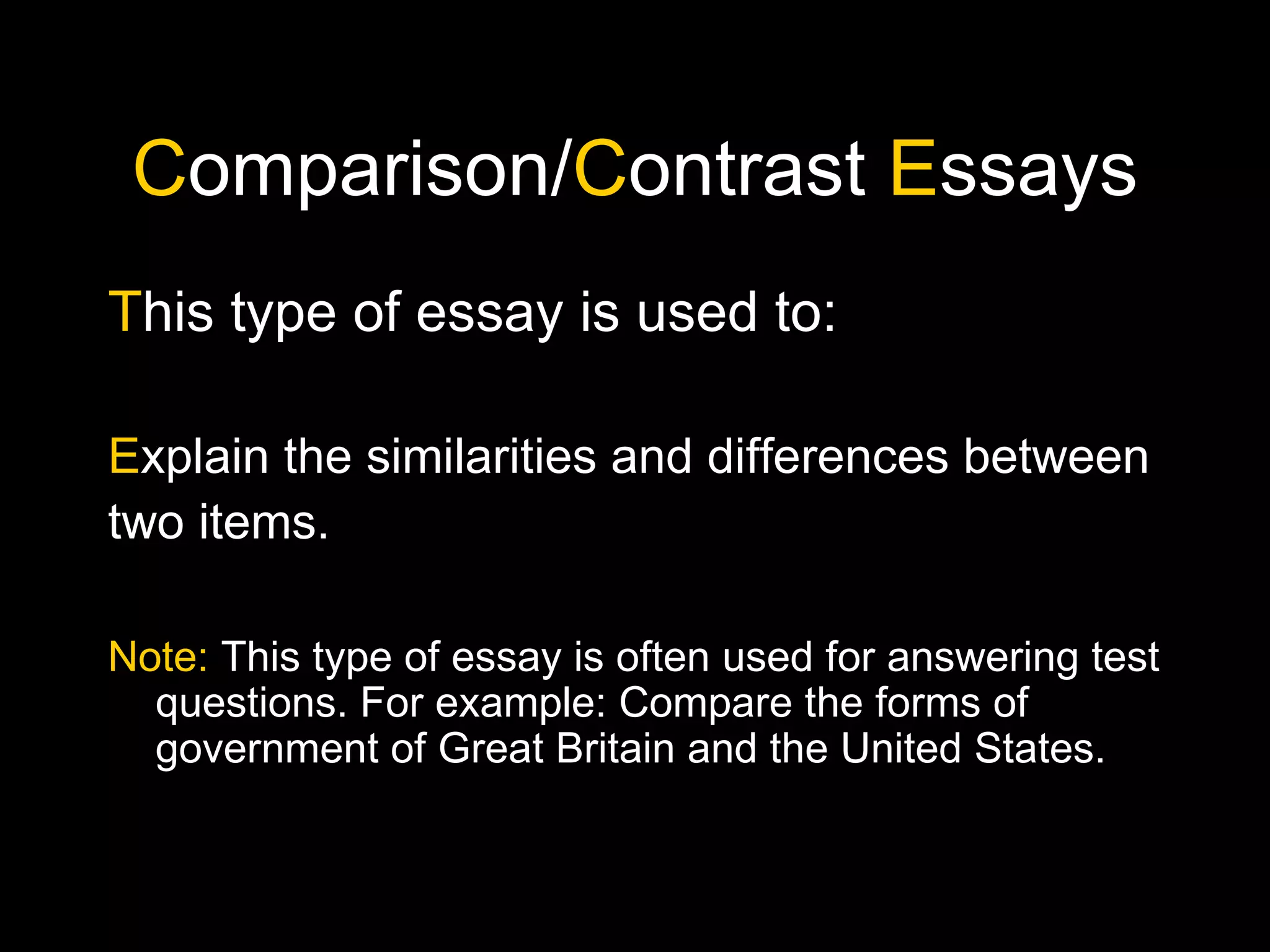
C omparison/ C ontrast  E ssays T his type of essay is used to: E xplain the similarities and differences between two items. Note:  This type of essay is often used for answering test questions. For example: Compare the forms of government of Great Britain and the United States.
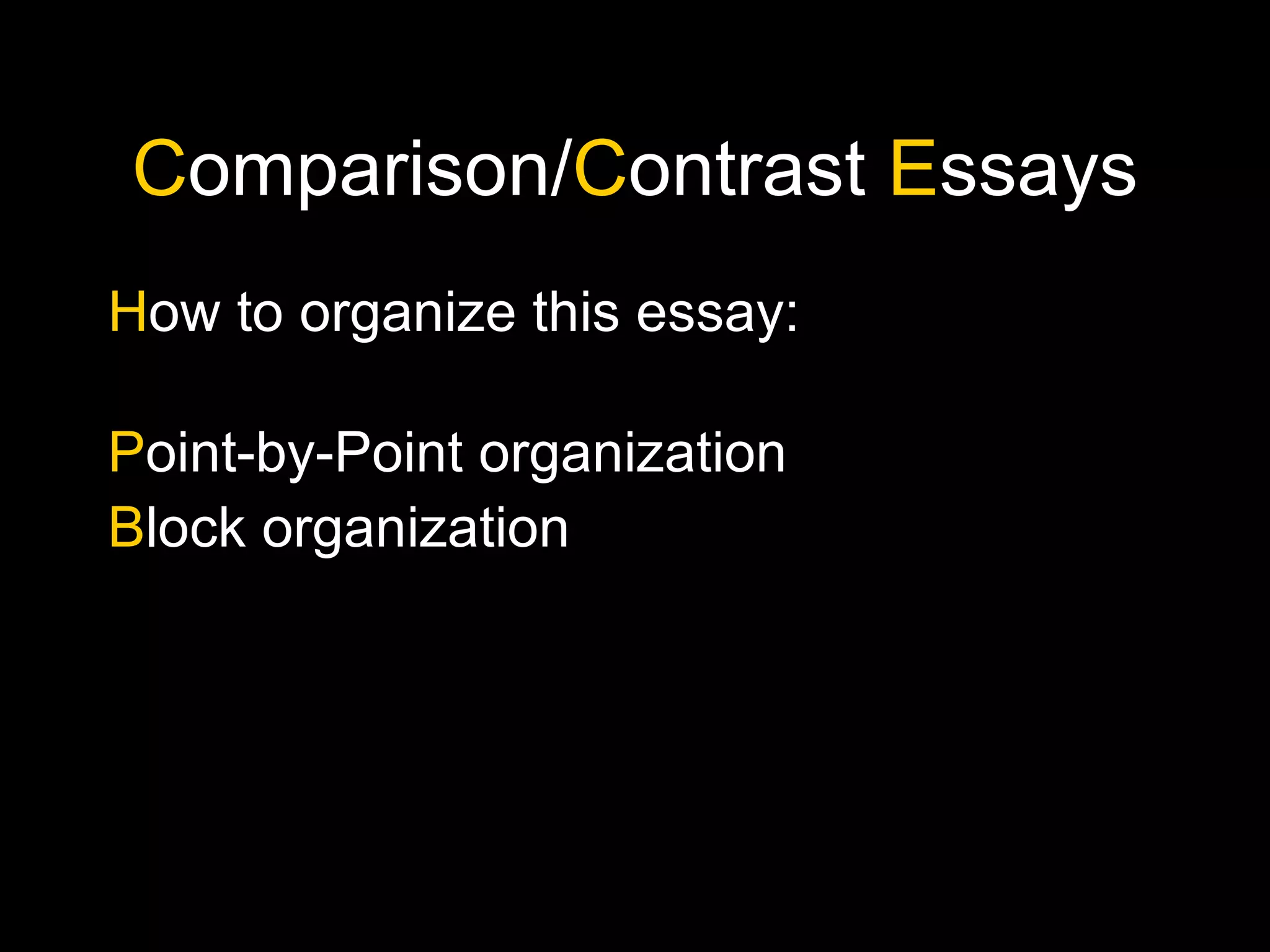
C omparison/ C ontrast  E ssays H ow to organize this essay: P oint-by-Point   organization B lock organization
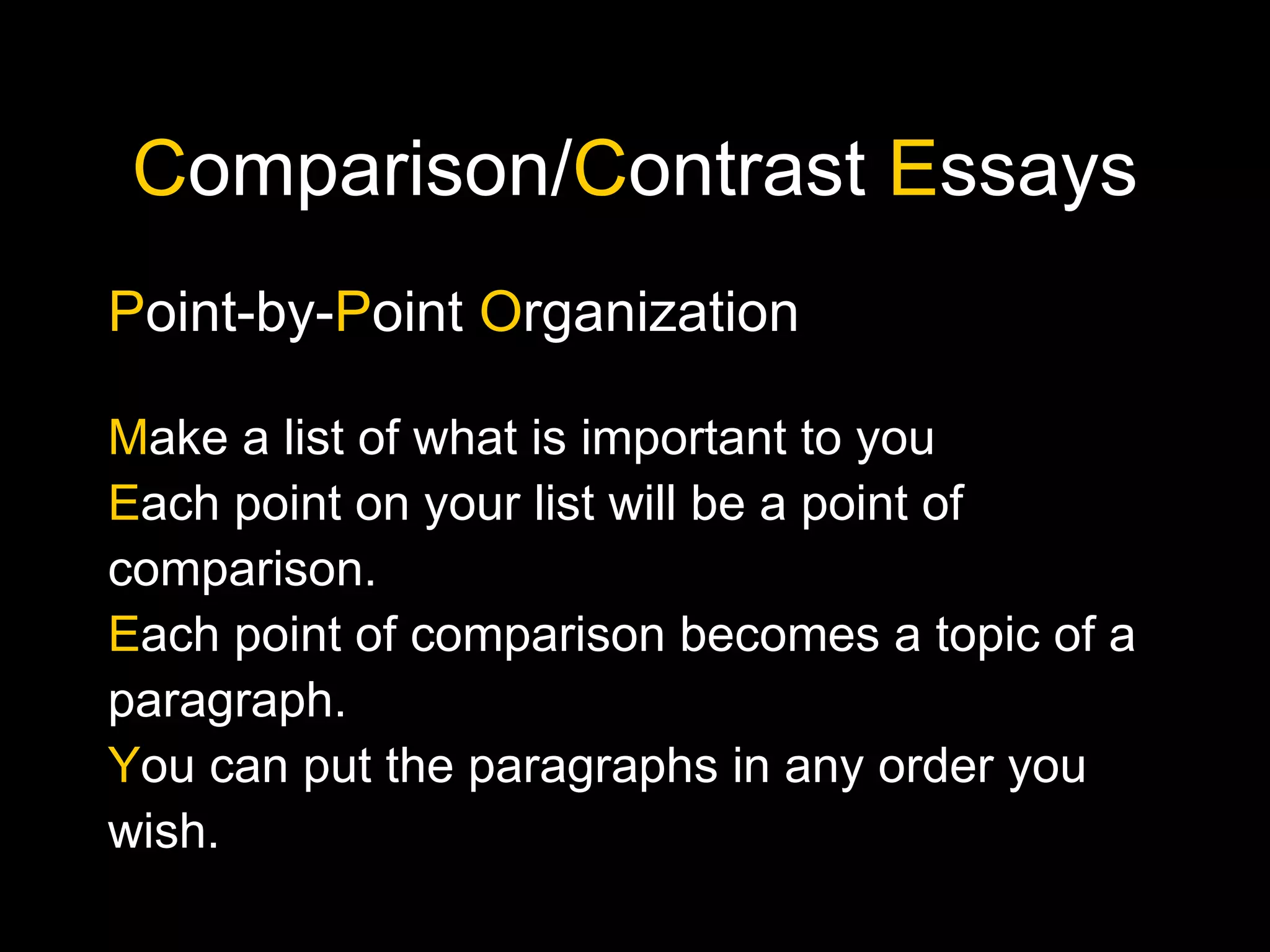
C omparison/ C ontrast  E ssays P oint-by- P oint  O rganization M ake a list of what is important to you E ach point on your list will be a point of comparison. E ach point of comparison becomes a topic of a paragraph. Y ou can put the paragraphs in any order you wish.
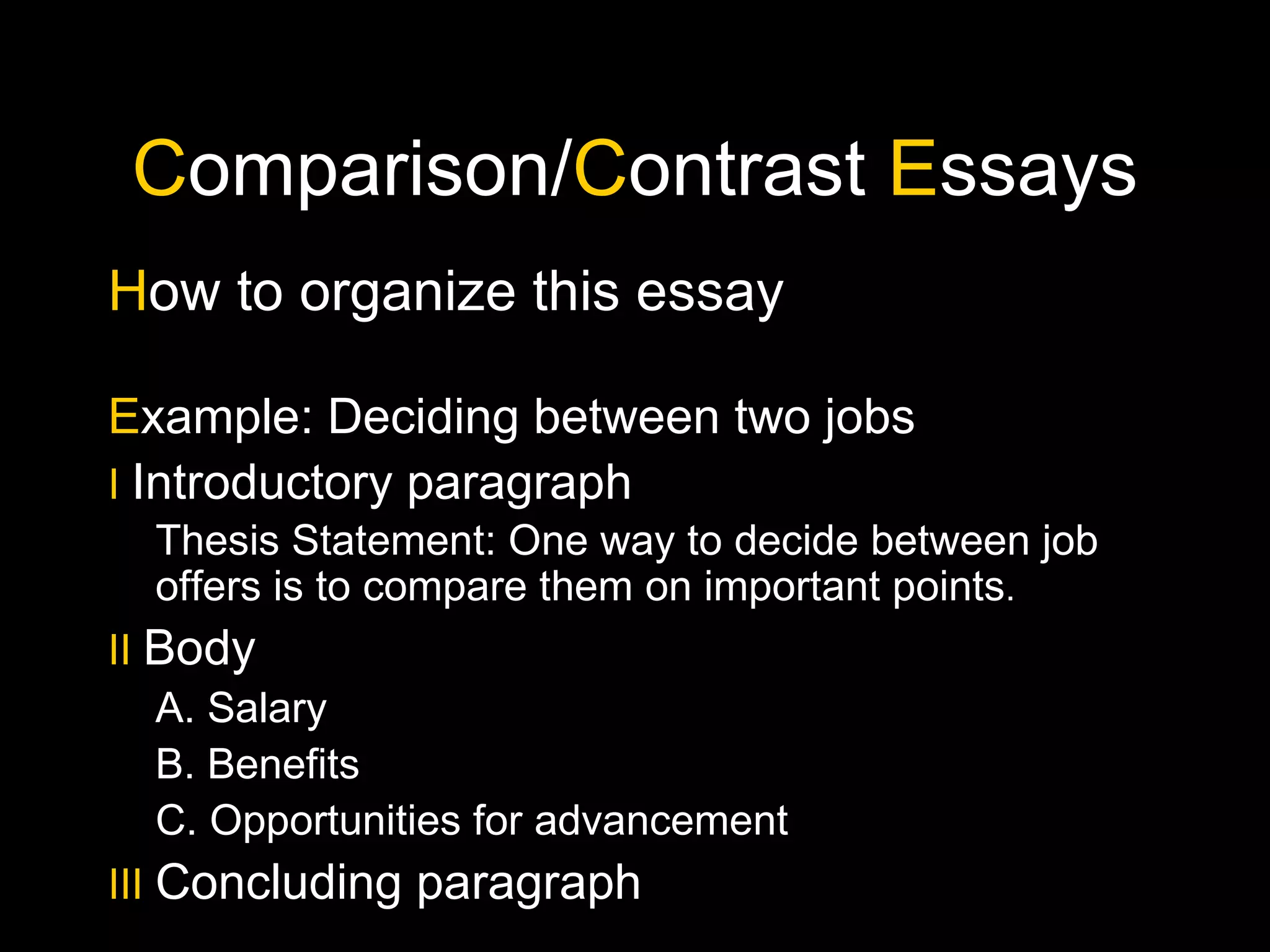
C omparison/ C ontrast  E ssays H ow to organize this essay E xample: Deciding between two jobs I   Introductory paragraph Thesis Statement: One way to decide between job offers is to compare them on important points . II   Body A. Salary B. Benefits C. Opportunities for advancement III   Concluding paragraph
C omparison/ C ontrast  E ssays B lock  O rganization A rrange all the similarities together in a block. A rrange all the differences together in a block. Y ou could discuss either the differences or the similarities first Y ou often insert a transition paragraph or a transition sentence between two blocks.
C omparison/ C ontrast  E ssays H ow to organize this essay E xample: Deciding between two jobs I   Introductory paragraph Thesis Statement: One way to decide between job offers is to compare them on important points. II   Body A. Similarities Benefits B. Differences Salary Opportunity for advancement III   Concluding paragraph
Q uestions?
This presentation was largely based on information taken from “Writing Academic English”  by  Alice Oshima and Ann Hogue

Essay styles

  • 1.
    E ssay S tyles by Piet van der Laan
  • 2.
    C ommon E ssay S tyles L ogical division of ideas essays P rocess essays C ause/effect essays C omparison/contrast essays
  • 3.
    P rocess E ssays C hronological Order is: A way of organizing ideas in the order of their occurrence in time.
  • 4.
    P rocess E ssays T his type of essay is used to: E xplain processes E xplain procedures
  • 5.
    P rocess E ssays H ow to organize this essay D iscuss the steps in your process in the order in which they occur. Divide the steps into separate paragraphs where natural breaks or groups of steps occur.
  • 6.
    P rocess E ssays H ow to organize this essay E xample: Making a ceramic vase. I Introductory paragraph II Body A. Shaping the vase B. First firing C. Glazing D. Second firing III Concluding paragraph
  • 7.
    P rocess E ssays T he T hesis S tatement: N eeds to indicate the time order the process of …, the procedure for …, etc S ometimes tells the number of steps in the process Follow these steps to…., …. involves three steps. M ay name the steps The main steps in the process of heating water by solar radiation are (1) trapping the sun’s energy, (2) heating and storing the hot water and (3) distributing the water.
  • 8.
    C ause/ Effect E ssays T his type of essay is used to: D iscuss the causes (reasons) for something. D iscuss the effects (results) of something. D iscuss both causes and effects. Note: This type of essay is often used for answering test questions. For example: Discuss the effects of global warming on the environment.
  • 9.
    C ause/ Effect E ssays H ow to organize this essay: B lock organization C hain organization
  • 10.
    C ause/ Effect E ssays B lock O rganization D iscuss all the causes as a block. (one paragraph for each cause) D iscuss all the effects as a block. Y ou can also discuss only effects or only causes. S ometimes you need a transition paragraph to conclude a section and introduce another section.
  • 11.
    C ause/ Effect E ssays B lock O rganization E xample Note: There are many different patterns and this is just one of the possibilities. For instance, it’s also possible to start with the effects instead of the causes.
  • 12.
    C ause/ Effect E ssays C hain O rganization T he causes and effects are linked to each other in a chain. O ne event causes a second event, which leads to a third event, and so on. E ach cause and its effect are links in the chain Y ou can devote either one or more links to one paragraph.
  • 13.
    C ause/ Effect E ssays C hain O rganization E xample
  • 14.
    C omparison/ Contrast E ssays T his type of essay is used to: E xplain the similarities and differences between two items. Note: This type of essay is often used for answering test questions. For example: Compare the forms of government of Great Britain and the United States.
  • 15.
    C omparison/ Contrast E ssays H ow to organize this essay: P oint-by-Point organization B lock organization
  • 16.
    C omparison/ Contrast E ssays P oint-by- P oint O rganization M ake a list of what is important to you E ach point on your list will be a point of comparison. E ach point of comparison becomes a topic of a paragraph. Y ou can put the paragraphs in any order you wish.
  • 17.
    C omparison/ Contrast E ssays H ow to organize this essay E xample: Deciding between two jobs I Introductory paragraph Thesis Statement: One way to decide between job offers is to compare them on important points . II Body A. Salary B. Benefits C. Opportunities for advancement III Concluding paragraph
  • 18.
    C omparison/ Contrast E ssays B lock O rganization A rrange all the similarities together in a block. A rrange all the differences together in a block. Y ou could discuss either the differences or the similarities first Y ou often insert a transition paragraph or a transition sentence between two blocks.
  • 19.
    C omparison/ Contrast E ssays H ow to organize this essay E xample: Deciding between two jobs I Introductory paragraph Thesis Statement: One way to decide between job offers is to compare them on important points. II Body A. Similarities Benefits B. Differences Salary Opportunity for advancement III Concluding paragraph
  • 20.
  • 21.
    This presentation waslargely based on information taken from “Writing Academic English” by Alice Oshima and Ann Hogue