CLASSIFICATION AND REVIEW OF
SECURITY SCHEMES
IN MOBILE COMPUTING
By: Habitamu Asimare
ID: BDU1000227PR
By:
Sathish Alampalayam Kumar
Cryptography and Network Security Paper
presentation
Contents
 Introduction
 Mobile Computing System Security
 MANET attacks
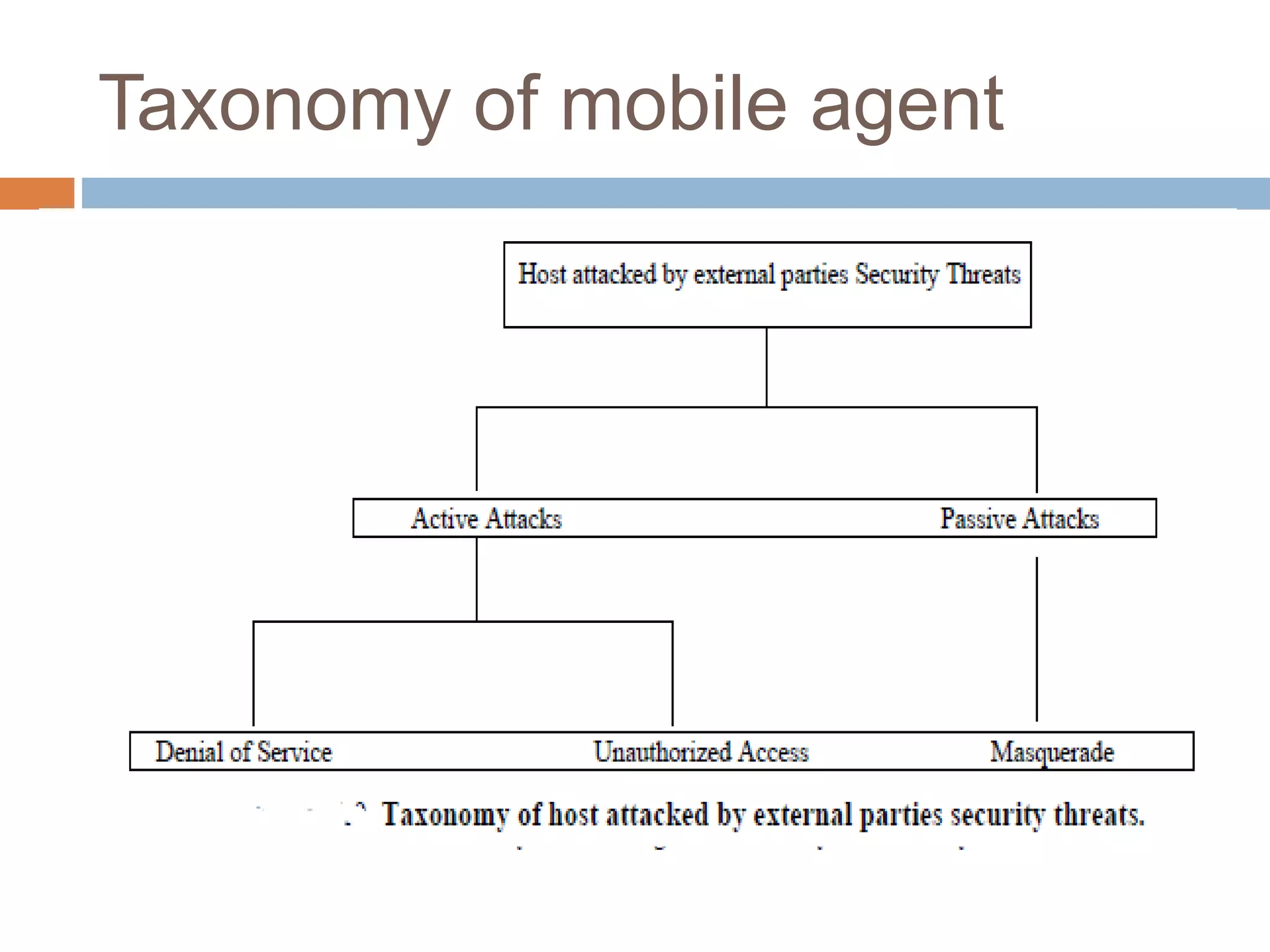
 Taxonomy of mobile agent
 MANET security approaches
 Mobile Agent Attacked by
 Another Agent ,
 Mobile agent, and
 the host
 The security research issues
 Conclusion
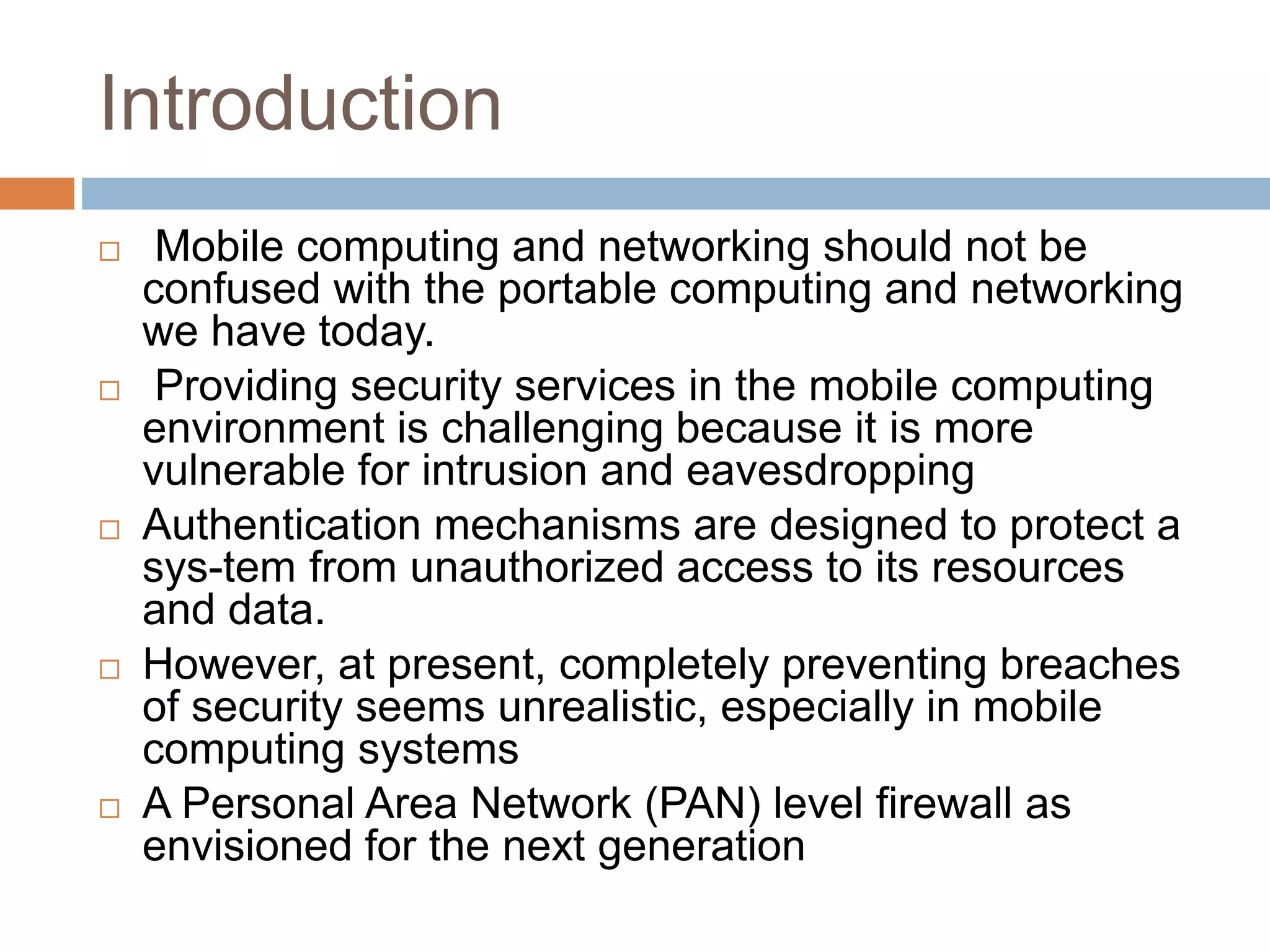
Introduction
 Mobile computing and networking should not be
confused with the portable computing and networking
we have today.
 Providing security services in the mobile computing
environment is challenging because it is more
vulnerable for intrusion and eavesdropping
 Authentication mechanisms are designed to protect a
sys-tem from unauthorized access to its resources
and data.
 However, at present, completely preventing breaches
of security seems unrealistic, especially in mobile
computing systems
 A Personal Area Network (PAN) level firewall as
envisioned for the next generation
Continued …
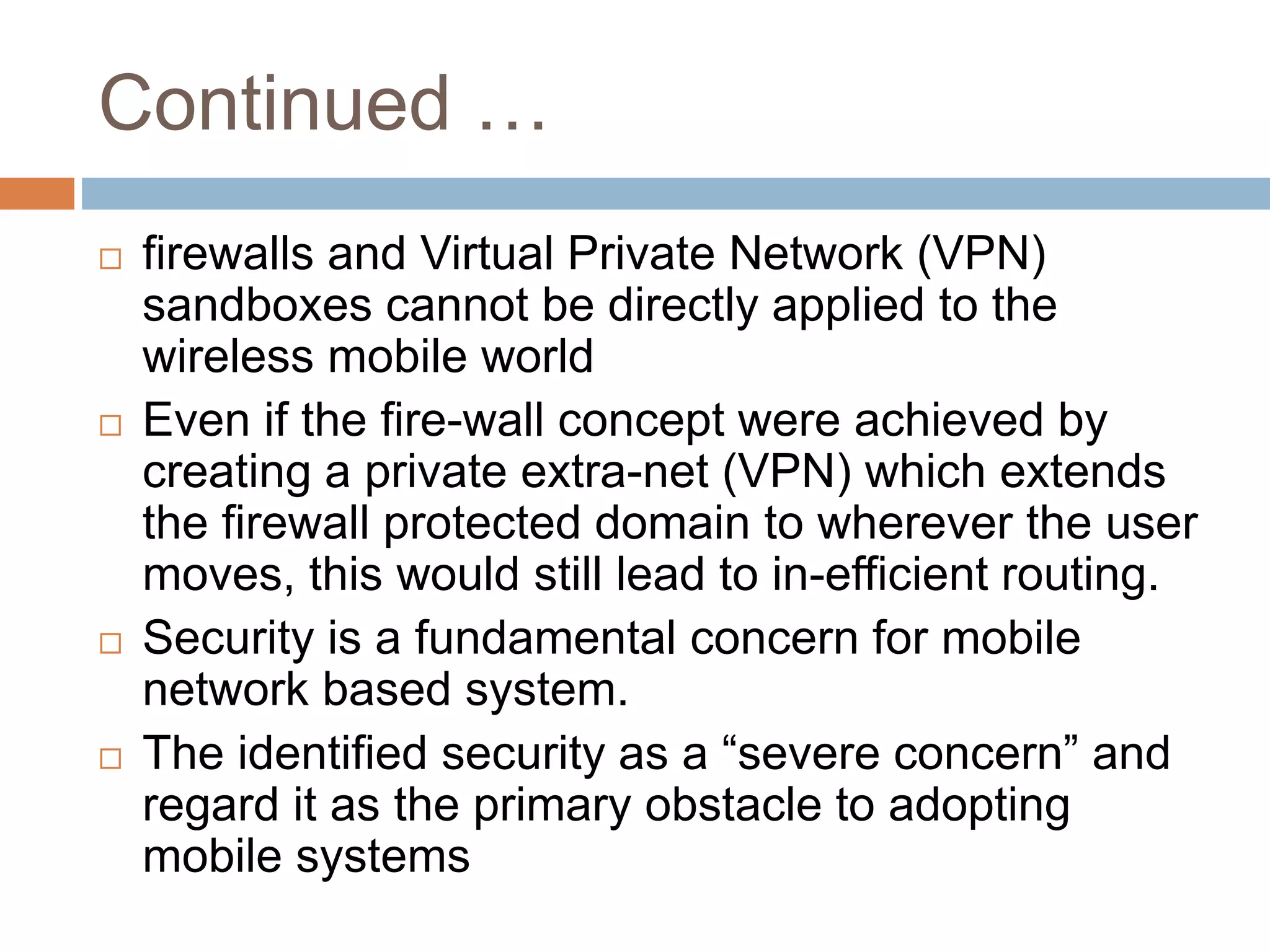
 firewalls and Virtual Private Network (VPN)
sandboxes cannot be directly applied to the
wireless mobile world
 Even if the fire-wall concept were achieved by
creating a private extra-net (VPN) which extends
the firewall protected domain to wherever the user
moves, this would still lead to in-efficient routing.
 Security is a fundamental concern for mobile
network based system.
 The identified security as a “severe concern” and
regard it as the primary obstacle to adopting
mobile systems
Mobile Computing Systems
Security
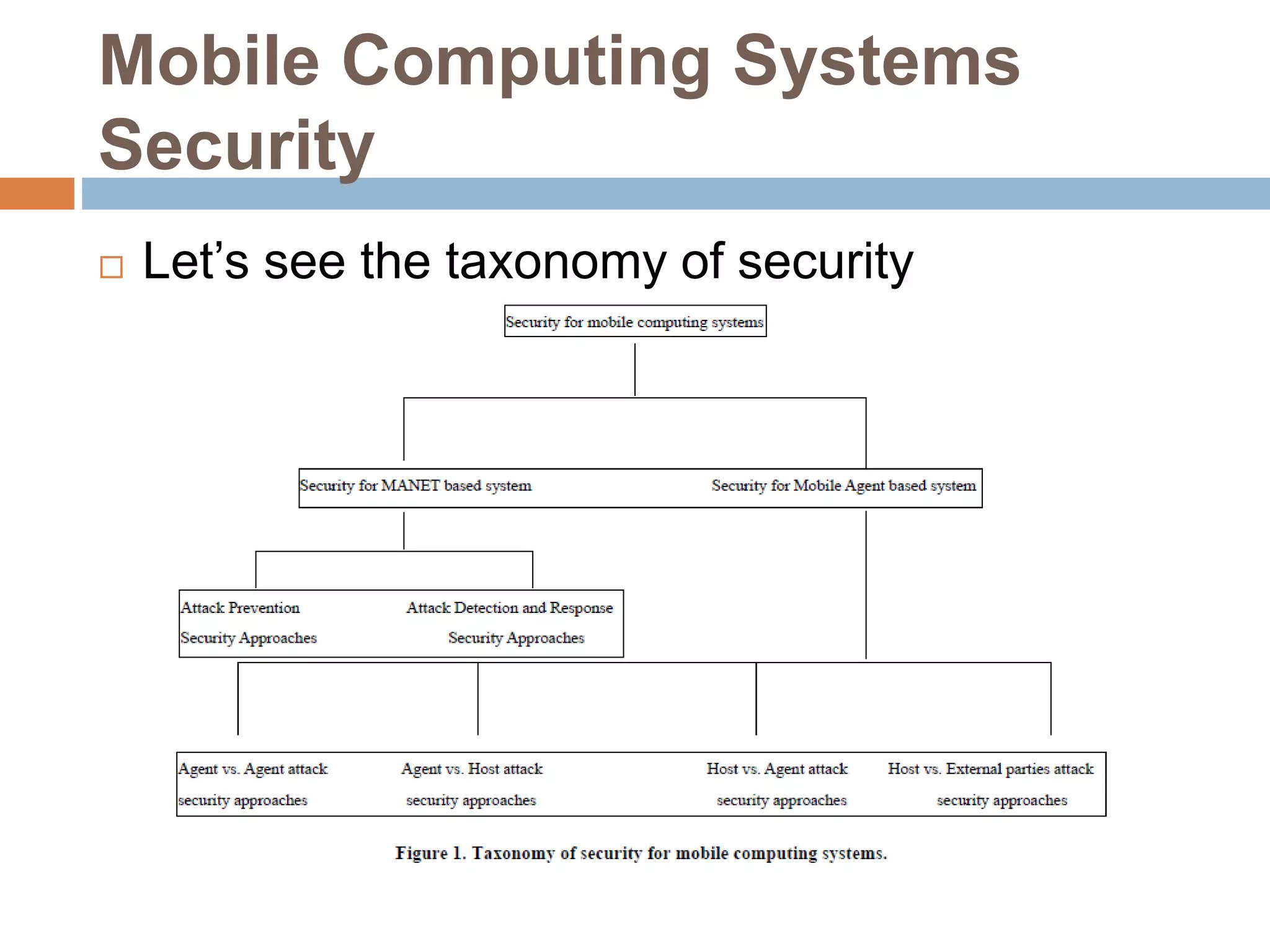
 Let’s see the taxonomy of security
Continued…
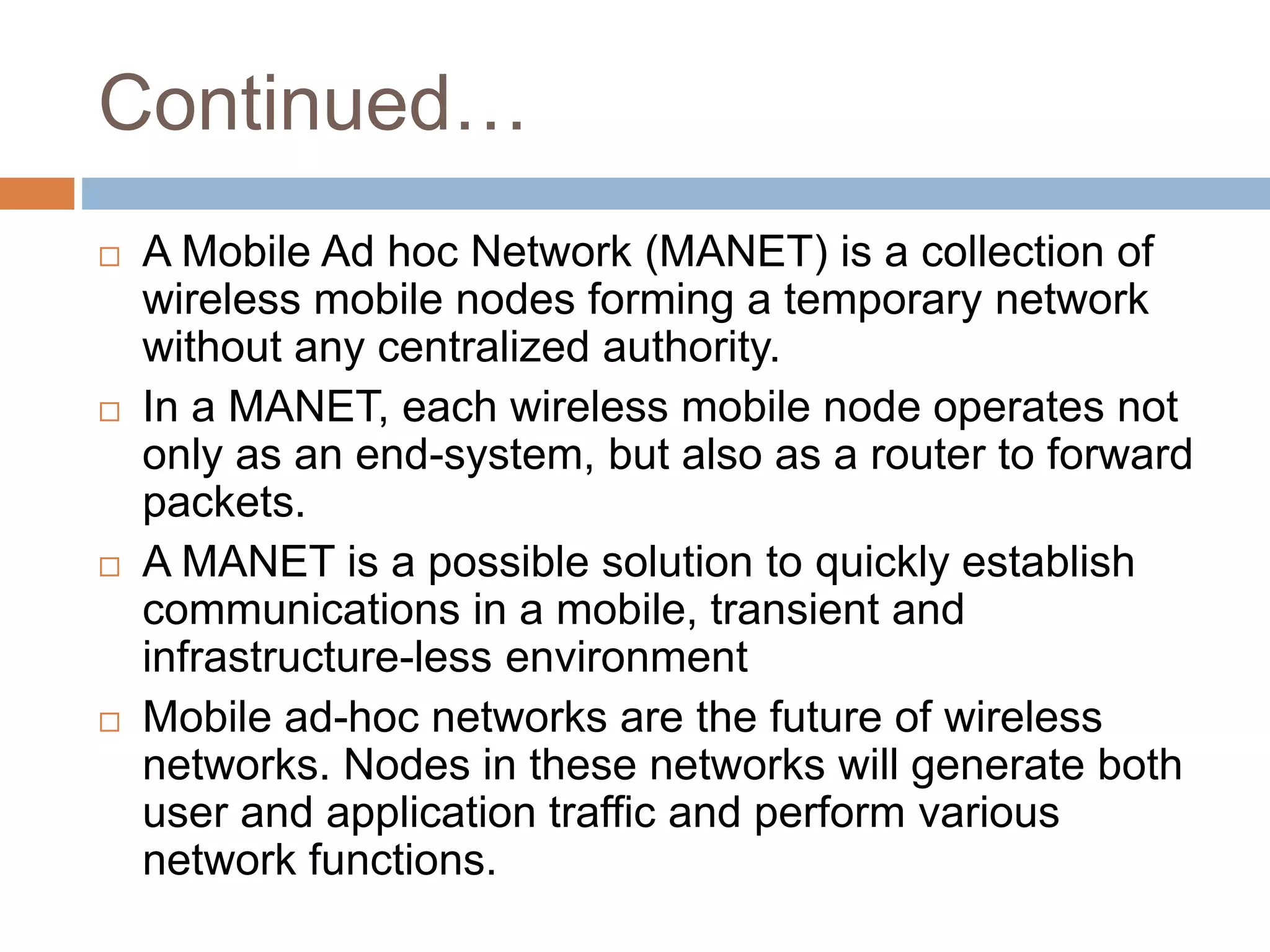
 A Mobile Ad hoc Network (MANET) is a collection of
wireless mobile nodes forming a temporary network
without any centralized authority.
 In a MANET, each wireless mobile node operates not
only as an end-system, but also as a router to forward
packets.
 A MANET is a possible solution to quickly establish
communications in a mobile, transient and
infrastructure-less environment
 Mobile ad-hoc networks are the future of wireless
networks. Nodes in these networks will generate both
user and application traffic and perform various
network functions.
Continued
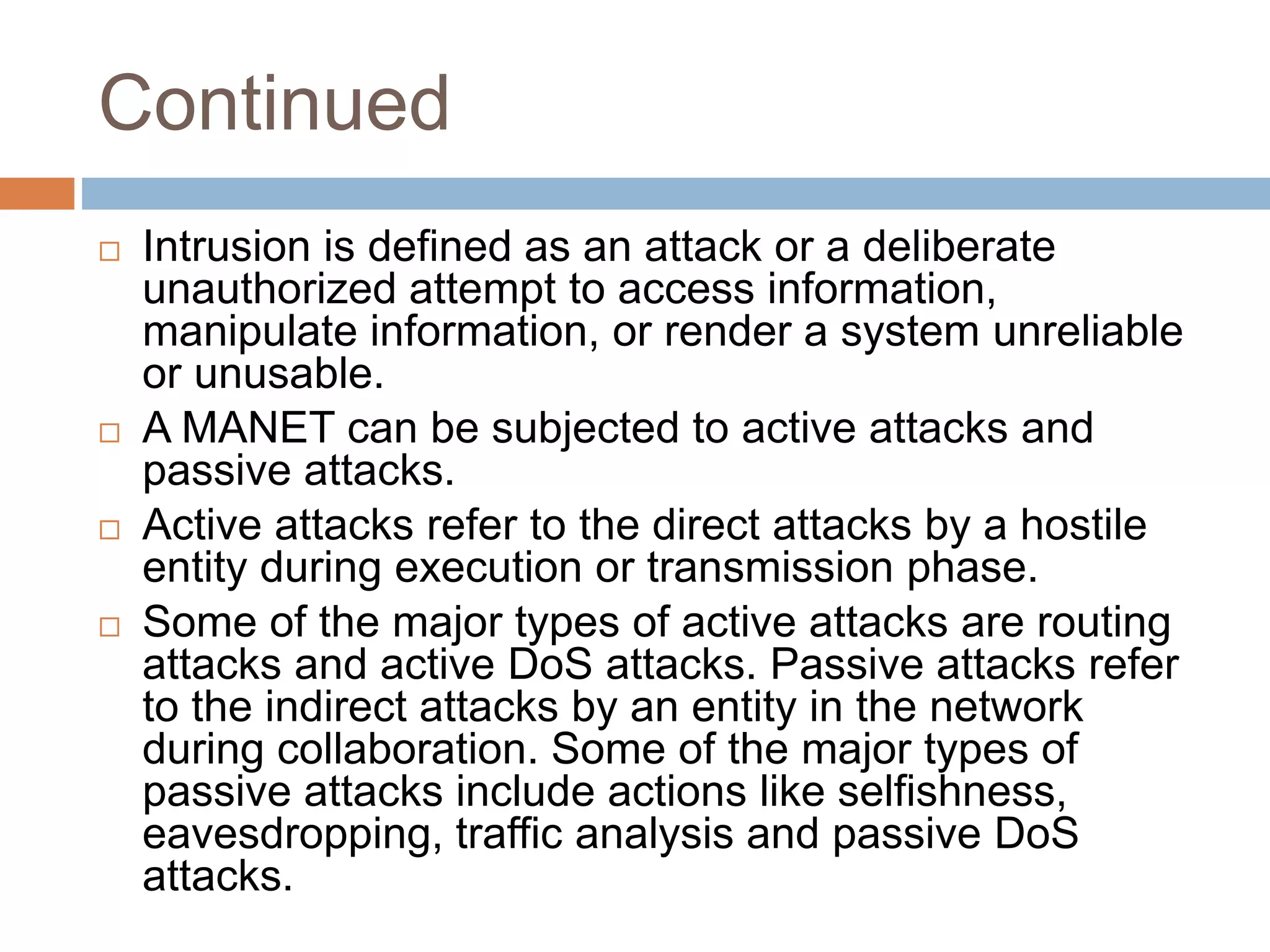
 Intrusion is defined as an attack or a deliberate
unauthorized attempt to access information,
manipulate information, or render a system unreliable
or unusable.
 A MANET can be subjected to active attacks and
passive attacks.
 Active attacks refer to the direct attacks by a hostile
entity during execution or transmission phase.
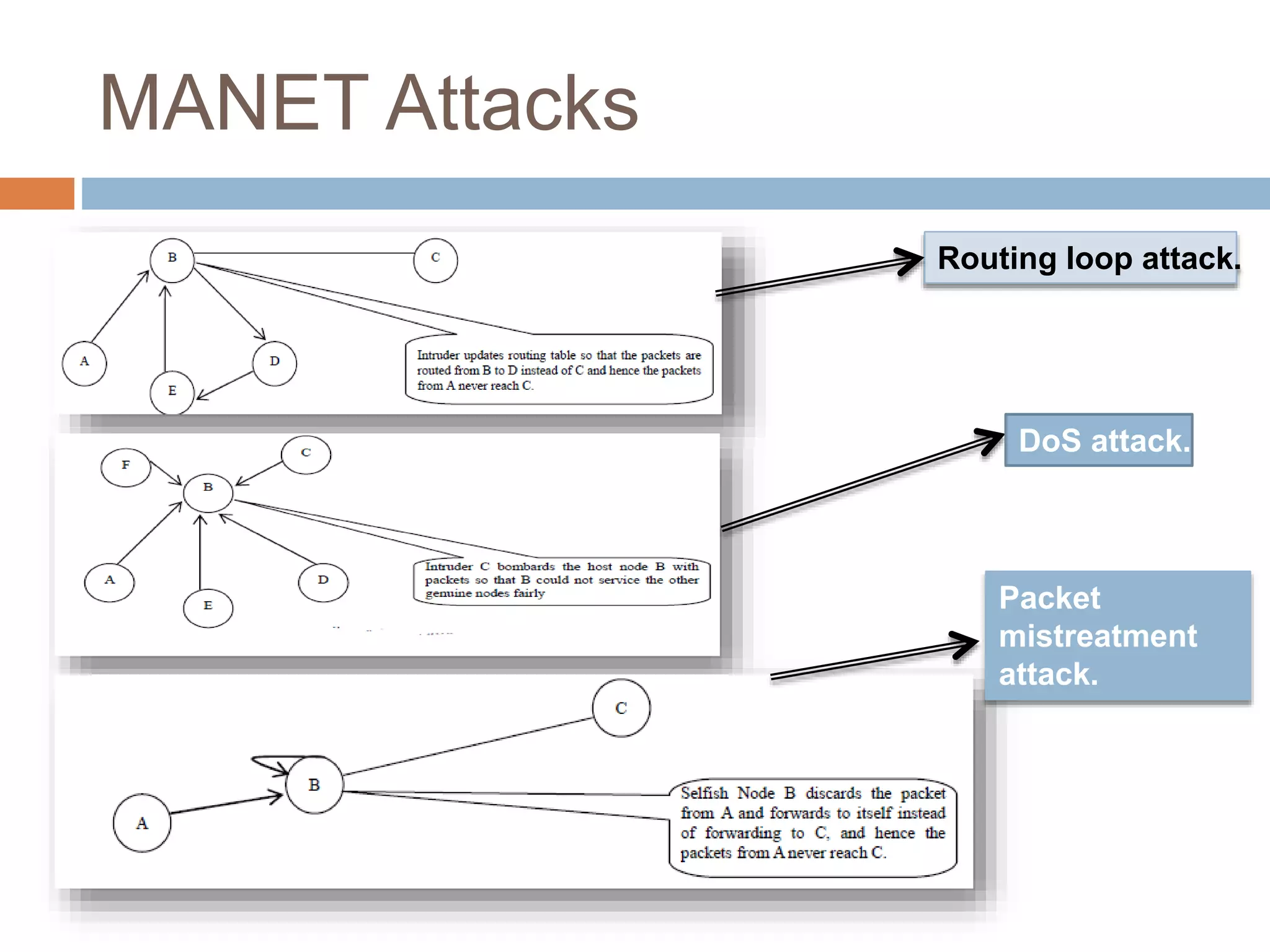
 Some of the major types of active attacks are routing
attacks and active DoS attacks. Passive attacks refer
to the indirect attacks by an entity in the network
during collaboration. Some of the major types of
passive attacks include actions like selfishness,
eavesdropping, traffic analysis and passive DoS
attacks.
MANET Attacks
Routing loop attack.
DoS attack.
Packet
mistreatment
attack.
Taxonomy of mobile agent
MANET security approaches
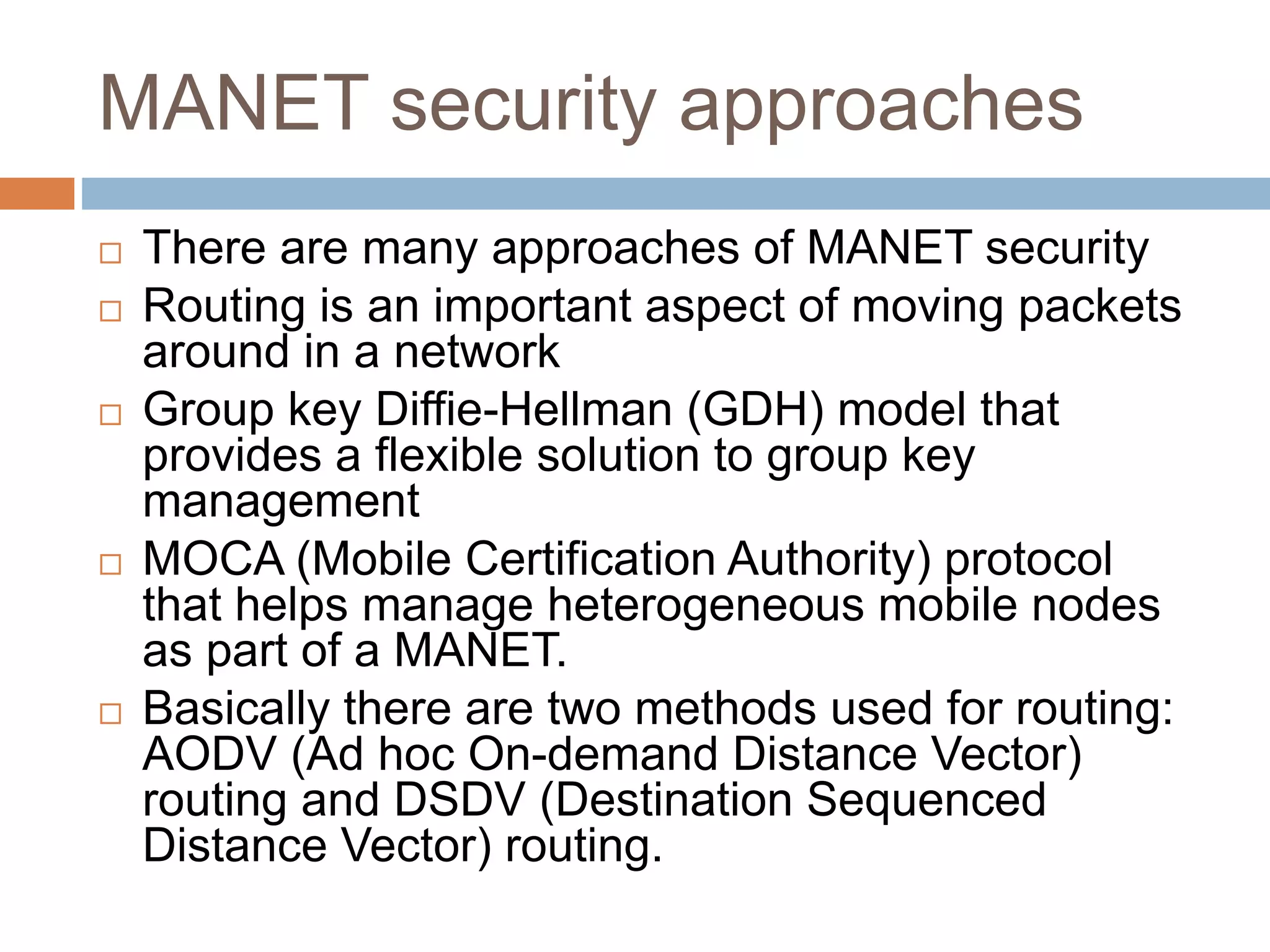
 There are many approaches of MANET security
 Routing is an important aspect of moving packets
around in a network
 Group key Diffie-Hellman (GDH) model that
provides a flexible solution to group key
management
 MOCA (Mobile Certification Authority) protocol
that helps manage heterogeneous mobile nodes
as part of a MANET.
 Basically there are two methods used for routing:
AODV (Ad hoc On-demand Distance Vector)
routing and DSDV (Destination Sequenced
Distance Vector) routing.
Continued …
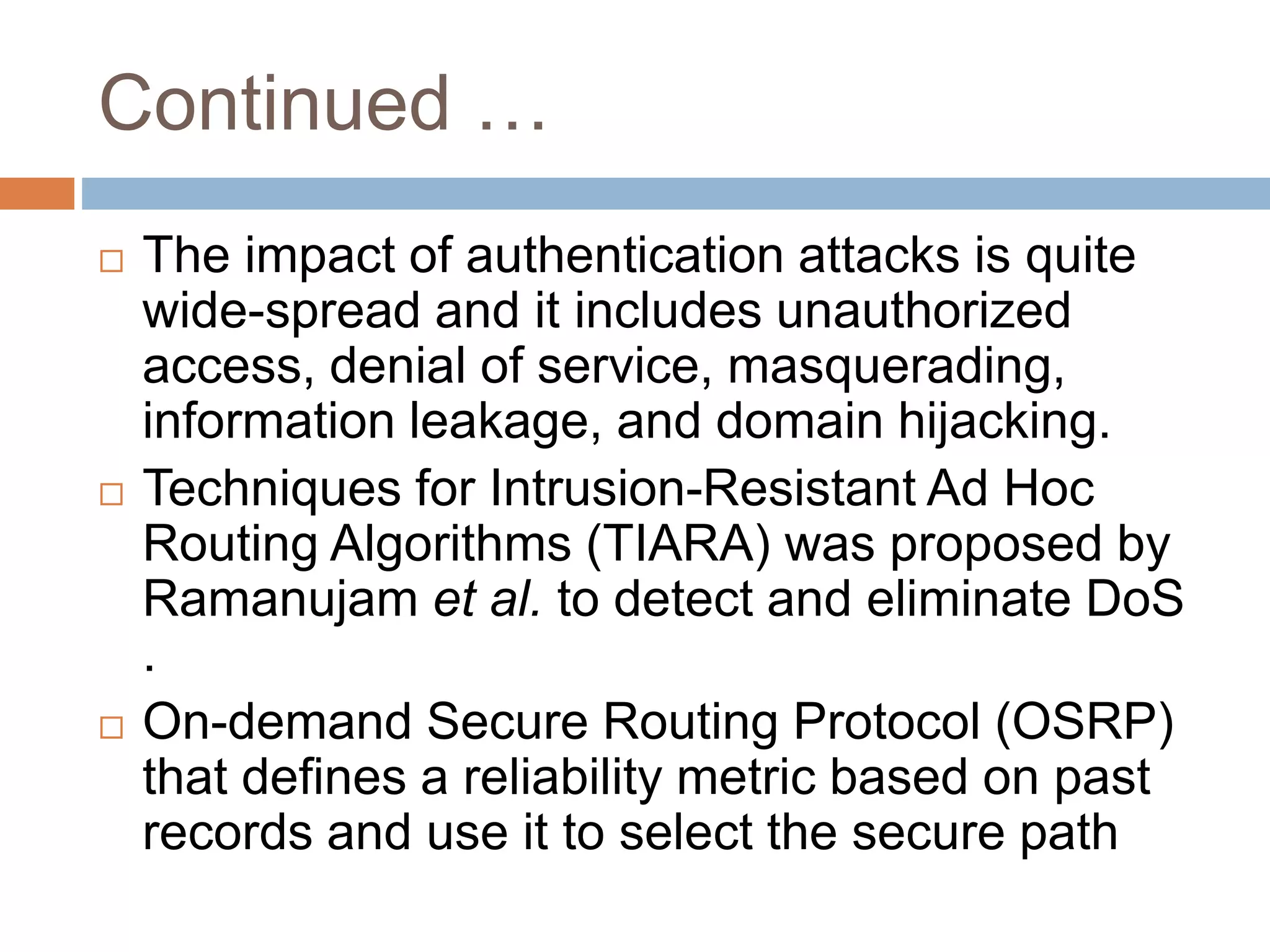
 The impact of authentication attacks is quite
wide-spread and it includes unauthorized
access, denial of service, masquerading,
information leakage, and domain hijacking.
 Techniques for Intrusion-Resistant Ad Hoc
Routing Algorithms (TIARA) was proposed by
Ramanujam et al. to detect and eliminate DoS
.
 On-demand Secure Routing Protocol (OSRP)
that defines a reliability metric based on past
records and use it to select the secure path
Continued …
 MOCA protocol do not take into account the direction of
Certification REQuests (CREQs).
 One possible solution for such a scenario is to utilize the
next hop field in the cached routing table entries.
 The SEAD approach does not incorporate mechanisms to
detect and expose nodes that advertise routes but do not
forward packets
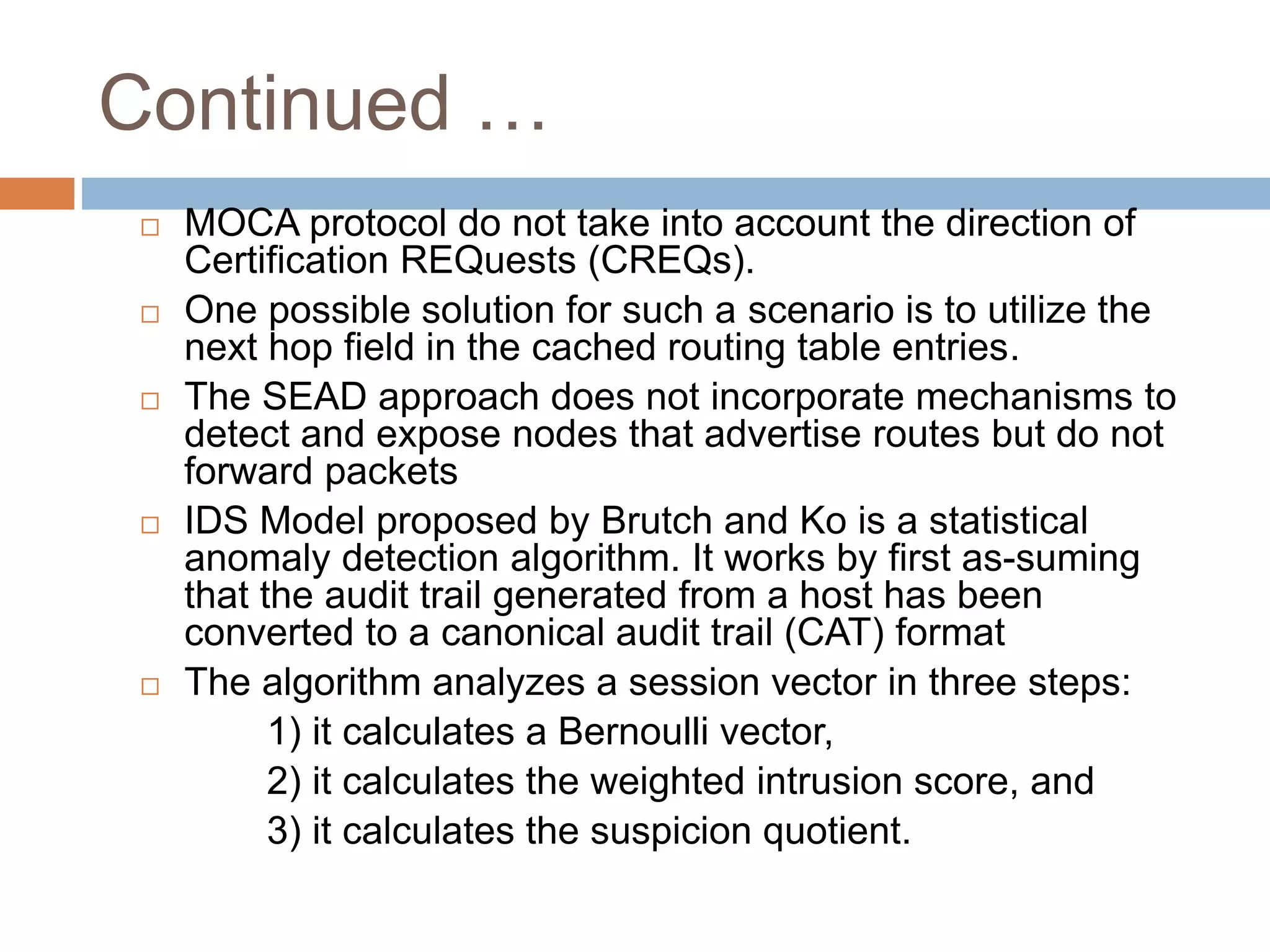
 IDS Model proposed by Brutch and Ko is a statistical
anomaly detection algorithm. It works by first as-suming
that the audit trail generated from a host has been
converted to a canonical audit trail (CAT) format
 The algorithm analyzes a session vector in three steps:
1) it calculates a Bernoulli vector,
2) it calculates the weighted intrusion score, and
3) it calculates the suspicion quotient.
Continued …
 The Bernoulli vector is generated from the
session vectors as well as some threshold
vectors.
 The weighted intrusion score is generated for
a particular session and for a particular
intrusion type.
 suspicion value, or suspicion quotient, for a
session is determined by what percentage of
ran-dom sessions have a weighted intrusion
score less than or equal to the weighted
intrusion score of the current ses-sion.
Continued …
 To summarize, the related existing intrusion
detection and intrusion response approaches
suffer from one or more of the following
limitations specifically with respect to mobile
ad hoc networks:
 Lower detection rate when mobility is used as a
parameter.
 Higher false positive rate when mobility is used as
a parameter.
 Appropriate response techniques to protect
Mobile Ad Hoc Networks after threat detection.
Mobile Agent Attacked by
Another Agent , Mobile agent,
and the host
 Secure and open mobile agents (SOMA) provide secrecy and
integrity to the mobile agents by means of encryption and
authenticated channels.
 AJANATA provides secure access to system resources and
supports isolated protection domains for agents by using
supported thread groups and class loaders.
 Enhanced privacy and authentication for GSM by C. H.
proposes three improved methods to enhance the security, to
reduce the storage space, to eliminate the sensitive
information stored in VLR, and consequently to improve the
performance of the system.
 Profiling mobile users by Bayesian decision algorithm
proposes to provide detection and response solution for an
agent attacked by agent privacy problems like masquerade
and unauthorized access.
Continued …
 The proposal of SOMA architecture provides authentication
and authorization for the host security from mobile agents.
 This scheme attempts to provide a solution for masquerade
and unauthorized access at-tacks by agents on host
 The solution through Proof Carrying Code (PCC) provides a
security for hosts in the masquerade and un-authorized
attacks via proof checker ensured by code producer which is
“tamper proof” and “self certifying code/agent”.
 MACKMAN propose a solution motivated by the deficiencies
found in the registration and authentication service of the
existing protocols such as GSM, CDPD, and IS-41. This
solution employs mutual authentication and digital signatures
to provide a more secure registration and authentication
service for mobile computing by using Elliptic Curve RSA
(ECRSA) for the efficiency reasons.
Continued …
 The scheme provides solution for unauthorized access,
denial of service and masquerade attacks by ad-
dressing the following issues:
 Trustworthiness of Intermediate Network.
 Mutual Authentication between a mobile agent and
mobile host.
 Data Confidentiality against both active and passive
intrusion by malicious agents.
 Un traceability requires protection of registered
users from unauthorized entities. A mobile host
should be able to request network services without
divulging any access control information to
eavesdroppers. The degree of intractability availability
to mobile host depends upon the policies enforced by
the underlying system and the tradeoffs between cost
and benefits.
Continued …
 Time Synchronization, since the mobile agents travel
across various time zones and administrative authorities
and hence the time synchronization in security systems
for mobile environments is not recommended.
 Optional Security and Modes of Security: Due to the
scarce mobile environment resources likes bandwidth
and power and hence various modes of security should
be made optional.
 Flexibility: The security system for mobile environments
should provide enough flexibility to incorporate future
advances in shared-key cryptographic techniques.
 Interoperability: The security system for mobile
environments should provide for interoperability between
numerous variations and versions of cryptographic pro-
ducts.
The security research issues
 The security research issues could be
summarized as follows:
 Can a mobile agent protect itself against tampering by
a mobile host? (code and execution integrity)
 Can a mobile agent remotely sign a document without
disclosing the user’s private key? (computing with
secrets in public).
 Can a mobile agent conceal the program it wants to
have executed? (code privacy)
 Secure routing or denial of service attacks protection.
 Can a host (computer) execute a cipher program
without understanding it?
Conclusion
 Viewed points
 taxonomy of security schemes for mobile computing systems
 Classification of for mobile computing systems
 With respect to the MANET based mobile computing system, our
analysis shows that the potential threats faced by MANETs come
in the form of denial of service, selfish node behavior, or routing
attack.
 With respect to the mobile agent model based mobile computing
system, providing security for the mobile agent from the fixed
host seems to be more challenging than providing the security
for fixed host from mobile agents.
 The taxonomy developed in this paper highlights the
contributions for different types of attacks and shows the different
types of approaches taken to provide security. This taxonomy
should help researchers focus on underlying methods, limitations
of the existing schemes and open research issues needed to
secure MANETs.
Classification and review of security schemes

Classification and review of security schemes

  • 1.
    CLASSIFICATION AND REVIEWOF SECURITY SCHEMES IN MOBILE COMPUTING By: Habitamu Asimare ID: BDU1000227PR By: Sathish Alampalayam Kumar Cryptography and Network Security Paper presentation
  • 2.
    Contents  Introduction  MobileComputing System Security  MANET attacks  Taxonomy of mobile agent  MANET security approaches  Mobile Agent Attacked by  Another Agent ,  Mobile agent, and  the host  The security research issues  Conclusion
  • 3.
    Introduction  Mobile computingand networking should not be confused with the portable computing and networking we have today.  Providing security services in the mobile computing environment is challenging because it is more vulnerable for intrusion and eavesdropping  Authentication mechanisms are designed to protect a sys-tem from unauthorized access to its resources and data.  However, at present, completely preventing breaches of security seems unrealistic, especially in mobile computing systems  A Personal Area Network (PAN) level firewall as envisioned for the next generation
  • 4.
    Continued …  firewallsand Virtual Private Network (VPN) sandboxes cannot be directly applied to the wireless mobile world  Even if the fire-wall concept were achieved by creating a private extra-net (VPN) which extends the firewall protected domain to wherever the user moves, this would still lead to in-efficient routing.  Security is a fundamental concern for mobile network based system.  The identified security as a “severe concern” and regard it as the primary obstacle to adopting mobile systems
  • 5.
    Mobile Computing Systems Security Let’s see the taxonomy of security
  • 6.
    Continued…  A MobileAd hoc Network (MANET) is a collection of wireless mobile nodes forming a temporary network without any centralized authority.  In a MANET, each wireless mobile node operates not only as an end-system, but also as a router to forward packets.  A MANET is a possible solution to quickly establish communications in a mobile, transient and infrastructure-less environment  Mobile ad-hoc networks are the future of wireless networks. Nodes in these networks will generate both user and application traffic and perform various network functions.
  • 7.
    Continued  Intrusion isdefined as an attack or a deliberate unauthorized attempt to access information, manipulate information, or render a system unreliable or unusable.  A MANET can be subjected to active attacks and passive attacks.  Active attacks refer to the direct attacks by a hostile entity during execution or transmission phase.  Some of the major types of active attacks are routing attacks and active DoS attacks. Passive attacks refer to the indirect attacks by an entity in the network during collaboration. Some of the major types of passive attacks include actions like selfishness, eavesdropping, traffic analysis and passive DoS attacks.
  • 8.
    MANET Attacks Routing loopattack. DoS attack. Packet mistreatment attack.
  • 9.
  • 10.
    MANET security approaches There are many approaches of MANET security  Routing is an important aspect of moving packets around in a network  Group key Diffie-Hellman (GDH) model that provides a flexible solution to group key management  MOCA (Mobile Certification Authority) protocol that helps manage heterogeneous mobile nodes as part of a MANET.  Basically there are two methods used for routing: AODV (Ad hoc On-demand Distance Vector) routing and DSDV (Destination Sequenced Distance Vector) routing.
  • 11.
    Continued …  Theimpact of authentication attacks is quite wide-spread and it includes unauthorized access, denial of service, masquerading, information leakage, and domain hijacking.  Techniques for Intrusion-Resistant Ad Hoc Routing Algorithms (TIARA) was proposed by Ramanujam et al. to detect and eliminate DoS .  On-demand Secure Routing Protocol (OSRP) that defines a reliability metric based on past records and use it to select the secure path
  • 12.
    Continued …  MOCAprotocol do not take into account the direction of Certification REQuests (CREQs).  One possible solution for such a scenario is to utilize the next hop field in the cached routing table entries.  The SEAD approach does not incorporate mechanisms to detect and expose nodes that advertise routes but do not forward packets  IDS Model proposed by Brutch and Ko is a statistical anomaly detection algorithm. It works by first as-suming that the audit trail generated from a host has been converted to a canonical audit trail (CAT) format  The algorithm analyzes a session vector in three steps: 1) it calculates a Bernoulli vector, 2) it calculates the weighted intrusion score, and 3) it calculates the suspicion quotient.
  • 13.
    Continued …  TheBernoulli vector is generated from the session vectors as well as some threshold vectors.  The weighted intrusion score is generated for a particular session and for a particular intrusion type.  suspicion value, or suspicion quotient, for a session is determined by what percentage of ran-dom sessions have a weighted intrusion score less than or equal to the weighted intrusion score of the current ses-sion.
  • 14.
    Continued …  Tosummarize, the related existing intrusion detection and intrusion response approaches suffer from one or more of the following limitations specifically with respect to mobile ad hoc networks:  Lower detection rate when mobility is used as a parameter.  Higher false positive rate when mobility is used as a parameter.  Appropriate response techniques to protect Mobile Ad Hoc Networks after threat detection.
  • 15.
    Mobile Agent Attackedby Another Agent , Mobile agent, and the host  Secure and open mobile agents (SOMA) provide secrecy and integrity to the mobile agents by means of encryption and authenticated channels.  AJANATA provides secure access to system resources and supports isolated protection domains for agents by using supported thread groups and class loaders.  Enhanced privacy and authentication for GSM by C. H. proposes three improved methods to enhance the security, to reduce the storage space, to eliminate the sensitive information stored in VLR, and consequently to improve the performance of the system.  Profiling mobile users by Bayesian decision algorithm proposes to provide detection and response solution for an agent attacked by agent privacy problems like masquerade and unauthorized access.
  • 16.
    Continued …  Theproposal of SOMA architecture provides authentication and authorization for the host security from mobile agents.  This scheme attempts to provide a solution for masquerade and unauthorized access at-tacks by agents on host  The solution through Proof Carrying Code (PCC) provides a security for hosts in the masquerade and un-authorized attacks via proof checker ensured by code producer which is “tamper proof” and “self certifying code/agent”.  MACKMAN propose a solution motivated by the deficiencies found in the registration and authentication service of the existing protocols such as GSM, CDPD, and IS-41. This solution employs mutual authentication and digital signatures to provide a more secure registration and authentication service for mobile computing by using Elliptic Curve RSA (ECRSA) for the efficiency reasons.
  • 17.
    Continued …  Thescheme provides solution for unauthorized access, denial of service and masquerade attacks by ad- dressing the following issues:  Trustworthiness of Intermediate Network.  Mutual Authentication between a mobile agent and mobile host.  Data Confidentiality against both active and passive intrusion by malicious agents.  Un traceability requires protection of registered users from unauthorized entities. A mobile host should be able to request network services without divulging any access control information to eavesdroppers. The degree of intractability availability to mobile host depends upon the policies enforced by the underlying system and the tradeoffs between cost and benefits.
  • 18.
    Continued …  TimeSynchronization, since the mobile agents travel across various time zones and administrative authorities and hence the time synchronization in security systems for mobile environments is not recommended.  Optional Security and Modes of Security: Due to the scarce mobile environment resources likes bandwidth and power and hence various modes of security should be made optional.  Flexibility: The security system for mobile environments should provide enough flexibility to incorporate future advances in shared-key cryptographic techniques.  Interoperability: The security system for mobile environments should provide for interoperability between numerous variations and versions of cryptographic pro- ducts.
  • 19.
    The security researchissues  The security research issues could be summarized as follows:  Can a mobile agent protect itself against tampering by a mobile host? (code and execution integrity)  Can a mobile agent remotely sign a document without disclosing the user’s private key? (computing with secrets in public).  Can a mobile agent conceal the program it wants to have executed? (code privacy)  Secure routing or denial of service attacks protection.  Can a host (computer) execute a cipher program without understanding it?
  • 20.
    Conclusion  Viewed points taxonomy of security schemes for mobile computing systems  Classification of for mobile computing systems  With respect to the MANET based mobile computing system, our analysis shows that the potential threats faced by MANETs come in the form of denial of service, selfish node behavior, or routing attack.  With respect to the mobile agent model based mobile computing system, providing security for the mobile agent from the fixed host seems to be more challenging than providing the security for fixed host from mobile agents.  The taxonomy developed in this paper highlights the contributions for different types of attacks and shows the different types of approaches taken to provide security. This taxonomy should help researchers focus on underlying methods, limitations of the existing schemes and open research issues needed to secure MANETs.